SHE VANISHED ON THE ROAD TO YELLOWSTONE. TWELVE DAYS LATER, RANGERS FOUND HER STRAPPED TO A BED IN A CABIN THAT WASN’T ON ANY MAP, WHISPERING ONE WORD OVER AND OVER
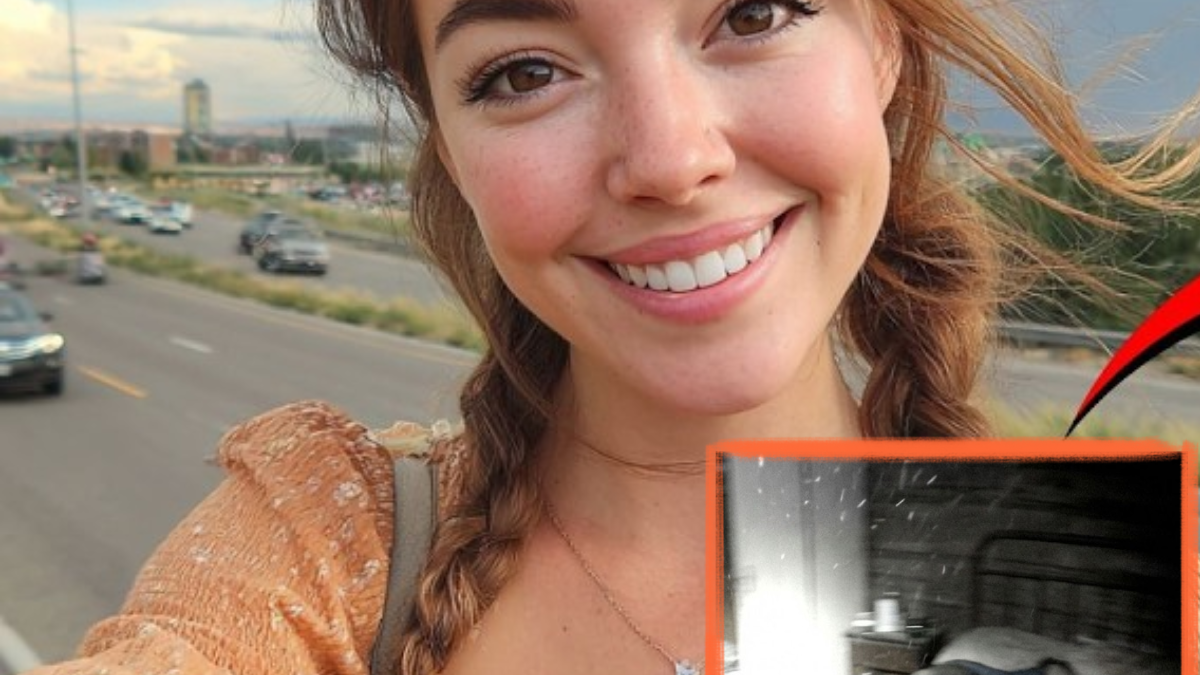
SHE VANISHED ON THE ROAD TO YELLOWSTONE. TWELVE DAYS LATER, RANGERS FOUND HER STRAPPED TO A BED IN A CABIN THAT WASN’T ON ANY MAP, WHISPERING ONE WORD OVER AND OVER 😨
Part 1
The door was propped shut from the outside.
Senior ranger David Brooks stared at the massive pine log wedged against the frame of the abandoned hunting cabin, and a cold feeling crawled up his spine. Nobody barricades an empty building. Nobody locks a door from the wrong side unless something inside is meant to stay there.
It was October 22nd, 2017, a little before noon. Deep in the northeastern forest of Yellowstone National Park, two and a half miles from the nearest trail, three rangers had left their route to check storm damage. The sector had been closed to tourists for a week. Wind had knocked down dozens of ancient pines. The air was thick with silence.
Then Brooks saw the building through the trees. According to the forest department’s records, the old Miller Hunting Shelter had been abandoned since the late 1980s.
But the three windows had been sealed with fresh boards. The wood was still pale.
“Somebody was here recently,” one of the rangers whispered.
“Somebody is here,” Brooks said.
Together they rolled the heavy log aside. A crowbar snapped the rusted lock. The door groaned open, and a wave of stale air rolled out, carrying a sharp, chemical stench of medical alcohol and ammonia that had no business in a forest.
Their flashlights cut through the darkness and found an iron bed in the center of the room. Its legs were bolted to the rotting floor. A young woman lay on it, held down by thick leather straps at her wrists and ankles.
Her skin was ripped raw where she had fought them. Her body shook with violent tremors. Her eyes were open, but her pupils were so dilated that her irises had vanished, leaving two black, bottomless circles.
Brooks swept the light across her face. Nothing. No flinch. No blink.
Her cracked lips were moving, though. She was whispering one word, again and again, like a prayer or a curse.
“Conductor… Conductor… Conductor…”
Her name was Jennifer Smith. She was 24 years old. She had been missing for twelve days.
Two weeks earlier, Jennifer was standing at her mother’s grave in Seattle.
A long, brutal battle with cancer had ended, and it had taken everything from the Smith family. Jennifer and her twin sister, Jessica, were hollowed out by grief. So they planned a trip to the one place that still felt like their mother: Yellowstone. They had spent every childhood summer there. They rented a small guesthouse near the western edge of the park and mapped out seven days.
Then, the night before they were due to leave, Jessica collapsed.
She sat down on the living room floor, gasping through a panic attack, and refused to go. Every inch of that park would remind her of Mom, she sobbed. She simply couldn’t.
Jennifer didn’t argue. Something inside her had gone strangely quiet. At 5:30 the next morning, she loaded a sleeping bag, a few shirts, a windbreaker and five gallons of water into her father’s dark blue Ford Explorer, and she drove away alone before the sun came up.
Investigators would later find the next detail deeply unsettling.
During the entire 16-hour drive, Jennifer never used her bank cards. No coffee. No motel. No gas receipts. She ate cold sandwiches from home and apparently paid for fuel in cash, as if she were deliberately erasing herself.
One toll-road camera in Idaho caught her at 2:45 p.m. She was alone, her face hidden behind large dark sunglasses.
On October 11th, the temperature in the park dropped to 35°F. At 6:15 that evening, Jennifer’s phone connected to a cell tower for the final time. Then it went dead.
Her father and sister called. Voicemail. Called again. Voicemail. On October 12th, at 8:30 a.m., they filed a missing person report.
Rangers searched every campground and parking lot in the park for more than eight hours. The Explorer wasn’t at a single checkpoint. It wasn’t on any main road. It was as if the girl and a four-thousand-pound SUV had dissolved into the mountain air.
Then the phone company delivered a report that made the case far stranger. Jennifer’s last signal hadn’t come from inside the park. It had come from ten miles before the western entrance, from an old logging road that had been closed for years.
Tourists don’t drive there by mistake. Someone had made her turn.
And now, twelve days later, Brooks was standing over her in a locked cabin, gently lifting her sleeve to cut the strap on her right wrist, when his flashlight slid up her arm.
A thin, clear medical tube ran out from under the dirty cuff of her windbreaker. A steel needle was buried in her skin. The tube snaked away across the floor into the black corner of the room, and whatever was at the other end was still pushing liquid into her veins, drop by drop.
😨 What they discovered next was even more terrifying… Find PART 2 in the comments, or leave ANY WORD below to receive it privately! 👇
Part 2
The tube snaked away across the floor into the black corner of the room, and whatever was at the other end was still pushing liquid into her veins, drop by drop.
“Don’t touch anything else!” Brooks shouted, thumbing the emergency satellite beacon.
The helicopter couldn’t land in the dense forest. The rangers carried Jennifer two miles on a rigid stretcher while paramedics fought to keep her breathing. Her oxygen level fell to 80%. Her pulse was a wild, unstable thing, jumping between 40 and 160 beats per minute. By 5:45 p.m. she was on a rooftop in Bozeman, rushed into intensive care.
At 9:00 that night, the toxicology results came back. The head doctor read the numbers twice.
Jennifer’s blood held a near-lethal concentration of LSD, blended with powerful veterinary tranquilizers made to immobilize large animals. This was no street dose. It was a custom, handmade mixture.
Someone hadn’t just imprisoned her. For twelve days, someone had been deliberately holding her mind in a state of chemical terror.
Back at the cabin, FBI forensic teams worked under floodlights. They found no signs of sexual assault. What they found was almost worse: seventy empty, unlabeled glass vials; three metal racks of automated drip machines, powered by car batteries hidden under the bed; and walls covered in black marker. Perfect fractal patterns. Geometric matrices. Chemical formulas with doses calculated per pound of body weight.
“This isn’t a hideout,” one analyst whispered. “It’s a laboratory.”
Then the lead investigator noticed what was missing. The ground around the cabin was soft from the storms, yet there wasn’t a single tire print within three miles. Jennifer could not have carried her belongings here on foot.
So where was her father’s SUV?
On October 24th, the answer began to emerge from a silver laptop in a quiet bedroom in Seattle. Cyber agents spent 48 hours cracking its encryption, and what they recovered was a portrait of a young woman coming apart. Jennifer had barely slept in weeks. Between 2 and 5 a.m. she had been haunting anonymous forums for the grieving, places with no counselors, no moderators and no protection.
On one of them, a stranger had found her. He called himself the Conductor.
Four hundred pages of private messages told the story. He never pitied her. He studied her. Day by day he whispered that her family couldn’t understand her pain, that therapy and medication were lies, that he alone could erase her grief forever through a secret practice he called a “radical acceptance session.”
Then came the message sent on October 8th, with a set of GPS coordinates: a dead-end turnoff ten miles before the park entrance. He told her to drive without stopping, use no cards, and tell no one, to keep her “purity of intent.” And in the end, to surrender her car keys, because her vehicle was a “heavy anchor” dragging her down.
Jennifer obeyed every word.
Then a senior analyst found something buried in the code of the last message: spyware that had silently copied her insurance documents a week earlier. The Conductor had known the exact make, model and weight of her father’s SUV before he ever offered her salvation.
Healing was never the point.
And in a hidden, encrypted folder inside that spyware, the agents found a list of names. Sixteen women.
The last entry was dated October 8th. Beside it, in a single line, was a note that made the room go silent.
😱 The truth behind this disappearance is more horrifying than anyone imagined… LIKE or COMMENT “REVEAL” to see PART 3! The final part will be posted after enough comments! 👇
Part 3
Next to the final name, someone had typed: “Patient four. Not the last.”
The agents in the Seattle Cyber Division understood then what they were hunting. This wasn’t one kidnapping. It was a machine, and it was still running.
On October 27th, the FBI’s Behavioral Analysis Unit in Quantico assembled a profile from the photographs of the walls and the chemistry in Jennifer’s blood. The man they described wasn’t a classic serial killer, and he wasn’t a cult leader. He was a brilliant, deeply disciplined man between 40 and 50, with academic-level knowledge of pharmacology and neurobiology. He sincerely believed he was saving people.
His theory, scrawled across those cabin walls, was something he called ego dissolution: that through overwhelming chemicals and total restraint, a person could be pushed through a “chemical death” and reborn without pain. To him, Jennifer was not a woman. She was a canvas.
He hunted the grieving because he understood grief. His empathy was his weapon. And the cars were his currency. Each heavy vehicle, sold quietly through shadow salvage yards, paid for his chemical precursors, sterile supplies and equipment.
“He won’t stop,” a psychiatrist warned the task force. “For him, the experiment matters more than any human life.”
On October 30th, an agent searching the forest around the cabin uncovered a camouflaged cache under pine needles, 500 yards away. Inside a plastic container was a tattered notebook, written in the same flawless handwriting as the walls. It held a list of dates stretching back ten years. Beside each, the color of a victim’s eyes and the engine size of her car.
The final number was circled in red. Jennifer was the nineteenth.
For weeks, the trail went cold. Then, on November 22nd, at 6:15 a.m., a task force raided a huge illegal salvage yard on the southern edge of Cheyenne, three hundred miles from Yellowstone. In the freezing wind, a senior criminalist spotted a dark blue steel chassis. Someone had cut away its identification numbers with a grinder.
They had underestimated modern forensics. After four hours of acid etching, ghostly digits rose out of the metal, and the national database confirmed it: Jennifer’s father’s Ford Explorer.
The yard’s owner, 52-year-old Marcus Wayne, sweated through nine hours of interrogation. He swore he only bought scrap. He’d paid $4,500 in cash, he said, to a man the underworld called “the Doctor.”
Then his voice dropped.
“Real thin. Mid-forties. Never took his blue gloves off. Never touched anything bare-handed. Smelled like bleach. And that voice…” Wayne shook. “Quiet. Calm. Like he was putting you to sleep. It made my skin crawl every time.”
Facing a life sentence, Wayne gave up the burner phone number.
The Doctor was careful. He powered the phone on for only minutes, then pulled the battery. But towers still logged the pings, and dozens of them, overlaid on a map, narrowed to a single patch of wilderness 35 miles east of the park.
A military satellite revealed a plain one-story house in the pines. Then the thermal scan showed something impossible beneath it: a massive heat source spread across more than 2,000 square feet of ground, fed by generators and an industrial ventilation system.
The house was just a lid.
At 4:30 a.m. on December 5th, in 15-degree cold, three dozen special forces agents surrounded the property the county called Ebony Retreat. At 4:35, a steel ram shattered the oak door. Stun grenades lit the dark forest white.
Inside, the suspect didn’t run.
He sat in his living room in a spotless, pressed white lab coat, sipping coffee.
His name was Elias Crawford. Fifty-two years old. Once a celebrated neuroscientist, until 2010, when a federal medical board stripped his license for cruel, unauthorized experiments on patients. As agents forced him to the floor, he showed no fear. One officer said he looked like a professor irritated by an interruption.
Behind a false wall in the storeroom, a metal staircase dropped twenty feet into a sterile concrete laboratory. Fume hoods. Centrifuges. Electron microscopes. And on a steel table, four black leather diaries.
The agents opened the one marked with a Roman numeral IV. It held minute-by-minute entries: a pulse rate, a pupil measurement, the length of a seizure, the nature of a hallucination. The subject had a title instead of a name. Patient Four. In his final entry, written on the eleventh day, Crawford had noted, without a flicker of emotion, that the subject was “too weak for the deep cleansing.”
Three earlier diaries held the same horrifying detail for patients one, two and three.
Then the lead investigator opened a desk drawer and found a fifth diary, brand new. Its first page already carried today’s date, and under it a name, an age and a car brand. Beside it, on a sterile tray, sat a freshly filled vial and a sharpened scalpel.
Somebody was due at that forest within the hour.
In May 2019, in a federal courtroom in Cheyenne, Crawford’s lawyers, paid with money from stolen cars, argued he was insane, a paranoid schizophrenic with a messiah complex who belonged in a hospital, not a prison. The prosecution answered by laying the four diaries on the judge’s table. They weren’t the ravings of a broken mind. They were cold, exact, scientific calculations. When the prosecutor read from them, one juror had to ask for an emergency recess.
In November 2019, the judge handed down three consecutive life sentences in a maximum-security prison in Colorado. Twenty-three hours a day in an 80-square-foot concrete cell.
But Jennifer’s story did not end with a miracle.
Twelve days of poison had left permanent damage in her brain. The doctors said they had never seen anything like it. She survived, but she lost the ability to fully trust her own eyes. She had to relearn how to walk and how to build sentences. And sometimes, without warning, the walls of her room would begin to pulse and fill with the fractal patterns of that cabin.
Her father and her sister Jessica sat beside her every day. Jessica’s collapse on the living room floor, the one that had felt like a failure, had saved her sister’s life. The Conductor had never hunted two women at once.
The Smiths turned down every interview. Their only goal was to bring Jennifer back to a life that felt as close to normal as possible.
Yellowstone stayed exactly as it had always been. But the case changed how America looked for the missing. The National Park Service rewrote its protocols for solo hikers. Highway patrols were ordered to check abandoned vehicles at park entrances. And searches now began not with dogs and trail maps, but with cyber specialists tracing a missing person’s digital footprints.
The lesson was terrible and simple: the most dangerous predators no longer hide in the dark woods. They sit in comfortable homes, reading anonymous support forums, offering a gentle voice to the brokenhearted.
Justice, it seemed, had been served.
But one detail still haunts the lead investigator. In his last interrogation, when agents demanded the burial sites of the first three patients, Crawford only smiled and leaned toward the microphone. His formula for “chemical rebirth,” he said softly, had been sent to encrypted servers one hour before the raid.
Cyber police have never found a single copy.
And last month, a new user appeared on another anonymous forum for people lost in deep depression. He does not call himself the Conductor. But he is offering desperate people a free “radical acceptance session.”
This time, in the deep forests of northern Oregon. 🌙
This story is entirely fictional and created for entertainment purposes only. It does not represent any organization or individual, nor does it encourage inappropriate behavior. The content was generated with AI assistance.








