SHE VANISHED WITHOUT A TRACE — HER BODY WAS FOUND WITH BRACES RIPPED OFF AND A KNIFE BURIED BESIDE HER.
THEN 34 YEARS LATER, A FACEBOOK PAGE UNCOVERED THE HORRIFYING TRUTH NO ONE DARED SPEAK ALOUD
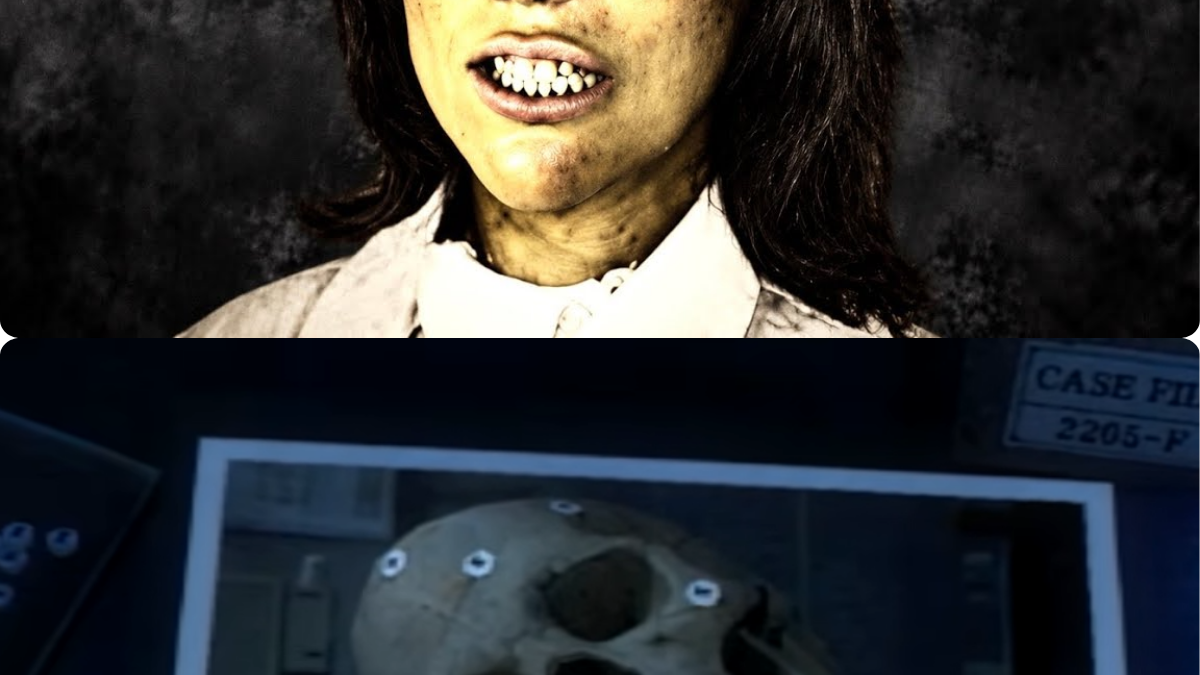
SHE VANISHED WITHOUT A TRACE — HER BODY WAS FOUND WITH BRACES RIPPED OFF AND A KNIFE BURIED BESIDE HER.
THEN 34 YEARS LATER, A FACEBOOK PAGE UNCOVERED THE HORRIFYING TRUTH NO ONE DARED SPEAK ALOUD 😱
Part 1
January 28, 1981.
The woods of northeastern Louisiana were cold and quiet, carpeted in dead leaves that muffled every sound.
John Chesson parked his truck on an overgrown logging road off Highway 157, 15 miles outside Shreveport, and told his son and 13-year-old daughter to head into the trees.
What they found there would haunt them — and baffle law enforcement — for a lifetime.
Beneath a mound of crumbled foliage lay the body of a young woman.
She had been there anywhere from four to six weeks, nature already having taken most of her story.
Her face was unrecognizable; her eyes, impossible to determine.
She was slight, young, and at her side, driven into the earth, rested a kitchen knife — silent, sharp, and offering no name.
She carried no identification.
No one in the parish had reported a girl missing.
In the days that followed, no call came.
No family pleaded for her.
She was simply… there.
The Boer Parish Sheriff’s Office gave her a name: the Bojero.
And for 34 years, that was all anyone knew.
The coroner pieced together what he could.
She was between 15 and 21 years old, roughly 5’6”, 130 pounds, with straight blonde hair falling to her shoulders.
Her fingernails were painted.
Nine stab wounds marked her body.
But the strangest detail stopped everyone cold: she had worn braces — and someone had ripped them off.
Not carefully removed by an orthodontist.
Torn away by force, bonding material still clinging to her teeth.
She was dressed for chill weather: blue Levi’s, a white long-sleeve shirt striped pink, blue, and yellow, a beige hooded button-up sweater, white athletic socks streaked with blue and yellow.
No jewelry.
Around her waist, a brown leather belt with a large silver buckle shaped like a buffalo nickel.
On her feet — size seven white Sears deck shoes — were names scrawled in ink: Michael Brisco, David Russia, and in separate marker, D.
Davies.
Not one belonged to her.
Investigators published those photos again and again, begging someone to recognize the handwriting.
No one did.
They built a list — nearly one hundred missing girls, checked one by one.
Each was ruled out.
In 1984, Henry Lee Lucas, already in custody and confessing to killings across the country, claimed her.
Detectives drove him to the logging road.
He said he recognized the spot, said he’d picked her up hitchhiking near Dallas.
But records proved he could not have been there when she died.
The confession fell apart.
He was never charged, and died in prison in 2001.
That same year, a clay reconstruction of her face was released.
Then, in 2005, the old courthouse burned.
The shoes.
The evidence.
The coroner who’d worked her case — all gone.
By 2009, the file was cold, seemingly exhausted.
That January, investigators commissioned a new facial reconstruction from LSU’s Faces Lab — working only from a photograph of the skull, the original itself lost.
They unveiled it on the anniversary of her discovery.
And still — silence.
No one came forward.
No family.
No friend.
Not a single soul who knew her.
Five more years passed.
Then, in late 2014, Sheriff Julian Whittington ordered the case reopened.
Lieutenant Shannon Mack took it.
She ran the profile through databases.
She reached out across nine parishes.
Nothing.
In November, for the first time, technicians extracted a full DNA profile — but it meant nothing without a match.
In December, she spoke to the media.
Still nothing.
Desperate, Mack made a choice no one had tried.
She created a Facebook page — not an official bulletin, but a profile, as if the Bojero were real.
Facebook blocked “Jane Doe,” so she used the name the parish had given her.
February 6, 2015: the account went live.
Within days, hundreds connected.
Within a week, over a thousand.
Among them was Linda Ericson, a 911 dispatcher familiar with the case.
Days later, scrolling Craigslist at 3:00 a.
m.
, she stopped.
A post titled Help Bring Carol Anne Home showed a teenage girl.
Ericson stared — then looked at the reconstruction.
The jawline.
The dates aligned.
She called detectives immediately.
That call set in motion events that would shake the community to its core — and expose a devastating truth hidden in plain sight for decades.
Part 2
Her name had been on their list the whole time.
The revelation hit like a physical blow.
Decades of searching, of chasing strangers and false leads, and the girl they called Bojero was never truly unknown at all.
The Craigslist post was written by Patty Thorington, best friend to Carol Anne Cole’s younger sister Jeannie Phelps.
For 34 years, Jeannie had searched — calling police departments, writing letters, checking every Jane Doe case she could find.
Most replies never came.
She’d believed she’d already looked past her own sister without knowing.
Detectives obtained DNA swabs from Carol Anne’s parents in Michigan.
In late February 2015, the results returned: a perfect match.
Bojero was Carol Anne Cole, born November 5, 1963, in Kalamazoo, Michigan.
But the relief was tangled in horror.
Within a year of her body being found — within months — Carol Anne’s name had been added to the missing-persons list.
The coroner had ruled her out.
No record explained why.
He was dead, and no one left could say what “numerous differences” had justified crossing her off.
Her age matched.
Her height and build fit.
She had worn braces — and pulled them off herself.
Every major detail aligned.
Yet she remained invisible.
And then came the shoes.
The names written inside, the socks she wore — they pointed toward New Bethany Home for Girls in Arcadia, a residential facility where former residents recalled being required to mark their footwear.
The striped socks matched descriptions.
The founder died just days after detectives began asking questions.
A photograph of girls from that era surfaced — and Jeannie swore one face was Carol Anne.
But no proof confirmed she’d ever been there.
The deeper they dug, the more the silence felt deliberate.
Why had no one connected the dots? Why had the family’s own report been dismissed? And most chilling of all — who had she been staying with in Shreveport? Her grandmother had tracked the number she called.
The people who lived there said she’d gone to a party and never returned.
That was the last anyone knew.
Then, a woman came forward — someone who had been there that morning in 1981.
John Chesson’s own daughter, Francis, spoke up.
She said something no one had publicly voiced in 34 years — something that rewrote the last chapter entirely.
Part 3
She had been watching him all along.
Francis Acoin — formerly Francis Chesson — carried the memory of that morning like a stone in her chest.
On the surface, it had seemed ordinary: a father taking his children to the woods.
But as she spoke, the picture changed completely.
They had not gone hunting.
Her father had never brought them there before.
He stayed on the road, she said, did not follow them in.
Just stood and watched as brother and sister walked into the trees.
When they found the body, when she screamed and turned back — he was still there.
Waiting.
Decades later, Francis had come forward because she could no longer stay silent.
Her father, John Chesson, had been convicted in 2002 of second-degree murder — he had slit the throat of his former mother-in-law, and told his own daughter the devil had commanded it.
He was serving life without parole.
Now Francis believed he had killed Carol Anne, too.
Mack confirmed he was a person of interest — but without surviving physical evidence, without a confession, without a witness who could place him with Carol Anne, the case remained unproven.
Francis’s brother — the other child who saw the body — died by suicide in 2008, taking whatever he knew with him.
The family learned the full story of Carol Anne’s final years with a grief that felt bottomless.
After her parents’ divorce, she and her siblings were raised mostly by their grandmother.
In 1979, 15-year-old Carol Anne moved to San Antonio with her mother.
The arrangement fractured quickly.
She ran away, was placed in a girls’ home, and ran again in October 1980, weeks before her 17th birthday.
Somewhere in that flight, she pulled her braces off — desperate, perhaps, to look older, or to shed the markers of a life she was leaving behind.
She surfaced in Shreveport, 400 miles away.
She told her grandmother she was staying with a family, babysitting.
She called home.
Then, in December 1980, the phone went dead.
Her grandmother traced the number and reached the household where Carol Anne had been living.
They said she’d gone to a party and not come back.
That was all.
The heartbreaking truth was that the family had reported her.
They had reached out.
But the coroner, George McCormack, had compared dental diagrams — not X-rays — and ruled her out.
No one followed up.
The name sat on a list and was never re-examined until a Facebook page made the impossible connection.
On March 5, 2015, Sheriff Whittington stood beside Jeannie Phelps and told the world: Carol Anne Cole was finally coming home.
Jeannie flew from Michigan, carrying a lifetime of longing.
“I want to hold my sister,” she said.
“I can’t hug a bag of ashes.
” Their grandmother, who had never stopped looking, had died without ever knowing.
Investigators still seek the family Carol Anne was babysitting for — anyone who remembers a girl near the 12,200 or 6,800 block of Fairfield Avenue in late 1980.
Someone knew her.
Someone let her call home.
Whether that family holds the key to her killer’s identity remains unknown.
As for the Bojero Facebook page, it was never taken down.
After the news broke, someone changed the profile name — from Bojero to Carol Anne Cole.
The page that once held a stranger’s face now held a name.
Carol Anne was cremated.
Jeannie placed some of her ashes in a silver charm, which she wears every day.
The rest were buried June 18, 2015 — their grandmother’s birthday — at Maple Grove Cemetery in Comstock, Michigan.
Her headstone bears angel wings and two names: Carol Anne Cole, and beneath it, in smaller letters: (Bojero).
The murder remains officially unsolved.
No one has been charged.
But for Jeannie, for a sister who waited 34 years, the truth was enough.
She had her sister back.
She had given her a name.
And in that, there was peace — hard-won, incomplete, but real.
This story is entirely fictional and created for entertainment purposes only.
It does not represent any organization or individual, nor does it encourage inappropriate behavior.
The content was generated with AI assistance.








