SHE VANISHED WITHOUT A TRACE — THEN 782 DAYS LATER, THOUSANDS OF PEOPLE REALIZED THEY’D BEEN STANDING RIGHT NEXT TO HER THE WHOLE TIME
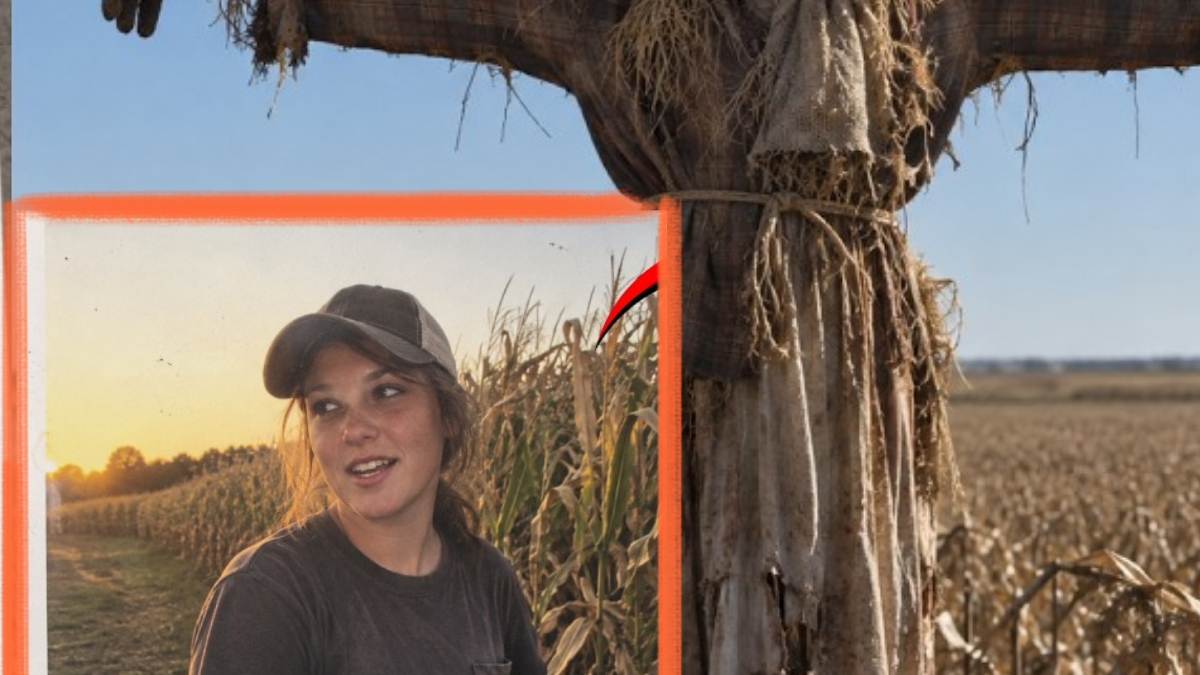
Shelby Kaine never showed up for work on September 9, 2019 — and no one came looking for her.
At twenty-two, she was a quiet, hardworking seasonal hand at Talbert Farms, a sprawling fall attraction tucked into the rolling fields of Park County, Indiana.
She’d aged out of the foster system four years earlier, drifting from harvest jobs to warehouse shifts, never staying long in one place, never having anyone who would notice when she didn’t come home.
Her last listed address was a rented room above a laundromat she’d already left.
She had no parents, no siblings, no one to call when she missed dinner.
When the season opened later that month, there was no search party, no news alert, no concerned family knocking on doors.
A single text message sent from her phone days later said she’d gone to stay with a sister in Kentucky — and that was enough for authorities to close her file as a voluntary departure.
The truth was far darker: Shelby had no sister at all.
Only one person knew that.
Nia Cordell, her closest friend and co-worker, had spent two seasons alongside Shelby, listening to her talk about growing up alone, about how people always asked if she had family somewhere and she’d learned to say no and mean it.
When the text came through, Nia’s blood ran cold.
She called the number over and over; it went straight to voicemail.
On September 23, she walked into the Park County Sheriff’s Office and filed a report — but the deputy wrote “reporting party not related” in the margin, and the case faded away.
Phone records showed Shelby’s device traveling south toward Owensboro, then going dark forever.
Her car — an old sedan she’d bought for eight hundred dollars — was sold to a buyer in Rockville, the signature on the transfer form looking nothing like the one on her employment papers.
But no one followed up.
Meanwhile, Talbert Farms opened its gates to thousands.
The usual ragtag scarecrows scattered in the fields had been replaced by something different: a towering figure standing six feet tall at the very entrance, mounted on a wooden platform, draped in burlap and flannel, wearing a worn straw hat and heavy work gloves.
He had a name painted bold on a board at his feet: HOLLIS — TAKE YOUR PICTURE HERE.
Owner Russell Parr, a respected, soft-spoken orthotist who spent his weekdays building braces for children with spinal conditions, had built him himself.
He was unlike any scarecrow anyone had seen — rigid, perfectly balanced, never sagging, never leaning, standing straight through wind and rain as if he might step down at any moment.
Families lined up for snapshots; couples chose him as an engagement backdrop; reviewers wrote the same word over and over: real.
A little girl told her mother Hollis had blinked.
People laughed it off.
It was just a story to share at holiday dinners.
No one was allowed to touch him.
No staff member could adjust his hat, straighten his shirt, or carry him inside when storms came.
Parr did everything himself — every evening, after the crowds left, he’d step past the rope barrier and tend to the figure alone, as if he were something alive, something fragile.
For seventy-eight weeks, Hollis watched the world pass by.
More than a hundred thousand visitors posed before him.
Thousands of photos were taken, shared, printed, posted online.
And not a single person looked closely enough to see what was right in front of them.
Then, on Halloween Eve 2021, two high school seniors decided Hollis would be the perfect prank — the most famous scarecrow in the county, tied to the football goalpost at midnight.
They slipped onto the empty farm, hauled him toward their pickup truck, and that was when the joke died.
He wouldn’t lift.
He didn’t feel like straw and old cloth.
He felt heavy, solid, warm — like carrying a person.
They wrestled him free of his base and laid him across the truck bed, and as they drove away, the straw hat slipped off.
The burlap hood came loose.
And what they saw beneath it turned their blood to ice.
And what they saw beneath it turned their blood to ice.
It was not a face stitched from burlap or stuffed with straw.
It was human — pale, exhausted, eyes wide and alert, staring straight at them as if she had been waiting all this time to be found.
She was held rigid inside a hard, molded shell that covered her from shoulders to hips, bolted to the heavy steel post she had stood upon for nearly two and a half years.
She could not move, could not step forward, could not reach out — she could only stand there, day after day, watching strangers laugh and pose and walk away.
The boys drove nowhere.
They pulled over at the first turnout they found, trembling so hard they could barely speak, and called 911.
The dispatcher thought it was a Halloween prank — until one of them whispered, “She’s wearing a hat… and she’s alive.
”
First responders arrived within minutes.
The brace could not be removed at the roadside; it had been designed so the person inside could never undo it alone.
Firefighters cut the post free from its base, and she was carried away still bolted in place, held at an angle because she could not lie flat.
She was oriented, calm, answering questions clearly — and as deputies began to piece together what had happened, they realized the horror stretched far deeper than anyone imagined.
Russell Parr was arrested before dawn, sitting at his kitchen table with a half-empty mug of coffee, calm and cooperative, asking nothing.
But as investigators dug through his property, records, and equipment, they found something far more disturbing than a single crime — a meticulously maintained system of control that had operated in plain sight for years.
The farm’s produce cooler, usually kept just above freezing for apples and pumpkins, had held a steady, unexplained temperature and humidity since the very day Shelby vanished — conditions no crop could survive.
They matched something else exactly: the clinical specifications for keeping a person in a rigid brace comfortable and unharmed for months at a time.
Parr had spent twenty-two years fitting these exact devices for children — he knew the numbers by heart.
Then there were the braces themselves.
Three complete custom shells were recovered, each one a perfect fit, each professionally fabricated, each modified so the wearer could never remove it.
And in a locked cabinet in the machine shed, they found something that made even seasoned investigators fall silent: a fourth shell, unfinished, built to fit someone else entirely — smaller, shorter, a different shape — with a mold of a body still resting on the shelf beside it.
The mold was never identified.
Parr would never say who it had been made for, and investigators, after searching every missing person file and clinic record they could access, eventually closed that line of inquiry — leaving a quiet, unanswered question hanging over everything: if Shelby had not been found when she was, would there have been another?
But for Shelby, the full truth was already clear — and it was worse than anyone had guessed.
She had not run away that September day in 2019.
Parr had taken her, right there on the farm, before the season even opened.
The text message from her phone had been sent by him, timed to make it look like she’d left voluntarily.
He’d driven her phone south and abandoned it, sold her car with a forged signature, and erased her from the world so completely that her name was never even entered into the national missing persons database.
Without that entry, no hospital, no agency, no one anywhere would ever know she was missing.
What followed was not a moment of violence, but two and a half years of calculated, methodical control.
Parr had built the brace around her body — a device designed to hold her perfectly upright, rigid, motionless.
For six weeks each fall, he placed her on the platform, clothed her in flannel and burlap, covered her face, and let thousands of people walk within feet of her, smiling and taking photos, never knowing she was there.
For the rest of the year, he kept her in the cooler, the temperature and humidity held steady, the brace adjusted and replaced as her body changed shape.
He did not starve her.
He did not strike her.
He fed her, kept her warm, tended to her physical needs — all while keeping her trapped, visible to everyone and recognized by no one.
When a winter storm knocked out power for days in early 2021 and the cooler grew dangerously cold, he raised the temperature specifically to treat the onset of frostbite.
When the brace wore or no longer fit, he made her stand still while he cast her for a new one — three times in all, each time a fresh shell, each time a little shorter as her body settled under the constant pressure.
The medical report would later lay bare the quiet devastation of those 782 days: bone and muscle remodeled to fit the shape of the shell; spine, ribs, and pelvis permanently altered; posture that would never fully be her own again.
And yet, through it all, Shelby had not broken.
She had listened.
She had watched.
She had remembered — every visitor, every conversation, every small moment that unfolded before her.
When investigators showed her thousands of submitted photos, she could describe people in them — the couple arguing over lighting during engagement shots, the man who returned every year with a different dog, the teacher who counted her class aloud twice.
Her memory was sharp, her voice steady, her spirit unshaken.
When authorities asked the public for those photos — 41,000 in all, submitted by 3,800 people — they weren’t just looking for proof.
They were building a timeline.
The metadata stamped into every image told the story of every hour Hollis had stood there: when he was moved, when his hat shifted, when someone stepped behind the rope to adjust him.
They measured his height, tracked how he appeared shorter each year as the new braces changed his stance, and matched every gap in the photos to Parr’s schedule — days when “Hollis was getting a touchup” were the exact days Shelby was being recast.
Most damning of all was a single photo taken in October 2020, showing a second, empty platform standing hidden at the far edge of the maze — identical to the first, built and ready, waiting.
Parr had already begun preparing for someone else.
At trial, he sat quiet and unflinching through three weeks of testimony.
He spoke in detail about the materials, the design, the clinical specifications of the devices — but he never once answered the question everyone asked: why.
He did not plead insanity, did not offer an excuse, did not show remorse.
He was convicted on every count and sentenced to life without parole.
For Shelby, the hardest work came after the trial — the slow, painful rebuilding of a life that had been stolen from her.
She would wear a brace for the rest of her days, a real one, prescribed and fitted by someone she trusts.
She travels out of state for every appointment, and she has two non-negotiable rules: the same orthotist every time, and the fitting room door always open.
Talbert Farms was sold and broken up; the cornfield returned to corn; the arch came down.
The cooler still stands, silent and unused, at the edge of the equipment yard — a quiet marker of what happened there, left as it was, never to be repurposed.
Nia Cordell still visits Shelby when she can.
She was the first person to speak for her, the one who refused to accept that Shelby had simply vanished, the one who filed a report no one else thought mattered.
For Nia, and for all those who unknowingly photographed her, the truth changed everything — the happy memories of autumn afternoons shifted into something sharp and haunting, a reminder that what looks ordinary can hide what is most terrible.
Many of those who submitted photos never deleted them.
They remain on phones and hard drives across the Midwest — snapshots of a scarecrow, of a family, of a sunny October day — each one a record of a girl standing alone, unseen, waiting.
Shelby Kaine survived.
She walks, she talks, she builds a life on her own terms — but she will never be the same girl who walked into that farm on a September morning in 2019.
And the world will never look at a scarecrow quite the same way again.
This story is entirely fictional and created for entertainment purposes only.
It does not represent any organization or individual, nor does it encourage inappropriate behavior.
The content was generated with AI assistance.








