SHE VANISHED WITHOUT A TRACE — THEN SEEN WATCHING HER OWN SEARCH FROM A LOCKED TOWER: THE UNBELIEVABLE TRUTH NO ONE SAW COMING
Part 1
On May 4, 2025, at Crater Lake National Park, 27-year-old backcountry ranger Julia Rogers parked her burgundy Jeep Cherokee at Rim Village — and simply vanished.
No footsteps, no scream, no trail of any kind.
By sunset, her vehicle sat locked and abandoned, her camera resting on the backseat, her wallet tucked in the console, two ceramic mugs wrapped in a dish towel on the passenger seat.
Her phone lay quiet in the glove box; the keys were gone.
And the only thing anyone saw? A pale, boxy vehicle with a roof rack pulling alongside her Jeep for exactly sixty seconds — then nothing but empty space where it had been.
For five weeks, the mountain roared with searchers.
Four hundred and twelve people, nine scent dogs, six helicopters, a dive unit plummeting into the deepest lake in the nation — and they found nothing.
Not a footprint, not a scrap of clothing, not a single clue that made sense.
The first theory was grief: she’d stepped onto a snow cornice, slipped into the icy blue depths, and the lake had swallowed her whole.
But three separate scent dogs, working independently, walked straight from her driver’s door to the exact same empty patch of snow, sat down, and refused to go further.
“She did not walk away from that car,” Special Agent Ingrid Halverson told her team that night.
“She was driven away.
”
The investigation spun in circles.
They chased reports of a cream-colored Blazer owned by Julia’s former boyfriend, who had texts from her in April and an alibi that felt thin.
They interviewed everyone who knew her — her roommate Tessa, who’d watched her leave with a thermos and a quiet promise to photograph the sunset; her mother Nora, who’d raised Julia alone and knew her daughter better than anyone.
Nora refused to give up.
When official search operations suspended on June 12, she launched her own volunteer patrols, gathering strangers in orange vests every Saturday morning to comb the slopes no one else had touched.
Among them stood Everett Lindgren — 67, a retired fire lookout, quiet-eyed, with hands that seemed permanently cupped around something.
He appeared in mid-June with a steaming coffee urn slung from a white trailer and never missed a week.
He handed out warmth when the wind bit through coats, asked gentle questions, listened more than he spoke.
“I know these mountains,” he’d say, his gaze drifting east toward ridges most ignored.
“Nothing out there but pumice and bear grass.
Not worth your time.
” And Nora, exhausted and grieving, nodded — trusting the man who offered comfort when the world felt cold.
Five months to the day after Julia vanished, on October 4, a forestry student named Kellen Ortiz stood on the Mount Scott Trail, binoculars raised against the low afternoon sun.
Something flashed — once, steady, then gone.
Then three short bursts, a pause, three long, three short.
Morse code.
S-O-S.
It came from Lost Cabin Butte — an abandoned fire lookout tower chained shut since 2011, its stairs removed, its shutters bolted tight.
“That’s impossible,” Lindgren said when told.
“Glass catching the sun.
Nothing more.
” But Kellen watched it repeat — again, and again — and refused to back down.
When rescuers finally pried through the rusted gate and climbed the steel frame, they found one shutter marred by a neat, coin-sized hole.
From the darkness behind it, a voice spoke — thin, hoarse, and terrifyingly familiar.
“How’s the dog’s paw?”
Mags Delaney, who’d searched for 26 years and knew every face in the volunteer line, froze.
Her black Labrador Juniper had injured her left hind paw three weeks earlier — a detail no one outside their small group should have known.
Then the voice came again, clear as a bell across the silence: “Don’t let him leave.
”
Part 2
“Don’t let him leave.
”
Deputies at the trailhead didn’t hesitate.
Their gaze locked instantly on the tan 1979 International Scout parked near the coffee urn — boxy, pale, roof rack mounted atop — the very vehicle description agents had been chasing since May.
Its owner stood beside it, hands clasped behind his back, calm as the ridge at dawn: Everett Lindgren.
Up in the tower, rescuers forced the padlock and stepped inside.
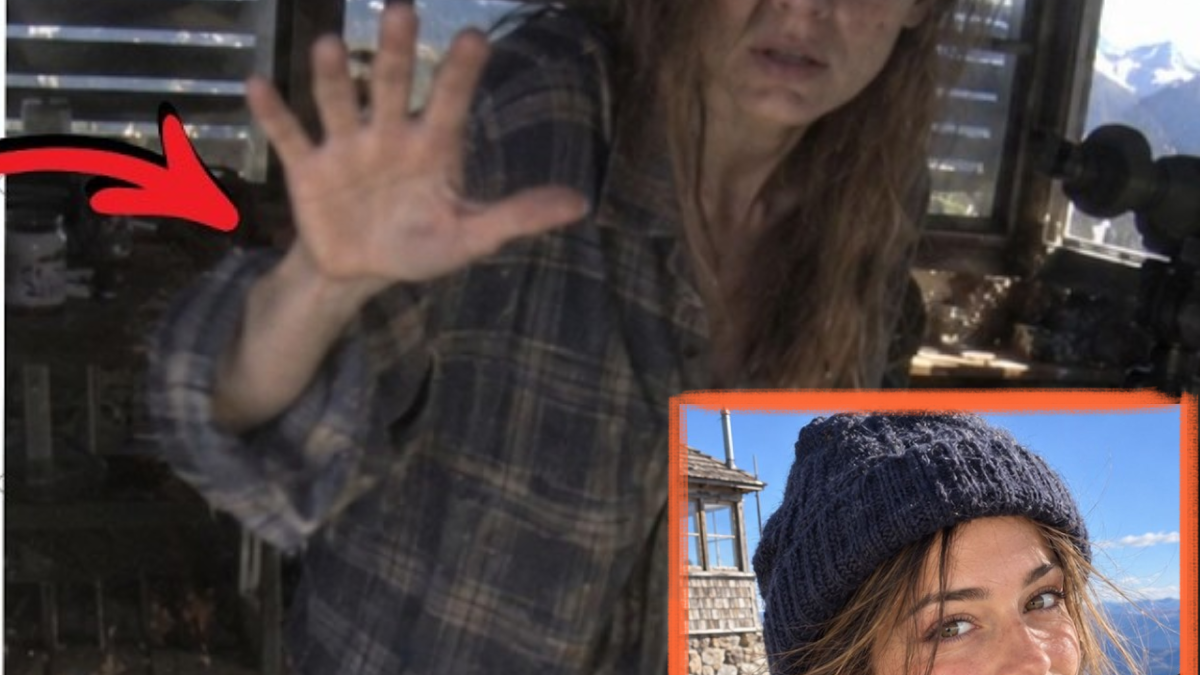
There was Julia — thinner, weary, but fully conscious — beside a spotting scope fixed through the hole, trained directly on the Mount Scott trailhead five miles away.
She was not injured, not bound, not chained.
But she carried a canvas-bound logbook clutched to her chest like a shield, and when they asked who had locked her there, she shook her head and would not speak — not until Nora arrived.
Down below, Lindgren waited.
He said he only wanted to go home, that the road was closing for winter, that no one would mind.
But Deputy Owen Pruitt — who had memorized the May bulletin — blocked his path.
“Step out of the vehicle, sir.
” Lindgren obeyed without resistance.
He asked if someone would tend the urn — it was still hot — and stepped into the patrol car as if he’d known this moment was coming for a very long time.
The truth began to unravel in fragments.
Agents searching his home found a bedroom untouched since 2011 — bed made, insulin case on the dresser, a framed photograph of a young woman with Lindgren’s eyes standing in this very tower, laughing.
Her name was Ren — his daughter.
She’d worked Lost Cabin Butte lookout in September 2011 when an early storm buried the road.
Her radio died.
Her relief never arrived.
By the time he reached her, she was gone — twenty-four years old, Type 1 diabetes, alone in the silence.
Julia knew Ren’s story.
Two years earlier, she’d interviewed Lindgren for her master’s thesis on fire lookouts — the last line of her paper read “Someone should still be watching.
” He’d written back, asking her to meet him at Rim Village on May 4 to receive the lookout’s historical logbooks personally.
She’d gone willingly, carrying coffee, believing she was preserving history — only to find herself locked inside, the ladder pulled away, the door sealed from outside.
“He told me I was her relief,” Julia told agents later.
“That a lookout doesn’t leave until someone comes.
That I was staying — until it was my turn.
”
But the most chilling detail had nothing to do with locks or ladders.
For five months, Lindgren had stood among the searchers every Saturday.
He’d handed Nora coffee.
He’d drawn patrol routes that kept teams west, toward the lake and cliffs, never east toward the tower.
He’d watched them walk past the truth week after week — while Julia watched from above, counting every orange vest, every face, every Saturday that passed.
And three helicopter pilots had flown directly over Lost Cabin Butte in May and June.
Each filed the same line in their logs: Shutters closed.
No activity.
They had looked right at her — and seen nothing.
Part 3
The truth was never about rage — it was about grief, twisted so deep it had hardened into a terrible, distorted kind of justice.
As agents pieced together the full story, they learned how it unfolded step by step.
When Lindgren met Julia at Rim Village that afternoon, he had seemed gentle, earnest, grateful for her interest in his daughter’s legacy.
She had climbed into his Scout willingly, the two mugs wrapped in cloth on her seat, believing they would share coffee and return before dark.
At the tower, he had followed her up the ladder, then descended alone, pulled the rungs away, and padlocked the door from outside — sealing her in the high, quiet space where Ren had breathed her last.
Through the slot he cut in the door, he passed food, water, a bucket, and a logbook — telling her to record visibility, wind, weather, every single morning.
“Relief not arrived,” she was to write, until someone came.
He spoke of Ren in fragments — how the Forest Service had forgotten her, how no one had pushed through the snow, how they had marked her down as “weather delay” and then silence.
He told Julia she was not a prisoner — she was a replacement.
If she was truly the person who thought someone should be watching, then she could watch.
Julia’s first weeks were a blur of shouting until her throat went raw, pounding on shutters until her hands bruised, standing on the table and waving as helicopters passed — only to see them turn away.
She realized then what he had meant: you can wave until you fall apart, but if people have already decided a place is empty, they will see nothing but empty space.
Then she began to notice the searchers.
On June 22, she widened a knot in the cedar shutter with a spoon handle until light broke through.
On July 12, she saw them — a line of orange vests moving slowly across the slope.
She counted them.
Twenty-six.
And she saw Lindgren too — standing at the trailhead, directing patrols west, keeping them away.
He was not hiding from the search; he was guiding it.
Every Saturday, he watched them search in the wrong places while she watched them from above.
She learned their faces through the scope.
The woman with the limping dog.
The man in the yellow hat.
Her own mother, standing by the coffee urn, listening to the very man who held her daughter tell her where not to look.
Nora had shown Lindgren Julia’s thesis.
She had told him her daughter wrote visibility from every ridge.
He had known exactly who she was — and what she meant to him — from the moment they met.
The postcard arrived at Nora’s home on May 19 — calm, kind, signed “Julie.
” No one but her father had ever called Julia that.
She had hated the name since childhood.
Nora walked straight to the sheriff’s office.
But handwriting analysis found no signs of duress; a behavioral profile suggested burnout and voluntary departure.
The card was filed away — a mother’s intuition dismissed as grief.
Julia had signed it “Julie” as a signal — a cry for help written in the only code she knew Lindgren would not catch.
And Nora had seen it instantly.
Yet no one listened.
By late September, Julia calculated the sun’s angle through the hole she had made.
She unscrewed a lens from old binoculars and practiced reflecting light until she could hold a flash steady for ninety seconds at a time.
She chose October 4 — five months exactly — because she knew the first snow was coming, the road would close, and this was her last chance.
When Kellen Ortiz looked up, she flashed S-O-S — three short, three long, three short — until someone finally saw.
In the tower, rescuers found Ren’s logbook resting on the shelf — its final entry, dated September 27, 2011: Relief not arrived.
Staying.
Below it, Lindgren had added his own hand: Relief arrived May 4, 2025.
He had believed he was completing a circle — giving Ren the watcher she had never had.
He was arrested, charged with kidnapping on federal property and making false statements.
At trial, he did not deny what he had done.
“Someone had to be there,” he told the court.
“She had the right habits.
She would have understood.
” When asked if he had ever intended to let her go, he answered quietly: “When her relief came.
” He was sentenced to forty-five years in prison.
Julia returned to the mountains six months later — not to hide, but to stand watch.
She resumed her patrols along the Pacific Crest Trail, still writing visibility in miles on every ridge, though she never sits with her back to a window.
She keeps Ren’s logbook in a drawer beside her bed — the final line she wrote before rescue reading simply: Relief arrived.
Lost Cabin Butte is scheduled for demolition — but Julia has applied to become its first lookout in fifteen years.
“Someone should be there the day a search party looks up,” she wrote on her application.
Not to wait in darkness — but to stand in the light, so that no one ever has to be unseen again.
If you stand on Mount Scott on a clear morning, you might see a figure in the tower window — not waiting to be found, but watching to make sure everyone else is.
“This story is entirely fictional and created for entertainment purposes only.
It does not represent any organization or individual, nor does it encourage inappropriate behavior.
The content was generated with AI assistance.
”








