SHE WALKED INTO A BLIZZARD TO DIE — BUT HER FATHER HAD HIDDEN A SECRET SO BIG IT COULD BRING DOWN A TOWN
Part 1
The snow fell so hard it swallowed the world whole.
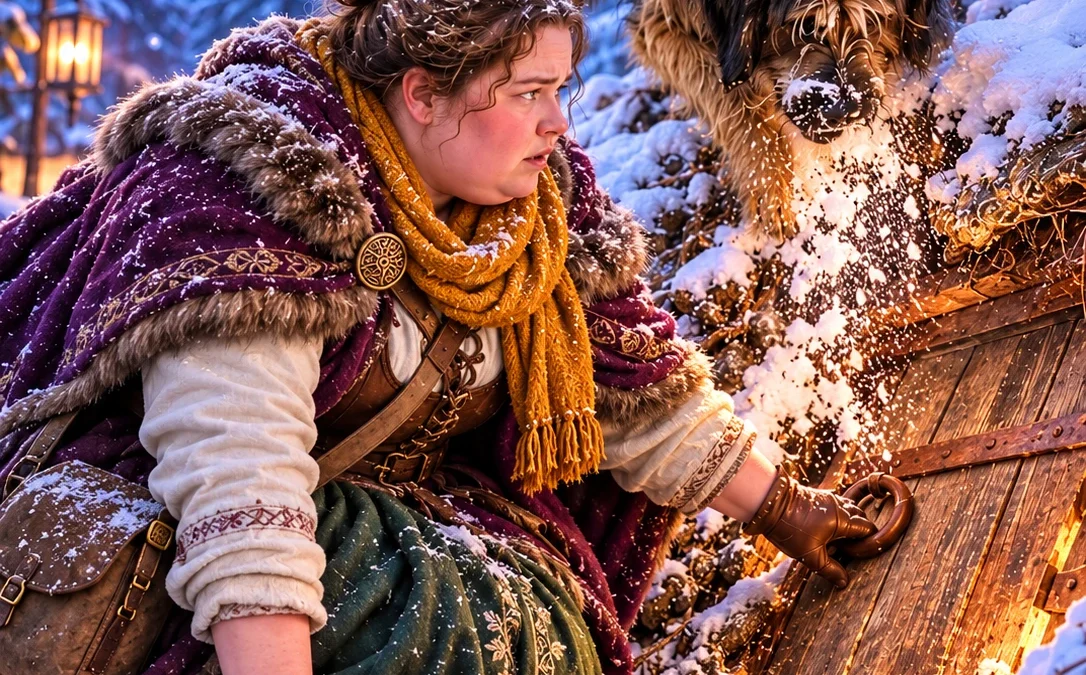
Delilah stepped off her porch on November 3rd with nothing but a coat, a toolbox, and Bramble her loyal dog at her heels.
Behind her, the farmhouse she had known her whole life stood empty — stripped, claimed, and handed over by a forged signature on a deed.
Orson Bellamy, the wealthiest man in the county, had watched from his carriage as they threw her out, his face calm, satisfied, as if he were simply waiting for winter to take its course.
“You’ll be back before dark,” someone had called after her.
“No one survives the ridge in this weather.
”
Delilah didn’t turn around.
She knew something they didn’t.
Her father Gideon had been sick for a long time, wasting away, but in the months before he died he had slipped away at dawn every single day.
He never told her where he was going — only handed her a tattered leather notebook and said, “If the worst comes, follow the writing.
Trust nothing else.
”
For three days she climbed through the storm, Bramble pressing close to her legs, his breath steaming in the freezing air.
When she finally found it — hidden beneath the cedars, buried into the hillside itself — she stopped and stared.
It was a cabin, but not like any cabin she had ever seen.
Stone walls fitted so tight not even wind could slip through.
A stove built into the rock, a platform for sleeping, shelves carved right into the earth.
Every beam, every stone, every detail bore her father’s hand.
He had built this place for her, alone, in secret, while he was dying.
Tears froze on her cheeks as she stepped inside.
The air still held the faint, familiar scent of him — sawdust, pine, tobacco.
She lit a fire, wrapped herself in the blankets he had left, and for the first time in days she let herself rest.
Every morning after that, she and Bramble walked among the trees, never going far, never letting anyone see them.
She learned the ridge not just by sight, but by sound — how the wind sang through the pines, where the snow stayed thin, which hollows held the sun longest.
She learned it the way you learn a home you were always meant to find.
On the third morning, Bramble stopped.
He lifted his head, nose pointed southeast, and a low, deep growl rumbled in his chest — not the bark he used for coyotes, but something darker, sharper.
Delilah dropped low behind a cedar and waited.
Two riders appeared far below.
She recognized the dark, expensive coat instantly — one of Bellamy’s men.
“She didn’t walk two miles into a storm like that and keep going,” he called, his voice carrying clear through the cold.
“She’s frozen somewhere by now.
We’ll find her in spring.
”
The second man shifted in his saddle.
“Boss wants confirmation.
”
“Confirmation of what? That she’s dead? Fine.
But I’m telling you — no one survives that ridge in November.
This whole thing is over.
”
They rode away, and Delilah stayed pressed to the tree long after the sound of hooves faded.
Bellamy thought she was dead.
He wasn’t looking for her.
He wasn’t rushing.
He had relaxed his guard.
She climbed back down into the cabin, sat on the sleeping platform, and opened her father’s notebook.
The first pages were full of measurements and diagrams — how to lay the stone, how to vent the smoke, how to keep the heat locked inside.
She read them twice, slowly, just as he had taught her — “Never rush the first pass.
That’s where the important things hide.
”
Then the writing changed.
The measurements stopped.
The handwriting grew tighter, more urgent.
Her father had been writing about Bellamy.
He had found it three years before — a massive, hidden underground spring beneath the western ridge.
Enough water to turn dry grass into rich grazing land, enough to supply a railroad that would cut straight through the territory.
And Bellamy had known.
He had been quietly buying up every parcel around the ridge, shifting boundary lines by inches, one survey at a time, until the spring sat entirely within land he controlled — except for their farm.
Their land was the final piece.
The only thing standing between him and a fortune no one could even imagine.
Delilah sat perfectly still as the truth unfolded.
The eviction, the pressure, the fake deed — none of it had been about their fields or their house.
It had all been about water.
At the bottom of one page, her father had written in plain, heavy letters: “He does not want the land.
He wants what lies beneath it.
And he has waited so long he believes no one can stop him.
”
She turned the page.
The final entry was dated three weeks before he died.
His handwriting was thinner, shakier.
“I have made copies of everything.
The originals are beneath the floor — pull the left stone, not the right.
Delilah, if you are reading this, you have already survived the first night.
That means you are stronger than you know.
”
Her hands trembled as she knelt, ran her fingers along the base of the wall, and found the loose stone.
She pulled it aside.
Beneath lay a flat oilcloth packet.
Inside were two survey maps, stacks of papers, and a sealed envelope.
On the front, in her father’s unmistakable hand, were three words that stopped her cold:
DO NOT OPEN ALONE.
She stared at those words for a very long time.
Who was he afraid of? And what was inside important enough to keep sealed even from her?
Part 2
She set the envelope gently back into the hollow, covered it over, and turned instead to the maps and papers she could understand.
The boundary adjustments, the dates, the names of people who had sold their land without knowing what they were really giving up — it was all there, piece by piece, built with the same care her father used to lay stone.
Each fact supported the next, nothing left to chance.
Days passed in quiet rhythm.
She tended the fire, studied the records until she could trace every line from memory, and watched the valley below.
Then one afternoon the wind fell completely still.
Thin, pale smoke from her fire hung motionless in the clear cold air — a thin, unmistakable signal against the white sky.
Bramble stood at the base of the stairs, ears pricked, silent.
He didn’t growl.
He didn’t bark.
He simply watched the hatch above, and his tail gave one slow, uncertain sway — the greeting he had only ever given her father.
Delilah grabbed the heaviest mallet from the wall, climbed the steps, and lifted the hatch just enough to see out.
Standing twenty feet away, hat in his hands, was Sheriff Thaddius Mercer.
He looked older, worn down, like he hadn’t slept properly in months.
“You’re alive,” he said, his voice rough.
“Evidently,” she replied, stepping out, keeping the mallet ready.
“What are you doing here?”
He hesitated, then told her the truth — Bellamy hadn’t just wanted land.
He had a buyer: a railroad company willing to pay three hundred and forty thousand dollars for guaranteed water access.
And Judge Edwin Hail, the man who would decide any legal case, had a son-in-law working for that very railroad.
The game was rigged from the start.
Delilah showed him the sealed envelope.
“My father wrote: Do not open alone.
Is that what’s inside — proof against the judge?”
Mercer went pale.
“It might be.
But Delilah…” He stopped, swallowing hard.
“There’s something else.
Something I haven’t told anyone.
Bellamy doesn’t just have the judge.
He has something on me too.
”
He confessed then — seven years earlier, he had led a raid on a homestead that went wrong.
A man had been shot.
Bellamy had covered it up, and ever since, Mercer had been trapped — owned, controlled, forced to do whatever was asked.
The forged deed, the eviction, the silence — all of it bought with that secret.
“Bellamy thinks he has everything locked down,” Mercer said, his voice shaking.
“But I’ve carried this long enough.
I’ll testify.
I’ll sign a statement.
Whatever you need.
”
Before Delilah could reply, a rider appeared on the ridge — Orson Bellamy himself, riding slow and steady, alone.
He stopped eight feet away, dismounted, and looked at her with that same calm, assessing gaze.
“I came to make you one final offer,” he said smoothly, pulling a folded paper from his coat.
“Twelve hundred dollars.
Leave now, and this is all behind you.
”
Delilah unfolded the survey maps so he could see her father’s handwriting.
“I know about the spring.
I know about the boundaries.
I know everything.
”
For the first time, something flickered in his eyes — surprise, quickly mastered.
He smiled.
“Maps are only evidence if someone can verify them.
Your father’s witness — Everett Sloan — has already signed a statement saying his memory is unreliable.
He was drinking heavily back then.
Nothing you have will stand in court.
”
Delilah looked at the paper in Bellamy’s hand.
At the signature at the bottom.
And then she saw it — the date was written in the exact same hand as the forged deed.
Not Sloan’s handwriting at all.
Bellamy had written it himself.
“That’s not Sloan’s signature,” she said, quiet and clear.
Bellamy stepped forward, reaching for the maps — and Bramble stepped between them, every muscle coiled, a low, terrifying sound rising from his throat.
Bellamy’s horse reared.
And then they heard it — hooves, approaching fast from below.
Two riders.
Delilah looked up.
One was Mercer.
The other… was Everett Sloan.
Part 3
Sloan reined in his horse, his face grim.
“I got your message,” he said to Delilah, then turned straight to Bellamy.
“And I have never signed any such statement.
I have never spoken to you or anyone acting for you about any survey.
That document is a fake.
”
He pulled a sealed paper from his case.
“Here is my actual signature, notarized in Pierre three days ago.
Compare it.
And I will testify — under oath, before any judge — that your boundary adjustments are fraudulent.
I have my own field journals, matching your father’s measurements exactly.
”
Bellamy said nothing.
He looked from Sloan to Delilah, calculating, weighing his options — and then he turned his horse and rode away without a word.
Sloan explained quietly that he had waited to come forward until he knew she was alive and safe.
“Your father came to me before he died,” he said.
“He said if anything happened to him, I should watch and wait — and only step forward when you were ready.
”
Delilah remembered the envelope.
Do not open alone.
She looked at Sloan.
“He left something else.
Something sealed.
”
“Then open it,” Sloan said gently.
“When the time is right.
”
The worst blizzard of the season struck three nights later.
The wind howled so loud it drowned out thought, and deep in the night someone knocked at the hatch.
Not Bellamy — Amos Pritchard, the man who had mocked her and bet she wouldn’t survive, knelt shivering in the snow, his hands blue with cold, his face streaked with shame.
His barn had collapsed in the storm.
His wife Margaret was gravely ill.
He had nowhere else to go.
Delilah didn’t hesitate.
She helped him down, warmed him, tended his hands, and then walked back out into the storm to treat Margaret.
When she returned hours later, Amos was sitting by the fire, silent and humbled.
“I was wrong,” he said simply.
“All of it.
”
Word spread.
Families began coming to the ridge — quietly, at first, then more openly.
Delilah taught them what her father had taught her — how to build fires that didn’t smoke, how to fix chimneys, how to store food through winter.
She gave them instructions written in her own hand, just as her father had done — “Knowledge is only useful when you share it.
”
When she returned one evening, she found the cabin ransacked.
The maps, the notebook, the papers — all gone.
Bramble lay in the corner, badly hurt, his breathing shallow.
Bellamy had come while she was gone.
He had taken everything.
She knelt beside him, pressing her hand gently to his side, her heart breaking — and then her fingers brushed something small and hard on the floor.
A calling card.
On the back, written in Bellamy’s hand, one word: Enough.
Delilah sat back on her heels.
Enough? He thought this was over.
But as her eyes rested on the tools hanging on the wall, she remembered something her father had written — a single line she had passed over as just another note: “The handle has always been the safest place.
”
She picked up his favorite mason’s mallet, turned it in her hands, and twisted the hickory handle.
It unscrewed.
Inside, wrapped in oilcloth, were duplicates — everything.
Copies of every map, every note, every calculation.
And another sealed envelope, addressed to Everett Sloan.
“He planned for this,” she whispered through tears.
“He planned for all of it.
”
Sloan arrived at dawn, having ridden all night with word of the break-in.
He took the envelope, opened it, and pulled out a sworn, notarized affidavit — everything her father had discovered, written down and witnessed more than a year before he died.
He had ridden to Pierre in the depths of winter, sick and in pain, to make sure it would stand forever.
The case moved forward.
Judge Hail recused himself when Mercer submitted his statement naming the conflict of interest — a small, brave act that cost him his job but gave them a fair hearing.
Witnesses stepped forward — Sloan, Mercer, Amos, and eleven others who had been too afraid to speak before.
On the day of the hearing, the church was packed.
Delilah laid out the evidence, piece by piece, exactly as her father had taught her — clear, steady, unshakable.
Judge Webb ruled in her favor immediately.
The deed was void.
The land — and the spring — was hers.
Bellamy withdrew his appeal days later.
Without the water, the railroad deal collapsed, and he left the territory, never to return.
The years that followed were full and bright.
Delilah rebuilt the farmhouse, taught families what she knew, and built a community rooted in care rather than fear.
The railroad came — but on her terms, through a fair lease that sustained the valley for generations.
Mercer spent the rest of his days helping people understand their rights.
Amos became her trusted friend and strongest ally.
Bramble recovered, and he stayed by her side through every season until the very end.
When he was laid to rest beneath the cedar trees, Delilah carved into the stone: He found the home love had hidden.
One evening, going through her father’s notebook, she turned past the last entry — past the pages she had read a hundred times — and found one final line, written faint in pencil, as if added in his very last moments: A home is not the walls that keep the winter outside.
It is the love that teaches someone how to endure it.
She closed the book gently, holding it close.
He had not just built a shelter.
He had built her strength.
He had built a community.
He had built something that would last far longer than stone.
And he had waited all this time — just to make sure she finally understood.
This story is entirely fictional and created for entertainment purposes only.
It does not represent any organization or individual, nor does it encourage inappropriate behavior.
The content was generated with AI assistance.








