SHE WALKED INTO A SALOON FULL OF MEN TO SAVE HER PEOPLE — AND EVERY SINGLE ONE LOOKED AWAY… UNTIL A STRANGER SPOKE 3 WORDS THAT CHANGED EVERYTHING
Part 1
Harrow, New Mexico Territory — autumn 1879.
Dust hung over the boardwalks like a secret no one would speak aloud.
Harrow was the kind of town that had made its peace with how things were — and stopped asking if that peace was earned.
It had one main street, a freshly painted land office, and a silence so heavy you could almost touch it.
That silence was about to shatter.
Doli rode thirty miles before dawn that day.
Alone.
Watching the horizon every step, because people had reasons to stop her.
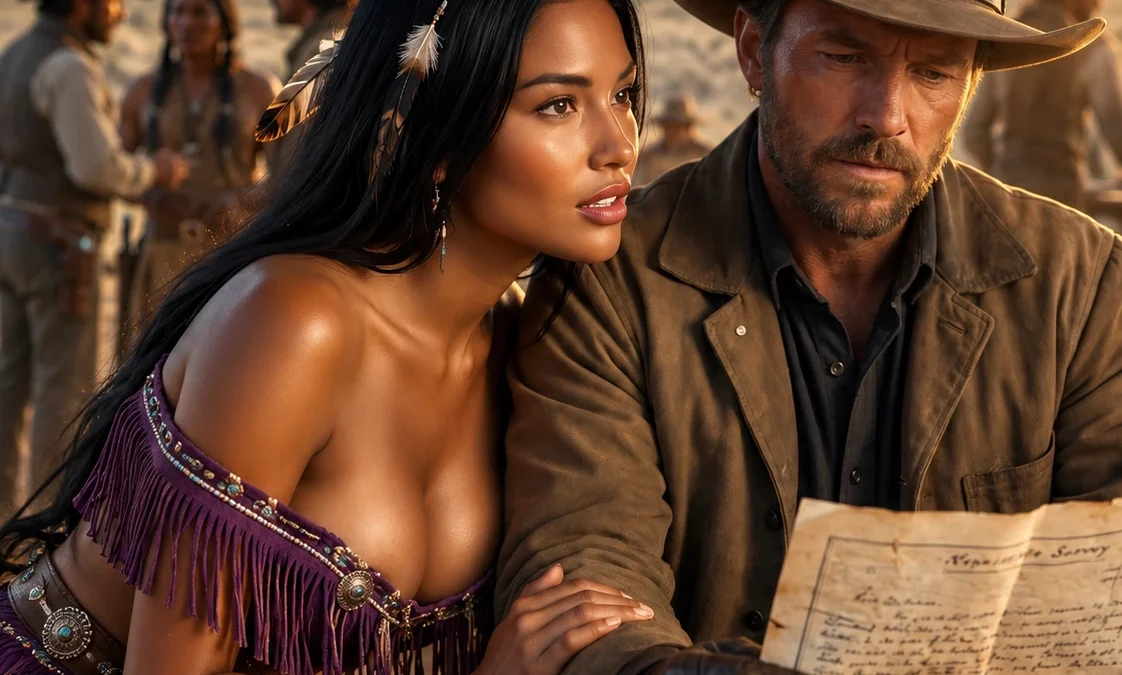
She carried something pressed tight to her chest — an old survey, ink faded soft brown like old tea, wrapped in oilcloth.
Her grandfather’s grandfather had marked out their land on it.
It proved their home was exempt from sale.
And in thirty days, every family in her settlement would be thrown off — unless she laid that paper before the right man before the deadline ran out.
She’d promised her father she’d come back.
She hadn’t told him she’d have to walk into a saloon to do it.
The land office closed at five.
The man she needed was drinking in the room behind it.
So she pushed through those swinging doors, chin high, arms locked around the only thing that could save them.
And that was when it happened.
Cutter — broad, brutal, the kind of man who did what he was told and asked no questions — grabbed her wrist and dragged her inside.
He threw her hard against the bar.
Glasses rattled.
“Nobody move,” he said.
Thirty men filled that room.
Thirty grown men.
Every single one found something suddenly fascinating: the grain of the bar top, the label on a whiskey bottle, the scuff on their boot.
Not one looked up.
Not the bartender.
Not the rancher.
Not the shopkeeper.
They all knew.
They’d all agreed — without ever saying a word — that seeing nothing was safer than seeing the truth.
Doli didn’t beg.
She didn’t fight wildly.
She just stood there, refusing to fall, holding that bundle of papers like it was her heartbeat.
Her eyes swept the room — searching, steady — and met only downward gazes.
Then, from a shadowed corner, a man stood.
He wasn’t loud.
He didn’t draw a gun.
He just set down his coffee cup — not whiskey — and walked across the room in six quiet strides.
Levi Cross.
Ex-Army scout.
Six years riding beside Apache guides, learning their language, burying friends, seeing things most men never would.
He’d left the service eighteen months earlier, still carrying the quiet weight of all the times he’d seen injustice and kept riding.
“Take your hand off her,” he said.
His voice didn’t rise.
It didn’t need to.
Cutter laughed.
“Sit down, friend.
This is government business.
”
Levi didn’t flinch.
“I know what government business looks like.
This isn’t it.
”
Then he did the thing that stopped the whole room cold.
He turned to Doli — and spoke to her in Apache.
Halting, imperfect, but real — the language of her people, coming from a white man’s mouth in a town where no one had ever bothered to learn it.
The silence that followed wasn’t cowardice anymore.
It was shock.
Every man in that saloon realized at once: they were no longer just watching a woman being pushed around.
They were watching something they couldn’t pretend not to understand.
Doli lifted her head.
Her eyes locked onto his — not with hope, not yet — but with the clear, sharp calculation of someone deciding if he was friend or foe.
“I am not hurt,” she said — loud enough for every man in the room to hear.
Levi turned back to Cutter.
He named the Territorial Citizenship Act of 1873 — the law that gave every permanent resident standing, Apache families included.
He gave his name, his service record, his knowledge of the land.
And Cutter — the big, confident man who’d dragged a woman through doors like she was luggage — hesitated.
The room had shifted.
The power had shifted.
He straightened his coat, turned on his heel, and walked out.
But the danger was only just beginning.
Doli told him the truth then — quiet, fast, urgent.
The land agent, Elias Warrick, had been selling their people’s land parcel by parcel for eight years.
He’d filed a new survey claiming the ground was never exempt.
If the fake document stood, they were gone.
But she carried the original — dated 1861, signed by the commissioner himself — proving the land was theirs forever.
They spread the papers out at the livery.
Levi studied them closely — the genuine one soft, yellowed, folded thin from decades of being kept safe; the new one sharp, clean, copied word for word… almost.
And then he saw it.
A detail so small no ordinary clerk would ever catch it.
A difference that unraveled everything.
He looked up at her, his voice low and grave.
“This second survey… it uses map markings that weren’t even invented until 1869.
Eight years after the date it claims to be from.
”
Doli went pale.
“Then —”
“Your land wasn’t just stolen,” Levi said.
“It was forged.
And this proves exactly who did it.
”
Before they could even breathe, the livery door swung open.
Elias Warrick stood there.
Calm, polished, holding a leather folder under his arm like it held nothing more serious than a grocery list.
He stepped inside, laid a document on the workbench beside the real survey, the fake survey… and the arrest warrant.
“Doli is charged with theft of government property,” he said smoothly.
“Tell me where she’s gone.
”
Levi didn’t answer.
He just looked at the paper — and saw the trap closing.
Warrick smiled.
“The marshal will be here within the hour.
You can’t hide her forever.
”
Part 2
…Warrick smiled.
“The marshal will be here within the hour.
You can’t hide her forever.
”
Levi didn’t panic.
He didn’t reach for a gun.
He just stood his ground, steady as the old mountains around them.
“Are you a deputized federal officer, Mr.
Warrick? Only a marshal or someone sworn in can execute a warrant like this.
”
Warrick’s smile didn’t drop — but his eyes tightened.
“The marshal is coming.
”
“Then we wait for him,” Levi said simply.
Warrick left to send word — and the moment the door clicked shut, Doli slipped out the back, leading her saddled horse from the shade.
She wasn’t running blindly.
She had a plan all along.
“Two miles east,” she whispered to him.
“Commissioner Hale is camped there — federal, independent.
He’s the only one who can stop this.
I’ll show him both surveys.
”
Levi nodded.
“I’ll hold them here as long as I can.
Ride fast.
”
She paused, hand on her horse’s neck, searching his face.
“Why are you doing this? You don’t know me.
”
“Maybe I know enough,” he said quietly.
Then she was gone — dust swirling behind her, east toward the creek, toward their only hope.
For the next fifty-eight minutes, Levi fought a war no one could see.
He didn’t draw a weapon.
He filed papers.
He registered a formal dispute at the county office.
He requested copies of records.
He asked questions — slow, polite, impossible to brush aside.
Every minute he delayed was a minute Doli gained.
Every form he filled out was a wall slowing Warrick down.
Warrick found him again, pacing, sharp-edged now, composure fraying.
“You’re obstructing justice.
”
“I’m exercising my legal rights,” Levi said calmly.
“Check with your lawyer if you don’t believe me.
”
The marshal arrived at the fifty-eighth minute — Briggs, practical, no-nonsense, tired of territorial messes.
“Where is she?”
“I don’t know,” Levi answered truthfully — he didn’t.
Not exactly.
They stood on the boardwalk then — Levi waiting, Warrick simmering, Briggs watching both — staring down the eastern road as the sun climbed higher.
The minutes stretched thin.
Had she reached Hale? Was he still there? Would he even listen?
A rider appeared on the horizon — coming fast, horse lathered, leaning low over the neck.
He pulled up hard before them, breathless, and handed Briggs a single folded paper.
“From Commissioner Hale.
He said don’t wait — deliver this now.
”
Briggs unfolded it.
He read once.
Then twice.
The silence that fell was heavier than before.
Warrick stepped forward.
“Well? What does it say?”
Briggs looked up — straight at Warrick — and his voice was flat, final, unarguable.
“It says the land is hers.
And you’re finished.
”
Part 3
…“It says the land is hers.
And you’re finished.
”
Warrick’s face drained of color.
“That order has no authority —”
“Federal authority supersedes territorial in land matters,” Briggs said, reading from the page.
“Hale examined both surveys.
He saw the date discrepancy instantly.
He’s issued an immediate stay — no one moves anyone off that land.
He’s launching a full investigation into eight years of transactions.
And you, Elias Warrick — suspended from duty effective immediately.
Don’t leave the territory.
”
Warrick opened his mouth.
Then closed it.
There was nothing left to say.
All his careful paperwork, all his quiet deals, all the years of building on ground that never belonged to him — it crumbled in a single afternoon.
He tucked his folder tight under his arm and walked away — smaller, older, the silence of the town settling over him at last.
Doli rode back at sunset.
She sat her horse differently — lighter, straighter, like someone who’d been carrying a mountain and finally set it down.
The men who’d studied the bar top so hard two days earlier stood on the boardwalks now.
They didn’t cheer.
They didn’t apologize aloud.
But they watched her pass — and this time, they saw her.
She found Levi by the livery fence.
“Hale said it was clear,” she told him softly.
“He didn’t even need me to explain much.
He knew.
He said the truth usually shows itself if you hold it up next to the lie long enough.
”
They stood together in the golden light.
The thirty-day clock had stopped ticking.
Her people were safe.
“Does the stay expire?” Levi asked.
Doli smiled — the first real, unburdened smile he’d seen.
“It doesn’t.
It holds until the investigation ends.
There’s no deadline anymore.
”
Night fell.
They sat on the fence together, talking quietly.
She told him of her father, of the children who’d been sleeping in fear of dawn.
He told her of the years riding the territory — the things he’d seen, the times he’d looked away, the weight he’d carried since leaving the army.
They didn’t rush.
They didn’t make grand promises.
They just spoke the truth, slow and steady, like people who’d only just learned it was safe to do so.
Morning came pale and soft.
Levi saddled his horse before the town woke.
Doli met him at the livery door.
“My father will ask your name,” she said.
“He will want to thank you properly.
”
Levi adjusted his girth — twice — before he looked at her.
“He doesn’t need my name.
He just needs the land to stay his.
That’s what matters.
”
“That isn’t what I asked,” she said, and there was warmth in it.
He paused.
“I didn’t stand up for a reward.
I stood up because someone had to.
That’s all.
”
Doli stepped closer, but not too close — respectful, steady.
“You could ride west with us.
If you want somewhere to be for a while.
”
It hung between them — not a demand, not a plea, just an open door.
Levi breathed it in.
“Maybe I will,” he said.
“One day.
If the road brings me back.
”
He swung into the saddle.
“Take care of your people, Doli.
”
“Take care of yourself, Levi Cross.
”
He rode out alone.
Two miles beyond town, a young rider — Apache, no more than seventeen — came alongside from the trees.
He matched pace for a moment, said nothing, then pressed a scrap of folded paper into Levi’s hand and wheeled away, gone as quickly as he’d appeared.
Levi slowed his horse.
He unfolded the paper.
Three words, written carefully in Apache — the hand of someone who’d practiced until they got it right:
WE REMEMBER YOU.
He read them once.
Then again.
He folded the paper carefully and tucked it inside his coat, pressed over his heart — the way Doli had carried her survey.
The road stretched empty and golden ahead.
He didn’t know when he’d return.
He didn’t know what lay beyond the next ridge.
But he sat his saddle differently now — lighter, straighter — the old weight lifted.
He’d walked into a town where everyone looked away.
He’d stood when it mattered.
And in return, he’d been given something far greater than thanks: he’d been seen.
This story is entirely fictional and created for entertainment purposes only.
It does not represent any organization or individual, nor does it encourage inappropriate behavior.
The content was generated with AI assistance.
✅








