She Walked Into A Stranger’s Cabin Bleeding And Barefoot, Laid A Folded Document On His Table, And Said “Before Sunrise, They Will Come… And You Will Have To Choose”
She Walked Into A Stranger’s Cabin Bleeding And Barefoot, Laid A Folded Document On His Table, And Said “Before Sunrise, They Will Come… And You Will Have To Choose” 😱
Part 1
She didn’t knock. She didn’t beg.
She walked into a stranger’s cabin in the dead of night, bleeding, barefoot, and carrying a secret that powerful men would kill to bury.
And the moment Silas Whitaker raised his rifle at her, she didn’t flinch.
She placed a folded document on his table and said, “Before sunrise, they will come. And when they do, you will have to choose.” 😳
The summer of 1886 arrived in the Arizona Territory like a punishment.
The heat did not break at night the way it was supposed to. It settled into the earth and stayed there, heavy and suffocating, pressing down on every rock and rooftop and living soul unlucky enough to still be breathing under that sky.
Silas Whitaker had stopped fighting the heat years ago. He had stopped fighting most things years ago.
He sat at his workbench with a cracked saddle across his knees and a lantern burning low beside him, the stitching needle moving through the leather in slow, practiced pulls. Outside, the coyotes had gone quiet.
That should have told him something. In ten years of living alone in that valley, he had learned that the desert never went quiet without a reason. 🏜️
The door opened. Not knocked, not eased. One push. The night air rolled in, carrying dust and the faint copper smell of blood.
Silas dropped the saddle and had the rifle in his hands before his boot touched the floor.
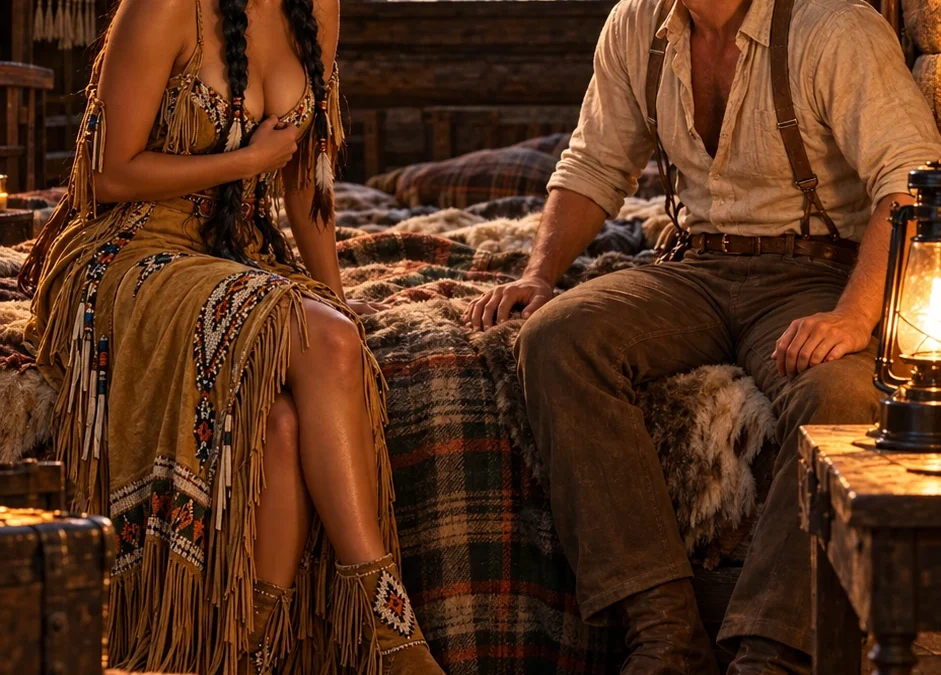
She stood in the doorway. Apache. Barefoot, her feet torn open and caked with dried blood and red dirt. Her dark blue dress was shredded at the hem and stiff with dust. Her hair had pulled loose across one shoulder. She was breathing hard, but not panicking.
Her eyes made one fast sweep of the cabin: the rifle, the lantern, the single exit. Then they locked on him.
She did not raise her hands.
“Close the door,” Silas said, the barrel steady.
She stepped inside and pulled it shut without turning her back on him. Then she reached into the fold of her dress and drew out a flat bundle of folded leather, the kind used to wrap documents that needed to survive rough travel. She set it on the table beside his lantern.
“Before sunrise, they will come looking for me.”
Her English was clear and deliberate, like someone who had learned it not from kindness but from necessity.
“Who are you?”
“My name is Ayana Red Feather.” She met his eyes without blinking. “The men coming here are not chasing me. They are chasing what is inside that leather.”
Silas looked at the folded document. He did not look at it long.
“You have about thirty seconds to tell me why I should not put you back out that door.”
“Because the men following me have already killed two people this week. And because you are a former cavalry scout who once rode with the Third Arizona, which means you already know what that document contains.” She paused. “You just do not know it yet.”
The lantern flame flickered. Somewhere out in the dark valley, a horse called.
Silas heard it. So did she. Her jaw tightened, but she did not run. She stood exactly where she was and waited for him to make his choice.
He did not put her back out the door. He could not have said why. Maybe it was the way she stood, spine straight, chin level, no trembling, like a woman who had already accepted that things might go badly and had decided it did not change what she was going to do. Maybe it was the blood on her feet, which told him she had been walking a long time before she started running.
“Sit,” he said, and lowered the rifle.
She sat in his only chair, hands folded in her lap. Silas went to the window and looked out without lighting anything near it. Three-quarter moon. The valley silver-gray and still.
Three horses, maybe four, stopped on the far ridge above the creek crossing.
“What is in it?”
“Survey documents. Original federal land survey records from 1874. The Apache land grant boundaries, signed by a federal land agent and witnessed by two officers.” She looked at him evenly. “They prove that the Carver ranch, all four thousand acres of it, sits entirely within the original Apache grant. Every deed Ray Carver holds is fraudulent. Every sale. Every government beef contract he signed to supply the forts, built on land that was never legally his.”
The name landed in the room like a stone in still water.
Ray Carver. Silas had heard that name exactly once, six years ago, from a dying man who had made him promise not to repeat it. He had kept that promise.
“Where did you get it?”
“My father. He was a translator for the federal surveying party. He kept a copy because he knew even then that the records would be altered. He hid it for twelve years. He died three months ago.” Her folded hands tightened. “The men who came to our camp the night he died were not there by coincidence.”
Outside, torch light moved along the base of the valley wall. Four riders, sweeping the tree lines.
And what Ayana told him next, about the cavalry scout who had once refused to sign a false report, changed everything Silas thought he knew about why she had walked straight to his door. 😨
💬 Part 2 is waiting in the comments! Can’t find it? Leave any word below and I’ll send it to you privately.
Part 2
“Six years ago,” Ayana said quietly, “a cavalry scout refused to sign a report confirming that land near the Gila River had been legally vacated by its Apache residents. Everyone else signed. The scout who refused was discharged six months later on a technicality.” She paused. “His name was Whitaker.”
The lantern flame bent sideways and came back upright.
Silas said nothing for a while. “That was a long time ago.”
“Yes. And nothing was done about it then, which is why I am here now.”
Below, one rider on a gray stopped at the turnoff toward the cabin and sat there, looking up the slope. “That one is Denton,” Ayana whispered. “He tracks for Carver.”
The man held his horse for a long count. Then he turned and rode on with the others.
Neither of them moved for another full minute.
“They will be back.”
“Yes.”
She did not try to make it seem less than it was. Silas knelt and cleaned her torn feet with water and strips of an old shirt. She did not make a sound.
“You said I would have to choose.”
“When Carver’s men come back, you can say you have not seen me, or hand me over and be done with it.” She met his eyes. “If you lie for me, you have chosen a side. That is all I am asking for. Not a rescuer. A witness.”
That night, he sat awake with the rifle across his knees. He thought of the document and of a man who had kept it twelve years because he believed it would eventually matter. He thought, coldly and honestly, I could burn it right now. Put her out in the morning. Go back to my life.
He sat with that thought for a while. Then he moved the document to the loose floorboard under the stove, where he kept his emergency cash. He did not examine his reasons too closely. 🕯️
In the morning, she told him about a judge in Tucson named Aldridge, one of three men in the territory Carver could not buy, who had spent two years trying to build a case without any original documents. “What your floor is protecting is the only surviving original.”
“Three days to Tucson. Four if your feet fail.” He set tin cups on the table. “Those cuts need another day.”
Denton came at midmorning with another man on a leggy bay mare.
“You Whitaker? We are looking for a woman. Came through this valley last night.”
“I have not seen any Apache woman on my property. I have not seen anyone on my property who should not be here. If you want to search, show me a warrant.”
The silence stretched. Denton touched his hat. “Appreciate your time.”
Behind the cabin, Silas knocked twice on the wall. The trapdoor to the root cellar creaked open.
“You told them I was not here.”
“I told them I had not seen anyone on my property who should not be here.”
“That is technically still a lie.”
“Welcome to the West, Miss Red Feather.”
Something moved behind her eyes. Not amusement exactly, but not far from it. 😏
That afternoon a boy on a mule brought a folded note in his hatband. The woman you may or may not have encountered is carrying stolen property belonging to the Carver Land and Cattle Company. Its return would be appreciated. Its continued absence would be unfortunate for a number of people, including yourself. I am a reasonable man. I hope you are the same. — R. Carver
Silas held it over the lantern flame until the corner caught, then dropped it into the iron pan.
“We leave at first light.”
“We?”
“You cannot ride four days alone with Carver’s men in the valley. I know every water source and every rancher between here and Tucson who can be trusted.” He looked at her steadily. “Because I burned your note, I already made the choice. I am just catching up to it.”
But at one in the morning, a single rider walked his horse up the dark trail. And what the young man said on that porch revealed that Carver’s men were bringing six guns at dawn. 😱
💬 Want to know who the mysterious rider was, and what waited for them on the ridge? LIKE or COMMENT “REVEAL” to unlock Part 3! It will be posted as soon as we have enough comments. 🔥
Part 3
The rider was the younger brother from the bay mare, twenty-something with bad posture and a rifle he had not quite raised.
“Denton is bringing six men at dawn,” he said, low and reluctant. “He figures you have her hid on the property. He is going to search it proper this time.” He looked at Ayana in the doorway. “Did you know a woman named Lily Red Feather? Older. Apache. Lived near the Gila.”
“That was my mother,” said Ayana.
He closed his eyes briefly. “She helped mine once. Twelve years ago, a fever went through the camp near Miller’s Creek. She helped when she did not have to.” He looked at Silas. “Denton does not know I came.”
“Consider it forgotten.”
When he was gone, Ayana stood with the revolver at her side and an expression Silas had not seen before. “She died two years ago. Fever.” Then she straightened, and it was packed away. “We need to leave now.”
They led the horses out without lighting anything and moved south along the back slope. The document rode flat against Silas’s ribs inside his coat. 🌌
At dawn, four riders blocked the ridge. Cole Pratt, a deputy sheriff out of Prescott who had done three honest years before someone made him a better offer, held up a warrant.
“Territorial warrant out of Yavapai County. The woman is wanted for theft of private property.”
“The judge who signed that works for Carver,” said Ayana steadily. “His appointment was recommended by the Carver Land and Cattle Company. Whatever that paper says, it is paperwork dressed as law.”
“What is Carver paying you?” asked Silas. “Whatever it is, it does not cover what happens next. The moment that document reaches Judge Aldridge, every man who carried a Carver warrant becomes part of the evidence. That is not a threat. It is arithmetic.”
The silence was long. Pratt folded the warrant and put it away.
“I did not see anyone on this ridge.”
He turned his horse, and his men followed.
“That was a risk,” Ayana said, her breath slow and not quite steady.
“I knew he was doing a job he did not believe in. Men like that are looking for a reason to stop.” 😮💨
At Hartsville, an old blacksmith named Adcock reshod Silas’s horse after one threw a shoe. He recognized Ayana’s mother’s name. And he told them that two men had passed through that morning on fresh horses, asking after a cavalry scout and an Apache woman. Denton had sent men ahead to cut them off at Sonoita.
“The old Apache route through the Santa Ritas,” said Silas.
“I was born in those mountains,” said Ayana. “I can navigate it in the dark.”
She did. They climbed a narrow, unmarked path at night, single file, while voices of searching men faded below. “My family gave you everything you needed for this,” Silas said later.
“I thought of it as what I had left,” she said. “After everything else was taken.”
Three hours from Tucson, Denton found them anyway, with five men and no pretense. Rifles up.
“The document. Now. Give it to me and you walk away.”
“You have my word,” Ayana said, “on behalf of a man who had my father killed.”
Denton said nothing. Then a rifle shot cracked from the ridge above.
“I would sit very still, Mr. Denton. My name is Judge Franklin Aldridge, and every man on that trail is in the sight of four federal marshals.”
One by one, Denton’s men laid down their rifles. Denton looked at Ayana, a man watching something he had bet against come true.
“She got to you already.”
“She did not get to anyone,” said Ayana. “She carried evidence to people who were already looking for it.” ⚖️
Silas handed over the leather case. The judge held it in both hands the way you hold something you have been reaching toward for a long time. “Your father kept this a long time,” he said.
“Thirty years.”
“Then we will make it count.”
The rest happened slowly, in the chambers of the federal court in Tucson, the grinding machinery of law doing what law does when it actually works. Silas stayed for his deposition, then stayed longer, because Ayana was still there and he had no urgent interest in being anywhere else.
Carver’s answer was not to attack the document but the woman carrying it. Stories spread through Tucson that the survey was forged, that Ayana was a thief expelled from the reservation, that her companion was an unstable former scout. Then Carver’s lawyers filed a second 1874 survey, forged, showing the grant boundaries elsewhere.
There was one man who could break it. Lieutenant Elias Reed, Third Arizona Cavalry, had witnessed the original survey. He had also signed the false report Silas refused six years ago.
Silas rode to Fort Huachuca alone. In a storage room, he found Reed older and heavier, a man who had made a convenient choice and spent six years living with the cost.
“They forged my signature,” said Reed quietly. “On a document with an 1874 date. I have been sitting here two days trying to figure out what I do with that.”
“Your name stays on a forged document in federal court permanently,” said Silas, “or you make it a federal court’s problem.”
Reed straightened his jacket. “Give me the name of Aldridge’s clerk.”
When Reed’s testimony landed nine days later, the forged survey collapsed within forty-eight hours. 💥
Cole Pratt had quietly resigned his post and walked into Aldridge’s office with his own account. “I told him on that ridge,” Ayana said, standing in Kora Vasquez’s courtyard doorway, “that Carver only stayed in power because people kept choosing to protect him. I did not think he was listening.”
“Some people listen slow,” said Silas.
Six weeks after Reed’s testimony, Aldridge’s court found the Carver land grants fraudulent. The beef contracts were referred to federal prosecutors. Carver’s assets were frozen. Judge Holloway resigned three days before he would have been removed.
It was not an instant return of the land. The Apache claim would take years and politics. Ayana had always known that. But the record existed now. The document Thomas Red Feather had carried for thirty years sat in a federal archive, authenticated and permanent. 🥹
“Well,” said old Kora, when Aldridge finished reading, “about time.”
Ayana did not laugh. She looked at her hands, then across the room at Silas. He was already looking at her. She gave him one small, real nod.
Kora held her a long time in the doorway of the boarding house. She pressed a small bundle of seeds into Ayana’s hands. “From your mother’s garden. I have been keeping them.”
They rode south together out of Tucson.
“My mother used to plant flowers near whatever door she lived by,” Ayana said on the second day. “She said it was how she knew she was home.”
“There is good light on the east side of my porch,” said Silas. “All morning.”
She glanced at him. “I will look at it.”
Two days later, they came over the ridge above the valley. The cabin looked smaller than he had left it, the way things always do after you have been away. She pulled her horse up and looked down at it for a long time. Then she kicked her horse, and they rode down together.
The sound of hooves on the dry ground was the good kind, the sound of something arriving, not leaving. In ten years he had never locked the door.
He lit the lantern. It caught on the first strike and threw its warm light into corners that had been too quiet for too long.
Ayana stood in the doorway looking at the bench he had built and never sat on with anyone, and the bare ground beside it in the evening light.
“East facing,” she said.
“All morning,” he confirmed from the stove.
He did not watch her. He gave her the privacy of the moment. He heard the small sound of the seed bundle coming out of her saddlebag. 🌱
When she came back inside, she sat at the table and wrapped both hands around the coffee he set in front of her, the same gesture as that first night, with her father’s document between them and her feet bleeding. A lifetime ago last week.
“It is a good valley,” she said.
“Yes.”
The lantern burned between them, steady and unhurried, as it would all night. Outside, the first star appeared, then another, then the whole desert sky opened up, enormous and full of more light than anyone could count.
And the two people inside the cabin drank their coffee and did not need to say anything more, because some things do not need words once they have already been chosen.
And what they had chosen was here, and real, and staying. ❤️
💬 If this story touched your heart, tell us in the comments: have you ever kept a truth safe for someone else, even when it cost you? Like and share this with someone who needs to know that doing the right thing is never wasted. 🙏
This story is entirely fictional and created for entertainment purposes only. It does not represent any organization or individual, nor does it encourage inappropriate behavior. The content was generated with AI assistance.








