She Walked Out of Her Dead Father’s Office With Eleven Shillings and a Folding Ruler
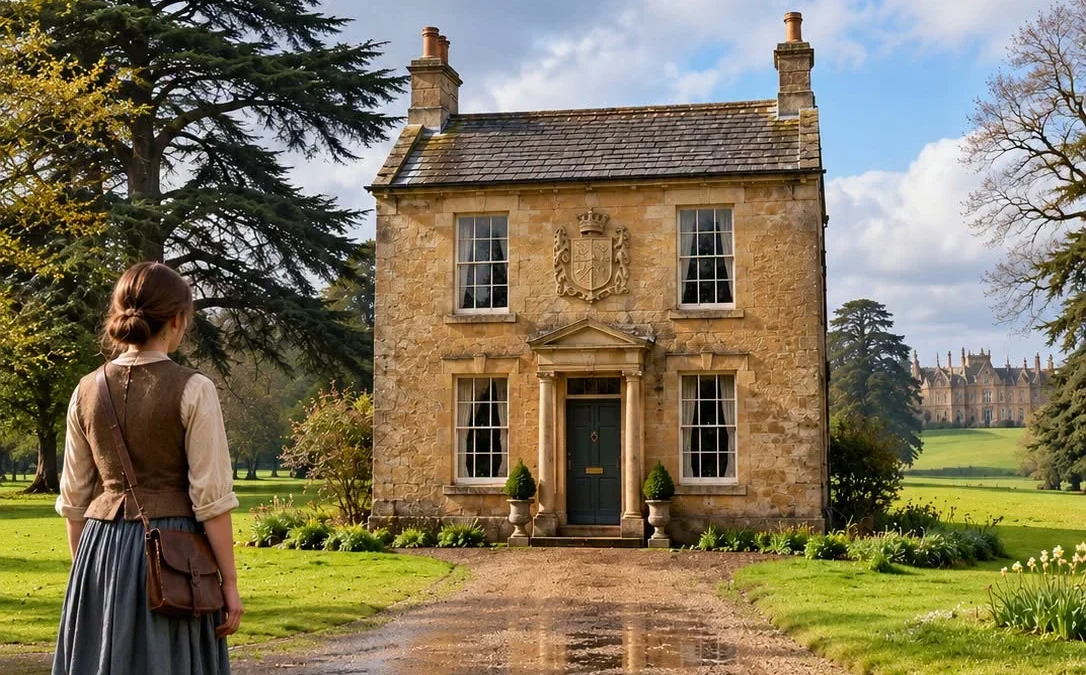
She Walked Out of Her Dead Father’s Office With Eleven Shillings and a Folding Ruler. Behind One Cellar Wall, a Mason Who Died Sixty Years Earlier Had Left Her a Message, and the Whole Village Had Forgotten Whose Land It Was…
Part 1
Eighteen-year-old Catherine Holt had lost her mother, her father, and the only person who ever called her clever. By the spring of 1870, she had a tin trunk, a rosewood folding rule, and eleven shillings to her name. 🏚️
Then a will nobody had read in sixty years gave her a small stone cottage on the edge of a ruined farmstead, and a title that no living man had troubled to claim.
She thought she had been left a roof.
Alden Hollow lay in the fold of a shallow valley where the river ran brown over gravel. It held ninety-one souls, a grist mill, a gray stone church with a tower too short for its ambitions, and one great house nobody had lived in properly for years. The maple avenue leading to it had gone half wild. Its two gatehouses had lost their roofs to a gale and never had them replaced. The old place stood at the end of that avenue, ninety feet of lichen-stained stone with shuttered windows, like something waiting to be told whether it was still alive.
The last man to hold clear title had died in 1810 and left no will anyone could find. For sixty years the land had been picked over by cousins, argued about in chancery, mortgaged twice, and let to tenants who plowed the park for corn. Nobody in living memory had called himself master of the place. The village had stopped noticing, the way you stop noticing a draft through a door.
Catherine was born in two rooms above the estate office, the only child of Godfrey Holt, clerk to the steward. A thatcher’s son, he had spent twenty-three years copying rent rolls and deeds in a hand so clean that solicitors in the county town asked for the Alden copies by preference. He could read a court hand that was dying out, and the older one behind it that was already dead. Her mother, Margaret, took in washing and made her own soap from wood ash. The smell of it, gray and clean and faintly sharp, was how Catherine remembered being completely safe. Between them they gave her the only dowry a clerk’s daughter was likely to have. She could read anything put in front of her, and she could count.
Her mother died of fever in January 1861. Catherine was nine. After that she kept the house, baking six-pound loaves in a brick oven, curing bacon, darning heels, keeping her father’s accounts in a ruled exercise book with every penny entered. Then Joseph Wick, the estate joiner, seventy-one and widowed, began letting her sweep shavings from his bench in exchange for watching. By twelve she was holding the plane. By fourteen she could mix lime plaster, set a slate, true a door, and judge a beam by the ring of it under her knuckle. He was the first person to call her clever, and he said it flatly, the way he said everything. Let the tool do the work, girl. Your hands are not for hurrying. On her fifteenth birthday he gave her his rosewood folding rule, two feet when opened, brass hinges worn pale as bone, his initials JW burned into the wood. She carried it in her apron pocket from that day on.
Her father died in February 1867. Joseph died in December 1869, in his chair by the workshop stove, his pipe going out in his hand. 💔
One wet afternoon when she was thirteen, her father had set down his pen and told her something she did not understand. Everything in this office is copy. The place’s true old title, the one that matters, is not here, and nobody has troubled to find it in fifty years. She kept the sentence the way you keep a key to a door you have not found.
The letter came on a Tuesday in March. The chancery suit had at last been settled. Three cousins, none of whom had ever set foot in the village, were to divide the old place, the farm, the mill, and the avenue and sell it at auction before Michaelmas. The estate office would close. The clerk would receive a fortnight’s notice, fifteen shillings, and orders to vacate the rooms by Lady Day.
She read it three times, folded it into the iron-cornered deed box, and stood a minute in the yard without weeping. That night she made two columns in her father’s exercise book. Things to keep. Things that were not hers. Her column was short. Her mother’s trunk and shawl. The rosewood rule. Eleven shillings in a cocoa tin. Her father’s pen and book.
The parson’s wife offered, kindly, to find her a place in service. Catherine thanked her and declined. She said she had been left a cottage, past the broken paling at the far end of the park, which her father had marked in the margin of a tithe map. “I do not know whether it is there. But I mean to go and see.”
She left before dawn, the key on the mantel, the door closed without turning the handle twice, which her father had always called unlucky. The carter took her trunk past the roofless gatehouses and the maple avenue crowded with self-sown ash, the frost crunching under iron tires. At a stone bridge over a little beck, he lifted the trunk down, took his penny, and turned back. She dragged it along an overgrown path into the hollies, the branches closing above her head.
At the end of the clearing, a small stone house waited with its door unlocked. And inside its cellar wall, something had been hidden by a dead mason who had hoped she would one day come. 😨
Part 2
The cottage was a single story under a steep slate roof, with a squat chimney and a door of weathered oak. Four slates were missing from the eastern slope. When she pushed the latch, it opened of its own weight with a sigh of cold air.
Inside she measured the room with Joseph’s rule. Nineteen feet by fifteen. A flagged floor, a wide hearth with a rusted fireback, a scullery with a stone sink and a copper, a plank trap under the stair opening onto a brick-vaulted cellar, dry as bone. In the loft, the ridge was straight and the rafters rang sound under her knuckles. She set down her trunk and took off her bonnet. “It will do,” she said aloud, to no one.
That afternoon she carried a lantern down into the cellar and began rapping the north wall with her knuckles, as Joseph had taught her to test a panel. The sound changed in a patch three feet wide, from dull brick to something hollow. With the flat iron from her trunk she worked at the lime wash until it came away in soft flakes, and under it she found a square of plaster laid later than the rest. Behind it, a smooth oak board was set flush into a niche. She drew it out. In the cavity behind lay three parcels wrapped in oiled linen gone the color of weak tea. 🕯️
The first held forty-two gold sovereigns. The second held four sealed parchments in a hand so old she had to find her way into it slowly, the court hand her father had taught her on winter evenings. Halfway down the first, she sat back on her heels. It was the freehold of this cottage and two acres, granted in the ninth year of King Henry the Eighth to one Walter Holt, mason, and his heirs forever, and confirmed in 1811 to Jeremiah Holt.
The third was a letter, sealed in red wax, addressed to whoever of my blood shall next come to this door.
I am Jeremiah Holt, mason of Alden Hollow, and I have lived in this cottage thirty-nine years. I write this in August of 1810, the owner of the place three weeks dead and the cousins already at law. I have no child living. My daughter was taken at four and my son at seven and my wife last winter. I have hidden these deeds and these sovereigns behind this wall because I do not trust the chancery to leave an honest freehold alone. The forty-two sovereigns are fifteen years of good work and they are yours to begin with. The parchments make this cottage yours by right and not by any man’s gift. No steward and no cousin and no court of Westminster can take them from you if you keep them safe. I hope you are young and strong and have somebody who loves you.
Catherine sat on the hearthstone with the letter on her knee. She did not weep. She laid the rosewood rule across it so the brass hinge held the paper flat, and she sat a long while in the lamplight saying nothing at all. 💛
In the morning she lit a fire of hazel sticks. The chimney drew clean. She walked into the village carrying one sovereign in her apron pocket and the four parchments wrapped flat against her ribs. A slater named Thomas Marple agreed to come Monday for five shillings and his dinner. Then she climbed the stairs above the saddler’s shop to Mr. Payton, a Methodist solicitor who had once drawn her father’s small will for a shilling and a bottle of elderflower cordial.
He read the parchments twice, then fetched a magnifier for the seals. He asked where she had found them. She told him. He sat back, took off his spectacles, and polished them on a yellow silk. If the deeds were what they appeared to be, the cottage and its acres had never been part of the estate to sell. The Tudor crown had severed the Holt holding long before, and for sixty years nobody had claimed the senior title because nobody had known where the oldest deed lay. He charged her nothing until the thing was done.
By April the roof was whole. Marple’s lad passed slates up the ladder, and Catherine learned the knack of setting an oak peg so a slate hung true. The widow Hannah Beck, who had once taken in Margaret Holt’s washing, walked up the path with a pullet under one arm and elder jelly under the other, and showed her how to lime-wash the scullery wall with a long, low stroke. A thirteen-year-old boy named Will Ashby turned the old bean ground at threepence a day. The chimney smoked morning and evening.
Then Mr. Payton filed her title, and the reply from the three cousins’ city solicitors arrived by the Tuesday post. They demanded her immediate removal and called her claim fantastical. They set a hearing for Michaelmas. 😱
Part 3
Mr. Payton read the letter aloud at his green baize desk. “We expected it,” he said quietly. He sent back the recital, certified copies of the Tudor grant and the 1811 confirmation, and the opinion of a city barrister, engaged for two guineas out of Catherine’s sovereigns. It filled four pages and ended in the plainest sentence she had ever read in a legal paper. The cottage was not theirs to sell, and the senior freehold was not theirs to divide.
The cousins did not reply for three weeks. In that time Catherine cleared the strip south of the cottage where Jeremiah had once grown beans. Under thirty years of nettle, the soil was black and sweet. With Will Ashby and a borrowed spade she planted potatoes, cabbages, leeks, and broad beans from seed Hannah had carried up in a twist of paper. By May a path through the hollies had worn visible under her daily passage. By Easter, when she walked down to church in her mother’s shawl and sat in her father’s old pew, three women turned to greet her by name. The parson shook her hand. He did not say glad to see her where. He simply said glad. 🌱
The hearing was called on the fifteenth of September in a paneled room above the county court, and it took forty minutes. Mr. Payton read the recital. The thin barrister laid the grants on the bench. The judge, having read the papers in chambers, said only that the cottage and its two acres were severed by prior freehold, and that the senior right, by the oldest surviving title and by direct descent, was vested in Catherine Holt, spinster, of that parish.
The cousins were not present. Their solicitors bowed and gathered their papers. Catherine walked back down the stone stairs, said she would walk the eighteen miles home rather than take the coach because she wished to think, and did. She reached the cottage after dark, her boots gray with dust.
That night she sat on the hearthstone with the fire low and the kettle warming on the chain. On the mantel lay the rosewood rule with its pale initials, Jeremiah Holt’s letter in its oiled linen, and her father’s exercise book with the four parchments pressed flat inside its covers. One man she had buried in a frost, one she had never met, and one who taught her to hold a plane had between them given her a house, a trade, a name, and a title no one in the parish had worn for sixty years. She felt no bitterness toward the steward who never came back, or the cousins who meant to divide a valley they had never walked, or even the parson’s wife who offered her a place in service. Only the small clean distance a person feels toward weather that has passed. 💛
The winter that followed was hard but not cruel. The beck froze solid enough to walk, but the chimney drew every morning and the loft stayed dry. She pointed the ridge as Marple had told her. Once a week she read Jeremiah’s letter by the fire, the way other people read a psalm, not because the words changed, but because their weight settled differently each time. When the cousins’ solicitors wrote once more asking whether she would sell the two acres at a fair price, Mr. Payton answered for her that she would not.
Spring turned the ground soft again. The brown hen hatched six chicks under the scullery step. On the twenty-fourth of June, her nineteenth birthday, Catherine walked alone to the churchyard and stood by the two stones under the yew. She set a bunch of the first wild roses at the foot of each. Then she walked home by the long way, past the shuttered old place and the roofless gatehouses, and did not look back. 🌹
That summer the village began again to call the cottage the Holt place, the way Jeremiah had written it. Men who had once tipped their caps only to the steward now tipped them to her on the lane, her basket of eggs on her arm. She took in a little copying when the mill or the parsonage needed a clean hand, and charged what was fair and no more. Hannah Beck’s eldest daughter came twice a week to help with the washing. Will Ashby grew into a quiet young man who still came each spring to turn the ground, and who once, unasked, mended the gate the frost had lifted.
Catherine never married, and no one asked. On winter evenings she sat with the folding rule open across her knee and the letter open beside it, reading the old mason’s words until she could say them without looking. She had been the first of those he hoped for, young and strong. She had become the second, loved, in the plain way a village learns to love someone who keeps her own roof pointed. The third, she thought, was what a person becomes who has kept a promise to the dead. 🕊️
And every November when the first frost came, she stood a moment in the doorway with her mother’s shawl across her shoulders and listened to the beck under the stone bridge. She thought of the day she dragged a tin trunk along that path with eleven shillings in a cocoa tin. She thought of the hollow sound the wall had made under her knuckles. She had believed she had been left a roof. She had been left a name. 🏡
This story is entirely fictional and created for entertainment purposes only. It does not represent any organization or individual, nor does it encourage inappropriate behavior. The content was generated with AI assistance.








