SHE WALKED TWO DAYS THROUGH A STORM WITH A BRUISE ON HER FACE AND ONE WOVEN BAG… THE LONELY RANCHER SWORE NO ONE WOULD EVER ENTER HIS LAND AGAIN. BUT WHEN THE MAN HUNTING HER FINALLY RODE IN, SHE SAID FOUR WORDS THAT STOPPED THEM BOTH
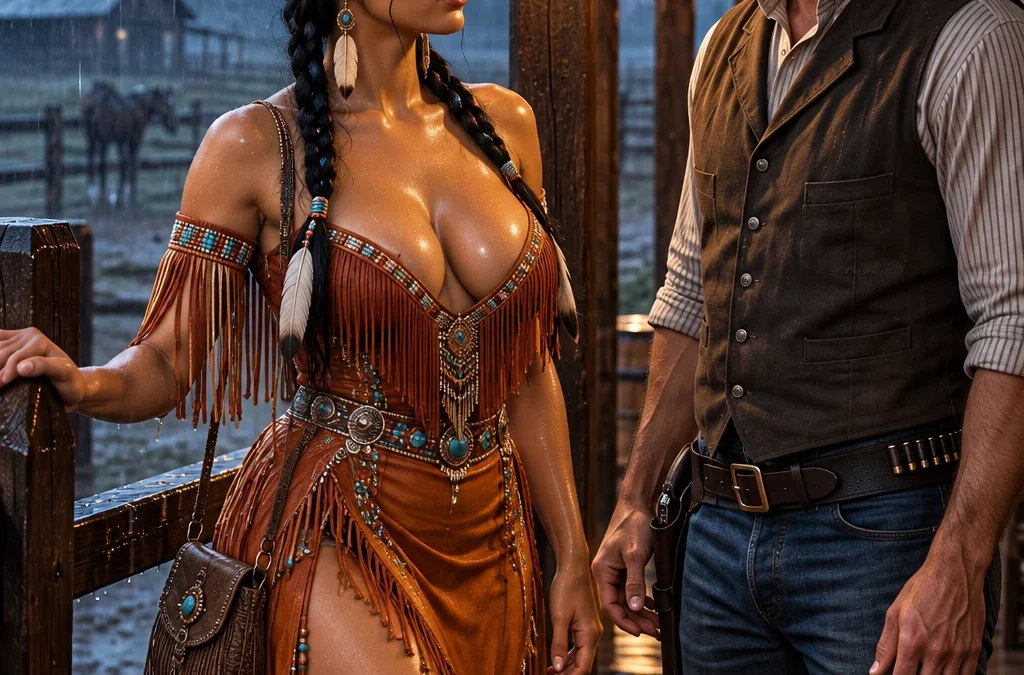
SHE WALKED TWO DAYS THROUGH A STORM WITH A BRUISE ON HER FACE AND ONE WOVEN BAG… THE LONELY RANCHER SWORE NO ONE WOULD EVER ENTER HIS LAND AGAIN. BUT WHEN THE MAN HUNTING HER FINALLY RODE IN, SHE SAID FOUR WORDS THAT STOPPED THEM BOTH 😱⛈️
Part 1
Bleeding and storm-soaked, Chenoa walked the last mile alone. 🌧️
She had left her own fire two nights before with one woven bag, one decision, and a bruise along her cheekbone that hadn’t finished darkening.
She didn’t run because she was weak.
She ran because she would rather cross an empty valley in a storm than let her own people bleed to keep her safe from a man who believed a woman’s no was just an answer he hadn’t beaten out of her yet.
Ahead, through sheets of gray rain, a single lantern burned in a cabin window.
She didn’t know the man who lived there.
She only knew that if he turned her away, she would keep walking into the dark. And if he didn’t, her whole life was about to bend around a stranger’s gate.
Arizona Territory. Late summer, 1884.
Wyatt Ward rode into his yard as the last hour of daylight died behind the ridge, dust chasing him the final quarter mile.
He had been checking fence since sunup, the long, silent kind of work that let a man’s mind wander into places he’d rather it didn’t.
Two years had passed since he buried his wife. Since the slow illness. The helpless months. The silence after.
He had built this ranch board by board, not out of love for the loneliness, but because loneliness asked nothing of him he couldn’t give. No one out here needed him to explain his silences. No one expected him to have healed by any particular season.
The ranch had become less a home than a wall.
He was brushing down his horse in the barn when a hard gust slapped the doors. He stepped outside and looked toward the valley entrance out of old habit.
Someone was walking toward his gate.
For a moment he told himself it was a trick of the fading light.
But the shape kept coming. Steady. Deliberate.
A person on foot, alone, a long way from anywhere a person on foot ought to be. 😨
The porch lantern caught her. A young Apache woman, clothes torn and soaked, a small woven bag clutched against her side. Her steps were careful, the walk of someone rationing the last of her strength. Her eyes never stopped moving. Ridge. Fence. Door.
The way a person watches when they’ve learned that a room, or a valley, can turn on you.
Wyatt stayed on the porch, one hand near the doorpost.
Closer now, he saw the swelling along her cheekbone, a fresh mark not yet darkened.
His voice came out rough, the voice of a man who hadn’t used it on another soul in a long while.
“Evening.”
She stopped at the gate and steadied herself against the post.
“My name is Chenoa. I need a place to stay the night.”
He didn’t answer right away.
She held his eyes without fear, but without hope either. The look of someone who has decided you owe her nothing and is only asking because the alternative is worse.
“Did something happen?”
“I left a place where I wasn’t safe.” Her voice stayed even, careful with every word. “I won’t bring trouble if I can help it.”
He weighed it the way he weighed everything now. Someone could be hunting her. Letting her in might invite a fight he wasn’t sure he still had the stomach for.
But leaving a hurt stranger outside while a storm rolled off the rim wasn’t the man he wanted to be. Not even out here, where no one would ever know.
He stepped back from the door.
“Come inside.”
A small breath left her. Not quite relief, but close. 🔥
Inside, he built the fire higher and set a tin cup of water on the table. She didn’t touch it until he nodded that it was fine.
In the firelight he saw scraped knuckles, a torn sleeve, and the way she kept steadying her breath to still the shake in her shoulders. Something in him, an old, unused muscle, answered that trembling with something close to grief of his own.
Her stomach betrayed her with a low growl in the quiet cabin.
Wyatt didn’t comment. He brought dried meat and soaked beans, and set the bowl before her without ceremony.
“It isn’t much. But it fills a person.”
Pride warred with hunger. Hunger won.
While she ate, he mended a broken bridle strap, hands steady with the awl. After a while she asked why he lived this far out.
“I wanted a place the past couldn’t reach me. Out here, things stay simple enough to make sense.”
“Does it help?”
“Most days.”
Something in the honesty settled her. She wasn’t the only person at this table who knew the cost of putting distance between yourself and everything that used to hurt.
“You didn’t have to let me in.”
“I know.”
“Then why did you?”
He gave her the honest answer instead of the easy one.
“Because I’ve known what it is to need help and have no one to ask.”
Thunder rolled past the ridge.
By midnight the storm hit full strength, rain hammering the roof, wind rattling the shutters. Chenoa sat close to the hearth, eyes half shut but never fully surrendering to sleep. Every gust tightened her shoulders.
She was bracing for danger in the one place he’d promised was safe.
He filled two cups and set them where she’d have a clear line to both windows and the door. She thought about it a long moment before she sat.
“You live out here alone.”
“Years now.”
“And you?” he asked. “Traveling far.”
“Far enough.” Her hands tightened around the cup. “I left my settlement two days ago. There was a man there who decided I belonged to him and wouldn’t hear otherwise. When I walked away, he came after me.”
The bruise confirmed more than her careful words did.
Wyatt didn’t press for the man’s name. She hadn’t come for an interrogation. She’d come for a place where her own decisions wouldn’t be challenged out from under her.
“I’ll be gone by morning. I don’t want your door marked because of me.”
“Tomorrow’s storm will be worse. You won’t make ten miles on foot.”
Her eyes narrowed slightly, as if she’d expected an argument, just not that one.
“If I stay, I work. I take nothing free.”
Something close to a smile crossed his face, unfamiliar territory for it.
“There’s always work on a ranch.”
That night he laid a bedroll by the fire and checked the latch twice before settling into the chair by the window.
“You’re not sleeping,” she said from the dark.
“Not yet.”
She understood. He was keeping watch so she could finally rest.
She didn’t thank him. The way her body finally went slack was thanks enough. 🕯️
Somewhere past midnight, he realized she hadn’t wandered onto his land by chance. This valley swallowed travelers whole. Something had driven her here.
Over the next days, the ranch took on a rhythm neither had known alone. Chenoa walked the fence line at first light, reading posts the way another person reads a letter, calling out weak points before Wyatt reached them. In the barn she gentled a mare that had kicked him bloody, speaking low words in her own language until the animal’s ears turned toward her.
“You move too fast for her,” she told him. “You handle her like a man with a list of chores. Horses feel that.”
He laughed, half embarrassed. She wasn’t wrong.
But on the third morning, near a trampled patch by the ridge trail, she crouched and went very still.
“Someone rode through here. Yesterday. Maybe the day before.”
One rider. Heavy horse. Moving fast.
The next day they found a snapped branch at eye height, with a clear line of sight straight down onto the ranch yard.
“Someone stood here and watched,” she said quietly. “Not by accident.”
Wyatt felt the old tightness climb into his chest.
“If he comes,” Chenoa said, “he’ll come from the trees. He likes an advantage. He prefers people who don’t see him coming until it’s too late.”
There was no self-pity in it. Only the flat, hard knowledge of a woman who had survived this man once and meant to do it again.
They spent the afternoon reinforcing the fence nearest the tree line, latching the barn, and checking both rifles. Neither spoke much. The silence came not from tension, but from two people who had already settled what needed settling.
That night, Chenoa stood in the kitchen doorway watching him set the second rifle by the door.
“This isn’t the first time you’ve prepared for trouble.”
“No.” He didn’t look up. “It’s the first time I’ve done it with someone standing beside me.”
The morning it happened began with a stillness that fooled neither of them. The wind had gone quiet. The sky was scrubbed blue, less like peace than like something holding its breath.
When the cattle drifted unusually close to the barn, Wyatt felt a chill that had nothing to do with weather.
Then he saw it. A small rise of dust behind the ridge.
A single horse, coming on hard, with the purpose of a rider who knew exactly where he was headed.
Chenoa stepped out of the barn already knowing, wiping her hands on her skirt with a calm that wasn’t calm at all.
The rider slowed at the fence line. Broad-shouldered, late twenties, dark hair tied back, sitting his horse with the lazy arrogance of a man who had never doubted that the world would give him whatever he decided he was owed.
His eyes found Chenoa and stayed.
“Found you,” he said, smirking.
And Wyatt saw what the man held across his saddle, wrapped in a red cloth stained dark at one end. 😰
Chenoa saw it too, and the color left her face for the first time since she’d arrived.
Part 2
Chenoa’s voice came out steady as stone, though her hands had gone cold.
“Turn around and ride back the way you came.”
“I don’t take orders from you.” The rider’s smirk widened. He patted the bundle across his saddle. “Thought you’d want to see what your leaving cost.”
He unwrapped one corner.
A woven shawl. Gray and blue, worn thin at the edges.
Chenoa made a sound Wyatt had not heard from her before. A breath torn loose from somewhere deep.
“My grandmother’s,” she whispered.
“She was fine,” the rider said lightly. “Fine enough to hand it over when I asked where you’d gone. Your people have been very cooperative. They want you home. They want this settled.”
Wyatt stepped down off the porch, unhurried, and put himself between the rider and the cabin. No shouting. No posturing. Just presence.
“She doesn’t belong to anyone.”
The rider looked him over with open contempt. “This doesn’t concern you, cowboy.”
“It does now.”
Chenoa moved, just enough that Wyatt understood she wasn’t stepping back. She was reading how the man reacted to seeing her flanked instead of alone.
“Your people gave me the right,” the rider said. “Her own family. They said she dishonored them by leaving.”
“No one gave you anything.” Chenoa’s voice cut across the yard like a blade. “You forced yourself on me and dressed it up as courtship. You ignored my no every single time I gave it. You aren’t here for justice. You’re here because you cannot stand a woman choosing her own freedom over you.”
His jaw tightened. Fury flickered across his face.
“I left so they wouldn’t have to fight you on my behalf,” she said. “I protected them by leaving. I owe you nothing. I never did.”
“You think hiding behind a man makes you strong?”
Chenoa stepped forward, closing the distance until she stood level with Wyatt. Not behind him.
Beside him.
“I don’t hide behind anyone. I stand with someone who respects my choices. That is not the same thing, and you know it.”
The rider nudged his horse half a step forward, testing the fence, testing them.
Wyatt’s voice dropped, cold and level as a closed door. “One more step, and you won’t like what happens next.”
Something in the man’s face wavered. A last scrap of sense held him back.
“You’ll regret this.”
“Leave.”
The man’s glare swung to Chenoa. “This isn’t finished.”
“It is. Because I said so.”
She held his gaze until something in him broke, and he wheeled his horse toward the hills, the shawl trailing from the saddle like a flag of surrender he hadn’t meant to give. 🌄
Wyatt didn’t lower his stance until the rider shrank to nothing on the horizon.
Only then did Chenoa let out the breath she’d been holding. Her shoulders trembled, not from fear this time, but from two days and two years of tension finally leaving her body.
“He won’t come back alone.”
“Then we’ll be ready for that too.”
She looked at him, something new moving behind her eyes. Relief tangled with a connection she hadn’t let herself feel until now.
That evening, they sat over a meal neither wanted. The adrenaline was still working its way out of them.
“You said my name in your sleep,” she told him quietly. “Not mine. Another.”
Wyatt didn’t flinch.
“Sarah. My wife. She was sick a long while before it took her. I spent those months so afraid of losing her that I forgot how to simply be with her while she was still there.” He turned his cup slowly. “After, I built all this so I’d never have to feel that afraid again.”
Chenoa reached across the table. Not quite touching his hand, just close enough that he felt the warmth.
“Being afraid of losing someone isn’t a reason to keep everyone out. It’s usually a sign they mattered enough to be worth the fear.”
He looked at her. Something loosened behind his eyes that had been locked tight for three years.
She let her hand settle fully over his.
The first time either of them had chosen the contact. 🤍
But in the dark that night, long after Chenoa slept, Wyatt stood at the window and watched the ridge.
And at the very edge of the moonlight, he saw them.
Not one rider this time.
Seven. Their torches dark, their horses still, sitting on the hilltop like shadows waiting for a signal.
And in the center of them, on a pale horse, rode an old woman in a gray blanket.
Wyatt’s breath stopped.
Because he had just recognized the woman in the cloth-wrapped story Chenoa told. And she was not a captive.
She was leading them. 😳
Part 3
Wyatt woke Chenoa with a hand on her shoulder, gentle, and a finger to his lips.
“There are riders on the ridge. Seven. And an old woman at the center.”
Chenoa sat up slowly. When he described the woman’s face, the pale horse, the gray blanket, the color left her cheeks.
“Grandmother.”
“She’s with him?”
“No.” Chenoa stood, pulling her boots on with steady hands. “She’s against him.”
She crossed to the window and looked out. For a long moment she said nothing. Then something moved across her face that was part grief, part fury, part relief so enormous she couldn’t hold it.
“He told me she gave him the shawl. He lied. He took it. That is what the red cloth was. Blood on the edge where she fought him.” Her voice broke. “She came to find me. She brought the elders.”
“The elders?”
“The men who run my band. The ones who were supposed to protect me and didn’t.” She wiped her eyes and straightened. “Grandmother has been telling them the truth for two weeks. Until now, they would not listen.”
Wyatt stared at the distant shapes. “What changed?”
Chenoa smiled, small and fierce. “He came to your ranch and showed his face. He threatened me in front of a witness. A white rancher. An outsider with no stake in our quarrels.” She looked at him. “My people needed someone who could not be accused of taking sides. Someone who saw what he did.”
“So they let him come.”
“Grandmother let him come. So he would hang himself.”
They stepped onto the porch together.
The riders had begun to descend the ridge, slow and silent. No torches. No war cries. Just seven horses in the pale light, with the old woman riding in front, back straight as a spear.
At the fence line, she stopped.
She was small, weathered, and impossibly dignified. Her eyes found Chenoa across the yard, and her hard face cracked wide open.
“Granddaughter.”
Chenoa crossed the yard in a run. She didn’t care who saw. She dropped to her knees before the pale horse, and the old woman leaned down and gathered her in, and they held each other for a long time, whispering in their own language.
Wyatt stood on the porch and looked away to give them privacy.
When the old woman finally lifted her head, she looked straight at him.
“You are the man who stood beside her.”
“Yes, ma’am.”
“Not in front. Beside.”
“She asked me to.”
Something warm passed through the old woman’s eyes. “Good.”
Behind her, six elders sat their horses in silence. One of them, a gray-bearded man with a scarred hand, dismounted and approached Chenoa.
He took a long breath.
“We failed you,” he said. “When you told us what he did, we said it was a private matter. We said you were young. We said he was a good hunter and that you would learn to forgive.” His voice shook. “Your grandmother told us we were cowards. She was right.”
Chenoa stood slowly. Her chin was high.
“Where is he?”
“He was camped three miles east. He is not there now.”
A cold voice spoke from the ridge behind them.
“I’m right here.”
Everyone turned.
The rider sat his horse at the crest, rifle across his saddle, and with him came four more men, all armed. Men from his own band, loyal to him, hard-faced and ready.
“You brought elders to my ranch,” Wyatt said, loud enough to carry.
“I’m not here for the old man,” the rider said. “I’m here for what’s mine.”
“She is not yours,” said the gray-bearded elder.
“She is whatever I say she is.”
The yard went very quiet.
Wyatt stepped forward, hand open, away from his rifle. He didn’t want blood in the yard. Not if there was another way.
“You’ve made your point,” he said. “You’ve scared everyone. You’ve humiliated her. Now put the rifle down and ride home.”
“Or what?”
“Or the whole territory hears what you did.”
The rider laughed. “Who would believe a dirty rancher and a runaway?”
“I would,” said a new voice.
A rider came slowly over the far hill. Tall, gray-coated, a tin star on his chest. Beside him rode two deputies with rifles drawn.
“Sheriff Dawson,” the old woman said calmly. “You are late.”
“Ma’am, I came as fast as I could.” He tipped his hat to her. “Mr. Ward. Miss Chenoa. Gentlemen.” His eyes turned hard on the rider. “Put the rifle down, son. I’ve been listening to testimony from three of your own band for the better part of a week. You’ve got a lot to answer for.”
For a long moment the rider didn’t move. His eyes flicked from face to face. Wyatt, the elders, the old woman, Chenoa standing straight and unafraid.
And the four men behind him. Slowly, one by one, lowered their guns.
The man who stood alone suddenly didn’t look very large.
The rifle clattered to the dirt.
The sheriff led him away in chains before noon.
By evening, the elders had camped near the creek. Chenoa’s grandmother sat on Wyatt’s porch with a tin cup of coffee, studying the land the way her granddaughter had studied it, reading it like a letter.
“Good fence,” she said. “Good water. Good horse.”
“Thank you, ma’am.”
“It is a good place to start something.” She looked at him sidelong. “You do not rush the things you care about.”
Wyatt blinked. “Did she tell you that?”
“She did not have to. I can see it in how you hold your coffee.”
He laughed, startled, and the old woman’s eyes twinkled.
Across the yard, Chenoa was speaking with the gray-bearded elder. She stood straight, her voice low and firm. He nodded slowly, then, to Wyatt’s surprise, bowed his head in front of her. A formal apology, made in the old way.
When it was done, Chenoa came to the porch and sat beside her grandmother, then reached for Wyatt’s hand without looking at him.
“They have asked me to come home,” she said. “They say I am welcome. That no one will ever speak of me as a burden again.”
Wyatt’s chest tightened. He had known this was possible. He had known it from the moment the old woman rode over the ridge.
“You should go,” he said, and the words cost him more than he expected. “You should be with your people. With her. You’ve spent too long running.”
Chenoa turned to face him.
“I told you once that I didn’t want to be your problem.”
“You never were.”
“And I told you I took nothing free.” Her voice trembled. “But I think I was wrong about one thing.”
“What?”
“I thought you were giving me a place to stay.” She laced her fingers through his. “You were giving me a place to choose. To choose to leave, or to choose to stay. No one had ever done that for me before. And when you gave it to me, I understood, for the first time, what I wanted.”
Her grandmother stood quietly and moved away, giving them the porch.
“I want to go home to my people sometimes. I want to visit my grandmother and sit by her fire. I want my brother to see that I am alive.” She swallowed. “But I want to live here. In this valley. On this ranch.”
Her eyes found his.
“I want you too, Wyatt Ward. I said it by the creek, and I say it again, in front of my grandmother and my people and the sky.”
The yard had gone silent. The elders watched. The old woman, pretending not to listen, took a long, slow sip of coffee.
Wyatt stood. He took both her hands.
“Chenoa,” he said. “I spent two years building a wall. I told myself it was peace. It wasn’t. It was a very quiet way of dying.”
He drew a breath.
“You walked through my gate with a bag and a bruise and a bigger heart than anyone I’ve ever met. You taught me the mare wanted patience, not a list of chores. You taught me that fear of losing someone means they were worth the fear.” His voice cracked. “Stay. Not because you owe me. Not because you’re hurt. Stay because you want to build something. With me. Beside me.”
“Beside,” she whispered.
“Beside. Always.”
She rose on her toes and kissed him in front of everyone, and the old woman on the far end of the porch said, loud enough to be heard across the yard:
“Finally.”
The elders laughed. A few began to clap. Someone whistled. The gray-bearded man who had bowed so low an hour before wiped his eyes with the back of his hand.
That autumn, they planted the garden behind the cabin.
Herbs, squash, beans, enough to last a full year. Chenoa taught Wyatt which plants along the creek could season a meal and which could heal a wound. Wyatt taught her the quiet patience of watching something you’ve built hold steady through a season.
Her grandmother came to stay for a month, then two, then every winter after, sitting by the fire telling stories until the lamps burned low.
The mare healed completely. She nickered whenever Chenoa came near.
In spring, a small band of Chenoa’s cousins came to help build a second room on the cabin. They stayed for the summer, then for the harvest, and some of them never left. By the time the second winter arrived, the valley that had swallowed travelers whole was home to a dozen families who traded horses, shared fences, and spoke of the Ward ranch as the place where nobody was ever turned away.
Wyatt stood on the porch one evening watching the light go gold across the pasture, children running along the fence line, smoke rising from three chimneys.
Chenoa came and stood beside him.
“You are thinking of Sarah.”
“I am.” He didn’t hide it. “I’m thinking she would have liked this.”
“I think so too.” Her hand slid into his. “I think she would be glad you did not stay in the wall.”
He looked down at her, at the woman who had walked out of a storm with a bag and a bruise and refused to be anyone’s property.
“You walked two days to find a stranger’s gate,” he said softly.
“I did.”
“What would you have done if I had turned you away?”
Chenoa considered it, her eyes on the horizon.
“I would have kept walking,” she said. “I would have found another gate. Or I would have made my own.”
She smiled, small and certain.
“But I am glad it was yours.”
The sun slipped behind the ridge. The first stars stood clear and steady above the valley, and for the first time in either of their long, guarded lives, they stood together on a porch in the quiet, entirely unafraid.
Chenoa had walked into this valley with nothing but a bag and a decision.
She had found a life she chose herself, beside a man who chose, just as plainly, to stand beside her. 🌄
This story is entirely fictional and created for entertainment purposes only. It does not represent any organization or individual, nor does it encourage inappropriate behavior. The content was generated with AI assistance.








