She Was 34, a Widow, and Caught Me Staring Over the Fence. What She Said Next Changed My Life Forever
🌾 She Was 34, a Widow, and Caught Me Staring Over the Fence. What She Said Next Changed My Life Forever 😳
Part 1
Montana Territory, 1883.
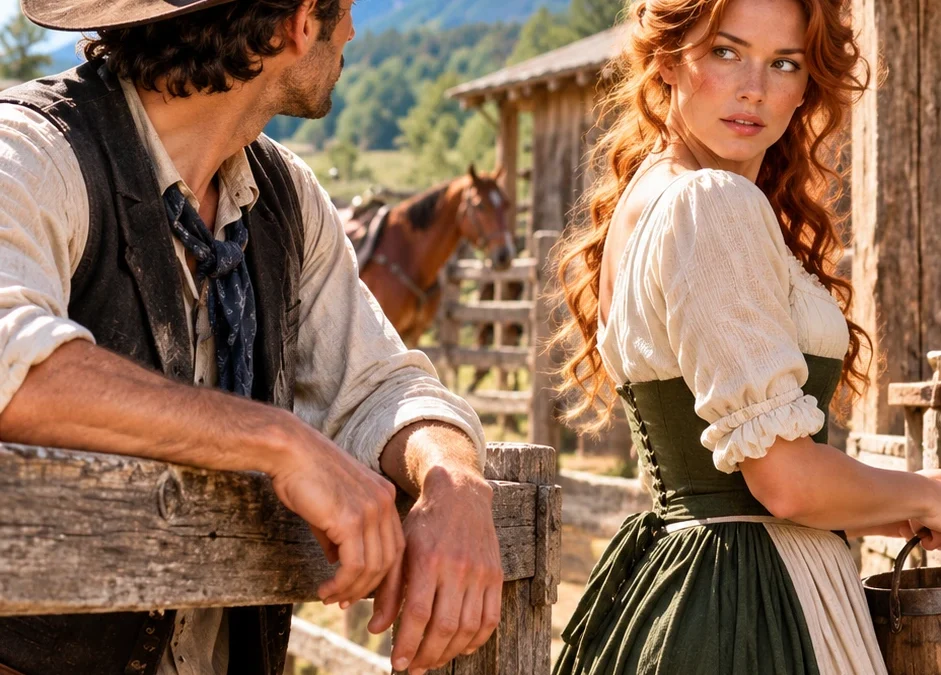
Jesse Carrow knew he had been caught the moment Vivian Hartley stopped beside the well and looked straight across the fence at him.
He had been staring. Worse, he had been staring long enough for her to know exactly why.
The afternoon smelled of cut grass and river water. Grasshoppers snapped through the weeds along the fence, and sweat had dried white along the collar of Jesse’s work shirt. Across the boundary, Vivian stood with an empty bucket in one hand and sunlight caught in her long red hair.
The bucket had stopped swinging. So had Jesse’s breath. 😳
Vivian was thirty-four years old. Jesse was twenty-three. She was a widow. He was her nearest neighbor, and there was no believable reason for him to be looking at her the way he had been looking.
Vivian raised one eyebrow. “Something wrong with my fence, Mr. Carrow?”
Heat climbed from his neck to his ears. “No, ma’am.”
“My well, then?”
“No, ma’am.”
She glanced at the bucket in her hand. “My technique?”
Jesse shut his eyes for half a second. “I beg your pardon.”
Vivian set the bucket down and started walking toward him. That was when his embarrassment turned to worry, because she did not look angry. She was smiling. Not broadly, just enough to make him wonder what, exactly, she intended to do with the fact that she had caught him.
By the time she reached the fence, Jesse had considered pretending he’d been studying the pasture, the well pulley, the sky, or possibly a bird that did not exist.
She rested her forearms on the top rail. “No need to apologize for looking.”
Jesse looked at the ground. “That doesn’t improve matters much.”
“It improves them some.”
He glanced up. Her eyes were amused. Then her expression changed.
“I do have a question for you.”
His stomach tightened. “Yes, ma’am.”
“I lost my hired hand two weeks ago.”
It was not the question he had expected. “He took work in Butte,” she went on. “Better wages. I don’t blame him. Haying starts proper next week, and I’ve got more acreage than I can manage alone.” She looked toward his side of the fence. “And you’ve got more than one man should be handling by himself since your father passed.”
Jesse straightened. “My place is manageable.”
“I didn’t say it wasn’t.”
“You implied it.”
“I observed it.”
That almost made him smile.
“I’m proposing a trade, Jesse. We work both places together through haying and fall roundup. Your labor on my land, mine on yours. We share equipment where it makes sense and keep the accounts separate. Neither of us has to hire what we can’t afford.”
It was sensible. Too sensible. That was the problem, because some foolish part of him wanted to say yes before she finished, and it had nothing to do with hay.
“I’ll do it.”
It came out too fast. Vivian smiled. “I thought you might.”
“On account of the hay.”
“Of course.”
“Entirely practical.”
“Naturally.”
She picked up her bucket. “And Jesse? If we’re going to spend half the summer side by side, you can call me Vivian.”
“All right.”
She took two steps, then glanced over her shoulder. “And if you’re going to stare, at least try not to look so guilty afterward.”
That evening, long after dark, Jesse was still wondering whether he had just agreed to the best or the worst idea of his life. 🌙
He had inherited his spread two years earlier when his father died. It was not large by Montana standards, but it was good ground, sloping toward the Clearwater River, where cottonwoods stood thick along the banks and the summer grass grew high enough to brush a horse’s belly.
Vivian’s place bordered his to the north. She and her husband, Elias Hartley, had settled there nine years ago and worked the land together for almost six, until Elias was thrown from a horse and killed. Three years had passed since. Vivian had kept the ranch. She fixed what she could, paid for what she couldn’t, and almost never asked anyone for help.
That was why her proposal surprised him. It was also why he respected it.
The first week proved she was right. Together, they finished Jesse’s lower field two days ahead of what he’d have managed alone. Then they moved north to hers. The work was hot and repetitive: cut, rake, turn, stack. Dust settled in his boots. Dry hay scratched his forearms. By midday Vivian’s hair was tied up beneath a hat, though red strands always escaped along her neck.
Jesse tried not to notice. He failed regularly.
She could handle a team as well as any rancher he knew. She could tell when rain was coming by the smell of the wind, and she never asked him to do anything she wouldn’t do herself.
He stayed for supper one evening. Then the next. By the end of June it was a habit neither of them named. Work ended, Vivian cooked, Jesse fixed something that didn’t need fixing, and they sat on the porch while the Clearwater moved dark and slow beneath the cottonwoods.
Then, in July, Jesse arrived at Vivian’s lower field just after sunrise and found something that stopped him cold.
Three fresh wooden stakes had been hammered into the ground beside her irrigation ditch. Each had a strip of red cloth tied around the top.
Vivian stood over them, her jaw tight, her face the color of ash.
“Who did this?” Jesse asked.
“Calvin Mercer.”
Jesse knew the name. Mercer had bought land upriver the year before. He had money from cattle and more confidence than judgment or patience.
Vivian said nothing else. She only reached into her apron pocket and pressed a folded note into Jesse’s hand.
Jesse opened it, and when he read the first line, his blood ran cold. 😨
👉 Want Part 2? Find it in the comments, or leave any word below and I’ll send it to you privately. 🌾
Part 2
Jesse opened it, and when he read the first line, his blood ran cold.
Mercer claimed his upstream ditch held senior rights to part of the Clearwater’s flow. If Vivian kept drawing water at the same rate, he warned, her diversion would be challenged, and she would lose it.
Lose the water, and you lose the ranch.
Jesse read it twice. “He’s bluffing.”
“You sound certain.”
“You and Elias were drawing from this bend years before Mercer ever bought his place.”
“That doesn’t stop him from making trouble.”
“No. But he’d have to prove his right comes first.” He crouched beside the ditch. “My pa fought the same kind of dispute once, with a man named Holcomb. He made sure I understood the rule. First in time, first in right. Who put the water to use first, for how long, and for what.”
“We’ve irrigated this ground nine years. Elias dug the first ditch himself.”
“Good. That’s better.”
“So what do I do?”
“Nothing today.”
Vivian’s face cooled. “I beg your pardon?”
“Nothing reckless. I’m not telling you to surrender. I’m telling you not to give him the fight he wants before you know what he can prove.”
Her eyes narrowed. “I asked for your labor, Jesse. Not for you to fight my battles.”
“I know.” He held her gaze. “I’m not going to fight it for you. I’m going to show you where Pa kept his old records.”
That stopped her. “What records?”
“His dispute with Holcomb. Statements, dates, names of men who testified about use along this stretch. They’re in a trunk under his bed. Pa never threw away anything involving land, water, or money.”
For the first time that morning, Vivian smiled. “Smart man.”
“He’d enjoy hearing that.”
That evening Jesse carried the trunk into Vivian’s kitchen. They opened it under lamplight, and the room filled with the smell of coffee, dust, and old paper. Inside were receipts, tax notes, cattle bills, hand-drawn maps, and letters he hadn’t seen since his father was alive. 📜
For two hours they read, side by side. One paper mentioned Hartley’s ditch. Another referred to Elias asking permission to extend the diversion after arriving nine years earlier. A third carried the name of a rancher still living six miles east.
Vivian tapped the page. “Samuel Crow.”
“He’ll remember,” said Jesse. “Maybe. That’s the difference between a claim and proof.”
She glanced sideways. “You’re enjoying this.”
“No.”
“You are.”
“I enjoy Mercer being wrong.”
“That I believe.”
By the next afternoon they had spoken with Crow and two other ranchers. All three remembered Elias putting the ditch into use years before Mercer purchased his land. One had helped dig it himself.
Two days later, Mercer rode into Vivian’s yard with a surveyor and a lawyer from town. Jesse was repairing a gate nearby. Vivian walked out alone.
Mercer looked past her toward Jesse. “I came to discuss your water.”
“My water?”
“The clear water.”
Vivian smiled without warmth. “You own that, too?”
“My attorney believes your diversion interferes with my senior use.”
She looked at the lawyer. “Does he?”
The lawyer cleared his throat. “We’re, uh, examining priority.”
“Good.” Vivian handed him a thick packet of papers. “Then examine these.”
Mercer frowned. “What’s that?”
“Sworn statements from three ranchers confirming my husband’s ditch was operating years before you acquired your land. One of them helped build it.”
The lawyer unfolded the first sheet. His eyes moved down the page, and his face changed.
Mercer’s gaze snapped to Jesse. His voice dropped low and cold. “You put her up to this, didn’t you?”
Jesse leaned against the gate and said nothing.
Vivian stepped between them, and her eyes hardened into something Jesse had never seen before. The yard went silent. Even the wind seemed to stop.
“I’m standing right here, Mr. Mercer,” she said quietly. “And you’re about to find out exactly who you’ve been threatening…”
👉 Will Mercer back down, or does he have a card nobody saw coming? LIKE this post and COMMENT the word “FENCE” 🌾 and Part 3 drops as soon as we hit our goal!
Part 3
“…and I don’t need a man to speak for me.”
Mercer looked at her. For the first time, he seemed to understand that he had misjudged the person he was negotiating with. The lawyer read another page, then another. Finally he murmured something low into Mercer’s ear, and Mercer’s expression soured.
“This isn’t finished.”
“Then bring better evidence next time,” said Vivian.
Mercer mounted and rode out, the surveyor following. The lawyer tipped his hat to Vivian before he left.
Jesse waited until they were gone. Then he smiled.
Vivian looked at him. “What?”
“Nothing.”
“You’re looking.”
He laughed. “Caught again.”
This time she laughed too. 😄
The dispute didn’t vanish overnight. Mercer sent one more letter. Vivian answered through the county clerk and enclosed the witness statements. Then nothing came for nearly two weeks. When word finally reached them, it came through Samuel Crow: Mercer had withdrawn his challenge.
Vivian found Jesse mending harness in his barn and held out the letter. He read it and handed it back.
“You won.”
She leaned against the stall. “We won.”
“No. You did. I helped you prove what was already yours.”
Something in the wording touched her more than he intended. She looked away. “Most men I’ve known would have liked saying they saved me.”
Jesse shrugged. “I didn’t.”
“No.” She looked back at him. “You didn’t.”
That evening she stayed at Jesse’s place for supper, instead of the other way around. It was the first time. When she rode home beneath a sky full of stars, he stood in the yard until he could no longer hear her horse. ⭐
The victory changed how the valley saw her. For years she had been Elias Hartley’s widow. Now, when men talked land, cattle, or water in town, they asked what she thought before asking what her late husband might once have done.
At Crow’s place one morning, Samuel handed a folded ditch map directly to Vivian. “Wanted your eye on this.”
Not Jesse’s. Hers.
Riding home, she was unusually quiet. “What?” Jesse asked.
“For three years, every time somebody talked ranch business with me, I could see them checking over my shoulder for the man who ought to be answering.” She smiled faintly. “Today, Crow asked me.”
“He should have been asking you all along.”
“That may be true. But knowing a thing is true and hearing another person treat it as true are different experiences.”
Jesse nodded. He understood that better than she knew. Most of the older ranchers still called him young Carrow before they called him Jesse. Maybe that was another reason the two of them fit. Both were tired of being measured first by what people assumed they lacked.
Then the second trouble came, from somewhere neither expected: town.
In early August they were at the mercantile buying salt, lamp oil, and harness leather. Jesse was loading sacks outside when Vivian stepped from the store. Two women stood near the hitching rail. They hadn’t noticed her.
“The Carrow boy spends most evenings over at her place.”
“So I’ve heard.”
“Eleven years.”
“That’s enough to make people talk.”
“More than talk. He’ll want children one day.” A pause. “And a wife who still has time for them.”
Vivian stopped. She didn’t confront them. That almost made it worse. She walked past as if she’d heard nothing.
Jesse noticed the change before they reached home. She became polite, then busy, then unavailable. For three evenings there was no invitation to supper. On the fourth, he crossed the fence.
She was stacking kindling beside the shed. “You mad at me?”
“No.”
“That answer means yes.”
“It means no.”
“Then why have I eaten alone four nights?”
She stopped. “Maybe I decided you spend too much time here. People notice.”
“So?”
“So you’re twenty-three.”
“We’ve established that.”
“And I am thirty-four.” She turned toward him. “You think eleven years means nothing because right now it feels romantic.”
His expression changed. “That what you think I’m doing?”
“I think you don’t know what eleven years looks like twenty years from now.”
“Neither do you.”
“I know what widowhood looks like.” The words came sharper than she meant. Jesse went quiet. Her shoulders lowered. “I’m sorry.”
“No.” He stepped closer, but not too close. “Finish.”
She looked at him. “I had a good marriage. I buried a man I loved. I’m not interested in becoming some lesson you learn because I was the first woman who made you feel grown.”
That hurt. Jesse let it.
“You think that’s what this is?”
“I don’t know.”
“Then ask.”
Her breath caught. “Ask what?”
“What you asked at the fence without knowing you were asking it.”
She stared at him. “Why I was looking?”
“Yes.”
A long silence. “Why were you?”
He smiled once. “Because you’re beautiful.”
She looked away. “That’s not enough.”
“I know.” He stepped closer. “I don’t know exactly when I fell in love with you.”
Her eyes snapped back.
“Maybe it wasn’t one moment.” His voice shook now. “Maybe it was every morning we worked the same field, every supper I stayed too long, every time you said Elias’ name without pretending he never existed, every time you trusted me enough to let me help without asking me to take over. That day at the fence, I thought I was only admiring a beautiful woman.” He smiled faintly. “Turns out I was looking at the woman I wanted beside me.”
Vivian’s eyes filled. “What about children?”
He blinked. “What?”
“You may want them.”
“I do.” Her face fell. “With you. If God gives us any.” He held her gaze. “And if He doesn’t, that doesn’t turn you into the wrong woman.”
Her chin trembled. “Eleven years is still eleven years.”
“Yes.”
“You could regret it.”
“So could you.”
That almost made her laugh. Jesse reached out slowly, his hand open between them. “I’m not asking you to pretend the difference isn’t real. I’m asking whether what’s real between us matters more.”
For a long moment she did not move.
Then she placed her hand in his. “Yes.” 🥹
They didn’t announce an engagement that day. Vivian insisted on time, and Jesse respected it. The rest of August passed in work: they finished haying, moved cattle, repaired fences, and argued over whether Jesse stacked tools badly. (He did.)
By September, Vivian had stopped pulling away.
One evening they sat on her porch while the cottonwoods along the Clearwater showed their first edges of gold. She turned toward him.
“You remember what you said? That you wanted me beside you.”
His humor vanished. “I remember.”
She looked toward the river. “I’ve been trying to decide whether staying alone makes me strong. I think maybe I got too used to proving I could manage without anyone.” She turned back. “I don’t want to anymore.”
His heart began to pound.
Vivian smiled through sudden tears. “So, I have a proposition.”
He laughed softly. “Another one? What are the terms?”
“You marry me.”
Jesse stared. Her smile widened. “Unexpected enough for you, young Carrow?”
He stood so fast the porch chair scraped behind him. “Yes.”
“To which part?”
“All of it.”
She laughed. Then he kissed her. And for once, Jesse Carrow was not embarrassed to be caught looking at her. 💛
They married that autumn, after the last hay was stacked and the river cottonwoods had turned gold. The ceremony was small. Neighbors came from both sides of the valley. Samuel Crow brought a bottle he claimed was too good for ordinary occasions, and Mrs. Danner from the mercantile brought cake. Even the two women Vivian had overheard in town attended, though neither mentioned age. Nobody needed to.
By then the valley had watched them work through an entire season together. They had seen the two ranches run more smoothly as neighbors than either had alone, and they had watched respect become companionship before companionship became love.
That winter they combined the operations formally. Not because Vivian disappeared into Jesse’s ranch, and not because Jesse took over hers. They created one set of books and kept both names on what had belonged to each of them. Vivian insisted. Jesse agreed.
Years later, children would grow up running between the two original houses as though the fence line had never meant anything.
But the old fence remained, mostly because Vivian refused to let Jesse remove the section near the well.
“Why keep it?” he asked once.
She leaned on the rail. “Historical importance.”
Jesse groaned. “You’re never letting that go.”
“Never.” She smiled. “You were staring.”
“I was appreciating.”
“You were staring.”
He stepped closer. “Best mistake I ever got caught making.”
Vivian laughed. And that laugh, more than the river, the cattle, or the acreage, became the sound Jesse associated with home. 🌄
The age difference was real. So was the grief both of them carried. So were the practical reasons they first came together. But none of those things made the decision for them. What mattered was what they built while standing beside each other: respect first, trust next, love after.
It did not begin with a promise. It began with work, with honesty, with one woman refusing to be rescued, and one young man wise enough not to confuse helping with taking control.
💬 Tell me in the comments: what do you think truly changed Vivian’s heart? Jesse’s honesty, the way he respected her independence, or the way he understood her grief without trying to replace the man she’d lost?
And if this story warmed your heart, share it with someone who believes the best love stories don’t always arrive on schedule. Sometimes they begin with a fence, a bucket, one very obvious stare, and a woman who decides to walk over and ask the question neither of you knew you were waiting for. ❤️
Disclaimer: This story is entirely fictional and created for entertainment purposes only. It does not represent any organization or individual, nor does it encourage inappropriate behavior. The content was generated with AI assistance.








