SHE WAS CALLED A FORTUNE HUNTER — THEN THEY LEARNED SHE OWNED THEIR ENTIRE ESTATE
SHE WAS CALLED A FORTUNE HUNTER — THEN THEY LEARNED SHE OWNED THEIR ENTIRE ESTATE
Part 1
Snow fell thick and silent over London that afternoon, wrapping Ravensmere House in a blanket of white that made the golden chandeliers glow all the brighter. Inside, the dining room blazed with warmth — polished silver, portraits of long-dead dukes lining the walls, crystal catching the light like scattered stars. It was the kind of evening the Dowager Duchess Margaret had perfected over thirty years: every detail chosen to remind everyone exactly how important this family was.
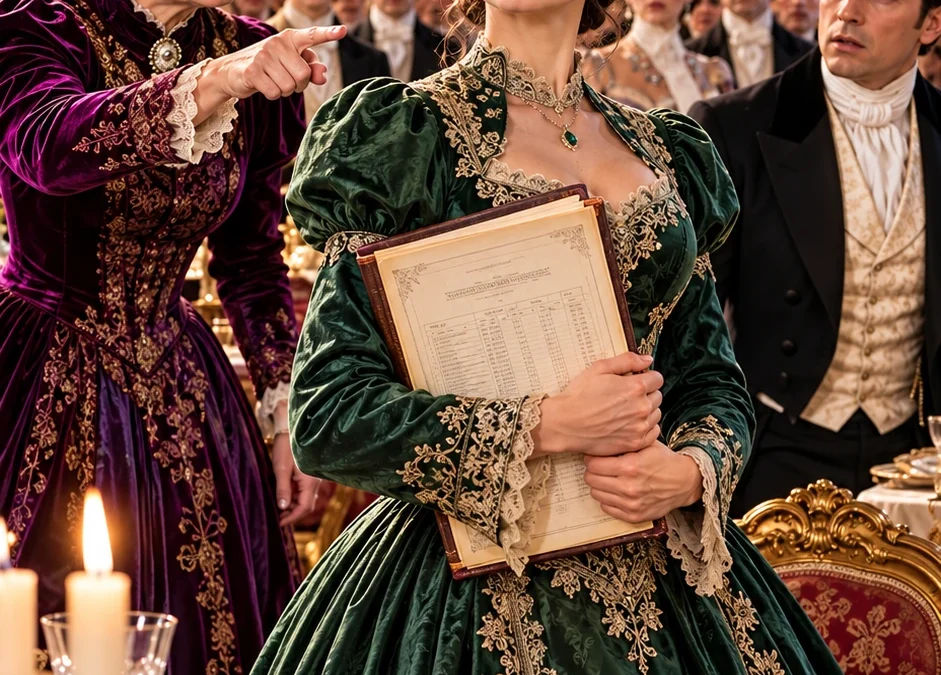
Into that room walked Evelyn Mercer. She wore a gown of simple blue silk with no jewels save a thin silver chain at her throat, her dark hair dressed plainly, no frills, no fanfare. Whispers rippled across the table. At twenty-six, daughter of a merchant, she knew exactly what they were thinking — she doesn’t belong here. She met their glances calmly and acknowledged none of them.
Nathaniel Pembroke, the thirty-four-year-old Duke, crossed the room to greet her before the butler had finished announcing her name. Serious, thoughtful, burdened by responsibility he’d inherited far too young, he’d spent the last two months talking to her at assemblies and quiet afternoon calls — and for the first time in his life, he felt someone saw him, not just his title. She never asked about his lands or his wealth. She asked about his tenants, the failing harvests, why he kept the village school open when his steward said it was a waste of money. No one had ever cared about those things before. He offered her his arm into dinner, and for a moment, he forgot his mother watching from the head of the table.
Lady Margaret had watched every interaction with growing displeasure. She’d spent weeks seeing her son’s attention drift toward this “merchant girl,” and tonight, she decided, it would end.
The first courses passed politely — talk of weather, theater, harmless things. Then Margaret steered the conversation toward blood and lineage, remarking how difficult it must be for those of “humble origins” to grasp the duties of an ancient house. Evelyn replied softly: “Obligations are understood by anyone who has ever kept a promise, whatever their beginnings.” The answer was gracious, but it made the Duchess’s lips thin. By the second course, the insults grew sharper — comments about ambition, women who sought marriage like merchants sought profit. Lady Harriet Caldwell giggled in agreement.
Then Margaret set down her glass. Her voice carried to every corner of the room, cutting through the hum of conversation. “Let us not pretend, Miss Mercer. You came here hunting a fortune.”
Silence crashed over the table. Outside, wind hurled snow against the glass. Every face turned toward Evelyn, waiting to see her crumble. She looked to Nathaniel — the man who knew her, who had spoken with her for hours, who had told her she was different from everyone else his mother pushed toward him. She saw his jaw tighten. She saw him grip his napkin. The words were there, rising in his throat — and then he lowered his eyes to his plate and said nothing at all.
Evelyn did not cry. She did not argue. She placed her fork gently beside her dish, smiled calmly at the Duchess, and said, “The lamb is excellent — your cook deserves every praise.” That quiet composure unsettled them more than anger ever could. She finished her meal with perfect dignity, thanked her hostess, and asked for her carriage. Nathaniel followed her into the freezing hall, but by the time he reached the doors, she was already gone. He stood bareheaded on the steps as snow settled on his shoulders, watching her carriage vanish into the dark. She could bear being insulted by strangers. What she could not bear was that the man who did know her had let her face it alone.
Morning came gray and cold. Nathaniel had not slept. By ten, he stood in the parlor of Mercer House, hat in hand, begging forgiveness. He told her his mother had gone too far, that the evening was a disgrace, that he was ashamed. Evelyn listened without interruption. When he fell quiet, she asked simply — “Your Grace, why is your apology private when my humiliation was public?”
He fumbled to explain — his mother was powerful, confronting her would only make things worse, it was complicated. As he spoke, he heard how hollow it sounded. Evelyn shook her head gently. “I do not need a man to fight his family for me. But I do need someone who can speak the truth in the moment — not the morning after, in a room where no one else can hear. Affection without courage is only a feeling. It cannot stand beside you when the room turns cold.”
He left with his apology accepted but his hope shattered. Days passed in silence. Evelyn kept her distance. Nathaniel wrote long letters full of regret; she replied with polite, distant notes. Meanwhile, Lady Margaret decided silence wasn’t enough — she would end this once and for all. At the grand winter assembly, before the music stopped and all of London watching, she announced Nathaniel’s engagement to Lady Beatrice Whitam — a match never discussed, never agreed, never even proposed. Nathaniel froze. Beatrice looked as stunned as he did. He stayed silent again, terrified to humiliate an innocent woman publicly — but this time, he knew he could not stay silent forever.
Evelyn heard the news through the drawing-room gossip the next day. She did not write or demand explanations. Instead, she went to work. At Mercer Trading Company — occupying three brick floors overlooking the river — she ran an empire built by her father, reviewing contracts, approving repairs for damaged ships, ensuring dockworkers received winter wages and coal allowances. Far from ballroom judgments, she was not some poor girl looking to climb. She was the head of one of England’s largest private trading firms, owner of thirteen ships, partner to merchants across Europe — and her personal fortune was three times that of Ravensmere.
Back at the estate, Nathaniel rode through knee-deep snow to check on his tenants, refusing to raise rents even as his steward warned of mounting debts. He visited the village school he supported out of his own pocket and realized — this was what Evelyn had always asked about. She hadn’t cared about his title. She’d cared about what he did with it.
Then Lady Margaret made a discovery. Digging through old financial records to prepare for Beatrice’s marriage settlement, she found something that stopped her cold — the family’s largest debt, held for years by a private firm: Mercer. It was a common name — until a formal letter arrived from the loan agents requesting an urgent meeting with the current holder. Shaken, she summoned Nathaniel home and ordered every ledger opened. What they found would turn their world upside down.
The documents laid it bare — thirteen ships, contracts across the continent, wealth beyond imagining. And the owner of it all? Miss Evelyn Mercer. Her fortune dwarfed Ravensmere’s entire value — lands, rents, heirlooms, everything combined. But the worst revelation was still to come. Nathaniel turned to the final page of the loan file, his blood running cold. The debt his father had taken eight years before — the one he’d struggled to pay down in secret — had been sold. And the woman seated across from him at dinner, the one they’d insulted and cast out, held it. Evelyn Mercer was their creditor.
The room spun. Every quarter, every payment he’d made — it went to her. Twice he’d paid late — after a failed harvest, after floods ruined the lower fields — and twice, under law, she could have demanded the full sum and seized Ravensmere itself. Instead, she’d extended the deadline, quietly, no penalty, no fanfare.
Lady Margaret sat ashen-faced. “Why didn’t she tell us?” she whispered. Nathaniel knew. “Because she wanted to be known for who she is — not what she owns. And we never gave her the chance.”
He rode to Mercer House that very hour through falling snow, his heart hammering, the truth burning on his tongue — she held their fate in her hands, and they had called her a fraud. But as he walked in, Evelyn looked up from her desk and said calmly — “I know why you’ve come. Let me tell you what you don’t know.”
👇 Find Part 2 in the comments — or leave ANY word below and I’ll send it straight to you! 💌
Part 2
“I know why you’ve come,” Evelyn said calmly, setting down her pen. “And let me tell you what you still don’t understand.”
Nathaniel stood frozen in the doorway, snow melting from his cloak, breath catching in his throat. “You hold the debt,” he said — not a question, not really. “All these years — you held it.”
She nodded steadily. “Three years ago, the bank that held it collapsed. My firm bought up their outstanding accounts — yours was among them. At the time, I didn’t know who you were. Just a name in a ledger.”
“Then why?” he asked, stepping closer, voice raw. “Twice we fell behind. You could have called in everything — seized the estate, ended Ravensmere as we know it. No court would have stopped you. Why didn’t you?”
Evelyn rose and walked to the window, where frost etched patterns across the glass. “Because I don’t destroy honest men when seasons turn hard. When your payments were late, I didn’t assume you were careless — I asked questions. My agents traveled north. They reported what you did — refusing rent hikes when harvests failed, forgiving arrears, paying for that school out of your own pocket even when your advisors screamed it was ruinous.” She turned back to him, her gaze steady and unflinching. “I wasn’t protecting Ravensmere’s name, Nathaniel. I was protecting the families who live on your land. If I’d called that debt, the Duchess wouldn’t have suffered — your tenants would. Their homes, their children’s schooling, their winter food — that is what would have been taken.”
He stared at her, realization crashing over him wave after wave. The woman they’d mocked as a greedy interloper had quietly shielded his people from ruin while he’d stood silent and let his mother destroy her reputation. She’d known his character long before he’d ever truly known hers. She’d chosen mercy when she held all the power — and he had chosen silence when it mattered most.
“I didn’t want gratitude,” she said softly. “And I certainly never wanted pity. I bought that loan as business — nothing more. But once I learned who you were… I saw no reason to use it against you.”
Nathaniel stepped forward, hand reaching out — then dropped it to his side, ashamed. “You kept this from me. All this time — you sat at my table, spoke to me, looked me in the eye — and never said a word.”
“Would it have changed anything that night?” she asked gently. “If I’d stood up and declared my fortune, would your mother have listened? Or would she have called it a bribe? Would you have believed I cared for you — or your estate?”
He had no answer. She was right — and the knowledge gutted him. Even now, he couldn’t be certain he wouldn’t have felt diminished, that pride wouldn’t have warped his view of her generosity.
“Please,” he said, voice breaking. “Let me make this right. Whatever you need — publicly, privately — I will do it. Just tell me how.”
Evelyn regarded him steadily, and for the first time, he saw a flicker of real pain beneath her calm. “Making it right isn’t something you do for me, Nathaniel. It’s something you do for yourself. And for Beatrice.”
He stopped short. “Beatrice?”
“Your mother announced an engagement you never agreed to. That young woman is being congratulated by every drawing room in London — and she knows she has no future with you. You know it, too. Until you stand up and speak the truth openly, not just to me but to everyone — nothing is truly fixed.” She paused, then added quietly — “And until you can look your mother in the eye and tell her no, you haven’t really changed at all.”
The words were gentle but struck harder than any blow. He knew she was right. Silence had become his refuge — at the dinner table, at the assembly, again and again. Breaking it would mean scandal, conflict, everything his mother feared — but there was no other way forward.
That night, Nathaniel sat by a dying fire until dawn, thinking it all through. The next morning, he set out — not for Mercer House, but for the Whitam townhouse. He asked to see Beatrice privately. When she entered the parlor, pale but composed, wearing a blue dress that made her eyes look bright and wary, he did not offer flowery words or vague apologies.
“My mother acted without my consent,” he told her plainly. “There was never any proposal, never any agreement — and there never will be. I should have said so publicly the moment she spoke. I failed you — and I am deeply sorry.”
Beatrice stared, then slowly sank onto the edge of a chair. “Then it’s true,” she whispered. “You love her — Miss Mercer.”
“I do,” he said simply. “And I will not pretend otherwise. You deserve a husband who chooses you with his whole heart — not out of duty, or pressure, or fear of scandal. You deserve someone who sees you.”
For a long moment, she said nothing. Then to his surprise, a faint smile touched her lips — sad, but relieved. “I’ve known for weeks,” she admitted quietly. “Not about Miss Mercer — but that you weren’t choosing me. I thought if I waited… perhaps you would. I suppose I was hoping someone would choose me for once.”
“You will be,” Nathaniel said earnestly. “By someone who sees you — truly sees you — and thinks of you first. And until then, I will clear your name. Every letter, every visit — I will make it clear this was never your doing.”
They agreed to issue a joint statement that very day — the engagement ended by mutual understanding, with Nathaniel taking full responsibility for the confusion. When he left, Beatrice thanked him quietly at the door. “It takes courage to say no when everyone expects yes,” she told him. “Don’t lose that courage now.”
Armed with that quiet encouragement, Nathaniel returned home to face the hardest conversation of his life. He found Lady Margaret in the library, surrounded by ledgers, her face tight with worry — and anticipation. She looked up as he entered. “Well?” she demanded. “Have you settled things with Beatrice? The invitations must be sent by week’s end —”
“There will be no engagement,” Nathaniel said firmly, closing the door behind him. “I’ve spoken with Beatrice. It’s ended — and I’ve taken full responsibility.”
Lady Margaret’s face hardened. “Have you lost your mind? The scandal — the Whitams — our reputation —”
“Our reputation is already damaged,” he cut across her, voice steady but unyielding. “By lies. By silence. By treating people as things to be arranged rather than human beings to be respected. Beatrice deserves better than being trapped in a marriage neither of us wants. And Evelyn —” He stopped, drew a breath, and met his mother’s gaze directly. “Evelyn deserves an apology. Publicly. From you. And until you give it to her, no one in this house will speak ill of her again. Not a guest. Not a friend. And certainly not you.”
The words hung in the air, thick and charged. Lady Margaret stared at him as though seeing a stranger. In thirty-four years, he had never spoken to her this way — never drawn a line, never refused to yield. She opened her mouth to protest — and then faltered, struck silent by something in his face.
“And there’s more,” Nathaniel said, pulling Evelyn’s loan file from his bag and placing it on the table between them. “You need to understand exactly who we’ve been hurting.”
He told her everything — the fortune, the debt, the extensions, the mercy shown when they would have shown none. As he spoke, the color drained from his mother’s face. Every insult, every sneering remark about trade and fortune-hunters, played back in agonizing clarity — directed at a woman who could have crushed them in an instant and chosen instead to protect them. When he finished, the room was quiet save for the crackle of the fire. Lady Margaret sat motionless, hands folded tight in her lap, staring at nothing at all.
At last, she spoke — so quietly he barely heard. “She… could have ruined us.”
“She chose not to,” Nathaniel said simply. “That is the difference between how she sees the world — and how we do.”
Lady Margaret looked up, eyes glistening. “What do I do now?”
“Make it right,” he said. “Truly right. Not because she has power over us — but because it is the only just thing to do.”
She nodded slowly, painfully — and then her expression shifted, hardening into resolve. “I will go to her. Tomorrow. But Nathaniel… if she turns me away… if she refuses to forgive us…”
“Then we will keep trying,” he said. “Because trust isn’t fixed in a single meeting. It takes time. And we have wasted far too much of it already.”
But neither of them knew — Evelyn had already made a decision of her own. A letter arrived at Ravensmere House the following morning, brief and formal, requesting Nathaniel’s presence at Mercer House “on a matter concerning the estate.” When he arrived, the drawing room had been cleared — the tea table pushed aside, replaced by documents neatly stacked and bound, sealed in green wax. Evelyn stood beside them, composed but unsmiling. Thomas Hail and a solicitor waited quietly by the window.
“I have called you here,” Evelyn said, her voice carrying clearly across the room, “to settle the debt between us.”
Nathaniel stepped forward, heart pounding. “Evelyn — whatever terms you wish — I will find the money, I will pay it —”
She shook her head. “You misunderstand.” She rested her hand upon the top document. “I am not here to collect.” She met his gaze directly. “I am releasing Ravensmere from the debt. Every penny forgiven. Every claim withdrawn. The bond will be marked — discharged in full.”
Silence swallowed the room. Nathaniel stared, certain he had misheard. “You… what?”
“The debt is gone,” she said steadily. “Today. Now.”
He took a step back, shaking his head in disbelief — and then the shock hardened into something sharper. “No,” he said firmly. “Absolutely not. I will not accept this. It is too much — far too much. People will say — I will think — that I pursued you for this. That my affection was ever a means to an end —”
“That is exactly why I am doing it,” she interrupted, cutting through his protest. “As long as I hold this debt, there is a chain between us. If we marry, the world will whisper I bought a duke. If we part, they will say you were trapped. And in our quietest, darkest moments — we might wonder it ourselves.” She stepped closer, eyes searching his. “I do not want you bound to me by obligation, Nathaniel. Not by gratitude, not by debt, not by anything — save choice. If we are to be together, we must stand as equals — free, clear, and nothing between us but what we truly are.”
She picked up the pen and held it poised over the page. “Do you understand what I am offering?”
He stood paralyzed, torn between overwhelming relief and a terrifying uncertainty. If she signed this… everything changed. All power vanished — hers over him, his burden from him, every complication between them stripped away. They would be simply — two people who cared deeply, with nothing standing in their way but the truth of their feelings. And that was exactly what frightened him most.
Evelyn did not wait for his answer. She dipped the pen in ink and, before he could speak again, leaned forward and signed her name — clear, bold, unhesitating — across the bottom of the page. She blotted it, pressed the seal, and then turned to him, holding out the discharged deed.
“It is done,” she said. “The debt no longer exists.”
Nathaniel stared at the paper in her outstretched hand — and then at her face, searching for any sign of regret, of calculation — and found none. Only quiet, steady expectation. He reached out slowly and took it from her fingers. The weight of it was light, but what it meant — what she meant — felt heavier than anything he had ever carried.
But just as he began to speak, to tell her he loved her, that he would spend his life proving he was worthy of this — there came a sharp, urgent knock at the door. A servant entered, breathless, and whispered something that made Evelyn’s face go pale. Nathaniel turned. “What is it?”
Evelyn stood frozen, her hand gripping the table behind her. “It’s my shipping fleet,” she said, barely audible. “The Lisbon convoy… it’s been lost in the storm. Every ship. Every cargo.”
She looked at him, eyes wide and bright with fear — and for the first time, Evelyn Mercer looked entirely, devastatingly vulnerable. “Nathaniel… I may have just given away my fortune — and I may not have any other left.”
Type “REVEAL” below to see Part 3 and how this story ends! 👇
Part 3
Nathaniel stepped toward her instantly, the discharged deed forgotten in his hand. “Evelyn — tell me what has happened.”
She gripped the table, her knuckles white. “The Lisbon convoy — five ships carrying wool, wine, cloth… they sailed into the worst storm in twenty years. Reports came in just now. None of them reached port. All lost.” Her voice trembled, but she lifted her chin, fighting to steady it. “The insurance covers some — but not nearly all. And without those cargoes… the firm will struggle to meet its obligations. I may have signed away the only asset that was truly safe — and now I may not be able to rebuild what is gone.”
There was no pretense now, no armor of composure or business-like calm. The woman who had stood unflinching through insults, who had held power and chosen mercy, who had forgiven a fortune’s worth of debt — stood trembling before him, stripped bare. She had given him freedom at the very moment she faced losing hers.
Nathaniel set the documents carefully upon the table and crossed to her. He did not offer empty words or false comfort. He simply took her cold hands in his and held them firmly. “Listen to me,” he said, looking directly into her eyes. “When you forgave that debt, you did not give to someone who would use it against you. You gave to a man who learned what honor is because he watched you live it. And I am not walking away now — not when you have stood beside me through everything.”
“But you don’t understand,” she whispered. “They will say — they will say I gave it all away foolishly, that I deserved it —”
“Let them say it,” he cut across her, steady and sure. “Let them speak while we act. Your father built this company from nothing but one ship and a determination to be fair. You will not lose what he built — and you will not face this alone.”
He did not wait for her to argue. Turning to Thomas Hail, he spoke clearly and decisively — the voice of a man who had learned not to hesitate. “Draw up a full statement of what is owed and what is lost. Every figure, every commitment — bring it all to me by sunset. Mercer Trading will not fold. We will secure capital against Ravensmere — not as a debt to you, Evelyn, but as a partnership. Your experience, your leadership — matched by the estate’s land, credit, and stability. Together we rebuild.”
Evelyn stared. “Nathaniel — you would risk your family’s estate — for my company?”
“I would risk it for you,” he said simply. “And for what we can build together. Not one of us above the other — but side by side. That is what equals do, is it not?”
Before she could reply, another carriage pulled up outside. A moment later, the door opened — and Lady Margaret entered. She stood in the hallway, cloaked against the cold, uncertain, almost timid — nothing like the commanding figure who had once presided over the dinner table. She looked from Nathaniel to Evelyn, and seeing Evelyn’s pale face, she stopped short.
“Have I come at a bad time?”
Nathaniel nodded to the chair by the fire. “No, Mother. It is exactly the right time — and you need to hear this.”
He told her everything — the lost ships, the collapsing fortune, Evelyn’s fear that she would lose all her father had built. As he spoke, the Duchess’s expression shifted from surprise to recognition — and finally, to something like resolve. When he finished, she stepped forward and addressed Evelyn directly.
“I came here today,” she began, her voice quiet but steady, “to apologize — truly apologize — for everything I said at that dinner. I judged you by your gown and your birth and my own fear — and I was wrong. Cruelly, unforgivably wrong. I did not know then about your wealth or your generosity. But knowing it changes nothing — because even if you had nothing at all, what I said was still unkind, still unjust.” She took a breath. “And now I learn you face hardship… and I want you to know: Ravensmere stands with you. Whatever is needed — ships, capital, connections — it is yours.”
Evelyn looked at her, astonished. “Your Grace… you would do this — after everything?”
“I would do it because it is right,” Lady Margaret said. “And because you showed us mercy when we least deserved it. It is your turn — and it is our turn to stand beside you.” She offered a faint, sad smile. “Besides — Ravensmere has survived worse than storms. And I have learned something lately — we survive best when we do not survive alone.”
Over the following weeks, they did not merely wait — they worked. Hail produced the full accounts, and the picture was grim but not hopeless. Most of the company’s commitments could be restructured; several wealthy merchants who had long respected Evelyn’s integrity offered credit on generous terms. Nathaniel and Lady Margaret together arranged substantial investment secured against Ravensmere’s assets — not as a rescue, but as formal partners in the newly restructured firm. Evelyn remained in full control of operations, her authority never questioned, never undermined. She worked late into every night, reviewing manifests, renegotiating contracts, writing letters to agents across Europe — but this time, she did not do it alone. Nathaniel sat beside her, learning the trade, offering counsel, and when doubt crept in, reminding her of her father’s words: A ledger tells you what a man owns… only how he spends it tells you who he is.
Slowly, steadily, the situation stabilized. News arrived that one ship — the Mercer’s Hope, last seen sheltering in a Spanish cove — had survived the storm and was making its way home. It was only one vessel, but it was a beginning.
Through those long, difficult weeks, something deeper grew between Nathaniel and Evelyn — a bond forged not in admiration or gratitude, but in shared struggle and quiet reliability. He saw her weary, sharp, unpolished, entirely human — and loved her all the more for it. She saw him patient, brave, willing to risk his legacy for hers — and knew she had found someone who truly saw her.
One evening, as they sat by her fire reviewing reports, Nathaniel closed his ledger and reached across the table to cover her hand with his own. The room was quiet, snow falling softly outside, lamplight gilding the edges of her hair.
“Evelyn,” he said gently. “When you forgave our debt, you said you wanted nothing between us but choice. That is all I have — my choice, freely made, every day since I first met you. I do not care about ships or fortunes or estates. I care about you. Will you marry me?”
Evelyn looked at him — at the man who had learned to speak up, who had stood by her when her world fell apart, who loved her not for what she had but for who she was. She smiled, and her eyes glistened. “Yes,” she whispered. “A thousand times — yes.”
The wedding took place on a bright winter morning in the chapel at Ravensmere. Snow lay deep along the paths; sunlight turned the drifts to fields of diamonds. The guests were not merely nobility — dockworkers and merchants stood alongside lords, the schoolmaster from Frostwick walked three miles through the snow to be there, and Thomas Hail gave Evelyn away, his face glowing with pride. When Evelyn came down the aisle, she wore no diamonds, no inherited heirloom — just a simple white gown and the thin silver chain she had worn that night at dinner. Nathaniel did not lower his eyes. He met hers openly, unashamed, and let the whole world see exactly what she meant to him.
After the ceremony, Lady Margaret stepped forward and took Evelyn’s hands in her own — not as a duchess addressing a guest, but as a mother welcoming a daughter. “I am so proud to call you family,” she said simply. “And I will spend every day proving it.”
Some months later, Ravensmere House held another grand dinner. The same table, the same chandeliers, many of the same guests — including Lady Harriet Caldwell, who whispered to her neighbor as Evelyn entered. Then Lady Margaret stood and raised her glass.
“Tonight,” she said clearly, “we welcome someone who has taught us all a most valuable lesson. We once judged her wrongly at this very table — and tonight I wish to say publicly what I have said privately: I was wrong. Evelyn is not defined by her wealth or her birth. She is defined by her courage, her kindness, and her integrity — and she makes this family better simply by being part of it.” She turned to Evelyn. “To the new Duchess of Ravensmere — and to the wisdom of seeing people as they truly are.”
Every guest stood and raised their glass. Evelyn smiled — not with triumph, but with quiet grace. Beside her, Nathaniel squeezed her hand beneath the table. Nothing had changed — and everything had.
Evelyn continued to lead the company; Nathaniel continued to manage the estate. They built new ships, repaired tenant cottages, expanded the school, and established a relief fund so no family on their lands would ever fear a bad harvest again. Lady Margaret became Evelyn’s staunchest advocate, defending her at every gathering, learning the business alongside her, and eventually becoming her trusted advisor and friend. They did not pretend the past had never happened — they learned from it.
One evening, as spring softened the air and daffodils pushed through the earth, Nathaniel and Evelyn walked the grounds together. He stopped and turned to her. “They called you a fortune hunter,” he said quietly. “Because they believed a title was worth more than a heart.”
Evelyn smiled and leaned against his shoulder. “I never came here hunting a fortune,” she said. “I came hoping to be seen. And in the end — I was.”
He kissed her then, as the sun set golden over the fields — two equals, partners in every sense, richer than either had ever dreamed. They had found something far greater than wealth or title — love that saw them truly, accepted them fully, and grew stronger with every choice made in honesty and courage.
This story is entirely fictional and created for entertainment purposes only. It does not represent any organization or individual, nor does it encourage inappropriate behavior. The content was generated with AI assistance.
Disclaimer: This story is fictional and created for entertainment purposes only.
Any names, characters, places, or events are fictitious or used fictitiously.
No real person or organization is intended to be portrayed.








