SHE WAS FROZEN IN THE SNOW, HER FINGERS LOCKED AROUND HER SISTER’S WRIST… THE LONELY RANCHER WHO FOUND THEM HAD NO IDEA THE MEN WHO HUNTED THEM WERE ALREADY WATCHING HIS CABIN
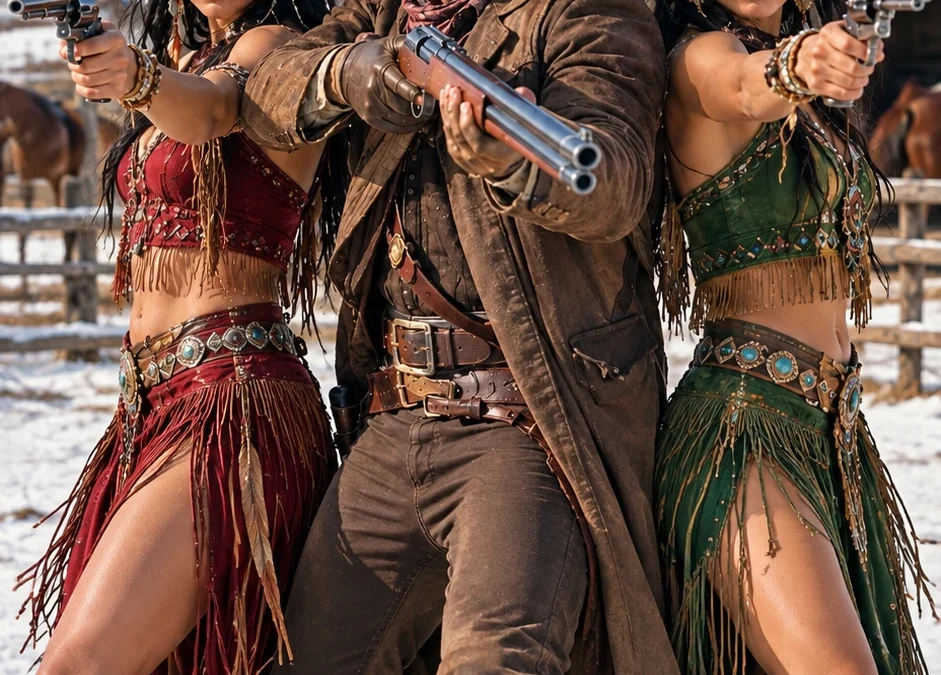
SHE WAS FROZEN IN THE SNOW, HER FINGERS LOCKED AROUND HER SISTER’S WRIST… THE LONELY RANCHER WHO FOUND THEM HAD NO IDEA THE MEN WHO HUNTED THEM WERE ALREADY WATCHING HIS CABIN 😳❄️
Part 1
The fence post was leaning again.
Hadley Cross spotted it from fifty yards out. The northwest corner, always that corner. Every winter the wind came down off the ridge as if it held a personal grudge against that one stretch of wire, and every winter he fixed it. 🌨️
Wyoming Territory, January 1893. The snow had been falling for two days. It wasn’t the soft, pretty kind painted on Christmas cards back east. It was the mean kind, sideways and merciless, the kind that finds every gap in your coat and settles in like it owns the place.
His horse, Rex, did not want to be out there. Ears flat. Hooves dragging. The whole animal communicating one clear message: this is a bad idea.
But Rex wasn’t the one making decisions.
Hadley was forty years old, lean from years of work without rest, with a face that gave nothing away. People in the nearest town, twenty miles south, called him quiet. That wasn’t quite right. Quiet means something is being held back. Hadley wasn’t holding anything back. There was just less of him these days.
He had come to this land eleven years ago with his wife, Eleanor, when they were both young enough to believe that hard work was romantic. And for a while, it was.
Eleanor used to hold her tea mug with both hands, even when it wasn’t cold, as if she were keeping the mug warm rather than the other way around. Hadley would watch her across the breakfast table and think he was the luckiest man in Wyoming. 💔
He still had that mug. He washed it twice a week and set it back on the shelf where she used to keep it.
Seven years since she’d touched it.
The cabin would be quiet when he got home. It was always quiet now. Not the peaceful kind. The kind that has weight, that presses against your ears and makes you aware of every sound your own body makes just to fill the space.
Then Rex stopped.
Not a slowing. A full stop, all four hooves planted. Hadley scanned the white. At first there was nothing, only snow and the dark shapes of pines along the north fence.
Then he saw them.
Two dark shapes at the base of the trees, half buried. Not moving. 😨
His stomach went cold in a way that had nothing to do with the weather. He had found people out here before. Wanderers who underestimated a Wyoming winter. It never got easier, the not knowing what you were about to find.
He was out of the saddle before Rex fully stopped, pushing through knee-deep drifts without thinking. Two women, young, lying close together, their clothes frosted solid, their hair stiff with ice.
He dropped beside the first and pressed his fingers near her mouth.
A ghost of warmth. Faint, but there.
He reached for the second woman, and then he stopped.
The first woman’s right hand was locked around her sister’s wrist. Not resting there. Not fallen there by accident. Locked. Ice-white knuckles, fingers curled in a grip that must have been deliberate long before the cold took her strength.
She had reached across and held on, and held on, and held on, until she couldn’t anymore.
Hadley Cross had buried a wife and a child in the same year. He knew what it looked like when someone refused to let go. 💔
He sat back on his heels in the snow and breathed. Then he stood and got to work.
Getting both women onto Rex was neither elegant nor easy. He talked the whole way, low and steady, to the horse, to the women, to no one. Easy now. I’ve got you. Just stay with me. He had said those words before, to a different person, with a different outcome.
The ride home took forty minutes through the storm. He laid them by the hearth, stoked the fire, and piled on every blanket he owned. His hands were shaking, and not from the cold.
Don’t let them go. You found them for a reason.
The older one woke first. Her eyes snapped open, brown and sharp, and immediately scanned the room: the exits, the distances, the stranger kneeling by the fire.
Hadley didn’t reach for her. He stood slowly, showed her his empty hands, and walked to the far side of the cabin. He sat on the bench ten feet away.
Something in her shoulders eased, just slightly.
“My name’s Hadley Cross,” he said. “I found you in the snow. You’re safe here.”
She said nothing. But her hand reached toward her sleeping sister, close but not touching, like she was checking for warmth.
Over the next days, he learned their names. Nayeli, the elder. Tsula, the younger. He learned they had been walking for a long time. He learned that Nayeli always sat where she could see the door.
And on the eighth morning, he stepped out into the cold with his coffee and saw it.
A thin column of smoke, rising from the north ridge. Straight up. Controlled. Deliberate.
Not a traveler’s fire. Travelers build fires that gutter and sprawl. This one had been built by men who knew exactly what they were doing. 😶
He walked back inside. Nayeli was already at the window. Her eyes went to his face, then to the door, then back to his face.
“You saw something.”
“Smoke on the ridge. Maybe eight miles.”
He watched her whole body respond to those words, and Hadley understood something in that moment.
This wasn’t news she hadn’t expected. It was news she had been waiting for. 😨
👉 Want Part 2? Find it in the comments, or leave any word and I’ll send it to you privately!
Part 2
This wasn’t news she hadn’t expected. It was news she had been waiting for.
“Tell me,” Hadley said.
Nayeli looked at him. He looked back, patient, not harder.
“Tell me.”
Tsula came down the ladder from the loft and sat at the table. Nayeli sat across from her. Hadley leaned against the wall by the window, not crowding, and listened.
It cost Nayeli to talk. You could see it in the way she set each sentence down like a stone for crossing a river, testing it before trusting it with the next.
Their band had been traveling south along a route they knew. A route they thought was safe. Before dawn, a man named Briggs Malone came with armed men. Not robbery. Not random violence. Something organized, something that knew where to go and who to separate out.
“They knew our camp,” Tsula whispered. “They came from the right direction. They knew where the horses were. Someone told them.”
“Yes,” Nayeli said. The word fell like something dropped from a great height.
She stared at her hands flat on the table as if they belonged to someone else.
“There was a man in our band. I called him uncle. Not blood, but close.” A long pause. “He had a wife. Children. He was afraid. He made an arrangement with Malone. The route, the timing, where we would be. In return, his family would be left alone.”
“Were they?” Hadley asked.
“I don’t know,” Nayeli said. “We ran before I could find out.”
Tsula reached across the table and covered her sister’s hand. For one second, something crossed Nayeli’s face that wasn’t composure. Something young and exhausted and afraid. 💔
Then it was gone.
Hadley looked north. Six or seven men against one rancher and two women. Math like that only works one direction.
He didn’t tell them what he was thinking.
Three days later, the smoke moved west. Closer. Then he found boot prints at the tree line, two sets, thirty yards from the cabin. Someone had stood there in the dark and watched his windows.
And the next morning, Malone rode into the yard alone, easy as a neighbor paying a call.
“Looking for two young women,” he said pleasantly. “Apache. Sisters. Might have gotten separated from their people.”
“Haven’t seen anyone.”
Malone’s pale eyes drifted to the line of laundry on the east side of the cabin. Two extra sets of clothes.
“Dangerous for two women out here alone,” he said softly. Then he smiled and rode away.
“He knows,” Nayeli whispered.
“He knew before he came,” Hadley said. “He came to put me on record.”
Two nights later, Hadley woke from a half sleep to the smell of smoke. Real smoke. He crossed the room and saw orange light growing through the glass.
The barn was burning.
“Up,” he said. “Both of you. Now.”
They were already moving. Neither had been fully asleep.
Rex was in that barn. Clara, too. Hadley heard them screaming through the roar of the flames and gripped the rifle until his knuckles went white.
Then the first blow struck the cabin door.
Wood splintered. A man’s voice rose above the fire, steady and certain.
“Send the women out. That’s all I need.”
The second blow split the frame.
Hadley Cross stood at the window with the rifle in his hands, and said nothing at all. 😨
👉 Want to know what happened when that door broke? LIKE or COMMENT “REVEAL” to see Part 3! It will be posted once we have enough comments! 🔥
Part 3
The third blow came.
Hadley stepped back from the door and let it come. When it burst inward and the first man stumbled through with all his momentum, Hadley was already standing to the side.
It went fast after that, the way violence always does. Not like in stories. Not dramatic, not extended. Sudden, and then over.
Two of the three men decided the inside of that cabin wasn’t worth the price. They retreated into the dark. The third lay on the floor, considerably less confident than he’d been sixty seconds earlier. Hadley gave him one look. The man didn’t need to be told twice. 🔥
From outside, Malone’s voice carried, controlled and calm.
“I’ve got five men, Cross, and you’ve got a burning barn.”
Hadley noted it distantly: he knows my name. Of course he did. The deed was filed in Cheyenne. Any man with money and time could find it.
“Send the woman out,” Malone called. “Nobody needs to lose anything else tonight.”
Like the barn wasn’t already burning. Like three men hadn’t just come through that door.
Hadley said nothing. He watched the barn. He could hear the horses, frantic through the roar. His hand tightened on the rifle.
“I’ll go to the east side,” Nayeli whispered.
“No. You stay where I can see you.”
“The horses,” she said softly. “I know you can’t go out there. I know that too.”
He knew. Rex, six years, the horse who had walked into a blizzard without complaint the day Hadley needed him. And he set the grief aside, because the cabin needed his attention more than the grief did.
At the east window, Tsula spoke. “Two on the east side. Not moving. Watching.”
“Backup,” Nayeli said. “If you go out, they close in.”
Hadley opened the window one careful inch.
“You should go,” he said, level as always. “I think the three men you sent in came out missing something they walked in with. I think your remaining men are wondering if this cabin is worth it. And I think you expected a widower alone in the dark.”
A long silence.
“I’ll come back,” Malone said.
“I know. I’ll be here.”
By some grace of construction, the green lumber on the barn’s north wall never dried enough to burn. The east side held. Rex and Clara had broken through the paddock gate and stood in the snow fifty yards out, spooked but alive. Rex had his ears forward, doing his “I have opinions” thing. Hadley exhaled for what felt like the first time in an hour.
When Malone’s men pulled back into the dark, he went to check the barn and stopped in the doorway.
Tsula was already there.
She sat on the hay in the east corner where the fire hadn’t reached, Clara’s head against her shoulder, and she was singing. Low, rhythmic, ancient, a song that wasn’t his to know. The kind of sound that exists to tell something frightened that it isn’t alone.
Clara stood perfectly still.
Hadley stayed at the edge of the moment and didn’t move. Some things ask you not to walk in, not to speak, because naming them would make them smaller. He thought of Eleanor, how she used to hum when she was worried, just sound, reminding herself she was still here.
He stood there until the song ended. Then he went back inside, hung up the rifle, and felt something wrong in his left side.
His hand came back wet.
Huh. When did that happen?
He pulled his shirt down over it and decided now wasn’t the time.
He was wrong about that. 😨
Nayeli found out at dawn.
She came in from checking the east perimeter and saw him in the chair, not sitting quite right. She crossed the room in four strides.
“Pull up your shirt.”
“It’s nothing—”
“Hadley.”
He looked at her face. He pulled up his shirt.
She looked at the wound without expression, then went to the shelf and began taking things down with the efficiency of someone who knew exactly what she was looking for.
“You sat in that chair all night with this?”
“There were more important things.”
“Lie down.”
He lay down. She cleaned the knife wound with steady hands, a cut he’d caught on the doorframe and never felt. She bound it tight.
“You are the most stubborn man I have met in my life,” she said. “And I grew up around men who thought suffering quietly was the same as being strong.”
He opened his mouth.
“Don’t agree with me. It’ll make it worse.”
He closed his mouth. Something happened in his face that wasn’t quite a smile. Something happened in hers, too. 💛
That night, a fever came. Not the dangerous kind, just enough to make everything feel underwater. In the drifting, he talked. Fever lowers the guard you spend years building. He talked about Eleanor’s voice in the morning, about the argument they’d had their second winter, about the December morning in 1886 when she knew something was wrong before he did.
Then he said a name. Quietly, like something precious being set down.
“William.”
Once. And then he was asleep.
Nayeli sat beside him and understood something about grief she had only known in theory. It doesn’t diminish. It waits, patient as stones, until the guard comes down.
She went outside into the cold. She stood in front of the small marker with only a year carved into it, the one that had stayed blank for seven years because the name had nowhere to land. She walked to the edge of the pines, found a small branch still green beneath its winter skin, and laid it carefully on the grave.
She said a few words in Apache. Not for Hadley. Not for the child. For all the small lives held in the wrong places by the right people.
Then she went back inside.
On the fifth morning after the fever broke, Hadley went out to check the rear fence and nearly walked past the graves the way he always did. Then he saw it. Green against white. A small pine branch, placed with intention across the little marker.
He stood very still. His breath made clouds in the cold air.
He thought about the fever. About a name said once into the dark of a room where he’d thought no one could hear.
“William,” he said.
Out loud, in the quiet Wyoming morning, to the air, to the year carved in wood, to the small life that had left a space the exact shape of itself.
“William.”
He didn’t cry. He didn’t fall apart. He simply stood with it, present, in a way he hadn’t let himself be for seven years. Being alone with it had always felt like the thing that would finally break him.
It didn’t.
He touched the top of the marker once, then went inside. Nayeli was at the stove. She didn’t turn around.
“Thank you,” he said.
“For what?”
“The branch.”
“The pine had good shape,” she said, which wasn’t an answer, and was exactly the right one.
They drank their coffee in a silence that had understanding in it. 💛
Eleven days after the attack, Malone returned.
Not at night. Not with subtlety. He rode up at mid-morning, sky clear and cold, at the head of five men in a loose line. Six in all.
Hadley watched them from the north window. “Six,” he told Nayeli.
She nodded once. Tsula was at her wall of charcoal drawings, and she set down her charcoal, her face the face of someone whose feared thing had finally arrived.
“We should go out,” Nayeli said. “The three of us. Together.”
He opened his mouth. She met his eyes. He closed it.
He stepped onto the porch first, rifle in hand. Then the door opened behind him. Nayeli walked out and stood on his left. Tsula walked out and stood on his right. No weapons raised. Just standing, upright, present, the way you stand before something that belongs to you.
Something shifted in Malone’s face. He had expected a man holding a door. A man negotiating from weakness. He had not expected this. Three people who were in agreement. 🔥
“You’re on my land,” Hadley said, steady. “Twice uninvited. There won’t be a third time.”
“This isn’t your fight, Cross.”
“You made it mine when you burned my barn.”
“I’ll pay for the barn.”
“No. You won’t.”
One of Malone’s men shifted in his saddle. Another glanced sideways. Then a voice from the line, low: “The women aren’t worth this.”
“Quiet,” Malone snapped.
But Hadley saw it. Confidence is a structure, and structures develop fractures, and fractures, once visible, spread.
He raised the rifle. Not aimed. Just present.
“I’m going to say this once, because once should be enough. Go.”
Malone studied them for a long moment. He was looking for leverage, for the thing that would make this worth what it would cost. He found nothing. People who have truly chosen, who haven’t stumbled into it from desperation, have no pressure point.
He turned his horse. The others followed, some with visible relief.
At thirty yards, Malone said without turning, “This isn’t done.”
“It is,” Hadley said.
Because sometimes you just say the thing and let it be true.
He stayed on the porch until they were gone over the north rise. Tsula exhaled long and slow.
“He’ll find another route,” Nayeli said. “Another easy target. That’s who they are. They look for easy.”
“And we weren’t easy.”
She turned to him. “No. We weren’t.” 💛
The barn rose again, board by board. Hadley and Nayeli worked the framing while Tsula called out measurements and delivered a running commentary on the quality of lumber that was detailed and occasionally profane. Rex supervised with the expression of a foreman who finds the entire crew disappointing.
One evening, Hadley came in from the barn and stopped.
Tsula had finished the new section of her wall. Three figures stood in front of a cabin. One taller, two women beside him, drawn so their shapes belonged together. Below them, at the base of the cabin, two small rectangles in the earth. Two markers. And from the larger one, a single thin line reached up toward the figures above.
Not gone. Connected. 💔
His throat did something complicated.
“It’s not finished,” Tsula said, looking at her hands. “I thought I’d ask first. I want to add spring. Green. Coming up from the ground. If that’s all right.”
“Yes,” he said. “That’s all right.”
One night soon after, Hadley took a chisel from the little box on the shelf, the one he’d looked at for months without opening. He put on his coat. Nayeli put on hers. He didn’t argue.
Under a sky packed with stars, he crouched before the small marker with only a year on it. He had carved Eleanor’s name with hands that shook. This time his hands were steady.
W. I. L. L. I. A. M.
Below it, in smaller letters: Beloved son. December 1886.
He sat back and looked at it, the name in the wood, out in the world, no longer locked inside him. Something moved through him that was not only grief. Something grief becomes when you finally let it have its shape.
Nayeli took the pine branch from her pocket. She had kept it, he realized. She set it on the marker, green against the carved letters.
“Thank you,” he said again, for a thing that wasn’t the same thing at all anymore.
She nodded once.
In March, the snow pulled back and the creek ran loud. Hadley went to the storage shed and found his seed bags, enough for one person, calculated carefully for one. He looked at them. He went to the barn and came back with a third bag he’d been saving.
He set all three on the workbench.
Tsula found them there. She picked one up, turned it over in her hands.
“This is a lot of seed.”
“It’s what we need.”
“For three people.”
“Yes. The beans go in the south bed. The squash—”
“Hadley.”
He looked up. She was smiling, a full, unguarded smile that changed the whole room.
“The squash,” she said. “Okay.”
That evening Nayeli came in, saw three seed bags on the table, and looked at him for a long moment.
“You made a decision.”
“I made a plan. Decisions are yours.”
She sat down. “We’ll need to expand the south bed.”
“I was thinking another four feet.”
“Six,” she said, and the corner of her mouth moved. “If we’re doing this properly.”
They had already talked about the south. About their people who had survived, about the road that would open when the thaw came. They would go, and they would find them, and they would come back. Staying didn’t mean forgetting where you were from. And going didn’t mean this stopped being home.
“I want to build something that lasts,” Nayeli told him at the creek. “I’ve been part of things that were taken. I want to be part of something that holds.”
“That can happen here.”
“I know.” She watched the water. “I don’t feel like a stranger here.”
“You’re not.”
“No,” she said. “I’m not.”
Morning came the way it does in early spring in Wyoming. Slow at first, then all at once.
Hadley was up before the light, as always. He built the fire and put the water on. He stood at the window and looked at his land: a half-rebuilt barn, a patched fence, two named graves, and a south garden bed that was going to need to be five feet wider.
Behind him, the ladder creaked. Two sets of feet.
“Coffee’s on,” he said.
“We can tell,” said Tsula. “It smells good.”
He turned. They stood in the middle of the room, morning-faced and present, and the cabin was full. Not crowded. Full. The particular fullness of a space with exactly the right number of people in it.
Eleanor’s mug sat on its shelf. The second chair was still pushed back in its corner. But for the first time in seven years, Hadley didn’t feel the weight of its being empty.
The sun came through the east window and caught the wall: mountains, people, fires, horses, a cabin with two graves and three figures, and a small green shoot growing up between the grief and the living.
“Six feet,” said Tsula.
“Four,” said Hadley.
“Five,” said Nayeli.
“Five,” said Tsula.
“Five,” said Hadley.
Then Tsula went for the tools, and Nayeli followed, and the man who had spent seven years maintaining a life, keeping the fences up and the fire going and the grief carefully managed, stood in the spring light for one more moment.
Then he went to help. 🌄
This story is entirely fictional and created for entertainment purposes only. It does not represent any organization or individual, nor does it encourage inappropriate behavior. The content was generated with AI assistance.








