SHE WAS GIVEN 40 ACRES OF “WORTHLESS” ROCK THAT NO ONE WANTED — THEN SHE FOUND WHAT HAD BEEN HIDDEN BENEATH HER FEET FOR 50 YEARS
Part 1
Mabel Whitcomb stood at the base of the Bighorn Mountains in the cold November wind, clutching the folded deed tight against her chest.
Her brothers Orson and Bram had laughed openly in the attorney’s office when their father’s will was read — the prime cattle ranch went to them, and she got nothing but this remote, rocky parcel everyone called “the useless piece up on the ridge.
”
“It’s nothing but stone and snow,” Orson had sneered.
“You’ll be back begging us for a roof by spring.
”
Mabel had said nothing.
She had $32 in her pocket, her horse Copper, and a quiet, unshakable resolve: she would not come back begging.
When she reached the land, she found more than she expected.
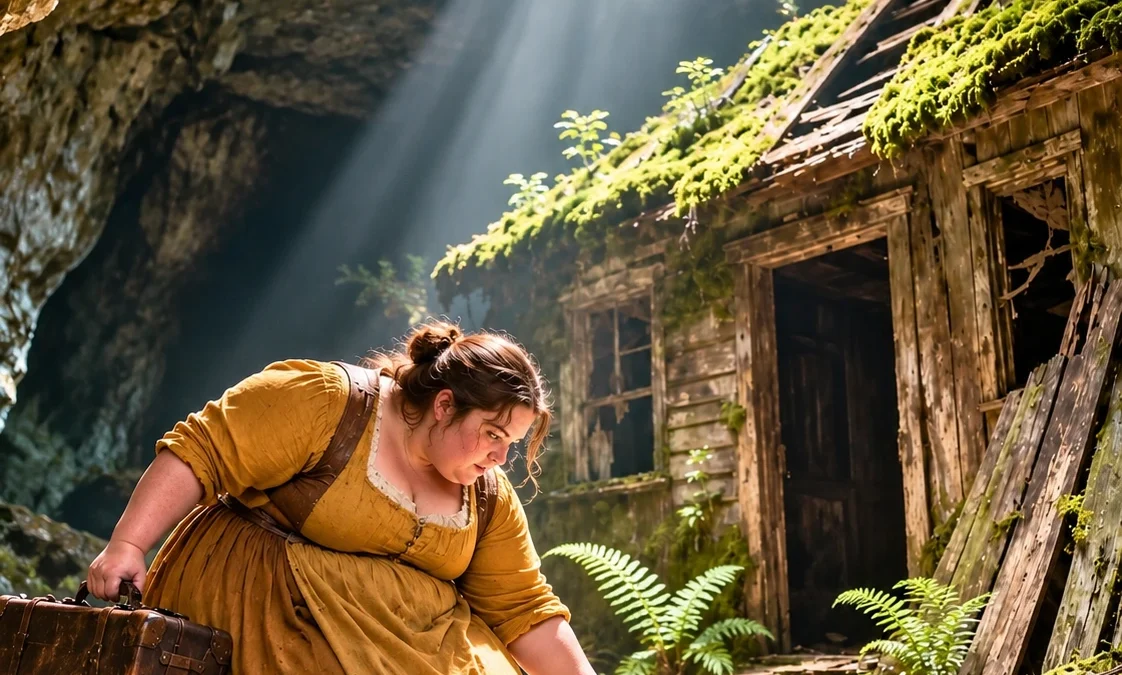
High on the slope stood a weathered log cabin, its door sealed shut as if it had been abandoned in a hurry half a century before.
Beside it, a cave mouth exhaled a faint, steady warmth — even in the freezing air, the air rising from within was soft and alive.
She pried open the cabin door.
Dust swirled in the slanted light.
A stone fireplace held cold ash exactly as someone had left it.
A bed frame had collapsed inward, its rope supports rotted away.
But the floorboards were solid — built by someone who had taken pride in every joint, who knew that in a wild, lonely place, strength was the only luxury that mattered.
On the shelves lining one wall, she found them: journals, leather-bound and neat, written in a precise, small hand.
T.
Vail, M.
D.
— Field Notes, Bighorn Mountain Survey, commenced June 1829.
Her heart gave a strange, quiet lurch.
She pulled free the first journal and turned the pages.
Thaddeus Vail — physician, naturalist, explorer — had come here following rumors of a cave that stayed warm through winter.
He had mapped its passages, cataloged crystals of celestine and barite, and then he had found something more: a lower chamber, sealed off by rockfall, where the air was warmer still, and where mineral veins of extraordinary richness lay waiting.
“What lies below represents a discovery of significant scientific and commercial value,” he had written.
“But I cannot gain access.
I have found an alternative route — a ventilation shaft — yet I am too unwell to attempt it this season.
I shall return in spring.
”
He never did.
Beneath the fallen bed frame, beneath layers of rotted canvas, Mabel found a cedar chest.
Inside lay more journals, hand-drawn maps, labeled mineral samples, letters sealed but never sent — and at the very bottom, a large map marked in red ink.
The Deep Deposit.
And a note, written small: Entry point beneath floor of upper shelter, northwest corner.
Large flat stone movable.
I have blocked it with timber for safety.
Mabel froze.
Her shelter.
Her lean-to.
The place where she had laid her blankets, built her fire, and slept every night since arriving — sat directly on top of the entrance to the very place Vail had never reached.
Before she could process what this meant, Copper whinnied sharply outside.
Mabel stepped to the door.
A man stood near the cave entrance — tall, broad-shouldered, weather-beaten, with a scar silvered across his eyebrow.
He touched the brim of his hat.
“Ma’am.
Name’s Silas Mercer.
Horse threw a shoe a mile back, saw your smoke.
”
He was careful, steady, his gaze meeting hers without wandering.
He offered to fix her horse in exchange for nothing more than water and a direction to the nearest smithy.
But as the days passed, he stayed — helping repair the cabin, reinforcing shelves, listening as she shared what she had found.
He never pushed, never assumed, never treated her like someone who needed looking after rather than standing beside.
Together they read Vail’s final journal entry.
He had found the way down.
He had seen the lower chamber — walls lined with crystals, a geothermally warmed pool glowing faintly in the dark, veins of mineral that would change everything — and then he had fallen ill.
The handwriting grew shaky, desperate.
I will leave everything secured.
Someone will come.
Someone will know what to do.
Then the entry cut off.
Silas looked at her slowly.
“He didn’t just leave it, Mabel.
He left it for whoever came after.
And your father — he paid the taxes on this land every single year, when everyone else laughed at it.
He knew.
”
Before she could reply, news arrived: Rufus Kincaid, a wealthy mining investor, had heard rumors of the cave.
He rode up the mountain with lawyers in tow, claiming the boundary was “ambiguous” and the richest deposits lay outside her land.
Then her brothers — Orson and Bram — agreed to testify against her, in exchange for shares in whatever Kincaid extracted.
They would hand her mountain over to be stripped bare, just to prove she had never deserved it in the first place.
Mabel stood firm.
She gathered surveys, documents, Vail’s journals, and wrote to a respected naturalist — Dr.
Beatrice Holiday — asking her to come and verify the site’s true value.
But as winter deepened, Kincaid grew bolder.
He knew she was waiting.
He knew she needed time.
And he intended to take it from her.
Then, hidden beneath a false bottom in the cedar chest, Mabel found something that stopped her breath entirely.
An envelope, sealed for fifty years, addressed not to her — but to the previous owner of the land.
And on the outside, in handwriting she knew better than her own: three words, added decades later.
For Mabel.
Eventually.
It was her father’s writing.
🥺
Part 2
She stood perfectly still, the paper trembling slightly in her hands.
Silas stepped closer, his voice soft.
“That’s his handiwork, isn’t it?”
Mabel nodded, unable to speak.
Her father had never once mentioned the cave, the journals, or Vail.
He had simply handed her the deed and said, “You’ll know what to do.
” Now it seemed he had been preparing her for this her whole life without ever saying a word.
When she opened the envelope, she found two documents: a letter from Thaddeus Vail, written in the final days before he fell ill, and a legal agreement signed in Philadelphia in 1828 — a preservation claim, stating that should he make a discovery of scientific importance, the site would be protected forever, never mined or stripped for profit.
Vail had signed it before he even saw the mountain.
He had come not to take, but to safeguard.
“He never got to file it,” Mabel whispered.
“He died before he could send it back.
”
Silas looked at the date.
“And your father found it.
Kept it.
Left it for you.
”
Filing it would mean giving up the chance to mine for quick wealth — but it would also mean Kincaid could never destroy what lay below.
It would mean honoring Vail’s wish, her father’s silent trust, and the mountain itself.
But it would also mean turning down Kincaid’s offer — one that would set her up for life — and standing alone against a powerful man who did not lose.
When Kincaid returned, he came alone this time.
He stood on her porch, hat in hand, and laid out his final offer — more money than she had ever imagined, enough to buy comfort, respect, everything she had ever been denied.
All she had to do was not file that paper.
“You can live well on the proceeds,” he said smoothly.
“Orson and Bram already understand how this works.
Why be the only one standing in the way of progress?”
Mabel looked past him, toward the cave entrance, toward the peaks rising sharp and white against the sky.
She thought of Vail, writing by candlelight, sick and alone but determined.
She thought of her father, paying taxes year after year, holding on, waiting.
She thought of the pool deep below, glowing warm and quiet, untouched for centuries.
Then she said something that made his smile vanish entirely.
“The property is not for sale.
And I am filing the preservation agreement.
”
Kincaid’s face hardened.
“You will regret this.
You think you’re doing the right thing, but you’re throwing away your future.
And your brothers? They will not stop pushing.
”
He turned and walked away, leaving her standing in the doorway, the weight of it all settling heavy and cold on her shoulders.
That night, Orson appeared at her cabin door.
He did not come to argue.
He came to warn her — Kincaid was preparing to file his own claim first, using forged documents, and he had people in the county office who would look the other way.
He had given up waiting for the law.
He intended to take what he wanted by force.
“He’s bringing men up the mountain at dawn,” Orson said, his voice rough with shame.
“I didn’t come to help him.
I came to tell you — you have until sunrise.
”
Mabel looked at him, really looked at him — the brother who had laughed loudest, who had turned his back on her when it mattered most — and realized he was not here to trick her.
He was here because for the first time, he was seeing clearly.
“He doesn’t just want the minerals,” Orson said quietly.
“He wants to be the one who decides what happens here.
And he doesn’t care who gets hurt to do it.
”
Silas stood beside her, checking the lanterns, securing the door.
“We can hold the cabin for a while.
But we can’t fight a whole crew.
”
Mabel looked at the preservation agreement on the table.
At Vail’s journal.
At her father’s handwriting on the envelope.
Then she knew what she had to do.
“There’s no need to fight,” she said.
“Because by the time they get here, the truth will already be where they can’t touch it.
”
She reached for her pen.
Part 3
By lamplight, Mabel wrote fast, her hand steady despite the urgency.
She made three copies of the preservation agreement, each one notarized and witnessed by Silas and Orson.
She included transcripts from Vail’s journals, Holiday’s preliminary assessment, and the original boundary survey her father had kept safe all these years.
“Silas — you ride for the county seat.
File this before the clerk opens.
If Kincaid’s people are there, you get in first, no matter what.
” She turned to Orson.
“You take the second copy to the telegraph office.
Send it to Dr.
Holiday in Denver and to the Philadelphia Society of Natural Sciences.
If Kincaid tries to claim this is all fake, they will already know the truth.
”
Orson stared at the papers in his hands.
“I’ve spent years calling this land worthless.
Laughing at you for holding on.
”
“You’re here now,” Mabel said simply.
“That matters more.
”
They left before first light.
Mabel stayed behind, standing watch from the cabin porch as the sky paled gray over the mountains.
She did not know if they would make it.
She did not know if the clerk would accept the documents.
She did not know if the society would honor an agreement signed fifty-five years before.
She only knew she would not let them take what others had protected.
An hour later, dust rose on the trail.
Kincaid arrived with four men, their expressions hard, their purpose clear.
He rode straight to the cabin, dismounted, and walked up the steps as if he already owned them.
“Where are your messengers?” he asked, calm as frost.
“They won’t make it stick.
An old piece of paper doesn’t mean anything against current claims.
”
“It means everything,” Mabel said.
“It means you don’t get to decide what happens here.
”
He smiled, thin and sharp.
“We shall see.
I have filed my claim this morning.
The ridge is mine to develop.
”
“Then you filed against documents that were registered before yours,” a voice called from the trail.
Silas walked into view, breathing hard but upright, the clerk’s stamped receipt held high.
“Accepted and filed at 8:02 a.
m.
— twelve minutes before yours.
”
Kincaid’s face darkened.
“That doesn’t prove anything.
”
“It proves priority,” Orson said, stepping up beside Silas.
“And the society in Philadelphia has already responded.
They confirm the agreement is valid.
They are sending representatives.
” He looked at the men standing behind Kincaid.
“And I have told the sheriff exactly what was planned here.
He knows who offered bribes.
He knows who forged signatures.
”
The men shifted uneasily.
One by one, they stepped back.
They were not prepared to fight when the law was already on the mountain’s side.
Kincaid stood alone.
For a long moment, he said nothing at all.
Then he looked past Mabel, toward the cave, toward the peaks rising beyond.
“You’re more like him than you know,” he said quietly.
“Vail.
He wouldn’t compromise either.
I read his papers.
I thought I could outwait you both.
” He mounted his horse without another word and rode away, and this time, he did not look back.
That afternoon, Mabel sat at the desk in the cabin, the sunlight streaming golden through the window, and finally opened the letter Vail had written to whoever might come after him.
He had written of his daughter Clara, left behind in Philadelphia, whom he hoped to provide for with his discoveries.
He had written of the mountain’s beauty, the wonder of the crystals, the silence of the deep pool.
“I do not know who will find this,” he had written.
“But if you are reading it, you are the one.
Protect it.
Share it.
Let it be something the world can see without destroying.
”
Silas came to stand beside her.
“We will find her,” he said.
“Clara.
If she is alive, we will find her.
”
And they did.
Months later, they traced her descendants — a granddaughter living in Ohio, who had grown up hearing stories of a grandfather who had gone west and never returned.
She came to the mountain that summer, stood in the lower chamber by the glowing pool, and wept.
“He was not lost,” she said.
“He was just waiting.
”
The years unfolded gently.
The site became known as the Vail-Whitcomb Preservation Site — visited by scientists, students, and travelers who came not to take, but to see.
Mabel established a program welcoming women and young people to learn surveying, geology, and stewardship — giving others the chance she had once been denied.
Orson and Bram became her first allies, helping manage the land and standing beside her when others still doubted.
They never fully made up for the years they turned away, but they stayed, and they tried, and in the end, that was enough.
Silas remained by her side, his quiet strength matching her own.
They built a life together on the mountain, stone by stone, word by word, choice by choice.
When they married beneath the pines in the meadow, Holiday stood beside her as a witness, and the community that once laughed came to honor her.
One evening, long afterward, Mabel found her father’s old photograph tucked in the back of a ledger — him standing outside the Philadelphia Society building, young and determined, years before she was born.
He had known Vail.
He had seen the agreement.
He had bought the land not by accident, but by choice.
He had paid every tax, kept every secret, and waited — not knowing if she would understand, only hoping she would.
“He left it to me because he knew,” she said softly to Silas, tracing the edge of the photograph.
“He knew I would not see it as worthless.
”
Silas squeezed her hand.
“He knew you would see what was worth saving.
”
She stood on the porch as the sun set over the Bighorns, the cave breathing its warmth into the cooling air, the crystal chambers glowing far below, safe and bright.
She had arrived with nothing but thirty-two dollars and a deed.
She had been called foolish, too weak, too alone.
But she had been enough.
She had always been enough.
💛
This story is entirely fictional and created for entertainment purposes only.
It does not represent any organization or individual, nor does it encourage inappropriate behavior.
The content was generated with AI assistance.








