SHE WAS GIVEN 60 MINUTES TO LEAVE HER HOME WITH NOTHING SHE COULDN’T CARRY — NO ONE THOUGHT SHE’D EVER COME BACK
Part 1
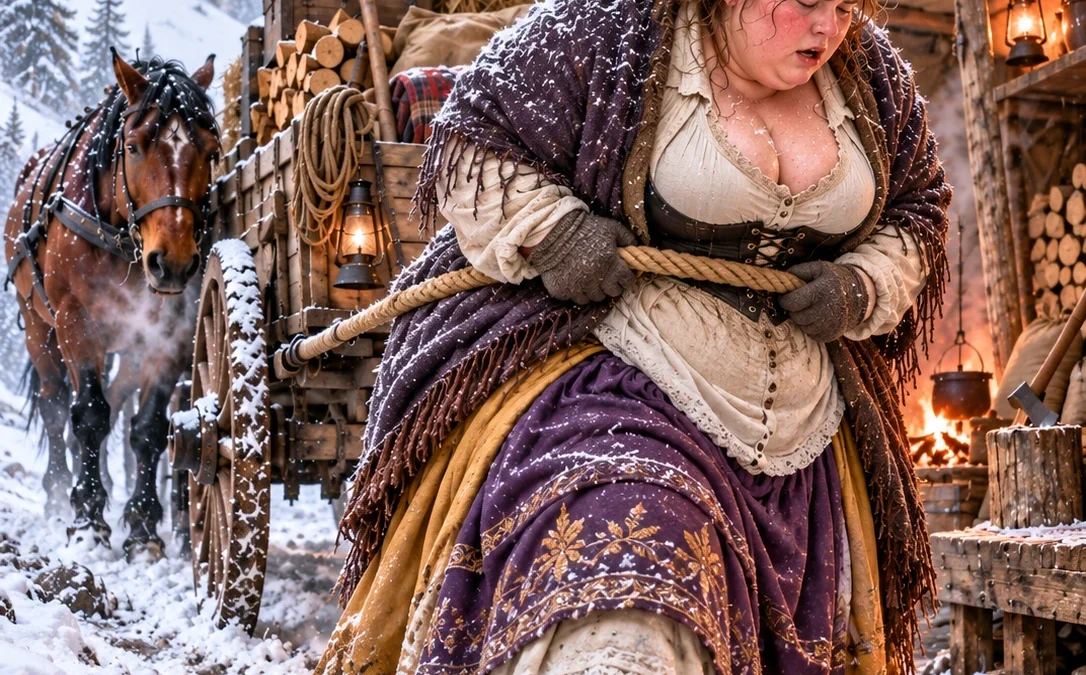
Rosie Witkim stood tall and solid, broad through the hips and shoulders, built exactly like her mother’s family — sturdy, full-figured, and unashamed of it.
But the town of Silverton had spent most of her life trying to make her feel ashamed.
People had underestimated her since she was old enough to lift a water bucket.
They looked at her size and decided they already knew everything about her.
And right now, her own uncle Gideon was doing the exact same thing.
“60 minutes,” he repeated, a thin, satisfied smile touching his lips.
“Anything you can carry.
After that, the property reverts to me.
”
Rosie looked past him at the house her father had built from nothing.
The place where her mother had died 11 months earlier, with Rosie holding her hand.
The home where she’d planted, harvested, repaired, and managed everything for two years — because someone had to, and there was nobody else.
She breathed in slow, steady.
“What am I allowed to take?”
Gideon blinked.
He’d expected tears, pleading, a young woman begging for mercy — something that would let him decide how much kindness to show.
Instead, she just met his gaze with dark, calm eyes and waited.
“Whatever you can carry away before sunrise,” he said, laughing shortly, dismissive.
“Like I told you.
”
An overweight 19-year-old girl and a rickety wagon.
That was all he saw.
He didn’t see the girl who’d hauled hay bales in storms, who’d mended fences in freezing rain, who’d kept this farm running when grief would have broken anyone else.
Rosie didn’t waste a second on anger.
Anger burned energy — and energy was something she couldn’t afford to waste that morning.
She turned and moved with purpose, every motion deliberate.
First the root cellar: three heavy sacks of flour she’d ground herself, salt pork hanging from the beams, tins of lard, beans, dried apples.
She weighed every item in her mind before she took it.
Will this keep me alive? Is it worth the space?
Back inside: candles, matches wrapped in oilcloth, her kettle, her mother’s black skillet — worn smooth from decades of meals, she held it for a heartbeat before tucking it safely away.
Then her father’s woodworking tools, hung in perfect order just as he’d taught her.
She wrapped each one carefully, handling them like treasures — because they were.
Blankets, her winter coat, extra boots, 40 feet of strong hemp rope, an axe, saw, hammer, nails, canvas… and finally Bramble.
Her father’s old bay draft horse, 16 years old, broad-chested, steady as a mountain.
He looked at her with big, patient eyes, and she stroked his neck.
“Easy, boy.
We’re going.
”
She loaded four bales of hay and two sacks of oats.
The wagon sat low and heavy, but she didn’t care.
She harnessed Bramble, checked every buckle, tightened every strap — then led him out into the cold gray yard.
Gideon hadn’t offered to help.
She hadn’t expected him to.
But he also hadn’t stopped her, and that told her something: he still didn’t believe she’d actually make it.
He was waiting for her to fail, to come crawling back.
The sun was just touching the eastern ridge when she climbed onto the seat.
Forty-eight minutes had passed since he’d given her the deadline.
She looked down at him one last time, long enough to let him see her face — no begging, no breaking, just quiet resolve.
“Goodbye, uncle,” she said.
She clicked her tongue.
Bramble leaned into the harness.
The wagon rumbled forward, the rear wheel creaking badly — it had been damaged since summer — and Rosie drove out of the only home she’d ever known without looking back.
Silverton was still asleep.
Nobody came out.
Nobody called her name.
As she passed the last house, the mountains rose ahead — dark, enormous, indifferent.
She had nowhere to go.
No husband, no family waiting, no plan.
Just a wagon full of supplies, an old horse, and a memory rising unbidden: her father, years ago, pointing to a narrow draw above the Animas River.
See that limestone shelf up there? Hunters used it.
Someone built a front wall.
It kept people alive through hard seasons.
It wasn’t a house.
It wasn’t even close.
But Gideon had left her with nothing else.
She tightened her grip on the reins and turned Bramble toward the mountains.
By noon, snow began to fall.
Thin flakes at first, then thicker, swirling sideways in the rising wind.
The wagon’s bad wheel groaned louder with every mile.
Rosie knew the roads would vanish soon — and so would any chance of turning back.
She kept going, following the faint trail, until Bramble slowed, ears pricked forward, nostrils flaring.
He’d found it.
There, 30 feet up the hillside beneath an overhanging ledge, stood the shelter — half-collapsed timber frame, open to the wind, looking like nothing more than a ruin.
Rosie’s heart sank.
It was smaller than she remembered, exposed, broken.
But it was also the only shelter she had.
She spent hours maneuvering the wagon under the overhang, lashing canvas to the standing timbers to make a rough wall, stacking branches to block the gaps.
When she finally sat beside her first fire, smoke filled the space — she’d built it too close to the back wall.
Coughing, eyes streaming, she dragged it toward the entrance… then noticed something: a thin natural fissure in the rock ceiling, barely two inches wide.
She carved it wider with her smallest chisel, working in the falling snow, until the smoke finally rose and drifted away.
Heat began to hold.
Real warmth.
She leaned forward, palms toward the flames — and then she stepped outside to check the trail.
It was gone.
Completely buried under fresh drifts.
No path, no ruts, nothing but unbroken white stretching down the valley.
She couldn’t go back.
Not tomorrow, not for days.
Rosie stood in the silence of the storm and understood.
She was trapped — alone, miles from anyone, in a makeshift shelter with limited food and winter just beginning.
And as she turned back toward the fire, she realized something else: Gideon was already sitting in her warm house, counting what was hers — and he never expected to see her again.
But he had made one fatal mistake.
He didn’t know the girl he’d thrown out wasn’t the kind to disappear quietly.
Part 2
That night, Rosie woke with ice in her hair — actual ice, not frost.
She sat up slowly, peeled a strand away from her cheek, and made a decision that would change everything.
She wouldn’t just survive; she would prepare.
She learned to read the mountain.
She gathered deadfall before dawn, stacking wood by the fire in her mind: enough for three days if careful, two if not.
She wove pine boughs into the canvas gaps, packed snow along the base until the wind no longer cut through.
She rationed flour and beans, stretched every meal.
For Bramble, she cut willow tips and dried grass from sheltered slopes, supplementing his dwindling hay.
Once, she got lost in a sudden whiteout, visibility dropping to nothing.
Her footprints vanished the moment she made them.
Panic rose — then she heard it: Bramble’s low, steady call from the direction of the shelter.
She followed the sound, stopping, listening, correcting her course, until the limestone ledge appeared through the snow.
After that, she tied one end of her longest rope to the entrance post and the other to her wrist whenever she stepped out.
She never got lost again.
Disasters struck one by one.
A frozen jar cracked and ruined a quarter of her flour.
She reorganized everything, moving supplies higher, building shelves, checking every container daily.
The canvas tore in a gale — she patched it by firelight.
A support post groaned under the weight of heavy snow — she braced it with a timber she’d set aside weeks earlier, working in the dark while the wind howled outside.
Through January’s brutal freeze, when temperatures dropped so low the river nearly stopped, she kept the fire going and watched Bramble closely, rubbing his legs when they grew stiff, rationing his feed but never letting him go entirely hungry.
She learned her own body wasn’t a flaw but a strength — she could carry heavier loads, stand firmer in the wind, endure longer than people gave her credit for.
By late February, the worst began to ease.
Icicles dripped in the mornings; the river broke free; patches of green pushed through the snow.
Bramble found grass hidden beneath drifts.
One day, Rosie filled her kettle directly from the running stream — no more melting snow over the fire — and realized she might actually make it.
She didn’t just survive; she built.
She fixed the wagon’s failing wheel, heating iron bands over her fire and hammering them tight, plugging splits with carved dowels, working until her hands ached.
She restocked the shelter, not just for herself — but for anyone else who might need it.
She left matches, dried food, a note tucked under a stone: Whatever you lost before you got here, you can build again from here.
I know.
I did it.
When the road finally cleared in March, she harnessed Bramble, checked every buckle one last time, and turned toward Silverton.
She was leaving the mountain behind — but she was no longer the girl who’d arrived there four months earlier.
The first person who saw her was a boy on a fence post, staring so hard he nearly fell off.
Then Harlon Decker at the livery stable — a man who’d known her father — looked at her as if he couldn’t believe his eyes.
“Miss Witkim?” he said, slow, disbelieving.
“We all thought…”
“I know what everyone thought,” Rosie said quietly, handing him Bramble’s lead.
“He needs water first.
Then grain — he’s earned it.
”
News spread like wildfire through Silverton.
By evening, people were talking — exaggerating, inventing stories — but none of them knew the real truth.
And then, on the fourth day, the shed door opened.
Rosie looked up from her work.
Standing there was Gideon.
He looked different — thinner, less sure of himself, like something had gone out of him since that morning in November.
He stepped inside, eyes darting from her to the tools laid out neatly on the bench, to the repaired wagon wheel propped against the wall.
“Rosalind,” he said.
“Uncle Gideon,” she replied calmly, setting down her needle.
He hesitated, then stepped further in.
“I didn’t think… I mean, everyone said—”
“You didn’t think I’d survive,” she said plainly.
“You counted on it.
”
He shifted uncomfortably.
“There’s… there’s something we need to discuss.
About the property.
Some of what I told you that morning… there may have been room to—”
“Stop,” Rosie said, soft but firm.
He fell silent.
“I’m not here to argue about what was yours or mine,” she went on.
“That morning is done.
I loaded what I could carry, and I left.
What you kept — you can keep it.
”
Gideon stared at her, mouth slightly open, as if he couldn’t quite process what he was hearing.
“But… the house, the land—”
“Isn’t what I need anymore.
” She met his gaze steadily.
“I built something else.
”
Gideon stood frozen, searching for words that wouldn’t come — and that was when he finally realized the terrible truth: he had kept the house, the land, everything he’d taken… but she had walked away with something far more valuable.
And he could never get it back.
😱 He thought she’d beg for it all back — but she didn’t want any of it.
Part 3
Gideon opened his mouth, then closed it again.
There was nothing he could say.
No argument, no claim, no deal that could bridge the space between them.
He had measured everything in deeds and land and buildings — and she had outgrown the scale entirely.
He turned and left without another word, defeated not by anger or revenge, but by her quiet, unshakable indifference.
Rosie watched him go, then picked up her harness needle and returned to her work.
She didn’t need to win an argument.
She was already building a life he could never touch.
Word of what she could do spread faster than gossip.
Within days, Thomas Aldridge from the hardware store sought her out — he had a wagon wheel that needed replacing, work most men in town would charge double for.
Rosie named her price, fair and sure, and when she finished, the wheel ran true and steady.
More work followed: porch railings, tool repairs, harness mending, wagon frames.
She kept a log — every job, every measurement, every observation — in the same careful handwriting her father had used.
She wasn’t just fixing things; she was building a reputation.
By summer, she had saved enough to lease a small workshop behind the hardware store — low ceiling, dirt floor, a gap in the wall where a window should be.
She patched the gap, leveled the floor with gravel she hauled herself, and built a workbench from lumber she milled to exact measure.
She hung her father’s tools on the wall in their proper order — and beside them, she hung the 50-foot guide rope she’d tied to her wrist through the snowstorms.
Clara, her landlady, came by to inspect the new place.
“That rope — for climbing?”
Rosie smiled, running a hand along the braided hemp.
“No.
For remembering.
”
“That the way home isn’t always visible,” she said gently.
“But it’s usually there, if you stop long enough to listen for it.
”
Clara studied her a moment, then nodded.
“I’ll send people your way.
”
“Thank you,” Rosie said.
“Don’t thank me,” Clara replied, turning toward the door.
“I’ll expect a discount on next month’s rent.
”
Rosie laughed — a bright, warm sound that filled the little shop.
“Of course you will.
”
One late August afternoon, Rosie saddled Bramble and rode up the mountain.
The trail was green now, loud with birdsong and rushing water — nothing like the white silence of winter.
She carried nails, canvas, provisions, and a folded note wrapped in oilskin.
When she reached the shelter, she dismounted and checked everything — the wall, the stack of dry wood, the smoke vent, the cache of supplies.
She reinforced loose branches, added more wood, replaced the worn canvas flap with fresh material.
Then she took out the note and tucked it under a flat stone beside the tin of matches:
If you found this place because you needed it, it’s yours for as long as you need it.
The wood is dry.
The provisions are sealed.
The fire goes beneath the fissure in the ceiling — not near the entrance.
Whatever you lost before you got here, you can build again from here.
I know.
I did it.
She pressed the stone down firm, stood back, and looked at the ledge that had sheltered her through the hardest months of her life.
She hadn’t chosen it — it had been forced upon her.
But in the end, it had become something far more than a refuge.
It had been the place where she learned who she really was.
She mounted Bramble and turned back toward Silverton.
He knew the way, steady and sure beneath her.
As they descended, she thought about that morning in November — the cold, the fear, the 60 minutes, the man who thought he’d won.
Gideon had kept the house and the land.
But he had never understood something simple and powerful: possessions don’t make you strong.
Knowing what to do when they’re taken — that’s what strength actually is.
Years later, people in Silverton still talked about the Great Freeze of ’91.
They spoke of losses and hardship — and always, eventually, of Rosie Witkim.
The girl who’d been cast out and forgotten, who’d returned not with a demand or a grievance, but with skills, integrity, and a business that grew until it served towns for miles around.
She never told exaggerated stories, never claimed heroism.
She just worked — steady, thorough, fair — and when people watched her examine a broken wheel or a cracked frame, quiet and focused, they realized: she wasn’t just fixing things.
She was teaching them how to see.
She married late, to a carpenter who admired her mind before anything else, and they raised a family who learned early that nothing worth having comes easy — and that being underestimated is often the greatest advantage you’ll ever have.
Every autumn, she rode up to the shelter, restocked it, repaired it, left it ready.
She never signed her name beyond the initials on the note.
It wasn’t about being known.
It was about passing on what she’d learned: no matter how much they take, they can never take what you know, who you are, and what you’re capable of building.
And somewhere, on cold nights when the wind howls through the mountains, someone lost and afraid might stumble upon a limestone shelf, find a fire already laid, and understand — they are not alone.
💛
This story is entirely fictional and created for entertainment purposes only.
It does not represent any organization or individual, nor does it encourage inappropriate behavior.
The content was generated with AI assistance.








