SHE WAS LAUGHED AT BY HER OWN SISTER IN FRONT OF 200 GUESTS: “NOBODY WILL EVER CHOOSE YOU.” THEN THE IMMORTAL VAMPIRE KING WALKED PAST HER SISTER, CROSSED 312 TILES, AND SPOKE TO HER IN A DEAD LANGUAGE
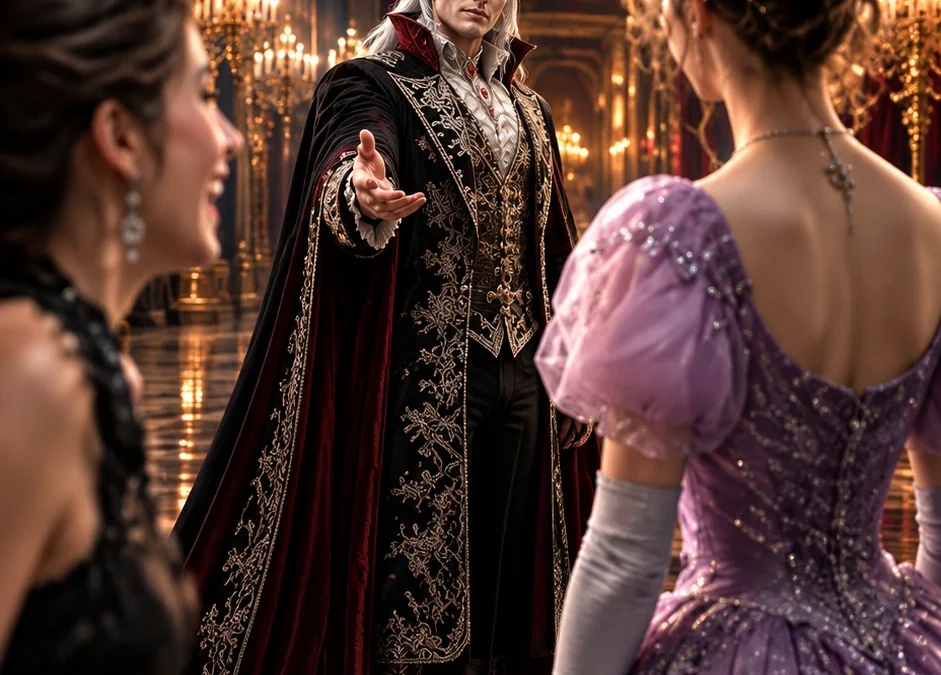
SHE WAS LAUGHED AT BY HER OWN SISTER IN FRONT OF 200 GUESTS: “NOBODY WILL EVER CHOOSE YOU.” THEN THE IMMORTAL VAMPIRE KING WALKED PAST HER SISTER, CROSSED 312 TILES, AND SPOKE TO HER IN A DEAD LANGUAGE 😱🩸👑
Part 1
My sister told me nobody would ever choose me.
She said it laughing, in front of two hundred people, on the very night the vampire king crossed an entire ballroom to stop in front of me. 🥀
I still remember how her laughter died. How the fan trembled in her perfect hand. How the silence fell over the great hall of Valdemar the way snow falls: without a sound, but covering everything.
And I remember that on that night I discovered my dead mother had left me an inheritance no one could see.
My name is Elena Miravalle, and until that night I was the wrong sister.
The right one was Cassandra. Cassandra the beautiful, the celebrated, who turned every head as if she wore the sun tied to her shoulders. She had our father’s golden hair and green eyes that provincial poets compared, in bad but sincere verse, to emeralds and spring seas.
I had our mother’s dark brown hair, our mother’s gray eyes, and our mother’s habit of standing quietly in corners, watching the world like a foreign text I was determined to translate.
“You look like a governess,” Cassandra said in the carriage. “No. The shadow of a governess.”
“Mother’s will only says I must attend,” I answered, watching the window.
It did. Leonor Miravalle had died two winters earlier, and her will contained a strange clause our weak, indebted father didn’t dare question: both daughters must appear together at one full court season.
Both. Not only the beautiful one.
What Cassandra didn’t know was that I carried another inheritance that night. Not a necklace. Not a brooch.
Words.
Ancient, dark, beautiful words from a language my mother had taught me through years of secret afternoons in the north library, door locked, curtains drawn. A language she said almost no one among the living remembered. 🌙
“Why are you teaching me this, Mama?” I asked once, age twelve, after conjugating a verb that sounded like wind between gravestones.
She touched my forehead with two cold fingers.
“Jewels get stolen. Dresses burn. Names are bought and sold. But what I put here is yours forever. And one day, someone will speak to you in this language. When they do, my daughter, do not lower your eyes. Answer. Even if the whole room is staring. Even if your legs shake.”
I thought it was one of her many oddities.
The Palace of Valdemar opened before us like the cover of a golden book. A thousand candles. Silks, jewels, bare shoulders. The old aristocracy of the kingdom of Arabel, gathered to open the season.
I walked three steps behind my sister, as was my role, and felt every gaze slide over me and ignite on her.
I took my place by the far wall with a glass of lemonade, where the widows and wallflowers stand. I didn’t mind. I was good at one thing: watching.
And something was wrong with the room.
The footmen were too stiff. The steward kept checking his pocket watch, his chain trembling. And on the dais, beside the governor’s chair, someone had placed a second seat, carved from wood so black it seemed to swallow the candlelight.
A throne.
At ten o’clock exactly, the great doors crashed open.
“His Eternal Majesty, Lucian Draven, King of the Night Court, Lord of the Seven Blood Clans, Guardian of the Pact of Arabel.” 😨
Two hundred people lost their breath at once. The vampire king never attended mortal balls. Ever.
He entered without guards, which was more terrifying than a hundred. Tall, in a severe black coat, no jewels but a signet ring. Skin pale as marble, dark hair swept back by someone who had not needed to impress anyone for centuries. He looked thirty. The treaties said four hundred.
His eyes were dark amber, almost red, and they moved across the hall slowly, like someone searching a drawer he had already checked many times.
Searching for something very specific.
Twenty paces away, I watched Cassandra slide to the front of the crowd like a sword leaving its sheath. She placed herself exactly on the path between door and dais. She sank into a curtsy so perfect it seemed choreographed, golden neck curved like a swan’s, offering herself to the legend like a trophy that delivers itself.
Then she turned her head, found me against the back wall, and smiled with every tooth.
“Nobody will choose you, little sister.”
Not a whisper. Aloud, amused, for her court of admirers.
“Not tonight. Not even a dead man.”
The laughter lasted exactly four seconds.
Because at the fourth second, the music stopped. And the vampire king, who had already passed Cassandra’s curtsy without so much as a blink, kept walking.
He crossed the empty center of the ballroom. He crossed the rows of nobles parting like water. He crossed three hundred and twelve tiles of black and white marble, each footstep echoing into my bones.
And he stopped in front of me. 🩸
Close up, he looked like two things overlaid: a young man and an ancient monster, like two transparencies held to the light. He smelled absurdly of old paper and rain on stone. And he was looking at me. Not through me, like everyone did. At me.
He inclined his head. A king who had bowed to no one in four centuries.
And he spoke, not in the tongue of Arabel, but in long, dark words with consonants like wind among tombstones and vowels like water under ice.
“Elena Miravalle. Will you grant me the first dance?”
The ancient language. The one the treaties said only the princes of the blood clans spoke.
No mortal in that hall could understand it.
No mortal but one.
My legs turned to water. Two hundred stares pinned my back. And louder than all of it, I heard my mother’s voice twelve years ago.
Do not lower your eyes. Answer.
I lifted my chin. I met those amber eyes.
And I answered him in the dead language, as if the words had been born in my mouth. 😱
👉 Want Part 2? Find it in the comments, or leave ANY word below and I’ll send it to you privately!
Part 2
And I answered him in the dead language, as if the words had been born in my mouth.
“The first dance is yours, Majesty. But I warn you, I dance as badly as I hide well.”
For one instant, his face showed nothing. Then something happened that, I would learn, had not happened in over a century.
Lucian Draven smiled.
Barely. A hairline crack in marble. A shadow of astonishment and something deeper, almost pain, as if my voice had reminded him of another voice.
“You speak the language of my court,” he said, still in the old tongue. “Without an accent. Who taught you?”
“My mother, Majesty.”
“And her name?”
“Leonor. Leonor Miravalle.”
Recognition. Pure, devastating recognition flashed across his eyes. The king knew my mother’s name, and it hurt him.
Then his face closed like a book, and he offered his gloved hand and said, in the common tongue, for the whole room:
“Miss Miravalle. The first dance.” 💫
His hand was cold marble that impossibly pulsed. As he led me to the center, I glimpsed Cassandra, white beneath her rouge, fan snapped in two. Her emerald eyes were looking at me with something I had never seen aimed at me before.
Fear.
Mid-waltz, he lowered his voice to a thread of sound between the violins.
“I did not come tonight to open your season. I came because your mother’s will was a message, a date, and a place. She knew I would understand.”
“My mother was a rural baron’s wife. She never left the province.”
“Your mother was, for eleven years, the royal translator of the Night Court. The only mortal in three centuries to master the ancient tongue. Then one night she vanished, her records burned, her name sanded off the bronze plaque in my library.” His fingers tightened on mine. “She discovered a treason inside my court, Elena. And she paid for it with her entire life.”
The music ended. The room burst into rehearsed applause.
He stepped back and murmured in the old language, just for my bones:
“Tell no one of the letters. No one. Not even your blood. Especially your blood.” 🕯️
Three days later I left for his Night Court, a hidden bundle sewn into my traveling cloak: twenty-two letters tied in gray ribbon, three black notebooks, and a bronze seal engraved with a night bird.
Besar Cariel. The one who translates.
Inside the Deaf Tower, whose walls were so thick no sound crossed them, the archivist Lady Ravenna met me and told me her oath: “The night they erased your mother’s name, I swore that if her blood ever crossed this door, I would stand beside it.”
We opened the first letter that night. The cipher was a nesting doll, layers within layers, and its outer layer was built from something that made me laugh and cry at once.
My childhood mistakes. Every verb I’d conjugated wrong at nine, every word I’d confused. My mother had saved them all and turned them into an alphabet. No one on earth could crack it, because no one else had sat in that library watching me fail.
Her message began: “Daughter, if you’re reading this, the king found you.”
It ended with a postscript: “Tell the king he still lacks the ninth declension.”
For the first time in over a century, Lucian laughed.
But two hundred leagues away, a man with too-perfect manners kissed my sister’s hand, and told Cassandra she was too lovely to be wasted in a province.
Count Bestrian Belmoro.
Soon she arrived at the tower as my “lady’s companion,” with seven trunks and a rehearsed smile. At night I found her creeping up the spiral stair, barefoot. Later, my notebook sat on my desk too neatly, squared to the edge like a gravestone. And on page 42, a faint ghost of graphite.
Someone had copied my cipher key.
Then, at a banquet in the Night Court, someone slipped three drops of lunar aconite into my spiced wine. Captain Marek snatched the cup from my lips.
“Heart failure in an hour,” Lucian said, knuckles white. “The most polite death in the repertoire.”
“Who pointed out which cup?” I whispered.
Marek had followed the servant. He told us who had laughed, and gestured to the exact glass with one gloved hand.
The floor opened under me before the name even came.
“Cassandra.” 😨🍷
👉 LIKE or COMMENT “REVEAL” and Part 3 will be posted once we hit enough comments! 🔥
Part 3
“Cassandra.”
“She may not have known what was in it,” Lucian said, and I heard him offering me doubt like a blanket given out of charity, not conviction. “Belmoro would not trust a murder to so fragile an instrument if he had another hand.”
“And if she did know?” The question fell out of my mouth like a dropped glass. “If my sister held the cup meant to kill me and smiled?”
Nobody answered. Outside, snow fell on Valdemar, covering everything without a sound.
That night, Lucian sat beside me by the library fire and spoke to me like a man, not a king.
“When my brother betrayed me,” he said, and my head snapped up, because no chronicle recorded a brother, “I was ninety. His name was Aldrick. He sold my location to the hunters of the old court for a seat on their council. They left me for dead in a frozen river. It took me a century to understand what actually broke me. Not the betrayal. The arithmetic afterward. Going back over every good memory and deciding which ones had been lies.”
He stared into the fire.
“I cannot tell you whether your sister knew. But do not do the arithmetic yet. I have lived four hundred years, and I regret only the accounts I closed too soon.”
Then he laid his open hand on the space between us.
“Whatever stands when this ends, I tell you this without a crown: if another interpreter appeared tomorrow, if your mother had never existed, I would still cross that ballroom for the woman who counts the tiles. For no one else.” 💔
I put my hand in his, cold and alive at once.
Three floors below, at that same hour, my sister was on her knees vomiting into a basin, because she had just understood too late what her cup had carried.
Two nights later, a knock at my door.
Cassandra stood there without her mask, unpinned, wrapped in a shawl, lips white.
“You have to leave the palace. This week. Invent anything, Father’s ill, anything. And tell no one where. Not even me. Especially not me.”
“Come in,” I said. “I know about the notebook. And the cup.”
Her knees buckled in the doorway. I caught her, and for the first time in twenty years I held my big sister’s full weight. She weighed like a bird.
She told it all, flat and fast, emptying her pockets before a judge. He’d said it was a tonic, a small scandal, your sister will faint, they’ll send her home, and you’ll finally have the place you deserve. “And I wanted to believe him, Elena. I hated watching you shine so much my teeth ached. So I asked no questions. I pointed at the cup. And I laughed.”
She shut her eyes. “The next morning I found the word aconite in the governor’s herbal. You’d have been dead an hour before anyone noticed.”
“Why didn’t you run?”
“Because he owns me.” A broken laugh. “Letters I signed. Receipts. Things wrapped in compliments that now say whatever he wants. And he’s planning something for the Long Moon Ball. He needs me that night. He says if I cooperate, I’ll have a place I never dreamed of. And if not, mortal sisters are so fragile.” She gripped my hands. “Go. I’m lost. I’ve been lost since the notebook. Maybe since the apple tree. But you go.”
I looked at my sister and understood, with strange clarity, that Cassandra was choosing me over herself. Late, ruined, but choosing.
So I made the biggest gamble of my life. I told her enough.
Lucian said no in three seconds. I argued like his translator, like a queen: “Belmoro needs her that night. His plan has a hole shaped like Cassandra. If she vanishes, he improvises. If she obeys, we know the rail he runs on.”
“And if she’s faking remorse like she faked affection?”
“Then she knows nothing Belmoro doesn’t already know. Not where the letters are. Not one word of the council.” I held his eyes. “You told me not to close accounts early. She’s my sister. Let me do the last sum.”
Ravenna turned a page slowly. “The girl reasons like her mother, Majesty. And the one time you ignored her mother, it cost you twenty-three years.”
“Word of a king,” Lucian said at last, and in the ancient tongue, that is no phrase. It is an iron chain on whoever speaks it.
The twelfth letter arrived in three nights of fever.
“Count the barrels of silver. When you reach the twelfth letter, count the coffins.”
It wasn’t about silver. It was about blood.
Beyond the eastern pass, the “ruins” were dormitories. Row on row of new stone coffins in the crypts of the old court, filled one by one with every vampire the Pact had exiled. Fed with blood bought by stolen silver, rocked in sleep, waiting for a bell. The day it rang, there would be no rebellion. There would be a second court waking with three centuries of hunger. And the Pact would burn in a night. 🔔
“The Sleepers,” Ravenna whispered. “A nursery tale.”
“An army in reserve,” Lucian said. “Bestrian doesn’t want my throne. He wants the world before the Pact.”
Then came the last letter, thicker than the rest, sewn shut, sealed not with bronze but with something dark and strangely wet.
“Not wax,” Lucian said softly. “Blood. Your mother’s blood, mixed with black hawthorn, sealed with an oath. Elena, the law demands double proof to condemn a clan lord: document and witness. Twenty-one letters are the document. This is the witness. A blood testimony. No one has ever forged one.”
Ravenna read the tiny signs. “It opens only before the full council. Only by the hand of her blood heir. Only in the king’s presence. Child, your mother didn’t leave you evidence. She left you a ceremony. She designed her own posthumous testimony twenty years ahead and named you her voice.”
Everything in my childhood rearranged itself. The locked afternoons. The verbs. The hawthorn flower. She hadn’t taught me a language. She had been preparing me, piece by piece, to walk into a room of ancient vampires and speak for her.
Raise what I planted.
The Long Moon Ball opened with two hundred more candles than the first, two courts mingled beneath crystal chandeliers. Bestrian arrived at half past ten, resplendent in black and silver, and bowed to Lucian with theorem-perfect precision.
“What a perfect night.”
“One of those nights, Count,” Lucian said pleasantly, “remembered for centuries.”
At 11:40, Cassandra crossed the ballroom toward me, theatrical tears shimmering, a note crushed in her fist, exactly as rehearsed. She opened her mouth for the agreed scream when the doors flew open, unannounced.
Captain Marek strode in, snow on his coat, the scar on his throat livid.
“Majesty. The riders you sent east never arrived. They were ambushed in Hawthorn Gorge. And the border beacons are burning. All seven.”
In the stunned silence, Bestrian’s voice, soft, almost tender:
“Well. It seems someone has rung the bell.” 🔔
Two hundred mortals heard words they didn’t understand. Seven blood lords turned slowly toward him.
Lucian didn’t move. I would later learn that stillness is the last thing many of his enemies ever see.
“Explain yourself, Count. You stand between two courts. Be clear for both.”
Bestrian stepped to the center, and the hall made room as for a knife. “Lords of the clans, ladies and gentlemen of the mortal realm: tonight in the eastern mountains, the old court awakens. Three centuries of exiles this king starved for a treaty signed with cattle. Yes, cattle. Forgive me, it’s the technical term. By dawn the passes are theirs. In a week, the province. I ask only: who wishes to stand on the right side of the night when it finishes falling?”
Panic rippled through the hall.
“Captain Marek,” Lucian said, not raising his voice. “The hour?”
“Midnight, minus seven, Majesty.”
“Perfect.”
Lucian raised his ringed hand and spoke one ancient sentence that ran through the seven lords like a shiver through a spine. “The council is convened. Full session. Here. Now.”
What followed had the pitiless logic of the rehearsed, because it was. Lucian had planned for even the surprise. The decoy riders were the bait; the true force had crossed the Northern Pass, the one my mother erased from every map thirty years ago. The false letters sat in the tower vault. The real ones had lain three days beneath the chapel altar, the one building no vampire searches.
Ravenna laid out the twenty-one deciphered letters on the orchestra dais. The seven lords formed the ritual semicircle. And two hundred mortal nobles, goblets forgotten, became the audience at a trial of the Night Court.
I’ll carry that image to my grave: six ancient creatures bent over my mother’s letters, marble faces cracking line by line, while Bestrian stood alone at the center, smile held by sheer habit.
“Scribbles from a dead deserter,” he said. “The ancient law requires double proof. Where is your witness? The dead do not testify.”
“The dead don’t,” I said. “Sworn blood does.”
And I crossed the ballroom. Three hundred twelve tiles, this time from the wall to the center, a blood testimony in both hands.
“I am Elena Miravalle, daughter of Leonor, Besar Cariel of this court, her heir of blood. We stand before the full council in the presence of the king. All three conditions are met. Mama, it’s your turn.”
I broke the seal.
Two hundred people later swore the candles bowed. A clean cold ran through the room. For an instant it smelled of ink, hawthorn, and rain on stone, and I felt, as clearly as I feel this memory, two cold fingers on my forehead. ✨
Then it was only paper, in my mother’s exact hand, and I read her testimony aloud. The night of the shipment. The crypts counted step by step. The conversation she overheard, hidden among the stone coffins, between Belmoro and the traitor archivist, quoted word for word.
The order to kill her, in the velvet voice, which I read looking into his colorless eyes: “Make it look like the traitor. Make it look like fire. Make it look like winter.”
“She’s dead,” Bestrian said. The velvet was gone. “Justice is dead. I erased her. Burned every line, sanded her name off the bronze, buried her in a wasteland.”
“You copied her badly, Count. My mother knew paper burns and bronze can be sanded. So she didn’t write herself in paper or bronze. She wrote herself into me, afternoon by afternoon, for nine years. I am the record. I am the plaque.“
“The lords of the clans have the floor,” said Lucian.
Odren rose first, a gray-braided war-lady, and spoke the ritual word: “Guilty.” Then Bal. Then Moret. Ascar. Denelm. Irval. Six times the same ancient word fell like paving stones.
Then Bestrian did what players of his kind do when the board is lost. He overturned it.
Faster than any mortal eye could follow, a black-and-silver blur, and not toward the king, nor me, nor the doors.
Toward Cassandra.
He lifted her off the floor by the throat in the exact center of the hall. “Still! Everyone, or the golden girl meets winter! Majesty, let us negotiate a safe-conduct to the border in exchange for…”
He never finished.
Not Lucian. Not Marek. Not the six clans.
Cassandra.
My sister, dangling, feet off the floor, did the one thing twenty-two years of mirrors, corsets, and flawless performance had truly trained her for. She slid her hand into her hair, drew out the long silver pin of her ball coiffure, the kind ladies call a moon pin and collectors call something else, because the Odren clan once forged them for the mortal wives of their ambassadors, and drove it into Bestrian Belmoro’s shoulder to the hilt. 🗡️
Ancient silver doesn’t kill a clan lord. It burns. Bestrian let out a sound no ballroom had ever heard and dropped her.
In the half-second his ancient body took to recover, Marek and the guards of three clans fell on him like night all at once.
Cassandra knelt on the marble, coughing, hair undone, the smoking pin in her fist. She found me in the crowd with eyes full of tears, the real kind, the kind that ruin a face, and said in a thread of voice that still carried through the silent hall:
“Mama gave it to me on my fifteenth birthday. She said, ‘You’ll shine in the salons, my girl, and those who shine can’t hide. So learn this. If a monster puts a hand on you, don’t cry. Aim.'” Her voice cracked. “I thought it was one of Mama’s oddities. All those years I thought she hadn’t taught me anything.”
And on her knees at the center of two courts, my sister burst into tears like a child, and I crossed the last tiles between us, knelt beside her, and held her. Above us, the clocks of Valdemar began to strike twelve.
The Sleepers’ crypts fell before dawn. Lucian’s real force found exactly what my mother had described: rows of stone coffins, feeding channels, the sweet, terrible smell of three centuries of patience. They also found what she couldn’t have known: that waking a Sleeper isn’t ringing a bell but a rite of weeks, blood, and hierarchy. Without the lord who fed them, without his administrators and his silver, the Sleepers were what they had always been.
Prisoners of their own sleep.
The council decreed the crypts sealed in perpetuity, under rotating guard of the six loyal clans, with double inspection every solstice. The ancient law that nearly died that night walked out of it with better locks. 🔒
Bestrian Belmoro was sentenced at dawn on the third day. No stake, no pyre; the Night Court considers those mortal vulgarities. He received what his own kind fear infinitely more. The Erasure. His name removed from every plaque. His titles dissolved. His clan placed in the crown’s custody. And he himself walled in alive and awake, in a cell of hawthorn stone beneath the roots of the night citadel, with time ahead and memory for company.
“Vampires don’t kill their worst traitors,” Ravenna explained. “Death is rest. We archive them.”
“There’s a symmetry your mother would have appreciated,” I said.
“Your mother designed it. Reread the postscript of letter twenty-one.”
I did. “For the gardener of coffins, I ask the ancient penalty: that he learn what it is to be erased, and that, unlike me, he have no daughter to contradict it.”
There remained my sister. And that was the longest deliberation.
Because the law was the law. Cassandra had copied a cipher key of the Night Court crown and delivered it to an enemy of the Pact. That she had been deceived, threatened, and finally drove a silver pin into the traitor’s shoulder before two courts all weighed. But none of it erased.
In my court, blood weighs less than word, Lucian had told me, and your sister gave hers to the wrong man.
They tried her in the Chamber of the Pact, behind closed doors. I asked to be present, and was granted it. And my sister, who had lied her whole life so needing the lie to be true that it came out warm, did the one thing none of us expected.
She lied about nothing.
“Guilty,” she said, standing, no advocate, chin high, voice clean. “Of everything I’m accused of, and of things not in the record, because they began long before that man kissed my hand. Guilty of twenty years of cruelty toward the only person in this room who shares my blood. Guilty of laughing at her in front of two hundred people the night you met her. No law punishes that. I know. I say it because my mother once wrote that false records are detected because they’re too clean. I don’t want a clean record. I want a true one.” She looked at the king. “My sister handed you a decoded treason. I can only hand you this: the whole confession. Do justice with it, Majesty. Not elegance.”
I watched six lords exchange glances, and saw something born on those marble faces that my sister had chased through every ballroom of her life and never caught. She won it the moment she stopped performing.
Respect.
The sentence bore Lucian’s signature: he was, I learned, incapable of both cruelty and sentimentality, two rare incapacities to find together. Five years of service to both courts at the border hospice, where lay sisters tend the wounded of both worlds. No title. No maid. No season. One letter a month. One visit each solstice.
“The council asks the blood heir,” said the lady of Odren. “Does the house accept?”
I looked at my sister. My sister looked at me. And in the ancient language she didn’t speak, but understood perfectly, I answered:
“House Miravalle accepts. And House Miravalle will wait for her return.”
At dusk I walked her to the carriage. She wore plain gray wool without a single stitch of embroidery, her golden hair in a simple braid, and, I say this having spent my life watching her, she was more beautiful than in all her years of silk.
On the carriage step she turned.
“Do you know what’s most ridiculous? I was right that night. ‘Nobody will choose you,’ I said. And it was true. You never needed choosing, Elena. You were chosen long before, in the north library. The one who desperately needed someone to choose her was me. Mama knew. That’s why she gave you the language and gave me the pin. To each of us, what we’d need.” She smiled, and for the first time since childhood, it reached her eyes. “Five years. When I come back, teach me. Even if it’s only the first declension. I want to read Mama’s letters before I die.”
“I’ll teach you the ninth,” I said. “The one the king never learned.”
She laughed, a new sound, with no knife beneath it.
The carriage rolled east toward the snow. I stayed in the courtyard until it vanished, and I did not cry. For the first time in twenty years, my sister’s departure was not a loss. It was a promise. 🌅
That night I climbed to the tower library. Lucian stood by the long table, and on it lay the bronze plaque of the royal translators, restored.
On the second-to-last line, where for twenty-three years there had been a scar of sanded metal, a name gleamed, newly engraved with a king’s own chisel.
Leonor. Besar Cariel.
And beneath it, on the last line, a new name.
Mine.
“The archivists protested,” Lucian said. “They say the post requires ten years’ service. I reminded them the last holder began training you nineteen years ago. They withdrew the protest.” He came closer. “The question I left waiting at this library’s door. May I ask it now?”
“That depends. Is it for the interpreter, the blood heir, or Leonor’s daughter?”
“It’s for the woman by the far wall,” said the vampire king. “The one who counts tiles and lies. The one who negotiates terms with kings and wins. If tomorrow there were no letters, no cipher, no surname, if you had inherited nothing from your mother but her gray eyes, the question would be exactly the same. Because I did not fall in love with your inheritance, Elena. I fell in love with the way you look at the world twice.”
And the Lord of the Seven Clans, Guardian of the Pact, four hundred years of night, shirtsleeves rolled like any scholar, knelt on the floor of his own library.
“Besar Cariel Elena Miravalle. Share the blood-bond with me. Not as the songs tell it. As it truly is. My word tied to yours, my centuries to your years, my night to your lamp. Be my companion. Be my queen if you accept the word. Be only mine, and I yours, if the word weighs on you. But answer me in the ancient tongue, so it can never be undone.”
I, who had once been the wrong sister, the shadow of a governess, the invisible girl by the far wall, looked into the dark amber eyes of the night king and answered with the words my mother had placed in my mouth, year by year, mistake by mistake, afternoon by afternoon, never telling me why, knowing perhaps from the start.
“Yes, Lucian. I accept. On one non-negotiable condition.”
“Of course.” The laugh escaped him. “Name it.”
“The ninth declension. You will learn it this winter, you insufferable man.”
“Three generations of insufferable women,” the king sighed.
And he kissed me for the first time, among ten thousand books and a freshly engraved plaque. His mouth was cold. The kiss was not. And somewhere very near, I swear it by sworn blood, it smelled for one instant of ink, hawthorn, and rain on stone. 🌹
The mark came in spring, at the bonding ceremony in the night citadel before both courts. It is not a bite, whatever mortal pamphlets insist. It is a rite of the ancient language, word upon word, and at the end a fine mark like handwriting appears on the inside of the wrist, unique to each couple, impossible for any artist to copy because no hand draws it.
Ours made even the clan lords smile. A hawthorn flower, and beneath it a tiny line of symbols that only two people in the world could read.
Lucian held my wrist to the light, studied it with an archivist’s eyes, and murmured: “Your mother signs even the sacraments.”
“Get used to it,” I said. “The family comes like this.”
I did not become a vampire. The bond doesn’t demand it; it offers it once and lets the choice ripen unhurried, because those with centuries ahead learn not to rush those with decades. That belongs to another story, and stories, like cipher letters, reveal their secrets only when read in order.
What I did become was what the plaque said. Royal translator of the Night Court, with my office in the Deaf Tower, my blue lamps, and my private war against three centuries of falsified archives, which Ravenna and I cleaned document by document with the fierce patience of two women who know that fine print is where empires hide.
My father cleared his debts, restored the house, and discovered, with the tender bewilderment that was his form of love, that both his daughters had taken after his wife. The younger in tongue, the elder in the pin. Every year, on Mama’s anniversary, we send him a bouquet of hawthorn, which he sets beside her portrait without ever quite asking why.
Cassandra’s letters arrived every month from the border hospice, the chronicle of a woman unlearning herself and learning herself again. At first she wrote like someone serving a sentence: lists of chores, complaints about the cold, rigid handwriting. By the third month, the first story appeared: a young vampire of Clan Bal, turned at nine by a monster the council had already archived, who spoke to no one, and who one night sat beside her because, he said, she smelled like apples. By the sixth month, her letters were rivers: names, lives, small victories, and questions. More and more questions about the ancient language. How do you say “to care”? How do you say “to stay”?
By the end of the year, the lay sister who ran the hospice wrote to the court on her own, to record that inmate Miravalle had organized the entire medical archive with a cross-referenced card system that had already saved two lives, and to formally request she be allowed a sixth year.
A voluntary sixth year. Cassandra Miravalle, who once wept over a lost dance, asking to stay another winter at a border hospice.
“People don’t change,” Lucian remarked, reading the letter with that half-smile of his. “The cynics of my court have said so for centuries and have yet to explain the archives.” 🌿
She visited at every solstice as her sentence allowed. The first visit was awkward, full of silences with corners. The second was better. By the fourth, she brought the boy from Clan Bal, who had special permission and the manners of a tiny duke, and who spent the entire evening in my library pointing at symbols and asking why? why? why? until Ravenna ruled, with three centuries of authority, that he was a born archivist and she intended to dispute him from Clan Bal by any means necessary.
And on the fifth visit, one summer dusk, my sister and I climbed alone into the apple tree in the palace orchard, younger and worse than ours. Two grown women scrambling up a tree with scandalous skirts and the laughter of the girls we had been. And up there among the green apples, Cassandra pulled a folded sheet from her pocket.
“Correct it,” she said. “And don’t go easy. The lay sisters already go easy enough.”
It was the complete first declension of the ancient language in a careful hand, with seven errors.
I marked them one by one, as Mama used to, not crossing them out, just a tiny dot in the margin so she could find them herself. She found six. The seventh resisted until I gave her the hint, and when she saw it, she burst out laughing and scared the blackbirds.
“Keep it,” I said, handing the page back. “Mistakes are gold in this family. Mama built an empire out of mine.”
She completed her five years, and so all stories return to the room where they began: the opening ball of the season, seven years after that first night.
The great hall of Valdemar was again an ocean of light, a thousand candles in crystal chandeliers, the two courts mingled with the new ease of the most fruitful decade of peace since the Pact. The steward, who no longer sweated, struck the floor three times with his ebony cane.
“His Eternal Majesty, Lucian Draven, King of the Night Court. Her Royal Highness, Elena Draven Miravalle, Queen Consort of the Night, Besar Cariel of the Pact.”
We entered together and the bows opened before us like a book. I confess that after seven years my knees still tremble a little when two hundred people bow. I hope they always will. The day I stop being astonished, I’ll have forgotten the far wall, and the far wall is my homeland.
And then I saw her.
Beside the tall windows, where the widows, companions, and wallflowers stand, a woman with golden hair in a plain gray dress and a moon pin in her coiffure, standing very straight with a glass of lemonade in hand, watching everything.
She had returned that very week with her letter of completed service and a recommendation from the hospice that the council had ordered read into the record. And she had gone straight to the far wall, to the place that was once mine. Not as punishment, I understood in a flash, but as an apprenticeship.
My sister, the one who shone, was learning to see.
I crossed the ballroom. The music didn’t stop, because I am not a vampire king and I don’t do things with such drama, but the conversations did, one by one. And two hundred pairs of eyes followed the Queen of the Night across three hundred and twelve tiles, more or less, to the woman in gray by the far wall.
Cassandra saw me coming and straightened, and in her green eyes I watched the whole thirty years pass in a second: the apple tree, the mirrors, the cup, the pin, the snow of the east.
I held out my hand before everyone.
“Sister,” I said, loud and clear, so the crystal chandeliers could hear it. “The first dance is yours.”
Cassandra’s eyes filled with the kind of tears that ruin a face, and she didn’t care. Neither did I. She laid her hand in mine, and the two Miravalle sisters danced the first waltz of the season together, laughing and crying at once, whirling beneath a thousand candles before two courts that would never quite understand us, while the vampire king watched from the dais with the smile he reserved for things worth centuries. 💫
And on the inside of my wrist, fine as handwriting, the hawthorn flower of the mark seemed to glow in the golden light.
My mother left me an inheritance nobody could see. She left my sister one too, though it took us twenty years to read it. It was not in chests or mirrors, not auctioned with the lands, not worn to balls. It was a language in my mouth, a pin in her hair, a way of looking at the world twice: once to see it, and once to never forget.
Jewels are stolen. Dresses burn. Names are bought and sold. But what is placed in you with two cold fingers on your forehead, in locked afternoons in a north library, is yours forever. And no one, in either world, can ever take it away. 🌹🦇
Would you have forgiven Cassandra? Tell me in the comments! 👇
This story is entirely fictional and created for entertainment purposes only. It does not represent any organization or individual, nor does it encourage inappropriate behavior. The content was generated with AI assistance.








