SHE WAS LEFT AT THE ALTAR IN FRONT OF 300 LAUGHING VAMPIRES. THEN THE FEARED VAMPIRE KING TOOK OFF HIS GLOVE AND SAID FOUR WORDS THAT STOPPED THE ENTIRE COURT…
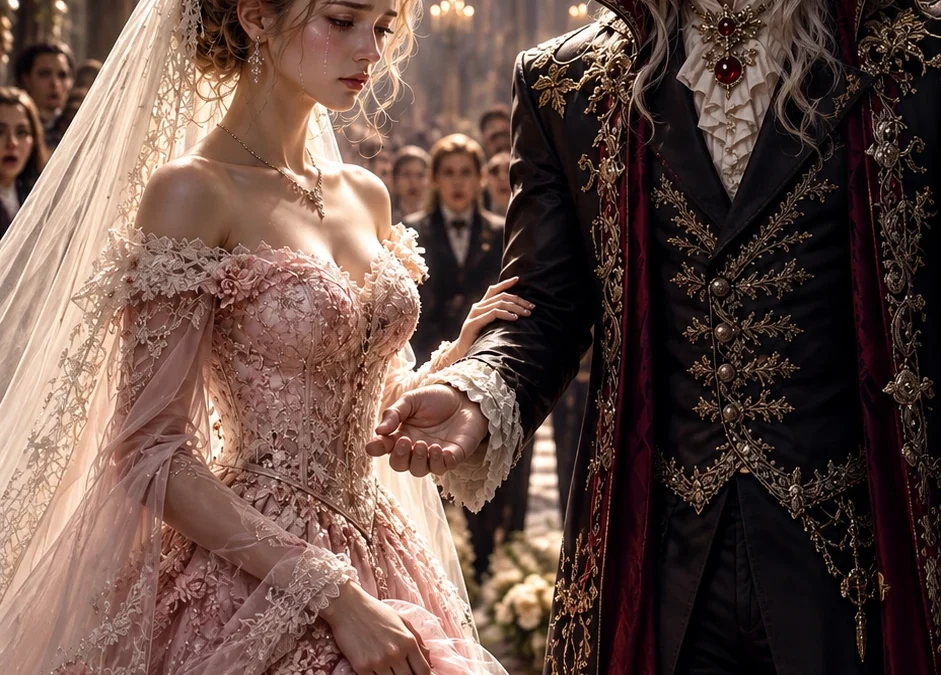
SHE WAS LEFT AT THE ALTAR IN FRONT OF 300 LAUGHING VAMPIRES. THEN THE FEARED VAMPIRE KING TOOK OFF HIS GLOVE AND SAID FOUR WORDS THAT STOPPED THE ENTIRE COURT… 🦇💍😱
Part 1
They abandoned me at the altar in front of 300 nobles of the Night Court. 🕯️
And the man who rescued me was my fiancé’s own brother, the Vampire King himself.
Everyone assumed he did it out of pity.
It took me a full year to learn the truth. When I finally did, I cried harder than I had that night, alone in a wedding gown before an empty altar.
But this story does not begin with a rescue. It begins with a humiliation.
My name is Isabela de Altamira. My father was the count of a minor mortal house that had served the Night Court for seven generations. We were noble in title and poor in pocket, the kind of family that mends the inside of a dress so the embroidery on the outside keeps shining.
When Prince Adrián, the king’s younger brother, noticed me during the winter season, my father wept with relief. I wept with hope. How foolish I was.
Adrián was charming. I learned to hate that word. Charming like thin ice on a lake: beautiful, glittering, and built to make you sink.
For three seasons he courted me, and for three seasons he taught me my place through little remarks wrapped in laughter.
“That dress is lovely, Isabela. You can hardly tell it’s last year’s.”
“I adore that you read so much. Though at court, a woman who quotes books looks like she’s showing off. Just smile. Smiling suits you better than thinking.”
Every sentence was a pin. One pin doesn’t hurt. Three hundred pins over three years leave you convinced you’re lucky anyone wants you at all.
That is how the poison works. It doesn’t destroy you all at once. It shrinks you until you fit in the palm of his hand.
The wedding was held in the Cathedral of the Vigil, where the stained glass lets in not sunlight but moonlight. It was a full-moon night in November. Three hundred nobles of the four blood clans filled the stone pews: the Corbino with their black feathers, the Belmonte with their rubies, the Vesper with their silver masks, and the royal Draven clan, wearing their ancient silence like a cloak.
I wore my mother’s wedding dress, which I had altered with my own hands over six months because there was no money for a new one. Tiny pearls on the bodice. A lace veil that still smelled faintly of her.
Mama, I did it, I thought. We’ll be safe. Papa will be safe. We will never be cold in winter again.
The organ began. I walked to the altar on my father’s arm, trembling with his pride. And I waited.
I waited while the black wax candles burned down. I waited while the murmuring began, first like rustling fabric, then like a swarm. He’ll be late, my father whispered, his voice cracking. Princes are always late.
Half an hour passed. Then an hour.
The murmur became a tide of stifled laughter, of fans snapping open to hide smiles, of whispered bets. I stood frozen in my pearls, feeling 300 pairs of eyes devour me with more hunger than any vampire had ever felt for blood.
Then a pale young messenger from the prince’s household rushed in, a letter in his hand and terror on his face. He gave it to the high officiant, who read it and turned white. And because protocol is cruel, he handed it to me.
I knew Adrián’s elegant handwriting instantly. I can still recite that letter by heart. Some wounds you learn like poems.
“Dear Isabela, forgive me, but I cannot. Last night I understood that marriage is a cage, and you, with all your sweetness, are its bars. I am leaving for the continent with the Countess Vivienne of Clan Vesper, who understands that a man like me needs open sky. Do not hold a grudge. You will always be a charming memory. —Adrián.”
A charming memory.
Three years of my life. My father’s entire dowry paid in advance. My name, my honor, my future.
Someone laughed in the Corbino pews, a sharp, crystalline, cruel laugh. Then another. Then the whole swarm.
Poor thing. I always knew she wouldn’t measure up. What did a little mortal countess expect? Look at the dress. It’s a hand-me-down.
My father staggered and gripped a pew. I wanted to die. I prayed for the floor to open and swallow me whole, veil and pearls and surname. I couldn’t move. If I moved, I would break in front of them, and not breaking was the only thing I had left.
And then the laughter died. Not gradually. All at once, like a candle snuffed under glass.
In the new silence I heard footsteps. Slow. Steady. Echoing on the marble of the central aisle.
The Vampire King had attended his brother’s wedding out of duty, seated alone in the royal box as always. Lucian Draven, King of the Eternal Night. Three hundred years old, with the face of a man of thirty. Black hair to the nape of his neck. Gray eyes that, the court whispered, had not looked on anyone with tenderness in a century.
They told terrible stories about him. That he crushed the Corbino rebellion in a single night. That he never smiled. That his heart, if he ever had one, was buried with his father.
That man climbed the altar steps one by one until he stood before me.
Up close, he did not look like ice. Up close, he looked tired. Tired and furious, but not with me. He looked at the letter in my hands, at my veil, at my eyes full of tears I refused to release.
Then the Vampire King did something no protocol in a thousand years had ever imagined. He took off his black glove, finger by finger, and held out his bare hand.
“Marry me instead.”
Four words, spoken low, only for me. And the whole cathedral heard them.
“Majesty,” I managed, my voice breaking. “You don’t have to do this. I don’t need pity.”
Something crossed those gray eyes, something fast and deep that I could not read then, and that breaks my heart to remember now.
“It is not pity,” he said. “It is the most selfish thing I have done in three hundred years.”
I took his hand. It was cold, as all his kind are cold. And I swear it was the first touch in three years that did not make me feel small.
That very night, in my mother’s veil and the pearls I had sewn myself, I married not the prince who broke my heart, but his brother.
I had no idea I had just placed my hand in the hand of the only man who had been silently, desperately in love with me for years.
The next dusk, I woke in a freezing palace wing and found three things outside my door. A tray with thick hot chocolate, fresh bread, and figs with honey, my favorite childhood treat, a secret no one in that court could know. A white wool shawl folded with almost shy care. And a note in firm, old-fashioned handwriting.
“The east wing is cold. The masons will come at dusk and work only when it suits you. —L.”
Weeks later, a bookshelf appeared in my sitting room, filled with every book from my impossible childhood wish list. On top lay a note.
“A woman who quotes books is not showing off. She illuminates. —L.”
I went cold from head to toe. That sentence was the exact answer, word for word, to the poison Adrián had whispered to me three years earlier at a winter ball.
Which meant someone else had been standing close enough to hear it. 😨
Someone with a vampire’s ears and a vampire’s memory.
Someone who had spent three years keeping that sentence like a splinter in his heart.
Why would the most feared king in the night remember something said at a ball years ago? 👇 Find Part 2 in the comments, or leave any word and I’ll send it to you privately!
Part 2
Someone who had spent three years keeping that sentence like a splinter in his heart.
I should have understood everything in that moment. I didn’t. And I want you to know why.
When you spend years with someone like Adrián, your heart learns a terrible lesson: everything good gets billed later. His charm in public was paid for in private with three days of coldness. His gifts always came with a favor attached. Tenderness was always the bait, never the fish.
So when the king began filling my life with silent acts of care, my heart did not say how wonderful. It said, careful, Isabela. The invoice is coming.
And I sat down to wait for it, like someone awaiting a forecasted storm.
Meanwhile the court seethed. It was one thing for the king to rescue me from ridicule. It was another for a mortal countess in an inherited dress to be his queen.
Duchess Morgana, the king’s aunt and the most venomous woman at court, made that clear at my first state dinner, her smile pure fang wrapped in lace. “How brave of you to use the antique silver, my dear. So hard to know which fork belongs to which dish when one wasn’t raised among them.”
The familiar giggles. The familiar heat crawling up my neck.
“Aunt,” the king said, without lifting his eyes from his cup. “How brave of you to lecture on upbringing, when your own husband left with the house diamonds and half the staff.”
Crypt silence. The duchess turned the color of ash. No one in the Night Court dared mention the duke’s flight.
“My consort will use the cutlery however she pleases,” Lucian added. “Anyone with a problem may bring it to me. Tonight I am feeling generous.”
Nobody had a problem. Not that night, not any night after.
Winter passed in this strange truce. We dined together twice a week at a table far too long, discussing treaties, harvests, and the books I devoured. I discovered the king had read everything, and that he argued with me as an equal, without the condescension of the court men who treated my opinions like a child’s whims.
One night I dared to correct him. “Maese Orión is wrong in the third volume. The blood tides follow the new moon, not the full. My own house’s records, seven generations of them, say so.”
The king set down his cup. For the first time in four months of marriage, I saw something like a smile touch the corner of his mouth. It lasted a second. It was like watching lightning in a closed night.
“Write it down,” he said. “Correct the treatise. The royal printing press is yours. You are right, and your house has been right for seven generations. It is time it signed what it knows.”
Adrián, in three years, never asked what I thought. This man gave me a printing press. And I still waited for the bill. Every gift made me tighter.
One January night I could not bear it. He had sent me an ermine-lined velvet cloak because he’d heard me cough in the gallery. I carried it down to his study in my arms like a corpse.
I found him among maps and candles, sleeves rolled. His gray eyes did what they always did with me: they stopped. In a court where everyone glanced at you sideways, calculating, he looked at me straight on, as if looking were his way of resting.
“I cannot accept it,” I said, and set the cloak on his desk.
“You dislike the color.”
“I dislike not knowing what it costs.” My voice cracked. Months of tension spilled out. “The books, the fire, the figs, the press, the chair facing east. When do you tell me the price? I would rather pay it now than wait every night like a condemned woman who doesn’t know her execution date.”
The silence was so long I heard the candles crackle. The king rose, circled the desk, and stopped two paces from me. Always two paces. A respectful distance he never crossed.
“That is what my brother taught you,” he said, his voice rougher than I’d ever heard it. “That all care is debt.”
“He taught me how the world works.”
“He taught you how he works.” His eyes flashed, and for an instant I saw the king who crushed a rebellion in a night, but the fury was never for me. “Hear me, Isabela. I will say this once. There is no price. No invoice. No execution. Burn the books. Refuse every cloak. Never dine with me again. Your fire will still be lit and your father will still be protected. What I give you is not charged. It is given.”
“Nobody gives without charging,” I whispered. I hate the woman who said that. But she was the only woman I knew how to be.
He took the cloak from the desk and settled it on my shoulders with a care that made me tremble. “Then I will have to prove it with time. It is the only thing I have in abundance.”
Later, my maid Rosaura braided my hair by the fire. Her grandmother had served in that palace sixty years. “She says vampires don’t love like us,” Rosaura told me. “We love in wildfire, fast, with big words. They love like glaciers. Slow, silent, forever. And in sixty years, Majesty, my grandmother never once saw the king order a fireplace lit for anyone.”
I didn’t sleep that morning.
Then spring came, and with it, Adrián.
He returned from the continent bankrupt. Countess Vivienne had abandoned him when she learned he owned nothing, that it was all the crown’s allowance, and that the king had cut him off after the failed wedding. He’d left debts in three cities. So he came back to the only place his face still opened doors.
He looked at me like a shop window. He catalogued my sapphires, my title, my silk. “The crown suits the queen better than I ever imagined,” he said. “Isabela, you are transformed.”
Beside me, the king’s gloved hand closed on the throne’s armrest, and I heard the ancient wood crack.
Then came the siege. Casual encounters that were not casual. Nostalgia laced with pins. You used to laugh more. He rewrote the past before my eyes. I didn’t abandon you, I stepped back. I was terrified of not deserving you. He cornered me in the moonrose greenhouse one April midnight.
“We’ll annul your marriage. You’ll come back to where you belong.”
And then the door opened, and the king stood there, holding a book of poems he’d come to leave on my chair.
He did not accuse. He did not shout. His only question, in those gray eyes, was are you all right?
“Moonroses close if you speak too loudly,” he told his brother, softly. “Some beautiful things spend years closed because of a single frost. Good night, Adrián.”
I caught him in the gallery. For the first time in my life, I explained myself not out of fear, but because I wanted to. He listened to everything.
“You stay silent,” he said gently, “because for three years speaking was punished. That doesn’t heal in one winter.”
He offered to exile Adrián that very night. Then refused to. “Because then you’d never know if you stayed with me or if he simply stopped being there. I can live without many things. I’ve spent three hundred years proving it. I cannot live with that doubt. Let him stay. Let him show you everything he is. And then you choose. Freely.”
His voice shook, a quarter-second tremor. “If you choose him, I will sign the annulment without a word. I swear it on the old blood.”
“And if I choose you?”
His gray eyes lit slowly, like embers meeting air. “Then you will be the first thing in three hundred years that is mine because she wanted to be.”
I sat on the stairs that night, laughing and crying. He gave me permission to leave. Adrián never even let me choose dessert.
Then a letter arrived from Countess Vivienne, the woman Adrián abandoned me for. She was warning the king. Adrián writes of paying everything soon. Of new friends with old gold. Of a throne with less dust.
I read it four times with cold hands. And when the king asked why I’d gone pale, I said, “It’s nothing. My father’s chest again.”
I lied. Because the old instinct to swallow danger alone was still faster than I was.
So I investigated alone. And what I found, with the help of a laundress, a footman, and a little candle boy named Tomás, was a half-burned scrap of paper rescued from the west-wing hearth, in Adrián’s elegant hand.
“Founding Vigil. Ceremonial cup. Silver aconite. After the toast, the clamor. A mortally weakened king cannot hold the night. The Corbino votes are guaranteed.”
Silver aconite is one of only three substances in the world that can kill a pure-blooded vampire.
They weren’t planning to overthrow my husband.
They were going to murder him in front of the entire court. And his own brother would be the one to hand him the cup. 😱
Will Isabela warn the king in time? And what is the secret he has kept for three hundred years? 💔 LIKE or COMMENT “REVEAL” to unlock Part 3, which will be posted once we have enough comments!
Part 3
I had eleven nights, a burned paper, and the word of a laundress, a footman, and a child, against a prince of the blood and the most powerful duchess in the court. Any blood tribunal would laugh at me. And if Morgana smelled that I knew, the paper would vanish and the witnesses would wake up mute or dead.
I should have gone straight to Lucian. You’re shouting it at me from the other side of this story, and you’re right. But I had just lied to his face about Vivienne’s letter. If I accused his brother of fratricide now, I’d have to confess that lie first. And the old terror whispered: He’ll see you hid it. He’ll stop looking at you the way he does. The light under the doors will go out.
Fear is a moneylender. It lends you silence and charges you in disasters.
So I did something in between. I went looking for more proof.
It took six of the most terrifying nights of my life. On the seventh, Petra, Morgana’s senior maid, whose sick granddaughter the royal physician had saved in January on the orders of someone you can guess, handed me a memorized copy of three dictated letters. And something better: the place and time Adrián would collect the vial. The old mausoleum crypt. The tenth night, at the third bell.
And then I made the mistake that nearly cost us everything. I decided to see it with my own eyes.
I wore Rosaura’s gray cloak and slipped down a servants’ passage that Tomás had traced on my palm with his finger. I hid behind the sarcophagus of King Draven the Second. At the third bell they arrived: Adrián in a traveling cloak, Morgana veiled, and a Corbino vampire in livery.
I heard everything. The smoked-glass vial changing hands. Three drops in the ceremonial cup, which Adrián, as prince of the blood, would have the honor of presenting to the king. Nobody inspects a brother’s hands. Morgana’s promise: the Corbino would call for a regency. Adrián would be crowned before dawn.
Then Adrián’s voice, light and amused, said the sentence that burned away my last doubt about who he was. “And the widow queen is mine, make no mistake. Now that she’s educated, she’s even a pleasure to look at. My brother fattened her up with titles. It’s only fair I inherit her. Like china. Like a horse.”
I felt no pain. Just a clean, clear, almost grateful cold. The cold of the last door closing.
I turned to leave, and Rosaura’s cloak brushed a bronze funeral urn. It fell. The sound of metal on stone was the end of my mortal world.
“I smell your fear, little one,” Morgana purred into the silence. “And I smell Altamira wool.”
I ran. I ran as I have never run, through Tomás’s passage, hearing behind me that silence worse than footsteps. Vampires make no noise when they hunt.
They didn’t need to catch me. Morgana, that old spider, saw in two seconds what to do. Not murder the queen in a tunnel. Too much scandal. Instead: accelerate the plan.
I reached the grand vestibule breathless, hair undone, still wearing the maid’s cloak, just as the court was leaving the evening concert. And from the top of the staircase, Duchess Morgana pointed at me and cried out in a trembling aunt’s voice:
“There she is! Majesty, your wife! We all saw her leave the old mausoleum, dressed as a servant, from the arms of Prince Adrián!”
Three hundred faces turned toward me. The swarm. The cathedral swarm, two years later, buzzing with joy at a new scandal.
And Adrián stepped from the colonnade with the perfect expression of a tormented lover. “Brother, forgive us. We tried to avoid it. Some loves don’t die.”
It was an exquisite trap. In one stroke they made me an adulteress, invalidated any accusation I might make, and broke the one thing anyone had ever seen Lucian love, so he’d walk into the Founding Vigil with a clouded mind and a shattered heart.
The king stood at the foot of the stairs, still holding the concert program. He searched for me over the crowd. The whole court watched him, savoring the moment, waiting for the legendary Draven wrath.
My husband looked at me. At my servant’s cloak, my wild hair, my heaving chest, all the evidence perfectly arranged against me.
And the King of the Eternal Night did the one thing Morgana, with all her ancient cunning, had never calculated.
He crossed the vestibule, took off his own cloak, and laid it over my shoulders, on top of the gray one. 🖤
“My wife holds the keys to every door in this kingdom,” he said, in a voice that reached the last column in the farthest corner, “including the mausoleum’s. She owes no explanation to anyone who breathes in this hall. Least of all to a woman who hasn’t set foot in a crypt in a decade and chose, how curious, this night to stroll among tombs.”
Silence.
“Majesty,” Morgana insisted, oily. “Grief blinds you. We saw them.”
“Did you see my wife leave a passage alone?” the king asked. “The rest your nephew added, and his word is worth exactly what his debts are worth. The evening is over.”
He offered me his arm, and with the court parted like a sea, he walked me out, my head high. Mine, because his had never bowed.
But under my hand, his arm was rigid as the bronze funeral urns. He believed me. He had defended me without a second of doubt. And inside, something was bleeding, because I had lied about Vivienne’s letter, and he had always known, and still he covered me with his cloak before the world.
At the door of my wing he said only one thing, low and without reproach:
“When you’re ready to tell me what’s weighing on you, I’ll be here. Even if it takes years. Waiting is what I do best, Isabela.”
I didn’t let him reach his study. My hand shot out and caught his sleeve, and the king stopped as if my hand weighed more than all his centuries.
“I’m ready now.”
And there in the corridor, with candles trembling, I told him everything. Vivienne’s letter and why I hid it. The burned paper. Petra and her granddaughter. The crypt, the vial, the three drops, the bought Corbino votes. Even the sentence, the widow queen is mine, because I had decided there would never again be a single hidden stone between that man and me.
Lucian listened without interrupting. His face changed three times, and I remember each. At silver aconite, something ancient and dark passed through his eyes, the shadow of a king who has watched his own die. At alone in the crypt, he closed his eyes a full second and a muscle jumped in his jaw, and I understood what it cost him not to shout never expose yourself like that! At the widow queen is mine, he looked down at his own hands, slowly, as if checking they still obeyed him.
“Do you know why I never pressed you about the letter?” he said at last. “Because it was your armor for years, and no one has the right to tear another’s armor off, not even with love. You can only wait until they no longer need it.” His gratitude was so naked I had to hold the doorframe. “Thank you for taking it off.”
“And now? The guard? Do you arrest them tonight?”
“Not tonight.” And there I saw, for the first time, the king’s full smile. Not a happy one. The smile of a chess player who has been underestimated for two hundred years. “If I arrest them now, I have a vial and mortal witnesses, and Morgana has ten bought judges and a story about an unfaithful queen. No. They will serve me that cup before all four clans, and the whole kingdom will see exactly who they are.”
“Silver aconite kills a pure-blooded vampire.”
“It kills one who hasn’t spent two hundred years waiting to be poisoned.” He rolled back his left sleeve. On the inside of his forearm ran a row of tiny, pale scars, neat as lines of verse. “My father made me take one drop every month since I was fifty. Mithridatism, the alchemists call it. A king of the night must be immune until his own death. I hated him for it for a century. Tonight, for the first time, I will thank him.”
He lowered the sleeve. “Three drops will not kill me. They will hurt me,” he admitted, with a frankness that froze me. “A night of blood fever. Maybe two. But not death. And that is exactly the margin I need, because there is a law older than the throne, written in the old tongue on the first stone of this palace. Whoever raises a hand against the blood of his blood loses all blood, the inherited and the promised. But the crime must be completed before witnesses of all four clans to invoke it. Stop it early and it’s only conspiracy. Ten years of slow poison at court. If they drink the whole show, it ends forever. For both of them.”
“It’s madness. A thousand things could go wrong.”
“Yes.” He took both my hands, the first time he’d ever held both. “That’s why I won’t do it without your permission. It’s my life at risk, but your peace at stake. If you say no, I walk in tomorrow with the guard and accept ten years of slow poison. You decide.”
You decide. Even for his own death, that man let me choose.
The days that followed were the strangest of my life. Outside, the palace prepared for the Vigil: garlands of shadowflowers, clan delegations arriving each night, protocol unfolding like a golden machine. Inside, my husband and I built the trap within the trap. Captain Elric, head of the Royal Guard and the only soul Lucian trusted blindly, was told. Petra and the witnesses were moved beyond Morgana’s reach, with their whole families, to Altamira, under the pretext of service to my house’s dowager. And the vial in the crypt was watched night after night, untouched, because we needed the treachery to reach the cup intact.
And through it all, the gentle tide kept coming. On the eve of the Vigil, I found on my chair the new edition of Sor Valentina’s sonnets, with the twelve unpublished poems, and a blue velvet ribbon marking a page. The sonnet spoke of a love that doesn’t ask. A love that stands by the door holding the lamp every night it takes.
I found him in the portrait gallery, before the painting of our wedding, where the artist had painted me sad. “If something goes wrong,” I began.
“It won’t.”
“If something goes wrong,” I insisted, and stood between him and the portrait. “I want you to know the woman in that painting no longer exists. The sad bride is gone. The woman here is one who no longer waits for the invoice. Who knows what it is to be cared for without being charged. Who learned, a little late, that love isn’t vertigo. It’s constancy.”
Lucian went utterly still, with that total stillness of his kind, like the world one moment before thunder. “Isabela,” he said, very low. “Don’t tell me this on the eve of a poisoning. I’ve been prudent for three hundred years and I have very little prudence left to spend.”
“And if I don’t want you to be prudent?”
He raised his hand slowly, giving me all the time in the world to step away, as always. Everything with him was my choice. He tucked a loose strand behind my ear. His fingers brushed my cheek, cold, and yet left a fire.
“When this is over,” he said, “there is something I have wanted to tell you for a very long time. I’ve forbidden myself every night since before you imagine. I’ll tell it when you are free of fear and I am free of poison. And if tomorrow doesn’t come, it will.” Then, with the first unguarded tenderness I’d heard in his voice: “You have given me a three-hundred-year reason to survive three drops.”
He kissed my forehead. His lips were cold, my skin burning, and the sad bride in the painting watched us from her gilded frame, no longer holding any power over us.
The Founding Vigil. A thousand black wax candles. The banners of four clans hanging from the vaults: Corbino feathers, Belmonte rubies, Vesper masks, the Draven night dragon. The old tongue echoing like wind in crypts, which no longer frightened me, because I understood it now.
I sat on my throne at the king’s right with my consort’s crown and a heart pounding so hard I feared three hundred vampire ears heard it like a drum. Lucian was calm made flesh. No one would have guessed he knew what was coming in the cup. Morgana sat in her seat of honor, splendid in black lace, handing out matriarch smiles. And Adrián, in silver finery, waited beside the altar, where the ceremonial chalice, an obsidian cup older than the kingdom, awaited the final toast.
The rite advanced. Oaths. Offerings. Chants. Then the high officiant consecrated the blood wine and called, by custom, the king’s nearest kin to the honor of the cup. Adrián stepped forward. I watched him in profile, golden and beautiful beneath a thousand candles, and I saw him make the gesture.
It was lightning fast. A flick of the wrist over the chalice as he bowed in ritual reverence, his hand covering the obsidian mouth for a second. Not one vampire in a thousand would have noticed unless they knew what to look for.
That night, three pairs of eyes knew. Mine. Captain Elric’s, posted behind the columns with six trusted guards. And Lucian’s own, as he accepted the chalice from his brother’s hands and smiled at him.
“By the blood of the blood,” Adrián said, in the ancient toast. “To the king who lives a thousand nights more.”
“By the blood of the blood,” Lucian answered. Looking his brother in the eye before the whole standing court, he drank the chalice dry.
I stopped breathing. I dug my nails into my palms until they bled.
For ten seconds, nothing happened. Adrián was already retreating to his place, with the slight haste of a man stepping away from a lit fuse. And then the obsidian cup slipped from the king’s hand and shattered on the marble. Lucian doubled over on his throne. His centuries-pale skin turned ash gray. The veins in his neck and temples drew themselves in black, like rivers of ink.
The King of the Eternal Night fell to his knees before the four clans.
The hall exploded. Screams, overturned chairs, the high officiant frozen with his hands raised. And above the chaos, punctual as an actress who’d been rehearsing a month, rose the voice of Duchess Morgana.
“The king is dying! The night cannot be left without a throne! The clans must proclaim Prince Adrián regent now, before dawn, or the kingdom burns!”
“Regency!” chorused the bought Corbino benches. “Regency!”
Adrián turned to the hall with the composed face of the devastated brother, the prince equal to the tragedy, and opened his arms, heartbroken. “I accept the duty that—”
I did not shout. I learned that from my husband. Calm frightens more.
I rose from my throne with the crown on my head, and my voice crossed the hall because the whole hall had turned to look at me. I, who two years earlier had died of shame before three hundred nobles, held three hundred pairs of eyes without blinking.
“Captain Elric. The prince’s left sleeve.”
Elric and his men came out from behind the columns like a tide. Adrián backed away, but two guards already held him, and from the lining of his left sleeve, sewn in with silk thread, the captain drew a smoked-glass vial, empty to three-quarters.
“Silver aconite,” Elric announced, thunder in his voice. “Bought eleven nights ago in the old mausoleum crypt, from the hands of Duchess Morgana. Before witnesses who have already sworn before the blood tribunal. The guard has watched it since without touching it. The chain of custody is intact, lords of the clans.”
“Lies!” Morgana shrieked, and her matriarch’s mask cracked for the first time in two centuries. “It’s a plot by that mortal! The adulteress, she and her rats of servants fabricated it!”
“Fabricated,” I said. And I descended one step from the dais. Only one. “Duchess. The poison is in the king’s blood. All four clans saw it. The only thing we dispute is whose hand put it there. And that hand has just appeared sewn into your nephew’s sleeve. But you are right about one thing. One voice is missing from this trial. The most important one.”
Behind me came the sound I had been waiting three minutes for, with my soul between my teeth, exactly as he had promised it would sound.
The king was rising from the marble. Slowly. With terrible, visible effort. Still gray, the rivers of ink throbbing in his temples. But whole. 🖤
The hall fell silent as the sea before a tidal wave, because all four clans understood two things at once: that the deadliest poison in the night had not conquered the Draven, and that the Draven had always known.
“Three drops,” Lucian said. His voice rasped but reached every corner. “Two hundred years I have taken one a month, brother, in case tonight arrived. Our father taught me a king must be immune until his own death. A pity he taught you only to arrive late. Though I admit, tonight you arrived early for the first time.”
He stepped toward the altar.
Adrián, held by the guards, began to shake. His golden beauty came undone in seconds. Beneath it was nothing but a cornered old child searching for an exit, for a staircase, for a veiled woman to save him. “Brother,” he stammered. “It was her. It was Morgana. She tricked me. I had debts. You wouldn’t help me. In the end this is my fault.”
Lucian stopped before him. Instead of anger, which Adrián had spent his life dodging and provoking, he gave him something no one can fence against. The truth, in a low voice.
“I raised you, Adrián. I taught you to ride. I covered your debts. I buried our mother holding your hand. I gave you everything except consequences. That was my sin, because a man without consequences becomes this.” He looked at him up and down, without hatred. The serene contempt of that gaze was worse than a hundred lashes. “Not anymore. Tonight they all arrive together.”
He turned to the clans and raised his voice, and though the poison still ran through him, it held up the entire vault.
“Law of the First Stone. Whoever raises a hand against the blood of his blood loses all blood, the inherited and the promised. Completed before the four clans. Does anyone dispute it?”
No one did. Not even the Corbino benches, where the bought votes were being resold at top speed, at the price of silence.
The sentence was pronounced that same night, because the law of the First Stone allows no delay. And I want to tell you how the villains fell, because I know you’re waiting for it, and because each punishment was, in its way, a mirror.
Duchess Morgana was stripped of everything. Title, lands, her seat at court, and something more precious to her than all the rest: her clan’s blood. The high officiant pronounced the formula of unclanning in the old tongue, and the Draven delegates, one by one, turned their backs on her. That is the rite. The woman who had ruled the salons for two centuries with venom and whispers left the palace that dawn a vampire without a clan, without a crest, without invitations, condemned to the cruelest eternity for someone like her: irrelevance. They say she lives in a small house on the border, writing letters nobody answers. When I think of her, I feel no pity. I feel symmetry. She spent her life closing doors on others, and she will spend eternity before closed ones.
The Corbino courier was handed over by his own clan before sunrise, with bows and cold sweat, to buy the king’s mercy. The Corbino paid their share with a century of doubled tribute and the loss of their council seat. Lucian did not annihilate them, though the law allowed it. A king who rules by fear breeds new traitors every night, he told me. A king who rules by debt breeds grateful ones. I told you he’d been playing chess for two hundred years.
And Adrián lost the inherited blood and the promised. By the First Stone: every title, every income. Even the name Draven was withdrawn before the clans. Now he is only Adrián, plain, which is what he always was beneath the embroidery.
The law allowed execution, and the whole hall expected it. And I, God forgive me, would not have wept. But Lucian stayed the executioner’s hand. Death, the king said before the clans, would be a gift to a man who has never endured a whole consequence. I grant him something far more instructive. The life he always claimed to deserve more than anyone. Let him earn it. Perpetual exile to the mortal provinces of the south. No escort, no income, no surname. Only his hands, which was all the law left him.
I watched him leave the next dawn from my window. A man on horseback without a retinue for the first time in his life, shrinking along the southern road. I expected to feel triumph. I felt nothing, only a sweet tiredness, like when a long fever breaks. The years have taught me this is the true end of sick love. Not hatred. Hatred is still a tie. What frees you is indifference. Years later I heard of him once: a clerk in a southern port, writing love letters for illiterate sailors.
Life has a frightening aim.
But that dawn I wasn’t at the window. I was where I belonged, in the king’s chambers, for the first time since our wedding, tending my poisoned husband. The blood fever arrived on schedule, exactly as he’d warned.
When the hall emptied and the crown could stop performing, Lucian collapsed in the corridor outside his rooms, and it was I who held him. I, with my mortal arms, holding up the King of the Night. And it was the first time the Royal Guard ever saw their lord allow someone to hold him.
The fever lasted two nights. Two nights of ink rivers throbbing under his skin, of shivers that shook the enormous bed, of the old tongue spilling out in delirium. Words from three centuries ago. His mother’s name. Orders to soldiers dead two hundred years. The royal physician, the same who saved my father, did what could be done, which was little. The aconite had to be sweated out drop by drop, hour by hour. I did not move. Rosaura brought me broth and changed the basins of cold water, and I laid cloths on my husband’s forehead and talked to him.
I talked to him two whole nights. I read him Sor Valentina’s sonnets, the twelve unpublished ones, with the blue velvet ribbon marking the one about the love that holds the lamp by the door. I told him my whole childhood, the true one, not the court version. My mother dying when I was nine. The cold of Altamira. The impossible books on the list. The girl who read hidden in the barn because dreaming was free.
And on the second night, my voice cracking from so much speaking, I told him what I had never told him, because doctors say the sick can hear. And I no longer wanted any hidden stone.
“Don’t leave, Lucian. Listen to me, King of the Night. Don’t you dare leave now. Because I spent my life waiting for the invoice, and when I finally understood there was none with you, that yours was the good kind of love, the kind that stays, that lights fireplaces and never mentions it, something terrible happened to me. I love you. There. I said it. I love you. I love your silences and your reading glasses you think no one has seen. I love how you look at me when you think I’m reading. I love that you even gave me the freedom not to love you. And if you die now, now that I finally know how to say it, I swear by the old blood I won’t forgive you in this life or the eternal one.”
Silence. The fire crackling. And then, from the pillow, eyes still closed, in a thread of rough gray voice:
“Promised. I’m not dying.”
A pause. And with the corner of his mouth trembling:
“Repeat the middle part. I’m hearing it terribly.”
I laughed and wept at once on his cold chest, and his hand rose, still trembling with fever, and settled in my hair. We stayed like that until noon, both asleep for the first time under the same closed roof, while outside shone a sun he could not see and, for the first time in three hundred years, as he told me later, did not miss.
When the fever broke fully on the third night, Lucian sat up against the pillows, still pale but with eyes clear of ink, and looked at me for a long time. “You said things,” he said.
“I said many things.”
“You said you love me.”
“I said that if you died I wouldn’t forgive you.”
“The other part you delirium’d, Isabela.” And there was that new smile, the one only I know. “I have my kind’s hearing. I heard your heart speed up at the word fireplaces.” Then, suddenly serious, with a solemnity that frightened me: “You still don’t know everything. I promised you when you were free of fear and I was free of poison.” He pushed back the blankets, rose unsteadily, and refused my arm with stubborn tenderness. “Come. I can walk. I’ve waited for this walk longer than you imagine.”
“Where are we going?”
“To the north tower. To the room no servant is permitted to clean.” He held out his hand. “You’re going to meet the man you’ve been married to for two years.”
The north tower was the oldest in the palace, the one of the first stone. We climbed the spiral steps in silence, he ahead with a candelabrum, I behind with my heart in my throat. Before an unadorned oak door, Lucian drew a small key from around his neck, warmed by his chest.
“I need you to know it was never my intention that you see this,” he said. “It wasn’t made to be seen. It was made because not making it was impossible. There’s a difference.”
He opened the door.
It was a circular study with covered windows and walls lined with shelves, and at first I didn’t understand what I was seeing. Then the candlelight began touching things, and I did, and I had to lean on the doorframe because my legs stopped holding me.
Sheet music. Dozens of handwritten scores, stacked and dated. I sing, I told you. I sang at court evenings during my years as Adrián’s fiancée, because Adrián displayed me like a songbird. And this man, this king who always sat at the back, alone and out of duty, had transcribed from memory every song I sang over three years. With notes in the margins in his firm, old-fashioned hand.
Tonight she sang lower. She was sad and no one noticed.
She failed the same passage again. It isn’t the passage. In that verse she always glances at the door, as if measuring the exit.
Today she laughed for real in the second chorus. I mark this day as memorable.
And there was more. A copy of my tide treatise, the first printing, which I’d believed lost, rebound in blue leather with silver-protected corners, the way relics are bound. Dozens of letters addressed to I., written and never sent, dated from a year and five months before my ruined wedding. And on the central lectern, under a velvet cloth that Lucian lifted with both hands, the way an altar is unveiled, the object that broke me and remade me in one stroke.
The program of a winter concert from four years ago, creased and smoothed a thousand times, with a note in the margin dated that same night, in my husband’s handwriting.
Today it happened. The light under the doors. She sings for three hundred and is lonelier than I am, which I thought impossible. She is my brother’s betrothed. God of the night, if you exist, do not let me be in her way. I will love her from the back of the room. No one will ever know.
Signed, in the old tongue: “Light of my night,” so that not even stolen could I deny her.
“The blood bond,” Lucian said behind me, very still, “does not ask. It fell where it fell, on another’s woman, on my own brother’s, and the law of my lineage is clear. The vampire who claims the mate of his blood unleashes war in his own house. So I did the only honorable thing there was to do. Nothing. Three years, Isabela. Three years attending every evening where you sang, sitting at the back, counting your sorrows from afar without the right to touch them. Three years watching my brother hold the entire universe in his palm and use it to wipe his boots.”
“The cathedral,” he whispered, and the words fell one after another with a sound that was almost music. “That’s why I was there. That’s why I climbed the altar. When he read that letter before you, when they began to laugh, my voice darkened. I broke the promise of my life in four steps, the four steps of that altar. And I told you the only truth I could say without frightening you. That it wasn’t pity. It was the most monstrously happy day of my existence and I could not know it, and I hated myself for it. I married you knowing you did not love me, swearing you would never find out, that you would never feel in debt. That’s why the books had no card. That’s why I never told you about your father’s physician. A signed gift demands gratitude. I never wanted your gratitude, Isabela. Gratitude is another invoice. I wanted you to have a good life, and if one day you loved me, to have it be free. The way it happened to me with you.”
I turned to look at him. The King of the Eternal Night stood in the middle of his secret sanctuary, the candelabrum trembling slightly in his hand. And for the first time since I’d met him, he was afraid. Afraid of me. Of the power I’d held over him for four years without knowing.
“Say the formula,” I said.
“What?”
“The one in the old tongue. The one you signed. Say it aloud.”
He swallowed. Kings swallow, too. I know that now. “Ascabeth Nairi,” he said, and the old tongue no longer sounded like wind in crypts. It sounded like what it was. Home. “Light of my night.” And how the mate answers.
“Because I read those treatises of yours, Lucian. All of them. And I know there is an answer, and I know it’s only valid if no one asks for it and no one is owed it.”
The gray eyes lit like they had that night in the corridor, embers meeting air. He didn’t dare say a word, because to ask would have been to ask.
So I said it myself. I had learned it months earlier, one random dawn, in the seventh volume of the chronicles, without admitting to myself who I was studying it for.
“Nairi Ascabeth. Night of my light. Nobody taught it to me. I owe it to no one. And I’m not expecting an invoice.”
I took a step toward him.
“It’s free, Lucian. Like it happened to me with you.”
What came next I have never told in full and won’t now, because some things are only ours. I will say this. The candelabrum ended up on the floor, upright, by a miracle. He kissed me the way one drinks after a three-hundred-year desert, and his cold lips and my warm ones found a temperature that had not existed in the world before and is only ours.
The years have passed. I have aged as much as a mortal ages, though the bond, the archivists say, lends me slowness. There are silver threads in my hair that Lucian collects with absurd enthusiasm. Each one is a year you gave me, he says, because the man is hopeless.
The court tells our story to newcomers, and like all courts, tells it wrong. They tell the altar, the poison, the trial. They forget the important part. So let me tell it, since it’s my story, and these are the last words I’ll give you.
I was abandoned at an altar in front of 300 people, and I believed it was the end of my life. It was the beginning.
For years I was taught that love was an exam I was always about to fail, and it was a lie. Real love doesn’t examine. I was taught to expect an invoice behind every caress, and the invoice never came. In its place, night after night, year after year, came a lit fireplace, a book with no card, a chair facing east, and a man standing by the door holding the lamp for as long as it takes.
If you are waiting for someone to dazzle you, wait instead for someone who stays. Everyone sees fireworks. Only those who live in the house know the lit fireplace.
Love is not vertigo, or hunger, or big words on a staircase. Love is constancy. It is someone who learns the map of your sorrows so he can put them out one by one, without charging, without announcing, without tiring.
And if one day, after years of gentle tides, that someone buys you a sunrise with a century of his eternity, let him. One extravagance per century is forgiven anyone. Especially when, as the most expensive sunrise in the history of the world rises, he doesn’t look at the sky for one second because he is too busy looking at you.
That is how my husband, the Vampire King, loves me. That is how I love him.
And this time nobody left me waiting at the altar.
The altar was waiting for me. ❤️🦇
Do you think Isabela should have told the king sooner, or was her silence something only a survivor could understand? Tell me in the comments, and share this story with someone who needs to hear that real love is not a firework, it is a lit fireplace!
This story is entirely fictional and created for entertainment purposes only. It does not represent any organization or individual, nor does it encourage inappropriate behavior. The content was generated with AI assistance.








