SHE WAS LEFT BLEEDING IN THE DUST, AND THE ONLY MAN WHO STOPPED NEVER ASKED HER NAME
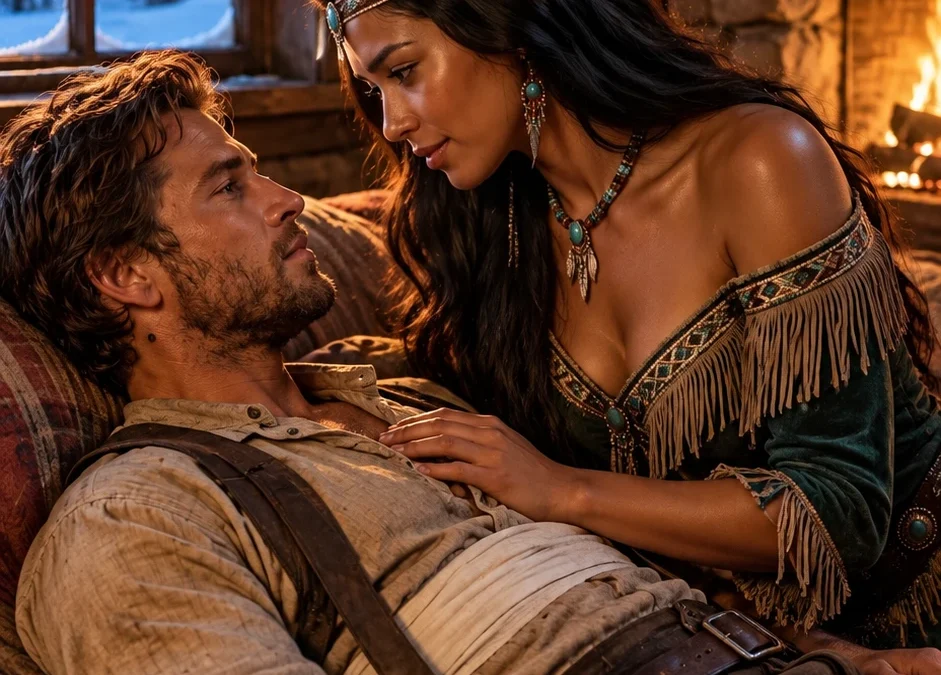
SHE WAS LEFT BLEEDING IN THE DUST, AND THE ONLY MAN WHO STOPPED NEVER ASKED HER NAME 🩸 BUT THREE DAYS LATER, SHE WALKED BACK THROUGH HIS DOOR TO COLLECT A DEBT HE DIDN’T KNOW HE WAS OWED
Part 1
Blood in the dust. Flies on a wound. A dying woman’s ragged breath.
And a hardened rancher who knelt beside her and asked for nothing. 🩸
His name was Gideon Marsh. By spring, he would not recognize the closed-off man he had been before she came.
This was Chiricahua country, the Dragoon foothills of Arizona Territory, autumn of 1881. Cattle range pressed hard against the reservation line, and the peace between settlers and the Chiricahua was thin enough to tear on one wrong word.
Gideon had ridden that ridge trail a thousand times without once expecting to find a body on it.
He was thirty-four, wide through the shoulders in the way of men who had built their own barn plank by plank, with a face the Arizona sun had turned the color of saddle leather. The town of Cochise Flat had long since given up trying to crack his quiet.
Two hundred head of cattle grazed on land his father had failed to hold. Gideon had refused to lose it. He worked it alone, ever since a fever took his wife Sarah four winters back, before either of them had the chance to raise the family they had talked about on their wedding night.
Company held no pull for him. His supply runs into town were quick and wordless. The saloon men described him as solid and closed off in the same breath, as though the two were one thing.
Maybe they were.
The house Sarah had once hoped to fill with children stood two rooms bigger than one man needed. In four years he had never once considered shrinking it to match the life actually lived inside. Practical, he told himself. A bigger house held supplies better through a hard winter.
He never examined that. He never examined most things about the years since Sarah. The endless chores stood conveniently between him and any hour with nothing in it. 🏜️
That afternoon he was moving cattle off the high ridge ahead of an early frost when his blue heeler, Scout, broke from the trail and refused every whistle.
Down into a dry wash choked with cholla and greasewood the dog led him.
And there she was.
Young, perhaps twenty. A doeskin skirt gone dark with old blood down one side. Black hair matted with dust. A gash along her scalp, crusted over. A second wound low on her ribs that had bled through twice and dried twice.
A knife lay near her open hand, its blade dark.
Off toward the rimrock ran a second set of prints. A man’s boot heel, deep and hurried, the stamp of someone running from what he had done. 😨
Gideon knelt. His hand had gone to his pistol on reflex, but it stayed there, undrawn.
Her eyes opened, black and glassy with pain. For one long moment she looked at him the way a cornered animal watches a hand reaching toward it, bracing for a blow that never came.
“Not going to hurt you,” he said, low and even.
Whether she understood English was beside the point. Silence felt like the wrong answer. He had nothing better to offer than tone.
He tipped a half-full canteen to her lips, slowly, the way you water a horse gone too long dry. She drank. Her hand found his wrist and gripped it, not out of fear, but the way a person grips a rope thrown across open water.
He tore the tail of his own shirt and pressed it hard against the gash in her ribs, tied off with a leather cord from his saddlebag. The whole time, her eyes stayed fixed on his hands. Never his face.
He chose the four miles to his cabin over the eight to the agency doctor. Eight miles was too far to ask of a body already losing this much blood.
She took his bed. He took the floor beside the stove. All night he sat up checking that the bleeding had truly stopped, not merely paused. Twice she surfaced, thrashing, words tumbling out in a language rough with pain.
Twice, the same low answer: “Here. Safe.” 🕯️
By the second morning, the fever had broken. When her eyes opened they were clear, and they moved across the cabin, the rifle on its pegs, the stranger asleep upright in a chair beside her bed, with no flicker of fear in them.
More like a woman taking inventory of a room before deciding what to do in it.
“Chiricahua,” she said, in careful English, each word set down like a stone chosen for its weight. “Halona.”
“Gideon Marsh.”
She did not explain the wound, not at first. Then, after a long pause, she did. A man from her own band had wanted more from her than she was willing to give. Her answer had come by knife. His had come by hands and a blade of his own.
She touched the bandage, matter-of-fact, as if closing an account.
Gideon asked why a stranger like her had trusted him not to leave her.
She studied him. And then she said the thing that stayed with him long after.
“Most white ranchers in this territory would have ridden past. Or worse.”
On the third morning she was strong enough to travel. Her people’s rancheria lay a half day’s ride northeast, tucked into a fold of the Dragoons the Army maps never named correctly. He saddled a gentler horse for her and rode with her as far as the ridge where the land dropped toward reservation ground.
At the ridge, she stopped, and looked back at his cabin, small against the wide brown land.
One economical nod. Then she turned her horse down toward the fold in the hills.
Gideon rode home alone and told no one. There was no one in his life close enough to tell.
Two days passed. A decent man had done a decent thing, and the account, in his own reckoning, was closed, the way every account in his life got closed. Quietly, without waiting around for a receipt.
Then, on the morning of the fourth day, before first light, Scout began barking at the door.
Gideon came off his cot with the rifle already swinging toward the sound.
And there she stood, just inside the doorway. The latch had not so much as creaked.
Upright. Steady. Color back in her face. A bundle wrapped in trade cloth balanced against one hip, both hands open at her sides. 😳
“I knocked twice,” Halona said. “You did not answer.”
His rifle lowered by degrees.
“What business brings you here?”
She set the bundle on his table.
“Work,” she said. “Through the winter. Among my people, a life saved is a debt that outlives thanks. I have come to pay it.”
📖 What did she mean by “a debt he never knew he was owed”? Find Part 2 in the comments, or leave any word and I’ll send it to you privately!
Part 2
“Work. Through the winter. I have come to pay it.”
“You don’t owe me anything,” Gideon said. “I told you I wasn’t looking to be paid.”
“You said that,” Halona answered. “I heard you the first time. That is not the same as there being nothing left to repay.” She held his gaze. “My people do not measure a debt by anyone’s hoping. We measure it by what was given. And what was given me on that trail was my life.”
He stood there in the gray predawn light, a woman in his kitchen with more resolve in her spine than most men he had ranched beside.
Every reason a sensible man in this territory had for turning her out the door crossed his mind.
He hung the rifle back on its pegs.
“There’s a room off the tack shed. Small. Has its own stove.”
“I saw it riding in,” she said. “It will do.”
That was, near enough, the whole of it. 🔥
The first days carried no ease, and neither of them pretended otherwise. She was up before him, the fire already built, mending a slack corral rail, resetting a barn-door hinge that had hung crooked for two winters. Meals passed in the particular silence of two people who had not found the shape of talking to each other.
Six days in, he came home from town to find three fence posts reset that had leaned for a year, and the barn roof patched with shakes she had split from scrap cedar.
“That roof wasn’t going to hold another winter,” she said, before he could ask.
“Agreed.”
That evening, extra kindling was stacked beside her door. Neither of them remarked on the trade. 🪵
In the second week she taught him words. Water. Horse. Fire. The word for stranger. Later, one that meant a person who has become known. When he got a sound wrong, she touched two fingers lightly to his throat to show him where the word lived.
He kept every word on a small card in his breast pocket and practiced while riding fence, lips moving whenever he was sure no one could hear him fail.
One evening, over a length of harness leather, Sarah’s name came out of him. Four years, and he had not spoken it aloud to another living soul.
Halona did not rush to fill the silence with comfort. After a while, she told him about her own mother, a hard winter when Halona was twelve, a wasting sickness her father’s medicine could ease but never cure.
“Grief that size doesn’t leave,” he said.
“No.” The corner of her mouth moved. “But it stops being the only thing in the room.”
Something in his chest loosened half a turn. He filed it away, unexamined, in the same orderly part of him that handled everything he was not ready to name. 💛
Her father, Nantan, was one of the last healers of his generation. What he had taught his daughter ran deep: creosote for cleaning wounds, desert willow bark against fever, prickly pear poultice to draw poison from a cut gone bad. When a heifer tore her flank on barbed wire, Halona packed it with prickly pear and had the animal walking sound inside a week.
She taught him weather too. Not almanac weather, but the smell the air carried ahead of a hard freeze, the way horses bunched at the north fence line hours before a storm. Eleven years he had worked that land, and he had read only half its signs.
When the first hard snow came in late November, she stood in the yard at dawn with a wool blanket around her shoulders, eyes fixed east on the Dragoons.
She spoke three low lines in Chiricahua, a blessing her father spoke every year, most of its words long since slipped from her memory.
He stood beside her and let it pass through the yard untouched.
Later that morning, walking the fence line near her tack-room window, he saw three smooth river stones and a sprig of dried juniper lined along the sill. Small things that made a borrowed room look, for the first time, like somewhere a person meant to stay. 🌨️
By December, a second cup of coffee was appearing at the stove’s edge before he woke. Her kindling got split first, ahead of his. When Scout took to sleeping across the threshold between cabin and tack room, neither moved him.
One night a coyote pack tore into the henhouse. Gideon came out in his union suit with the shotgun and found Halona already there with a burning brand from the stove, driving the animals off with fire and noise before a single hen was lost.
Afterward, in the cold yard, both breathing hard, a rusty laugh broke loose from him like a hinge unused for years. After a beat, hers followed.
It was the first time they had ever laughed together. Both noticed. Neither mentioned it. 😂
A week later, he came back from the mercantile with a length of blue trade cloth he could not have explained to the storekeeper. “A color you’d wear well,” was all he said.
The next week, the same cloth appeared as a band at her cuff.
He was looking for it. Nothing got said.
Then, in the third week of December, four horses rode in on a mid-afternoon.
Silas Combes, who ran cattle two sections east, a man who in eleven years had never offered a friendly word that did not come with a price. His brother-in-law Purdy. And two range-hard strangers, armed in the unbothered way of men used to being the biggest thing in any room.
Halona stood in the cabin doorway. She did not retreat inside.
“Folks in the Flat are uneasy,” Combes said. “A man keeping a Chiricahua woman on his land. Got people thinking things have shifted that haven’t.”
“She’s here by her own choosing,” said Gideon. “You’re on land that isn’t yours. I’m asking you once to leave it.”
“I’m being reasonable.”
“This is the reasonable version.”
Combes’s jaw worked. He looked toward Halona, then back.
“Think hard on what you’re doing here.”
“Already have.”
They rode out. Gideon watched until the dust thinned to nothing on the road to the Flat. 😠
Halona, still framed in the doorway, spoke quietly.
“They will come back.”
“Probably,” said Gideon. “The fire needs banking.”
Five weeks later, deep in the hardest part of January, they came back.
But by then, Gideon had been fighting a chest fever in silence for two days.
And before dawn, as he broke a skin of ice off the horse trough, his legs stopped answering. 🥶
🔥 Part 3 will be posted once this gets enough comments. LIKE or COMMENT “REVEAL” to see the ending, and share this story with someone who needs it!
Part 3
Gideon hit the frozen ground hard, the cold coming up through his coat as if to finish what the fever had begun.
Across the yard, a barn lantern that should have been moving went still. Halona read it wrong in an instant and came running.
She did not panic. She made the same fast, steady assessment her father had trained into her for every patient. Then she looped a rope under his arms, planted her feet, and hauled him sixty feet to the cabin, talking low and steady the whole way to keep him from sliding under. 🕯️
Three hours of work followed without a pause. Willow bark tea, spooned in small amounts. A wild-onion poultice at his chest and the back of his neck. The fire built to exactly the heat that would warm the room without making his body fight it.
When he finally surfaced near midmorning, soaked through and aching, the fever had broken.
Halona sat in the chair beside the bed, hands folded, clearly having not slept at all.
“I thought it would pass,” he rasped.
“Men always think that.” She handed him a cup. “Finish it.”
That same afternoon, the worst of the cold barely lifted and his legs still unsteady, they came back.
Eight riders this time. Combes. Two faces half-known from the Flat. And two men wearing tin stars that belonged to no proper county office anyone recognized, the kind handed out for a single afternoon’s purpose and taken back after. 😨
They stopped in the yard.
Gideon was at the window, swaying but upright, coat already going on over fever sweat, one hand reaching for the rifle.
“Let me speak to them,” Halona said.
“No.”
That was when the sound rose from the south ridge.
Not eight horses. More. Fifteen. Twenty. Moving unhurried along the rimrock above the wash where she had first been found, three months before.
Through the south window, Chiricahua riders sat their horses along the ridgeline, wrapped against the cold, rifles and bows visible but not raised, watching the yard below with the flat patience of people who had already decided where they stood. 🏔️
Halona came to stand beside him.
“Friends of my father’s,” she said quietly. “People who loved my mother. And who love me still. They have been watching this place since the night I arrived. I asked them for distance until Silas Combes first rode onto this land. After that, I stopped asking.”
“You could have told me.”
“You needed to survive the fever first. This could wait its turn.”
In the yard, Combes had seen the ridge. His horse shifted under him, reading the danger before he’d processed it himself. The men with the borrowed badges went very still.
Gideon walked out onto the porch, legs unsteady, spine straight anyway.
“I’ll say this once,” he called, voice rough but carrying clean across the yard. “This woman is on my land by her own choice and her own right. I owe her a debt I can’t measure, and she’s paid me back a hundred times over. Any man rides onto this place again looking to change that, badge or no badge, will find consequences I won’t apologize to anyone for.”
Combes’s eyes held his.
“Go home,” said Gideon.
A long, taut moment passed with nobody moving.
Then Combes turned his horse. The others followed. The two borrowed badges rode last of all, and not one word passed between yard and riders the entire retreat. 💥
On the ridge, the Chiricahua waited until Combes’s party had cleared the road toward the Flat. Then, without ceremony, without a single shout of triumph, they rode back into the fold of the Dragoons and were gone.
Gideon came back inside and sat down hard by the stove. She put the tea back in his hands.
“A foolish thing,” she said. “Standing out there as sick as you were.”
“Probably.”
“I could have let you send me out.”
“No,” he said. “You couldn’t.”
She looked at him over the rim of her own cup. Not surprised. Weighing, perhaps, whether the moment called for naming aloud.
It didn’t get named. Not that day.
Two days later, sitting up in the pale winter sun without the world tilting, he asked how many riders there had been.
“Nineteen. My father’s oldest friends. Two cousins. And a woman named Sunki, who studied medicine at my father’s side longer even than I did. She rode farther than any of them to stand on that ridge.”
“What do we owe them for it?”
“Nothing. They came because they chose to.” She almost smiled. “Same as I did.”
He sat with that while the sun, thin and cold and clarifying, fell across both their faces. 🌅
The weeks that followed carried a different weather. Not because the season had shifted so much as because both of them had stopped waiting for something to go wrong. Evenings by the fire replaced her early retreats to the tack room.
One night she taught him to braid sweetgrass into small knots for luck, the way her mother once had. His clumsy fingers failed three times running, and a full, surprised laugh broke out of her, a sound neither of them had heard from her before.
Failing at that knot every evening for a year, he thought, would be a fair trade, just to hear that again.
When his strength returned slowly, she kept him from the heavy chores and took on double work without letting him see what it cost her. He noticed anyway. He always noticed, by then. She preferred her care unremarked. Praise, she had told him, made a kindness into a performance.
So he answered in smaller ways. Her boots dried by the stove before she asked. The water barrel kept topped so she never had to haul it in the cold.
Neither called it a courtship. Both understood, by then, that it plainly was. 💛
On a clear evening in late January, he asked her to teach him the names her people gave the stars. She obliged, pointing out the shapes her father had shown her.
“Is there a star,” he asked, half in jest, “for a man who’d stopped believing in anything much before a stranger walked through his door?”
She considered it with more seriousness than he had expected.
“My father says some things do not have stars of their own,” she said. “They only appear, when a person has lived long enough and been patient enough, in the space between two stars that already exist.”
He thought about that long after she had gone in.
In February, over coffee made her way, she spoke plainly.
“The debt is paid. Paid many times over. Whatever I choose now, I choose because I choose it. It has nothing to do with a trail in September.”
He looked at the grain of the table a long while.
“There’s not much on offer for a woman like you. Hard land. No money worth mentioning. No standing in this territory that carries weight from the outside.”
“From the outside,” she repeated.
“Yes.”
“I have lived three months on the inside,” said Halona. “I know exactly what is on offer here. I have judged it enough.”
A long look held between them. And then a single slow nod.
That evening, as the sun went down over the Dragoons in long bands of orange, she built a small fire in the old ring of stones near the corral. She brought out a beaded cord, sent down by her father with the last of the riders who had come to check on her. A token of his blessing, she said. Imperfect and hard-won, but given all the same.
Once around both their wrists the cord went, loose, resting rather than binding. The old way her people marked a thing too large for speeches.
Gideon turned his hand slowly palm up on his knee.
Her hand settled into it.
They sat like that while the fire burned low and the stars came out cold and close over the mountains. For a long while neither said anything at all.
Neither needed to. ❤️
Word of the two of them reached Cochise Flat within the month, as word always does in country that wide and thinly settled. Silas Combes never came again. Whether that owed itself to nineteen riders on a winter ridge or some quieter reckoning, no one ever learned.
Otis Prather rode over one spring afternoon with a jar of his late wife’s preserves. He set it on the porch rail, allowed that it seemed a decent thing to welcome a neighbor properly, and rode home before either of them could thank him.
It was, in its own way, the whole territory’s verdict, delivered by the one man in it with the sense to keep it simple. 🥫
In the last week of April, Nantan rode down out of the Dragoons with two of his oldest friends. An old man, still upright and sharp-eyed, the tremor in his hands having long since ended his fine needlework.
He spent two days watching more than talking, the way Halona had said he would. He studied the mended fences, the well-kept stock, the particular way his daughter moved through a day she had clearly claimed as her own.
On the second evening, by a fire Gideon had built without being asked, Nantan spoke to him directly.
“Why did you stop that day on the trail? So many men would have ridden on.”
Gideon considered it honestly.
“I don’t have a clean explanation. I couldn’t leave a dying person in the dirt and go on with my day as though I hadn’t seen her.”
Nantan studied him for a long time, the firelight moving over a face that gave little away.
“A man who does right without knowing why,” he said at last, in careful English chosen as deliberately as his daughter chose hers, “is worth more than a man who does right for a reason he can explain. That is the difference between a debt honestly owed, and a debt performed for an audience.”
He gave his blessing that same evening, plainly and without ceremony, in a manner so like his daughter’s that Gideon understood exactly which parent Halona had inherited her steadiness from. 🙏
By the time the first green came up along the wash where she had once lain bleeding in the dust, the two of them had built something neither the reservation line nor the ranchers of Cochise Flat had a name for. They needed none.
It asked permission from no one outside that cabin’s four walls. It simply was, the way weather is, the way the mountains are.
There is a particular thing that happens when two people from two worlds that were never supposed to touch find that they fit together anyway. It does not announce itself. It does not wait for the territory’s approval. It simply grows, the way grass finds its way up through stone, slow and stubborn, taking whatever thin light is offered and making do. 🌱
Gideon Marsh had knelt beside a dying stranger because the reflex to kneel was in him and had nowhere else to go. Halona had walked back through his door on her own two feet to answer a debt her people’s honor would not let lie, and had stayed, in the end, not because of any debt at all, but because the man she found on the far side of it was worth staying for.
What they built was not repayment. Not rescue. Not obligation dressed up as feeling.
Two people at one kitchen table in the Dragoon foothills, making coffee in the cold mornings and choosing, each day fresh, to keep showing up for each other.
That was the whole of it.
That was, in the end, everything.
Outside, the mountains stood vast and indifferent to the small warm life going on inside one cabin at their feet. And somewhere along the south ridge, the horse tracks from that winter were already softening under new grass.
The only thing that had truly changed was everything that mattered. 🌄❤️
THE END
This story is entirely fictional and created for entertainment purposes only. It does not represent any organization or individual, nor does it encourage inappropriate behavior. The content was generated with AI assistance.








