SHE WAS LEFT TO DIE ALONE IN THE MOUNTAINS—THEN SHE FOUND A 90-YEAR-OLD SECRET THAT CHANGED EVERYTHING SHE KNEW ABOUT HER FAMILY
Part 1
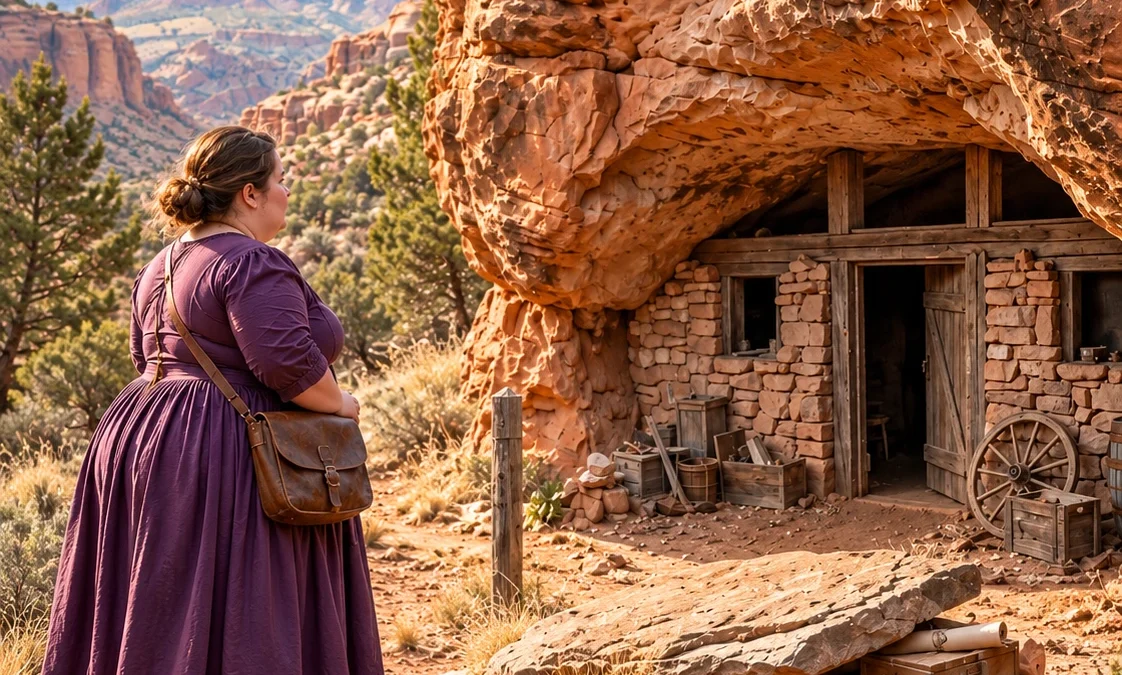
Beatrice Whitcomb was 26 years old, 300 pounds of quiet strength, standing alone in the freezing Montana mountains as the last wagon rolled away.
They had voted to leave her—43 people who had traveled beside her for months.
Harlan Pritchard, the man who had married into her family, who had managed her father’s affairs, had told them she carried a dangerous contagious illness.
No one had looked her in the eye as they climbed back into their seats.
No one had asked her if it was true.
She had four days of hard biscuit.
Her knee throbbed so badly she could barely kneel.
Night was falling, and the storm pressing down from the peaks felt like it meant to stay.
But she did not break.
She built a fire behind an old stone shelter, pulled her father’s heavy coat tighter around her, and remembered his voice: Don’t react to what you find until you understand it.
What you do with information is as important as finding it.
It was then her fingers brushed the iron ring set into a flat stone at the corner of the shelter wall.
She hesitated.
Harlan had spent years searching for something—she knew that now.
He had worked his way into her family, gone through her father’s papers by lantern light, and still he had never found this.
Whatever lay beneath had waited 90 years through every season, every storm, every traveler who had passed this way and never looked closely enough.
Carefully, she lifted the stone.
Beneath lay a narrow hatch, sealed tight against time.
She smoothed the soil back exactly as she had found it, sat beside her fire, and opened her father’s brass compass one more time.
The crescent moon caught the firelight, and she thought about all the things people had said about her—too big, too much trouble, too difficult to care for.
She had spent so long waiting for someone to see her, not the size of her or the inconvenience of her.
She was done waiting.
When dawn broke, she pulled the hatch open slowly.
The wood gave way with a soft sigh, like something that had held its breath for nearly a century had finally decided to let go.
Inside, wrapped in layers of waxed canvas and packed charcoal, sat a small wooden chest.
The brass hasp was green with age, but the wood was solid.
Her hands trembled as she lifted it out.
On top lay nearly fifty pieces of old Spanish silver, worn smooth by handling.
Beneath them rested a leather-bound journal, small enough to fit in a coat pocket.
The handwriting inside was precise, careful, as if the writer knew every word mattered.
Begun at Fort Pitt, September 12, 1793.
Property of N.
Vail, late Captain, Continental Army.
First Pennsylvania.
Beatrice froze.
N.
Vail—Nathaniel Vail.
That was the name Harlan had whispered in his sleep.
The name Lucinda, Harlan’s own wife, had pressed into her hands like a secret she dared not speak aloud.
She turned the page.
Nathaniel had not kept a diary of feelings—he had kept a record of truth.
He wrote of an expedition that claimed to map the frontier, but really moved stolen money and forged land deeds.
He had discovered his commander’s crimes, taken the evidence, and fled west.
They called him a deserter and a thief.
He wrote: I deserted a corrupt man in a criminal enterprise.
If the law sees that as deserting my country, then the law will have to find me first.
Then she reached an entry dated January 1794 that stopped her breath entirely.
I have decided that the name Nathaniel Vail must cease to exist.
The name I will take is the one my brother’s family carries in the East—Whitcomb.
Beatrice’s hands went still.
She read it again, and again, until the words blurred.
This was not a stranger’s secret buried in a stranger’s mountain.
Nathaniel Vail became Nathaniel Whitcomb.
He was her ancestor.
Her father had known—had kept the compass, had guarded the mark, had waited for her to be the one to find this.
She looked toward the quiet plot marked with a simple cross.
The truth shifted beneath her feet.
If Nathaniel lived, then someone else died here—someone who had come with him, someone who had never gone home.
And Harlan Pritchard had married into her family to find exactly this.
Part 2
If Nathaniel was not buried here, then Nathaniel had lived.
And if he had lived, there was a trail.
And if there was a trail, then somewhere in records or family Bibles lay the full story of who had really been lost in these mountains.
Beatrice packed everything carefully back into the chest, strapped it secure over her shoulder, and set out toward Alder Creek—four miles away, with a twisted ankle and a storm gathering fast.
She had barely made a mile and a half when she heard it: the steady clip of hooves on frozen earth.
She stepped behind a tree, her heart hammering.
After what the wagon train had done, her first instinct was not to be seen.
Around the bend rode a broad-shouldered man leading two pack horses.
He sat his saddle like someone who had spent most of his life there—calm, steady, watchful.
He saw her immediately, did not gasp or ask why a woman was alone in the wilderness, did not look her up and down the way most men did.
He just said, “You need water.
”
That was all.
No Where’s your husband? No What are you doing out here? Just a simple, true observation.
Beatrice stepped out.
“I do.
And I want to pay for passage on one of those horses.
I have documents worth more than money, and I need to reach the land records clerk before someone else gets there first.
”
He studied her—her walking stick, her wrapped ankle, the heavy pack, the coat that had belonged to her father.
“Gideon Rourke,” he said.
“Heading toward Alder Creek anyway.
What price do you offer?”
“Your books,” she said.
“I saw your ledgers are a mess—receipts in coffee tins, accounts scattered.
I ran numbers for 43 people across four months on the trail.
I can organize them properly.
”
He nodded slowly.
“That’s fair.
Get up—stirrup low enough for you?”
He adjusted it without comment, without making a show of being helpful, just making it right.
As they rode, Gideon told her who to see: Everett Bellamy, the county recorder—thirty years in the job, knew every deed, honest as daylight.
And to watch her back—Harlan Pritchard had already been seen riding hard toward town, spreading his version of the story before Beatrice could even speak hers.
By late afternoon, they crested the final ridge—and there it was.
Beatrice’s blood ran cold.
Tied at the general store rail stood a gray roan with a split left ear.
Not a local horse.
Harlan was already here.
They moved fast, slipping to Everett’s office by a side street.
Everett read the journal, the military orders, the hand-drawn survey marking land taken through forgery—land now owned by the Morrow family, the wealthiest in the territory.
“This is significant,” he said quietly.
“If their title traces back to these documents, everything rests on ground that never belonged to them.
”
The door swung open.
Harlan stood there.
He looked at the chest on the desk, at Everett holding the journal, at Gideon standing guard by the window—and his face smoothed into that practiced, sorrowful mask Beatrice knew so well.
“I was coming to report a theft,” he said.
“Those materials were removed from my wagon without consent.
”
Beatrice stood steady.
“You took everything from my father while he was too ill to read what he signed.
You left me in the mountains to die so you could get your hands on this.
”
Harlan turned to Everett, voice thick with regret.
“She’s been alone days.
Distraught.
She’s with a stranger—unchaperoned.
People will talk.
”
“That man’s name is Gideon Rourke,” came a clear voice from the doorway.
Miriam Hatcher stepped forward, her hands steady but her eyes burning.
“And I was there when we voted to leave her.
I voted yes, and I lied to myself.
I knew it wasn’t right.
I’m not staying silent anymore.
”
The room went silent.
Harlan’s control flickered—just for a second, but Beatrice saw it.
He was losing the crowd.
Part 3
Harlan’s jaw tightened.
He took a breath, ready to spin another story, but Everett raised a hand.
“Enough.
We will sort this formally.
Mr.
Pritchard, return tomorrow with any claim papers you believe you hold.
These documents remain here, locked, overnight.
Marshall Caldwell will post a guard.
”
Harlan hesitated, his eyes lingering on the chest—calculating, planning—then put on his hat and walked out.
But Beatrice knew: he would not wait for morning.
That night, well past midnight, Gideon heard it first—the faint scrape of wood at the back window.
He had slept in Everett’s front room, unannounced, simply deciding it was the place to be.
When the lock gave way, he was already standing there with a lamp.
Harlan stepped through—and froze.
Two of Marshall’s men stood waiting.
The chest sat on the table, untouched.
The performance was gone.
No sorrow, no concern, no pretense.
Only exhaustion—the hollow, defeated look of a man who had carried a heavy secret for twenty years and finally could not hold it up anymore.
“That chest belongs to my family,” he said quietly.
“Silas Morrow—my great-great-uncle—he built everything on what happened in 1793.
The land, the money, the standing… it’s all we have.
”
“Nathaniel Vail wrote the truth down,” Beatrice said.
“You didn’t care about justice.
You cared about covering a crime so you could keep what was stolen.
”
She reached for the journal and gently eased the leather cover open.
Tucked between the lining and the spine, folded carefully, lay a final letter Nathaniel had hidden away.
She read it aloud:
If you have come this far, you know what was done.
What matters more than names and deeds is what the silver is for.
I took 47 pieces—one for each family whose land was stolen.
It is not treasure.
It is a debt.
Not an inheritance.
Whoever carries this far enough to make it right—they will know what to do.
They always do.
She looked at Harlan.
“You spent twenty years chasing a fortune.
Nathaniel left a responsibility.
”
Before anyone could speak, the door opened again.
Lucinda—Harlan’s wife—walked in.
She looked tired, as if she had been walking a very long road in the dark.
She set a heavy ledger on the desk.
“These are his private accounts,” she said, her voice steady.
“Separate from everything else.
Every sale, every transfer, every debt he meant to pay with your father’s property.
I’ve been afraid to touch it for years.
I’m not afraid anymore.
”
The evidence was complete.
By morning, the truth spread not through whispers, but through facts laid out plainly.
Harlan was formally charged.
The transfer of Beatrice’s father’s estate was voided—Everett revealed her father had filed a protective notice months before he died, knowing he was being manipulated, leaving one last safeguard for her.
Daniel Morrow, head of the powerful landowning family, arrived that afternoon.
He listened, read the documents, and did not demand silence or threaten lawsuits.
Instead he said, “Tell me what you need.
”
“Not your land,” Beatrice told him.
“Courts may take years to untangle titles, and I won’t build anything on tearing people down.
But the silver—47 families.
I want a fund created, in their names, to find descendants and repay what was taken.
I want it public.
I want it permanent.
”
Morrow sat quiet for a long time.
Then he nodded.
“It will be done.
”
Weeks turned into months.
Beatrice bought 120 acres with clear title—cabin damaged, orchard overgrown, land waiting for someone to care for it.
Gideon showed up the next morning with lumber.
“Roof won’t hold the winter,” he said simply.
“I can help.
No strings.
”
They worked side by side—she measuring, he lifting, both moving at the same steady pace.
Miriam joined them, and together they built a business preserving and selling orchard fruit and produce, supplying local ranches through the winter months.
It was honest work, shared work, and it grew strong.
One spring day, Everett sent a letter that changed everything once more.
Researchers tracing names had found something: the man buried beside the mountain shelter was not a stranger at all.
It was James Ashford—23 years old, who had traveled west in 1794 to help Nathaniel prove the truth.
He had never returned home.
Nathaniel had buried him, marked his resting place, and kept his memory safe until someone could give him back his name.
Beatrice commissioned a stone:
James Ashford • 1771–1795 • He came west to put right what was wrongly done
When descendants of James’s family arrived from Oregon, they stood at the grave and wept—for the uncle they had only heard stories about, who had been lost to them for nearly a century.
For the first time, they knew where he was, and why he had gone.
One afternoon as the orchard bloomed pink and white, Gideon found Beatrice checking saplings.
“I’ve been meaning to say something,” he said, his voice quiet but sure.
“I don’t need anything from you.
You’ve built everything yourself.
But I don’t want to pretend anymore—I’m not just here to fix things.
I want to be here, with you, for everything.
”
Beatrice looked at him—the man who had never asked her to be smaller, quieter, less.
Who saw her and stayed.
“I don’t need you,” she said honestly.
“But I want you.
That’s better.
”
They married under the orchard trees in May—small, warm, surrounded by people who knew her worth.
Lucinda came, Miriam stood beside her, Everett wiped his eyes, and the life Beatrice had chosen—not waited for—grew around her.
Harlan left for work elsewhere, never coming back.
He had lost everything he chased, but Beatrice—who had nothing left but a fire and a compass—had gained a family story, a purpose, a home, and a love freely given.
Looking out over the valley one evening, Gideon said softly, “They left you out there.
And look what you found.
”
Beatrice smiled.
“They left me because they thought I had nothing worth keeping.
But the mountains didn’t care what they thought.
They kept the truth safe until someone was ready to carry it.
”
She touched the compass hanging above her mantel, beside Nathaniel’s journal and her father’s handkerchief.
The past was not a burden—it was a promise kept.
And the future? That was hers to build, day by day, stone by stone, hand in hand with the people who saw her, loved her, and stayed.
This story is entirely fictional and created for entertainment purposes only.
It does not represent any organization or individual, nor does it encourage inappropriate behavior.
The content was generated with AI assistance.








