SHE WAS SIX MONTHS PREGNANT WHEN THE DUKE’S FIANCÉE KICKED HER ON THE KITCHEN FLOOR. SHE WIPED THE TEA FROM HER HANDS AND SAID FOUR WORDS THAT TURNED THE WHOLE HOUSE WHITE… BUT THE REAL HORROR WAS WHAT THEY TOOK FROM HER NEXT
SHE WAS SIX MONTHS PREGNANT WHEN THE DUKE’S FIANCÉE KICKED HER ON THE KITCHEN FLOOR. SHE WIPED THE TEA FROM HER HANDS AND SAID FOUR WORDS THAT TURNED THE WHOLE HOUSE WHITE… BUT THE REAL HORROR WAS WHAT THEY TOOK FROM HER NEXT 😱💔
Part 1
The silver tray hit the stone floor with a crash that echoed down the entire kitchen corridor.
Every servant in Ravensworth Manor froze. 😨
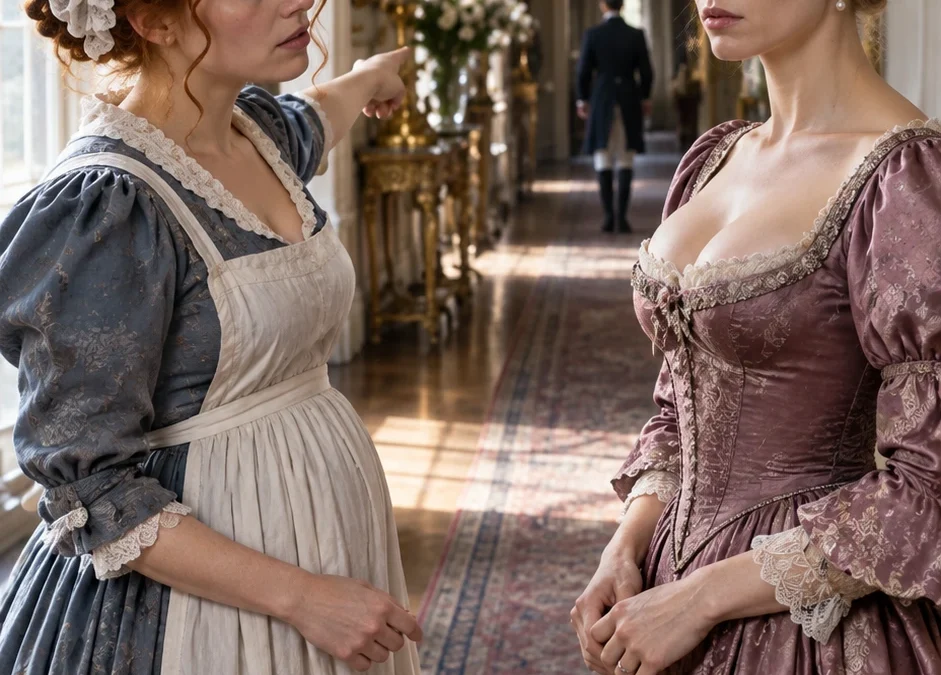
Lady Victoria Ashcombe stood in a pale blue silk gown, chin raised, eyes cold as ice. At her feet, on her knees among broken teacups, was the new scullery maid.
“You clumsy little rat. Do you know what that tea set cost? More than your whole miserable life.”
The maid said nothing. She simply began picking up the pieces with shaking hands.
That silence made Victoria angrier than any answer could have.
“Look at me when I speak to you.”
The maid looked up. For one second, something passed between the two women. Something Victoria did not like at all.
Then Victoria’s eyes dropped to the girl’s apron. To the round shape beneath it.
“You are with child,” she said slowly. “A maid in this house, with child? Who is the father? The stable boy? The butcher’s son? Or do you not even know?”
A few kitchen girls laughed nervously.
The maid tried to stand.
Victoria’s foot shot out. The hard toe of her silk shoe struck the girl’s side, right beside her belly. The maid cried out and fell against the wall.
Nobody moved. Nobody breathed. Old Mrs. Hail, the housekeeper, pressed a hand to her mouth. The cook dropped her spoon.
Slowly, holding the wall, the maid pulled herself to her feet.
She did not cry. She did not beg. She wiped the tea from her hands, looked straight into Lady Victoria’s eyes, and said in a quiet, clear voice:
“This child is his.”
She did not need to say whose. Everyone in that corridor understood.
Victoria’s face went white as chalk. “You lying little…”
She never finished. A voice came from the top of the servants’ staircase. Cool. Calm. Aristocratic.
“That will do, Victoria.”
Every head turned. There stood the Dowager Duchess of Ravensworth, the Duke’s mother. She had heard every word.
And she was smiling.
Not an angry smile. Not a shocked one. The smile of a woman who had been waiting for this exact moment.
“Bring the girl to my sitting room. Now.”
As the maid was led up those stairs, one thought pounded in her heart like a drum.
She knows. She already knows.
To understand how a doctor’s daughter ended up scrubbing floors in a duke’s house, carrying a duke’s child, we must go back eight months. To a small village. To a stormy night. And to a man who arrived at her father’s door more dead than alive. ⛈️
The rain had been falling for three days when the knock came.
Clara Whitmore was nineteen. She lived with her father, Dr. Samuel Whitmore, in a small stone house at the edge of Ashbury. He treated the poor for free and the rich for very little, so there was never much money. But there was always bread on the table and books on the shelves.
Two men stood in the rain. A soaked, frightened groom, and a tall, pale man leaning on him, eyes half closed.
“My master’s horse threw him on the road. He’s burning with fever. Please, is the doctor here?”
They laid him in the spare room. Dr. Whitmore felt his forehead and frowned. “A bad fever. And his arm is broken. He may not live through the night.”
Clara did not sleep that night, or the next. She cooled his face with wet cloths and gave him water drop by drop.
On the third night, he opened his eyes. Clear gray, like the sky after rain.
“You stayed with me,” he whispered. “Every night, I heard you.”
Two days later, the groom told her the truth in a nervous whisper. The man upstairs was Alexander Hartley, the Duke of Ravensworth. 👑
Clara nearly dropped the bread knife. A duke, in her father’s spare room, wearing her father’s old nightshirt.
When she curtsied stiffly with his soup, he groaned. “Please don’t start that now. For a week you have ordered me to drink, told me to lie still, and once you called me a stubborn fool. I would like you to keep talking to me like that. Nobody else does.”
His arm needed weeks to heal. So one of the richest men in England stayed in a little stone house, and every day, he and Clara talked.
He told her of his cold father, his mother who cared only for the family name, and the London balls where smiling mothers pushed their daughters at him like horses at a market.
“They do not see me. They see a title and money. If I lost it all tomorrow, not one of them would remember my name.”
“I didn’t know your name,” Clara said softly, “when I sat by your bed.”
The fire crackled. That was the night he first kissed her. ❤️
The weeks that followed were the happiest of her life. He read her poems badly. He helped her father in the garden with one arm and ruined his fine boots. And one evening, under the old oak by the river, he pressed a small gold ring into her hand. A dark red stone. Inside, the crest of Ravensworth: a raven with open wings.
“It was my grandmother’s. She told me to give it to the only woman I would ever trust. Clara, will you be my wife?”
“Your mother…”
“My mother does not choose my wife. I do.”
“They will laugh at you.”
“Then let them. I would rather be laughed at with you than admired without you.”
She said yes.
Two days later, a rider brought a sealed letter from the Prime Minister’s office. A secret negotiation with France. Alexander was needed in London at once.
“Six weeks. Perhaps eight. Then I come back, and we marry in your village church. I will write every single week.”
He kissed her at the garden gate. His carriage rolled away down the muddy road.
The first week passed. No letter. The roads are bad, her father said kindly.
The second week. The third. The fourth.
Every morning Clara walked to the post office. Every morning the old postmaster shook his head.
In the sixth week, two things happened on the same day. That morning, Clara was sick for the third time in a week. Her father examined her, then took her hand gently.
“Clara. You are going to have a child.”
She did not cry. She smiled. When Alexander comes back, this will be the happiest news of his life.
That afternoon, the weekly London newspaper arrived. On the third page, under the society news, she read:
“It is announced that His Grace, Alexander Hartley, Duke of Ravensworth, is engaged to be married to Lady Victoria Ashcombe, daughter of the Earl of Ashcombe.”
The paper slipped from her fingers.
She looked down at the ring on her hand, the raven with open wings.
👇 Want Part 2? Comment any word and I’ll send it to you privately, or look for it in the comments!
Part 2
She looked down at the ring on her hand, the raven with open wings.
And for the first time since the stranger came out of the storm, Clara wondered if she had ever really known him at all.
She did not believe the newspaper. Not at first.
“Papers print lies all the time,” she told her father. “He gave me his grandmother’s ring.”
That night she wrote a letter, three times over until it was right. She did not beg. She did not accuse. Alexander, I have read the newspaper. I don’t believe it. Please write me one line and tell me the truth. There is something I must tell you that I cannot put in a letter. Clara.
She sent one copy to London and one to Ravensworth Manor.
No answer. She wrote again. And again. Five letters in all.
Silence.
Then, as autumn turned cold, something worse happened. Dr. Whitmore caught a fever from a family he was treating. A strong man all his life, he lasted nine days.
On his last night, he whispered, “Go to your Aunt Martha. She is hard, but she is family. And Clara… if he ever comes back, make him look you in the eye. A man can lie in a letter. He cannot lie to your face. Not if he is a real man.”
The house belonged to the landlord. Within a month, Clara packed one small bag, her father’s medical book, and the ring. She wore it on a ribbon around her neck, hidden under her dress. She could not wear it. She could not throw it away. 💔
Aunt Martha gave her a freezing attic and worked her from dawn to dark. Clara never complained. She let out her dresses a little more every week.
For two months it worked. Then one morning, her aunt walked into the kitchen without knocking and stared at Clara’s belly. Her face turned purple.
“You little harlot! Who is the man?”
What could Clara say? That the father was the Duke of Ravensworth? Her aunt would laugh in her face, or call a doctor to say she had gone mad.
“Then get out of my house. This minute.”
Six months pregnant, in November, with four shillings in her pocket, Clara stood in the road with her bag and the cold wind in her face.
Make him look you in the eye.
Ravensworth Manor was forty miles away. It took five days. She rode on farmers’ carts when they allowed it and walked when they did not. She slept one night in a barn and one in a church porch. Her feet bled through her shoes.
On the fifth evening, she saw it. A gray giant on a hill, a hundred windows shining gold in the dusk.
At the iron gates, she almost turned back.
Then the baby kicked, small and firm.
Clara pushed the gate open. She went around the back to the servants’ entrance.
“Please. I need to see the Duke.”
The kitchen maid laughed out loud. “Did you hear that, Cook? This one wants to see the Duke!” Laughter rang inside. “His Grace is in London till the wedding. Go on.”
The door began to close.
“Wait.”
A small, gray-haired woman in black stepped forward, a ring of keys at her waist. The housekeeper. She stared at Clara’s face. Then her eyes went wide.
“Dear God. What is your name, child?”
“Clara Whitmore.”
The old woman gripped the doorframe. “Was your mother Anne Fletcher?”
“How did you know?”
“Because you have her face. Exactly her face. I am Margaret Hail. Your mother was the dearest friend I ever had.”
Mrs. Hail pulled her inside, sat her by the fire, and made her tell everything. The storm. The fever. The ring. The letters that never came.
“I believe every word,” the old woman said at last. “When he came home this summer, he was humming on the stairs. I had never seen him like that. And then, suddenly, the engagement. It made no sense.” Her lips pressed together. “In this house, every letter goes first to the Dowager Duchess’s desk.”
A chill ran down Clara’s back.
So Clara Whitmore became Mary Brown, scullery maid. She scrubbed pots until her hands cracked and kept her apron loose and her eyes down.
For nine days, she avoided Lady Victoria. On the tenth, Clara was on her knees scrubbing the back hall when Victoria swept past. As Clara leaned over her bucket, the ribbon slipped from her collar.
The ring swung out into the light. Gold. A dark red stone. A raven with open wings.
Lady Victoria stopped walking.
She did not say a word. But Clara saw her face, and what filled it was not anger.
It was fear.
Then Victoria smiled. A thin, sweet, deadly smile.
That night, a note scented with roses was slipped under Mrs. Hail’s door.
“Tell your little maid I know exactly who she is.” 😱
👇 Want to know what they did to her? LIKE or COMMENT “REVEAL” and Part 3 will be posted once we reach enough comments!
Part 3
Mrs. Hail burned the note, but she could not burn the fear it left behind.
“You must leave tonight, child. I will find you a room in the next town.”
“No,” said Clara. “I have walked forty miles. I have buried my father. I have been thrown into the road. I am not running anymore. Not until I have seen his face.”
Mrs. Hail sighed. “You are your mother’s daughter. God help us all.”
Then Victoria began.
First, small things. Clara’s bread vanished at supper. Her clean water was kicked over. Her one spare dress was found in the yard, soaked in pig slop. Then the orders: bath water carried up four floors, fireplaces cleaned before dawn, boots polished at midnight. Always by the scullery maid.
Clara did it all, and never complained once. That silence drove Victoria mad.
One evening, young Polly, who carried Victoria’s breakfast tray, whispered, “Her ladyship sends back her food untouched. Yesterday I heard her being sick behind the screen. Twice.”
Clara said nothing. But she remembered.
On the twelfth day, Victoria stepped in front of her in the kitchen corridor. The tray fell. The cups shattered. And everything happened exactly as you saw at the beginning of this story.
The insult. The laughter. The kick. This child is his.
Now Clara stood in the Dowager Duchess’s private sitting room, her heart pounding. Silk on the walls. A gold clock. A bright fire. The Duchess, handsome, perhaps fifty-five, had her son’s gray eyes. But there was no warmth in them at all.
“Mary Brown. That is what they call you downstairs. But your name is Clara Whitmore, daughter of the late Dr. Samuel Whitmore of Ashbury.”
Clara’s breath caught.
“A mother knows everything that touches her son. I know who nursed him. And I know what kind of girl takes advantage of a sick man in a fever.”
“That is not what happened.”
“Isn’t it?” The Duchess lifted a leather purse. “Two hundred pounds. And a first-class ticket to New York, sailing in four days. You will tell people you are a young widow. You will raise the child as you like. And you will never come near my son again.”
Clara looked at the purse. She thought of her bleeding feet and the four shillings.
“I did not come for money. I came for the truth. If he looks me in the eye and tells me he does not love me, I will leave and never return. But I will not go until he tells me himself.”
The Duchess’s smile did not move. Her eyes turned to stone. “Go back to your pots. Oh, and Miss Whitmore. That ring you wear belongs to Ravensworth. People who keep things that do not belong to them sometimes end up in very unpleasant places.”
When the door closed, the Duchess knelt at the fireplace, something no one had ever seen her do, and pulled a half-burned envelope from the ashes. Her son’s handwriting. Miss Clara Whitmore, Ashbury.
She held it over the flames until nothing was left.
She never saw the door to the next room, open a crack. Polly had been dusting the dressing room. Through that crack, she had seen everything.
That night, white as a ghost, Polly pulled Clara behind the coal bin. “She burned a letter from His Grace, miss. With your real name on it.”
“Polly, who carries out the Duchess’s ashes?”
“I do, miss. To the ash heap behind the stables.”
Clara squeezed her hand. “You are braver than you know.”
In the Duchess’s bedroom, Victoria paced, twisting a lace handkerchief until it tore. “You said she would take the money! Alexander comes home in eight days. If he sees that ring…”
“Then we stop trying to break her,” said the Duchess calmly. “We destroy her.”
She opened a velvet box. Inside lay the Ravensworth diamonds, three rows of stones that caught the candlelight like fire.
“Tomorrow they will be found under a certain scullery maid’s mattress. And I have a groom, Tom Briggs. He drinks, he gambles. For twenty pounds, he will swear on a Bible that the child is his.”
Victoria began to smile. Then, strangely, her hand drifted to her own stomach before she pulled it away.
The Duchess noticed. She said nothing.
At dawn, the house woke to screaming. Thief! The servants were lined up in the great hall. Twenty minutes later, a footman came running, a necklace blazing in his hands.
“Under the scullery maid’s mattress, Your Grace.”
“Someone put them there,” Clara said, her voice steady. “And you know very well who.”
The Duchess walked down the stairs. “Search her.”
The ribbon snapped. The ring fell into the Duchess’s palm. She held it high.
“The Ravensworth ring. Around the neck of a thief.”
“Your son gave it to me! He asked me to marry him!”
A few servants laughed. Most looked away in shame.
Tom Briggs shuffled in, cap in hands. “It’s mine, Your Grace. The baby. We have been behind the stables since she came.”
Clara looked at him until his face went red. “I came here seven months with child. I had never seen you in my life. How much did she pay you, Tom?”
“Enough,” said the Duchess. “Send for the constable.”
As the cart carried her away, Mrs. Hail pushed through the crowd and caught her hand. “I swear I will find a way.”
Clara leaned down. “Search the ash heap. She burns his letters. One must have survived.”
At an upstairs window, Victoria watched the cart disappear. She pressed her hand to her stomach and whispered, “Eight days. Just eight more days.”
Mrs. Hail and Polly dug through that mountain of ash all night. They found nothing. Two days later, a carriage came racing up the hill, six days early.
The Duke had come home.
In the library, his mother told him everything. A girl calling herself Mary Brown. The stolen diamonds. The ring around her neck. Then she told him the girl’s real name.
Alexander went white. “Clara is here?”
“In the county jail.”
Alexander remembered the letter that had broken him in London, after six weeks of writing every Sunday with no reply: “I was foolish to believe a duke could marry a doctor’s daughter. I have accepted an offer from a man of my own kind. Please do not write again. Keep your ring. CW.”
He rode to the jail that night. Clara sat on a wooden bench with a thin gray blanket around her shoulders.
“Is the child mine?”
“Yes.”
“Tom Briggs swore otherwise.”
“Tom Briggs was paid twenty pounds.”
“Why should I believe you? You never answered one of my letters.”
“I wrote to you five times. All I got back was a newspaper.”
“I have your letter in your own hand telling me to forget you!”
“I never wrote it.”
Both were certain the other was lying.
“Ask yourself who reads every letter before you do,” Clara said, her voice suddenly tired.
His face hardened. “You accuse my mother?”
“Then believe her. Marry your lady. I came to see if you had ever loved me. Now I have seen. You loved me, but not enough to trust me.”
She turned her face to the wall. He walked out. Behind the slammed door, Clara finally put her face in her hands and cried.
The next morning, he returned. The jailer rubbed his hands nervously. “She will not see you, Your Grace.”
Clara had never been told he came. The jailer counted the coins in his pocket and smiled.
That same afternoon, Polly’s brother Jack brought news. Tom Briggs had been boasting at the Red Lion. And an hour ago, a man in a fine coat, Mr. Graves the butler, had put him on a coach south.
The only witness who could save Clara was gone.
That night, Clara woke with a terrible pain. It was far too early. She screamed and beat on the door. The woman who finally came was not the doctor. She was thin-lipped, cold-handed, and gave no name.
“Who sent you?”
“Someone who wants this done quietly. Now breathe.”
Before dawn, Clara heard it. A tiny, thin, angry cry. The most beautiful sound she had ever heard.
“A girl,” the woman said.
“Let me hold her. Please.”
The room spun. The last thing Clara saw was the woman wrapping a bundle in a gray blanket and turning to the door.
When she woke, there was no baby.
“I am sorry, miss,” the jailer said, not meeting her eyes. “The child did not live. They took it away to be buried.”
“That is a lie! I heard her crying!”
Her screams followed him all the way down the passage. 💔
At Ravensworth, the Duchess read a folded note, dropped it in the fire, and told Victoria, “The girl’s child was born too early. As far as this county will ever know, there will be no child.”
Even Victoria went pale.
That evening, Mrs. Hail found someone waiting in her dark room. Mr. Graves. His collar was crooked and his eyes red.
“I have done a terrible thing. I carried every letter to the Duchess’s desk for months. This morning I read a note before I delivered it. The child is alive. Taken to St. Agnes foundling home in Hollowbridge as you wished.”
Mrs. Hail’s hand flew to her heart.
“I was left on the steps of a foundling home myself, fifty-eight years ago. And I have helped do the same thing to His Grace’s own child.” He took a crumpled letter from his coat. “She told me to burn them all. I could not burn this one.”
It was Clara’s fifth letter, dated two months before she ever came to Ravensworth. “I am carrying your child. I will not ask you for anything. Whatever you decide, I will love you until I die.”
By dawn, Mr. Graves and Mrs. Hail were at St. Agnes. The matron’s ledger read: Girl. Small. Born early. Alive.
In the smallest cot lay a tiny baby in a gray blanket. On the back of her neck, just below the hairline, was a dark mark shaped like a bird with open wings.
“The Ravensworth mark,” Mr. Graves whispered. “His Grace has the same.”
The matron could release her only to a parent or a magistrate’s order. Mrs. Hail touched the little fist. “We will be back before tomorrow’s sun goes down.”
On the way home, she told Mr. Graves something no one knew. Forty years ago, the future Duchess had been a poor governess in the attic, crying because the maids mocked her accent. Mrs. Hail, a girl of thirteen, had carried up her washing water.
“The woman who threw a pregnant girl in jail for being common was once poorer than Clara Whitmore. And she has spent forty years making sure nobody finds out.”
At the gates, Polly came running. Jack had found Tom Briggs, now locked in the coal cellar and ready to talk. And Jack had also found Captain Robert Drake, an officer who had loved Lady Victoria for two years. The Captain had gone white at the news of the wedding. Then he had drawn his sword.
“Twelve hours,” whispered Mrs. Hail.
The wedding morning was cold and bright. The little church was packed with lords and ladies in silk and diamonds. At the altar stood the Duke, dressed in black, looking like a man at a funeral. In the front pew, the Dowager sat with her chin high.
Lady Victoria walked down the aisle in white satin and pearls. Behind her veil, her face was the color of paper.
“If any person here knows any reason why these two should not be joined together, let them speak now.”
The great doors crashed open.
In the doorway stood a little old woman with a ring of keys at her waist. Beside her, Mr. Graves. Behind them, Jack held a red-nosed man by the arm, and beside Jack stood a tall officer in a red coat with murder in his eyes.
“I know a reason,” said Mrs. Hail. “I know several.”
“Leave this church at once!” cried the Duchess.
“Not this time, Your Grace.” She stopped before the Duke. “You have known me since the day you were born. Have I ever once lied to you?”
“Never.”
“Then hear me for five minutes. And then marry whoever you like.”
Tom Briggs, gray with fear, said, “I lied. The Duchess paid me twenty pounds. Mr. Graves gave me the money.”
The church erupted.
Mr. Graves held out the crumpled letter. Alexander read it. They watched his hand begin to shake. I am carrying your child.
“And the letter telling me she had taken another man?”
“Her Grace wrote it herself,” said Mr. Graves quietly. “She has a very fine hand. She used to teach handwriting.”
The Duchess had gone white as marble. “Lies! Servants’ lies!”
Captain Drake stepped forward. “I have loved Lady Victoria for two years. Tell him, Victoria, or I will.”
Victoria tore off her veil, her face wet. “I am with child. It is Robert’s. My father is ruined. He said if I did not marry the Duke, we would all be in the street.”
“And Her Grace?”
“She guessed weeks ago. She said it did not matter, so long as it was done quickly.”
The Earl sat down heavily, face in his hands. Three hundred faces turned toward the Dowager Duchess. For the first time in forty years, she looked afraid.
“Everything I did, I did for this family! That girl is nothing! A doctor’s daughter!”
“A nobody, Your Grace?” Mrs. Hail said softly. “Shall I tell them where I first met you? The attic room? The governess who cried because the maids laughed at her accent?”
The Duchess stared. No sound came out. She sat down slowly, like a woman made of glass.
“Where is Clara?” Alexander’s voice was hoarse.
“In the county jail. They told her the baby was dead.” Mrs. Hail took his hands. “Your daughter is alive, Your Grace. At St. Agnes. With the Ravensworth mark on her neck, just like yours.”
He wrote an order for the magistrate, pressed it into her hand, and then, in front of all of London, the Duke of Ravensworth ran down the aisle of his own wedding and out into the winter sunshine. 🏃♂️
The cell was cold and dark. Clara sat in the corner, as she had for two days. She did not look up when the lock turned.
“Clara.”
Then she heard a sound she never expected. A man falling to his knees on stone.
Alexander knelt in his wedding clothes on the filthy jail floor, eyes full of tears. “I know everything. The letters. Tom. The diamonds. My mother. I wrote to you every Sunday, and I believed her instead of you. I loved you, but I did not trust you, and I will regret it every day of my life.”
“They took our baby,” she whispered. “They said she died. But I heard her cry.”
“I know you were right about that, too.”
Light footsteps hurried down the passage. Mrs. Hail appeared, breathless, a small bundle in her arms. She knelt and placed it gently into Clara’s.
A tiny face. A small fist against one cheek. On the back of her neck, a little dark mark like a bird with open wings.
The baby opened her eyes. Gray.
Clara made a sound half laugh, half sob, and pressed her daughter to her heart. Alexander wrapped his arms around them both. Then he took out a small gold ring with a dark red stone.
“Make me one promise,” Clara said. “Never again believe anyone over me. Not your mother. Not the whole of England.”
“Never again. I swear it.”
And in a cold stone cell, Clara Whitmore held out her hand, and the Duke slipped his grandmother’s ring onto her finger. 💍
Sir Henry, the magistrate, stood in the doorway, red with shame. “Every charge against you is dismissed, Miss Whitmore.”
“It is not me you should apologize to,” Clara said, looking down at her baby. “She spent the first two days of her life in a foundling home because no one in this county asked a single question.”
Alexander turned to the jailer. “You told me she would not see me. You told her the child was dead.”
“I was paid, Your Grace.”
“So was everyone. That seems to be the trouble.”
He carried Clara out, baby and all. He did not leave her bedside for three days. When the baby cried at night, it was the Duke of Ravensworth, humming his old nurse’s song, who walked her up and down.
On the fourth day, he rode home alone. His mother sat in the library, dressed in gray, looking old for the first time in his life.
“Every Sunday,” he said, “for six weeks I wrote to her. I told her I had bought a little wooden horse for our first child. And every Monday, you burned it.”
“I did it for you.”
“You did it for yourself. You put a girl seven months with child in jail. You paid a stranger to take her baby. Your own granddaughter.”
Her voice finally shook. “Do you know what it is to be laughed at? To hear women whisper governess behind their fans? For thirty years! I swore no son of mine would ever be dragged down by…”
“By someone like you,” said Alexander quietly. “You, of all people, knew exactly what Clara felt. And instead you did to her the same thing that was done to you. Only worse.”
The fire crackled. “What happens to me now?”
“Rose Cottage, at the end of the village. Four rooms and a garden. One woman to come in the mornings. The rest you will do yourself. You will keep your title. I will not drag you through the courts, but for my daughter’s sake. And you will never enter my house, or go near my child, unless my wife allows it.”
She nodded once. After he left, the Dowager Duchess sat alone, looked at the fireplace where she had burned her son’s letters, and wept.
The next morning, he gathered every servant in the great hall, the same hall where Clara had been shamed.
The lady’s maid who hid the diamonds left without a reference. The girls who laughed at the door could stay, “because I believe people can learn. But the girl you laughed at will be your mistress in a month, and she has a very good memory.”
“Polly Turner. You told the truth when silence would have been easy. You are my wife’s own lady’s maid, at double wages. Jack Turner, my head groom retires at Christmas. The position is yours.”
Last was Mr. Graves, his bag already packed by the door.
“Forty-one years of service, your name, your post. You kept one letter you were ordered to burn. Whether you stay is not my decision. It is my wife’s.”
They were married on the first Saturday of December in the little stone church at Ashbury, exactly as he had promised her under the oak. No lords. No diamonds. The village filled every pew. The old postmaster cried through the whole service.
Clara wore her mother’s white dress, which Polly had altered three times. She asked one man to walk her down the aisle.
“Me, madam? After everything I did?”
“You did wrong, and then you did right when it cost you the most. My father always said that is the only kind of goodness that counts.”
When the vicar asked who gave this woman, old Mr. Graves answered, “I do,” so proudly that the whole church smiled.
At her father’s grave, Clara laid a sprig of winter jasmine. “I made him look me in the eye, Papa. Just like you said.”
Her daughter was christened that afternoon. “Anne,” Clara said. “After my mother. Your dearest friend.” Mrs. Hail covered her face with both hands.
Two weeks before Christmas, Victoria, now Mrs. Drake, stood in Clara’s sitting room in a plain traveling dress, no pearls, unable to meet her eyes.
“Robert’s regiment sails for India in three days. I came because I could not leave without saying it. I kicked you when you were carrying a child. I was so frightened of being ruined. When I saw that ring, I knew you could destroy me. So I tried to destroy you first.”
Clara looked at the sleeping baby in her arms. “Do you remember what I said to you that day?”
“This child is his.”
“And here she is.”
Victoria began to cry, real tears this time.
“I forgive you,” said Clara. “Not because it was small. I forgive you because I do not want to carry it anymore. It is too heavy, and I need my arms for her. One day your child will have servants. One day one will drop a tray. Remember this room.”
“I swear I will, every day.”
Years later, a letter came from Bombay. Victoria had three children now. She had never once raised her hand to a servant. And she had never forgotten.
That spring, London waited to destroy the doctor’s daughter. At Lady Pembroke’s ball, the hostess looked Clara up and down. “You must feel like a little mouse in a palace.”
“I recognize an illness in rich houses, Lady Pembroke. Unkindness. My father said there is no medicine for it. Only time and a little humility.”
The tittering stopped. Then Alexander spoke, quietly, and every word carried. “When I lay dying of fever in a stranger’s house, my wife kept me alive with her own hands. She knew nothing of my name, my title, my money. In this whole ballroom, I doubt three people would do the same. She is a country doctor’s daughter, and I have never been so proud of anything in my life.”
He led her onto the empty floor, and three hundred people watched in silence.
By the end of the season, Ravensworth’s invitations were the most wanted in London.
Years passed. The Dowager Duchess learned to light a fire, then to bake bread. She planted roses, then, to everyone’s surprise, potatoes. When the blacksmith’s boy cut his knee, she knelt in the dust and bound it with her own handkerchief.
When Anne was five, Clara took her down to Rose Cottage.
“Mother,” Clara said. She had never called her that before. “This is Anne. She has been asking about her grandmother.”
The old woman looked at the little girl with her son’s gray eyes. “Hello, Anne.”
“Grandmama, were you always a lady, or were you poor once, like Mama?”
The old woman knelt slowly. “I was poor once. A governess. Some people were very unkind to me. And then, when I should have known better, I was very unkind to your mother. It was the worst thing I ever did.”
“Did you say sorry?”
“Not yet.” She rose and lowered her head to someone below her for the first time in her life. “I am sorry, Clara. For all of it.”
“Would you like to come to Sunday dinner? Anne would like that. So would I.”
And every Sunday after, a small figure in gray walked up the hill. Mrs. Hail sat in the best chair. Mr. Graves, who had found his mother’s name, Sarah Graves, in a faded foundling ledger, stood straight in his black coat. Little Samuel, three years old, fed his peas to the dogs.
“To Mrs. Hail,” Alexander said every week, “without whom none of us would be here.”
One winter evening, Clara heard crying in the kitchen corridor. A new girl, no more than fifteen, knelt among broken teacups, shaking.
“I am sorry, Your Grace! I will pay for them! Please do not send me away, my mother needs the money!”
For a moment, Clara was not the Duchess. She was a frightened girl with tea on her hands and a silk shoe coming toward her. She knelt on the stone in her fine dress and picked up a shard.
“What is your name?”
“Lucy, Your Grace.”
“Lucy, they are only teacups. Cups break. People do not break so easily, but they can if they are treated badly enough. No one will make you pay. No one will send you away.” She stood and helped the girl up, looking down the corridor to where a cold woman had once smiled from the stairs. “I promised something in this very spot. No one in this house will ever be kicked again.”
At the end of the corridor, unseen, the Duke watched his wife and smiled.
He had once been told a duke could not marry a doctor’s daughter. That she would drag his name into the mud. That she was nobody.
Now every servant, every farmer, every child in Ravensworth knew her name. And they said it the way people say the name of someone they love. ❤️
This story is entirely fictional and created for entertainment purposes only. It does not represent any organization or individual, nor does it encourage inappropriate behavior. The content was generated with AI assistance.








