She Was Thrown Out of a Coaching Inn Like Trash, Then the Meanest Duke in England Whispered Six Words That Changed Everything
She Was Thrown Out of a Coaching Inn Like Trash, Then the Meanest Duke in England Whispered Six Words That Changed Everything
PART 1
“You are not required, Miss Corbold.”
Lady Sutherby said it in the yard of the Sorrel Horse at Wickersham Cross while the Winchester coach changed horses behind her. It was four o’clock on a wet afternoon in October 1814, and eleven strangers had stopped to watch.
Philippa Corbold, four and twenty, had been engaged to Lady Sutherby’s son for two years and one month. By her own reckoning, she had been unengaged for about forty seconds.
She had expected a quarrel. She had expected tears, her own, and a lecture on gratitude to follow.
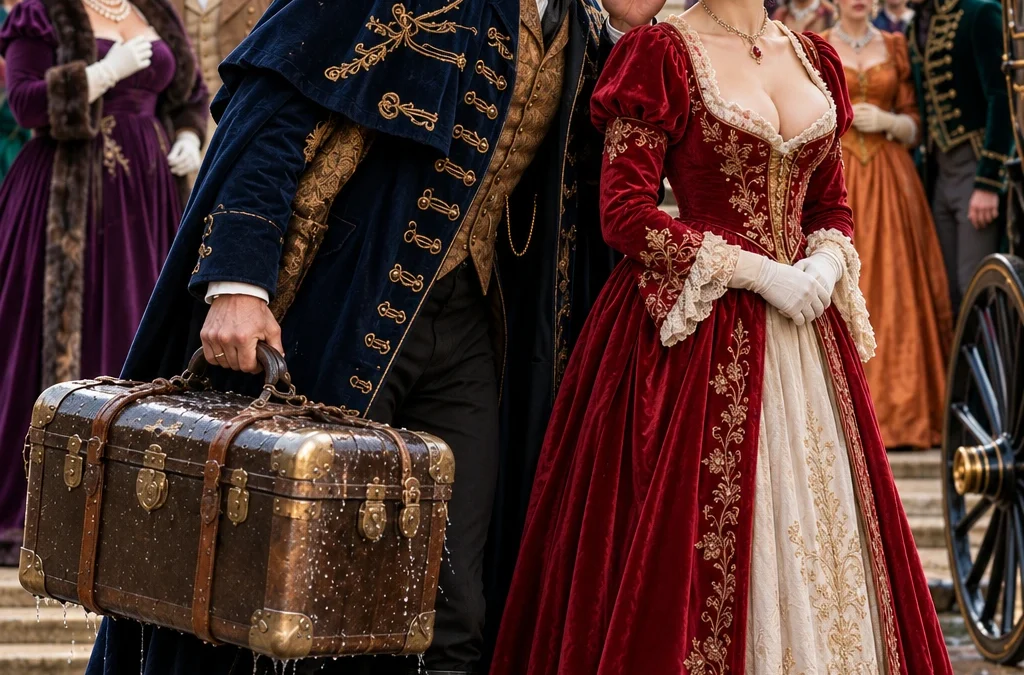
She had not expected to see her trunk standing in the road. It sat in a puddle beside the mounting block, rope-bound, with horse dung drying on one corner. 🌧️
Mrs. Pargeter paused with her fan half open. The two Mrs. Rexhams gave up pretending to study the coach. The ostler leaned on his pitchfork. Every person in that yard was waiting for Philippa Corbold to break.
A man in the taproom doorway had not stopped watching her since the coach rolled in.
She did not break. Her pelisse was gray merino, turned twice. The ribbon on her bonnet was one she had bought herself. There was ink on the second finger of her right hand. She had four pounds eleven shillings and a quarter’s pin money not yet paid.
She also had the one gift the Sutherby family had never found a way to ration. She could total anything. She totaled the yard: twelve witnesses, one footman, two horses, one of them lame. She had just been priced, in front of every one of them, at nothing.
Lady Sutherby was two and fifty, upholstered in plum velvet, and warm in every part but the eyes. Her husband held the keys to Philippa’s late father’s estate, and she carried herself like a woman owed thanks. In six years she had never raised her voice. She had never needed to.
“Crispin has reconsidered,” she said. “A young man must be allowed to reconsider. Six years of your keep, my dear. Six winters of coal. One does not like to count such things.”
But one does, Philippa thought.
Crispin Sutherby stood beside the carriage wheel studying his boots. He was six and twenty, fair and soft about the jaw. He had spoken four words to her since Basingwell: “I am so sorry.” She had counted them as three.
“I see,” said Philippa. Flat. Nothing more.
She did not cry. She had stopped at eighteen, on the day she buried her father, and had never started again.
The man in the doorway stepped out into the rain.
He wore a drab greatcoat nine winters old and a hat that had once been black. He was compact and broad through the shoulder, sun-browned like a farmer, with chestnut hair going gray above the ears and eyes the color of weak whiskey. A gray greyhound with a white muzzle leaned against his knee.
He was Ambrose Delemere, eighth Duke of Kestrel Mere, and he owned forty thousand acres of Hampshire. The county said he would not mend his own roof. The county said he counted candle ends at his own table. The county said, in short, that he was the meanest man in England, and not one soul had ever learned why.
He crossed the yard. He did not look at Lady Sutherby. He took Philippa’s trunk by its rope, lifted it out of the puddle, and set it on the dry step. Then he wiped his palm on his coat.
Nobody in that yard had ever seen the Duke of Kestrel Mere carry anything for anyone. 😳
He stopped beside her. He was not tall, so he did not have far to lean.
“Can you keep accounts, Miss Corbold?” he said, very low.
“To the farthing.”
“Then listen.” He spoke so quietly that the two Mrs. Rexhams leaned together and still lost it. “My house has needed a woman like you.”
She had been called many things in that yard. She weighed this one for a trap. Pity would have been warmer. A joke would have been louder.
“Is that a kindness, your grace, or an insult?”
“Neither. It is a vacancy. Sixty pounds a year, a fire, and a door that locks.”
On the sill beside the step, the landlord’s lantern had burned down to a stub of tallow. Philippa took it without looking and slipped it into her reticule. A stub was a halfpenny, and she was not too proud to count.
“Sixty is ten short of what I am worth.”
“Seventy, then.”
He did not smile. Neither did she. It was the first honest bargain she had struck in six years.
“Your grace cannot mean to take her up,” said Lady Sutherby.
The Duke handed Philippa into a carriage with cracked leather and unlit lamps. He did not answer. It was the only reply Lady Sutherby received, and the whole yard heard every word of it.
Inside, the carriage smelled of wet dog, old leather, and a great deal of economy. The Duke took the cold seat with his back to the horses and left her the forward one without a word, as if it were arithmetic. She noted it. She did not credit it.
The greyhound, Brigadier, laid his chin on her boot and shut his eyes.
“He disapproves of strangers,” said the Duke.
“He appears to be failing.”
“He has never failed before.”
By nightfall they had agreed terms: seventy pounds a year in coin, a room with a key, whole candles, and one clause she made him read twice. I will not write a lie in my own hand for any reason.
“If this is pity, your grace, stop the carriage now.”
“I have no pity to spare. It is not a thing I keep in stock.”
Something in her chest, clenched since Basingwell, let go by a single notch. 🕯️
Kestrel Manor rose out of the dark, a long gray front with half its windows shuttered and a stain on the hall ceiling the size of a tablecloth. In her room there was a fire already lit, a whole candle, and a folded note: The chimney smokes if the wind is east. Open the left window two fingers. Ambrose.
She sat on the edge of the bed and did not cry. It was not for want of cause.
Nine nights later she found the roof. Twelve entries, one each quarter, for three years: Slating, west range. £34 7s 4d. To the penny, every time. Real repairs are never the same twice.
£412 8s, paid to Mr. Pettigrew for a roof that had never been touched. She and Mrs. Culpepper counted 281 missing slates in the rain.
She laid the proof on the Duke’s desk.
“Thank you,” he said. He did not look surprised. “Mr. Pettigrew will stay.”
A man too idle, or too stingy, to discharge a thief, she thought.
Then she found the other column. Eleven names, paid in secret every quarter from the Duke’s private account, £400 in all, entered as “sundries.” She wrote the possibilities in pencil. She did not like any of them.
That midnight, the Duke stood in the library doorway watching her bent over the ledgers, a whole candle burning at her elbow. He had put it there himself.
He had spent fifteen years making certain no one could ever read that third column, and she would reach it by Martinmas.
PART 2
He had spent fifteen years making certain no one could ever read that third column, and she would reach it by Martinmas.
He ought to send her away in the morning with a character and a quarter’s wages. He had dismissed three bookkeepers before her. He did not want to dismiss this one, and that frightened him more than the thief did. 😶
Four weeks after the inn, a letter reached Philippa by the Winchester post. It was from Mr. Fenwick, her father’s solicitor. She read it at the study window, twice, then sat down in the Duke’s second-best chair without being asked.
“My father left nine thousand pounds in the three percents,” she said. “Two hundred and seventy a year, paid to the trustee. Sir Aldous Sutherby. I was allowed forty-eight.”
“Forty-eight?”
“Two hundred and twenty-two a year, for six years. One thousand, three hundred and thirty-two pounds. I was told the estate was encumbered. It was not encumbered. It was spent.”
She turned the letter over and read the date again. She had written to Mr. Fenwick on the sixth. He had written to Sir Aldous on the ninth, asking for the trust accounts. On the twelfth, she had been told she was not required.
“She did not throw out a poor relation,” she said slowly. “She threw out a creditor.”
It had never been contempt in that yard. It had been fear. 😮
The Duke put down his pen. “I wondered when you would count your own.”
“I am going to Winchester in the morning. But first I will have one answer. I will not keep books I do not understand. Who are the eleven?”
The truth, when it came, came quietly.
He crossed to the iron chest beneath the window and laid both hands flat on the lid. “My father forged his friends’ names, Miss Corbold. Eleven of them. I found the notes the week I buried him. I was nineteen. I did not go to the magistrate. I told no living person until this minute.”
Twenty-six thousand pounds in his father’s hand. He had sold the horses and the plate, let the roofs go, and let Hampshire call him a miser, because every quarter day four hundred pounds went out to eleven families.
“I have paid twenty-five thousand six hundred. You may go to Winchester. You may go to Lady Sutherby tonight, or to the Gazette. I shall think no worse of you. Nothing in our terms is withdrawn.”
Philippa did not answer at once. She was doing a sum with eleven names in it, and it came out nothing like what she had feared. She had put him down as a miser. She had put him down as a man with a secret household. She had been wrong twice, and each time the error had been in his favor.
“I see,” she said. They were the same two words she had given Lady Sutherby in the yard. They did not mean the same thing. “I shall want the notes. All eleven. And a fire, and a whole candle.”
She read until the candles burned low, and she did not look at him with horror, or with pity. She asked what the paper weighed.
“The sixth is better,” said the Duke. “My father improved with practice.”
One corner of her mouth moved once. It was the nearest thing to a smile that house had seen in fifteen years.
On Monday, a boy brought two letters. The first, in a clerk’s round hand: £600 by Friday, your grace, or the Winchester Gazette shall learn the history of the late duke’s friendships. The second was a gilt-edged card. Lady Sutherby requested the pleasure of his grace and Miss Corbold at dinner on Thursday.
Philippa laid them side by side. “A thief and a baronet’s wife want the same man at the same table on the same night. That is not coincidence. That is a partnership.”
“You have not dined out in fifteen years,” said the Duke.
“If you are to be exposed, your grace, I would sooner it were by someone who has counted.”
He looked at her a long moment. “I shall stand where you stand.”
The dining room at Sutherby Court glittered with sixty candles, in a house that had once counted her coals. The talk did not die when the Duke walked in. It was cut. And at the fish course, Lady Sutherby rose, smiling, and raised her glass.
“I am told the late Duke’s friendships were conducted in other people’s handwriting.”
A fork rang on a plate. Every head turned. And Philippa Corbold slowly pushed back her chair. 😳🔥
PART 3
Philippa stood. The Duke stood with her.
He did not speak. He stood a half pace behind her chair with his hands at his sides, so that she would not be alone on her feet. It was a small courtesy, and the whole county saw it.
“A house with such a history,” said Lady Sutherby, “cannot be too careful whom it receives. One does hope Miss Corbold keeps a better set of books than the family she serves.”
“I do keep a better set, Lady Sutherby,” said Philippa. “I have kept both.”
Nobody breathed.
“You mentioned forged notes. That is correct. The late Duke forged eleven, to the sum of twenty-six thousand pounds. His son found them at nineteen. He did not go to the magistrate. He has repaid twenty-five thousand six hundred to the eleven families, every quarter, in silver, for fifteen years. The roofs of Kestrel Mere have paid the interest. The balance is four hundred pounds. It falls due on Christmas Day.”
She turned her head a quarter inch.
“Colonel Haverley, who held the second note, is at your left hand, Lady Sutherby.”
The Colonel set down his knife. “It is correct,” he said. “To the penny.”
“Squire Danby, who held the sixth, is opposite.”
Squire Danby lifted his glass an inch from the cloth and did not drink. 🥂
“A debt confessed is a debt no man can sell,” said Philippa. “Your ladyship has bought nothing tonight but a dinner.”
Down the table, someone had gone the color of candle wax. Mr. Pettigrew, who had slipped in at the far end as a “guest of the house,” stared at his plate. The letter in his coat pocket had just become the most worthless paper in Hampshire. 😏
“While we are in the way of accounts,” Philippa went on, quite gently, “my father left nine thousand pounds in the three percents. I was told it was encumbered. I was allowed forty-eight pounds a year of two hundred and seventy. Mr. Fenwick holds the statement.” She turned. “One thousand, three hundred and thirty-two pounds, Sir Aldous. I shall be glad of it by the quarter day.”
Sir Aldous Sutherby, who had said nothing for six years, looked at his wife. Then he looked at the fish.
“It is correct,” he said faintly.
Down the table, Mr. Fenwick, who had been summoned by express, laid down his spoon and gave a single, satisfied nod. He had been eating his soup as if it were evidence. Now, it was.
The room had gone so quiet that Philippa could hear the candles.
“It was generosity,” said Lady Sutherby, her voice thin for the first time. “You must see how much we have done for you.”
“I do. I have the figure.” Philippa folded her napkin. “The candles on the sideboard are guttering, Lady Sutherby. I should see to those.”
The Duke offered his arm. She took it.
They walked the length of that room together, past sixty candles, past the Mrs. Rexhams and Mrs. Pargeter, who did not lift their eyes from their plates. Not one soul spoke until the door had closed behind them. ✨
They did not speak for two miles.
“Ambrose,” said Philippa at the turning for Kestrel Mere.
“Philippa. Your hands are shaking.”
“Yes,” he said quietly. “So are yours.”
She looked down. He was right. She put one of them in his. It was colder than his.
She did not cry. She had stopped at eighteen, and she saw no reason to be sentimental about it, though her eyes disagreed. 🥹
The reckoning came faster than anyone had guessed.
Mr. Pettigrew repaid four hundred and twelve pounds, eight shillings, with an air of great wounded dignity, and left Hampshire by the Tuesday coach. He had tried, once, to sell his silence a final time. But a secret is worth precisely what its keeper fears to lose, and the Duke had stopped fearing.
Sir Aldous repaid thirteen hundred and thirty-two pounds before the quarter day. He paid it himself, and in person, without once looking his wife in the eye. Lady Sutherby spent the winter in Bath, where nobody asked her to dine.
Crispin Sutherby wrote once. The letter was not answered.
On Christmas night, in the study at Kestrel Mere, the eleventh forged note lay on the desk with a receipt pinned to its corner. The last four hundred pounds had gone out that morning. The fire was high. Brigadier was snoring across both their feet.
Philippa opened her reticule.
The stub of tallow had ridden there since the inn, a thumb’s length of gray wax, and she had never once burned it. She lit it at the fire.
“It was a halfpenny,” she said.
“It is the best investment you have ever made,” said Ambrose.
He held the note to the flame. It was the eleventh forgery, and it took less than a minute to burn. Paper that has cost so much is generally in a hurry. 🔥
For a long while, neither of them spoke. He watched the ash fall. She watched his face.
“Fifteen years,” he said at last.
“And a roof,” said Philippa. “I have ordered the slates.”
He laughed. It was a rusty sound, like a gate that hadn’t been opened in years, and Brigadier lifted his head in alarm. Mrs. Culpepper, passing in the corridor with the tea tray, stopped dead outside the door, listened for a moment, and quietly went back the way she had come. She told the cook that the dog had sneezed. 😄
“Ambrose,” said Philippa.
“Yes?”
“At twelve months I was to have an honest reference.”
“You were.”
“I find I no longer want one.”
He looked at her. The Duke of Kestrel Mere, who had never been surprised by arithmetic, was entirely lost.
“My terms have changed,” she said, very level. “Seventy pounds a year is no longer adequate. I should like to renegotiate.”
“What are your terms?”
“A key that is mine. A fire that is ours. A whole candle, always, and a pencil line down the middle of the desk.”
“That is not a wage,” said Ambrose.
“No,” said Philippa. “It is a partnership.”
He said yes before she had finished the sentence. She made him read it again anyway. 💛
They were married that March in the chapel at Kestrel Mere, by special license, before eleven guests who were the eleven families and had asked to come. The vicar had been told to be brief, and for once he obeyed. Colonel Haverley wept openly into a very large handkerchief. Squire Danby gave the bride away, since she had nobody else, and refused to be thanked.
Philippa wore gray merino, turned twice. She had bought the ribbon herself. 🎀
Seven years later, the roof of Kestrel Mere was sound from the west range to the stables. The morning room smelled of beeswax, wood smoke, and nothing owed.
The county no longer called the Duke the meanest man in England. It had searched for something to put in its place and found nothing it cared to say aloud.
His Grace and Her Grace kept the estate ledger at a double desk beneath the window, with a fine pencil line ruled down the middle that nobody on the staff could explain.
“It is the border between two sovereign powers,” Mrs. Culpepper told every new housemaid.
Brigadier’s grandson slept across it.
Philippa’s hands were cold. They generally were.
“Your hands,” said her husband, without looking up from his column. He took them anyway and held them until the sums came out.
“You are not required, Miss Corbold.”
Lady Sutherby had said it once in an inn yard, and she had been right. Nobody had required her. A house requires nothing. A house needs — and his had needed a woman like her, and she had come.
Her worth, entered at nothing before eleven strangers, now stood at a figure no one in Hampshire had the arithmetic to reach.
On the mantelpiece, beside the clock, a pewter dish held a thumbnail of gray tallow. And no servant at Kestrel Mere was permitted to dust it. 🕯️❤️
💭 Isn’t it something, watching a woman who was priced at nothing price a whole house at last?
If this story moved you, a LIKE genuinely helps. 👍 Share it with anyone who adores a quiet, hard-earned vindication in a candlelit house. And tell me in the comments: would you have taken the Duke’s whisper in that inn yard, or kept walking? 👇
Disclaimer: This story is entirely fictional and created for entertainment purposes only. It does not represent any organization or individual, nor does it encourage inappropriate behavior. The content was generated with AI assistance.








