SHE WAS TRAPPED IN A BOUNTY HUNTER’S IRON JAWS, BLEEDING ALONE IN THE MOUNTAINS 😱 THE COWBOY WHO FOUND HER HAD A LOADED RIFLE… BUT WHEN THREE ARMED MEN RODE UP HIS DRIVEWAY, SHE DID SOMETHING THAT STUNNED THEM ALL 🏹
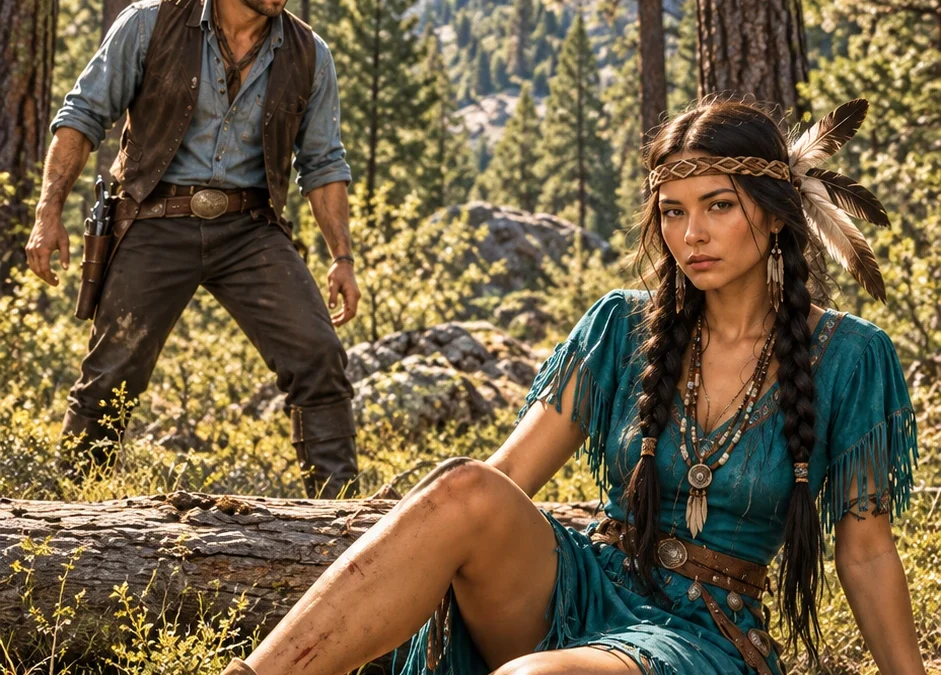
SHE WAS TRAPPED IN A BOUNTY HUNTER’S IRON JAWS, BLEEDING ALONE IN THE MOUNTAINS 😱 THE COWBOY WHO FOUND HER HAD A LOADED RIFLE… BUT WHEN THREE ARMED MEN RODE UP HIS DRIVEWAY, SHE DID SOMETHING THAT STUNNED THEM ALL 🏹
Part 1
Caught between iron jaws, her blood staining the pine needles beneath her, the young woman would have died alone in those mountains if no one had come. 🌲
And the cowboy who found her would never walk away from that morning the same man.
Her name was Aina. His was Ran Treadwell.
It was the fall of 1883, in the foothills of the Apache Mountains in Arizona Territory. The cold had come early to the high pine country that year. October still clung to the last battered colors of summer, but nightfall already carried winter’s teeth.
Ran was thirty-one, though grief had carved enough lines into his face to make him look older. Four years earlier, a ranch dispute had taken the life of his younger brother, Aemon. Aemon had borrowed money from the wrong man and sunk every dollar into cattle. Then fever swept the herd. The man who lent the money was not known for patience. He sent men to collect.
Ran buried his brother on a Tuesday morning in the hard ground of Cochise County. By sundown, something inside him had gone quiet.
Before Aemon died, Ran had been a man who made plans. A proper ranch. Good horses. Strong fences. Maybe a wife someday. Maybe children running between the barn and the house. Aemon’s death didn’t erase those dreams. It did something worse. It drained the weight from them. The shape remained, but the reason for building any of it was gone.
So he rode west and found a hundred and sixty acres of pine and open grass below a long mesa, with spring water and an old trapper’s cabin. He patched the roof, stretched fence, and made the place small, quiet, and his. He kept the cabin clean because his mother had always kept a clean house. But he never hung a curtain. He never laid a mat by the door. He kept the place orderly, but he never made it warm.
Most evenings he ate at one end of a table built for two.
That fall, he ran a modest trap line. Marten, fox, now and then a beaver, sold at the trading post eleven miles south. He set each trap deep in the timber and marked every one on a rough map folded inside his vest. He didn’t mind killing an animal when there was a reason. He saw no reason to make one suffer.
What he didn’t know was that someone else had been laying traps in those woods for nearly a week.
He’d found horse tracks under the pines after dark. The blackened ring of a campfire he hadn’t built. And three heavy iron traps hidden on deer trails above his land. Larger than anything he used. Built with cruel springs and thick jaws, capable of holding far more than a fox. Ran pulled every one, ruined the mechanisms, and stacked them at the base of a pine where whoever set them would understand the message.
He didn’t think much about it. Poachers drifted through every season.
What he didn’t know was that the men who set those traps weren’t hunting animals.
On the morning of October fourteenth, he rode into the woods above the mesa to check his line. The sky was pale gray. Low clouds pressed over the mountains. The forest smelled of cold resin and the faint promise of snow.
Then he heard it. A hard metallic snap. A heavy thud. And a low cry of pain, cut short, as if whoever made it had forced the sound back down through sheer will.
Ran pulled his horse up. That wasn’t a deer. It wasn’t a wolf. Whatever had been caught was alive, and it was trying very hard not to make another sound.
Forty yards off the trail, what he found made his blood go cold.
A young Apache woman lay on her side in the pine needles, no more than twenty. One moccasin was clamped inside a massive iron trap that had thrown her violently off her feet. Her palms were torn. Blood marked the ground.
But when she looked at him across the clearing, fear wasn’t the first thing he saw in her eyes. She was measuring him. Her gaze went to the rifle across his saddle, then to his face, studying him the way a person studies a darkening horizon before a storm.
Her hand slid toward a stone beside her head.
Ran stopped well away and slowly raised one empty palm.
“I’m not going to hurt you,” he said in his rough Spanish. “That’s a bounty man’s trap. Not mine.”
He knelt in the pine needles and took hold of the release levers…
👉 Want Part 2? Find it in the comments, or drop any word below and I’ll send it to you privately! 👇
Part 2
“I’m going to open it. It’s going to hurt. I’m sorry.”
For several long seconds she watched him. Then slowly, she took her hand off the stone.
Ran wrapped both hands around the levers and pushed with everything he had. The iron barely moved. His forearms locked. His shoulders shook. The jaws opened an inch, then two, before the springs fought back. For one uneasy moment he wondered if he was strong enough.
He clenched his teeth and leaned harder.
The jaws spread to nearly four inches. Aina jerked her foot free with one sharp, tightly controlled breath. It was the only sound she allowed herself.
She tried to stand. The ankle gave. Ran caught her before she hit the ground. She pulled away immediately, and he let her go just as quickly.
“My cabin’s about a mile and a half down the slope. There’s nobody else around. I can carry you, or you can stay where you are.” He glanced toward the northern timber. “But whoever set that trap is going to come back and check it.”
She weighed it. Then she spoke a hard, clipped sentence in Apache that left no doubt she disliked every part of this.
And she held out her arm. 🤝
His cabin was two rooms, a stone fireplace, a rope bed, a plank table, and two chairs. He settled her by the fire and went out to see to the horse. When he came back, she had already pulled off the ruined moccasin and was pressing along the bone with the practiced touch of someone who knew exactly what signs to look for. She said something in Apache. It was not a request for his opinion.
Ran set water to boil and left a small tin of real comfrey salve on the table within her reach, the kind made properly from the plant, not the watered-down patent medicine sold in frontier remedy boxes. She smelled it. Something almost invisible changed in her face.
Recognition.
He touched his chest. “Ran.”
She placed a hand over her own. “Aina.”
That night, she slept in the chair with her knife locked in one hand. Ran never mentioned it. He banked the coals, left wood by the hearth, and went to lie in the dark of the back room, wondering what exactly he had brought into his life.
In the days that followed, a strange rhythm formed. Aina couldn’t sit still. She found the broken harness straps by the door and stitched them with a bone awl and dried sinew, so fast and sure that Ran stood watching ten minutes before realizing he was staring.
On the third day, she looked into the bean sack, then at Ran. He had been quietly making his own portions smaller. She said something and limped out the door before he could stop her.
An hour later, she returned with the edge of her blanket held out like an apron, heaped with piñon nuts, dried berries he couldn’t name, and a bundle of fresh green leaves. She mimed boiling them. Tea. Medicine.
For the first time, Ran understood he hadn’t taken in someone helpless. He had brought home someone who knew how to survive. 🌿
She pinched an herb into the beans, barely enough to notice, and the plain meal gained a depth he’d never have known how to create. She tried to teach him its name. He butchered it. She didn’t laugh, but the hardness around her eyes eased.
It was the first time their silence stopped feeling like a wall.
By the end of the first week, the swelling had gone down by half. Ran had seen frontier doctors do worse with twice the equipment and ten times the boasting. He told her about Aemon. She told him, in fragments, about her people, and about the plant she’d followed south, needed for a traditional winter preparation. That was how she’d wandered into that country. That was how she’d reached the trap.
He learned the Apache word for pine. For cold. And an expression that meant something deeper than blood: the people who share my fire.
Around the fifth night, he noticed she no longer slept with the knife in her hand. He wisely said nothing.
She salted her coffee. He started making it that way without announcing it. He checked the window latch every night, an old childhood habit, and by the third night she stopped watching him do it. In the afternoons she wove a willow basket, and when she held it out, he turned it over, thumb tracing the tight spiral at the bottom.
“That’s mighty fine work,” he said, and knew the words were too small.
She made a quiet sound, almost a laugh. He asked her how to say it in her language. He ruined the word. She corrected him. He ruined it worse. Then she broke it into two clear sounds, patiently, like taking apart a piece of craftsmanship. On the third try, he came close.
That night he unfolded his trap map across the table. Aina leaned over it, comparing his pencil lines against another map she carried in her memory. Her finger stopped on a stretch of country northeast of his fence.
“That’s outside my land,” he said.
She gave him a small gesture that meant exactly.
The next morning, he rode there and found two more oversized iron traps buried beside a deer trail. Whoever set them knew what they were doing. And somewhere in those mountains, those men were camped.
On the twelfth day, three riders came out of the pines…
👍 LIKE or COMMENT “REVEAL” to see Part 3! It will be posted once we hit enough comments! 💬
Part 3
They weren’t traveling fast. That bothered Ran more than if they’d been galloping. They studied the ground, the treeline, the distant cabin, like men hunting for something specific.
He ran back to the cabin. Aina was already rolling her belongings. She’d heard the horses before he arrived.
“They’re coming here. I want you in the back room.”
She shook her head slowly. He knew that look. Only this time something harder lay beneath it. She stood, and only then did he see the short ash bow tucked among her belongings. A compact recurve, tightly strung, ready.
“This isn’t your fight.”
She gave him a look near contempt. “My ankle,” she said, in slow, careful Spanish. Until that moment he hadn’t known she spoke it. Then, quietly: “My trap.”
She sat down with the bow across her knees.
An hour before sunset, three men rode into the yard. Hard men, long roads behind them, the kind who earned money in ways respectable people didn’t ask about. The bearded one in front called himself a licensed trapper. Somebody had been interfering with his traps. Also, he’d heard of an Apache woman who had escaped “lawful capture.” A federal order. A substantial reward.
Ran held his rifle easily. He didn’t aim it. He didn’t need to.
“Haven’t seen any woman like that.”
“Thad Quillin,” the man said at last. “I’d still like to look inside the cabin.”
“No.”
The word landed like a stone.
For several seconds, nobody moved. Thad’s eyes flicked from Ran’s rifle, to the treeline, to the cabin door.
That was when the arrow came.
It flew from the shadowed doorway and sliced a strip off the cheekpiece of Thad’s bridle. His horse threw its head violently. By the time he got control, he found himself facing two things: the unmoving barrel of Ran’s rifle, and Aina.
She stood in the doorway with a second arrow already on the string, putting as little weight as possible on the bad ankle, and still she stood straight. She looked like someone who had made every important decision before anyone else had begun talking. 🏹
Thad stared at her. At the arrow. At Ran. He muttered something, turned his horse, and rode back into the pines. The other two followed.
Aina lowered the bow, leaned against the door frame, and finally let her jaw tighten against the pain she had hidden for ten minutes.
“That was a good shot,” Ran said.
She looked at him. In slow Spanish: “I know.”
She went back inside.
He didn’t believe they’d return. Men like Thad Quillin did their arithmetic first, and the sum had changed. But he sat across from her anyway.
“How long before you can walk two days north?”
“Seven days.” A pause. “Maybe eight.”
“Then you’ll stay until you’re ready.”
She said something short in Apache. He couldn’t tell whether it meant agreement, gratitude, or both.
The next eight days were the quietest he had known in four years, and somehow the fullest. In the mornings, he worked the fence while she sat on the top rail. She showed him three plants growing in the draws that he’d ridden past a hundred times: one for fever, one for pain, one for a wound that refused to close. He wrote their names phonetically in the back of his account book. She taught him a phrase: Share the fire with me. At first she corrected every attempt. Then one day, she stopped.
On the tenth day, he found a bird’s nest the wind had knocked from a pine and brought it back to the table. She turned it over, tracing the hollow center.
“My mother made nests.”
“Bird nests?”
“No. The other kind.” She gestured around the cabin. “A place where things stay safe.”
Ran looked around through her eyes. Tools. A table. A fire. No photographs. No cloth across the table. Nothing kept simply because someone cared about it. For four years he had treated the place like temporary shelter, as if part of him had never decided to stay. 🪶
That evening, he told her everything about Aemon. The borrowed money. The fever. The Tuesday in the hard ground. She didn’t try to comfort him. That was exactly right. She simply carried the weight of the story with him for a while.
Then she told him about her mother, Nah, a healer, trusted with plant knowledge not given freely. Fever had taken her in the spring of 1880. Aina spoke of her the way people speak of someone still near. Aina was a healer too. And the plant her people needed grew on the south side of a rock formation three miles above Ran’s land, and she was the only one who still remembered exactly where.
“She would know what to call you,” Aina said one evening.
“What word would she have used for me?”
She was quiet. Then she spoke a single Apache word he didn’t know.
“What does it mean?”
She lifted her eyes to his.
“The man who opens the trap.”
Outside, the wind moved through the pines in one long breath. Then the forest went still. 🌲
On the eighth day, she tested the ankle. She walked the length of the cabin and back. It hurt, but it held. She rolled her bundle and checked her bowstring. Ran had already prepared a gentle mare with an easy gait, and packed venison, corn, and salt for the two-day ride north.
She stopped in the yard when she saw it all waiting. Her eyes went from the horse to the food to him.
“Ride up through the timber to the crest, then drop toward the northern canyons. Your people should be somewhere beyond.”
“I know where my people are.”
“Of course you do.”
She placed one foot in the stirrup. Then she stopped. She reached into the blanket roll behind the saddle and drew out a flat piece of worked leather no bigger than his palm, stitched with a delicate geometric design in red and blue thread. He had no idea when she had made it. Then he remembered the afternoons he’d been outside with the horses while she sat near the fire.
She held it out. He took it carefully, and then he looked up. She was already watching him.
“When your ankle’s completely healed, when you’ve made it back to your people.” He paused. “If someday you want to come back, you’ll have a place here. For as long as you want it.”
The words sounded too small for what he meant. He looked at the cabin.
“This house doesn’t have to stay so quiet anymore.”
She held his gaze long enough for him to hear the wind in the pine branches and the mare breathing beside them.
Then she spoke in Apache. The phrase she had made him practice again and again.
Share the fire with me.
Ran answered in Apache. This time he said it correctly.
Something entered her eyes. Not quite a smile, but it came from the same place smiles begin. She turned the mare north and rode into the timber until the trees swallowed them both. 💛
He stood in the yard long after, the little piece of leather in his hand. Nothing about the cabin had changed. The roof. The fence. The barn. The woodpile.
And yet the place no longer felt the same.
Forty-two days later, she came back.
She rode out of the northern timber beneath a gray sky on the same mare. But she wasn’t alone. Beside her rode an older Apache woman, short, straight-backed, with the quiet authority of someone accustomed to being listened to. Her eyes were sharp. Even from a hundred yards, Ran felt her studying him. Not casually. Carefully. Like someone who had heard the whole story and had come to see whether the man at the center of it matched what she’d been told.
Her name was Sari. Aina’s aunt, or the closest English word for the bond. One of the most respected women in Aina’s community, and she had come to meet the man Aina had chosen to return to.
Ran stood quietly in the yard. He didn’t step forward. He didn’t try to look more welcoming or more impressive than he was. He simply let Sari look. There was nothing he meant to hide.
She spoke rapidly in Apache. Aina answered, calm, like someone who had answered the same questions many times. Sari raised an eyebrow. Then her eyes settled on Ran, and she spoke three words, slowly, clearly.
“She wants to know if you understood,” Aina said.
He shook his head.
“She says you are to take care of me.”
He looked at the older woman. Then he nodded slowly. Not the careless nod of a man agreeing because it’s easier than arguing. It carried the weight of a promise, the kind a man intends to keep for the rest of his life.
Sari watched him several seconds longer. Whatever she was searching for, she seemed to find enough of it. She said a few more words to Aina, turned her horse toward the trees, and was gone.
“She’ll come again in the spring,” Aina said.
“Why?”
“To see if you told the truth.”
Ran looked toward the pines where Sari had vanished. “Then I reckon I’d better make sure it is the truth.”
Aina studied him. It was almost the way she’d looked at him that first day from the forest floor beside the iron trap, measuring, reading. But now there was something warmer in her eyes that hadn’t been there before.
She dismounted. He held out his hand. For one brief moment, she only looked at it. Then she placed her hand in his.
Nothing more. Just her fingers resting between his. A small gesture. A clean one. 🌅
“You know,” Ran said quietly, “I don’t have a word for this.”
“I do.”
She said a word in Apache. He recognized it. The same word she’d once told him her mother would have chosen for him.
“What does it mean now?”
Her expression softened. “Something different from what I thought at first.”
He didn’t ask her to explain. He simply kept holding her hand. The sunlight filtered between the pines, and after a while the cold stopped mattering. It was only the ordinary cold of hard country, the kind that always demands something of the people who stay: strength, patience, work, loss. But every now and then, if a person has enough luck, enough patience, and a heart still willing to open after everything it has endured, that same hard country gives something back.
Ran Treadwell and Aina came from different worlds. They carried different losses, spoke different languages, and had learned survival in different ways. At first, the only thing that connected them was an iron trap buried beneath pine needles, and one man’s decision to kneel beside it and force its jaws open.
After that came something quieter. Trust built meal by meal, word by word, silence by silence. The kind of trust that grows slowly, like certain mountain plants that survive only in cold places where most living things cannot take root.
Ran had ridden into those foothills years ago looking for silence. Instead, he found something better. Aina had come into those pine forests searching for a route her people needed. She found something she hadn’t known she was looking for.
Neither would have chosen the road that brought them together. But that is the trouble with the traps a person never sees coming. Sometimes the most important thing isn’t the trap itself.
Sometimes what matters most is who kneels down to open it, and who chooses to stay after the jaws are gone. 💛🌲
This story is entirely fictional and created for entertainment purposes only. It does not represent any organization or individual, nor does it encourage inappropriate behavior. The content was generated with AI assistance.








