She Wasn’t One of the Nine Women Waiting to Be Chosen… But When the Rancher Rejected Them All and Said “I’ll Take the Apache Woman Nobody Wants,” Her Answer Silenced the Entire Town
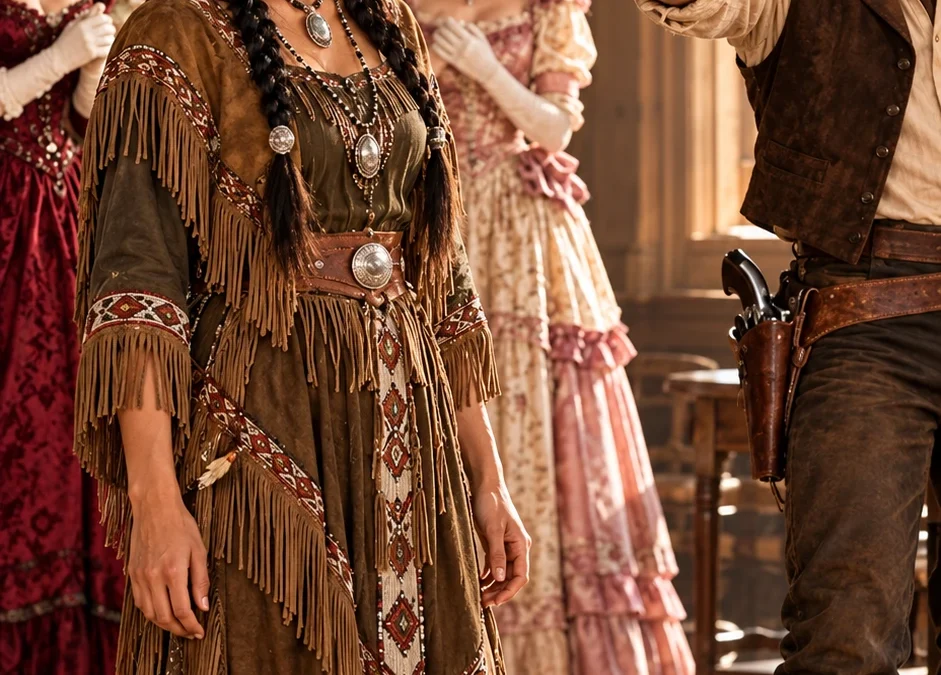
😱 She Wasn’t One of the Nine Women Waiting to Be Chosen… But When the Rancher Rejected Them All and Said “I’ll Take the Apache Woman Nobody Wants,” Her Answer Silenced the Entire Town 🔥
Part 1
She didn’t beg. She didn’t wait.
When the woman in the fine dress grabbed her wrist and told her the water wasn’t for her kind, Tlaya Nakai pulled free. Looked her dead in the eye. And said nothing at all.
Because some women have learned that silence hits harder than words. 🤫
That was the moment Ror Halden rode into Dry Mesa.
And instead of stopping where everyone expected him to, he kept walking straight toward her.
The stage depot at Dry Mesa smelled like dust and ambition.
Nine women stood beneath the narrow awning, arranged in a loose half circle the way Lenora Pike preferred. Neat. Visible. Presentable. Their hair was pinned. Their hands were still. They tried to look capable without looking desperate, an art Lenora had coached them on during the two-day journey from Tucson.
Capable, but soft enough to need someone.
Lenora held a leather portfolio with a summary of each woman: age, domestic skills, health, references, and a carefully worded note on temperament. She had been arranging frontier placements for eleven years. She knew what ranchers wanted before they could name it themselves.
It was a Thursday, July 3rd, 1884. The heat didn’t announce itself. It simply pressed down until a person forgot there was any other way to exist. ☀️
Twenty yards away, a wooden water barrel stood on a platform beside the freight shed, a ladle hanging from a leather cord.
Tlaya was reaching for it when Lenora saw her.
“That water is for the women waiting to be chosen.”
Lenora’s fingers closed around Tlaya’s wrist. Not violently. Just firmly. The way a person grabs something she believes she has every right to redirect.
Tlaya didn’t flinch. She looked at the hand the way someone measures weight and intent.
Then she pulled her arm free. Clean. Unhurried. She set the ladle back on its hook.
“Then I am fortunate,” she said. “I am waiting for no one.”
A few men near the entrance laughed. Lenora’s mouth pressed into a thin line. Laughter at her expense, even indirect, was something she cataloged and never forgot.
“You need to move along. This is a placement event.”
“I know what it is.”
Tlaya wasn’t rude. She wasn’t apologetic. She simply stated it like a fact that wasn’t about her.
She walked to a shaded spot against the freight shed wall, crossed her arms, and watched the road.
Ror Halden didn’t arrive the way a man with a failing ranch probably should have. Quietly. A little ashamed.
He rode in like he was the only one on the road, which for three hours he had been. His gray quarter horse, Bishop, was too big for the depot yard and moved through it anyway. Ror sat straight in the saddle, the way men do after fifteen years outdoors, his shirt faded to the color of sky seen through smoke.
He did not look like a man excited to choose a wife.
He looked like a man reviewing a ledger in his head and finding the numbers disagreeable. 📒
The nine women straightened as one. Lenora noticed and was professionally satisfied.
Ror swung down, handed off the reins, removed his hat. His eyes moved past the awning almost immediately. Not dismissively. Just the way eyes move when they’re looking for something specific.
They settled on Bishop first. Habit.
Then across the yard. The gate. The road. The barrel. The freight shed.
The woman leaning against the freight shed wall.
She wasn’t watching him. She was watching Bishop. With the focus of someone not looking at a horse so much as reading one.
Her eyes moved to the foam at the corner of the bit. Then slowly down the near front leg.
Ror looked at Bishop. The foam was heavier than it should have been. Bishop was shifting his weight, favoring the left front leg just enough to miss if you weren’t paying attention.
Ror had noticed it on the ride in. He’d told himself it was trail fatigue. He’d told himself that because he needed the horse fine today, and sometimes need shapes what you let yourself see.
The woman against the wall had no such need.
She’d looked at Bishop for thirty seconds and seen what Ror had spent three hours negotiating with himself about.
He started walking toward her.
“Mr. Halden.” Lenora was beside him in four steps. “Welcome to Dry Mesa. I have several exceptional candidates for your consideration.”
“Your horse is hurting.”
The voice came from the freight shed. Quiet. Not trying to carry, but carrying anyway.
The yard went quieter. The social quiet of people who have all registered that something unexpected just happened.
“Front left,” Tlaya said, still watching Bishop. “He’s been managing it a while. You can see it in the foam. He’s been holding the bit differently to keep pressure off.”
Ror was silent. Then: “How long have you been watching him?”
“Since you came through the gate.”
He glanced at Lenora. Back at the woman. Then he walked straight to her.
“Mr. Halden, she isn’t one of the women available.”
“I can see that,” Ror said. Without heat. Without dismissal. As though her not being available was a detail about the situation rather than a judgment on the person.
He stopped in front of her. She was shorter than he was, which she clearly found neither interesting nor relevant. Her face wasn’t performing anything. It was just attentive.
“What do I do for the leg?”
“Cold water wrap tonight. Check the shoe on that side for a stone bruise. It may be set too tight. Walk him slow for two days. Don’t push him on the second day, even if he seems fine. He’ll compensate again and set the injury back.”
Ror nodded once. “What’s your name?”
“Tlaya Nakai.”
“You’ve been working horses a long time.”
A pause. “Longer than I’ve been in Dry Mesa.”
Which told him something. He didn’t ask what. 🐎
Lenora had collected herself. “Mr. Halden, today’s arrangement is for domestic placements and household partners. Miss Nakai is not.”
“You said Miss Nakai.” Tlaya looked at her without particular hostility. “I heard something specific in how you said it.”
“I said it correctly.”
“You said it the way people say a word they don’t believe should exist.”
The yard was definitely quiet now. Lenora’s expression went rigid, the way women with genuine social power go rigid. Not breaking. Reinforcing.
“I think you’d be more comfortable elsewhere during this event.”
“I’m comfortable here.”
Ror turned and looked at Lenora. Not with anger. He wasn’t an angry man by nature, more a deliberate one. But with the attention of a man who suddenly realizes he’s been redirected away from something he was walking toward.
He turned back to the yard. Nine women, watching. Good women. They’d come a long way, same as anyone comes a long way toward something they need. He felt bad about what he was about to do.
Not bad enough to stop.
He said it loud enough to be clear.
“I’ll take the Apache woman nobody wants.”
The words just sat there in the heat. 😶
Then Tlaya pushed off the wall and took two steps toward him. Her expression was no longer neutral.
“Excuse me.” There was something in the word. Not exactly anger. The thing that precedes anger when a person is intelligent enough to control it. “You will take no one.”
Ror blinked. The surprise showed on his face before he could manage it.
“I’m not merchandise.” Her voice was controlled. Her eyes weren’t. It was the particular anger of someone who has been cataloged as an object so many times that even an offer of kindness, if it arrives in the wrong package, reads as one more version of the same thing. “You said you’ll take me like I’m livestock that didn’t sell.”
She glanced at the watching crowd. Back at him.
“I’m not asking for rescue. I’m not waiting to be selected. And I am not…” She said the next word with careful precision. “Available.”
Several of the watching men found something else to look at. 😳
Ror was quiet. Then he did something that surprised her, and clearly surprised himself a little. He put his hat back on and exhaled through his nose. Not frustrated. More like a man recalibrating.
“You’re right,” he said.
She blinked, just once.
“That was a poor way to say it. I’ve been on that ranch eight months without anyone worth talking to, and apparently I’ve forgotten how sentences work.”
He pulled a small, stiff-backed livestock notebook from his shirt pocket and opened it to a clean page.
“My name is Ror Halden. I own a cattle ranch nine miles east of here. I’m short one experienced hand, possibly two. The work is hard and the house is not much. I need someone who can work from first light without being told what first light looks like.”
He named a figure. It was fair. Possibly more than fair. The kind of number that told you the man was more afraid of getting the wrong person than of paying too much.
“Wages, a room, and transportation out of Dry Mesa when the season ends in October.”
“And I make my own decisions on the ranch,” Tlaya said. “You can disagree. You cannot command me. If I see something that needs doing, I do it. You don’t approve it first. If I decide in week two the arrangement isn’t working, I leave with my wages up to that point.”
“Fair.”
“And nobody, including you, tells me what my place is because I sleep beneath your roof.”
The yard had gone very still.
“Miss Nakai,” Ror said carefully. “I’ve got seventeen head of cattle, a cracked water trough, a broken corral gate, three hundred acres with nobody to help me work it, and a neighbor actively hoping I fail before October. I don’t have time to tell anyone their place. I barely have time to find my own.”
It was, she would think later, a better answer than she’d expected.
She didn’t say yes right away. She looked at Bishop. She looked toward the eastern road. She did a version of arithmetic that wasn’t about money, but about risk, and what the alternatives currently looked like.
The alternatives were not good.
“Your horse needs water before your ranch needs a partner,” she said.
Something near his eyes shifted. “I know.”
“Then go see to him.” She pressed the notebook back into his hand. “I’ll be here when you’re done.”
While Ror was at the water barrel with Bishop, Lenora approached her. She didn’t make a scene. Scenes were for people without leverage.
“You’re making a mistake,” she said quietly. “A ranch nine miles from here. Alone with a man you don’t know.”
“I know the desert.”
“You don’t know him.”
“I know he noticed what the horse needed, and didn’t decide the horse was fine just because he didn’t want it to be broken.” Tlaya watched Ror crouch beside Bishop’s foreleg, working his thumb along the line above the hoof with more gentleness than his size suggested. “That tells me something about his judgment.”
Lenora was quiet. Then:
“He had a wife. Three years ago. She left after the first winter.”
Tlaya turned to look at her.
“I’m telling you as information. Not to dissuade you. Only so you’re not surprised later.” Not kindly. More the way a person drops a stone into water to watch the ripple. “Because you might convince yourself you matter to him. And then the cold will come, and the isolation. You’ll find out what she found out. That Ror Halden loves a piece of land more than he’s ever loved anything that breathes.”
“Mrs. Pike,” Tlaya said, “I’m not going to love him. I’m going to work.”
She looked back toward Ror.
“He doesn’t need what you think he needs. He needs someone who knows what a stone bruise looks like before it becomes a lame horse. Someone who sees a cracked trough and understands it isn’t a maintenance problem. It’s a water loss problem.” She met Lenora’s eyes. “He doesn’t need a house manager. He needs a partner who isn’t afraid of July.”
Lenora said nothing. She walked back to her awning.
They left Dry Mesa forty minutes later.
Ror rode Bishop at a walk. Tlaya walked beside them on the road, declining the saddle behind him. The seat’s not built for two comfortably, and Bishop doesn’t need the extra weight right now.
Nine miles of flat alkaline soil and amber rock. Ror didn’t talk much. It wasn’t the silence of a man who wanted her to fill it. It was the silence of someone accustomed to his own thoughts keeping him company.
She respected that.
“The ranch,” she said. “Tell me what’s failing.”
“Why?”
“Because I’d rather know the truth now than discover it by parts.”
So he told her. The well at sixty percent of spring capacity. The cracked trough, losing water every day, making the well problem worse. Seventeen cattle, two of them not right. The roof, patched badly after a spring storm. A garden planted in full sun by a man who thought more sun meant more growth, and was wrong about Arizona.
“And I have no one to help me.”
She didn’t offer reassurance. She took the information the way she’d read Bishop’s foreleg. Practically.
“Move the tomatoes and squash to the east side. Morning sun only. The trough, is it wood?”
“Cracked on the bottom seam.”
“I can seal it with stone and clay pack. It won’t be permanent, but it’ll stop the loss while we address the well.”
He looked at her. “You’ve never seen my ranch.”
“You’ve told me enough.”
For the first time since she’d watched him ride into Dry Mesa, something in his face changed. Not softened exactly. More like exhaled.
“All right,” he said.
The ranch appeared at the crest of a low rise. The house. The barn. The corral. The garden on the south side catching every brutal hour of Arizona sun.
She said nothing about any of it. She had learned long ago that the first thing you say about someone’s home tells them what you actually think of them.
She wasn’t ready to say that yet.
When they entered the corral, the loose hinge on the gate banged, and a young mare in the far corner threw her head and slammed against the fence.
Ror swore under his breath. Tlaya went directly to the hinge.
“Do you have a leather punch and a spare rivet?”
She found them in the barn. She fixed it in eight minutes.
The banging stopped. The mare settled. Gradually. The way nervous animals settle when the threat disappears and they’re giving themselves permission to believe it.
Ror stood in the corral entrance with the expression of a man who has been proven wrong before he even finished forming the assumption. 🔧
Her room was a small side room off the kitchen with an east-facing window. Morning light meant reading terrain early, which mattered.
“It’s not much, Mr. Halden.”
“I have slept in a dry wash with three inches of sand between me and rock. Your room is fine.”
She set her pack on the table. She put her knife on the inside of the bed near the wall. She thought about what Lenora had said, about his wife, the cold, the man who loved land more than anything that breathed.
That’s his problem, not mine. I’m here to work. October is the end of it. That’s clear and simple, and I can operate within those terms.
Then she went outside to look at the water trough.
The crack ran eight inches along the lower seam. The soil beside it was darkened in a spreading arc that told the story plainly. Slow, constant loss.
“Six weeks,” Ror admitted. “Things get ahead of you.”
“How much water are you losing a day?”
“Four gallons. Maybe.”
“Multiply that by six weeks.” She stood. “It’s not the well. The well is fine. You’ve been losing the water before you can use it. I need flat stone, palm-sized, and heavy clay. This is the first thing we fix.”
Something passed across his face she couldn’t immediately read. Not irritation. Not resentment. It was the expression of a man who has been talking to himself for eight months and just realized the conversation is now two-sided.
“You’re not going to settle in first?”
“I’m not here to settle in. I’m here to work, and the trough is losing water right now.” She looked at him. “Are we going to get the stone, or are we going to talk about getting the stone?”
He went to get the stone.
They worked until the light failed. She showed him the pack method. Stone is structure. Clay is seal. Overlapping layers, because water finds the easiest path, and if you don’t overlap you’re just offering it a series of easier paths.
“How do you know this?”
“My grandmother. She kept her family’s water for forty years in a desert. If she’d waited for someone to build her a proper trough, we’d have been thirsty for forty years.”
She pressed a stone into place. “She taught me the watching. The rest you pick up when you pay attention and stop assuming that what other people do is the only way things can be done.”
He glanced at her. “You mean me?”
“I mean most people.” A pause. “But yes. Also you.”
He almost smiled. She caught it at the edge of her vision and didn’t acknowledge it.
That night she cooked, not because it was her job, but because she was already in the kitchen and hungry. Beans. Cornbread. Dried meat. Ror ate without comment, and she took that as a good sign.
He poured coffee from a pot that had been sitting since morning. She looked at the color of it.
“You used too much coffee.”
“Everyone says that. Then everyone is right.”
She drank water instead.
“Miss Nakai.”
She stopped at the door.
“Thank you. For the trough.”
He wasn’t looking at her. He was looking at his coffee cup, the general middle distance of a man who finds gratitude harder than labor.
“That’s not thanks,” she said. “That’s wages.”
He looked up.
“Call me Tlaya. Miss Nakai sounds like someone expecting a school lesson.”
“Tlaya.”
She went to her room and lay on the narrow bed in the dark and listened to the ranch settle around her. The creak of the house. The soft movement of horses. The dry wind that smelled like sage and hot rock.
October. She had until October.
The hinge on the corral gate was silent for the first time in weeks.
She was up before sunrise. She’d slept fine. She was up because the ranch was quietest in that hour, and quiet was when you could hear what a piece of land was telling you.
She walked the perimeter of the well. She lowered the rope and measured the depth by the sound the bucket made. She paced the distance between the well and the trough, the trough and the garden, the garden and the barn, without writing anything down. Her memory for terrain was better than most men’s compasses.
By the time Ror came out with two cups of coffee, she was crouched in the garden with her fingers three inches into the soil.
“The tomatoes are dying. Not from lack of water. From too much heat on the roots. The soil is baking them from below.”
They moved them before breakfast. She dug. He carried. She replanted. He mixed water into the soil the way she showed him, slow and even, letting it absorb before adding more.
When it was done, she looked at the twelve plants in their new position and felt something cautiously resembling optimism.
“Give them four days. If they take, the leaves will stop curling inward.” She wiped her hands. “Plants tell you everything. Most people just don’t speak the language.”
“You talk about plants like they’re people.”
“I talk about them like they’re alive. Which they are. Most people treat living things like furniture until they stop working.”
He gave her a long look. Not unfriendly. The kind of look that meant she’d said something that landed somewhere he hadn’t expected.
“What’s first today?”
“Fencing on the north section’s been down since May. Three posts. And the cattle in the east quarter need moving.”
“I’ll take the cattle.”
He stopped. “Alone.”
“You take the fence. Two people on fence work wastes one person.”
“You’ve never…”
“I’ll learn them this morning.” She glanced at him. “Or are you going to tell me it takes longer than a morning?”
He looked like he was going to say yes. Then he looked at her face and apparently decided that was a battle with a predictable outcome.
She found the water point at the far end. The cattle moved in three hours. She came back with every head she’d been given, plus one more she’d found tangled in scrub, a young steer with a rear leg caught between two rocks. She’d freed him, walked him back, and checked the leg. Bruised, not broken.
“That’s sixteen,” Ror said, straightening from the last fence post. “The steer in the east draw was yours?”
“He’d been out there a while. Keep him separate from the herd two or three days. He’s stressed, and he’ll spread it.”
Ror stared at the steer. Then at her. “I didn’t know I was missing one.”
“You’ve been trying to do everything yourself.” Not accusing. Just a fact. “When you do that, the things that go quiet are the ones that slip past you.”
He didn’t answer.
She unsaddled the mare and gave her water. Ror watched without offering to help. She noticed he wasn’t offering because he was watching her method. Not checking whether she was doing it right. Learning the specific way she did it.
She didn’t say anything about that either.
A rhythm developed over the following days that neither planned and neither acknowledged. She woke first. She read what the land and weather and animals had said overnight. He came out. They divided the work without ceremony. They ate together without much conversation. They worked until dark.
It was not comfortable, exactly. It was functional, the way well-maintained tools are functional.
What neither of them said was that it was also the most efficient either had worked in years.
The first real argument came on day eight, over a horse named Copper.
Copper was a three-year-old bay gelding who had developed a habit of refusing the gate. Not spooking. Refusing. He’d stand at the threshold, lock all four legs, and decline to proceed no matter how much pressure came from behind.
Ror had been dealing with this for six weeks. His method was persistence. You pushed until the horse ran out of reasons to say no.
Tlaya watched him work the horse for twenty minutes before she spoke.
“He’s not being stubborn.”
“He absolutely is being stubborn.”
“He’s afraid.”
She came to the fence rail. “Something happened at a gate. Not here. Before you had him. You can see it in where he holds the fear. He drops low in the back when the gate gets close. That’s not defiance. That’s memory.”
Ror turned, jaw tight. “Six weeks of the same thing every day.”
“And has six weeks of pressure changed it?”
A long pause. “No.”
“Then the method is the problem. Not the horse.” She climbed through the fence rail. “Can I?”
He stepped back. Not with grace. There was something clearly effortful in it, a man accustomed to being the authority in his own corral making room for someone else’s judgment.
But he did it.
She didn’t approach Copper headon. She came from the shoulder, slow and sideways, and let the horse track her without having to commit to acknowledging her. She stood beside him and breathed normally and waited.
Then she walked toward the gate. Not at it. Alongside it, as though it were just another piece of the corral. She stopped two feet away and looked at something else. A fence post. Very interested in that fence post.
Copper watched her. She moved a little closer. Still not looking at the gate. Still extremely interested in the fence post.
The horse took one step toward her. She moved away from the gate, entirely disinterested now. She scratched his withers where they itched.
She spent forty minutes near that gate without once trying to push Copper through it. By the end, he was standing at the threshold voluntarily, head low, relaxed, occasionally sniffing the gate post.
“Tomorrow,” she said, returning to the fence, “he’ll walk through on his own.”
“You didn’t get him through.”
“Not today. But I didn’t lose ground either. Every time you forced him and he refused, that registered as a loss for you and a victory for the fear. Every time I made the gate irrelevant, the fear had nothing to win against.” She looked at him. “Fear needs an opponent. If you stop being one, it runs out of fuel.”
Ror was quiet a long time. “That’s not how I learned to work horses.”
“I know. It’s slower. It’s permanent. Your way might get him through the gate this week. My way means he goes through willingly for the rest of his life.” She paused. “Which would you rather have?”
He didn’t answer out loud.
But the next morning he didn’t go near Copper’s gate work. And on day two, Copper walked through on his own. 🐴
Ror found her at the water trough checking the clay seal, which was holding beautifully.
“You were right.”
“I know.”
“You don’t have to…”
“I don’t need to say it,” she said. “You seeing it for yourself is more useful. If I have to tell you I was right every time, you’re not learning. You’re just ceding ground.”
He looked at her a moment. “You’re a very particular kind of person.”
“Is that a problem?”
“No,” he said. “No, I don’t think it is.”
Neither mentioned that it was the longest conversation they’d had about something that wasn’t strictly about the ranch.
Two weeks in, she found the second water source.
She’d made it a habit to walk the land before breakfast, not to use it, just to watch. Let it show her things without asking questions.
She found it by the ants. The colony had shifted slightly northeast of its previous position, which they’d have no reason to do unless moisture had moved. She traced the direction fifty yards and crouched again. The soil was subtly lighter at the surface, the kind of lighter that comes from subsurface moisture wicking up and evaporating.
She dug with her knife. Six inches down, the soil was cooler and held together.
She marked the spot with a rock cairn and found Ror in the barn.
“There may be a secondary water source. Northeast of the main well, about fifty yards.”
“There’s nothing out there. I’ve worked that land for…”
“The ants moved their colony. And the soil color is wrong at depth.” She looked at him. “Worth digging.”
He set down the tack. “Show me.”
He dug while she directed, because he was stronger and the digging needed to go deep fast. At three feet, the shovel hit damp clay. At four, water began to seep into the hole.
Slowly. The way water that’s been traveling underground for a long time seeps. Patient. Quiet. Inevitable. 💧
Ror sat back on his heels and stared.
“I’ve been here five years.”
“The land’s been here longer. Drought years shift where the water goes underground. This one might not have been reachable five years ago.”
“Can we use it?”
“If we develop it carefully. Stone line the channel. Keep it clean. Don’t overdraw. It won’t replace the main well, but it’ll supplement it through the rest of summer. That’s what you need.”
His jaw worked through something complicated. The way some men process surprise, by briefly going silent while their understanding of a situation restructures at the foundation.
“I’ve been panicking about water for six weeks.”
“I know. And it was here. You weren’t looking for it. You were managing the shortage you could see. That’s not wrong. It’s just not all there is to do.”
He pushed himself upright. “What else am I missing?”
Not defensively. Not performing humility. Genuinely asking.
“Your northwest corral posts are being undermined by runoff from the barn roof. In a month they’ll start to lean. Also, the mare you’ve been calling untrainable is not untrainable. She’s bored. She needs work, not management.” She paused. “And you make coffee like a man who’s angry at sleep.”
He almost laughed. A real almost.
“That’s your most serious concern?”
“It’s my most daily concern. The rest are fixable in a week. The coffee I have to live with every morning.”
This time he did laugh. Brief, controlled, like a man not entirely sure he’s allowed to do that in his current circumstances. But real. The laugh of someone who has been taking everything very seriously for a very long time and was just reminded, by a woman standing over a muddy hole in the ground, that not everything is a catastrophe.
She didn’t join it. But she didn’t stop it either. 😊
“Stone channel started by tomorrow, if we’re going to use this seep for August.”
“Right,” he said, still slightly warm from the laugh.
They worked.
👉 But then a man named Silus Crowell rode in, smiling, with an offer that sounded generous and a warning about August. Find Part 2 in the comments, or leave any word and I’ll send it to you privately! 👇
Part 2
It was Silus Crowell’s horse that announced him before he arrived.
Tlaya was adjusting the irrigation line she’d rebuilt from stone when she heard it come in fast. Too fast for a social call. The speed of a man who wants to establish something before he gets off his horse.
She finished what she was doing. Then she came around the corner of the house.
Crowell was a large man who took up atmospheric space, the kind that announces itself and expects adjustment. He had the confidence of someone who has never had a reason to wonder whether he was welcome.
He was talking to Ror from the saddle. His eyes found her immediately and moved over her, designed to be noticed.
“Ror. I heard you’d made a unique arrangement for the summer.”
“Silas.” Ror’s voice was level. “What can I do for you?”
“Came to talk cattle. If you’ve still got any worth talking about.” That smile, carrying something else inside it. “I’m heading to the Tucson buyer in three weeks. And I hear your numbers are down. Seventeen?”
“Seventeen in good shape is worth more than twenty-five in poor shape.”
“If they’re in good shape.” His eyes returned to Tlaya. “Didn’t know you’d taken on extra hands this summer. Mrs. Pike sent a note.”
“He didn’t take me on,” Tlaya said. “We have a business arrangement.” She looked up at Crowell. “If you’re here to talk cattle, talk cattle.”
“You speak for the ranch, do you?”
“I speak for myself. If that happened to redirect your attention from something that was only going to waste both your time and Mr. Halden’s, that’s a coincidence.”
Crowell looked at Ror. His smile had gotten smaller. The smile of a man filing something away.
“She’s direct.”
“She’s efficient,” Ror said. “Which is more than I can say for this conversation so far.”
Crowell looked around the yard. The repaired trough. The relocated garden. The realigned fence line. Something shifted in his expression. Brief. Small. Surprise, swallowed before it could show.
She caught it.
“Place is looking better than I expected.”
“It’s looking like what it is. A working ranch.”
Crowell gathered his reins. “My offer on the land stands. Whenever the arithmetic stops making sense.”
“It’s July,” Ror said.
“It’ll be August soon. Driest August in four years, from what I hear.” He looked at the sky with the casual concern of a man who has never had to worry about water. “Hardest month on livestock.” A pause. “Come August, you’ll be begging me to take this place.”
He rode out.
Tlaya watched the dust.
“He’s been waiting for you to fail,” she said.
“Since last October. He made an offer for this land two years ago. Low. I turned it down. He decided the market would eventually make me regret it.”
She turned to look at the ranch. The sealed trough. The seep. The tomatoes that had, as of yesterday, stopped curling their leaves and started standing upright.
“He was right about August.”
Ror turned.
“Not about the ranch failing. About August. The weather’s going to get worse before it gets better.” She looked at him. “We have three weeks to prepare.”
His jaw tightened. Not with fear. With focus. She had learned to read the difference. Fear went soft around the edges. This was clean and hard.
“What do we need to do?”
“Finish the secondary channel. Move the most vulnerable cattle closer to the main well. Check the barn roof. The sections you patched in spring will fail if there’s a storm.”
“How do you know there’s going to be a storm?”
She thought about how to explain it in terms he’d accept. Not as mysticism. As observation.
“This morning before you came out, I walked the east perimeter. The birds are gone from the low brush. Not hunting, not resting elsewhere. Gone. Moving higher. And the ants that showed me the seep have moved their eggs uphill.”
Ror looked at the cloudless sky. The particular vast, clean blue of an Arizona summer, giving nothing away.
“There’s not a cloud between here and Mexico.”
“Clouds aren’t the first thing that knows.”
He looked at the sky a second time. Not skeptically. Carefully.
“How long?”
“A week, maybe two. Could be less.”
“I need you to tell me if I’m wrong about something like this. If you see something I’m missing.”
“I always will.”
He nodded once, the way he nodded when a thing was decided.
“Three weeks of prep.”
“Three weeks.”
They turned toward the ranch and started planning.
It was the evening of the fifteenth day when she asked the question she’d been sitting on since Lenora Pike had spoken outside the freight shed.
They were on the porch after supper. The heat had let up. The desert had a mercy it only showed at night, dropping twenty degrees between sunset and midnight as though apologizing for the day. Ror was repairing harness leather. She was sharpening her knife.
“Why haven’t you asked where I came from?”
The leather kept moving.
“Because if you wanted me to know, you’d tell me.”
She looked at him. His hands kept working. He didn’t look up.
“Most people ask.”
“Most people ask because they want to know whether to be comfortable with you. I already know whether I’m comfortable with you.” A pause. “I’m not.”
She blinked.
“That’s not an insult.” He glanced up briefly. “You challenge how I do things. You’re better at half of this than I am, and you’re not polite about it. That makes me uncomfortable.” Another pause. “But it also means the ranch is working better than it has in two years. So being comfortable with you turns out not to be the relevant thing.”
She was quiet a long time. He finished the harness and set it aside.
“I’ve made mistakes,” she said finally. Not an explanation. A statement she’d been holding that needed to be said to someone, at some point. The silence and the night air and this particular man who hadn’t asked had somehow created the space. “The reason I was in Dry Mesa was that the previous place I’d been became dangerous. And the place before that, I’d made the situation worse by trusting someone I should have seen clearly.”
She looked at the dark desert.
“I’m very good at reading terrain and animals and weather. I’m not always as good at reading people.”
Ror said nothing. She was grateful for that.
“I’m trying to be more careful now. About what I offer and what I protect.”
He looked at her. Not with pity. She was watching for pity and would have closed the conversation immediately if it appeared. He looked at her with something more like recognition. The look of a person who has their own version of a similar inventory.
“That’s a reasonable thing to be trying.”
She turned toward him. “You had a wife.”
The harness sat still in his hands.
“Three years ago. She did.” He was quiet. “She was a good woman. She just needed a different life than this one.”
“And you needed this one.”
He thought about it. “I don’t know if I needed it. But I made it.” He looked down at the leather. “Took me a while to learn the difference.”
She understood that distinction with a precision that probably showed on her face, because he looked at her again.
“Same?”
“Something like it.”
They sat with that for a while.
Then he stood, folded the harness, and paused at the threshold the way he did when he was about to say something he’d been thinking about longer than this moment.
“The water channel. I was thinking tomorrow we start lining the lower section. I’ll bring the stone from the east side.” A beat. “But I’d want your eyes on the angle of the grade before we set it.”
She recognized what this was. Not a request. Not a command. A partnership question. The kind that required both parties to be necessary.
“Before breakfast. I want to check the bird positions in the east again.”
“I’ll go with you.”
She looked at him. He met her look without flinching.
“Two sets of eyes.”
“Before sunrise, then.”
“Before sunrise.”
He went inside. She stayed on the porch a little longer, looking at the dark outlines of land that still felt borrowed. Temporary. The way everything had felt for the last two years.
Like something she was passing through rather than standing on.
The birds came back on a Tuesday.
That was how she knew the timeline had shifted. For twelve days, the birds had stayed high and the air had held that stillness she’d learned to recognize as pressure building somewhere above the visible sky.
Then Tuesday morning, they were back in the low brush. Not settling. Moving through. Restless. The way animals move when the thing they’re running from has gotten close enough that direction no longer feels like a solution.
She came back to the house at a near run. Ror was at the stove. He read her face and set down the coffee pot.
“How long?”
“Maybe today.”
He didn’t argue. Didn’t look at the sky and tell her it was clear. He’d done that once, three weeks ago, and she’d been right about everything since. A man who only learns from being wrong twice isn’t learning. He’s just updating his loss count.
Ror had updated once. That had been enough.
“Cattle first,” he said.
“The three weakest need to move now. East of the wash, high ground. If the wash fills, they’re cut off.”
“I’ll take them. You start on the barn.”
The roof was what she’d been worried about for two weeks. She found the ladder. She found the spare timber. She went up.
The patches were worse than she’d assessed from below. The northwest corner had been repaired with boards that didn’t overlap properly, leaving a gap the weight of rain and wind would pry open like fingers finding a seam.
She pulled the loose boards. Recut the angle with the hand saw. Reset them with longer nails, overlapping correctly. Sealed the edge with pine tar she’d found two weeks ago in the storage shed and moved to the barn specifically because she’d expected to need it.
She worked fast. Not rushed fast. There’s a difference. Rushed makes mistakes. Fast is just quick accuracy.
She was on the second section when the wind shifted.
Not gradually. All at once. Like a door being opened in a house you thought was sealed. One moment the air was still and hot. The next it was moving from a completely different direction, cooler, smelling of rain that was still twenty miles away but moving at a speed with no interest in politeness. ⛈️
She finished the second patch and came down the ladder.
Ror rode in at a hard canter, dismounted, and tied his horse in one motion.
“Cattle are moved. What else?”
“Horses inside. All of them. Close the main barn doors and prop them. The wind’s going to come from the northwest, and the latch won’t hold without support. I’ll take the young mare. You take Copper and Bishop.”
“Copper’s going to…”
“Trust me now. Take Bishop first. He’s the heaviest. He anchors the others.”
He went.
She found the young mare in the far corner of the corral. Ears flat. Eyes wide. Reading the wind and the sound the coming storm made in the brush to the west, a low, persistent hiss like something very large exhaling.
Tlaya didn’t rush her. She put her hand on the mare’s neck and stood with her, breathing steady, letting the mare feel that she wasn’t panicking. Animals catch panic like a cold. Calm is contagious the same way, if you’re patient enough to wait for it to spread.
“I know,” she said quietly. “I feel it too.”
The mare’s ear swiveled toward her voice.
“We’re going in. You’re going to be fine inside. I’m going to be right there.”
She walked. The mare walked with her.
The storm hit at two in the afternoon.
It didn’t build. It arrived. The wind came first, hard and lateral, the kind that doesn’t push so much as redefine direction. Dust became a wall. The temperature dropped fourteen degrees in eight minutes.
Then the rain. Not the gentle kind. The kind that falls like it’s been held back under pressure and has finally found release. It hit the barn roof like a fist, then settled into a continuous roar that made it impossible to hear anything more subtle than a shout.
Ror was in the barn with her. They’d both ended up there without discussing it.
“The wash,” he said, close to her ear. “It’ll be filling.”
“Probably fast. The soil’s been hard all month. It won’t absorb. It’ll run.”
Outside, something hit the side of the barn. Hard.
“Fence section,” Ror said. “North, probably. There was a post I hadn’t reset yet.”
She thought fast. “The cattle I moved are east of the wash. Not north. The yearlings are north.”
He swore.
“How many?”
“Four.”
She went to the door and looked through the gap. Rain. Wind. Visibility maybe thirty feet. The north pen’s fence line was leaning but holding.
“If we go now while the fence is still up, we move them before it falls. If we wait for it to go, we’re chasing them in a flash flood.”
“Let’s go.”
They went.
The rain was not something you moved through so much as something you moved against. The alkaline soil was sheeting water sideways, every low point running. The yearlings were bunched in the far corner of the pen. Scared, but bunched. Which meant they hadn’t started moving yet. Which meant they were manageable.
Ror took the gate. Tlaya went into the pen. She moved them the way she’d moved every herd on this ranch. Calm authority. Consistent pressure from behind. Directing without chasing.
All four went through, toward the high ground behind the storage shed.
The fence section fell sixty seconds later.
Not dramatically. It simply leaned past the point where it could hold its own weight and went down, the post pulling free as the soil beneath it turned to soup.
Ror looked at the fallen fence. Back at Tlaya.
“Clear,” she said.
They ran back toward the barn. That was when the lightning hit the ridge.
A quarter mile away, maybe more. But the sound was immediate and physical. A crack that reorganized the air around it.
The horses inside erupted.
She was already at the barn door when she heard the structural sound. At the same moment, Ror shouted. Not pain. Warning.
She turned. He was already inside, moving toward the stalls and the beam. The long cross support on the northwest wall. The old one she’d seen and noted as something that needed attention when there was time.
It was moving.
Not falling. Shifting. The way old timber shifts when something external removes the balance it’s been depending on for years.
It came down in two stages. First the end dropped, catching Ror across the right shoulder. Not the full weight. The edge of it. But enough.
She heard the sound it made. She didn’t want to categorize it.
He went down to one knee. Then the second stage. The full section, rotating on its pivot, caught his leg as he tried to move.
He didn’t cry out. He made a sound like exhaling through something very large pressing on his chest.
“Ror!”
She was there. He was on the floor, his right leg pinned from the knee down, his shoulder at an angle that was clearly wrong. He was conscious. His face was the color of someone experiencing pain that requires management. 💔
“How bad?”
“Leg is pinned. I can’t see the shoulder properly.”
She looked at the beam. Old timber. Heavy. Long. Resting its weight across a stall divider.
She couldn’t lift it. She was strong, but not that kind of strong.
She looked at the barn rope. The pulley hook on the east rafter. The saddle on the rack. Bishop’s, the heaviest, with a strong horn. A wood block from the stall.
“I’m not going anywhere,” Ror said, with something dark in the humor that meant he was working hard to hold the pain in a manageable shape.
She moved fast. She set the block at the right angle, beside the beam to redirect force. She pulled Bishop’s saddle from the rack. She ran the rope from the beam around the block, up over the hook, and back to the saddle horn. A configuration that was not elegant, but was mechanically sound.
“What are you doing?”
“Leverage. I can’t lift it. I can redirect it.”
“That rope won’t hold…”
“I know what I’m doing. Hold still.”
She brought Bishop out of his stall. This was the dangerous part. A frightened horse near a pinned man was a specific kind of dangerous that required very precise management. She talked to him the entire time. Not commands. Conversation. The voice you use when you’re telling a frightened person you know it’s bad, and you’re still here, and you’re still working.
Bishop let her position him.
She tied the rope to the saddle horn and looked at Ror.
“When the beam moves, pull back with your arms. Not forward. Do it immediately. You’ll have about five seconds of clearance before the rope pulls and the beam comes back.”
“You’ve done this before.”
“Similar.”
“Similar meaning you know it works?”
“Similar meaning hold still.”
She backed Bishop forward. The rope went taut. The block caught the redirected force.
The beam moved. Not much. Not easily. But it moved.
The end across his leg lifted eight inches.
“Now!”
He dragged himself backward across the floor with his arms, pulling his leg through the gap. The eight inches she’d bought him were barely enough.
“You’re out. Move. Roll.”
She stepped back.
The beam came down.
The sound it made when it landed was the sound of something that would have broken him in half if he’d still been under it. 😰
For a moment, neither of them moved.
Then she went to him. His leg was intact, deeply bruised, maybe worse, but the shape of it was right, and he could move his foot when she told him to. His shoulder was dislocated.
“Your shoulder is out.”
“I know.”
“I can reset it. It will hurt for about four seconds. After that, it’ll hurt less than it does now.”
He looked at the ceiling. “All right.”
She reset it.
He made one sound. One. Then nothing.
He lay on the barn floor breathing carefully while the rain continued its assault on the roof and the horses settled incrementally around them.
She checked the horses. Frightened but uninjured. Bishop had done everything she’d asked of him, and she told him so in the same low voice she’d used to position him. He pressed his nose briefly against her palm, the way horses do when they’ve decided you’re the thing they’re going to trust.
When she went back to Ror, his face had gone from pain-white to the particular gray that means the body is processing something bigger than adrenaline can hold.
“Sit down.”
“I need to check…”
“Sit. Down.”
He sat.
She found the cleanest cloth, soaked it in the horse barrel, and wrapped his leg.
“Tlaya.”
She tightened the wrap and looked up. He was looking at her with an expression she hadn’t seen on him before. Not gratitude. She could read gratitude. Something older and more private. The expression of a man who has just discovered, in the least convenient circumstances possible, that he is not alone in the way he has arranged his entire life around being.
“You could have left me. Gotten yourself out.”
She looked at him a moment.
“I gave my word until October.”
He held her gaze.
“That’s not why,” he said quietly.
She didn’t answer that.
👉 Did Tlaya really stay only because of her word? And what did the storm leave behind that Crowell was waiting to use against them? Like or comment “REVEAL” to unlock Part 3, which will be posted once we hit enough comments! 🔥👇
Part 3
She stood. She went to the barn door and looked out.
The rain was still heavy, but the worst of the wind had passed. The wash was running hard. She could hear it from here, that particular roar of a channel with too much water moving too fast. The ridge where the lightning struck showed a dark scar.
The ranch was standing. Badly battered. Fence sections down. The north pen opened to the desert. One structural beam gone from the barn, the floor showing the scar of it.
But standing.
She turned back. Ror had his back against the stall and his eyes closed. Not unconscious. She checked that immediately. Resting, because the pain required that much management.
“You need to be inside.”
“I can manage.”
“I know you can manage. You’re still going inside.”
She helped him up. They crossed the yard in the thinning rain. She got him through the house door and onto the bed in the main room. She elevated his leg with a folded blanket. She looked at his face for signs of confusion or uneven pupils and found neither.
“The cattle,” he said. “I’ll go back out in an hour when the water drops.”
“The yearlings are safe. We’ll deal with the fence tomorrow.” She said it the way she said everything. Direct. Without performance. “The ranch is still here. You are still here. Those are the two things that matter tonight.”
She pulled the blanket over his leg.
“You fixed the roof before it hit,” he said. “I saw you up there when I came back with the cattle.”
“It needed doing.”
“I’d been meaning to get to it for six weeks.”
“I know. You told me.”
She sat in the chair beside the bed. Not because she was tired. Because she needed to be within arm’s reach in case his color changed.
“Crowell’s going to hear about this,” he said. “He’ll say the arithmetic finally stopped making sense.”
“Crowell doesn’t know what the arithmetic is. He only knows the numbers he can see.”
“What’s the number he can’t see?”
She thought about the seep she’d found by following ants. The tomatoes alive and growing in their new position. The young mare who now walked like a horse who trusted the ground under her feet. The channel that would hold through August.
“Everything we built,” she said.
He held her gaze.
Outside, the storm pulled east. The desert did what the desert does. Absorbing. Reorganizing. Continuing. It had no opinion about what had happened on this particular piece of it. That was the thing about land. It didn’t award points.
But inside the house, on a narrow bed with a folded blanket under his leg and a woman sitting beside him who had lifted a beam off his body with a rope, a saddle, a block of wood, and a knowledge of physics she’d learned from necessity, Ror Halden was discovering something his body had known for weeks before his mind admitted it.
He needed her.
Not the way a struggling ranch needs capable hands. Deeper. The way a person who has been operating at the edge of their limits for so long they’ve forgotten what it felt like not to be at the edge needs someone whose strengths cover the places where theirs end.
He couldn’t say that. Not tonight. Maybe not for a long time.
But he lay in the dark and listened to her moving around his house, checking, managing, taking care of things she hadn’t been asked to take care of. And something in his chest that had been wound tight since the wife who left, the brother who moved on, the father who died, and the slow accumulating isolation of a man who had stopped asking for anything, loosened.
Just a fraction. Just enough to let him breathe differently.
He closed his eyes.
She sat in the chair and listened to the storm move east, and did not allow herself to think about the expression on his face when he’d said that’s not why.
Because October was the end of the arrangement. Because she had made herself a promise about being more careful.
She kept watch. 🌙
The fever started on the second day.
She knew it before he admitted it. She’d been watching since the barn, because wounds that sit in barn dirt in July don’t stay clean by good intention. She cleaned the leg properly, packed it with salt and cotton from the house medicine box. But infection is patient.
By day two, his skin was radiating the specific kind of heat that isn’t sunburn or exertion.
“You’re feverish.”
“I’m fine.”
“Your definition of fine needs revision.”
She made willow bark tea from the bark she kept in her own pack for exactly this kind of situation. Another thing her grandmother had taught her. He drank it without arguing, which told her he felt worse than he was admitting.
On day three, Crowell came back.
He didn’t knock. He rode into the yard the way he always did, like a man who has decided in advance that his presence is welcome. He looked at the fallen fence, the barn with its patched roof, the water line on the corral posts showing how high the runoff had risen.
He was taking inventory.
Tlaya came around the side of the barn with her sleeves rolled to the elbow and her hands dirty. She stopped when she saw him reading the ranch like a ledger.
“Miss Nakai.” A warmth with nothing warm in it. “I heard about the storm. Heard Ror took some damage.”
“The ranch took some damage. Ror is recovering.”
“Recovering.” He let the word sit. “That’s serious enough.”
She closed the distance, making it clear she wasn’t going to stand at the far end of a conversation with this man.
“What do you need, Mr. Crowell?”
“Just checking on a neighbor.”
“You don’t look like a man checking on a neighbor. You look like a man checking on a property.”
Something moved behind his eyes. Not anger. Amusement. Which on Crowell was more unsettling.
“You read people fast.”
“I read situations fast. People are usually slower.”
He clasped his hands in the practiced way of a man who has learned that looking relaxed is a form of pressure.
“I’ll be honest. Ror’s down. His fence is open. He’s got cattle scattered from here to the wash. I want to help. Take the weakened stock off his hands. A fair price. Fairer than what he’d get at the autumn sale with half the herd in poor condition after a drought and a flood in the same month. He can settle the land note with what I pay him. Walk away without debt.”
Tlaya looked at him for a long moment.
“And the land?”
“What about it?”
“If he sells the cattle, he can’t make the autumn payment on the land note. So the land goes next. That’s the actual offer.”
Crowell’s smile stayed exactly in place, which told her she was right.
“Ror’s a practical man.”
“Ror’s not available.”
“No.” He looked toward the house. “But you’re here. And from what I can see, you’ve been running this ranch for three days. You’ve got more authority here than you’re letting on.”
“I’ve got exactly the authority that comes from doing the work. Which isn’t the same as the authority to sell someone else’s cattle.”
“You could recommend it to him.”
“I could. I won’t.”
His head tilted slightly. “Why?”
She looked at the ranch. The repaired trough. The water channel. The north fence, propped with spare timber two days ago.
“Because it isn’t his cattle you want. He sells the cattle. He loses the land note. You buy the land. You’ve been planning that sequence since he turned down your first offer two years ago. I’m not going to be the person who makes the sequence work.”
Crowell was quiet. Then he said something she hadn’t expected.
“It isn’t your land.”
Quietly. Without heat. The way someone places a card on a table.
“Whatever you’ve built here this summer, it isn’t yours. When October comes…”
The words landed exactly where he’d aimed them. She felt them hit. She kept her face still.
“No,” she said. A pause. “This is my work.” She held his gaze. “And I protect what I built.”
He looked at her a long time. The assessing look had changed into something she couldn’t categorize immediately. Not respect exactly. The recalibration of a man who came expecting a softer target and found something else.
He picked up his reins.
“Tell Ror I came by.”
“He’ll know. This is his ranch. He knows everything that happens on it.”
Crowell mounted. He looked down at her from the saddle.
“October,” he said. Just the reminder. The way a man leaves a door open on his way out.
He rode away.
She stood in the yard until the sound of his horse faded. Then she turned toward the house.
October. He was right about that. Whatever she’d said about protecting what she built, it was also true that in October the arrangement ended and she left, and everything she’d put into this land would stay when she walked away.
She’d known that from the beginning.
She went inside.
Ror was awake. She could tell from the quality of the silence, which was different when he was sleeping. When he slept it was complete. When he was lying awake managing something, it had an effortfulness to it.
His color was better. The fever had broken in the night somewhere between two and three in the morning, and she’d been sitting in the chair when it happened, watching his face change from that wrong heat back to something closer to himself.
“Crowell came.”
“I heard the horse. What did he want?”
“To buy the weakened cattle. Fair price.” She leaned on the door frame. “Which was actually an offer to buy the ranch in two steps.”
He closed his eyes briefly. “What did you tell him?”
“That you weren’t available. And neither were the cattle.”
He opened his eyes. He was reading her face the way she’d learned to read his. “What else did he say?”
She thought about telling him the surface of it. The practical version. Crowell came. Crowell left. No cattle were sold. That was accurate. It was also incomplete in a way that felt dishonest.
“He reminded me that the ranch isn’t mine.”
Ror was quiet a long moment.
“Were you protecting it?”
“Yes,” she said without hesitation.
“Why?”
“Because I built part of it. The trough. The water channel. The garden. The fence work on the northwest corner.” She paused. “I don’t need a deed to have built something real.”
He held her gaze. “No. You don’t.”
She pushed off the door frame. “Can you sit up?”
He sat up. He went slightly gray around the jaw and then corrected, which was an improvement over yesterday, when he’d gone fully gray and attempted to act like it hadn’t happened.
“Sit down,” he said. “I want to say something.”
That sentence from Ror was unusual enough that she sat.
He was quiet a moment, organizing something.
“The money box. Under the floorboard, left side of the hearth.” He looked at her. “You knew it was there.”
She had. She’d found it on day two while sweeping. Not snooping. The natural inventory of someone taking over the management of a space.
“I knew it was there.”
“Bishop was saddled in the barn. The whole time. I left him saddled because I needed to be able to move him fast if the infection got worse and I needed help from Dry Mesa. But he was available.” He paused. “You had the money and a horse. You could have left anytime in the last three days.”
Silence.
“Why didn’t you?”
She’d known this was coming. She’d decided on day two what she would say.
“Because I gave my word until October.”
He let it sit. Then, quietly:
“That’s not all of it.”
She looked at him. He wasn’t pushing. He was just seeing her the way he’d been seeing her for two weeks without saying so.
She looked at the window.
“At first it was the word I gave.”
Silence.
“After that…” She found the words the way you find something in a dark room. Carefully. By touch. “After that, leaving started to feel more like losing than staying.”
The room was very quiet. Outside, a horse moved in the corral. The sound of ordinary ranch life, continuing regardless of what happened in this room.
Ror didn’t say anything for a long moment. Then he leaned over, pulled open the small drawer in the bedside table, and took out a worn leather ledger. The ranch ledger. The one she’d seen him write in but never opened to her.
He put it on the bed between them.
“Open it.”
She did.
The first page was the land note. The full amount. The terms. The monthly payment schedule. The current balance. She could see immediately how close the margin was. Not desperate, but tight. The kind of tight where a bad autumn sale would cross the line, and a second bad year would finish it.
She turned the page. Cattle inventory. Condition notes. Projected sale prices. His handwriting was precise, a careful man’s accounting.
She turned again. Water notes. His own records of well depth, dated weekly. She saw the moment in late June when the numbers started dropping. Her eyes traced down to his most recent entry, three days before she’d arrived. Fifty-eight percent capacity.
She knew what it was now. She’d checked that morning. Eighty-one percent.
She looked up. He was watching her read.
“The debts. The cattle numbers. What the autumn sale needs to bring.” He held her gaze. “No secrets.”
She understood what this was. Not a man showing her his finances. A man who had built his entire survival strategy around not needing anyone, around being the only person who needed to know how close to the edge he was operating, making the most intimate gesture he knew how to offer.
He was trusting her with the real number. 🤍
She looked at the ledger. She did the arithmetic. She looked at the cattle inventory, the condition notes. She could now add her own knowledge to the three weakest cattle.
“If we supplement their feed for the next three weeks, the grain in the storage shed, plus browse from the east section, they’ll gain enough condition to bring a reasonable price.” She traced a column with her finger. “The secondary channel takes the pressure off the main well through the rest of summer. Your herd goes to the autumn sale in better shape than Crowell thinks.”
“You think we can make the note payment?”
“I think if the three weakest reach sale weight and the rest of the herd holds its condition, yes.” She looked up. “It’s not comfortable. But it’s not impossible.”
“We,” he said.
She realized she’d said it.
“The planning is both of ours,” she said carefully. “The sale will be yours.”
His face had the expression she’d seen in the barn, the one she hadn’t let herself analyze. It was fully present now in the better light of morning.
It wasn’t gratitude. It wasn’t relief. It was a man looking at someone he had decided was necessary. Not useful. Necessary. The specific way a person looks at something that has become the thing their days orient around, without their planning or permission.
She closed the ledger. “We should talk about the fence.”
He let her redirect it. He knew what she was doing and gave her the space to do it, which was its own kind of statement.
“Tlaya.”
He said her name the way he’d been saying it for three days. Not calling her. Not commanding. Just placing her name in the air between them like something he wanted to hold.
She stopped.
“Thank you.”
Not for any single thing. The kind of thank you that means everything, which is the hardest kind to say.
“That’s not thanks,” she said. “Like the first night. Like the trough. That’s wages.”
But she said it differently this time.
He heard the difference. 🌅
The next five days were the hardest on the ranch since she’d arrived, and also the most productive. She worked first light to past dark. She reset the fence posts one per day, methodically, because fence work done fast fails in the next storm. She moved the weakest cattle to the supplemental grazing. She checked the water channel daily and found it holding. She watched the tomatoes grow.
Ror was on his feet by day four. Not full weight, not full speed, but moving with the careful deliberateness of someone navigating around pain he refuses to let navigate around him.
On the evening of day five, she came in from checking the seep to find him at the table with the ledger open. Beside it was a second piece of paper in his handwriting. A column of numbers.
“Sit down.”
She sat. He pushed the paper toward her.
It took her a moment to understand what she was reading. Another moment to accept it.
It was a revised split of the autumn cattle sale. A specific share. Calculated against the work she’d contributed. The water she’d found. The cattle she’d recovered. The fence work. The barn repair. The storm preparation that had saved the herd.
“That’s not what we agreed.”
“We agreed wages for the season. We didn’t agree on what happens when the person earning the wages turns out to be the reason the season works.” He met her eyes. “I’m correcting the agreement.”
“You can’t just…”
“I own the ranch. I can distribute its proceeds how I choose. And I choose to distribute them accurately.”
The number was significant. Not equal to his share. He wasn’t offering that, and she wouldn’t have accepted it if he had. But substantial. Enough for the independence she’d been building toward. Enough for a real start somewhere. Not just survival.
Something moved in her chest she didn’t immediately want to name.
“Why?”
“Because half of what’s going to sell in October is alive because of you. Because the water situation exists because of you. Because I have a dislocated shoulder instead of a crushed leg because of you.” He paused. “I’m not a man who takes without accounting for it. I just…” He looked at the ledger. “I didn’t have a category for this.”
“A category for what?”
“For someone who does what you’ve done. Not because they were told to. Not because they had to. Because they decided the work mattered.” He looked at her. “I didn’t have a ledger line for that.”
She was quiet.
She thought about Crowell saying it isn’t your land. About October. About the promise she’d made herself.
She thought about the expression on Ror’s face in the barn. About how the word we had come out of her mouth without her deciding to say it.
“I’ll take it,” she said. “Under one condition.”
He waited.
“The calculation stays between us. Not because I’m ashamed of it. Because it’s ours, and it’s not Crowell’s business or Lenora Pike’s business or anyone else’s.”
“Agreed.”
He held out his hand. She looked at it. She shook it.
Neither of them released immediately. 🤝
Three days before the autumn sale, Ror found the money box on the kitchen table.
Not hidden. Not moved. Exactly where it should be. Beside the ledger. The lid closed.
He stood in the doorway and looked at it before he understood what he was seeing.
She’d counted it. Not the way someone counts money they’re considering taking. The count sheet was beside it, in her precise, clear handwriting. The same handwriting she used for water records and condition notes. She’d counted it, recorded it, and left it so he could see exactly what had been available to her and exactly what remained.
Every dollar present.
He stood there a long time.
She came in from the yard a few minutes later, dusty and direct. She saw him at the table. She saw his face.
“Transparency,” she said simply. “You showed me the ledger. I showed you the box.” She moved to the basin. “Now we both know where everything is.”
“Tlaya.”
She waited.
“Stay.”
The word sat in the room. Not an offer. Not a proposition. A single word from a man who had constructed his entire adult life around not saying words like that. Because words like that were the things that could be refused, and refusal was the thing he’d stopped allowing himself to risk.
“Why?” she said. Not testing him. She genuinely needed to know the shape of what he meant.
“Because I asked you here because I thought I needed another pair of hands.” He looked around the kitchen. The ordered shelves. The repaired hearth. The east window she’d cleaned because morning light mattered to her. “Turns out I needed someone willing to tell me when those hands were doing everything wrong.”
She waited.
“And someone who stayed anyway.”
She was very still.
“Not because you have nowhere else to go. Not because the arrangement requires it.” He held her gaze. “Because half of what survived here survived because of you.”
“Half?”
Something crossed his face. That particular shift she’d first seen weeks ago when she told him his horse needed water before his ranch needed a partner. The recognition of a man who has just been told something accurate and can’t pretend otherwise.
“All right,” he said.
She looked at the ranch through the kitchen window. The east garden with twelve tomato plants standing upright in green. The corral where Copper walked through the gate every morning without hesitation. The secondary channel catching sunlight along its stone-lined edges.
“October,” she said.
“October. And then after October.”
“The arrangement was for a season.”
“Arrangements can be renegotiated. When both parties agree.”
“And if I don’t agree?”
He was still. “Then you take your wages and your share and go wherever you were planning to go. And that’s your right. And I won’t say another word about it.” He held her gaze. “But I’d like you to tell me the truth about whether that’s what you actually want. Not what’s safe. Not what’s careful.”
She looked at him for a long time.
Outside, the horses moved in the corral. The channel ran quiet and steady. The ranch was alive in the particular late-summer way of a thing that has survived something and come out different on the other side.
She thought about being careful. She thought about the promise she’d made herself, which was about not giving herself to a situation that hadn’t earned it.
She thought about what this situation had earned.
“I’ll think about it,” she said.
He nodded once. He understood what that meant from her. Not a dismissal. Not a delay. A real answer from a woman who made real decisions and needed to make them in her own time.
“Then let’s go over the sale figures. The buyer’s coming in three days, and I want to know our number before he gets here.”
She pulled out the chair and sat. They opened the ledger together.
The cattle buyer’s name was Harold Fitch, and he arrived exactly the way Ror had described. Sharp eyes. Soft handshake. The manner of a man who had spent twenty years finding the gap between what something was worth and what the seller believed it was worth, and living in that gap.
He came alone, which Tlaya noted. Buyers who brought company were making a social call. Buyers who came alone were working.
Fitch looked at the corral. The cattle. The repaired fence. The sealed trough. The channel running clean along the south side of the yard.
Then he looked at her.
“This your operation?”
“My ranch,” Ror said. “My partner handles the livestock management.”
Fitch looked at Tlaya with the assessment of someone recalibrating. “I’d like to see the herd.”
“All seventeen,” Ror said. Then: “One steer had a leg injury before the storm. He’s recovered, but he’s carrying some muscle damage. I won’t sell him at full weight, because that wouldn’t be an honest transaction. You’ll get sixteen cattle in good condition, or I’ll hold the steer until spring.”
Fitch looked at him a moment. Something shifted in his expression. The particular shift of a man who deals primarily in people trying to oversell damaged goods, encountering someone who has just done the opposite.
“Let me see them.”
They walked the herd. Tlaya followed one step behind and to the side, close enough to answer questions, far enough not to crowd Ror’s negotiation. She watched Fitch examine each animal.
He paused at the three that had been the weakest in August. After three weeks of supplemental feed and the secondary water channel running full, they were in the best condition of any animal on the ranch.
He crouched beside the third, ran a hand along its spine, checked the hipbones. He stood.
“These three weren’t this condition a month ago.”
“No,” Ror said. “They weren’t.”
“What changed?”
Ror looked at her. Fitch followed the look.
“We moved them to better grazing,” Tlaya said. “Supplemented with grain from the storage reserve. Fixed the water situation so they weren’t competing for reduced supply.” She looked at the cattle. “They gained condition because they had what they needed. That’s all.”
Fitch looked at her for a long moment.
“You know cattle.”
“I know what they need. That’s usually enough.”
He did arithmetic. She could see it in the set of his shoulders. The recalculation of the number he’d come prepared to offer against the number this herd actually warranted.
“Fair weight on the sixteen,” he said to Ror. “Plus a premium on those three for condition.”
Ror named a number.
“That’s above my opening.”
“It’s below what they’ll bring in Tucson once you add your margin. We both know that.”
Fitch almost smiled. “Your partner teach you to negotiate?”
“She taught me to know what things are actually worth,” Ror said. “Which turns out to be the same thing.”
They settled on a number three dollars per head above Ror’s internal target. The number she’d calculated with him three nights ago, looking at the ledger together. The number that covered the land note payment with enough remaining to carry the ranch into spring.
Ror shook the hand. Fitch nodded at Tlaya on his way out. Not a courtesy. An acknowledgement.
She nodded back.
When his horse was out of the yard, Ror turned to her. His face was doing the thing it did when he was containing something significant. Jaw tight. Eyes steady. The deliberate stillness of a man holding a large feeling inside a manageable shape.
“That’s enough,” he said. The sale. The note. The spring.
“Yes.”
He looked at the corral, the channel, the garden.
“We did that.”
“Yes.”
He turned to her fully. “Have you thought about it?”
She knew what he meant. She’d known every day since he asked. She’d been carrying the question the way you carry something fragile. Carefully. Aware of it constantly. Trying not to let the awareness become a decision before she was ready.
“I’m still thinking,” she said.
He nodded. No frustration. No pressure. Just acceptance of her timeline, which was the thing that made it possible to consider the question honestly instead of just reacting to it.
She went back to work.
Lenora Pike arrived four days later.
She didn’t come alone. She brought two women from Dry Mesa. Social calls were always calibrated in numbers on the frontier, and two companions meant Lenora considered this visit official enough to require witnesses. She came in a buggy, which told Tlaya she’d planned to stay long enough that a riding visit seemed insufficient.
Ror was on the porch. His leg was mostly right now.
Lenora stepped down from the buggy with the practiced grace of a woman who had been stepping down from buggies in a way designed to project authority for thirty years.
She looked at the ranch. Tlaya watched her look. She saw the moment Lenora’s expression changed. A small tightening around the eyes. The involuntary reaction of someone whose expectations have been contradicted.
She’d come expecting damage. What she found was a ranch that looked, in the late August heat, like a ranch that had survived something and reorganized itself on the other side. The trough was sealed and full. The corral gate moved without noise. The horses were calm. The garden on the east side of the house was producing.
“Ror. I heard about the storm. We’ve come to see whether there’s anything that can be done.”
“Nothing that hasn’t been done.”
Lenora looked past him. She found Tlaya in the yard, standing with her arms at her sides and the particular stillness of someone deciding in real time how much space to take up.
“Miss Nakai.”
The complicated tone. Years of social architecture in three words. Not hostile. Worse. Managerial.
“Mrs. Pike.”
“The arrangement has run longer than I expected,” Lenora said. To Ror. About Tlaya. A specific kind of social diminishment she deployed the way other people use tools.
“The arrangement is ongoing.”
“Ongoing?”
“That’s what I said.”
One of the women behind Lenora exchanged a look with the other. Tlaya noted it without acknowledgement.
“Ror.” Her voice moved into the register she used when being patient with someone she believed was making an error. “I understand the summer has been difficult. But unconventional arrangements can seem practical in the short term. There are matters of standing to consider. Community standing.”
“People talked before she arrived,” Ror said. “They talked about the ranch failing. About me having to sell to Crowell. About whether I’d make it to autumn.” He held her gaze. “The talking didn’t change any of the actual facts. What changed the facts was the work.”
Lenora’s chin lifted. She looked at Tlaya. “We can find somewhere more suitable for you. There’s a household in Tucson…”
“Mrs. Pike.”
Tlaya stepped forward. Not aggressively. Into the conversation, claiming the space she’d been standing outside of.
“You came to help. I understand that.”
Lenora blinked. She’d expected deference or defiance. She’d gotten neither.
“But I don’t need placement. I’m not in the situation you’re imagining.”
“What situation am I imagining?” Careful. A woman checking whether she’s been read accurately.
“That I’m here because I had nowhere else to go. And that I’m staying because I still have nowhere else to go.” Tlaya looked at her directly. “Both of those are wrong.”
Silence.
“Then why are you here?”
This time the question was genuine. Not a setup. She was actually asking.
Tlaya thought about what to say. She thought about the ledger on the table. The seep she’d found by following ants. The horse that walked through the gate it had been afraid of. The beam. A rope and a block of wood and a frightened horse that trusted her. Ror saying stay, and the specific weight of that word from a man for whom it was the most expensive word he knew.
“I found somewhere suitable,” she said. “Myself.”
Lenora looked at her a long moment. Then she looked at Ror.
“So she’s staying.”
Ror started to answer. Then he stopped. He looked at Tlaya. He waited.
She saw what he was doing. He was giving her the question. Not answering for her. Not managing it. Leaving the answer entirely in her hands in front of Lenora Pike and two witnesses from Dry Mesa and the full social weight of whatever judgment was going to come.
He trusted her with the answer.
Tlaya turned to Lenora.
“I already told you. I found somewhere suitable.”
Lenora looked between them. The social calculation in her eyes was visible. She was updating rapidly.
“And you?” she said to Ror.
“That’s her decision.”
Tlaya turned to him. Something moved across his face. The open version of the expression she’d been seeing in pieces for six weeks. Not the almost-smile. The real thing. Unguarded. The face of a man who has put down something very heavy and hasn’t yet registered that his hands are free.
“And yours?” Tlaya said.
He held her gaze.
“I asked you here because I thought I needed another pair of hands. Turns out I needed someone willing to tell me when those hands were doing everything wrong.”
One of the women behind Lenora made a small sound. Lenora didn’t.
“Stay. Not because you have nowhere else to go. Not because the arrangement says so.” He paused. “Stay because half of what survived here survived because of you.”
“Half,” Tlaya said.
The reluctant shift crossed his face. The one that meant she was right and he knew it.
“All right,” he said. A beat. “All of it.”
He extended his hand.
She looked at it. Then she looked at Lenora Pike, at the two women behind her, at the whole accumulated weight of what Dry Mesa’s respectable society thought was appropriate for a woman who’d been standing twenty yards from an awning in July because someone told her the water wasn’t for her.
She turned back to Ror.
She shook his hand. Neither of them let go immediately. 🤝
Lenora said nothing. One of the women behind her whispered something. The other, after a moment, said quietly:
“Good.”
Lenora left without the speech Tlaya had expected. That was the surprise.
She’d prepared for another round of weaponized charity. More finding somewhere suitable. More community standing. Instead, Lenora looked at the ranch one more time. The water channel. The garden. The horses calm in the corral. Then she looked at Tlaya with an expression that was difficult to read, because it contained things in conflict with each other.
“The tomatoes,” Lenora said.
Tlaya blinked.
“The east side. They’re producing.” A pause. “I told Margaret Hollands to move hers out of full sun in June. She didn’t. Yours are producing.”
“Yes.”
Lenora looked at the ranch one final time.
“I was wrong about what he needed.” Not to Ror. To Tlaya. The admission of a woman who doesn’t make them easily and has decided this one is owed. “I thought he needed someone who could manage what was already there.” She paused. “He needed someone who could see what wasn’t.”
She got back in the buggy. She drove away.
The two women followed. One of them looked back once. The one who had said good. Tlaya nodded. The woman nodded back.
Ror came to stand beside her. They watched the buggy until it was out of sight.
“She apologized,” he said. “Approximately.”
“That’s approximately everything, for Lenora Pike.”
Tlaya was quiet.
“She wasn’t entirely wrong. What she said to me in Dry Mesa about being careful.” She looked toward the road. “She was wrong about the reason. But the instinct wasn’t wrong.”
“What was the reason?”
“She thought I should be careful because I didn’t belong. Because the situation wasn’t mine, and wouldn’t become mine, and I’d end up with nothing.” She paused. “The actual reason to be careful was to make sure that what I chose was real.”
He held her gaze.
“And?”
She looked at the ranch.
She had an answer. She’d had it for a while. She understood now that she’d had it since the barn. Since the beam. Since the night she’d sat in the chair watching his fever break and felt the specific relief of someone who has been frightened and is no longer frightened. A feeling that only happens when something matters enough to be afraid of losing.
She’d had the answer. She just hadn’t been ready to say it in the shape that saying it required.
She was ready now.
“It’s real,” she said.
He exhaled once. The sound of something that had been held too long finally letting go.
He didn’t move toward her. He didn’t reach for her. He was still the man he’d always been, the one who didn’t rush, who didn’t perform, who let things be what they were without forcing the shape.
But he turned to face her fully. And she turned to face him.
They stood like that in the late August heat with the ranch alive around them. The secondary water channel running quiet. The tomatoes growing on the east side of the house. Copper moving through his gate without hesitation.
Neither said anything for a long moment. Because there are things that have already been said completely in other languages. In boards reset and clay packed and ropes tied and ledgers opened and hands that don’t let go immediately. And the words are almost an afterthought.
“Almost partners,” she said.
He nodded. “Partners.”
She looked at his hand at his side, slightly open.
She reached out. Not a handshake this time.
She put her hand in his.
He closed his fingers around it. 💍
Three weeks later, Silus Crowell received a letter.
It wasn’t from Ror directly. It was from the land office in Tucson, confirming that the note payment on the Halden ranch had been received in full, on schedule, with no outstanding balance for the current term.
He read it twice. He sat at his desk and looked at the wall and thought about an Apache woman standing in his way in a damaged ranch yard, telling him it wasn’t her land, but it was her work.
He’d thought that was a temporary position. He’d thought October would resolve it.
He was wrong.
He folded the letter and put it away. He went to look for other opportunities.
The last weeks of August moved the way August moves when the worst has passed. Slowly. With the particular quality of time that has stopped being a threat and become ordinary again. The heat was still fierce. The ranch was still the kind of work that started before sunrise and didn’t apologize for it.
But it was different. Not easier. Different. The difference between carrying a weight alone and carrying it beside someone. The weight doesn’t change. The distribution does. And that changes everything about what the body can sustain.
Ror noticed it in the way he moved through the day. He wasn’t managing the ranch’s survival anymore. He was running it. Survival is reactive. Running is intentional. The difference between a man watching the edge and a man who’s moved back from it.
Tlaya noticed it in smaller ways. The side room with the east-facing window had stopped being temporary shelter and started being hers. Not because she’d stopped being able to leave, but because she’d stopped thinking about leaving as the relevant option.
The relevant option was what needed doing tomorrow, and the day after, and through the autumn, and into the planning conversations they’d started having in the evenings over the ledger about what the winter would require and what the spring could become.
Planning for spring. That was new. That was the clearest signal that something had changed.
On the evening of the twenty-eighth, she was on the porch with the ledger and a cup of water. Ror came out and sat in the other chair and looked at the sky.
“Temperature dropped tonight.”
“Two degrees. Maybe three. It’ll be back tomorrow.”
“But it dropped.”
She understood what he was saying. The brutal peak of summer was passing. Still hot. Still dry. Still the Arizona desert. But the season was beginning to shift, in the small daily adjustments that accumulate until one morning a person realizes August has become September.
“What are you thinking?” she asked. She didn’t ask it often. He was a private man with a private interior, and she respected that. But tonight, she asked.
He was quiet a long moment.
“I’m thinking about what she said. My wife. She said I cared more about this land than I’d ever care about a person.” He looked at the stars. “At the time I told myself she was wrong.”
Tlaya was still. “Was she?”
“I think she was right about who I was. And I think she was right to leave for what she needed.” He paused. “And I think if she’d stayed, I’d have stayed that person. Because I didn’t have a reason not to be.”
She held very still.
“And now?”
“Now I have someone who tells me when I’m wrong. And who is wrong herself sometimes. The drainage on the east channel ran two inches too deep.”
“That was the soil settling.”
“And who argues about it when I point it out.”
“I argue when you’re incorrect.”
“And who won’t let me get away with doing things wrong just because I’ve always done them that way.” He paused. “And who stayed.”
He said the last word quietly. Without pressure. Just the fact of it, stated plainly.
“You stayed,” he said. “When you could have left. When you had money and a horse and every logical reason.”
She looked at him. The open expression. The one she’d stopped cataloging as unusual because she saw it frequently now.
“That’s not wages,” she said.
“No,” he said. “It’s actually everything.”
The stars were very bright. The ranch was quiet in the way it was quiet after a full day of work. Not empty. Resting. The horses in the corral. The cattle in the east pasture. The water channel running its quiet, constant work through the dark.
She reached over and put her hand on the armrest of his chair.
He put his hand over hers.
Neither said anything about it. They sat in the late August dark and let the evening be what it was. Earned. Quiet. Real.
Two people who had met as a transaction and become something else entirely. Not because the world had arranged it for them. Not because anyone had decided they deserved it. But because they had worked for it, and argued for it, and stayed for it, and finally, without ceremony or applause, simply arrived at it.
The brutal summer was loosening its grip. September was close. And on a ranch nine miles east of Dry Mesa, in the particular quiet of two people who have learned each other in the most unromantic and thorough way possible, through drought and emergency and disagreement and the shared management of sixteen cattle and a secondary water seep and a horse that was afraid of gates, something had become permanent.
Not because society had decided it should.
Because they had decided it was true.
And that was enough. That had always been enough. It just took a summer this hard to prove. 🌅
This story is entirely fictional and created for entertainment purposes only. It does not represent any organization or individual, nor does it encourage inappropriate behavior. The content was generated with AI assistance.








