SHE WHISPERED FOUR WORDS BEFORE SHE FROZE TO DEATH IN THE SNOW, BUT THE MARSHAL WHO CARRIED HER HOME HAD NO IDEA THE RICHEST MAN IN TOWN WAS ALREADY HUNTING HER
SHE WHISPERED FOUR WORDS BEFORE SHE FROZE TO DEATH IN THE SNOW, BUT THE MARSHAL WHO CARRIED HER HOME HAD NO IDEA THE RICHEST MAN IN TOWN WAS ALREADY HUNTING HER 🥶🔔
Part 1
“You see any Apache sign up here, Marshal? You send word to the Bar T first. Before town. Before anybody.”
Clint Mabry rode off into the blizzard with a Henry rifle across his pommel. He said he was hunting one stray cow in the mountains. In December.
But he hadn’t been watching the ground.
He had been watching the hollows. ❄️
A mile north, I found what he’d lost.
My hand cleared leather before my boots hit the snow. Thumb on the hammer. Ten steps. Five.
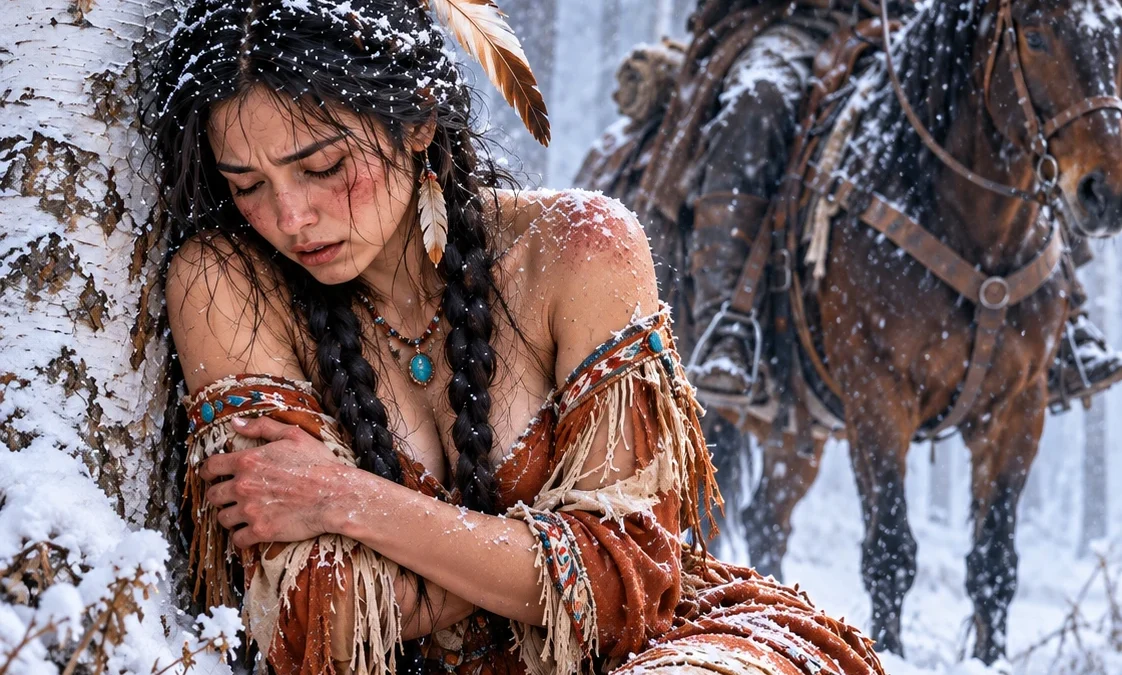
It was a woman. Apache. Curled beneath a dead aspen, beaten black and blue. Her feet were bare. Somebody had taken her moccasins.
You do that in December for one reason only. So she can’t run far.
On her shoulder, under frozen blood, was a brand.
I put two fingers under her jaw. Nothing. Don’t you dare.
Then a flutter.
I could have ridden on. One night of snow and no living soul would ever know. Instead I lifted her from the drift. Her eyes cracked open. Her blue lips moved. A few words, not English.
The last breath she meant to spend, she spent on me. 💔
What would you do? Be honest. Alone in a mountain storm, cold enough to split a fence post, you find a beaten, branded Apache woman in a country that wants every Apache dead or gone.
I stopped. That is the whole confession. Everything after came from that one choice.
Because before the snow melted that winter, I would stand inside our little church while men I had sworn to protect pulled the marshal’s star off my coat. The richest man in the territory would point at her across a crowded room and call her his property, out loud, before God and the whole town.
And that same town would one day haul on the bell rope until their palms burned, ringing for our wedding.
But I am getting ahead of the snow.
My name is Caleb Hollis. In December of 1871, I was thirty-four years old and felt a good deal older than the peaks that leaned over our valley. Three years I had worn the marshal’s star in Cold Spring Crossing, New Mexico Territory. Two hundred souls, one church, one saloon, one mercantile, and a long memory for grudges.
The war did the aging. Not the cannon. The quiet afterward.
At Chickamauga, I found a nineteen-year-old Confederate private propped against a log with his hands pressed over his belly. He didn’t ask for water. He didn’t ask for his mother. He asked if I had ever eaten a peach straight off the branch, still warm from the sun.
“Then you ain’t lived yet, Yank. My daddy’s got forty trees.”
He counted them for me, one at a time. Somewhere around the twenty-sixth tree, he stopped. And I sat there with a dead man’s hand going cold in mine, waiting for the twenty-seventh tree that never came.
That same autumn, my wife Clara died of typhoid back in Ohio. Her last letter arrived after they buried her. I carry it in the back of my Bible. The creases have gone soft as cloth.
So I came west, looking for a country big enough to swallow the noise in my head. I built a cabin on the mesa above town, beside a cold spring that never froze.
Then came October. Elam and Ruth Puit, sixty-three and sixty, were murdered on their homestead. Their barn burned with the milk cow inside. Moccasin prints in the mud. Painted feathers on the fence. An arrow in the well post.
Apache. The word went through town like a grass fire, and nobody tried to stamp it out.
A posse rode out. Seven men went. Six came back. The seventh was Will Gaines, the kindest blacksmith I ever knew. His widow Martha has not worn a color other than black since.
So when Clint Mabry sat his horse in that blizzard with two men behind him and a lie about one stray cow, I knew he hadn’t come for cattle.
“Mr. Danforth is particular about his property.”
Property. He said it flat and easy, the way some men say rain.
I carried her home inside my coat, her back against my chest, and bargained with God out loud the whole way. I kicked open my door, piled every quilt I owned on my only bed, and worked like a man on fire.
Near midnight, her eyes opened. Clear, this time. It wasn’t the fear of dying I saw in them. It was a different fear. She was adding up the bill. What I would take. What she would owe.
“You’re safe,” I said. “Nobody’s going to hurt you here.”
In the morning, she touched her own chest with two fingers. “Tani.”
A name is the last thing they cannot take from you. She had just handed it over. 💛
I rode to town for flour and bandages. At Tibbs’s mercantile, Royce Danforth came in out of the snow like he owned the weather. Silver at the temples, fur collar, a gentleman wherever people could see.
“A town ought to have a voice, don’t you think? We’re forming a vigilance committee. Neighbors keeping watch.”
Behind him, Clint Mabry pinned a fresh sheet on the notice board.
REWARD $200. Runaway Indian woman. Thief. Dangerous. Return to the Bar T.
And beneath the words, the ranch brand in heavy black ink. A capital T with a bar laid across the top.
“A kitchen girl,” Danforth sighed. “We took her in out of pity. She robbed us and ran into the worst storm of the year. You haven’t seen any sign of her, Marshal?”
In three years, I had never once lied in the course of my duty. It was the one clean thing I had kept.
“No. Haven’t seen a thing.”
It came out smooth as river stone. Three years of honesty, and it took me less than a breath to throw it away.
I pulled the handbill off the board on my way out and folded it into my coat pocket.
That was my mistake. The whole of it.
I hung my coat on the peg and went outside to bed down Ironside. When I came back in, the cabin was empty. The quilt lay on the floor. My Winchester was gone from its pegs.
And on the table, smoothed flat with deliberate care, lay the handbill.
She couldn’t read the words. She didn’t need to. She knew that brand better than her own face.
I ran. The tracks were easy to follow. Small feet, wrapped in rags, stumbling uphill toward the ridge where she had nearly died. Behind a lightning-split pine, I came around the trunk and looked down the barrel of my own rifle.
It was cocked. Her finger was inside the guard. Her eyes were steady as a hawk’s.
“Stop.”
I unbuckled my gun belt and dropped it in the snow between us.
“If I wanted that two hundred dollars, I’d have brought them up here this morning. Danforth was in that store. One word from me. That’s all it would have cost.”
The barrel dipped slowly, all the way to the snow. Her knees folded.
I caught her before her face hit the drift. 😢
👉 Want to know what the brand on her shoulder was hiding, and what Tani sewed into her ruined dress? Part 2 is waiting in the comments. Leave any word and I’ll send it to you privately!
Part 2
I caught her before her face hit the drift.
That night, the cabin was very small. Somewhere past midnight, her voice came out of the dark. Every word placed carefully, like stones across a creek.
“Why? You find me in the snow. Easy to ride. Nobody see. Why you stop?”
She spoke English. Real English, broken at the edges. She had understood every word I’d said since I carried her through that door.
So I told her the truth. About the war. About men who stepped around the wounded in the ditch and told themselves somebody else would come along.
“Somebody else mostly didn’t. A man finds out who he is by what he leaves lying by the road and by what he picks up. I’ve left enough lying by the road, Tani. I’m done with that.”
She didn’t thank me. I was glad. Thanks would have meant she thought she owed me.
She lay down facing me, not the wall.
In the morning, I cleaned the wound on her shoulder. And there it was, clear as print, raised and shiny and puckered where the iron had been held too long.
A capital T with a bar across the top. Burned into her skin like she was a heifer at a spring roundup.
I knew that mark. I had seen it on a thousand hides, on a carved sign over the south road, and on a handbill in my own pocket.
“Now you know,” she said, barely audible. “Whose cow I am.”
I wrapped clean linen over Royce Danforth’s brand and tied it off with a square knot. I did not ask a single question. The questions were lined up in my throat like cartridges, but one wrong word and she would be gone again.
Trust doesn’t come in through the front door. It sneaks in sideways, through a cup, a chore, a pair of socks.
Over the following days, she told me in pieces. Two winters ago, Comancheros hit her river camp before sunrise. Her husband and brother fell fighting them. A rope went around her neck. A white man looked at her teeth at the Taos plaza like she was a horse, and paid two horses and a jug of whiskey.
“Two years I cook. I wash. I sew. I don’t speak, they hit.”
She had run once. They caught her in a day. Then they made sure everybody knew whose she was.
“And the second time,” she said. “The time you found me.” Something shut behind her eyes, like a heavy door. “Not now, Caleb.”
“All right.”
I meant it. She heard that I meant it.
Then came the storm. A white wall rolled down the mountain, and by dark the cold was a living thing. Tani lay wrapped in every quilt I owned, shaking so hard I could hear her teeth. Then I heard them stop.
I knew what came next. First the shaking, then the false warmth, then the tiredness so sweet you’d trade your soul for it.
“The fire’s not enough tonight. Only thing that works against this kind of cold is another warm body. That’s all I’m offering. I’ll lie on top of the quilts. Boots off. You can put the bolster between us.”
I watched the war cross her face. Fear, pride, every hand that had ever touched her without her say. And then the plain, stupid animal cold.
She gave one short nod, sharp as snapping a stick.
I lay stiff on top of the covers, staring at the roof poles. For a long time she lay rigid, not touching. Then the cold won the argument. Her back came up against my side. Her head found my shoulder, the bad one, and I didn’t care.
Her voice came small into the wool of my coat. “Under that tree, I lie down. I tell my husband, wait, I am coming. I close my eyes. I am finished.” A breath. “Then I open them. And there is a stove and a man who talks too much to his horse.”
I almost laughed. “He likes to be kept informed.”
A sound came out of her. Not quite a laugh. Close. 🥹
I lay awake the rest of the night, listening to the wind try to tear my roof off, and a woman sleeping like she hadn’t slept in two years.
At dawn I found bootprints under my window. A man had stood there in the last of the storm and watched us sleep, long enough to smoke a cigarette. Hiding her was finished.
So I decided to do the opposite. I took her to town in broad daylight, under my star, so every soul in Cold Spring Crossing could see her riding in beside the marshal. A secret gets taken in the night. A fact is harder to steal.
Main Street went silent. Tibbs’s mouth bent into something that wasn’t a smile. I bought a plain brown calico dress and a pair of lace-up shoes, and Tibbs totaled it out loud so every customer heard the marshal buying a dress for an Apache.
Then we walked out, and they were waiting.
Clint Mabry stood in the middle of the street with his Henry. Behind him, men with white armbands. At the edge of the crowd stood a woman in black with a face carved out of grief. Martha Gaines.
She walked up to Tani and spat on the boardwalk at her feet.
“Your people killed my Will.”
I braced for Tani to shrink, to let it run off her like rain, as she had let everything run off. She lifted her head, pushed the hair back from her face so Martha could see her eyes, bruises and all.
“No Apache killed your husband.”
A silence so total I heard a horse shake its harness at the far end of town.
And Clint Mabry’s face went white. Not pale. White. Then he spat and laughed. “Lying savage.”
But he did not raise the Henry. And he did not come one step closer.
Old Doc Whitfield bound her cracked ribs that afternoon. While he wound the bandage, he muttered to himself, the way old men talk to walls. “No Apache killed your husband. Funny thing to hear. I dug the ball out of Will Gaines myself. That wound never sat right with me.”
I went cold. “What do you mean, Doc?”
He blinked, like he hadn’t realized he’d spoken aloud. His face closed. “Nothing. An old man’s ramblings.”
That night, at my table, Tani finally told me everything. In October, Mabry had brought her deerhide and red ochre. Leggings Apache style, with fringe. One night he and six men put them on, painted their faces, took feathers, and rode out. They came back before morning with cattle bearing a different brand, a blue dish with flowers, and a lady’s shawl.
“I wash blood out of that shawl, Caleb. Next day I see it in the Puits’ house.”
Then Danforth, drunk and happy in the cookhouse, talking over her head like she was a chair. When the railroad came through this valley, that water was his. All of it. Old Puit’s spring first. Then the marshal’s.
The Denver and Rio Grande had surveyors working south all that autumn. A railroad needs water every twenty miles. Whoever owned the springs in our valley could name his price.
She had run to tell somebody, anybody. Mabry caught her on the ridge. “Let the winter do it. Nobody hangs for winter.”
I reached across the table and put my hand over hers.
“I believe you.”
“You are one man.”
“One’s where it starts.”
Then everything came apart.
Two nights later, riders surrounded my cabin at midnight. The barn went up in flames. Tani threw the latch and freed Ironside, then took my Winchester off its pegs like she had done it all her life. When she stepped into the doorway, firelight on half her face, she breathed out and fired. A man shrieked by the woodpile. The rest fled into the dark, leaving one behind.
Lyall Peck, face painted with two red stripes across each cheekbone, exactly the way Tani had drawn them on her own face at my table.
He started blubbering before I asked him a thing. “Mabry made me. Danforth’s orders. Old man Puit wasn’t supposed to be home. And Gaines, it was Mabry shot Gaines. I swear on my mother.”
I took him to the jail. By evening, a lawyer named Griggsby had arrived from Danforth’s table, and by morning my only witness had accepted a hundred dollars and a stagecoach seat to California.
And at nine o’clock, the new church bell called an emergency town council.
Every debt in that town ran through Tibbs’s store. Every note had been quietly bought up by Royce Danforth the summer before.
The vote took less time than it takes to saddle a horse.
Two men I had pulled out of bar fights tore the star off my coat. The pin ripped a ragged hole in the sheepskin. Then Clint Mabry stepped up, raised his right hand, and was sworn in as marshal.
My star, pinned to the chest of the man who had painted his face red and shot Will Gaines in the back. 😡
I rode home with a hole in my coat where the star used to sit. At three o’clock, nine riders came up the mesa trail with Mabry out front.
And Tani, who had been quiet all day, stepped out of the doorway into the open snow.
“Stop. Don’t shoot him. I go with you.”
“The devil you do.”
She turned back to me. Her face was soft, almost gentle, like she was the one doing the comforting.
“You pick me up out of the snow, Caleb. So now I don’t let you lie down in it.”
She pressed a folded bundle into my hands, the deerskin dress, still warm from her lap. Her lips were at my ear.
“Cut the hem.”
Then she walked to Mabry with her head up. 😭
👉 Like or comment “REVEAL” to unlock Part 3! It will be posted as soon as there are enough comments. ❤️
Part 3
“Cut the hem.”
I never saw the man who swung. A rifle butt cracked across the back of my skull, and the white world tipped on its side. Somebody roped my ankles. I was dragged behind a horse, down off the mesa, through drifts and brush, until they rolled me into a snowbank at the foot of a dead aspen.
Mabry laid my hat on my chest like a man laying a lily on a coffin.
“Should have kept riding that day. Let the winter do it.”
Then I smelled coal oil. Smoke climbed over the rim of the mesa. My cabin.
I crawled toward the smoke because it was the only direction my mind could hold. My fingers went dead. The light failed. Under my coat, pressed against my bruised ribs, were Clara’s Bible and Tani’s folded dress. They hadn’t bothered to look. That was my whole estate.
Then, off to my left, trace chains jingling. A wagon creaking over frozen ruts. A woman’s voice, thin with fright.
“Marshal Hollis? Lord, is that you?”
Martha Gaines, in her black bonnet, driving Will’s old buckboard.
I woke in an iron bed in her boarding house. Two cracked ribs. A knot on my head like a hen’s egg. Frostnip on four fingers.
“Why were you out there, Martha?”
She stared into the dark. “Three nights I haven’t slept. Since that boardwalk. No Apache killed your husband. Who says that to a widow, with half the town watching? A liar wants something. And I couldn’t find what that woman wanted.”
Doc Whitfield cleared his throat. “Martha, there’s a thing I should have put in your hand two months ago.”
He came back with a little pasteboard pillbox. Inside, on a twist of cotton wool, lay a squashed gray slug of lead.
“Took that out of Will’s back. Right shoulder, against the blade. I wrote Apache on the death paper and kept my mouth shut, because I’m old and a coward. That’s a .44 rimfire. Henry cartridge. The Apache bands in these mountains carry bows. A Henry costs forty dollars cash.”
“Clint Mabry,” I said.
Martha put her hand flat over her mouth. Her shoulders shook. She wept the way I have seen soldiers weep. Without a sound.
I reached for the deerskin dress and spread it on the quilt. “Doc. Your knife.”
I worked my fingers along the hem, past Tani’s coarse stitches, my army thread, crooked and stubborn. On the left side by the seam, I felt a hard little lump, sewn deep into a doubled fold of hide.
I cut one stitch, then another. It slid out into my palm.
A gold locket, oval, worn smooth by forty years of resting against one woman’s heart. On the back, in curling script: Elam and Ruth, 1831.
Martha made a sound I hope never to hear from a human throat.
“Ruth’s. She never once took it off. They buried her without it. The undertaker said the Apaches must have taken it.”
I looked at all those ugly, faithful stitches. Every day by my stove, I had thought she was mending a dress. She had been guarding the only proof in the territory. 💛
Then Horus Tibbs came knocking, hat in his hands, looking like a sack with the grain let out.
“Clint Mabry came in my store tonight. Bought three boxes of .44s. They talked like I was a cracker barrel. Comancheros, Rincon Canyon, first light. Danforth is selling her south. Chihuahua. ‘No woman, no witness, no trouble.'”
“And Peck?”
His hands went still on the hat. “Mabry walked him out toward the stage road. I heard two shots. Then Clint came back alone, and lit out south like the devil was holding his stirrup.”
Danforth doesn’t pay his debts. He buries them.
Martha went to her hall closet and came back with a buffalo coat and a gun belt. An old Navy Colt, the brass trigger guard worn bright by a working man’s grip.
“Will’s. He would want it to be good for something. Bring her home. I owe her an apology on that same boardwalk, in front of every one of those same people.”
I climbed into Ironside’s saddle on the third try.
What happened to Tani that night, I only know because she told me afterward, sitting on a sawbuck in the spring sun, cleaning a rifle. Matter-of-fact, like a woman describing the weather.
They put her in the smokehouse. Dirt floor, no window, a padlock on the outside, hams hanging over her head like a row of hanged men. Nobody hit her. That frightened her more than hitting would have. A man only takes care not to bruise something he means to sell.
Danforth came in a silk dressing gown with a cigar and a glass of brandy. In a fine humor. He pulled out a letter bearing an engraved locomotive.
“Can’t read, can you? Pity. Denver and Rio Grande. Survey line number four, straight down our valley, across the mouth of Puit Canyon. A locomotive needs clean water every twenty miles. Elam Puit wouldn’t sell. So he shrugged. Apache is tragic. When the county sold his land for back taxes, who do you suppose bought it? Forty dollars. The railroad will pay twenty thousand. And your marshal’s spring is the next water stop north. Hollis wouldn’t sell either, but dead men don’t argue.”
The lock clicked. The dark came back.
She sat on the dirt floor a long time. Then she stood and reached up until her hand found an iron meat hook, cold and rusty, as long as her forearm. She worked it back and forth until the nail squealed and gave. She jammed the point into the rotted sill log at the back wall. Her cracked ribs screamed every time, and she bit down on her shawl so she wouldn’t make a sound.
It took most of the night. A hand’s width. A forearm’s. A gap a starving woman could squeeze through on her belly, if she didn’t mind leaving skin on the splinters.
She didn’t mind.
In the corral stood Danforth’s own gray, still saddled for the morning trip, his engraved Winchester in the scabbard. She led it out a step at a time. She didn’t ride north to town, and she didn’t ride west to her own people. She rode east to Puit Canyon.
Because she had overheard something once in that cookhouse, Mabry laughing, telling a hand where to hide the painted leggings and feathers after the raid. Somewhere nobody would dig. In the old man’s own root cellar, under the ashes of his own house.
She didn’t want to run anymore. She wanted proof.
And I was riding south on Ironside with one good eye, two cracked ribs, a dead man’s coat and a dead man’s revolver, and I took the shortcut through the mouth of Puit Canyon.
That is how two people running in different directions for different reasons ended up at the same burned house in the gray before dawn, looking at each other over a rifle and a revolver.
“Caleb.”
My name, in a voice that cracked straight down the middle.
I don’t remember crossing the distance. I remember her hands on my swollen eye, my rope burns, checking me over the way I once checked her.
“He say you are dead in the snow.”
“He keeps saying that about people. He keeps being wrong.”
I put my arms around her. Not for warmth. Not for survival. Just because I couldn’t stand one more second of not doing it. 💛
Then Ironside snorted at the canyon mouth. Three riders, following the gray’s tracks in fresh snow like a road map.
Mabry came straight up the middle, with a man on each flank. A cavalry pincer. His Henry spat brick dust off the chimney an inch from my ear. Then something hit me in the left shoulder like a sledgehammer. The same shoulder where the old minie ball had lived for eight years. As if the war had been waiting all that time to finish its sentence.
Tani saw the blood. Her face went flat and still. She stepped out from behind the chimney, raised Royce Danforth’s own engraved Winchester, and did not aim at Mabry.
She shot his horse.
The black went down on its knees and rolled. Mabry went over its neck into the snow. She levered another round and swung the muzzle at him.
“Next one is you.”
He believed her. They all did. His men hauled him up behind a saddle and fled.
She knelt in the ashes and cut my shirt away with my own pocketknife. The ball had gone clean through. She packed both holes with snow, tore the gray shawl into strips, and bound me tighter and better than I had ever bound her.
“Two years in a ranch kitchen. Cowboys cut themselves, shoot themselves, fall off horses drunk. Who you think fixed them?”
Under a heap of charred floor joists, we found the trap door to the root cellar. Wrapped in a canvas tarp behind empty pickling crocks, it was all there. Eight pairs of buckskin leggings painted with red and yellow stripes. A bundle of eagle feathers. Moccasins sewn wrong. “No Apache woman alive would sew them that way.” A tin of red ochre gone stiff. And a saddle blanket woven red and black with a capital T and a bar stitched into the corner.
We sat on the edge of that cellar as the sun came up over the east rim of the canyon, pink, then gold. My shoulder throbbed. My ribs throbbed. I had never been happier in my life.
“Tani, when this is over, I don’t have a house anymore, or a star. I’ve got a burned barn and forty cows and a horse that likes you better than me. I’d like you to stay anyhow.”
She was quiet a long time.
“In my people, a woman does not stay with a man because he save her. That is a debt. Debt is a rope.” She turned and looked at me full on. “I stay because you are the only man who ever lie down in the cold next to me and ask nothing. Not one thing.”
Then she kissed me carefully on the side of my face that wasn’t swollen.
“So yes. I stay.” ❤️
We rode into Cold Spring Crossing before noon. Nobody stopped us. The street filled in behind us, a low murmur following like water under ice.
Martha helped Tani down off that tall gray horse as if she’d done it all her life. Doc stitched me at Martha’s kitchen table, fourteen stitches in front, eleven in back, calling me several names, none of them Christian.
And that afternoon, Horus Tibbs came back again. This time with a thick green cloth ledger under his arm. Not the debt book. His special order book.
“Every special order that comes through my store. I write it all down. Habit.”
His finger trembled on one line.
September 9, 1871. For R. Danforth, Bar T. Red ochre, ground. Two dozen eagle feathers. Eight pairs moccasins, Apache pattern. Eight yards buckskin, smoked. And in the margin, for a theatrical troop, with Royce Danforth’s own bold, looping signature beside it.
“I thought it was strange. I didn’t ask. A man who owes what I owed doesn’t ask.”
Tani stood and walked around the table until she was right in front of him. “Why you bring this now?”
“Because I saw Ruth Puit’s locket in Martha’s hand last night. And because I’m sixty-one years old, miss, and I’d like to die someday without being the kind of man who sold you.”
She nodded once. Horus let out a breath like he’d been holding it since September.
The next afternoon, a bugle sounded on the north road. Twenty troopers in dark blue came down Main Street at a trot, a captain at their head, a tall stooped judge beside him on a rented horse. Behind them rode Lonnie, grinning like he’d won a turkey shoot. And between two troopers on a borrowed mule, arm in a sling, face scrubbed raw and pink where someone had finally washed off the ochre, sat Lyall Peck.
“Found him in a sheepherder’s hut thirty miles north, half-froze,” Lonnie said. “Mabry walked him to the stage road and tried to put a bullet in the back of his head. Missed in the dark. Peck’s been talking ever since.”
Judge Quincaid looked up at Danforth’s bronze bell hanging silent in the cold. “I’d like to hear about it, Marshal. All of it. Today. In public. Ring the bell, if you please.”
Reverend Pike hauled on that rope with both hands. And for the first time since it came up from St. Louis, Royce Danforth’s bell called the town together to hear the truth about Royce Danforth.
The church was fuller than it had ever been. The judge took the council’s table, read the Taos indenture, and laid it down with two fingers, the way a man handles something he’s found under a porch.
“Mr. Griggsby, are you familiar with the Peonage Act of March 2nd, 1867? This paper is void. It was void the day it was signed. It is evidence, sir, against you.”
Martha laid Ruth’s locket on the table. Doc set down the pillbox. Lonnie untied the canvas bundle in the aisle where every pew could see. Horus laid open his order book.
Then Tani walked up that center aisle in the brown calico, her head high, past the white armbands, past the woman who had jerked her skirts aside from my boots, and in her careful, broken, absolutely clear English, she told it. All of it.
When she finished, nobody made a sound. Then two troopers brought in Lyall Peck.
“It’s true. Every word she said. I was one of the seven. Mabry shot Will Gaines in the back because Will got close enough to see a Bar T horse under one of us. Mr. Danforth paid us fifty dollars ahead. And last night but one, Clint walked me out of town to put me on the California road, and tried to blow my head off.”
Danforth leaned across the rail toward the judge, his voice low and smooth. “A word, Judge. Name a figure.”
Judge Quincaid didn’t lower his voice at all. “Mr. Danforth has just offered to bribe a federal judge in open court. Captain Hail, please note it. That’s one more charge.”
That was when Clint Mabry ran.
He shoved through the crowd at the north window and dropped out into the snow. I came out onto the church steps. He stood in the middle of Main Street, thirty yards off, coat thrown back, my star thrown in the snow at his feet.
“Come on down here, Hollis. Let’s finish it.”
I walked down the steps, Will’s Navy on my right hip, my left arm strapped to my chest. He was too smiling, too sure for a man facing twenty cavalrymen. His eyes flicked once up and to my left, toward the livery roof.
And from the church steps behind me, Tani’s voice cut across the street like a whip.
“Caleb! The roof!”
I didn’t look. I trusted her. I dropped to one knee and drew.
Mabry’s shot went over my head, where my chest had been a heartbeat before. Mine went into his gun arm. His Colt spun out into the snow. On the livery roof, a Bar T hand rose with a rifle, and two troopers dropped him before he could lay his cheek against the stock.
I walked up, kicked Mabry’s Colt away, and picked my star out of the snow. “You’re going to hang, Clint. By the law, in Santa Fe, with a judge and a rope and a preacher. Not out here in the snow. Not like you’d have done it.”
Behind me, on the church steps, Captain Hail took Royce Danforth by the arm. And in front of the whole town, under his own bronze bell with his brand cast into its lip, the richest man in the territory held out his wrists for the irons. ⛓️
Martha Gaines kept her promise. On Saturday, when the boardwalk in front of Tibbs’s store was most crowded, she walked up to Tani on the exact boards where she had spat at her, and took both her hands.
“I was wrong. I was wrong in front of all these people, so I’ll say it in front of all these people. You told me the truth when it cost you everything, and I paid you back with spit. I’m sorry. Will would be ashamed of me.”
Tani stepped forward and put her arms around another person for the first time that I had ever seen. Martha held on a long time. 🥹
In February, the court in Santa Fe ruled. Danforth’s purchase of the Puit land was declared void for fraud. A jury found him guilty of the Puit murders and of holding a human being in bondage. Clint Mabry hanged that spring, by the law, with a judge and a preacher, the way I’d promised him. Danforth was sent east in irons to a Kansas penitentiary for the rest of his days.
The court awarded Tani three thousand dollars for two years of unlawful servitude. The territory added the standing reward for the arrest of the Puit murderers.
In March, the county put the Puit homestead up for public sale. Speculators came up from Santa Fe in good suits, because everyone had heard about the railroad. Tani bid in her brown calico, steady, raising every offer by five dollars, never more. The speculators laughed at first. Then they stopped.
When the auctioneer banged his gavel, the deed to Puit Canyon and its spring was made out in her own name. Not mine. Hers. She signed it herself. She had been practicing her letters at Martha’s kitchen table all winter.
Ruth Puit’s locket went into the ground in April, on a new chain, beside Ruth. Martha’s idea. Tani’s hands.
We were married in June of 1872. Martha and the women of the ladies’ aid sewed the dress. Blue calico, long-sleeved, with a beaded sash Tani worked herself in the old patterns of her people. I wore a black frock coat I borrowed from Judge Quincaid, with a collar so stiff I couldn’t turn my head. Doc gave her away, because she asked him to. Horus closed the store for the whole day, which nobody could remember happening before.
And when Reverend Pike pronounced us man and wife, half the men in town fought over who got to pull the bell rope. In the end it was Martha Gaines, in a dove-gray dress, the first color she had worn since October, who hauled on that rope until her palms burned.
Royce Danforth’s bronze bell, with his brand cast into its lip, rang out over Cold Spring Crossing for the marriage of a Union soldier and the woman Danforth had tried to sell.
It rang twice, the way it always did. Once from the steeple, once back off the mountain. 🔔
That is the story. Most of it. Here is the rest.
April, 1873. Snowmelt running loud in every gully. We had built a new house on the mesa beside my spring, squared logs, two rooms, a real glass window facing south. Down in the valley, little white survey stakes from the railroad marched across the flats, and one of them stood within a stone’s throw of her spring. The railroad’s lawyer had already written twice, asking what she would take for the water.
She had not answered. She said a woman who once sold for two horses could afford to let a railroad wait.
One morning she asked me to ride north with her up the ridge. She wouldn’t say why. We stopped at the foot of a dead aspen. The snow around it was rotten and gray, and new grass was coming up through it in green needles.
I knew this tree.
She got down off Ironside, who still liked her better. She stood looking at the place in the snow where she had lain down to die. Then she turned to me.
“You remember when you pick me up? I say something in my language.”
“I remember.”
“You never ask what.”
“I figured you’d tell me when you were ready.”
She took my hand, pulled off my glove, and laid my palm flat against her belly under the shawl.
“I say, I will repay you.”
Her eyes were wet. Her smile was not. 😭
I stood there in the snowmelt with my hand on my wife and my child beneath it, beside the tree where I had once knelt and argued with myself about whether a stranger was worth the trouble.
A wrong thing don’t get any righter just because the right thing is heavy. My father taught me that over an anvil. It took me thirty-four years and a blizzard to learn what he meant.
So here is what I would tell you, if you are sitting somewhere tonight thinking your best years are behind you. Thinking the road is too long, or your back too stiff, or the world too cold to bother.
Every one of us is known in the end by what we chose to leave lying by the road, and by what we were willing to stop and pick up.
It is never too late to stop.
It is never too late to pick something up. 🕊️❤️
This story is entirely fictional and created for entertainment purposes only. It does not represent any organization or individual, nor does it encourage inappropriate behavior. The content was generated with AI assistance.








