SHE WHISPERED “I WISH SOMEONE WOULD CHOOSE ME” THINKING NO ONE HEARD — BUT THE VAMPIRE KING WAS STANDING RIGHT BEHIND HER… AND WHAT HE DID NEXT SHOCKED EVERY GUEST
Part 1
Emily Fairmont had mastered the art of fading into the background long before she arrived at Cedar Veil.
At 24, she was the youngest of four sisters — and the only one still unmarried.
Catherine had married a banker within a single spring.
Rose’s voice could hush any drawing room.
Gentle Mary had wed a devoted Boston physician.
And Emily? She was the one everyone called “sensible.
” The one who didn’t ask for much.
The one who learned to smile through wedding after wedding, quietly wondering: What would it feel like to be wanted first?
Her mother packed Emily’s pale blue dress with a gentle, well-meaning warning.
“You have good judgment, dear.
That matters more than people admit.
Don’t build hopes from this visit.
Everyone knows Vincent Ardan is spoken for — Isabelle Langford has been practically promised to him for years.
”
Emily nodded, her heart heavy but accustomed to the weight.
“I know.
I expect nothing.
”
Vincent Ardan was no ordinary host.
He was the Vampire King — ruler of an ancient court that had stood in Massachusetts long before most estates existed.
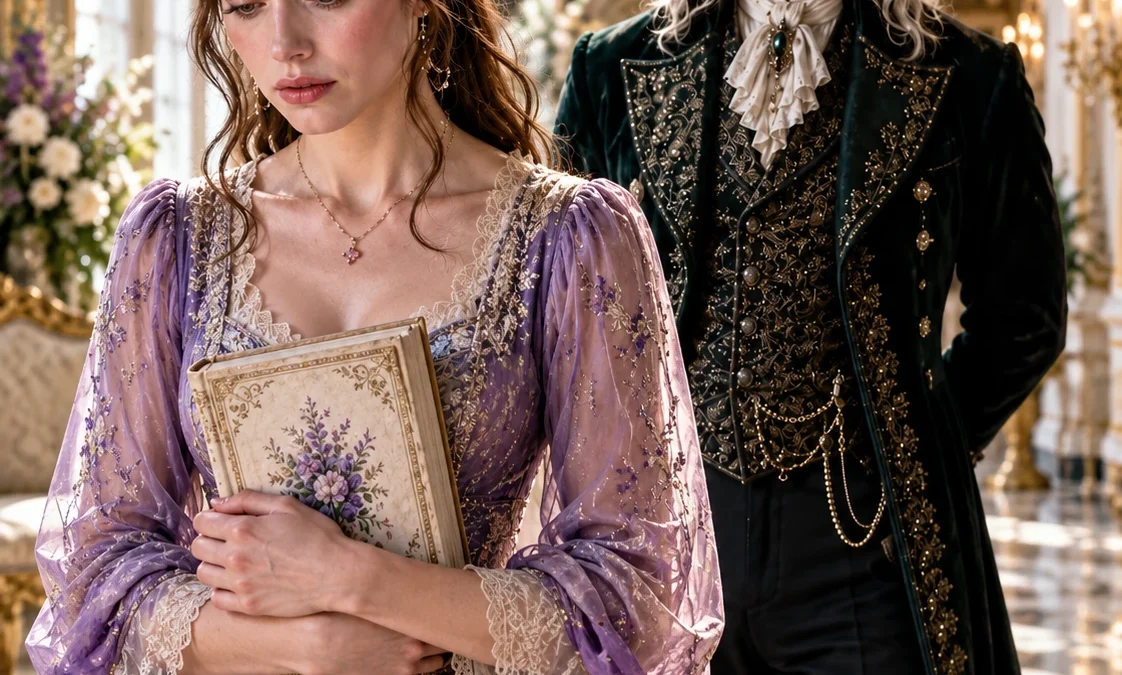
Tall, with white hair tied back and skin like moonlight, he was calm, polite, and impossibly intimidating.
Families treated his attention like a prize to be won.
Isabelle Langford carried herself as though she had already claimed it.
For two days, Emily watched from the edges.
She sat beside a rambling judge and a shy young minister at dinner, while across the table Isabelle laughed and charmed, holding Vincent’s gaze as the rest of the room looked on.
Once, Vincent glanced toward her — but she turned away too quickly to know if he had truly been looking at her.
By the third evening, loneliness wore thin.
She slipped away from the card room with her notebook and found refuge in the West Gallery — quiet, lined with old portraits, empty.
She sat on the window seat, a dried sprig of Mary’s wedding heather tucked between her pages, and let the truth slip out in a whisper she thought no one would ever hear.
“I wish someone would choose me,” she breathed into the hush.
“Not because I’m sensible.
Not because everyone better has already been taken.
I wish someone would look at a room full of women… and want me.
Particularly me.
”
A floorboard creaked.
Emily froze.
Slowly, she turned — and her heart stopped.
Vincent stood several steps away, motionless.
His expression wasn’t mocking.
It wasn’t pitying.
It was something far more dangerous: attentive.
“I didn’t know anyone was here,” she stammered, clutching her notebook to her chest.
“I know,” he said, his voice low and steady.
“I entered too quietly.
By the time I realized you were speaking privately… interrupting seemed worse.
”
“Then — then forget it,” she pleaded, burning with shame.
“Please.
Just pretend you never heard.
”
He gave a faint, sad smile.
“My memory is inconveniently good, Miss Fairmont.
” He took a slow step forward, careful not to crowd her.
“But tell me this — who taught you that you are the kind of woman someone chooses only after considering everyone else?”
Emily stared, stunned by the question.
“No one cruel,” she whispered.
“That’s the problem.
My mother calls me sensible.
My sisters were loved for beauty, music, kindness.
I was praised for knowing what not to expect.
”
“Ordinary arithmetic,” he murmured.
“I’ve lived a very long time.
And ordinary arithmetic has been wrong before.
” He held out his hand — not as a king issuing a command, but as a man offering company.
“Walk with me.
Keep your secret if you wish.
I would simply like the chance to disagree with your calculations.
”
Emily looked at his hand, then up at him — and slowly, she placed hers in it.
Over the next few days, everything changed.
Vincent walked with her in the gallery, pointing out the absurd old paintings and making her laugh.
He told her about his mother’s roses in the conservatory.
He let her re-tie his lopsided garland knots.
During a snowball fight, he defended her when a stray snowball struck her shoulder.
He saw her — not as the quiet sister, not as an afterthought, but as her.
But not everyone was pleased.
Isabelle Langford cornered Emily before dinner, her smile polished but her eyes like ice.
“You are receiving a great deal of attention from our host,” she said, loud enough for nearby guests to hear.
“But don’t mistake courtesy for something more.
Vincent and I have a lifetime of expectations between us.
A king does not choose based on holiday distraction.
”
Emily kept her voice steady.
“I was not aware a pleasant conversation required permission.
”
Isabelle leaned closer, dropping her tone so only Emily could hear.
“Let me be direct.
He feels sorry for you.
That is all.
By spring, he will barely remember your name.
Do not forget your place — or you will be hurt.
”
Emily retreated, those words sinking deep — because they fit so perfectly with what she had always believed.
Later, passing the library, she heard Isabelle speaking to her mother inside.
“Vincent has a soft heart for lonely people,” Isabelle said confidently.
“But he won’t choose her.
She has no fortune, no connections, nothing to offer a court.
He’ll go back to duty.
She’ll go home.
And everything will return exactly as it should.
”
Emily’s hand fell away from the door.
The words didn’t just sting — they made sense.
Of course it’s pity, her own heart whispered.
What else could it be?
She avoided Vincent the next morning.
When he invited her to see the frozen pond, she claimed letters to write.
She stayed in her room, wrote to Mary, and prepared herself to leave — to return to being the overlooked daughter, to let Isabelle have what everyone said was hers.
That night, she returned to the West Gallery, the place where she had whispered her secret.
She sat in the same window seat, notebook closed in her lap, when the door opened.
She didn’t need to look up to know who it was.
“You have been avoiding me,” Vincent said gently, pulling up a chair but giving her space.
“I’ve had a headache,” she lied.
“You’ve had Isabelle,” he said simply.
“My housekeeper misses very little.
What did she say to you?”
Emily hesitated — then the truth spilled out.
“That you feel sorry for me.
That I bring nothing of value.
That you will choose her because it is your duty… and I was foolish to think it could ever be anything else.
”
Vincent went still.
Then he leaned forward, his gaze steady and intense.
“Let me offer another explanation.
I have spent years being courted by people who wanted a crown, money, influence — anything but me.
I learned to spot a performance long ago.
And what you said here? That was not a performance.
That was honest.
”
He paused, his voice softening but sure.
“I sought you out because I wanted your company.
I walked in the snow because I wanted to hear your voice.
I let you fix my knots because I like seeing you smile.
None of that was pity, Emily.
” He took a breath.
“I am in serious danger of choosing you — not out of kindness, not out of duty… but because I want to.
”
Emily stared at him, her heart trembling.
“You barely know me,” she whispered.
“Then watch me,” he said.
“Decide from what I do — not from what Isabelle says.
Not from what your fear says.
Watch me… and tell me what you see.
”
Part 2
“Watch me… and tell me what you see.
”
Those words hung in the quiet gallery, heavy and hopeful and terrifying all at once.
Emily didn’t answer — not that night.
But she didn’t turn away, either.
Over the next two days, she did exactly as he asked.
She watched him.
She saw him listen patiently to the judge’s repetitive stories as though hearing them for the first time.
She saw him stop to help a servant carry a heavy coal bucket, refusing to let anyone stand aside.
She saw him decline an adviser’s suggestion gently but firmly, without making the man feel small.
Most of all, she saw how he treated her — moving the sugar bowl closer at breakfast because he’d noticed she always had to ask, inviting her to the conservatory instead of demanding her time, stepping back when she needed space.
Mary’s letter arrived on Christmas Eve morning.
Emily read it twice, her sister’s wisdom cutting through every old fear: “Look at the man, not the woman telling you what he means.
Trust your own eyes.
”
That afternoon, Isabelle found Emily arranging chairs in the main hall.
“Still here?” she asked, her tone sugary-sharp.
“Do not forget — affection is not enough for a king.
Vampire houses marry for alliances.
Duty always wins.
”
Emily lifted her chin.
“Maybe he is tired of everything being a transaction.
”
Isabelle’s smile tightened.
“You will regret forgetting your place.
”
That evening, the Christmas Eve gathering filled Cedar Veil with music and laughter.
The judge forgot his song lyrics; guests joined in with made-up verses.
Then Isabelle stood, bright and commanding, turning all eyes toward Emily.
“If we are sharing talents,” she said, her voice carrying across the room, “surely Miss Fairmont has something for us? She has been so quiet all week — I confess I am curious what accomplishments the youngest Fairmont daughter found time for after her sisters took all the best ones.
”
Silence fell.
Every face turned to Emily.
Her heart hammered so hard she could hear it.
She couldn’t sing well.
Her piano playing was ordinary.
She had no polished performance to give.
For a breathless, terrible moment, she felt seven years of being overlooked crash down on her — she was back in every drawing room, every dinner, every wedding where she was the one left standing on the edge.
Then Vincent stood.
He did not move fast.
He did not need to.
The room quieted instantly as he walked to Emily’s side, his gaze never leaving hers.
“I believe,” he said clearly, “I have something more suitable to offer than another performance.
”
He turned to the guests, his voice steady and ringing through the hush.
“This week, I have watched nearly everyone show me the version of themselves they thought I wanted to see.
I do not blame them — a crown encourages that habit.
But one person in this house did something different.
She spoke honestly when she thought no one was listening.
And since then, she has continued to be herself — even when pretending would have been easier.
”
He looked back at Emily, and the whole room seemed to hold its breath.
“You once wished to be chosen particularly,” he said softly.
“I heard you.
And I have spent every day since realizing how much you matter to me.
”
He offered his hand.
“I planned to ask you privately,” he said, “but I realized privacy would let people keep telling you this was pity, or a holiday fancy, or a mistake.
I want there to be no confusion.
”
He took a breath — and spoke the words that would change everything.
“Emily Fairmont — I choose you.
Not because it is convenient.
Not because anyone advised it.
Not because I feel sorry for you.
I choose you because I want your company when rooms are loud and when they are quiet.
I want your questions, your judgment, your stubborn habit of fixing my knots.
I want you.
”
He paused, his eyes searching hers.
Emily stood frozen — tears stinging her eyes, her heart racing — as Isabelle’s face went pale across the room, as her mother gasped, as every person waited for her answer.
Part 3
“Yes.
”
The word slipped out — quiet, shaky, but sure.
Emily laughed through sudden, hot tears.
“Yes, you may court me.
And unless your conversation grows much worse between now and spring… prepare for a second yes.
”
The room erupted — applause, laughter, her mother weeping openly, the judge thumping his cane in approval.
Isabelle stood frozen a moment longer, then quietly took her seat, defeated.
Later, when the crowd had thinned, Vincent found Emily by the window.
“I am sorry it was so public,” he said gently.
“I had imagined something quieter — the conservatory, perhaps.
”
Emily shook her head, wiping her eyes and smiling.
“I spent years believing if anyone chose me, it would be in secret — something to be ashamed of.
I want everyone to hear.
”
His face softened.
“Then I am glad they did.
”
Christmas morning, Isabelle and her mother left early, perfectly polite but without warmth.
Months later, word came she had married a diplomat who admired her directness — and Emily found she could wish her well.
Not every rival needed to be an enemy.
That same day, her mother asked Emily to stay behind after breakfast.
Her hands twisted her napkin.
“I called you sensible,” she said, voice trembling.
“I meant it kindly.
I thought if I lowered your hopes, disappointment would hurt less.
But I taught you to hide from happiness instead of protecting you from pain.
I should have told you — long before a king noticed — how thoughtful you are.
How you listen.
How you see people no one else does.
”
Emily squeezed her hand.
“I know you loved me your way.
”
Her father found her later, awkward and earnest.
“You read contracts better than your brothers-in-law.
You remember every servant’s name.
You corrected my accountant and saved me from embarrassment.
I should have said I was proud — then.
”
Those words settled deep, healing something Emily hadn’t realized was broken.
It hadn’t been her family’s love that was lacking — only their courage to say what truly mattered.
Vincent gave her time, exactly as he promised.
He visited her home, endured endless questions about vampire law, and wrote her letters full of ordinary things — court squabbles, a stubborn greenhouse window, memories of his mother — while she wrote back with family news and questions no authority could answer.
They learned each other not as monarch and subject, but as two people still figuring out who they were.
They had hard conversations, too.
Emily asked what being queen would require — meetings, delegations, learning laws for both humans and vampires.
Vincent spoke honestly — and made one thing perfectly clear.
“You will remain human unless you choose otherwise.
Marriage will never change you without your full consent.
”
“And if I never choose to become like you?” she asked, voice tight.
“You will outlive me.
”
“I will love you through the life you choose,” he said simply.
“Wanting something is not the same as having the right to ask it of you.
”
That was when she understood: respect could be the most romantic thing of all.
By spring, the question had shifted — she was no longer wondering if he chose her, but whether she chose him.
One evening in the conservatory, beside the first blooming roses his mother had planted, she found him reading her notes.
“I think you should ask me properly now,” she said.
He looked up slowly.
“Are you certain?”
“No,” she laughed softly.
“But I am certain enough to want the uncertainty — with you.
”
He closed the book and stood.
“Emily Fairmont — will you marry me?”
“Yes.
”
No applause, no audience — only the roses, the fading light, and Vincent laughing as he opened his arms.
It was exactly the right kind of private.
They married in early summer, quiet and surrounded by those they loved.
Her sisters stood with her; her mother cried without restraint; her father stared very hard at the church windows.
Vincent’s court sat beside human neighbors and friends — a reminder their world was bigger than any single kind.
Life after marriage was not a fairy tale without trouble.
Emily forgot titles; she spoke her mind too directly; she worried endlessly she was failing.
Vincent only said, “You were right — and accuracy and tact are separate skills.
You have mastered one.
” And when she corrected outdated traditions, he encouraged her to ask why.
She kept her notebook, filling it with pressed flowers, ordinary days, and the time Vincent tried to bake bread and produced something the cook called “structurally ambitious.
”
On their first anniversary, he found the line she had written so long ago — I wish someone would choose me — and beneath it, in steady ink, added: I do.
I will keep choosing you for as long as you allow me.
Years passed.
Emily chose to become a vampire — in her own time, peacefully, surrounded by love — not because she had to, but because she wanted more life with him.
They had daughters who inherited his pale hair and her habit of asking difficult questions.
Every Christmas, Cedar Veil filled again — and every Christmas Eve, Vincent found Emily somewhere in the house and whispered, “I still choose you.
”
One winter evening, long after they had grown old together in their new way, Emily sat in the West Gallery with her notebook open on her lap.
Through the floorboards, she heard her daughters laughing and Vincent pretending not to interfere with their garden plans.
She touched the faded heather from Mary’s wedding and smiled at the girl who had once whispered into an empty room.
She had been brave, that girl — braver than she knew.
And the greatest miracle wasn’t that a king had heard her.
It was that he had seen her — and that in time, she had learned to see herself, too.
Love hadn’t rescued them.
They had simply chosen each other — again and again — through quiet mornings, hard talks, ordinary winters, and every day in between.
And that, Emily finally knew, was the happily ever after worth having.
This story is entirely fictional and created for entertainment purposes only.
It does not represent any organization or individual, nor does it encourage inappropriate behavior.
The content was generated with AI assistance.








