“She Will Never Marry a White Man,” the Chief Swore Over His Wife’s Grave… Seven Years Later, Four Hundred People Watched Him Break That Vow in a Way No One Saw Coming
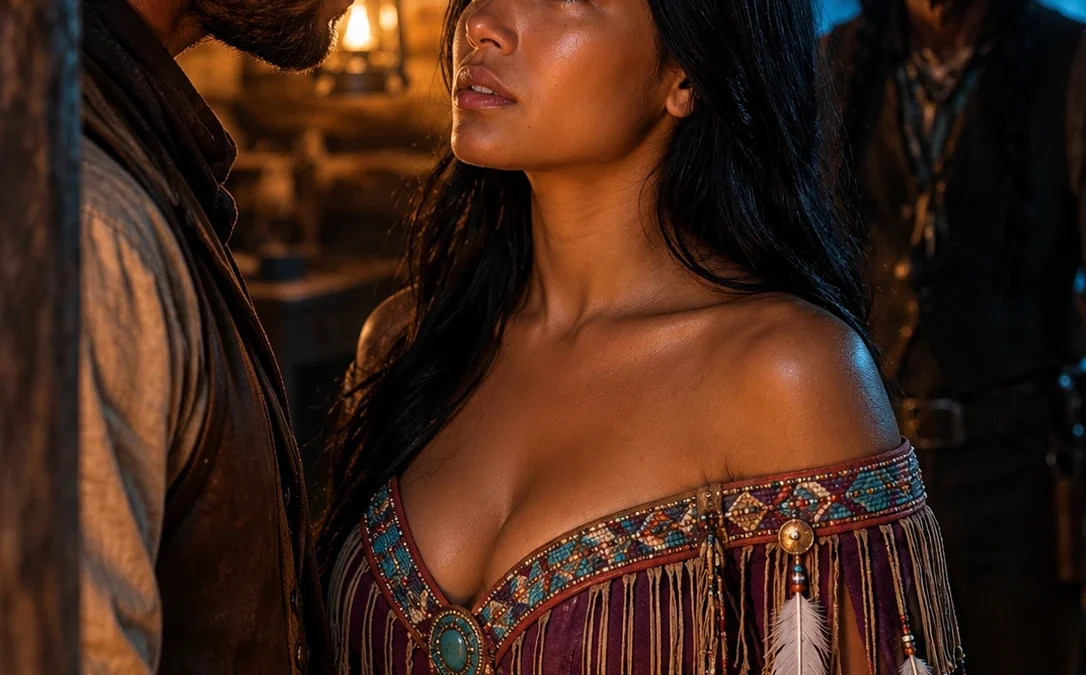
🔥 “She Will Never Marry a White Man,” the Chief Swore Over His Wife’s Grave… Seven Years Later, Four Hundred People Watched Him Break That Vow in a Way No One Saw Coming 😱
PART 1
The vow was seven years old. 🌙
It was older than most of the young men who now carried it around the cookfires like scripture handed down from a war they had never fought.
Chief Nokosi had made it the autumn his wife died. Not from fever. Not from winter. She was cut down by a rancher’s hired guns who mistook a hunting party for a raiding one and left three women dead in the grass before anyone thought to ask a single question.
His daughter Halona had been eleven, hiding behind her aunt in the rocks above the wash. She watched her father carry his wife’s body back into camp with a stillness on his face that frightened her more than any open grief ever could.
That night, before the whole band, Nokosi drove his knife into the dirt at the center of the fire circle.
“No daughter of my blood will ever again be given into a white man’s house,” he said. “I would sooner bury her beside her mother.”
The band answered with a low, grieving agreement. Sorrow wants a shape to hold, and a vow is a shape an entire people can carry for a long time. 💔
Now it was October of 1885, in the Guadalupe foothills of West Texas, and Halona was a woman grown. She had her mother’s eyes and her father’s iron. She was quick with a bow, quicker at the loom, and possessed of a stillness that unsettled anyone trying to read her face. The elders trusted her with the camp’s most delicate work, settling disputes and tending the sick alongside Doya, the sharp-tongued healer who had raised her nearly as much as her own mother had.
But the trouble with a vow sworn in grief is that it never stays confined to the wound that caused it.
It widens. It hardens into policy long after the grief has begun to heal.
That autumn, a blood feud had simmered for two seasons between Nokosi’s band and a harder, hungrier one to the east, led by a young war leader named Chodo. Raids had grown worse. Cattle run off. Two young men wounded. And the elders were openly weighing what it would cost four hundred souls if their chief let his daughter’s future stand between them and peace.
So on a gray morning stiff with frost, Nokosi summoned Halona to his lodge. His voice broke only once.
She would go to Chodo before the spring planting.
Halona did not weep. She had learned that tears, however honest, were also a weapon, and she would not hand him one to use against his own conscience. She asked only one quiet question.
“Do you remember what you promised the night my mother died?”
He remembered every word.
“You vowed to protect me from a man I feared,” she said softly. “You never vowed to give me to one.”
Her father had no answer. He turned to the fire and left the silence standing between them. 🔥
Within the week Chodo rode into camp with six ponies and a wolf pelt, laying them at Nokosi’s feet as if the marriage were already a settled trade. He was not unhandsome. He was not foolish. Which made him more dangerous than either.
When Halona twice refused to sit beside him at the evening fire, he laughed it off as shyness. But his eyes carried something closer to a warning.
“A man who smiles that easily through a public refusal,” Doya whispered to her niece, “is banking his anger for later, in private, where no one else will see it spent.”
It was into this brittle peace, a camp holding its breath between an old vow and a new war, that a stranger rode in. 🐎
Gideon Marsh was twenty-eight and carried himself like a man ten years older. Four years earlier he’d owned a small spread outside Fredericksburg, with a wife named Ellen and a boy not yet two. A fever took them both in a single week while he was three days out on a cattle drive he had needed for the money.
He came home to two fresh graves.
He had been drifting ever since, letting the miles do what grief alone never could. That October afternoon he rode ahead of his outfit to scout water, and that was the only reason he was alone, armed and awake when gunfire carried to him on the wind from the Lipan camp.
Every practical instinct told him to turn around. A lone white cowboy riding into an Apache camp under fire was as likely to be shot by both sides as thanked by either.
Then he thought of Ellen. Of arriving three days too late to matter.
He put his heels to the horse before he finished deciding anything. 💨
Renegade outlaws had struck the eastern picket line at dusk, wearing no colors and answering to no law. Two of Nokosi’s young men were already down when Gideon came over the ridge at a dead run. He put his horse between a fallen warrior and a rider with a drawn revolver, took a shot through his own coat sleeve, and answered with fire.
Then he saw the chief go down.
A rifle stock swung at Nokosi’s skull. Gideon drove his horse into the outlaw’s mount, took the second swing across his own forearm instead, and ended the threat with a single close shot. Then he dragged the dazed old man behind a fallen wagon and stood over him with an empty rifle until the last raider scattered into the dark.
Halona reached her father first, dropping to her knees in the frozen mud with a cry that carried no words, only relief.
Only when she knew he would live did she look up and truly see the man standing over them both.
Younger than trouble had any right to look. No triumph on his face. Only exhausted watchfulness.
Their eyes held across her father’s body, and neither looked away first. 😳
That night, Halona cleaned and stitched the wound on his forearm by firelight. For minutes neither spoke.
“You didn’t have to ride in,” she finally said.
“Most men weren’t close enough to hear it,” Gideon answered. “I was.”
It was a small answer. But Halona heard the truth folded inside it.
Across the fire, Chodo was watching. He had spent that entire hour three miles east, chasing stray horses, while a stranger bled defending the chief he hoped to marry into. Halona watched the calculation move behind his eyes, and she knew the balance of the camp had just shifted.
And then Nokosi, still dazed, bandaged, too proud to say thank you, made a decision that stunned the whole band.
He told the cowboy to stay.
And as Gideon lowered himself beside the chief’s fire, Nokosi leaned close and whispered something in a voice only he could hear:
“You saved my life, white man. Now tell me why I should not be afraid of what that has cost me.” 😨
PART 2
Gideon met the old chief’s eyes and did not flinch.
“I don’t know what it’s cost you,” he said quietly. “I only know I’d do it again.”
Nokosi studied him a long moment. Then he looked away, into the fire, and said nothing more. ❄️
Three days later, Gideon’s outfit rode on toward the Pecos without him, the trail boss grudgingly accepting that a debt of honor kept him behind. Nokosi insisted the cowboy remain until his wound closed. The elders raised eyebrows. Chodo’s carefully composed face went pale with fury.
And a slow, careful courtship began, built entirely out of small things.
On the second morning, Halona brought him stew before anyone asked, and stayed to watch him eat. On the third, Gideon mended a broken cradleboard for a young mother without being asked. Across the fire circle, Halona found herself smiling before she noticed she had started. 🥹
They began teaching each other words. Gideon learned the Lipan word for horse, then fire, then, haltingly, gratitude, stumbling so badly that Halona laughed, a sound so unguarded it startled her own aunt.
“Why do you stay?” she asked one evening. “You owe my father nothing more.”
Gideon studied the flames. “I had a wife once. And a boy. I lost them while I was three days off working someone else’s cattle. I decided a long time ago I wasn’t going to be the kind of man who rides away from trouble a second time.”
She didn’t press him. She only sat a little closer to the fire. And a little closer to him.
Late on the eleventh evening, he found her at the horse line, brushing a paint mare by lantern light. She handed him a second brush without a word. For an hour they worked in a silence neither hurried to fill. When the work was done, Halona reached out almost without thinking and set two fingers against the back of his hand.
Only Doya saw it. She kept it to herself for years. 🤍
But Chodo’s patience was running out.
At a council called to fix the date of Halona’s marriage, Nokosi suggested pushing it to spring. Chodo’s composure finally cracked in front of everyone.
“You delay because a white man has clouded your judgment! I offered a peace that protects four hundred souls. He gave you one good night.”
It was not an unreasonable argument. That was what made it dangerous.
Then Halona stood. No unmarried woman had ever addressed the council. Her hands trembled in the folds of her dress, but her voice did not.
“I am not a peace treaty. If this council decides my marriage on the strength of one man’s debt against another’s, let it at least decide honestly, and not pretend that trading me is peace rather than the very thing my father once vowed to prevent.”
The silence was so complete the fire seemed suddenly loud. 😶
Nokosi looked at his daughter a long time. Then, for the first time since the raid, he closed the council without a decision.
Two nights later, under a moon too thin to witness anything, Chodo found Gideon alone at the horse line with six of his men within call.
“Leave before the council meets again, or you will leave it carried rather than walking.”
“I’ll leave when Halona asks me to,” Gideon said, his hand close to his weapon, “and not one day before.”
Chodo’s hand moved to his knife. The horse line held its breath.
“Touch him,” a voice cut through the dark, “and you touch a man under my protection.”
Nokosi stepped from the shadows with two warriors behind him. Chodo withdrew, but everyone understood the peace had just moved closer to breaking.
Chodo rode out to a smaller camp of his own warriors, and there, away from the chief’s eyes, he began to speak more openly of the insult done to his people.
Doya had been right. The quiet man was storing his anger somewhere Nokosi could no longer reach.
Ten days later, at dawn, the renegades returned. 🔥
Larger. Bolder. They had scouted the camp for weeks. Gideon was already moving toward the horse line when the shooting began, but in the chaos, Halona was cut off between two lodges with a rider bearing down on her.
She did not freeze. She threw herself behind an overturned cart and drove her blade into the first hand that reached for her.
But a second rider was already closing.
And across the open ground, on foot at a dead sprint, came Gideon.
He threw himself between Halona and the drawn weapon. A glancing shot tore along his ribs and dropped him to one knee, but he fired back and ended the threat.
Halona caught him as he fell, her hands pressing against his bleeding side.
And across the camp, Nokosi watched, and a terrible understanding began to dawn on his face. 😨
PART 3
Chodo, whatever else could later be said of him, fought hard that morning. It was his own arrow that brought down the renegade leader and broke the attack.
But no one would remember that.
They would remember a cowboy bleeding into the frozen dirt with Halona’s hands pressed against his side, who had thrown himself between her and a killing shot without a single second’s hesitation.
That evening, Nokosi stood at the entrance of the small tent where Doya worked to close the wound properly. Halona sat beside Gideon, her hand wrapped tight around his, her face open with fear for the first time in years.
“He will live,” Doya said before the chief could ask. “If the fever stays away. If he rests, which he will not do easily.”
Nokosi watched his daughter lean toward a stranger, as though some instinct older than any vow had already decided what her heart wanted. He thought of his wife, seven years dead. Of the promise he’d driven into the dirt beside her body, a vow born of grief, meant to protect his daughter from ever losing what he himself had lost.
And he understood.
The vow had stopped protecting her. It had begun to threaten the very thing it was sworn to save. 💔
“Rest,” he said at last. “And when he wakes, tell him the council meets in three days. And this time, I will speak first.”
Gideon’s fever broke on the second night. On the third day, weak but standing, he walked beside Halona to the council fire. Chodo and his warriors sat on one side. Nokosi’s people on the other. The silence felt like the held breath before a storm.
Nokosi rose slowly, favoring the arm that had never fully healed.
“Seven years ago, I made a vow beside my wife’s grave that no daughter of mine would ever be given to a white man’s house. I believed, with my whole broken heart, that such a match could only cost her everything, the way it cost me my wife.
“I have carried that vow like a shield ever since. And I confess before all of you tonight that I mistook the shield for the very thing it was meant to protect.
“I promised to protect my daughter. I did not promise to govern her heart.”
Gasps rippled through the circle. 😲
“I have watched a white man bleed twice on this ground to keep her alive, while a warrior of my own people threatened his life for daring to try. If honor means anything, it cannot mean rewarding threats and punishing sacrifice.”
He turned to Chodo, whose face had gone very still.
“I release you from any promise regarding my daughter’s hand. The peace between our bands can be built on trade, on shared hunting ground, on the word of two chiefs who choose to keep it. Not on a woman traded like a horse to settle old debts. If that is not enough peace for you, say so now, before everyone, and let this council know exactly what kind of peace you were truly asking for.”
Chodo went silent. Four hundred eyes were on him. In the end, whatever pride still burned in him, he was not fool enough to admit before all those witnesses that he had wanted a wife more than he had wanted peace.
He rose, gathered his warriors with one sharp gesture, and rode out that night. He did not trouble the camp again that winter. 🌙
Then Nokosi turned to his daughter, and to the cowboy beside her.
For a long moment the old chief studied Gideon’s face the way he might once have studied a stranger he did not trust, searching, perhaps for the last time, for any sign of the danger he had spent seven years bracing against.
He did not find it.
What he found, in that steady, unflinching gaze, was something closer to the man he himself had once been, before grief narrowed his whole world to a single unbending promise.
He took his daughter’s hand in his weathered one. And before the entire gathered council, he placed it in Gideon’s. 🥹
“I made a vow that she would never marry a white man,” Nokosi said, his voice rough with an emotion he no longer tried to hide. “I was wrong to make it, and I am not too proud, at my age, to say so in front of my own people.
“What I promise now is different. Whoever loves my daughter enough to bleed for her twice, and to stay when leaving would have cost him nothing, has already proven himself worthy of her in every way that matters, whatever the color of his skin or the land of his birth.
“Take her hand, Gideon Marsh, and take my blessing with it. Though I suspect you would have found your way to each other with or without an old man’s permission.”
The response was not immediate. Seven years of a vow does not dissolve in a single speech. Several elders sat in visible discomfort, even as the younger warriors, many of whom owed their lives to Gideon’s rifle, began to murmur approval.
Then Doya rose from her place by the fire.
“I buried my sister beside her mother seven years ago. I have watched this girl carry her mother’s death and her father’s vow, both, in silence, every year since. I have also watched this cowboy bleed twice defending people who once feared him on sight. I have never in all my years seen a man earn a place among us more honestly.
“If any of you doubt this match, ask yourselves plainly: would you rather she marry for peace, or for love that has already proven itself in blood and fire?”
No one argued. 🔥
In the days before the wedding, Halona led Gideon along the trails she had known since childhood. Up past the spring where her mother taught her to weave baskets. Out to the ridge where the whole camp lay spread below them, gold and brown in the late autumn light.
She showed him the graves of her mother and grandmother beneath the junipers, and told him plainly that whatever life they built would have to hold room for her people’s ways.
“I have no intention of becoming a woman who lives in your world and forgets the one that made her.”
“I didn’t ride through gunfire twice,” Gideon said, “to ask you to become anyone other than exactly who you already are.”
It was not a grand declaration. But standing there above the golden camp, it was a vow every bit as binding as the one her father had once driven into the dirt beside a grave.
The wedding took place three weeks later, after Gideon’s wound had fully healed and the first heavy snow had passed. Halona wore her mother’s beadwork, kept safe in Doya’s lodge. When Nokosi placed her hand in Gideon’s a second time, in the golden light of a winter afternoon, no hesitation remained in the gesture at all.
The feast lasted two full days. Nokosi himself helped roast the meat, an old chief’s humility that moved several elders to tears. Gideon had ridden two days to the nearest town to buy coffee, sugar, and a length of blue cloth Halona had once admired without knowing he’d noticed. 💙
Gideon did not carry Halona away from her people, as some had feared. He built a small cabin at the edge of the camp’s winter range, with Nokosi’s blessing and, in time, with help from the very warriors who had once eyed him with suspicion. He learned to hunt in the old way beside his new brothers. And slowly, season by season, watchfulness gave way to kinship.
There were hard years ahead, as there are for every marriage built across a divide so wide. 🌵
A drought in the third summer nearly broke the small herd, and it was Halona’s knowledge of hidden seep springs, taught by her mother before she died, that saved half the cattle when Gideon’s instincts ran dry.
Then, two winters later, a fever swept through the camp. The same kind of fever that had taken Ellen and their boy.
Halona fell ill.
Gideon sat awake three nights running at her bedside, doing for her what distance had once kept him from doing for the family he lost. On the dawn of the fourth day, her fever broke. He wept in a way none of the warriors who found him ever spoke of afterward, out of respect rather than embarrassment. 😭
He had not been too late this time.
Each trial only deepened what they had built. The marriage that had once seemed the most unlikely thing any of them had witnessed became, slowly, the most ordinary and most trusted thing among them.
Word reached Gideon’s widowed aunt near Fredericksburg, who had raised him and long ago given up hope of seeing him settled. She wrote a short, careful letter, unsure what to make of a nephew married into a Lipan camp. Gideon wrote back at length, describing Halona’s steadiness, her father’s blessing, the cabin taking shape. Her replies grew warmer each season, until she came to see it for herself, riding the last stretch beside Halona on a borrowed mare.
She left a week later with a friendship neither woman had expected to find. 🤝
Chief Nokosi lived another eleven years, long enough to hold two grandchildren on his knee by the same fire where he had once driven in a knife and made a vow he came to regret. He told the story of that vow and its breaking often. Not as a warning against love across old divides, but as a lesson to every young father in the band:
The promises we make in our darkest grief are not always the promises that best protect the people we love.
Halona kept her mother’s beadwork all her life and passed it to a daughter of her own, along with a story the whole camp told for generations. Of a chief who made a vow. Of a cowboy who bled twice to break it. And of a woman who refused, at the one moment it mattered most, to let anyone else decide her heart’s answer. ❤️
THE END 🌄
💬 Have you ever had to break a promise you made in pain, because holding to it was hurting the very people you loved? Tell me your story below. 👇
Disclaimer: This story is entirely fictional and created for entertainment purposes only. It does not represent any organization or individual, nor does it encourage inappropriate behavior. The content was generated with AI assistance.








