Sold for $50 on an Auction Block, She Followed the Stranger Who Bought Her Home. Then He Told Her What He Had Done the Day Her Husband Died…
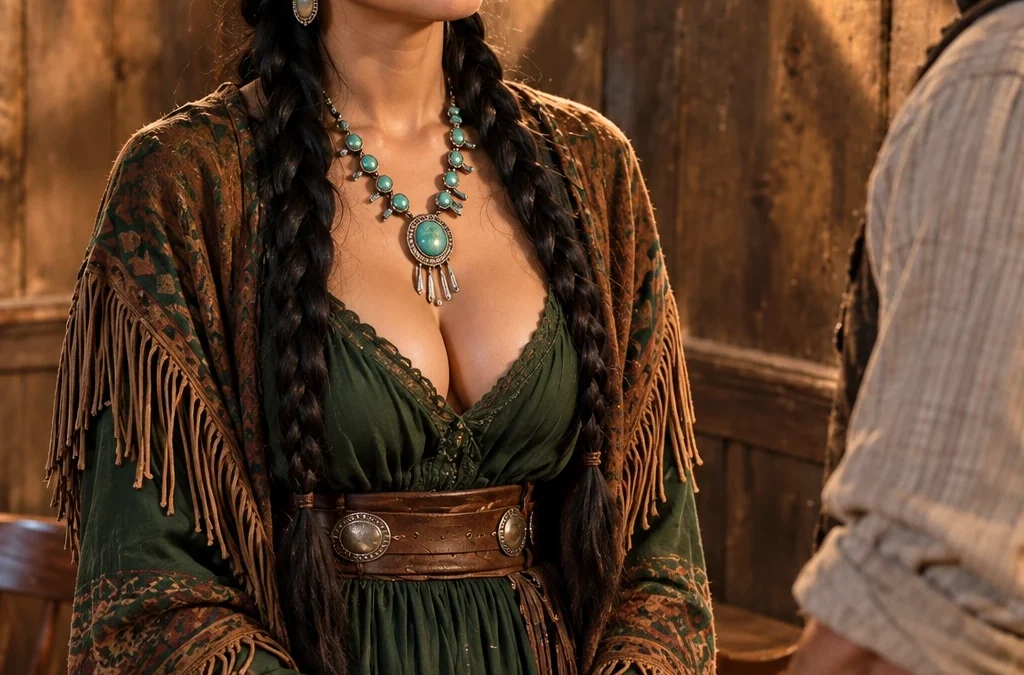
😱 Sold for $50 on an Auction Block, She Followed the Stranger Who Bought Her Home. Then He Told Her What He Had Done the Day Her Husband Died…
Part 1
“Sold.”
The auctioneer’s block hit the wood so hard that the sound bounced off the canyon walls twice.
Taja Red Willow did not flinch.
She stood on the platform with her wrists bound in front of her and dust on the hem of her blue dress. The July sun pressed on her shoulders like a hand trying to force her to her knees. Around her, two dozen men shifted and scratched at their beards. They were miners, debt collectors, and ranch hands with nowhere better to be on a Tuesday afternoon.
Not one of them looked her in the face.
So she looked at all of them, one by one, holding each gaze until the man broke it and found something else to stare at. His boots. The canyon wall. Her father had taught her that. Make them see you first, before they decide. 🔥
The auctioneer, a soft man named Welford who held his ledger like a Bible, cleared his throat.
“Outstanding debt registered in the name of Nakai Voss, deceased. Forty-one dollars principal. With interest, fifty-two dollars and twenty cents as of this morning. Bidding opens at ten.”
A red-bearded miner’s hand shot up before the word was out of Welford’s mouth, as if he had come here for this. “Twelve,” said another, thumbs hooked in his belt like he was at a horse sale. Someone behind him laughed. It was the low, easy laugh of a man who found all this perfectly normal.
That laugh moved in Taja’s chest like a coal shifting in a fire.
“Tell me something,” she said.
The laugh died. The red-bearded miner looked at her, surprised, as if the horse had spoken.
“My husband has been dead six years. He died on a railroad blasting crew. If he owed the railroad, that debt died with him. So why are you selling me?”
Welford’s smile arrived too quickly. “Out here, ma’am, a debt always belongs to somebody.”
“I am not a debt. I am a person.”
“Thirteen,” said the red-bearded miner, and the crowd moved on as if she had never spoken. The words fell into the dust, and the dust swallowed them.
Welford raised his block.
“Fifty.”
The voice came from the back of the canyon. It was low and unhurried, and it did not need to be loud. Every head turned.
A man stood at the canyon entrance with one hand on his horse’s neck. He was forty-three or so, with brown-gray hair, a short beard, and a weathered face that was hard to read. He wore a plain shirt and trail-worn boots. He did not look heroic or angry. He looked like a man carrying out a decision he wasn’t at peace with.
“Fifty,” Elias Mercer said again. “That covers fifty-two twenty.”
“Sir, that sum…”
“I can count. Can you?”
He counted the bills and coins onto the platform boards, not fast and not slow. Welford counted them twice with unsteady hands.
“Payment accepted.”
Elias stepped up onto the platform. Taja moved back, one step, two, until her knees found the edge.
“Don’t touch me.”
He stopped instantly, as if her words had weight and he’d walked into them. He held out both hands, empty. Then he drew a small knife and laid it flat on his palm so she could see all of it before he moved.
“I’m going to cut the rope. Just the rope. I’ll stand beside you, not in front.”
Two clean cuts. The rope fell to the boards.
“You can go,” he said, stepping off the platform. “The dun mare at the south wall is saddled and steady. Take her anywhere you need to go. I won’t crowd you.” 😳
Taja looked at the mare, at him, at Welford inching toward the canyon wall with his ledger bag.
“Why did you pay five times what anyone else offered?”
Something moved behind his eyes, like a door closing, or maybe opening.
“I’ll tell you. Not in front of these men.”
She looked at the red beard, the cracked faces, the men who had stopped pretending not to listen. None of them would help her. She had known that when they tied her wrists that morning.
“You ride first,” she said. “I follow. If you stop for any reason I don’t understand, I go the other way. And when we get where you’re taking me, you tell me the truth. All of it.”
“All of it.”
She checked the girth strap, found it properly tightened, and swung into the saddle. She did not thank him, and she did not look back.
They rode three hours without a word. Taja spent them the way she spent all waiting, counting his water bags, noting which side he favored on narrow trails. She noticed that he pointed at trail forks before turning, giving her time to see the choice. At a seep spring, he moved away from the water to leave the approach open for her.
“Pell’s trading post is three miles east,” he said. “If you’d rather go there.”
“I know where Pell’s is. My husband worked the railroad through here.”
“What was his name?” Elias asked.
“You already know his name.”
She said it without accusation, simply as fact. She had known since the canyon, from the way he went still when Welford read from that ledger.
“I worked that railroad stretch three years,” he said. “I’ll tell you at the ranch. I’d like to be sitting down.” 😶
The ranch was working land, nobody’s idea of comfort. Adobe and timber, a barn patched by three different hands, a fence line crying out for repair. He gave her the back room with a door that locked from inside.
“I’ll take the barn.”
“You paid fifty dollars, and you’re sleeping in the barn?”
“The fifty was so you’d have a choice.”
That night in the barn, she brushed the mare in long, even strokes. “We’re at the ranch,” she said. “Tell me.”
Elias set down the feed scoop.
“The foreman was pushing the crew hard that summer. The blasting material was bad. Stored wrong. Your husband saw it. He told the foreman in front of the whole crew that someone was going to get killed.”
Taja’s hand went still on the brush.
“The foreman told him to get back to work or clear out. The explosion came twelve minutes later. Four men died. Nakai was one of them.” His voice was flat, worn down below feeling. “And I was standing eight feet away. I heard him. I knew he was right.”
“And?”
“And I said nothing.” 💔
Part 2
“And I said nothing.”
The barn held the silence like a held breath.
Taja put down the brush. She turned and laid both hands flat on the stall rail, staring at the wall, breathing through the kind of grief that comes back already knowing where the cracks are.
“Why tell me now? Six years later?”
“Because you deserve to know.”
“I deserved to know six years ago.”
“Yes.” He didn’t flinch. “I was a coward. I was afraid of losing my job, of the foreman, of a man named Rourke who held the land contracts and had the sheriff’s ear.”
She turned around and looked at him for a long time. Most men would have started explaining themselves. He stood there and took the full weight of her gaze.
“You didn’t kill him with your hands,” she said at last.
Something almost like relief flickered across his face.
“But you watched. You stood eight feet away and watched my husband warn them, and went home.” The relief left. “Get out of the barn.”
He got out of the barn.
She stood alone with the mare as the last light striped the boards. Then she locked herself in the back room and lay in the dark, thinking not of Elias but of something Welford had said. A debt always belongs to somebody. Why had the auctioneer known exactly who she was? Why had someone told Rourke she was coming?
He wasn’t collecting a debt, she thought. He was checking whether I knew anything. 😨
Rourke came to the ranch two days later with a folded paper and a smile that never reached his eyes.
“Mrs. Voss. Welford’s transaction wasn’t legally binding.”
“Her husband’s debt died with him,” Elias said. “She wasn’t a signatory.”
“We might see it differently in a county court.” Then, almost casually: “Your husband worked the canyon section, didn’t he? Terrible accident. I cooperated fully with the inquiry, of course. It’s important not to let old grief lead a person to ask questions that won’t help anyone.”
“Was there something specific you were worried I might ask?”
The smile held. “This territory can be hard on people who stir up old dust.” He looked at Elias. “And on anyone who helps them.”
When the dust settled, Taja turned. “He’s not worried about the debt. He’s worried about what I might find.”
Elias stared at the road. “The inquiry. Rourke had a hand in it. Most of us kept quiet.”
“Are there records? Supply manifests, blasting orders?”
“There was a railroad depot in the canyon. Abandoned when the line was finished. I don’t know if anything is left.”
“Then that’s where we start.”
Two of Rourke’s men rode by the next morning with a “courtesy notice.” Old railroad structures were dangerous for civilians. The narrow-faced one stared at Taja for ten full seconds without looking away.
“He’s telling us he knows,” she said. “So we go tomorrow. Every day we wait gives him time to move whatever’s in there.”
They left before first light, riding the dry creek beds, staying below the ridgelines. The depot stood in the canyon wall, door hanging by one hinge. Inside, it smelled of old wood and dust. At the far end sat a timber cabinet, its padlock decorative, the wood around it cracked by years of heat.
Taja hit it twice with the flat of her hand. The door sagged open.
Inside lay a metal sleeve of manifests, three ledgers, and papers gone brown at the edges. Elias opened the manifests and went straight to a page, which told her he had imagined this moment many times.
“Grade A blasting material, sixty units ordered. Sixty units delivered, signed by the foreman. But I helped unload those crates, Taja. The markings said Grade C. Railroad salvage.”
“Who signed the purchase order?”
His finger moved to the top of the page. “There’s a county authorization stamp. Rourke.”
She opened the third ledger to the week of the explosion. The entry for the day before read: Crew concerns re: blasting material raised by worker N. Voss. Foreman Garrett addressed. Work to continue on schedule. 💔
Her husband’s name, in the company’s own hand. They had written it down and buried it.
“How high does this go?” she whispered.
“Higher than Rourke.”
That was when they heard the horses. Taja was at the door in four steps. Two riders at the canyon mouth, the broad man and the narrow-faced one, standing beside her tied mare.
There was no back door. The only way out was a rotted board and a gap in the wall that might not hold, and the sound of boots was coming closer… 😰
Part 3
Taja was already on her knees, pushing at the bottom board. It gave way, dry and barely holding.
“Go,” she told Elias. He went through first to take the documents. She passed the metal sleeve through, then the ledger, then squeezed through herself, scraping her shoulder on the stone foundation and not stopping.
Behind them, the sagging door scraped fully open.
They did not run, because running makes noise. They moved fast and deliberate along the narrow cut, east through a drainage gully, then south until they were out of the canyon system entirely.
“They’ll find our horses,” Elias said, breathing hard.
“They already knew we were coming. They don’t know what we found. And they don’t know we got out.”
“We’re four miles from the ranch on foot.”
“I know how to walk four miles.”
Two miles on, Elias said, “I’m sorry. For the way I told you. I’ve rehearsed it six years and still said it wrong.”
“Is there a right way to tell someone you let her husband die?”
“No.”
“No,” she agreed. They walked a while. “Nakai used to say silence is a choice. When you stay quiet in a moment that needs a voice, you’re not absent. You’re present on the wrong side.”
“He was right.”
It was not forgiveness, but it was quiet in a way that needed no words.
Back at the ranch, Taja laid out the evidence on the kitchen table. The manifests showed Grade A ordered and Grade A confirmed. The materials log showed Nakai’s warning recorded and ignored. Together they proved the company had known the material was wrong and proceeded anyway.
“I’ll testify,” Elias said. “Whatever you need. I was there.”
“It’s a start.”
She heard the horses on the south road, three of them, slowing well before the gate. She split the papers into two sets, lifted a loose stone from the hearth, and hid the manifests beneath it. She kept the materials log on the table in plain view.
“That’s the copy we don’t hide. If he thinks it’s all we found, he won’t look for more.”
Elias studied her. “You’ve done this before.”
“Every day of my life, Mr. Mercer.”
Rourke arrived with four men and the stance of someone who had decided the conversation was over. “Give me the ledger, Mrs. Voss.”
“My husband’s name is in this ledger. This doesn’t end. This is where it starts.”
Rourke weighed her, then smiled coldly. “Twenty-four hours. Think carefully about what you want the next chapter of your life to look like.” He looked at Elias. “Both of you.”
“I’m going to Pell’s,” she said when they’d gone. “Tonight.”
She rode eight miles in the dark. At the trading post, a short man with a ragged beard and sharp eyes opened the door six inches, then wider.
“Figured someone would come. Didn’t figure it’d be you.”
Rourke had been bleeding Pell’s supply contracts for two years. When she laid the sleeve on his counter, he understood at once. “My rider goes east before he goes south. There’s a junction post twelve miles out. Doesn’t touch Denton Flats. It’ll reach Hargrove in four days, maybe five.”
“Rourke gave us twenty-four hours.”
“Then you’ve got a problem on your end. I can move this. I can’t move his timeline.”
At the door she stopped. “Your husband checked supplies on this route,” Pell said, not looking up. “Found two short-weighted deliveries in a month everyone else had signed off on for a year. I was sorry when I heard what happened.”
“Thank you,” she said, and rode into the dark.
She came home to a small fire at the south edge of the property. Rourke’s watchers. Elias waited in the barn with a rifle across his knees.
“He’s waiting for us to make a mistake,” Taja said. “So we give him one. A mistake he can see.”
That night she copied the log entry in her own hand. Word for word, three times. One for Elias, one to travel with Pell’s rider, one inside her dress.
“When he comes tomorrow, let me talk.”
“You don’t have to carry this alone.”
“I know that. That’s why I told you the plan.” 💛
When Rourke came at eight with a county clerk, she handed him the ledger exactly as he expected. He relaxed visibly when he saw it. Then Elias said quietly, “Long enough for a federal inquiry to get underway.” The air changed.
“What did you send, Mrs. Voss?”
“I went to Pell’s. I bought soap and a length of rope.”
Rourke laughed, short and cold. “You’re smarter than I gave you credit for. But smart doesn’t change the geography.”
Then Elias told her the part he’d been holding back. There had been a second, informal investigation, started by two surviving crew members. One of them, Cole Garrett, had come to Elias a year later looking for witnesses.
“I turned him away.”
Taja stood very still. A witness had existed, and she had grieved alone for a year while he sat in a drawer. “Where is he?”
“Yuma. Two days’ ride.”
“Then Pell’s rider carries two things today.”
The replies came faster than she dared hope. She had written to eleven men who lost land or money to Rourke’s contracts. Seven said yes. I’ll be there. Tell me where to stand. One letter was different.
“Cole Garrett wrote back. He has eight signed statements from men on that crew. He’s been carrying them five years, waiting for somewhere to send them.”
“Rourke doesn’t have a ledger anymore,” she said. “He has kindling.”
The next morning, Taja wore the same blue dress she had worn on the auction block. She wanted every man in the assay office to remember it. Elias stood beside her, not sitting, because standing men are harder to dismiss.
Rourke arrived at ten exactly, with two men. “I’m glad you came to your senses.”
“I always had my senses. I’d like to discuss Nakai Voss. Grade A ordered, Grade A confirmed, Grade C installed. Your authorization stamp is on that purchase order. Either you knew, or someone used your stamp without your knowledge. Which is it?”
“You illegally removed those documents.”
“I made copies. The Federal Claims Office in Tucson received the originals three days ago, with a letter from Cole Garrett and eight signed statements from the crew.” She laid the copied entry on the counter. “The foreman’s brother is in Denton Flats tomorrow. He’ll testify in person.”
The pleasantness left Rourke’s face. What replaced it was colder and quieter.
“You came here to tell me it’s already done.”
“I came because you deserve to hear it face to face. The same courtesy you never extended to me.”
He left. Outside, the seven ranchers and freight men stood in the street and watched him go. They didn’t confront him. They just stood and were seen, like a claim marker on occupied land.
Rourke came that night after dark, as she knew he would. Four men rode in without lamps. Taja waited in the barn’s deep shadow.
One of them was the foreman himself, Garrett, heavy through the shoulders, with the face of a man who had once looked authoritative and now looked only capable of damage.
He stepped inside with a low lamp. Taja spoke from the dark.
“There are three men behind this barn who have been here for an hour. And a federal deputy from Tucson is at the Henderson place with Elias Mercer and your brother Cole.”
The lamp shook. “Cole’s here?”
“He brought the statements.”
“I told him to stop,” Garrett said, almost to himself. “I told him it would only bring trouble. I was protecting myself.” He looked at her. “Your husband was right about the material. I knew it. I told him to get back to work because Rourke was threatening to pull the contract. I’ve known it every day since.”
“Then say it again, in front of the deputy, with your name on it.”
He stood there a long moment. “He wasn’t afraid of anything, your husband.”
“He was afraid,” Taja said quietly. “He said it anyway.”
Garrett nodded. He turned and walked out of the barn.
In the yard, Rourke stood with the narrow-faced man and two others. Facing them from the north side stood Frank Henderson and two of the seven. Beside Elias stood a man in a good coat.
“Deputy Marshal Aldrin,” the man said. “Federal jurisdiction. I have a letter of inquiry regarding the Western Continental Railroad canyon blasting section, 1880. Mr. Rourke, I have questions for you.”
Rourke looked at Garrett. Garrett was looking at his brother Cole, standing quiet beside the deputy.
“It’s done,” Garrett said.
Something collapsed behind Rourke’s face, the ground he’d built his life on shifting and not shifting back. He looked at Taja.
“You should know your place.”
“I know exactly where I belong,” she said. She did not raise her voice. “Where I choose.”
He handed over his badge without a word. He walked to his horse and rode south and didn’t look back. The narrow-faced man looked at the deputy and apparently reconsidered his own future. 🌙
Taja sat on the porch steps afterward, too tired for victory, too full for a clean word. Elias sat a few feet away and said nothing, having learned when to speak and when to simply be present.
“He was afraid,” she said at last. “I used to wonder. I thought I’d made up his certainty because it was easier to grieve someone certain.”
“He was certain,” Elias said. “It’s in the record.”
“You don’t owe me forgiveness,” he added.
“I know.”
“I won’t stand eight feet away from anything again. Whatever that’s worth.”
For the first time since the barn, she looked at him completely. A man who had been a coward and decided to stop. A man who had spent fifty dollars making good on something he could never fully make good on, and meant to keep trying.
“It’s worth something.” 💛
Cole Garrett testified for two hours the next morning. He opened his leather folder and laid eight signed statements on the table, one by one. When he said, “He wasn’t angry when he warned us. He was calm, like a man who knows he’s right,” Taja held her breath and did not cry.
Then she told Deputy Aldrin everything. The auction. The rope. The fifty dollars. The depot, the letters, the night in the yard. Forty-five minutes, in the level voice she had learned to use when she needed to be heard without being dismissed.
“This process takes time,” Aldrin said. “The railroad has lawyers. The outcome isn’t guaranteed.”
“The odds were certain enough. What was uncertain was whether anyone would stand up and make them count. Turned out more were willing than I expected.”
Three weeks later, the federal inquiry opened. The railroad’s Tucson offices received a subpoena. Two shareholders began cooperating on their own. Rourke was arrested in a town forty miles south, waiting to see which way things fell. They had fallen clearly.
Foreman Garrett went to Aldrin himself and agreed to cooperate fully. “It won’t undo anything,” Cole told Taja. “No,” she said. “But it’s something.”
She wrote letters that night to the families of the other three men who died, telling them what the inquiry had found and how to add their voices. Hargrove himself came from Tucson, a compact, careful man. He told her it was the most complete documentation of willful negligence his office had seen in fifteen years.
“Your husband’s warning is in the record. His name is in the record. That doesn’t go away, whatever the legal outcome.”
In December, Taja walked into the land office and filed a claim for forty acres in the foothills east of the old railroad grade. The survey measurements were exact, the boundaries described correctly, the fee in hand. The clerk looked at the paperwork, then at her, then at the paperwork again.
He stamped it.
Forty acres. No husband’s name. No debt collector’s hand. Her name, her choice, her land. 🌄
On the ride home, she stopped at the old mesquite tree beside the grade. From her saddlebag she took a marker she had carved from good hardwood, taking her time with every letter. Nakai Voss. He spoke the truth. She drove it into the cold ground and checked that it stood level.
Elias rode up and read it without a word.
“He spoke the truth,” he said quietly.
They stood together in the December cold, two people who had arrived at this place through different kinds of failure and different kinds of trying.
“Are you staying?” he asked. He had said he’d ask in a year. It had not been a year. But some things don’t need the full year to become clear.
She looked at her land, at the smoke rising from the ranch chimney, at the fence line she had built straight and true.
“I am.”
“Because of me?”
She turned to look at him. And for the first time since the auction block, since the wood came down and her wrists were bound and she had decided never to look at the ground, Taja Red Willow smiled. It was full, and real, and entirely hers.
“No,” she said, and the smile stayed. “Because I chose it.”
She turned her horse east, toward her own land, and rode into the clean December morning. Behind her, at the base of the mesquite, the marker stood steady in the cold ground, Nakai Voss’s name in the winter air.
Witnessed at last. She did not look back. She rode forward. That had always been the choice. 🌅
This story is entirely fictional and created for entertainment purposes only. It does not represent any organization or individual, nor does it encourage inappropriate behavior. The content was generated with AI assistance.








