“SOLD,” Read the Chalk Above the Bound Woman’s Head. Then a Drifter Paid 28 Dollars and Cut Her Rope. What She Did Next Left Him Speechless…
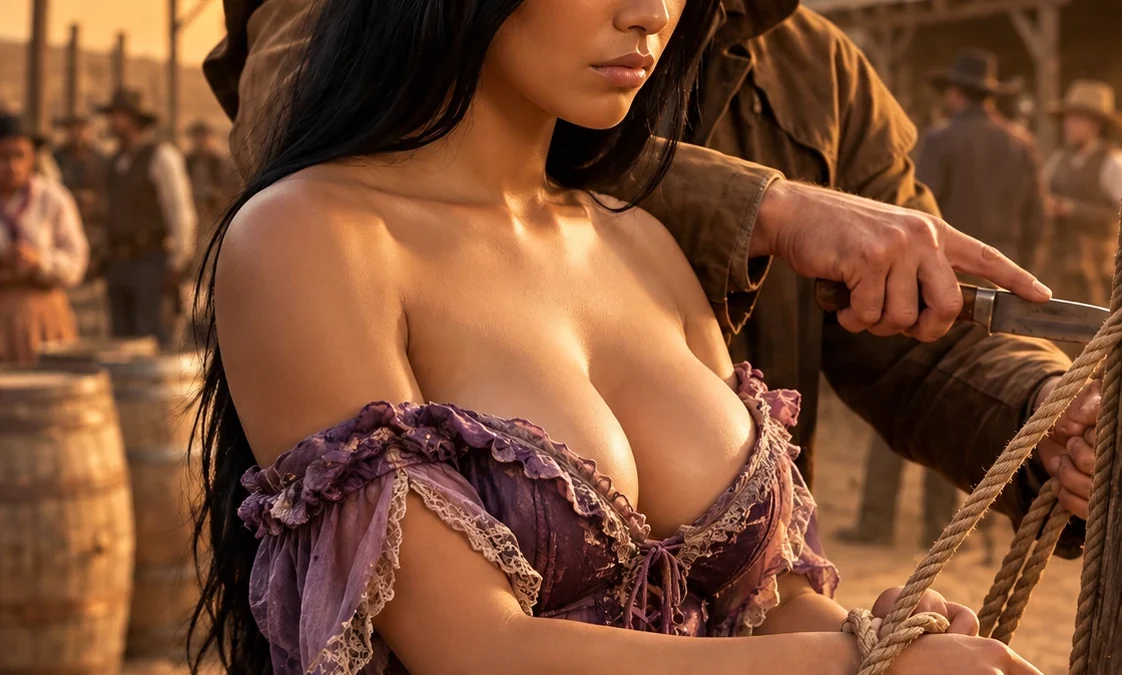
🔥 “SOLD,” Read the Chalk Above the Bound Woman’s Head. Then a Drifter Paid 28 Dollars and Cut Her Rope. What She Did Next Left Him Speechless… 😳
Part 1
Sold.
That single word was chalked above a bound woman’s head outside the trading post, on the morning that would change everything.
No warrant hung on that wagon. Nothing lawful marked the rope at her wrists. There was only a man named Barrett Sloane, counting on nobody looking twice.
Jonah Reed had ridden into Cottonwood Crossing for flour, coffee, and a plug of tobacco. Nothing grander than that.
Then he saw the wagon.
The woman knelt in its bed, her wrists lashed with rope gone dark at the edges. Her back was straight as a rifle barrel. Her chin was lifted like she had decided long ago that no one would ever see her flinch.
She did not look like a woman who had done anything wrong. She looked like a woman unlucky enough to be alone on a road where men like Sloane made their living.
Jonah was maybe thirty, sun-cured the color of saddle leather, with a quiet that made some men uneasy because they could not read what sat behind it. Years back he had worn a cavalry uniform. He told himself he had simply outgrown army life.
That was not entirely a lie. It was not entirely the truth, either. The gap between the two was a debt he had carried for eight years.
Sloane stood near the tailgate, making sure everyone heard it. The woman was a horse thief from down near the Gila. He was hauling her to the marshal in the next county. A fine public service, in his own words, deserving of a drink bought in his honor.
Nobody asked to see the paper that would have made any of it true. Nobody wanted trouble with an armed man who answered to no law.
Jonah asked anyway.
Sloane waved the question away, easy as swatting a fly. Jonah did not push again with words. He filled a tin cup at the horse trough, carried it to the wagon, and backed off three full paces.
She would not drink with a stranger close enough to touch. Only when the distance was wide enough did she lift the cup, and even then her eyes never left Sloane.
That told Jonah everything.
A lawful prisoner does not fear the law. She fears exactly one man, and it is always the man holding the rope.
It turned out Sloane owed the storekeeper twenty-eight dollars on an account he’d been dodging for a month. Jonah counted out nearly every dollar of his winter wages on the store counter, loud enough for the storekeeper and two travelers to remember every word.
“That’s your debt. Not hers.”
Greed beat suspicion on Sloane’s face. He pocketed the money the way a man pockets what he hasn’t earned.
Then Jonah walked to the wagon and drew his pocketknife. She flinched, the way a person flinches who has learned that blades near them rarely mean good news.
So he turned the handle toward her first. Hilt-first. He let her see plainly that he meant to cut something, not someone.
Then he reached past her wrists and cut the rope. Just the rope.
“You’re free to go.”
He stepped back like a man finishing an errand. He never asked her name. He never waited to be thanked. He mounted up, touched his hat to the storekeeper, and rode west, certain he would never see that woman again.
He was wrong within the hour. 😮
A mile out, on a stretch of road with nothing but heat and dust and the violet shadow of the mountains, Jonah looked back.
She was there. Walking.
Not running. Not calling. Not waving him down for a ride. Just walking the same road, a quarter mile behind, as though she had decided that was simply where she was going too.
He slowed his horse. She slowed her steps, holding the same quarter mile of open dust between them. Something in her shoulders made it plain that closing the gap was not an invitation he had been given.
He did not understand yet. In her world, a gift from a stranger was never simply a gift. It was the first thread of a rope nobody admits they are tying.
That evening he built his fire far from hers and left a canteen on a flat rock halfway between. He did not watch her take it.
At dawn the canteen sat exactly where he’d left it. The water was gone, and the cap was turned tight.
I owe you nothing extra for this.
The next night he left a plate of beans. In the morning it sat rinsed clean with sand, returned to the same rock.
“Guess that makes us even,” he muttered, grinning like a fool. 😊
On the third day he offered his spare horse. She refused it with one shake of her head, definite as a closed door.
On the fourth night he laid a second blanket at the usual distance, then sat down at his own fire and waited. Only after he sat did she come and take it.
The order mattered. A gift taken from an open, waiting hand is a transaction. A gift taken while his back is turned, expecting nothing, is a kindness a person can accept without owing a single thing.
He was learning her rules without her ever speaking one aloud.
And he never asked her name. He had learned long ago what happens to people freshly cut loose from captivity. A question can become another kind of rope.
Then, near midnight, he woke to an empty camp and a jolt of pure fear.
A voice came out of the dark behind him, low and even.
“Three riders. Coming from the east, slow, like men who don’t want to be heard before they want to be seen.”
She had climbed the rise above camp and counted them long before he had stirred. In the starlight she gave him her name for the first time.
“Chenoa.”
And in the same breath, the name that mattered more right now.
“Sloane comes.”
Part 2
“Sloane comes.”
Jonah was on his feet before the words finished echoing. He kicked dirt over the coals, and Chenoa stood beside him in the dark without a word.
“Stay behind me,” he said.
“No.” She did not raise her voice. “I stay beside you, or I do not stay.”
He looked at her, and for the first time he understood how rare that was. Beside, not behind. He nodded.
Dawn came gray and slow. Sloane rode in with two hired men at an easy pace that was meant to look casual and fooled no one.
“I came for what belongs with me!” His voice carried thirty yards, rehearsed and pleased with itself.
Jonah stepped between him and the dead fire, unhurried.
“People do not belong to you.”
Sloane laughed. He tried the horse-thief story again, louder this time, playing to his hired men more than to Jonah. Chenoa stood motionless, her face a locked door. Her hands, Jonah noticed, were shaking just slightly at her sides.
Then Sloane overplayed his hand.
“Her people carry influence,” he snapped. “There’s a reward waiting, worth more than a few stolen horses, if I bring her back instead of losing her for nothing.”
He meant it as leverage.
It landed like a confession. 😨
A man does not need a bounty on a lawful prisoner. Bounties are for property somebody wants returned.
Jonah let the silence stretch. Then, calm as Sunday, he spoke.
“The storekeeper saw you take my money. Two travelers heard me say your debt, not hers. They all saw the rope. They all saw the missing paper.” He tilted his head. “I’ll ride the whole party back to Cottonwood Crossing right now. Let every one of them swear to what they saw. The rope. The chalk. The price you put on a human being like she was a horse.”
Sloane’s hired men had gone quiet well before their employer did. It was the quiet of men who had signed on for easy wages and were only now doing the arithmetic on what holding a free woman without lawful cause might cost them before a circuit judge.
Neither reached for a holster.
But Sloane’s hand drifted down toward his hip, slow, almost absentminded.
Chenoa’s breath stopped.
And Jonah, who had spent eight years hiding the one thing he feared she would learn, realized Sloane had one last card to play, and it was not a gun.
“You want to talk about what people owe, Reed?” Sloane smiled thinly. “Ask her what you really are. Ask her what you did, out east, the winter you wore that uniform.”
Jonah’s blood went cold.
The one secret he had told no one in eight years, and a man he had known for two days was about to speak it aloud.
Part 3
Sloane never got the chance to say more.
“Enough.”
Jonah had not raised his voice. But something in it made even the horses go still.
“I’ll tell her myself,” he said. “Not you.”
Sloane’s smile slipped. The truth was that he had no idea what Jonah had done. He had only guessed at the army uniform, at the way a man like that carries a weight. He had been fishing. And now the fish had said yes.
Chenoa watched Jonah’s face. Whatever she saw there, she turned to Sloane and spoke.
“You have said enough. Go.”
Sloane’s confidence went thin fast. He tried one more line about how her own people would never thank this man for any of it. Then he turned and rode east, his hired men trailing behind him, out of options and unwilling to test whether Jonah was bluffing about the ride back.
Chenoa watched them shrink on the horizon without a flicker of relief.
“They will see a white man who took me,” she said quietly, not thanking him, not quite accusing him. She was only naming the shape of the story her people might build around this morning, a story that would have nothing to do with what had actually happened.
Jonah let the words stand. He had learned long ago not to waste breath correcting a fear that was, in its own way, entirely reasonable.
They traveled together after that, not quite strangers, not yet anything with a name.
She accepted the spare horse on the second day, only after he stopped pressing it and simply left it saddled and waiting each morning. The choice was hers, made without him watching.
She began teaching him things without being asked. The names the ridges wore before any surveyor renamed them. Which stands of mesquite hid water underground. How to read a coming storm off the color of the light two hours before the first cloud.
He cooked beans one evening that came out scorched on the bottom and thin on top, an unhappy combination he had not known was possible.
“Very interesting,” she said, tasting it, her face perfectly composed.
“Bad?”
“Very.”
“Good. Thought maybe my standards were slipping.”
She laughed. One short, surprised sound, gone almost as soon as it came, but real. It was the first unguarded thing he had heard from her since the trading post, and it did something to the fire between them that no amount of careful gift-leaving ever had. 🔥
She told him about her brother, Tahoma, four years older, steady where she was quick to judge, a man whose word already carried weight in council. She spoke of her family the way a person speaks of ground they still stand on, even after everything that has tried to take it.
Jonah listened more than he talked. The careful quarter mile she had kept between them closed down to almost nothing, and neither of them marked the moment it happened.
Then, on the third night, with the fire burned down to red coals, he finally let out the thing he had carried for eight years.
“I was an army scout. Good at reading sign. Good at finding passages through country most men called impassable. Proud, in a young man’s way, of being useful.” He stared at the coals. “One winter I showed a column of cavalry a mountain pass east of the river. I believed they meant to negotiate. To settle something with paper instead of powder.”
She said nothing.
“I found out afterward what the pass was used for. Families driven off land that had been theirs longer than anyone could count. Driven out through a door I opened for the men who did the driving.”
“You brought soldiers.” Her voice held no heat at all, which was somehow worse.
“Yes.”
He put nothing after it. No they lied to me. No I was young. None of the things a man reaches for when he wants forgiveness handed over bundled with the truth.
She stood and walked out past the reach of the firelight. He let her go. Nothing left unsaid would have sounded like anything but begging.
He sat up a long while, turning that winter over in his mind. He had told the story to no one in eight years, not a chaplain, not a friend. Saying it aloud had cost him more than the twenty-eight dollars, and he did not know yet whether it had cost him her as well. 💔
At first light, the spare horse was gone. Her bedroll was empty.
For one long, sick moment he believed she had left for good.
Then he saw it, laid carefully across the folded corner of his blanket, catching the early sun.
A turquoise pendant, worn smooth by years of handling. It had been her mother’s. A woman does not lose such a thing by accident, and she does not leave it behind by carelessness.
It was not goodbye. It was a trail, left on purpose, for a man she had apparently decided was worth following, if he was willing to find her.
He rode west into a narrow canyon where the walls closed in tight enough to swallow the morning light. He found the spare horse first, pulled up lame on a rear leg. He checked it before anything else, ran his hands down the leg, and satisfied himself it was a strain and not a break.
Only then did he look up and find Chenoa on a flat rock twenty feet off, her ankle wrapped in a torn strip of cloth. Her face was set in the stillness of someone determined not to show pain.
He left his canteen within her reach and sat down apart from her. Then he told her what he had worked out in the night. The pendant. Her mother, who had died the same winter, on a road that may well have been the very one his information had opened.
“I am sorry.”
“You want forgiveness?” The question landed sharper than anything she had put to him yet.
“No.”
That surprised her more than any other answer could have. She had expected what every guilty man eventually wanted from her: absolution, handed over neat, so he could stop carrying the weight.
“I did not know enough,” Jonah said. “That is not the same thing as not being at fault.”
He left it there, without softening it.
She studied him a long moment. Then she looked away and rewrapped her own ankle without his help, refusing it the way she had refused every gift since the day he cut her free. But that night, when he built the fire, she sat down on his side of it instead of across from it.
Neither of them put a word to what that meant.
They stayed two more days in that canyon while her ankle mended and the horse worked out its stiffness. She showed him which canyon plants held water in their roots and which would only poison a thirsty man for the trouble. He showed her, badly, how to skip a flat stone across the shallow pool at the canyon’s bend. He missed four times. She managed it on her first try and did not bother hiding how pleased that made her. 😄
It was the closest thing to an ordinary courtship either of them had ever expected to get, born out of a lame horse and a wrapped ankle.
On the second day of riding after that, riders began to appear along the ridgelines. Five at first, then ten, then near twenty. Mounted, silent, watching.
“They are deciding what you are,” Chenoa said softly.
Jonah understood that nothing he could say would settle it. Only what he did.
So he dismounted well short of the camp, before anyone rode down to demand it. He unbuckled his gun belt, laid it flat across his saddle in plain sight, and waited.
A tall, steady-eyed man rode out to meet them. Tahoma. His gaze went straight to the faint marks still visible on his sister’s wrists, the fading ghost of rope.
“You touched her.”
“Only to cut the rope,” Jonah said, and added nothing else.
Beyond Tahoma, the camp opened along a shallow bend in the river. Brush shelters and hide lodges curved with the water instead of fighting it. Cook fires smoked blue-gray in the morning air. Children paused mid-chase to stare at the stranger standing hatless and unarmed at the edge of everything they knew.
He had not expected the smell of woodsmoke and river water to feel so much like every other camp he had ever ridden into. He had not expected how much that would unsettle him.
Chenoa could have explained everything. The trading post. The twenty-eight dollars. The food left at careful distances. The man who wanted nothing and never once said grateful.
She said none of it. She stood silent beside her brother and let Jonah stand entirely alone, because she needed her family to reach the same answer on their own.
Tahoma led him to an old woman seated outside a dwelling, weaving by the light of a small clay lamp, her hair gone entirely silver. Her hands never paused as Jonah approached.
Her eyes found the faded cavalry insignia stitched into his saddle strap, a detail he had stopped noticing years ago. Her fingers went still for the first time.
Through Tahoma, she asked plainly whether he had known, that winter, what the soldiers meant to do with the passage.
“No.”
Would he have shown them the road, had he known?
“No.”
Then, before anyone asked more, he knelt and laid out everything he owned on the ground before her. The last of his money. His bedroll. His revolver.
“It isn’t enough. But it’s everything I have.”
She did not touch any of it. She reached out and touched the faded insignia, the mark of the army that had cost her the husband she lost that same winter. Then she spoke slowly, and Tahoma turned her words into English with the care of a man who did not want them carried wrong.
“A man cannot walk backward over yesterday’s trail. He can only choose where his tracks point tomorrow.”
She pushed his belongings gently back toward him and returned to her weaving. No ceremony. No forgiveness pronounced for the whole camp to hear. Only that, which turned out to be enough.
Tahoma handed back the gun belt himself. “My sister stayed silent because she already knew, since the trading post, what you did for her. What she needed us to see was what you would do when nobody owed you a single word of thanks.”
Jonah stayed three days at the edge of that camp, useful where he could be, careful never to overstay a welcome he had not fully earned. On the fourth morning he saddled before first light, meaning to ride east and leave Chenoa to the family that was rightfully hers.
Staying longer, he was certain, would look less like a kindness freely given and more like a bill quietly presented. He had not cut that rope wanting to be paid.
She caught him four miles out, her horse lathered, and did not slow to plead her case.
“My family gave me a home. They did not give me my choice.”
That was her whole explanation, and it was entirely sufficient.
She turned her horse to ride beside him rather than behind him. It was a small thing, and also not small at all.
“One rule,” she said before they had gone another mile. “Tomorrow, do not ask when I am leaving. If I leave, I will let you know. And if I stay…” Something almost like humor showed in her face. “I will let you know that too.”
Neither of them broke that rule in all the months that followed. 💛
Three months later, on a modest spread of land by the river, the days had settled into a rhythm neither had dared hope for. She kept a garden going in soil that had been stubborn ground before her hands got into it. He kept the corral fences straight and the roof mostly from leaking. A second horse was broken to the plow. A chicken coop went up in an afternoon with two neighbors who rode over without being asked twice. Jonah built a shelf along one wall for the pottery she collected from a passing trader.
Somewhere in those months she stopped calling the place Jonah’s cabin inside her own head and started calling it home. She said the word aloud for the first time while they were fixing a stubborn gate hinge. He caught it, and let it pass without remark, because some things land better left quiet.
He asked her at the corral one evening near sunset, with no ring and no speech, because he had never trusted himself to get a speech right.
“Would you want to keep building this with me?”
“Yes.”
No hesitation. The same plain directness she had carried since the day she followed a stranger down a dusty road instead of vanishing alone into the desert.
They married three months later in a small wooden chapel that smelled of fresh-cut pine. Jars of prairie flowers lined the windowsills, more enthusiasm than arrangement. A fiddle waited against a pew. Sixty people crowded a room built for forty, spilling into the yard where the doors stood open to the light.
The storekeeper, Harlon, had ridden two hours to be there. He brought a jar of good coffee as a wedding gift, which struck more than one guest as exactly the right gift for how the whole story had begun. He sat near the front with the satisfaction of a man who had once counted twenty-eight dollars onto his counter without any idea what it would build. ☕
Tahoma had ridden two full days with the rest of Chenoa’s family. He walked her down the short aisle, one hand light at her elbow. But at the front, he stepped back and did not place her hand in Jonah’s. Everyone understood that choice belonged to her alone, not even to the brother who loved her enough to ride two days and then, at the last step, decline.
The preacher asked her plainly, in front of everyone, whether she came to that altar by her own choosing.
She looked once at Tahoma, who gave the smallest nod. Then she looked at Jonah.
“I chose him.”
She placed her own hand into his. No one guided it. No one decided for her. It was simply her hand, moving of its own will, the way it had been moving toward this ending since the morning a stranger turned a knife handle-first and cut only the rope.
The marks on her wrists had faded almost entirely by then, a scar a person has to know to look for. What replaced them was plainer to see: a woman in a small frontier chapel, having chosen at every turn since the day she was freed exactly the life and the man she wanted, with nobody’s hand closing around hers to make the choice for her. 💍
That, in the end, was all Jonah Reed had given her outside that trading post. Not rescue. Not ownership dressed in a gentler name, the way so many kindnesses quietly are. Just the plain return of a choice that had always belonged to her alone.
Cottonwood Crossing kept its trading post standing another twenty years. Travelers sometimes heard the story from the storekeeper, a version that got the twenty-eight dollars right and very little else, the way stories do when told by people who stood only at the edges of them.
The whole truth belonged to two people. They rode out of that town on the same morning as strangers and rode back into it, months later, as something else entirely. She was a woman who had chosen at every turn. He was a man who had finally learned the difference between owing a debt and simply choosing to be decent, expecting nothing in return. Not gratitude. Not company. Not a future he had any right to ask for.
He got one anyway. 🌅
Some men spend a lifetime trying to earn what Jonah Reed received the moment he cut a single length of rope, not because he calculated it would be repaid, but because it was the only decent thing to do. He did it without once looking back to see whether anyone was grateful.
This story is entirely fictional and created for entertainment purposes only. It does not represent any organization or individual, nor does it encourage inappropriate behavior. The content was generated with AI assistance.








