SOLD TO THE “CRIPPLED” DUKE TO PAY HER FATHER’S DEBTS… BUT ON THEIR WEDDING NIGHT, THE MAN IN THE WHEELCHAIR STOOD UP AND WHISPERED: “DECIDE TONIGHT WHETHER YOU ARE THEIRS OR MINE”
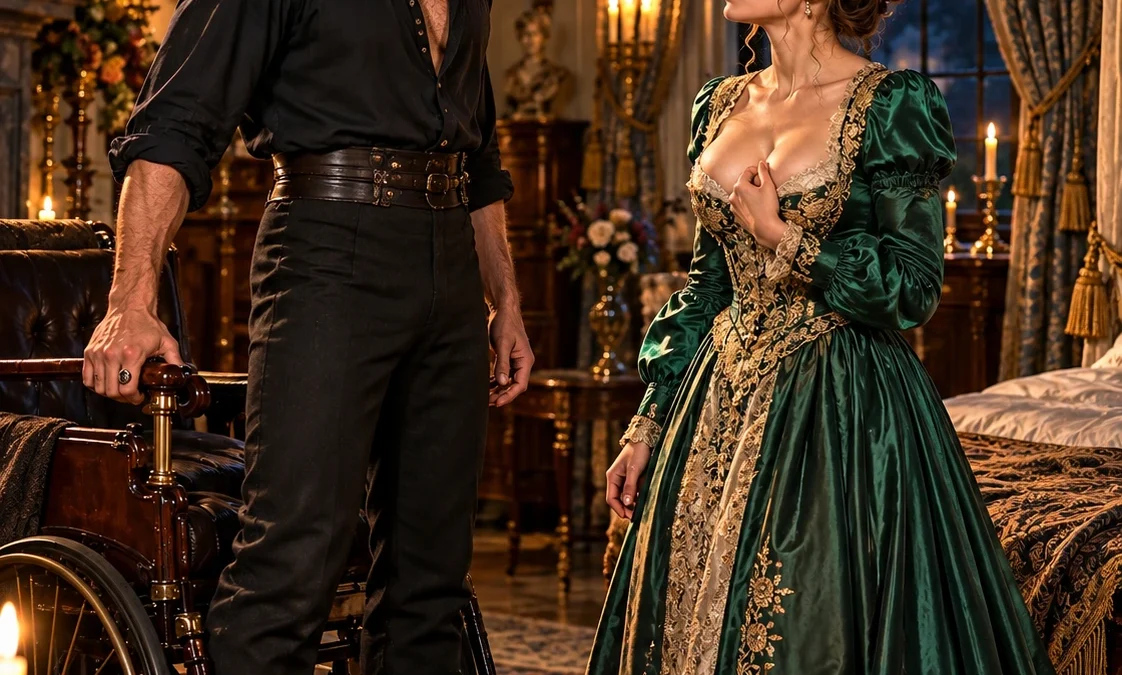
SOLD TO THE “CRIPPLED” DUKE TO PAY HER FATHER’S DEBTS… BUT ON THEIR WEDDING NIGHT, THE MAN IN THE WHEELCHAIR STOOD UP AND WHISPERED: “DECIDE TONIGHT WHETHER YOU ARE THEIRS OR MINE” 😱
Part 1
The mortgages were bought up in a single afternoon.
The Dowager Duchess of Stenmore’s man of business rode from Carlisle to the squire’s house at Ullswater and back before dinner. By the time Verity Lamb understood what had been done to her father’s land, the land itself no longer mattered.
What mattered was the letter that arrived a week later.
Her marriage to the Duke of Stenmore would settle everything. Every acre. Every debt. Every year of bad harvests her father had borrowed against, hoping for a better one that never came.
Squire Lamb sat her down in his study. The room smelled of damp plaster and cheap tallow candles, the kind they could no longer afford to replace with wax. He could not meet her eyes. He turned his signet ring round and round on his finger as he spoke.
“It is the only way, Verity,” he said, more to the account books than to his own daughter. “The mortgages are called in by Michaelmas otherwise. We shall have nowhere left to go. Not even this house.”
She asked him only one question. Had he thought, even once, of asking her opinion before the letter went out?
He did not answer. That was answer enough. 💔
Verity had seen the Duke of Stenmore exactly twice in her life, both times at a distance, both times in the wheelchair he had not left since a fall from the fell road two years before. All of Cumberland spoke of that fall in hushed voices, as though his ruin were catching.
Carlisle called him the Duke who would die without an heir. They said it the way people say things they have decided are inevitable, and therefore no longer worth grieving.
Her father called him, more practically, the only man in the county who could clear the Lamb debts in a single stroke.
It did not seem to trouble him that the stroke in question was his own daughter’s life.
The wedding was held in the Stenmore Chapel on a gray April morning. Verity walked the short aisle before a congregation that watched her with the particular pity people reserve for those they believe already lost.
She heard the whispers even over the organ.
Poor girl… married to a man who cannot stand… who will never…
She kept her chin level and her eyes on the altar. She would not let herself hear the rest, because hearing it would have undone the careful composure she had built brick by brick since the letter arrived.
Afterward, she was led beside her husband through the whispering hall. He was a tall man gone thin with two years of confinement, his dark hair overlong, his face composed into the blankness of someone who has learned to give the world nothing to pity him with. Together they went up the wide stair to the great chamber.
And then they were left there.
The door closed behind the last departing servant with a soft, final click that seemed to Verity louder than any cannon.
She stood very still in the middle of the room in her wedding gown, waiting for whatever came next and dreading it in equal measure.
It was the Duke who moved first.
He put both hands flat on the arms of his wheeled chair…
…and rose.
🕯️ He unfolded to his full height, slowly and deliberately, like a man who had practiced that single motion a thousand times in private and never once let it be seen.
Verity’s breath caught audibly.
He crossed the few feet of carpet between them on legs that did not so much as tremble. He stood before her whole, upright, and entirely unlike the man the whole county had married her to out of pity.
“Now you know something that will get us both killed,” he said, his voice low and even. He watched her face for the flinch he half expected, and did not entirely find it. “Decide tonight whether you are theirs… or mine.”
She looked at him, really looked, for the first time since the wedding had been arranged over her head like a business transaction. She saw no invalid. She saw a man holding himself very carefully together, with the weariness of someone who had learned that trust was a luxury he could not afford.
“Whose am I meant to be,” she said at last, “if not my husband’s?”
“My stepmother’s,” he answered. “My cousin Lionel’s. Theirs, if you go back to them tomorrow and tell them what you have seen tonight. Mine, if you do not.”
He said it without pressure. He seemed to expect, even want, her to choose the easier road. Something in that resignation, in the loneliness beneath it, decided her more thoroughly than any argument could have.
He sat beside her on the edge of the great bed, a single candle burning low between them, and told her what he had not dared tell another living soul in two years.
He had been walking in secret for eight months, rebuilding his strength in the dead of night along the long gallery.
And the fall that had supposedly crippled him?
His voice dropped to almost nothing.
“The girth on my horse was cut, Verity. Deliberately. Cleanly enough that only a man who went looking afterward would have found the mark.” His eyes held hers. “And the woman who bought your father’s debts, the woman who chose you for me… is the very same woman who wants me dead.”
Part 2
“…is the very same woman who wants me dead.”
Verity did not scream. She did not faint. She sat very still while the candle guttered between them, and she worked it through the way her father never had.
“Why?” she asked at last. “Why would anyone want you dead badly enough to cut a girth and pay a physician to lie for two years?”
“Because my stepmother wants the title for her own son,” Julian said. “Lionel has no blood of mine and no true claim. But if I die without an heir, and die slowly enough that the succession can be arranged quietly, she believes she can see him styled Duke before anyone asks hard questions.”
“And a wife,” Verity said slowly, “who might yet give you an heir is the one thing that could undo two years of her patience.”
“Precisely so.” Something almost like admiration crossed his tired face. “Which is why she chose you. A bride from nowhere, with no family of consequence to make trouble, would be easy to frighten off or discredit. She did not reckon on a wife who reads a room as quickly as you have read this one.”
Verity felt a small, fierce satisfaction she had never expected to feel on her wedding night.
“Then we had better disappoint her,” she said, “on every count she has counted on.”
That night, the girl who had been sold like timber made the first choice anyone had offered her in months. She would be his. Not his wife in name only, but his ally.
Over the winter, she learned to live two lives. By day she was the pitiable young duchess, eyes lowered, voice soft, cutting her husband’s meat with exaggerated tenderness while Lionel smirked across the table. By night she bolted her door and became a spy, learning which servants could be trusted and which reported to the dowager’s maid before breakfast.
They walked the long gallery after midnight while he rebuilt his strength, step by careful step. He told her of his father. She told her of Ullswater. And somewhere in those candlelit hours, the pretense and the truth began to blur. 🕯️
“I begin to worry you are better at pretending to love me,” he murmured once, “than I am at pretending to need you.”
“Perhaps neither of us is pretending quite as much as we intended,” she whispered, and did not dare look up.
But secrets like theirs never last.
Dr. Farrand, making his weekly rounds, found a single fresh boot print in the dust of the long gallery, in a wing where the duke was never supposed to walk.
The dowager moved fast. A Chancery petition was sent to London to place the estate under Lionel’s control. Farrand certified that Verity was hysterical and must be removed. And Squire Lamb, offered his mortgages back, arrived at Stenmore with his hat in his hands and a signed statement declaring his own daughter unfit to judge her own interests.
“I cannot lose the land twice over, Verity,” he said, unable to meet her eyes.
She refused to go. That same night, Lionel cornered her in the gallery, drunk and sneering.
“Once you’re gone, the duke will have a second fall from the fell road. Accidents happen twice to a man who can’t walk, my dear. And this one will be final.”
Verity ran.
She ran to the great chamber, her heart hammering, and found it empty. The bedclothes were thrown back and a candle lay knocked on its side. Through the half-open servants’ door she saw two strange men carrying her husband down the stair, drugged and limp, toward a carriage with its lamps unlit.
She threw herself at them with nails, fists and teeth, and for one wild moment she believed she could hold them.
Then a third man pinned her arms from behind.
She could only watch as the carriage rattled into the black Cumberland night, with her husband inside it, unconscious and utterly defenseless.
The sound of its wheels was the last thing she had of him. 💔
Part 3
Her father’s carriage took her south that same night, over her screams, to Kendal. She was locked in an upstairs room of the house where she had grown up. It was the very room where she had once kept her childhood dolls, and she laughed bitterly when she realized it. Farrand’s certificate of her “disorder” lay in her father’s desk drawer, ready if she caused any trouble.
She beat on that door until her hands were raw. No one came.
Three days later, a frightened servant girl brought a tray of food, her hands shaking, and the news.
The Duke of Stenmore had been found at the bottom of the Hardknott Pass at dawn, his overturned chair beside him. He was dead.
The Carlisle papers printed it within the day. The dowager ordered black crepe on every window of the estate. And Lionel, with indecent haste, was styled Duke of Stenmore before the inquest had even been convened, in mourning clothes that fit a shade too well for a man who supposedly had no warning at all. 🖤
Verity did not believe it.
She could not. A man who had spent eight secret months teaching his legs to hold his weight did not simply fall from a road he had ridden a hundred times. She turned it over in the dark, refusing food and refusing her father’s visits, until the certainty settled in her like a stone.
They had not caught him falling. They had caught him escaping, and something had gone wrong with their plan.
Then her father spoke through the locked door, in a voice that would not quite carry conviction. She was to be married again, to whichever creditor would take a widow with a small settlement.
That, more than any grief, drove her to the window.
She worked the old swollen sash loose with a hairpin through half a night of patient effort. Three nights after the news, in the black hour before dawn, she climbed out with nothing but the clothes on her back and a fury that had burned every trace of fear out of her. She began to walk the fells toward the ground where he had supposedly died.
What she did not know was that Julian had never gone over the pass in his chair.
The drug had been dosed for a man they believed had not moved his legs in two years. By the time the carriage reached the high pass, it was thinning. When Farrand’s men hauled him into the wind-scoured dark and set the chair at the edge of the drop, one white flash of understanding cut through the fog.
He threw himself sideways in the instant they shoved the chair over.
Eight months of secret walking carried him just far enough. He hit the scree slope below instead of the sheer drop, tumbling through gorse and broken stone while the two men above watched the empty chair vanish and believed their work done. 🌑
His arm was shattered and two ribs cracked. He lay half-conscious in the freezing bracken for what felt like the whole night. Then some last reserve of will got him crawling, one good arm at a time, to a low stone shepherd’s hut a mile below the pass.
An old shepherd and his boy found him at first light, more dead than alive. They took him in without a single question, because in that country a man found broken on the fell was helped first and questioned after.
Julian pressed his signet ring into the boy’s hand. Find a Miss Lamb, or a Mrs.—the squire’s house, and no other. Trust no one else with it.
The boy reached Kendal and found the window empty. But providence, or something very like it, put him on the same fell path as Verity in the gray light of that morning. They met at a stile above Ullswater. He held out the ring.
“The Duke of Stenmore is alive,” he said, “and asking for you.”
She ran the last mile with her skirts torn and mud to her knees. She ducked through the low doorway into a room thick with peat smoke, and there he was. Pale, his arm bound in strips of an old shirt, propped against the stone wall on a bed of folded plaids.
For a moment, neither of them could believe the other was real.
“You came over the fells alone,” he said, his voice cracked.
“You fell off a mountain and crawled into a hut rather than die where they left you,” she answered. “I do not think either of us has much room to be astonished at the other.”
She did not weep, though she had thought she would. She knelt on the packed earth beside him, put her hand over his good one, and said nothing for a long moment. There was nothing to say that the silence did not already hold. 🕯️
It was the old shepherd who finally broke it, asking with a weather-reader’s bluntness whether the gentleman meant to be carried to Carlisle or walk there himself. More snow was coming off the tops.
“I will walk,” said the Duke.
And he did. He leaned hard on her shoulder for the first mile. By the third, he needed her arm far less than either of them admitted.
The inquest into his own death was set to sit within the week.
The courtroom in Carlisle was packed with half the county, all gathered to hear the formal confirmation that the Duke of Stenmore was dead.
Then the doors opened.
The Duke of Stenmore walked in on his wife’s arm, on his own two legs, with his broken arm bound and his back straight.
The gasp that went through that room was, Verity thought afterward, the most satisfying sound she had ever heard. 😮
The Dowager Duchess, seated in the front row in carefully chosen black, went white to the lips and gripped the bench. Lionel half rose, found every eye upon him, and sat again with the stiff, hunted look of a man watching his own future collapse.
The coroner set down his pen. “Your Grace… we had been told you were dead.”
“So I understand,” Julian said, and there was iron under the dry courtesy. “I have come to correct the record, and to tell you precisely who arranged for me to be.”
He looked along the front bench until his stepmother was forced, at last, to meet his eyes. Whatever composure she had carried into that room did not survive the look.
Methodically, without a trace of theatrical fury, he laid out the letters he had spent a year copying from her desk. They detailed her arrangements with Farrand and her negotiations for Lionel’s succession. Each was read into the record in a voice that never rose, though Verity, watching, could see what the steadiness cost him.
Next came Dr. Farrand’s own bottle of sleeping draught, recovered from his dispensary by a constable acting on the Duke’s sworn information. The doctor’s hand shook visibly as it was passed along the bench for the jury’s inspection.
Then Verity took the stand.
She told the court of Lionel’s drunken boast in the gallery, naming the plan before it was ever carried out. Her voice was steady and unhesitating, and the silence was so complete that it seemed to fill the whole room. ⚖️
When she finished, the coroner ordered the Dowager Duchess and Lionel committed to await trial for attempted murder, and Dr. Farrand for conspiracy beside them.
The dowager’s own counsel, in a doomed attempt to discredit Verity, produced Squire Lamb’s signed statement declaring his daughter disordered since childhood. The coroner tore it in two with his own hand and struck it from the record as the fraud it plainly was.
Then Julian turned to the whole of the county that had pitied his bride aloud in the chapel eight months before.
“I was sold a wife,” he said, “by men who thought only of debts and acres. And I was given in that trade the one person in all of Cumberland I would trust with my life without a moment’s hesitation.”
He turned to Verity.
“I stood for you once, in a locked bedchamber on our wedding night, to prove I was more than the county believed me. I tell you now, before all of Carlisle, that I will stand beside you always, in whatever truth comes next.”
Verity, who had held her chin level through every whisper in the chapel, finally let herself cry. 🥹
Her father was called before the same bench to answer for the statement he had signed. He could not meet his daughter’s eyes across the courtroom. He offered no defense beyond the debts that had driven him to it.
The coroner, unmoved, noted the perjury for further proceedings and released him to go home to Ullswater, a broken and much diminished man.
Verity felt, watching him go, less triumph than a tired sorrow. She did not seek him out afterward. Some doors, once a person has shown you plainly what lies on the other side, are better left closed.
On a bright morning some weeks later, the dowager, Lionel and Dr. Farrand were all awaiting trial, and the question of the Stenmore succession was quietly and permanently settled.
Verity did the last small thing that mattered most to her.
She wheeled the Duke’s old chair out to the stable yard with her own two hands. It was the chair he had sat in for two years of performed helplessness, the chair Farrand’s men had shoved over the Hardknott Pass believing him inside it.
And she had it burned.
Board by gilded board, it went up in a bonfire the whole household came out to watch. 🔥
Julian stood beside her the entire time, his arm still healing, resting easily across her shoulders. He needed no chair, no pretense, and no one’s pity ever again.
Together they watched until nothing remained of the invalid the county had grieved but ash, carried off on the fell wind.
And in his place stood a Duke and Duchess who had chosen each other freely, out of a marriage neither of them had ever been asked to choose. ❤️
THE END
This story is entirely fictional and created for entertainment purposes only. It does not represent any organization or individual, nor does it encourage inappropriate behavior. The content was generated with AI assistance.








