“Take My Baby and Run,” the Widow Screamed at a Stranger in the Dark. Then the Lawman Hunting Her Did Something No Killer Would Ever Do…
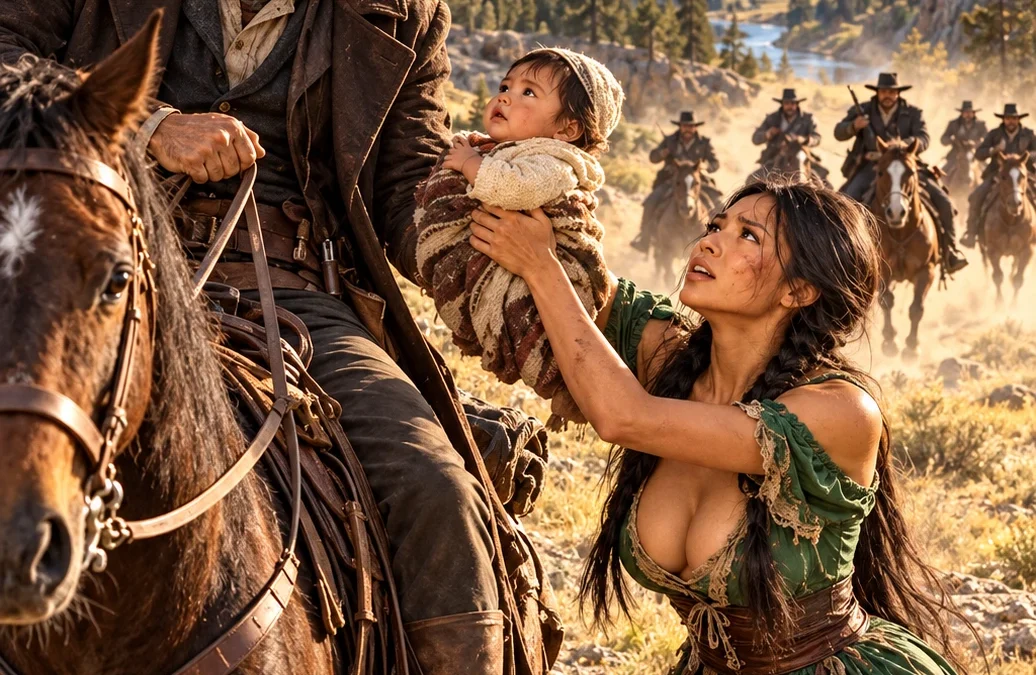
“Take My Baby and Run,” the Widow Screamed at a Stranger in the Dark. Then the Lawman Hunting Her Did Something No Killer Would Ever Do… 😱
Part 1
Addie Truitt had been a widow for twelve days.
She knew because she had counted every one of them, the way you count stitches when your hands need something to do.
Tonight, she was riding for her life.
The night was black as a stove lid. No moon, only cold stars and the sound of six horses somewhere behind her, a low, steady drumming she could feel in her teeth.
Her eighteen-month-old daughter, Linny, was tied against her chest with a bedsheet, warm and heavy with sleep. One tiny fist was wrapped around a wooden horse her father had carved. She had not let go of it in a week.
Addie could not stop. Could not think. Could not scream, which was what she wanted most.
Because the men behind her were not in a hurry.
That was the part that turned her stomach. They weren’t racing. They were herding her, like a calf, like something that already belonged to them.
Her mare was blowing hard, foam on the bit. One more mile and the animal would drop.
Then she saw a fork in the road, and a lantern.
A tall man stood in its glow with a gelding on a lead rope. He looked like he had been walking a long way and had enjoyed none of it.
Addie didn’t slow down. She didn’t ask. She tore the sheet loose and shoved the baby into his arms.
“Ma’am, what in the…”
“Her name is Linny. Keep her breathing.”
“I can’t…”
“There’s no time!”
Linny, who had slept through six horses at a gallop, chose that exact moment to wake up. She looked at the stranger, looked at his beard, and grabbed a fistful.
“Ow,” he said.
“Ride north. Don’t stop for anyone.”
“I won’t ride off with somebody’s baby. They’ll find her next to me.”
The drumming grew closer.
“Who are they?”
“Six men who bury anyone who sees their faces.”
“Then we find the law.”
“The law is riding behind me,” she said, and hated how her voice cracked. “Wearing a star.”
His jaw tightened. Something crossed his face, like a man who had been handed something heavy once before and dropped it.
“I’m not a kidnapper, ma’am. I’m a rancher.”
“Today you’re whatever keeps her alive.”
Then Addie did something she would later remember with horrified pride. She pulled the revolver from his holster, thumbed the cylinder, and counted six rounds, because her husband had taught her to.
“I’m borrowing this. And the gelding.”
“That’s my best horse!”
“Then he’ll be fast.”
She swung onto his horse before he could close his mouth.
“What are you doing?”
“Making them follow me.”
“That’s insane! What’s your name?”
“Everett Dunley.”
“Addie Truitt. If I don’t come back, her name is Linny. She likes sugar water. She hates wool.”
She was gone before he could answer.
She fired once into the sky. The crack rolled across the valley, and every dark shape behind her turned toward her, exactly as she wanted.
Then the gelding screamed.
The world flipped. Sky and ground traded places. Addie hit the dirt shoulder first, and the breath left her like someone had pulled a plug. The horse thrashed beside her, a dark stain spreading across its foreleg.
Six riders came to a halt in a loose ring, thirty yards out. One lit a cigar like it was a church picnic.
And the tallest, sitting apart on a big bay, raised a rifle and sighted down the barrel at her heart.
Deputy Rufus Toiver. She had known him six years. He had come to her wedding. He had eaten her pie. 💔
His finger rested on the trigger. Three full seconds, which is a very long time when you are staring down a barrel.
Then he lowered the rifle. Just like that.
Why would a man who wants you dead lower his gun?
She had no time to wonder. She fired twice, then twice more over her shoulder, and ran into the dark, through the cottonwoods and into the icy water of Sable Run, because her husband once told her water takes your scent.
She ran until she saw it: a wooden stake driven into the creek bank, a strip of red cloth on top, a single letter burned into its face.
P.
Another ten feet down. Another P. And another.
Nobody had asked her permission to survey her creek.
Then she heard a voice, close.
“Check the house. Boss says it’s in the house.”
What was in her house?
She reached her land and crouched in the barn’s shadow. Three men stood in her yard. Two held a pry bar and a sledgehammer, and they were beating on her well. Her husband had built that well himself, forged its iron lid himself, and never told her why it needed a lock.
“Blow it,” one man said.
“You want to collapse the whole shaft? The water’s the whole point.”
The water.
The word dropped through Addie like a stone down a well.
She should have run. Instead, she stood up with a borrowed revolver and a rage so pure it felt like clarity.
“Step away from my well.”
The lantern man, young and lanky with a gap in his teeth, smiled. “Ma’am, there’s no call for…”
She shot him.
She hadn’t planned to. He folded in the middle like a pocketknife, sat down in the dirt, looked up at her with puzzled offense, and lay back.
The world went silent.
She had never killed anything bigger than a chicken. She had cried over the chicken.
Then she saw her house, the curtains already burning, the blue cornflower wallpaper she had hung herself curling away in flames. Someone grabbed her arm. She spun and pulled the trigger.
Click.
Empty.
“Mrs. Truitt,” said a low, dry, annoyed voice. “You didn’t leave me with much of a choice.”
Everett Dunley stood in her burning yard with Linny on his hip and a shotgun in his arm, his beard full of baby drool.
“I told you not to come back for me!”
“You gave me an order. I don’t take them. Move.”
Behind them, a voice roared with fury: “Alive! You hear me? Pel was clear. Alive and able to hold a pen!”
Alive.
Able to hold a pen.
Addie’s blood ran cold. A woman alive with a pen meant only one thing. A signature.
They fled to an old stone springhouse. Addie collapsed, shaking, whispering that she had killed a boy. Everett crouched in front of her, not touching, and said, “Be sorry. I’ll watch the door.”
Then Linny screamed and hurled her wooden horse across the room.
It cracked against the stone basin and split clean in half, as if it had been glued shut with great care.
Something small and bright dropped from inside it, rang once against the floor, and spun still.
A brass key. Stamped with two numbers: 41.
Addie stared at the toy her husband had carved for their daughter. Keep this close, sweetheart, he had told a baby.
He hadn’t given her a toy.
He had given her a hiding place.
Part 2
He hadn’t given her a toy. He had given her a hiding place.
Because nobody searches a baby’s toys.
“Whatever this opens,” Everett said quietly, “he was afraid enough to hide it in his child’s hands.”
Addie tucked the key into her torn dress. It settled against her ribs, already warm. “There’s one bank in this territory with lockboxes. Fort Calder. Four days east.”
“They’ll expect that.”
“They’ll expect me to hide. I’m done hiding.”
Then the candle flame bent sideways, as if something outside had stolen the air.
Everett snuffed it. In the dark, he put his eye to a crack in the rotted door.
A glint far up the ridge. A spyglass.
Eight hundred yards away sat a rider on a big bay horse, a rifle across his saddle, a brass tube raised to his eye.
Rufus Toiver. Looking straight at the springhouse.
“He sees us,” Addie breathed.
Everett’s hand tightened on his shotgun. Then the rider lowered the glass, lifted one gloved hand, and tipped his hat, politely, like a man greeting a lady across a church aisle.
Then he rode away.
“That’s twice tonight,” Everett whispered. “He had a clear line and he didn’t shoot.”
“He isn’t on our side.”
“No.”
“But he isn’t on theirs.”
“You can’t know that.”
“No,” Addie said, closing her fist around the key. “I can’t.”
They stole a mule at dawn. It was a terrible mule, with one torn ear and the soul of a tax collector. Addie left her last silver dollar on the barn floor to pay for it and ran, laughing, because Warren always said she’d make a terrible outlaw. 😂
By dusk, they reached a lonely telegraph station. Linny burned with fever. An old man in a worn cardigan took them in, made willow bark tea, and told stories about his late wife’s awful cooking.
For the first time in days, Addie felt warm.
Everett never relaxed. He sat by the door with his shotgun across his knees.
“He’s seventy years old,” she whispered.
“Seventy-year-old men have sold out better people.”
She decided to be kind anyway.
She woke to a soft, dry sound in the dark.
Tick. Tick. Tick-tick.
Bent over the telegraph key, one hand trembling on the brass lever, sat Ephraim Doyle.
Warren had taught her a few signals once, tapping them against the headboard for fun. She knew the shape of one word.
Here.
Her teacup slipped from her fingers and shattered.
Ephraim whirled. His face had gone gray. “Mrs. Truitt, please. I owe Mr. Pel everything. He holds the note on this station…”
The shotgun was already against his chest.
Addie felt something rise in her that wasn’t contempt. It was colder and clearer.
“Mr. Doyle. Did you eat my daughter’s bread tonight?”
He nodded, crying.
“Then you can do something for me.”
She had Everett tie him to the chair, gently, because he was old. She wrote four lines on a telegraph blank. A message in Pel’s own cipher, sending his men to the wrong place.
“They’ll kill me,” Ephraim whispered.
“Then I’d run, if I were you.”
The key clattered. Then she saw it through the window: a handcar sitting on the rails.
“Fort Calder is sixty miles down that line.”
“It has no brakes!”
“Then we won’t stop.”
They rolled out under the stars, pumping like fools, Linny shrieking with joy at every bump. For one wild moment, Addie felt alive.
Then Everett stopped pumping.
Far behind them, a light was rising and falling on the track. A locomotive lamp.
“Ephraim’s message,” he said. “It wasn’t a message. It was a decoy. Pel wanted us to run. He’s been herding us the whole way.”
The rails began to hum. The whistle cut across the plains.
Then they saw it ahead: a wooden trestle over a deep ravine, a red lantern burning at its mouth, and a figure standing on the bridge.
The figure slowly raised a rifle.
A train thundering behind. A gunman waiting ahead. Her daughter in her arms.
And Addie finally understood what this whole night had been.
They hadn’t been fleeing. They had been driven, every mile, every choice, every clever little plan, exactly where Augustus Pel wanted them to go.
The rifle on the bridge settled into the lantern light, and the man behind it did not move.
Part 3
The man on the bridge did not fire.
That was the first thing Addie noticed. The second was the switch.
Everett saw it a heartbeat before she did: a rusted iron lever beside the track, a hundred yards short of the trestle, where a work spur peeled off toward an abandoned gravel pit.
“Hold the baby!”
He vaulted off the rolling handcar, hit the gravel, and threw his whole weight against the lever. It screamed. It gave. The handcar slid onto the spur, the grade biting at its wheels.
“Jump!”
She jumped, Linny clutched to her chest, and rolled through sage and thorn as the locomotive thundered past, a wall of iron and steam, armed men clinging to its sides. They swept the dark with their eyes and found nothing. The train crossed the trestle and shrank into the east, its whistle trailing like a woman’s scream.
Silence.
On the bridge, the lone figure lowered his rifle. He held up the red lantern for a moment, looking straight toward the sagebrush where she lay.
Then he blew it out.
“That’s three times,” Addie whispered. “Three times Rufus Toiver has had me and let me go.”
Everett crawled up beside her, blood on his chin. “A man doesn’t do that out of kindness. A man does that when he’s counting something.”
“Then I wish I knew what he was counting.”
They reached Fort Calder at sunrise, on foot, blistered and filthy, smelling of smoke and mule. Addie walked into the territorial bank at ten past eight on Friday morning wearing a widow’s veil stolen off a clothesline, a baby on her hip.
“Box forty-one.”
The clerk looked her over. Thin mustache, eyes that never settled. “Warren Truitt’s widow.”
Her blood stopped. “You knew him.”
“Everyone knew Mr. Truitt.” He smiled, and the smile reached no part of his face. “Right this way.”
A man who stops to smile is a man who has already sent a boy running. She knew it the way she knew her own name. And she followed him into the vault anyway, because she had come a hundred miles to open one small brass door.
The bank’s key turned in the upper lock. Hers turned in the lower, with a sound like a sigh.
Inside lay a bundle wrapped in oilcloth and a single folded sheet.
Warren’s handwriting. That slanted, stubborn hand she had seen on grocery lists and birthday cards.
I am sorry.
Her knees went to water at the third line. A list of names, every homesteader along the upper Sable Run. Beside each, a date. Beside each date, three terrible words: Signed by me.
She unwrapped the oilcloth. Half a ledger. Water-right transfers, page after page, each granting a farmer’s claim to a company called Pel Freight & Land. Each carrying that farmer’s own neat signature.
She knew those signatures. She had seen them at church socials and on Christmas cards. And she knew the hand beneath them. Warren’s ink, in a dozen disguises. A forger’s careful, patient art.
Her husband. The man who built her a well. Three years of it.
At the bottom, in a shakier hand, the only line that did not end in signed:
Truitt senior claim. I will not. I kept the first page back. A man should keep his best water clean.
“He did exactly what he was paid for,” said a voice behind her.
The clerk held a small nickel-plated revolver, pointed at her belly with great politeness. “Mr. Pel sends his regards. He says you’ve been very expensive.”
The vault door crashed open. Everett hit the clerk at the waist like a cannonball, driving him into a wall of brass boxes. The revolver went off. Boxes spilled across the floor like coins.
“Run!”
She crammed the sheet and the ledger into her bodice and ran, through the lobby, past the teller who fainted behind his cage, out into the white glare of Main Street.
Twelve men waited on rooftops, behind water barrels, rifles raised.
“Drop the bundle, Mrs. Truitt!”
They thought the bundle was the book. They did not see that Linny was the weight in her arms.
So Addie screamed. A raw, rising widow’s shriek that sent every pigeon in Fort Calder into the sky. In the storm of wings, she flung the empty veil into the street and bolted for the freight yard.
A boxcar yawned open on a train already rolling. She hurled Linny in, then herself, then reached for Everett’s hand.
A wet, sharp sound, like a slap on raw meat.
He looked down, surprised, at the red bloom on his shoulder. “Well. That’s new.”
“Everett!”
“I’m shot, which is different from not fine. Pull!”
She hauled all two hundred pounds of him onto the planks while bullets splintered the door frame. He lay beside her, white and sweating, grinning.
“Stupid,” she hissed. “Stupid, stupid man.”
“It’s a habit.”
Inside the boxcar, she found a poster, fresh and still tacky. A woodcut of a woman with her hair in a bun. Big black letters: WANTED FOR MURDER. ADELINE TRUITT. $500.
And at the bottom, in small print: Printed at Fort Calder, Tuesday noon.
“I shot Dell on Tuesday night,” she whispered.
Everett understood a half second later. “They printed it before. They knew you would.”
“They wanted me to kill someone. A woman wanted for murder can’t go to the law.” A sick laugh. “And the law has a star on its coat and eats my pie.”
The train carried them to Red Hollow, a boomtown dressed for a party. Bunting on every porch. A banner forty feet wide: GRAND OPENING. SABLE RUN JUNCTION. MONDAY NOON. Honored guests: the Territorial Governor and Deputy U.S. Marshal B.K. Hadley.
And on every hill, red-ribboned stakes.
They didn’t mark property. They marched in a graceful curve across the narrowest bend of the creek and ended at a stone cliff.
“That’s not a survey,” Everett said. “That’s a dam.”
A freight wagon rumbled past, loaded with kegs of black powder. Under the canvas, a roll of plans: Sable Run Reservoir. Capacity: 4 billion gallons.
“He’s going to shut off the creek,” Addie said, “and sell the water to the railroad.”
“Forty farms downstream. Forty-one, counting yours. Yours is the senior claim, which is why he needs your name.”
The whole terrible shape of it unfolded. Warren forging twenty-two signatures. Warren refusing the twenty-third. Warren’s wagon going over a ravine on a road he could drive blindfolded.
“He wouldn’t sign,” she said. “That’s why he died. He said no to one man, and that man said, Fine. Then I’ll ask his wife.”
Across the yard, a knot of men in bowler hats surrounded an old farmer in a patched coat. Amos Teague. A pen was being pushed into his fingers. “Your wife is sitting in a nice warm hotel room, Amos. Sign.”
Everett’s good hand closed around her wrist. “Not yet. They’ve got a lot of wives, and we’ve got one chance.”
They left Linny with Dorcas Linde, a boardinghouse widow built like an oak stump. “Biscuits are on,” she said. “If I wanted to know why, I’d have been a deputy.”
The leaving was the worst part. Addie kissed the damp curls and whispered, “I’ll be back before breakfast.”
She had never lied so badly in her life.
That night, disguised in a temperance sash and a feathered hat, she crossed the rooftops of Red Hollow while Everett stampeded a hundred railroad horses through the square. She dropped through the land office skylight and found a green book lying under glass on a desk, unlocked, unguarded.
Too easy. A smell nagged at her. Fresh ink. But gunfire cracked outside, and she grabbed it and ran.
Across the tin roofs. Through a hotel awning. Onto the back of Everett’s gray horse. Out of town in thirty seconds.
And not a single bullet touched them.
“Everett,” she said. “Nobody shot at us.”
He didn’t answer. His face had gone cold. “Dorcas.”
The boardinghouse door hung open. Biscuits cooled on a tin. The one-eyed dog lay with a rope around his muzzle. Dorcas sat bound against the wall, blood on her lip.
“They took her, child. They knew the house. They knew the name on the door.”
On the floor lay the wooden horse. It was still warm.
On the porch, an old man in a cardigan lay dying, one slipper missing, a bent skillet beside him. Ephraim Doyle.
“I came to say sorry,” he whispered. “I read Pel’s wires before I ran. I couldn’t send a warning faster than a train.” A bubble of blood on his lip. “Hit one with the skillet. Don’t cry, it’s unbecoming. Feed the starter, Mrs. Truitt. Every day. Mildred would be…”
Pleased. And he was gone.
“I was wrong about you,” Addie whispered, closing his eyes. “I was only half wrong.”
“Addie,” Everett said. “Don’t move.”
The yard was full of lanterns. Thirty guns. And in the center, in a gray frock coat with a silver watch chain, stood a man who looked like a grandfather. Silver hair, pink cheeks, a peppermint in one cheek. In his arms, a little girl in a white nightgown, sucking her thumb.
“Mrs. Truitt,” said Augustus Pel. “At last.”
A rifle cracked from the dark. Everett dropped, clutching his ribs.
“No heroics, Mr. Dunley. I find a living man a better lesson than a dead one.”
“Give her back.”
“Do you know what you’ve cost me? A bank clerk, a dozen horses, a very nice hotel awning.” He kissed Linny’s hair. “You ran straight to her like a good mother. A woman who never thought she might be followed.”
Addie opened the green book with shaking hands. The names were neat. The smell rose to meet her. She rubbed a thumb across a line, and the ink smeared wet and black.
“Copied Saturday by a very fine hand. I left it in the land office with the lamp lit and told every man not to shoot at you. I wanted you to run. I could have searched for days. Instead, you led me to the child.”
Her knees hit the porch boards. Every moment she had thought herself clever came crashing down.
“Sign for me tomorrow, before the governor and the crowd. One page. Your daughter comes home. If you don’t, she rides east on the noon train to a family who will never know her name.”
Addie looked at the wooden horse instead of the baby. If she looked at the baby, she would sign.
She heard Warren’s voice at a kitchen table at three in the morning. It’s just business, Addie.
“No,” she said. “Warren signed other people’s names for three years. I won’t sign theirs.”
Pel sighed, like she had broken a plate. “Rufus. You’ll sit with her tonight.”
The jail was one room. Iron bars, a cot, a bucket. Addie sat for hours. Then boots, a key, a lamp.
Rufus Toiver filled the doorway, rifle in the crook of his arm, and at his collar, half hidden, hung a thin gold chain with a small worn ring.
“Mr. Pel wants me to sit with you tonight.”
“Has he?”
“His man is at the siding watching the child’s car. Tonight, no one is watching me.”
He closed the door, turned the key, and sat on the stool outside the bars. Then he drew out a small brass key with no number stamped on it.
“Your husband had this made in another town. The week he stopped sleeping. He said, Hold this for her. If I don’t ask for it back, you’ll know.”
A man should keep his best water clean.
“You work for Pel.”
“I am paid by Pel. It’s a different thing. I grant the difference has been hard to see.”
“You lowered your rifle three times! Why let me shoot a boy? Why let my house burn?”
“Because a man has stood at my shoulder every day since the week Warren balked. One wrong word and your daughter rides east that night, and you are in a ditch.” He leaned in. “Mrs. Truitt, I have to tell you something else, and you will want to kill me. I’ll stand still.”
She waited.
“I was on the ravine road. Two riders strung a rope low across the grade. I was told to watch from the top and make sure it was clean.” His jaw worked. “I watched the team go over. I heard him shout one word.”
“What word?”
“Your name.”
Something broke open in her. She didn’t scream. She folded at the knees and sat on the cot, and the sound that came out of her was small and low and went on and on. He had said her name at the very end. And a man she had fed pie to had stood on a hill and listened.
But Toiver did not look away. He sat on that stool and let every second land on him.
When it was over, she stood and put her face six inches from the bars.
“I should hate you.”
“Yes.”
“I do hate you.”
“Good.”
“And I need you. Open the door.”
The jail office was cold lamplight. A guard snored by the stove with laudanum in his coffee. And on a cot, pale and bandaged, with the one-eyed dog across his feet, lay Everett. Beside him stood Dorcas, scowling.
“You’re alive,” Addie said stupidly.
“I’m told it’s a trend.”
She hit him on the good shoulder. “You said you were fine!”
“I said I was still fine. It’s a different sentence.”
“Come here,” he said, softly. She did. Her forehead came down against his collarbone, and for four breaths, neither of them spoke.
“I know it’s too soon,” she said into his shirt. “I buried my husband eighteen days ago.”
“Take your time,” said Everett gently. “I’ll be around.”
She straightened, wiped her face, and drew the folded sheet from her bodice. “Before Pel could buy a farmer’s water, the farmer had to own it. A court filing. The original claim, sealed and signed. Warren kept the first page back. The one that says who owned what before a single lie was told.” She held up the brass key. “A man doesn’t put a lock on a well. A man puts a lock on a strongbox.”
Eleven miles. An hour on a hard horse.
She rode Toiver’s bay through the gray dawn, past the red stakes cutting her valley like a scar, to what was left of home. A blackened chimney. A rocking chair on its side. A mound of fresh earth with a stick for a marker. And two men on the rim of the well.
Toiver rode down alone and drew Burke away. Hollis stayed. “Pel said nobody touches the well.” His rifle rose.
Addie came around the corner at a dead run with a nine-pound sledgehammer in both fists and swung with eighteen days of grief behind it.
It rang like a church bell.
Hollis went down. Burke dropped his cigar. “Ma’am, sit,” said Addie. He sat.
She knelt at the well, brushed ash from the lid with her bare palms, and found it: a keyhole no bigger than her thumbnail, hidden in the heart of an iron flower.
“Oh, Warren,” she said.
The key went in like it had been waiting. A deep clunk. A hiss of cold air. The lid swung open on a hidden hinge. Below, on a dry stone shelf above the waterline, lay oiled canvas and a lead tube sealed with wax.
One crisp sheet slid into her palm. The Register of Original Claims, Sable Run, sealed by the Territorial Court. Twenty-three names. Twenty-two farmers, and one more. Truitt, Warren J. Every date years before any transfer. At the bottom, three signatures: the judge, Augustus Pel acknowledging each claim lawfully held, and Warren, witness under protest.
In pencil, in the margin: Addie, if you are reading this, I could not finish it myself. I’m sorry. Read it aloud where all of them can hear. A lie needs quiet. The truth only needs enough ears.
She read it twice, kneeling in the ashes of her kitchen. Then she folded it against her heart and stood.
“Burke,” said Toiver. “Ride with us and tell the marshal who lit the curtains, or run.”
Burke looked at the mound at the edge of the pasture. “I’ll come.”
Noon. Brass band. Bunting snapping. Farmers in clean collars packed the platform, wives in Sunday hats, children on shoulders. On the stage stood the governor, a judge in black, a marshal with a drooping mustache, and Augustus Pel, smiling like a grandfather at Christmas, with Linny in his arms.
Addie’s knees almost went. She locked them and walked up the center aisle alone.
The crowd turned. Dorcas, arms folded. The preacher. And behind them, quiet and watchful, the farmers of the upper run. They did not cheer. They simply stood where Pel could see them.
Near the back, white as paper, leaning on a hitching post, stood Everett. He nodded.
“Mrs. Truitt,” Pel beamed. “Sign, and she is yours.”
“Mama,” said Linny. The very first time. Addie’s breath caught like a fish hook. She did not let her face move.
She took the pen. “Adeline Truitt. I’d like to say something first.”
She turned to the crowd and drew out the sheet. “My husband was a forger!”
The band died.
“For three years, he copied the names of twenty-two of you onto papers you never saw. He did it for money. He did it for Augustus Pel. And when the twenty-third was my own, he said no. Ten days later, a rope was strung across the ravine road and his wagon went into the dark.”
“Governor, she is distraught,” said Pel.
“I have the first page of the register!” The noon sun lit it like a lantern. “Signed by Judge Haskins. Signed by Mr. Pel, who swore every one of these farms belonged to the man who worked it!”
The judge sat down very suddenly.
“Those are forgeries,” said Pel. “And that woman is wanted for murder.”
“By whom?” a heavy, nervous voice answered. A man in a printer’s apron pushed forward, shaking. “They paid me double to print that poster Tuesday noon. I heard the boy was shot that night, and I knew.”
Burke stepped out from behind a wagon wheel, hat in hand. “I lit the curtains. Pel’s order. The boy Dell never touched a match. He was twenty.”
Amos Teague shoved to the front. “I never signed that paper. Not once. Two of his clerks held my arm and put a pen in my hand. They said they had my wife in a hotel room.”
“We found her,” said Marshal Hadley, without turning his head. “Forty minutes ago. She is eating pie.”
Amos sat down on the ground and put his face in his hands.
“Nor me,” said a woman near the front. “Nor me.” Again and again, voice after voice, rolling back through the crowd. Twenty-two families, not shouting, just standing. Pel’s men looked at their boots, then at each other. One lowered his rifle. Then another. They stepped back, one pace, then another, until nothing stood between Pel and the people but air.
A muscle jumped beside Pel’s eye. “Rufus,” he said gently.
Rufus Toiver stood at the edge of the stage. “Augustus Pel, I’m taking you into custody.”
“I own your pension. Your house. Ruth’s grave.”
Toiver touched the small worn ring at his collar. Just once. “Then you’ll understand what I stood on that road for.”
Pel’s hand moved too fast for an old man. A silver derringer pressed against Linny’s white dress. The whole plaza froze.
“Everyone stay where you are.” His voice was still kind. That was the horror of it.
Addie’s feet were already moving, hands open at her sides. “Take me instead. Linny is a baby. She can’t sign anything. I can.”
“For a child who isn’t even yours by blood?”
“She’s mine in every way that counts. Give her to me, Mr. Pel.”
He looked at her for a long moment. “Your husband would have taken the money.”
“My husband said no.”
He sighed. “Very well.”
She took the baby, kissed her, and walked three steps to place her in Dorcas’s arms. Then she turned and held out her wrist.
The derringer pressed under her ribs. “Walk.”
They took one step, and Rufus Toiver stepped in front of her.
The derringer cracked, a small flat sound. He grunted, caught himself on her shoulder, and looked down at the stain spreading across his waistcoat with mild surprise. “Well. That’s inconvenient.”
“Rufus!”
“Tell Warren…” His weight came against her. “I turned around. This time, I stood on the road.”
His hand closed over hers and went slack. She eased him onto the boards. His pale eyes looked at a sky that no longer hurt him. 💔
Marshal Hadley moved like a man half his age. One swing. His pistol butt cracked against Pel’s wrist, and the derringer spun away across the planks. Another blow put the old man on his knees.
“Augustus Pel. You are under arrest for murder, forgery, and conspiracy to defraud the territory.”
The crowd began to roar. Addie didn’t hear it. She knelt beside a man who had once eaten her pie, holding his gloved hand in both of hers. When she finally looked up, Everett stood with his good hand resting lightly on her back.
“He turned around,” she said.
“It took him six years,” said Everett, his voice thick. “Some of us are slow.”
“Everett.”
“Yes?”
“Take me home.”
The hearing was brief. Marshal Hadley tore up the warrant in front of the whole town. Pel confessed on the second day. His clerks traded testimony for pardons. Sheriff Bidd, who had bought a nice little ranch, lost it, his star, and a good deal of his dignity in one afternoon. The dam was cancelled. The farmers pulled up the stakes themselves, a long line of neighbors in the first light of spring, hauling red ribbons out of the earth like weeds.
The twenty-two families kept their water.
Addie carried a small gold ring to a grave on the hill behind the church. Ruth Toiver, said the stone. She set the ring on the marker and told her quietly that he had turned around.
In April, she signed a paper at last. Not Pel’s. A covenant. Her own senior claim, held for every farm on the run, by deed, forever. No man could buy it. No company could own it.
“Mrs. Truitt,” said the clerk, “that water is worth a great deal of money.”
“I know what it’s worth. My husband paid for it twenty-two times.”
In May, she planted a garden in new ground beside a new cabin. The old chimney stayed where it was, wrapped in morning glory, because she wanted it there. Beside it, the well ran cold and clear. On the shelf above the stove sat a crock with a cloth over the top, a gray paste that smelled of sour apples, sent down from Dunore Crossing by the new telegrapher.
Every morning, Addie fed it. Flour, warm water, a good stir.
“Mildred would be pleased,” she told it. It bubbled. She took that as agreement.
She was on her knees in the dirt when she heard the gate. Slow boots. A man who had learned to walk gently.
“Morning,” said Everett.
“Is it?”
“Seems so. Someone mentioned bread.”
“Someone mentioned maybe bread.”
“I came in a spirit of optimism.”
She sat back on her heels, a streak of dirt across her cheek. Linny toddled off the porch and attached herself to his boot. “She likes you.”
“She likes my beard. It’s a package.” He lifted the baby onto his knee and did not say what he had clearly ridden over to say. She waited. A mockingbird sang from the old chimney.
“Daniel was always the better man,” Everett said finally. “I used to think that meant he’d have turned around. Maybe he would. Maybe he already did, somewhere I couldn’t see.” He cleared his throat. “I’m finished carrying it. I’m not asking for anything. I wanted you to know I’m here for as long as you’ll have me.”
She stood and brushed the dirt from her knees. She looked at him, at the baby, at the well bright and cold beside its iron lid. Eighteen days had become six months, and she had stopped counting somewhere in between.
“Stay,” said Addie.
He stared.
“I’m choosing this. Nobody else’s choice. Not Warren’s. Not a ledger or a will or a judge.” She took his hand. “I’m twenty-eight years old and entirely out of patience.”
Everett grinned slowly, the way a long road finally finishes.
“Hello, kidnapper,” she said.
“Hello, widow.”
“Not a widow.”
“No. Not anymore.”
She looked toward the chimney, where Warren’s small wooden horse sat on the well lid, whole again, one ear longer than the other, keeping watch over the water.
“I think he wanted me to be something else,” she said.
“What?”
She thought about it.
“Home,” said Addie Truitt. 🌾
This story is entirely fictional and created for entertainment purposes only. It does not represent any organization or individual, nor does it encourage inappropriate behavior. The content was generated with AI assistance.








