“TAKE MY REJECTED DAUGHTER AS YOUR WIFE… OR LEAVE MY LAND FOREVER”: THE APACHE CHIEF’S WARNING STUNNED THE LONE RANCHER, BUT NOTHING PREPARED HIM FOR WHAT HID BENEATH THE BLANKET, OR WHAT HIS NEW BRIDE DID FROM HIS OWN CEILING
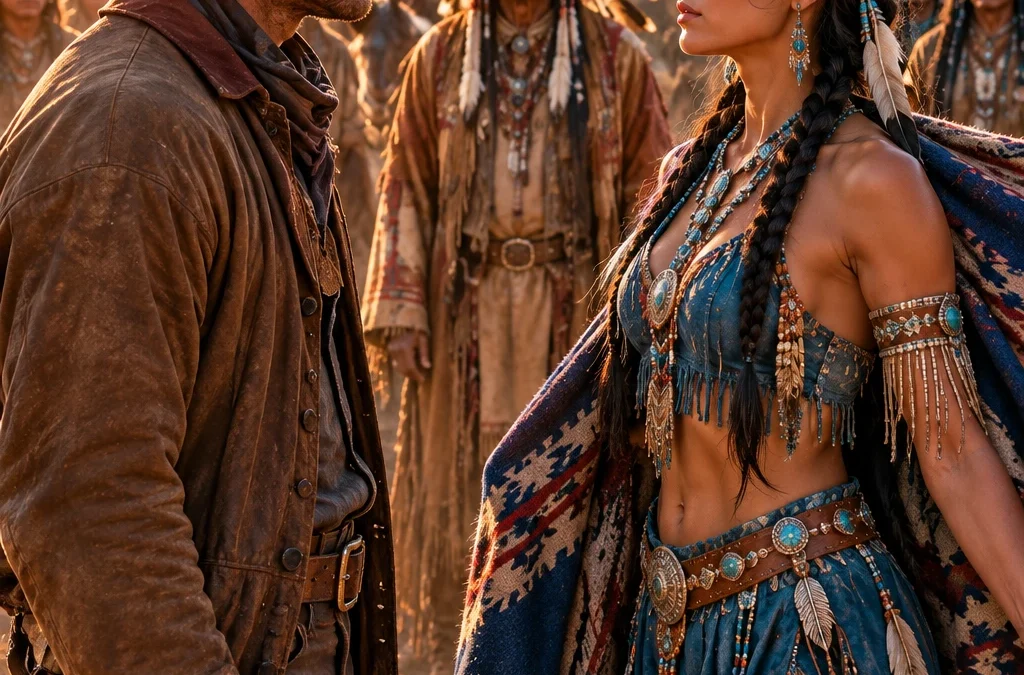
“TAKE MY REJECTED DAUGHTER AS YOUR WIFE… OR LEAVE MY LAND FOREVER”: THE APACHE CHIEF’S WARNING STUNNED THE LONE RANCHER, BUT NOTHING PREPARED HIM FOR WHAT HID BENEATH THE BLANKET, OR WHAT HIS NEW BRIDE DID FROM HIS OWN CEILING 😱🔥
Part 1
That night, the man thumbed the rifle’s hammer back, then stopped halfway.
Fifteen torches were crawling across the Arizona desert toward his house, and not one soul inside knew why they were coming. 🔥
Three months of quiet. Three months he had believed everything was settled. Then firelight appeared in the east. Not lanterns. Torches. Twelve, fifteen, moving in formation at the pace of people who know exactly where they are going.
On the porch, one hand found another. Neither spoke. A knife rested quiet at the woman’s hip, familiar as part of her own body. Her hand tightened once, then let go.
And the man at the front of those torches was someone Cole Harrove recognized.
Three months earlier.
The desert doesn’t forgive mistakes. Cole knew that the way he knew his own hands. His father had dropped him on this land at ten years old and said, “Work it or starve,” then left to become a man who sent letters instead of showing up, and eventually stopped sending letters.
Cole was twenty-five now, still working it. The ranch sat four miles east of Dustfall, Arizona: a post office, a saloon, a sheriff who preferred the saloon, and 347 people who knew each other’s business. Cole knew his cattle, his fence lines, and the way the sky bruised purple twenty minutes before a storm. He did not know loneliness exactly. He just knew what it felt like when a house stayed too quiet and you stopped noticing.
It was a Tuesday in late September when everything changed, though he wouldn’t understand that until much later. There was a hole in his left boot sole, and he was thinking about riding into Dustfall before winter. New boots. A meal that wasn’t his own cooking. Maybe a conversation with someone who talked back.
Then he heard it. Not loud. Smaller than crying. The sound something makes right before it stops making sound altogether. A thin thread of noise rising from the dry canyon on his left.
He tied his mare Biscuit to a scrub bush and went down on foot.
A girl, eight years old, maybe less, curled against the canyon wall like she had melted into it. Lips cracked pale. Eyes glassy, with the distant look of a body shutting down one room at a time. She said something in Apache. Cole didn’t speak Apache. But every language has a word for water that sounds like a man drowning, and he had his canteen.
He knelt in the dirt and gave her slow, small sips. He had seen men drown themselves drinking too fast in this heat. The cattle could wait. She couldn’t.
When she sagged against him, he sat at the bottom of a dry canyon with a stranger’s child asleep on his chest and thought, Well, this is going to be a thing. 🌵
He carried her four miles on his back. When the first stars came out, he smelled woodsmoke. Then horses. Then the thunder of hooves.
He stopped walking. There are moments when running is the reasonable choice. Cole stood still, because a man who runs while carrying someone’s child is not a man worth being.
Fifteen Apache warriors thundered up and halted in a storm of dust, every weapon aimed at his face.
He did not move. Fifteen men. Fifteen weapons. One canteen. Zero plan.
Then the girl woke on his back, recognized them, wrapped both arms around his neck, and explained the situation to them in rapid Apache, with the patience of a child who has decided that adults need some convincing. She said it three times. Then she patted the side of Cole’s head, like a dog that had done something unexpectedly right.
The scarred warrior at the front said something brief. The weapons came down.
The camp lay at the base of the Dragoon foothills. Inside the largest tent, in cedar smoke and firelight, sat Chief Grey Elk, old the way granite is old. When the girl, Sosi, ran to him, relief moved across his face like the animal kind that lives in the chest.
“The chief asks what you want,” said the translator. “There is a debt.”
Cole could have asked for land. Horses. Money.
“Nothing,” he said. “She needed help. I helped her. That’s the end of it.”
A long quiet. Then the translator turned back, his face more careful.
“The chief says that is a good answer, but not one he can accept. He has something to offer. But he must be honest with you first.”
The cedar smell thickened.
“He has a daughter. Twenty summers. Strong, healthy, sharp.” A pause that felt deliberate. “And no warrior in this camp has been willing to marry her.”
Cole’s mind raced. “Is she sick?”
“No.”
“Violent?”
“The chief says you may refuse, with no dishonor. But if you refuse, you will not be permitted on Apache land after tonight. Any Apache land. In any direction.”
His only route home ran straight through it.
But Cole looked at the old man’s face, and saw something that wasn’t manipulation. It was desperation, worn smooth by carrying it too long. This man had a daughter no one wanted, and it was hollowing him out.
Cole thought of his house. Two rooms. Too quiet.
“All right,” he said.
The ceremony was at dawn. He didn’t sleep. He lay in a tent by the horses, imagining the worst. Every reason he could think of for an entire camp of men to avoid a healthy twenty-year-old woman was worse than the last.
At sunrise, two elderly women led out a figure wrapped head to toe in a woven blanket, red and turquoise and canyon gold. Medium height. That was all he could tell.
He had spent the night pre-accepting whatever lay beneath it. He was quite proud of his radical open-mindedness.
One of the women pulled the blanket away.
Cole’s brain stopped.
What was under that blanket? And why had every man in the camp run from her? Part 2 is waiting in the comments. Drop any word below and I’ll send it to you privately! 👇
Part 2
Cole’s brain stopped.
The woman standing in the dawn light was the most purely, simply beautiful person he had ever seen. Not the announced kind. The quiet kind, that takes you off guard because it isn’t trying.
A dress of soft ochre hide with long fringe. Turquoise beads stitched across the chest. Two long black braids reaching her waist. A silver disc at her throat. High cheekbones, a firm jaw, lips held with the pressure of someone who had practiced silence until it became a posture. And amber eyes, looking at him with no warmth and no coldness. Only careful assessment, like someone reading terrain. 😳
He realized he had been standing with his mouth open for five seconds. He closed it.
Why would anyone not…? The question collided with itself. A woman like this, and not one man would have her? Something had to be wrong.
Her name was Kaya. She didn’t flinch when the leather cord was tied around their wrists. Her pulse under it was perfectly steady. She was not nervous at all. Cole was nervous enough for both of them, which seemed deeply unfair.
“Take care of her,” Grey Elk told him in English. “She is worth more than you know.”
Then Cole noticed her brother, Riverwolf, watching from the edge of the crowd. He expected anger. What he saw was relief. The exhausted relief of a man who has carried a worry for a long time and has just set it down.
And Cole understood, with a cold clarity: They didn’t find someone for her. They found someone to take her off their hands.
What did I just agree to?
On the ride home, Kaya said nothing. Not the silence of someone holding back, but of someone for whom his words were weather. Present, but irrelevant. Then Cole realized, with embarrassment, that everything he had said was just the noise lonely people make to fill the space where connection should be. She had known it. She had been waiting for him to know it too.
He shut up.
Two miles out of camp, the trail split. Left, the main road. Right, rougher and narrower. He was already angling Biscuit left when Kaya’s horse stopped. She dismounted, knelt in the dirt, and read the ground word by word for thirty seconds. Then she stood, pointed right, and rode that way.
He followed. Two hours later, from the direction of the main road, came the sound of gunshots. Multiple. Organized. Wrong.
Kaya didn’t change pace.
She had known. She hadn’t said a word. She had simply pointed, and expected him to follow. And his compliance had just saved his life.
At the ranch, she walked straight to the stable, and ran her hands along the walls, examining every join. She looked up at the three crossbeams Cole had replaced himself two summers ago, and shook her head.
“Those beams are fine,” he said, defensive.
She shrugged one shoulder. The shrug of someone who has said what they have to say, exactly once.
That night she took his bedroom and closed the door with a soft, absolute click. Cole lay on his sofa, and faintly, almost imagined, heard a sound from the ceiling. He looked up. Nothing but beams.
You married a stranger. Go to sleep.
In the darkness above him, a shape settled against the largest beam, and waited. 🕯️
The days that followed were full of small impossibilities. The south fence he had avoided for two weeks was repaired before breakfast. The mare Rosie, who bit anyone who came near her limping hoof, stood calm while Kaya dressed the puncture in thirty seconds. The coffee she brewed was perfect on the first try, though no one had told her about the percolator.
When his neighbor Bradock rode up to warn him that the whole town has concerns about an Apache living this close, Cole set down his hammer.
“She’s my wife. She lives in my house on my land. The town can bring its concerns directly to me.”
He didn’t know Kaya was listening. That night, after dinner, she sat down across from him for the first time. “Thank you,” she said. Two words, quiet as something that cost something. Then she went to bed.
Sheriff Puit came on day eleven. “Puma County has a registration requirement for non-settler residents. You’ve got seventy-two hours.”
Cole rode to Tucson to fight the paperwork. And a week later, a sharp-tongued widow named Etta Crane drove up in a broken wagon with her six-year-old grandson, gray with fever. “Dr. Hennessy hasn’t touched it. I’d rather be made a fool than watch this child get worse.”
Kaya looked at the boy. Went to the garden. Came back with herbs and precise, wordless instructions. Forty-eight hours later, the boy ran ahead of the wagon, arguing loudly about a lizard.
“Anyone in this county who speaks an ill word about you in my presence,” said Etta, “is going to have a conversation they weren’t planning on.”
Then came the night in week five.
A creak. Not the ordinary kind. The sound of someone applying weight in a chosen place. Cole grabbed his Colt, reached the bedroom door, and opened it.
The bed was empty. Untouched.
Three men burst through the front door. At their head, a scarred giant named Rail Decker, smiling with half his mouth.
“Heard there’s a woman here. Apache. Knows medicine plants. That kind of knowledge sells.”
“She’s not here,” said Cole.
“You look a lot like a man guarding something that isn’t there.”
Something descended from the ceiling.
From the very beams Cole had insisted were fine.
What dropped from the rafters into the middle of three armed men? And why were fifteen torches heading toward the ranch three months later? LIKE or COMMENT “REVEAL” below! Part 3 will be posted once we hit enough comments! 🔥👇
Part 3
It landed with no sound at all. Like cloth settling. Like a branch finding a lower place.
Kaya stood in the center of Cole’s main room. She had not been asleep. She had not been in the bedroom at all. She had been on the ceiling, on the very beams she had shaken her head at on day one. Not because they would fall, but because she had been deciding whether they would hold her.
One braid had come partly undone. A length of rope hung coiled in her right hand. She looked at Decker, and only Decker, with the quality of attention that separates the primary problem from everything else.
Decker laughed. “A woman.”
The rope moved.
Cole had roped cattle his whole life. What Kaya did in the next two seconds bore the same relationship to what he did as surgery bears to a kitchen knife. The loop flew, opened, and closed around Decker’s ankles with the certainty of something that had always been going to land there. She pulled. Two hundred thirty pounds of man went horizontal, and the back of his skull met the floor with a sound that ended all the other sounds he had been making.
The second man lunged. She moved like water around a rock, added something small to his momentum with one arm, and he hit the table. The table hit the floor. Two chairs did not survive.
The third, barely twenty, dropped his knife. Kaya pointed at the door. He went through it so fast Cole heard him trip on the porch step.
Decker lifted his head, blood on his nose, and looked at her. Something crossed his face that was fear dressed in an older word.
“What are you?”
She took one step toward him. Just one. Unhurried. Inevitable.
He grabbed his companion by the collar, and both of them went out the door more falling than walking.
Silence. Cole was against the wall, and had not fired a shot. His wife had handled three armed men while he stood holding a gun he never used. 😶
“You’re going to ask questions,” she said. Not accusing. Accurate.
“Yeah. I think I am.”
“Not tonight.”
“Fair enough.”
In the morning, over good coffee, she told him.
“My mother died when I was seven. My father did not know what to do with a daughter after that. My brother Riverwolf took me with him. Hunting, fighting. He taught me everything he knew.” She turned the cup slowly. “When I was fifteen, warriors came to marry. I could beat them in horse races. Track better. Shoot farther. The first said my hands were too rough. The second said I didn’t smile enough.”
She stopped, and started again.
“They were not embarrassed by what I could do. They were afraid of it. Afraid their children would look at their mother more than their father. So I stopped competing. I became silent. I thought if I made myself smaller, they would stop being afraid.” Her amber eyes lifted to his. “They didn’t. You can stop performing. You cannot make people forget what they have seen.”
Cole understood then why her father had chosen a stranger. A man from outside would not carry the same fear.
“I don’t want a wife who stays in her room,” he said quietly. “I don’t want someone who makes herself smaller so I can feel bigger. In five weeks you fixed things I didn’t ask you to fix, grew things on ground I’d written off, and last night you handled three armed men while I stood there. The men in your camp were afraid of that. I’m not afraid of you. I’m relieved. I’m glad you’re here.”
He put his hand on the table, palm up.
“Partners. Not chief’s daughter and rancher. Just partners.”
Kaya looked at his hand for a long moment. Then she laid hers over it. Warm. Rough. The hand of someone who works hard and apologizes for none of it.
“Partners,” she said. And then, because she was exactly who she was, she picked up her coffee and drank. 🤝
Three months passed. The garden he had once written off as dead scrub now rose green in shades Cole hadn’t known Arizona possessed. Dustfall talked about Kaya the way they talked about weather. Factually, with a kind of relieved wonder, like a drought ending. The provisional registration came through from Tucson. Even Sheriff Puit rode up, hat in hand: “I was wrong about how this was going to go.”
Cole bought new boots. No holes. He also bought a silver-handled comb, and left it on the table without a word. In the morning it was gone. Neither of them mentioned it.
Then came the night of the torches.
Fifteen riders, walking pace now, the pace of arrival. Then the firelight got close enough to see.
Apache. Sitting their horses low and easy, the way only one people do. At the front, a white-haired man Cole had last seen in a cedar-smoked tent five months ago.
Grey Elk.
Kaya’s hand tightened in his once, brief. An involuntary word. Then she let go.
The old man dismounted slowly. For a long time he simply looked at his daughter. A conversation passed between them that Cole did not try to read.
“I came,” Grey Elk said at last, “because traders speak of an Apache healer three miles from Dustfall. Travelers speak of a woman who grew a garden on dead earth. And of a man who stood at his door and told a sheriff his wife was not going anywhere. A father cannot rest on rumors.”
“And what do you see?” Kaya asked.
The old man looked at the garden, at Cole, at the small distance between them, the distance of two people who have chosen proximity.
“I see my daughter, who has stopped running.”
Kaya made a small sound. Riverwolf swung down and crossed to her. “Little sister. You look different.”
“Different how?”
“Like someone who stopped apologizing for who she is.”
She looked away fast, the way you do when something gets through before you’ve decided how to receive it. 🥹
Then Grey Elk turned to Cole, and asked with no preamble:
“Do you love her?”
Cole did not have to think.
He looked at Kaya, in her ochre dress, with turquoise beads dusky in the torchlight, her amber eyes on his. Three months of mornings and silences and shared work lay written in the way she stood.
“Yes,” he said. “I love her.”
Something happened on her face that was in none of the lexicon he had spent three months learning. It was new. He filed it immediately and completely.
“Good,” said Grey Elk, the word of a man who has put down something very heavy. “We camp here tonight. Tomorrow we ride back with good news.”
It was the strangest, most ordinary night of Cole’s life. Apache warriors at his corral. A fire east of the stable. A pot of coffee handed to a man who five months ago had held a spear to his face. History, apparently, was contextual.
Riverwolf found him at the fence near ten.
“Take care of her.”
“That’s my intention.”
“I taught her everything I knew. I was proud of her. And then I let the camp decide she was too much. I could have fought it. I didn’t.” His jaw worked. “You walked in and took her sight unseen, because a man who owed you a debt said please. And you were better to her in three months than her family was in three years.”
“She gave herself what she needed. I just didn’t get in the way.”
“That is not a small thing.”
“No. I don’t suppose it is.”
Near midnight, Grey Elk sat on the porch step beside him. “I did not know what to do with a daughter like that. I told myself the right man would find what was valuable in her.”
“Instead they found what frightened them.”
“I was wrong. I gave her to you because I was out of choices. It was not generous. I want you to know that I know that.” He looked at Cole. “You said you love her. Has she heard you say it?”
“Not directly.”
“She has never been told that she is loved well. Her mother loved her perfectly. Then her mother was gone. Tell her.”
After the camp slept, Kaya came to sit on the porch, her side nearest the post, his side the left. The stars were at their fullest. The fire in the yard had gone to silver coals.
“Kaya.”
She turned.
“I love you.”
Three words. The simplest, the most complicated. Saying them felt less like a declaration than like setting down something he had carried without noticing the weight.
She looked at him with a steady amber gaze, the gaze of a woman who has been building an assessment for three months and is confirming her conclusion.
“I know,” she said.
He almost laughed. “You know?”
“I was waiting to see if you knew.” She looked back at the sky. “The chair. You made two chairs. You measured the joint wrong the first time. I showed you where. You fixed it. You didn’t argue. You didn’t explain. A man who can be corrected without losing himself. That is not a small thing.”
“That’s what did it? The chair?”
“Also the boots. You bought new boots. Finally.”
The left corner of her mouth was doing the thing. The fractional lift. He had been cataloging it for three months.
“You’re making fun of me.”
“A little.” She turned and gave him the full amber gaze, direct and warm in a way that had been building so gradually he couldn’t point to the moment it changed. “I loved you first. I just did not have the word until tonight.”
“Your father asked me if I loved you. In front of you.”
“I know. And when you said yes, I believed you. You do not say things you do not mean.” ❤️
“Good morning,” Cole said softly. “Partner.”
And then she smiled. Not the fractional precursor. Not the almost. The complete thing, which he had waited three months to see, and which was extraordinary, not for what it looked like, but for what it said without a single word. I am here. I chose this. I am not afraid of this.
“The north beam in the stable,” she said, looking back at the stars.
“What about it?”
“You reinforced it. On the wrong side. The stress is coming from the east. You reinforced the west face.”
He stared at her.
“It is better than it was. But it will still need attention in spring. You should have listened to me on day one.”
Cole opened his mouth. Closed it. Looked at the stable.
“In the spring,” he said.
“In the spring,” she agreed.
At dawn, the Apache camp stirred. Riverwolf paused beside Cole. “Spring. You’ll come back to see how the garden grows?”
“It’ll be hard to miss.”
Riverwolf looked at what his sister had made from dead ground in three months, improbable and complete against the red Arizona dirt. “No. It will not.”
Grey Elk held his daughter for a long time, then spoke into her ear in Apache. Cole didn’t hear the words. But he saw her face afterward, and the two tears, one per cheek, the tears of someone who has carried something for a very long time and has finally been given permission to set it down. She didn’t wipe them.
The old man nodded once, with the gravity of a man whose heart is at peace, which is rarer than a heart that is happy. Then the riders moved west toward the Dragoon foothills in the early gold light. No torches now. They didn’t need them.
Cole stood beside Kaya until the dust settled back to ground.
“You said you loved me,” she said to the horizon.
“I did. Last night.”
“And it’s true.”
“Yes.”
She turned, and her eyes were the opposite of what they had been on day one. Not assessing for threat. Only seeing him, as specifically as she saw everything.
“I love you,” she said. “First time. I wanted to say it when you said it, but it felt important to say it separately. Not as an answer.”
“Not as an answer,” he said. “As its own thing.”
“Yes.”
“Okay.”
She looked at the garden, at the stable where the north beam waited patiently for spring, and at the porch he had built badly and redone twice, about which she had apparently never commented, though he suspected she had opinions.
“Good morning,” she said. “Partner.”
Cole smiled, the full version.
She turned toward the garden. He turned toward the cattle. The sun climbed over the Dragoons and landed on the Harrove Ranch, and found it changed from what it had been, and still becoming. Which is all you can ask of any place, or any person. 🌅
THE END
This story is entirely fictional and created for entertainment purposes only. It does not represent any organization or individual, nor does it encourage inappropriate behavior. The content was generated with AI assistance.








