“Take Nothing That’s Mine,” the Duke Told His Wife. She Took Only One Thing… and by Sunset, It Was Already Destroying Him
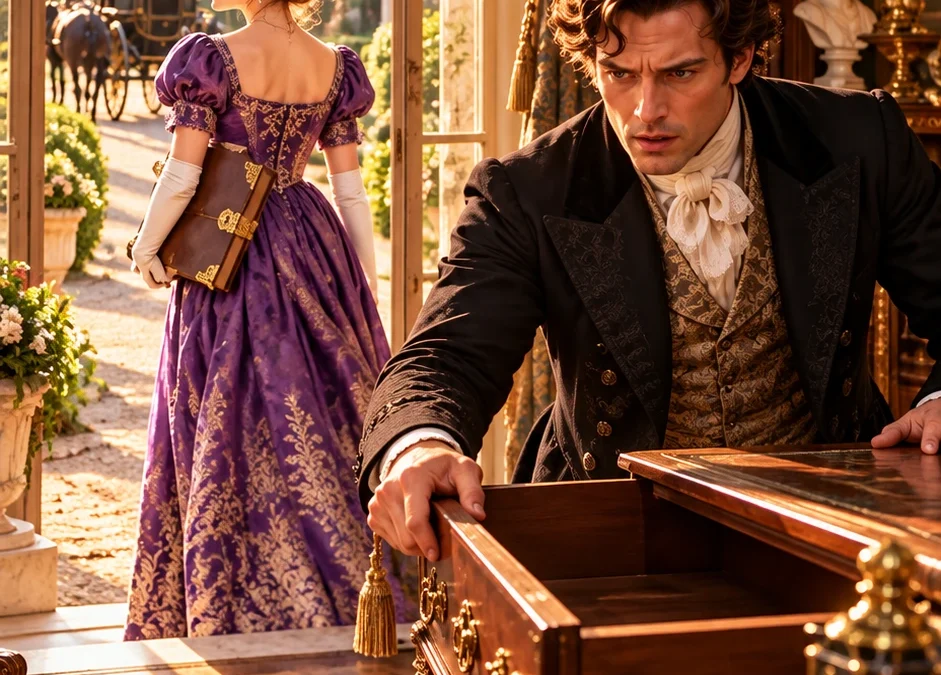
😱 “Take Nothing That’s Mine,” the Duke Told His Wife. She Took Only One Thing… and by Sunset, It Was Already Destroying Him
Part 1
The Duke of Ravenhurst opened the top drawer of his own library desk and found it empty. 😨
For six years he had never touched that drawer. It was where his wife kept the dull things: papers, tenants, accounts. But tonight a banker was coming to dinner, and the Duke had no idea what the arrears on the Long Meadow Farms were.
Inside the drawer there was nothing but a pale rectangle on the green lining, where something heavy had rested for years.
A cold prickle climbed the back of his neck.
Through the tall window, golden light lay across the park. And far down the gravel drive, a black carriage was rolling toward the gates.
His own old traveling coach.
That morning, in this very room, he had ordered his wife to take it with her clothes and be gone by sunset. “Take nothing that’s mine,” he had said. “Nothing.”
Alistister Kendrick, sixth Duke of Ravenhurst, ran. 🏃♂️
Down the corridor, across the marble hall, past a footman who flattened himself against the wall. Out the great doors, down the drive, coat flying, gravel spraying from his boots.
He caught the carriage at the gate posts.
His wife sat inside, perfectly calm. Adelaide, twenty-nine, in royal blue velvet and white gloves, her brown curls pinned with a single jeweled clip. She looked out at the sunset as if she were going on a picnic.
And in her lap, beneath her folded hands, lay a thick, reddish-brown leather ledger with brass corners and a heavy brass clasp.
“Stop!” he roared. “That’s the estate ledger! I told you to take nothing of mine!”
Adelaide turned her head. Her hazel eyes were steady, and the faintest smile touched the corner of her mouth.
“I haven’t, Alistister. This was never yours. It was my father’s. He left it to me in his will. You were there when they read it. You weren’t listening then, either.”
She tapped the coachman’s seat once with her fan.
“Everything is in that book. The rents. The loans. The farms. The bank.”
The carriage picked up speed and rolled out into the last of the light.
The Duke stood alone in the middle of his drive. Behind him, the dinner gong began to sound. 🔔
For the first time in his life, he understood that he could not answer a single question about the place that bore his name.
But to understand how one old book could bring down a duke, we must go back.
Samuel Ward was steward of Ravenhurst for thirty-one years. The Duke owned the land. The steward ran it: sixty tenant farms, every wage, every roof, every ditch. Everything he knew, he wrote in the Book. The household always said it with a capital letter, as if it were scripture.
He had bought the first blank ledger with his own wages, and paid the blacksmith for the brass corners from his own pocket. Over thirty years it grew fat and soft at the edges, holding every rent, every loan, every promise. Which tenant paid late. Which widow needed her rent forgiven. Which field flooded in a wet spring.
His daughter learned to read from it.
Adelaide could add columns at six. By fourteen she rode out to the farms on her gray pony, and the farmers stopped laughing and started asking her questions.
“Could a woman be a steward?” she once asked.
Samuel did not like to lie to her. “Not in England. Not yet.”
Then, one cold March, he fell from his horse on an icy road and was dead before help could reach him. Adelaide was twenty-three. Sixty tenant families stood in the rain at his funeral.
His will was short. The last line was read aloud by a bored lawyer while the Duke’s son yawned at the back of the room:
“My ledger being my own private book, kept at my own expense and in my own hand, I leave to my daughter Adelaide, and to no other.”
The dying old Duke feared for his estate. His son, Alistister, did not know wheat from turnips. So he made one last demand.
Alistister found Adelaide packing her father’s books. “My father wants me to marry you,” he said. “I want to live in London. You can play steward to your heart’s content. I won’t interfere.”
It was the least romantic proposal in Northamptonshire.
She looked through the window at sixty families’ worth of land. “Yes,” she said.
For six years she drained the Long Meadow, rebuilt eleven cottages, and opened a school. When the summer never came and the wheat rotted, she forgave the rents of starving families. She walked into a London bank and persuaded old Mr. Lassels to wait six months on her word alone. She even paid for the spring seed corn with her own £2,000 inheritance, and wrote it quietly in the Book.
Her husband never read a page. He called her my steward, and his friends thought it witty. 🥂
Then, in April, he came home with a charming silver-haired stranger.
Mr. Vincent Rook. He spoke of a new canal, and £40,000 in shares, to be raised by mortgaging the Ravenhurst Woods and the three best farms.
Adelaide disliked him in ten minutes. She checked the Book. There was no such canal extension. She wrote to the real canal engineer, and his reply was brutal: no such plans, and no director named Rook.
At the dinner party, before sixteen guests, she laid the letter beside her plate and asked a magistrate to look at it.
Rook laughed it off. And her husband, white with fury, said, “My wife is a steward’s daughter who has spent six years counting turnips.”
At midnight he found her in her father’s office. “Leave tomorrow. Take the old carriage. But take nothing that’s mine.”
“I understand you perfectly,” said Adelaide.
She sat up all night, thinking about that word. Everything at Ravenhurst belonged to him. Except the one thing her father had paid for himself.
At six, she put on her blue gown and climbed into the carriage with the Book.
Back at the great house, young Mr. Thomas Lassels, the banker’s son, set down his spoon. “May I see the estate ledger, Your Grace? My father would want the figures checked before we lend another £40,000.”
“The ledger,” said the Duke stiffly, “is being rebound.”
The banker’s son looked at him for a long moment. He had been trained since boyhood to know when a man was lying.
He closed his leather case. And beside the Duke, Mr. Rook leaned forward with a warm, sympathetic smile.
“No need to trouble Lassels at all, Your Grace. I have other friends in the city.” 😏
👇 Want to know what happened to the Duke once the money arrived? Find Part 2 in the comments, or leave any word and I’ll send it to you privately! 👇
Part 2
“No need to trouble Lassels at all, Your Grace. I have other friends in the city.”
Alistister looked at the banker’s son rising to leave. Then at Rook.
“Write to your Mr. Salow,” he said.
Nine days later, a small, round, smiling man in a brown coat spread his papers across the mahogany desk, right above the empty drawer. £40,000, lent at twelve percent. No ledgers. No questions from your wife.
“And this clause is quite standard, Your Grace. If any quarter’s interest is more than seven days late, the woods and farms pass to the lender. A mere formality.”
Alistister had never read a clause in his life. He signed.
The money went straight to Rook in exchange for handsome certificates on thick cream paper. Rook shook the Duke’s hand and left that afternoon.
No one at Ravenhurst ever saw him again. 😶
Meanwhile, fifteen miles north, Adelaide was sitting by a fire with a nearly blind old countess.
Lady Agatha of Mere Hall was seventy-four, fierce, and surrounded by ruin. Her steward was dead. Her roof leaked in fourteen places.
“That fool turned you out, and you took Samuel’s book. Good. Will you run Mere for me?”
“My lady, no one will deal with a woman steward.”
“They’ll deal with whoever I tell them to deal with. I’m a countess.”
Adelaide started at six the next morning.
At Ravenhurst, the new London steward arrived and asked for the books. There were none. Thirty-seven years of history had left in a carriage at sunset.
He demanded rent twice from families who had already paid. He demanded old arrears from families Adelaide had forgiven in their own kitchens. Old Joseph Tate stood four hours on the front steps in his Sunday coat.
“Forty years I farmed this land for your family. Your wife never once called me a liar. Where is she, Your Grace? What have you done with her?”
The Duke rode past without a word.
By August, twenty families had left. Then the letters came. Gentlemen in London whom Adelaide had quietly paid, a little each month, now received nothing. And the Duke at last added up what he owed, for the first time in his life.
He did not have it.
He rushed to London to sell his canal shares. The broker looked at them for ten seconds, then handed them back.
“There is no such company, Your Grace. There never was. I should frame them.”
Alistister stood in the middle of the street while carts went around him, remembering a letter on a tablecloth. We have no director named Rook. He had not even picked it up. 💔
On the seventh day after the quarter’s interest fell due, Mr. Salow arrived with two lawyers and a timber merchant. Six hundred acres of oaks that had stood since Queen Elizabeth were marked with white paint, to be felled before Christmas.
A meeting of creditors was called in Lombard Street to decide whether all of Ravenhurst should be sold.
One night, Alistister walked alone to the steward’s office, where he had never set foot in six years of marriage. On the wall hung a list in small, neat handwriting.
Long Meadow, drained, second year. Tate’s arrears forgiven. School: forty children. Lassels repaid, one month early.
He sat in her worn leather chair until the candle died.
Then, on a wet November night, he rode fifteen miles through the rain to Mere Hall. He had no carriage and no pride left.
“I don’t know what I owe,” he said hoarsely. “I don’t know who I owe it to. I’ve come to ask you for the book.”
“It isn’t for sale.”
“Then lend it to me. For one day.”
Adelaide laid her hand on the brass clasp.
“Do you know what’s in it? Not the figures. The promises. Hundreds of them, made by me in kitchens and banks over six years. That’s what kept Ravenhurst standing. You can’t borrow those, Alistister. They were never yours to make.”
He bowed his head. “Then Ravenhurst is finished.”
She was silent for a long moment.
“I’ll come to the meeting,” she said. “Not for you.”
On the fifteenth of November, every chair in the dark paneled room on Lombard Street was full. Creditors, lawyers, old Edmund Lassels at the head of the table, and near the far end, smiling his round, pleasant smile, Mr. Salow.
The debts were read: over £11,000. The creditors proposed selling everything.
“Does His Grace have anything to say?” asked Lassels.
Alistister opened his mouth.
And the door at the far end of the room swung open.
In blue velvet and white gloves, with a thick leather ledger under her arm, the Duchess of Ravenhurst walked in.
Every man turned. Mr. Salow stopped smiling. 😳
Seventy-one-year-old Edmund Lassels rose to his feet, for the first time in twenty years.
Adelaide set the Book on the table, unfastened the clasp, and said calmly:
“I believe you’re discussing my husband’s debts. I’ve brought the accounts.”
👇 LIKE or COMMENT “REVEAL” to see Part 3! It will be posted as soon as we have enough comments. 👇
Part 3
Adelaide did not sit down.
She stood at the side of the long table with the Book open, and went through the clerk’s board line by line.
The red-faced gentleman from German Street claimed £900. She turned a page and read aloud the date of every payment he had received over three years, and the receipt he had signed for each.
“You are owed £340, sir.”
He went scarlet and sat down.
The wine merchant claimed £620. He was owed £210. The tailor claimed £400. He was owed £90. The jeweler, who had included a necklace the Duke had returned three years earlier, was owed nothing at all. He said so himself before she could, because she was already holding his signed receipt.
In twenty minutes, £11,000 had become a little under £4,000.
Thomas Lassels stared at her with his mouth slightly open. His father was smiling for the first time in living memory. 😲
“There is one more debt,” said Adelaide. “It is not on your board. I would like it added.”
She turned to a page near the end.
“December the third. Received from a Kendrick, from her own private funds, £2,000. Seed corn, the lower farms. That was my inheritance from my father. It was never repaid.”
She looked down the table.
“I am also one of your creditors, Alistister.”
He stared at her. He had not known. Of course he had not. He had never read that page.
“Now,” said Adelaide. “Mr. Salow.”
The round little man had been edging his chair back from the table. He froze.
“Mr. Salow holds the Ravenhurst Woods and three farms under a forfeiture clause, because my husband missed one quarter’s interest by seven days. He missed it because he spent £40,000 of Mr. Salow’s money on shares in a canal company that does not exist.”
She laid a letter on the table: the engineer’s reply from Birmingham, the same one that had lain beside her plate in April.
“Those shares were sold to my husband by a Mr. Vincent Rook, who introduced him to Mr. Salow, who lent him the money to buy them, and who then took his land when he could not pay.”
She turned the Book around so that old Edmund Lassels could see the page.
“My father wrote this nineteen years ago. Read the last four lines aloud, sir, if you would.”
The old banker put on his spectacles. His dry voice carried to every corner of the room.
“Salow works in partnership with a gentleman calling himself V. Rookwood, who sells shares in companies that do not exist, so that the borrower cannot pay. Silver-haired, soft-spoken, very charming. Have nothing to do with either of them.”
He took off his spectacles.
“A loan obtained by fraud is no loan at all, Mr. Salow. And a forfeiture obtained by fraud is no forfeiture. I believe the Court of Chancery will agree with me. So, I suspect, will the magistrates at Bow Street.”
Mr. Salow was already on his feet. He made it as far as the door. 🚪
But Adelaide had written to Colonel Hastings a week earlier, and the Colonel had written to Bow Street. Two officers in red waistcoats were waiting on the landing. Mr. Vincent Rook, it was learned later, had been arrested at Dover four days before, trying to board a packet ship with a trunk full of handsome certificates.
When the door closed behind Mr. Salow, the silence in the room was complete.
The man from German Street cleared his throat. “Well. £4,000 is a different matter from £11,000. Ravenhurst can pay that in time.” He looked down the table at the Duke. “But not under his management. I’ll not leave my money in the hands of a man who signs whatever is put in front of him.”
A murmur of agreement rolled around the table.
“I agree,” said old Edmund Lassels. “Lassels and Company will extend the mortgage. We will even lend again against the woods, at four percent, to clear the rest. On one condition.”
He turned in his chair.
“The estate goes into trust until every debt is paid, under a manager of our choosing. And I choose her.”
Every head turned to Adelaide.
“I lent on your word once, Your Grace. You paid me back a month early. I will lend on it again. On yours, not his.”
Adelaide looked at her husband at the foot of the table.
Alistister did not argue. He did not shout. He sat with his hands on the table, looking at the open Book, at a page in her father’s handwriting that he had never once read. Something in his face had changed.
“Draw up the deed,” he said quietly. “I’ll sign it.”
They drew it up that afternoon. The estate, its farms, woods, and every penny of its income, was placed in trust for ten years, or until every debt was cleared. Its management was given entirely to Adelaide Kendrick, Duchess of Ravenhurst, with full power to collect, spend, lend, and decide. The Duke would have £500 a year, the east wing of the house, and no say in anything else.
Alistister read it slowly, page by page. Twice he stopped and asked her what a clause meant. She told him. He listened to the answer.
Then he signed. ✍️
Adelaide went home in December, though not to the great house. She moved back into the square gray steward’s house at the edge of the park, where she had been born. She set her father’s Book on her father’s desk, lit the fire, and got to work.
On the first morning, old Joseph Tate came up from the Long Meadow in his Sunday coat and stood in the doorway with his hat in his hands. He could not say a word. Adelaide made him a cup of tea. 🫖
By Lady Day, nineteen of the families who had fled had come home. By midsummer, every one had. The white paint marks on the great oaks faded in the rain and were gone, and the trees stood as they had since Queen Elizabeth’s time.
Lady Agatha still cackled every Friday as Adelaide read the Mere accounts aloud. Lord Penhallow, who had once laughed at her across a dinner table, now paid her £50 a year and raised his hat when she rode past.
And the Duke lived in the east wing on £500 a year, and kept to himself.
In February, he came to the steward’s office. He knocked, which he had never done before, and stood in the doorway in his old riding coat.
“I’d like to learn how it works,” he said. “All of it. If you’ll teach me.”
Adelaide looked up from her desk. “It’s dull. Columns of figures. Rents and ditches and roofs.”
“I know,” said Alistister. “I’d like to learn anyway.”
So she pulled a second stool up to her father’s desk, the same high stool she had sat on as a little girl. She opened the Book to its very first page, dated thirty-seven years earlier, in Samuel Ward’s younger, neater hand.
Ravenhurst. Accounts kept by S. Ward, Steward.
The Duke sat beside his wife and began to read. 📖
He came back the next week, and the week after. By summer he could find any tenant’s account without help. By autumn he rode out with her to the farms. One wet October morning, in the middle of the Long Meadow, Joseph Tate shook his hand for the first time. Neither of them said anything, and neither needed to.
On the first anniversary of the night she left, Alistister walked down to the steward’s house in the evening light and found her at the gate.
“Will you ever come back to the house?”
Adelaide looked at him for a long moment. This was the man who had told her to take nothing that was his. The man who had sat in a banker’s office and watched her open a book he had never read, and finally understood what it was.
“I never left Ravenhurst, Alistister,” she said gently. “I only left you.”
He nodded slowly. There was no argument in him. That year had taught him when not to argue.
“Then may I come to the office again on Monday?”
And for the first time in seven years of marriage, Adelaide smiled at her husband. 💛
“Bring a pencil.”
THE END
What would you have done in that meeting room? Tell me in the comments, and share this story with someone who loves a good comeback. ❤️
This story is entirely fictional and created for entertainment purposes only. It does not represent any organization or individual, nor does it encourage inappropriate behavior. The content was generated with AI assistance.








