“That Can’t Be Her…” He Said It Out Loud in Front of the Whole Town, and Then the Bride in the Red Dress Opened the One Door He Swore Nobody Would Ever Open
😱 “That Can’t Be Her…” He Said It Out Loud in Front of the Whole Town, and Then the Bride in the Red Dress Opened the One Door He Swore Nobody Would Ever Open
Part 1
“That can’t be her.”
Owen Renick said it out loud, on the platform at Sixmile, in front of eleven people. He could not take it back, and every one of them heard it.
He hadn’t meant to say anything at all. He had spent the twenty minutes before the coach came talking himself into being reasonable. This was a practical arrangement. He had written a practical letter, and a practical woman had answered it. He would shake her hand, put her trunk in the wagon, and drive her out to the place. Neither of them would make it into anything.
He had it worked out down to the sentences.
Then the coach door opened a second time, and every word walked out of his head and did not come back. 😶
The eleven people on that platform were not there by accident. Sixmile had two hundred and forty souls and one telegraph office, and news moved through it the way water moves downhill. Amity Peele had a room made up at the boarding house. Renshaw went wherever there was something to see, and had for thirty years. The Vance boys sat on a feed barrel, pretending to be bored.
They were all there because everybody remembered the last time Owen Renick stood on that platform.
Two winters ago, a woman named Elizabeth had come down that same coach step. Eleven people had watched him take her trunk and drive her out to the Renick place. By the fourth of March the following spring, Elizabeth Renick was in the ground.
So the town came out. Sixmile was not a cruel place. They came the way people come to something they cannot look away from, with their faces set to neutral. They watched Owen stand there with his arms crossed and his hat pulled down, waiting for the second one.
The coach rolled in trailing September dust. A drummer climbed down. A young mother with a baby on her hip followed. Then the platform went quiet, the way a crowd does when it turns toward one point without anyone deciding to.
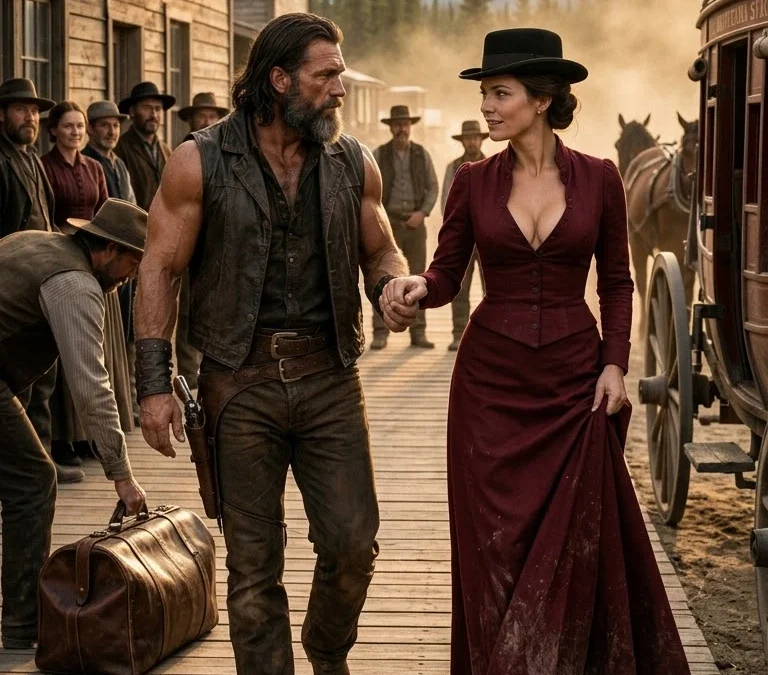
She stood on the coach step with one hand on the frame.
She was not timid. She was not smiling at anybody. She was reading the platform, the buildings, the road north, the eleven faces. She was taking inventory the way a person does when deciding whether she can live somewhere.
Her traveling dress was the deep red of good wine, dusty from two days of stage road. Her dark hair was pinned beneath a plain hat. She was thirty-four or thereabouts, and she carried her own case.
Owen Renick had spent two winters building a wall. A woman he had never met walked straight through it in a red dress.
“That can’t be her,” he said.
Renshaw, two feet away, bit down on a grin and turned away. Then her eyes crossed the platform and found Owen’s.
The letter had taken him three weeks to write.
Not because words were hard. He had kept his own books for fourteen years. But words on paper never looked back at you, and every sentence he wrote seemed to accuse him of something.
I am a man of thirty-six who buried a wife he never got to know. He burned that one in the stove.
What he finally mailed was eight practical sentences about acreage and stock and winters. At the bottom was one more line, which he told himself was purely logistics:
Do not send a photograph. I do not want to make this emotional.
Her name, she told him on the platform, was Thea Coin, lately of Abilene, Kansas. She said it like a fact she had no intention of apologizing for.
“Mr. Renick,” she added, “I imagine you spent the last twenty minutes talking yourself into being reasonable about me.”
His jaw said he didn’t know what she meant.
“I think you do. I did the same thing for two days on that coach. Only I couldn’t work out what this is, so I stopped trying. I’m here. You’re here. The rest we can work out as we go.”
It was the most unsettling thing anyone had ever said to him, because it was entirely reasonable. 😳
The arrangement was a trial week. She would take a room at Amity Peele’s, and Owen would ride in each day. She lasted four hours.
By evening she was on the bench of Corbin Tillery’s wagon, hauling fence wire north. When she hopped down in Owen’s yard, he found his voice.
“The arrangement was a week in town.”
“I know what the arrangement was. I’m not going to decide about the rest of my life somewhere I haven’t stood. Are you?”
By morning she had read his whole place like a book. At dawn she was crouched in the south pasture, hand flat on a sick heifer.
“Three head. Respiratory. This one worries me.”
She was right about every animal.
“My father was a traveling doctor,” she said. “I rode with him from nine until twenty-two. Sickness looks the same in any species.”
She cooked. She walked every fence. She turned over a garden plot in ground nobody had broken in two years. And she noticed the one closed door at the end of the hall, the only closed door in the house. She looked at it and did not touch it.
“That one is shut,” she said. Then she kept walking, leaving the question lying where he could pick it up someday.
Sixmile came around to her in stages. First the town didn’t know what to do with her. Then they started asking her things. A girl’s running ear healed in four days. A Vance boy’s hand finally closed.
Then came Dosha Quill, seventy-three years old, the valley’s medicine woman for thirty-one years. She had sat up three nights with Elizabeth at the end.
By the last week of October, Dosha was telling everyone that the woman at the Renick place was no doctor and had no business near anybody’s child.
Then the rain came. On the first of November, it found a leak in the northeast corner of the house. Thea followed the damp down the hall with a candle.
Owen came up that hall and found the last door standing open.
Thea Coin was inside with the candle in her hand, in the room where his wife had died. 😨
Part 2
Thea Coin was inside with the candle in her hand, in the room where his wife had died.
The flame went still. She looked at his face and understood in half a second.
“I’m sorry,” she said quietly. “I should have asked first.”
“It’s all right.”
“It isn’t. I should have asked.”
He looked past her. A bare bed frame. A chair. A water stain spreading down the plaster. And against the far wall, a trunk with its straps still buckled and a finger of dust across the lid.
“That was hers,” Owen said.
Thea said nothing. Her stillness made it possible to keep going where sympathy would have stopped him.
“She came off that coach on the eleventh of December. Thirteen weeks later, she was dead. Diphtheria. It came through the schoolhouse and took nine people. Seven were children.” His voice did not move. “I sat in that chair and listened to her fight for every breath for two days. I could put a cloth on her head. That was all I had.” 💔
“She never unpacked that trunk. So I shut the door.”
He stared at the window.
“The day she arrived, I walked her through this house. She said one thing about it. ‘These windows want curtains.’ That’s the only thing she ever asked me for. I said I’d see about it in the spring.”
Thea set the candle down. “I’ll fix the wall,” she said. “Then I’ll close the door, and it can be whatever you decide. Even nothing.”
She never mentioned the room again.
Then, on the ninth of November, it came back.
A boy named Curtis Vance came home from school with a sore throat. By Thursday he couldn’t swallow. By the following Monday, six children couldn’t. The nearest doctor was four days away in good weather, and the weather was not good.
Corbin brought word to the yard at a hard trot. Thea listened with her arms folded and her face going somewhere Owen had never seen it go. It was not fear.
“I need to go into Sixmile,” she said. “I’ve seen this forty times. I know which ones you can bring through. There is no doctor, Owen. There’s me.”
“I know what it does,” he said. “You’re asking me to drive you into a town where six children have the thing that killed my wife.”
She understood then what she was asking. Her face changed.
“Yes,” she said. “I am.”
He looked at her for a long moment. Then he went and got the wagon. 😰
But Sixmile did not want her.
At the Vance house, Ivy Vance opened the door a foot and no more. “You’re not a doctor. Then what are you?”
“The only person within four days of this house who has seen sixty cases of this and can tell you which one your son is.”
The door closed.
Two more houses never opened. The third was Renshaw’s. The man who had grinned on that platform stood in the doorway gray-faced.
“My girl is four years old. She’s been fighting for air since last night. I don’t care what you are.”
He stepped back from the door.
And inside that house, a stranger in a muddy gray dress rolled up her sleeves and began a night that would decide whether a town would ever trust her… 🌙
Part 3
Thea was in that house eleven hours.
It took no miracle. She propped the child upright instead of flat, because flat was killing her. She tented a sheet over the bed to hold the steam where the girl was breathing. She swabbed the throat every hour and got water into her a spoonful at a time, because a child who can’t swallow goes dry in a day, and dry kills faster than the membrane does.
None of it was clever. All of it was relentless.
At four in the morning, the girl coughed something loose and drew a breath that went all the way down. Renshaw, who had already buried a wife and a son, sat down on his own floor and put his hands over his face. 🙏
Word moved through Sixmile before it was fully light. The Vance door opened at seven. Ivy Vance did not apologize, and Thea did not ask her to. She went upstairs to Curtis and stayed until dark.
By the thirteenth, fourteen were sick. On the fourteenth, the storm came off the divide and put eighteen inches of snow down in a night. By morning, every road was shut and the valley was sealed. There would be no doctor.
Thea stood at the Vance window and did the arithmetic out loud. Fourteen sick in nine houses. Nine stoves. Nine exhausted families, every well person walking between infected homes carrying it on their coats.
“We’re not treating an outbreak,” she told Owen at the wagon. “We’re feeding one. They have to come out of the town. One stove big enough, rooms enough, far enough out that it stops moving. There’s one house in this valley that answers all three.”
Owen Renick stood in the snow and understood what she was asking. She wanted him to open his house to the sickness that had killed Elizabeth, in the rooms where it had killed her.
“How many?”
“All of them.”
He looked down the street at nine chimneys and a wind that wasn’t finished.
“Get them ready,” he said. “I’ll start with the worst.”
Over two days, in the worst weather of that winter, they moved fourteen children and four adults to the Renick place. Doss Tillery brought his wagon, Corbin a sledge, and Renshaw his own team. Thea took the main room for the worst of them. The convalescents went to the back bedrooms. The well went to the barn loft, with one rule she never bent: nobody crossed between barn and house without washing to the elbow in boiled water and changing coats.
Dosha Quill arrived on the eighteenth, driving a buggy through snow at seventy-three. She walked in without knocking and looked at fourteen sick children in one room.
“You’ve stacked them like cordwood.”
“I have them where I can reach all of them from one stove,” Thea said, not raising her voice. “Mrs. Quill, I know what you are. You brought two hundred children into this valley. I’m not here to take that from you. I’m here to not lose fourteen of them, and I can’t do it alone.”
The old woman stood a long moment with snow melting off her shoulders. Then she hung her coat on the hook.
“Where do you want me?” 🤝
On the twenty-first of November, they ran out of cloth.
Nobody had thought of it. Everyone counted medicine and firewood and food. But fourteen throats swabbed every hour meant a clean cloth every hour, and Thea’s one iron rule was that nothing which touched a sick throat was ever used again. It all went into the fire.
Sixmile had sent everything it had. Amity Peele had stripped the boarding house. Doss’s wife had stripped her own beds. Four clean cloths were left in the kitchen, and Dosha Quill was cutting up her own petticoat.
Thea found Owen in the barn, splitting wood because he could not sit still.
“I have to ask you for something,” she said. “There’s a trunk in that room.”
He set the maul down.
“I would not ask if there were one other thing left in this valley to ask for. There’s an eleven-year-old boy in your main room, and four cloths in your kitchen.”
“I don’t know what’s in it,” Owen said at last. “I’ve had two years to imagine. I never once got past the straps.”
He walked across the yard, through the snow, down the hall past fourteen sick children, and opened the door he had shut on the fourth of March. He knelt before the trunk and put both hands on the straps. It took him some time.
Then he lifted the lid.
Linen. Four pairs of good sheets, the kind a woman buys once and keeps. Pillow slips. A tablecloth with white work along the edge. Toweling, a whole bolt of it, unopened. A wool shawl. A stack of soft cotton squares, hemmed, that Owen stared at before he understood they were for a baby. 😭
Under them lay a bag of garden seed, twelve paper twists labeled in a small clear hand, a box of buttons, and yards and yards of plain cotton, the kind a woman brings west because she doesn’t yet know what she’ll need, only that she’ll need cloth.
Elizabeth had packed to build a life. Every item in that trunk was for making a house into a house. She had carried it nine hundred miles and had thirteen weeks and never opened it.
“Take it,” Owen said, and his voice came out wrong, and he didn’t fix it. “Take all of it. She brought it out here to make a house with, and she never got to. Let her make one now.”
Thea knelt beside him and laid her hand over his on the cotton. Then she picked up the first bolt and carried it down the hall.
They used every thread. Sheets became steam tents. Toweling became swabs by the hundred. Dosha, Amity, and Ivy cut the cotton in shifts and boiled and burned and cut again. The shawl went around the shoulders of the Renshaw girl. The baby squares went to a woman from the east road with a nine-month-old, and Thea never told her what they were. The child lived.
By the twenty-sixth, the trunk was empty except for one thing at the bottom. Thea found it, stopped with her hand on it, closed the lid, and told no one.
The worst night was the second of December.
They had lost nobody. At eleven that night, Curtis Vance stopped being able to breathe.
His color went. He sat bolt upright on the settle, fighting for air with his whole body. Dosha got her fingers in his mouth with a hooked swab and pulled out a piece of the membrane. It didn’t matter. There was more behind it.
“It’s in his windpipe,” she told Thea across the room.
Ivy Vance made a sound no mother should make.
Thea stood absolutely still for three seconds. “Get his mother out of this room. Mrs. Vance, in four minutes I’m going to do something to your son you can’t watch. I need the room.”
“Is he going to die?”
“He is dying now. That’s what this is.”
Doss led Ivy out. Thea turned to the table. “Dosha, boil the small knife and the two silver tubes from my father’s roll. Bring the lamp close. Owen.”
He hadn’t moved from the wall in an hour.
“I need you to hold him.”
Owen Renick stood in the main room of his own house, seven feet from the chair where he’d sat two days while his wife died. He was being asked to put his hands on the one thing he’d spent two years unable to touch. 😰
“Tell me what you’re going to do.”
“Open his windpipe below the blockage and put in a tube so he can breathe through his neck. My father did it nine times. I did the last two myself. It takes ninety seconds. If he moves, I cut through something I can’t put back. And if I don’t, he’s gone in a quarter of an hour.”
“And if it goes wrong?”
“Then everybody in Sixmile will say a woman off a stagecoach cut a boy’s throat in Owen Renick’s front room.”
The stove ticked.
“Then don’t let it go wrong,” Owen said.
He crossed the floor, got behind the boy, one arm across his chest and the other steady beneath his jaw. He put his head down beside the boy’s ear.
“You’ve got hold of me. I’ve got hold of you. Do not move.”
The voice came from somewhere he hadn’t been in two years.
Dosha held the lamp. Thea took the knife, found what she was looking for with two fingers, and did not hesitate.
It took a hundred and ten seconds.
Owen carried one sound for the rest of his life. Not the cutting. The other one, eighty seconds in, when the tube went home and the boy’s chest hauled in air through his neck for the first time in half an hour. A long, wet, dragging whoop, the ugliest and most beautiful noise he ever heard.
Curtis’s hand rose off the settle and closed on Owen’s forearm, and held on. 🙏
“Well,” Dosha Quill said, very quietly.
Thea tied the silk, seated the tube, and sat back on her heels. Her hands started shaking four seconds after they were no longer needed. Owen noticed. So did Dosha. Neither ever mentioned it.
Ivy Vance came in and saw her son breathing through a silver tube, a stranger’s bloody hand beside him. She did not scream. She crossed the room, knelt, and pressed her forehead against his knee, and stayed there.
Nobody in the Wolfhead Valley died that winter. Not one. Eighteen sick in one house at the head of a road shut five weeks, and every one of them walked out.
Dosha Quill told it in Sixmile for the rest of her life, always the same way. She had been the medicine in that valley for thirty-one years and had never seen anything done so well. And the woman who did it had asked her permission first, and spoken her name in front of the room, and had not needed to do either.
The road opened on the ninth of January. By the fourteenth, the house stood emptier and quieter than it had been since November. They burned the bedding in the yard, scrubbed the floors to the grain, and opened every window to a January wind that would have killed a lesser building.
Sixmile didn’t know how to say what it wanted to say, so it said it the way small towns do. Hendrick’s ledger “went missing,” so Thea’s orders cost nothing. Renshaw left a hind quarter of elk in the barn without knocking. Ivy Vance sent four lines, rewritten a dozen times, with a scrap of Curtis’s handwriting at the bottom.
Somewhere in February, the town stopped calling her the Renick woman and started calling her Mrs. Coin. That was not accurate. Nobody corrected it, because it was on its way to being accurate, and everybody knew it.
Owen said it on the fourth of March.
He hadn’t planned the date. By the time he realized what day it was, he was already on the porch and too late to go back in. Thea came out with two cups and sat beside him, not two steps below.
“You’ve been out here an hour.”
“It’s nine degrees.”
She handed him a cup and waited, one of the hundred things about her he could no longer imagine the house without.
“I wrote a letter asking for the least I could think of,” Owen said. “Practical. Capable. I put a line at the bottom telling a stranger not to make it emotional. You read that in an office in Kansas and knew exactly what it was. You came anyway. I said what I said in front of the whole town, and you didn’t flinch. Then you walked into a house with a boy dying in it and put your hands on him.”
He looked out at the dark.
“I tried for two weeks to say the next part in a way that wasn’t smaller than it is. I can’t. So I’ll say it plain, because you taught me plain carries further. I love you, Thea. I did not want to. I built a great deal of structure to prevent it, and it didn’t hold ten seconds on that platform. I’m asking you to marry me. Not the arrangement. You.” ❤️
“Say the date out loud,” Thea said.
He was quiet. “The fourth of March. I know what today is. I’ve known all day.”
She laid her hand over his. “I needed to be sure you did. If you’d asked me without knowing, I’d have said yes and spent thirty years wondering.”
“Then yes,” she said. “Yes, Owen.”
They were married in April, in Amity Peele’s front room, because there was still no church in Sixmile and there is not one now. Doss Tillery stood up with them. Dosha Quill sat in front with her hands folded. Half the town came, and the other half sent word that they would have come if the road had been better, which in that country in April was true.
Thea wore the red dress. Owen had said nothing about it, and she hadn’t asked. He understood that she wore it on purpose. It was the dress she had chosen this life in, and she meant to be wearing it when she said so out loud. Renshaw told the story of the platform at the wedding, told it badly, and enjoyed himself enormously. 😄
Dosha Quill taught Thea everything she knew in the eleven months before she died, and both treated it as a formal course of instruction. The territory licensed Thea in ‘ninety-one. For twenty-six years she was the only trained medical practitioner between Sixmile and the Divide. She delivered upward of six hundred children in that valley. One of the first was her own.
On an afternoon in May, when the road was finally clear and the house finally quiet, Thea went into the room at the end of the hall, the one that was no longer shut. She opened the trunk and took out the one thing left at the bottom.
Curtains.
Two pairs, unbleached cotton, cut and hemmed and pressed, the corners squared by someone who had done it carefully on a coach. The stitching wandered where the road had been rough. A woman had sewn them nine hundred miles from a house she had never seen, for windows she had only been told about in a letter. 🥹
Thea hung them that afternoon. Every window in the house.
When Owen came in at dark and stood in his doorway and saw what had been done to his home, he said nothing for a long time. Then he said the only thing there was to say. It was Elizabeth’s name.
Not Thea’s.
Thea stood in that kitchen and let him say it. She did not mind at all. She had understood from the first line of one badly written letter exactly who she had come out there to marry. She had never once wanted him to be a man who could forget.
This story is entirely fictional and created for entertainment purposes only. It does not represent any organization or individual, nor does it encourage inappropriate behavior. The content was generated with AI assistance.








