THE ALPHA KING SHAVED HER HEAD IN FRONT OF THE ENTIRE COURT TO HUMILIATE HER… THREE DAYS LATER, HIS GREATEST ENEMY KNELT IN A RUINED CHAPEL AND OFFERED HER SOMETHING HE NEVER EXPECTED
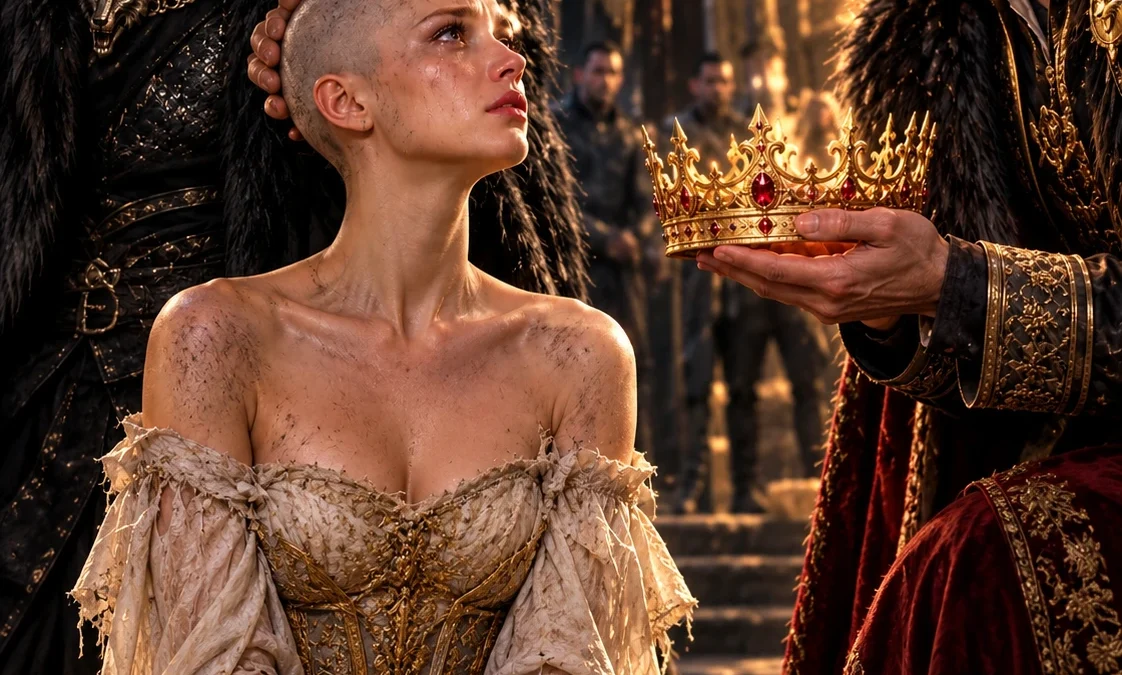
THE ALPHA KING SHAVED HER HEAD IN FRONT OF THE ENTIRE COURT TO HUMILIATE HER… THREE DAYS LATER, HIS GREATEST ENEMY KNELT IN A RUINED CHAPEL AND OFFERED HER SOMETHING HE NEVER EXPECTED 😱👑
Part 1
“Shave her head. Let every wolf in this kingdom see what becomes of a woman who forgets her place.”
Those were the last words Alpha King Davis spoke to her before the executioner’s shears touched her hair. ✂️
The nobles did not gasp. They murmured, the careful, cowardly sound of people who had benefited from Mary’s counsel for seven years and were now quietly relieved that someone else was being punished for having too much of it.
Lady Isolda stood beside the throne in a white-and-gold gown she had chosen for the occasion, watching with the composed satisfaction of a woman who had already decided how the story would end.
They believed they were watching an omega adviser lose everything.
They did not watch closely enough.
When the guards shoved Mary into the iron chair at the center of the great hall, she did not beg. She did not weep. She kept her eyes on Davis’s face, the way a person looks at a doorway they are memorizing before walking through it for the last time.
She had spent seven years learning to read him. The slight tightening of his jaw when a report unsettled him. The way his gaze slid to the floor when he was choosing comfort over truth.
She read him now. He would not look at her hair as it fell.
The first lock of chestnut hair dropped to the marble. Behind his cold expression, his smile deepened by the smallest possible degree.
Mary felt each severed strand the way you feel a debt being calculated. Not the pain of the moment, but the slow accounting of everything it had cost.
Seven winters of famine plans drawn in candlelight after the council slept. Seven years of treaties negotiated with hostile packs who had never intended to listen. Seven harvests saved. Two assassination plots unraveled. One kingdom held together by the invisible labor of a woman whose name rarely appeared in the records of its success. 💔
When the last of her hair fell, Davis stepped forward and lifted her chin with two fingers, the way a man handles an object he is deciding whether to discard.
“Remember this, Mary. You were useful. You were never irreplaceable.”
The hall went very quiet.
Mary slowly touched the bare skin of her head, deliberately, so every noble would understand the gesture was not grief.
Then she stood.
“You may take my hair, Davis.” Her voice did not shake. “You may take my title, my home, and everything I built for you. But one day you will understand that your crown was never standing because of your strength. It was standing because someone cared enough to hold it in place.”
She walked out of the great hall without an escort. The guards let her pass, perhaps because no one had thought to order otherwise, or perhaps because even men following commands recognized something in her spine that made the doorway feel like hers to cross. 🚪
Three days later, a black-and-gold carriage bearing the crest of Nightfall crossed Silverthorne’s border.
It carried no soldiers. No declaration. No demand for territory or tribute.
It carried a king.
King Lewis of Nightfall was the one ruler Davis had never managed to outmaneuver, not at the trade summits, not at the border negotiations, not in any of the quiet contests of political will that shaped the balance between their kingdoms. He rode into the territory of a man who had every reason to see his arrival as an act of war.
He did not come for Davis.
He found Mary in a ruined border chapel, three days’ walk from the palace, huddled beneath a borrowed cloak with her bare head hidden under its hood.
He did not offer sympathy. He did not ask her to tell him what Davis had done, as though she were a wound he had come to inspect.
He knelt.
He opened a velvet case he had carried personally from the capital of Nightfall. Inside, catching the gray light from the chapel’s broken window, sat a crown of hammered gold set with sapphires the color of deep water. 👑
“Davis believes he has made you nothing,” Lewis said. His voice was even and certain, the voice of a man who states only what he has already examined from every angle. “I have spent years watching you save a kingdom that never understood what it owed you.”
He extended the case.
“Come with me, Mary. Help me build something that does not require a woman to kneel before a foolish king to be heard. I am not offering you protection.”
The sapphires caught the light.
“I am offering you a throne.”
Mary stared at the crown. She stared at the king who had once been her enemy, kneeling on cold stone with no army behind him and no condition attached to his words.
She did not say yes. Not yet. She would never again answer a king’s offer before she understood its full terms.
But for the first time in three days, she lowered her hood.
Six days before the shears touched her hair, Silverthorne Palace smelled of lavender, hot beeswax, and the particular tension that lives in rooms where powerful people are about to make promises.
Mary had been awake since before dawn. The alliance banquet was tonight, and the banquet was hers to manage, as most things in Silverthorne had always been: quietly, and without credit.
She had corrected the seating twice, reviewed the grain contracts attached to the alliance proposal, and rewritten the ceremonial portion of Davis’s opening address, because the first draft made him sound like a man reading a list of things he intended to own.
She had just opened the third ledger of the morning when she found the number that would not reconcile.
It was small enough to miss. That was the point.
Three moonroot shipments, each logged as delivered, each signed and sealed by a transport official whose name appeared nowhere else in the palace records, had supposedly reached border settlements that were currently sending healers to the capital, begging for supplies.
Mary closed the ledger. Then she opened it again, because she was the kind of woman who checked twice before allowing herself to be certain.
The number did not change. 🔍
She was at the royal medicinal stores before the palace woke. The quartermaster, a heavyset man named Orr, took considerable pride in the fact that nothing left his stores without documentation. He did not enjoy being questioned at dawn. But he answered, having learned over seven years that Mary’s questions eventually led somewhere he would prefer to have been ahead of.
Every shipment had left properly sealed, he insisted. He could show her the manifests.
She asked to see the wagon weights instead.
The silence that followed was more useful than anything he said next. The weights recorded at departure did not match the weights acknowledged at the border depots. The wagons had been lighter when they crossed the border than when they left the capital.
Something had been removed along the way. Someone was altering the paperwork after the shipments left the palace walls.
Near midmorning she found Tamzin in the lower city, a healer who had walked two days from a border settlement because her children were sick and the medicine due six weeks ago had never arrived. Tamzin confirmed it: the royal records marked the delivery complete. Her settlement had received nothing.
Mary arranged what medicine she could from the secondary stores and asked Tamzin to preserve everything. Receipts, names of transport workers, dates.
“Keep it somewhere they won’t look.”
Tamzin studied her face. “How much trouble is this going to cause?”
“That depends,” Mary said, “on how many people are involved.”
That afternoon she brought the discrepancies to Davis.
His study smelled of pine resin and old paper. She spread the records across his desk in the order that made the pattern clearest: the weights, the mismatched dates, and a transport seal with a strange, slight variation that did not appear in the official registry.
For a moment, Davis listened the way he used to, leaning forward, following her reasoning with the focused attention that had once made her believe he was different from the kings in the histories she had studied.
“The figures are concerning,” he admitted.
“The figures prove that medicine meant for sick children is being redirected. Through a transport network connected to Lord Varic’s commercial contracts.”
The name changed the temperature of the room.
Davis straightened. Varic’s support, he said, strengthened Silverthorne against Nightfall and three other hostile territories. Accusing his future father-in-law without irrefutable proof could collapse the alliance before the banquet was finished.
“An alliance built on overlooking theft is not security,” Mary said. “It is a debt being written in other people’s suffering. Eventually someone will present it for payment.”
He told her to continue investigating quietly. He told her not to make a formal accusation against Varic or his daughter until she had something that could not be disputed.
She agreed. She did not yet understand that she was not being asked to find stronger proof.
She was being given time to be silenced before she found it. 😨
An hour later, Lady Isolda found her in the portrait gallery. The conversation began pleasantly. Compliments on the seating. Then the questions sharpened like a blade running along something resistant.
Why had Mary been visiting the medicinal stores? Why was she interviewing transport officials the week of the alliance ceremony?
“An adviser serves at the king’s pleasure,” Isolda said, in the temperature of someone who has already won. “A queen helps secure the kingdom’s future. Those are not the same position.”
“No,” Mary agreed. “They are not.”
She left before Isolda could decide whether that was a concession. She did not see Isolda send the message to her father.
That evening, Elder Sarah helped her find the relevant treaty: an old law stating that medicine reserved for border settlements could not be redirected without written approval from both the crown’s medical office and the affected pack leaders. The recent shipments carried neither. The authorization they did carry bore a royal seal, but the date was wrong by four days.
Someone had used the seal without Davis’s knowledge. Or with it. She could not yet determine which frightened her more.
She copied the pages, hid them in a leather notebook beneath her bed, and returned to the ledger to find the one record she had not yet examined.
The final delivery page had been cut out, cleanly, close to the binding, recently enough that the edge had not yet yellowed.
She was still holding the notebook when she heard the sound she had been quietly dreading.
The measured, deliberate footsteps of royal guards moving down the corridor toward her door.
They did not knock. 🚪
Part 2
The door opened the way doors open when the people behind them have already decided what they will find.
Two royal guards. A sealed order. The expression of men who have been told they are delivering justice.
Mary slid the leather notebook beneath the mattress in the same motion she used to turn toward them.
The evidence found in her quarters, they explained, linked her to the missing moonroot. Inventory records, transport logs, papers discovered beneath her writing table. She asked to see them. The inventory numbers were correct. She recognized them immediately.
But the transport seal in the lower corner was the same altered mark she had spent two days tracing back to Varic’s commercial network. Whoever planted the papers had used the very seal that proved her right, without understanding she had already found it.
“This is fabricated,” she said. “I can demonstrate exactly why, if someone will allow me to examine the original dispatch records.”
Lord Varic, who had arrived with suspicious promptness, told the guards that her refusal to comply was itself evidence of disloyalty. Isolda, standing just behind him, murmured that Mary had been manufacturing accusations for weeks to protect her position from a woman of proper standing.
Elder Sarah, summoned to witness the arrest, said nothing. But Mary caught the look on the old woman’s face and understood. Sarah believed her.
Sarah also understood, with the clarity of someone who had survived this court for forty years, that belief was not the same as protection. 💔
The great hall was full in the particular way it fills when people have arranged to be present for something they will later claim they witnessed reluctantly.
Mary laid out the evidence clearly. The weight inconsistencies. The missing authorization. The seal absent from the registry. She asked Davis to order a single independent inspection of the merchant warehouses.
One inspection, and the truth would resolve itself.
Varic produced a document, properly formatted, bearing what looked from a distance like Davis’s seal, authorizing the transfer of medicine into Mary’s personal custody. He presented it with the unhurried confidence of a man who had prepared for this moment.
Mary looked at the royal mark. The inner ring was pressed too deep on one side. A copied seal, applied without the weight of the original instrument.
She said so.
Davis asked whether she could prove it. She answered honestly that she needed the original dispatch book to establish who had altered the records.
“She is attempting to delay judgment,” Varic told the hall.
Then Isolda spoke. Her voice was calm, perfectly modulated, and aimed with great precision at the one thing that would poison every other word Mary had said.
She suggested that Mary’s accusations had nothing to do with missing medicine. That a woman who had spent seven years hoping to stand beside the king might find it difficult to accept that a nobleman’s daughter had been chosen in her place.
The room changed.
Mary watched it happen. The slight shift of posture. The glances exchanged between nobles who had followed her arguments carefully and were now quietly reconsidering the frame through which they had been listening.
Jealousy was a simpler explanation than conspiracy. Simpler explanations were more comfortable.
She looked at Davis.
“Seven years. I have defended your decisions, protected your soldiers, and warned you about threats your senior commanders failed to see. I am asking you to judge the evidence by its content, not by the rank of the person presenting it.”
Davis looked at her for a long moment. Long enough that she thought, for one unguarded second, that he was going to remember who she was.
He chose the alliance. 😢
He declared she had exceeded her authority, questioned the family of his intended queen without grounds, and defied the crown. He dismissed her from the council, revoked her palace privileges, and ordered her hair shaved in public view.
The iron chair was cold. She felt it through her palms when they pushed her down, cold and rough at the edges, and very permanent.
The first cut was the loudest. After that, she stopped hearing the individual sounds and began feeling them instead. The strange lightness at her temples. The whisper of chestnut hair crossing her cheekbones on its way to the marble. The murmur of nobles who had once asked her to settle their disputes and were now watching her be settled.
Some looked away. Most did not.
She kept her eyes on Davis. She thought about the winter fever and the moonroot preparation she had developed through three sleepless nights, and the soldiers who had expected to die. She thought about the treaty he had signed with his own hand while she sat beside him reciting the terms she had spent four months negotiating. She thought about the night two years ago when he had told her privately that he did not know how the kingdom would function without her.
When it was over, Davis stripped her of her title and forbade her from entering the palace again. A guard moved to push her back down.
She looked at him with an expression that made him reconsider.
Then she spoke her final words to the king, and walked out of the great hall.
Elder Sarah was waiting outside the palace walls with a cloak and a small purse of coins. She offered shelter in the lower city, time to gather witnesses, the possibility of a formal appeal.
Mary accepted the cloak.
“If you hide me, the council will spend the next year pretending the question was properly settled. Davis will be allowed to believe that silencing me was enough.” She pulled the hood carefully over her bare head. “Someone has to stop protecting him from what he chose to do.”
She walked toward the border road as the sun dropped behind the palace towers. She was frightened. She did not know where she was going. She carried a leather notebook, a small purse, and seven years of knowledge that a king had just publicly declared worthless.
She did not look back to see if anyone was watching her go.
The first village she passed through had already heard a version of the story.
She sat at the back of a roadside inn with her hood up, hands wrapped around a cup of broth she could not bring herself to drink, listening to two travelers debate what kind of woman steals medicine from sick children. One thought greed. The other thought jealousy.
Neither considered a third possibility.
A third traveler, older and less interested in the drama, said only that the finest harvest Silverthorne had seen in a generation, and the border treaties that had kept the smaller packs from open conflict, were both the work of an adviser whose name rarely appeared in the record. He said it without heat, the way people state things they have observed firsthand and do not expect to be believed.
Mary did not speak. She was almost at the door when a healer from the far table caught her arm.
The woman was sixty or close to it, with the permanently stained fingers of someone who had spent her life among medicinal plants. She pressed a folded cloak into Mary’s hands, warmer than the borrowed one, properly lined.
She remembered the winter fever three years ago, she said quietly, and the treatment that had saved her grandson. She did not believe a woman capable of that had stolen anything from anyone.
Mary could not find the words. She pressed the woman’s hand once and walked out into the cold. 🥹
The border chapel was half a day’s walk further. It was an old structure of stone walls and a collapsed eastern corner, with carvings of twin crowns above the entrance, worn smooth by decades of weather and the hands of travelers who had touched them for luck.
It was dry. That was what mattered.
Mary sat against the interior wall and finally removed her hood. She had not allowed herself to feel it fully until now. There had always been something that required her to be composed.
Alone in the dark, with her hand on the bare skin of her head, she allowed herself to understand what had actually happened.
It was not the title she grieved. It was not the palace or the office or even the seven years of work Davis had publicly dismissed as worthless.
She was grieving the belief she had carried through all of it. That loyalty, if it was patient enough and consistent enough, would eventually be answered with something like respect.
She had been wrong. The grief of discovering it was quieter than she had expected, and much heavier.
She was still sitting with it when she heard horses.
The carriage bore Nightfall’s crest, black and gold, unmistakable in the early light. Her first thought was that Lewis had sent someone to gather intelligence on Silverthorne’s disorder. Her second was that she should have kept walking.
Lewis came in without a ceremonial guard and without any of the performance powerful men bring into a room. He was taller than the diplomatic reports had suggested. He looked at her directly. Not at her shorn head. At her face.
“I know what happened in the great hall,” he said. “I did not come to hear it again.”
He sat across from her on the chapel’s remaining bench and told her he had been following her work for years without knowing her name. A border negotiation over flooded farmland. The proposal had been attributed to Davis’s council, but the terms were too precise, too carefully weighted toward the smaller packs, to have originated with the men who presented them. He had found the same reasoning in three trade agreements and two proposals for grain distribution. It took him a year to trace the source to a name buried in a secondary administrative record.
“I came because the people who dismissed you are making a mistake that may affect both our kingdoms,” he said. “And because I do not intend to make the same one.”
Then he opened the velvet case.
He explained the ancient Nightfall Charter, a law allowing a second sovereign to share authority based on demonstrated service, requiring her free acceptance, public ratification, and formal recognition by the governing council. Not a queen’s position. Not a consort’s title. Independent authority over the council, the treasury, and the rights of border packs.
“Why?” she asked. “You barely know me.”
“I know your work. That is not the same as barely knowing you.”
She told him she would not accept the crown. Not yet. She had spent seven years building her life around one king’s promises, and she was not prepared to transfer that arrangement to another man with a different crest on his carriage.
He did not argue. He offered her passage to Nightfall, access to his own missing shipment records, and the freedom to leave the moment she concluded his intentions were not what he claimed.
She considered him for a long moment.
Then she picked up her notebook, and followed him to the carriage.
The merchant manifests were waiting inside, already organized. Nightfall had purchased enough moonroot to supply its eastern settlements through the full winter. Barely half had arrived.
Mary traced the routes with her finger until she found the stretch of road where the supplies had last been verified, a section that ran directly through Lord Varic’s commercial network.
The theft was not contained to Silverthorne. It had never been about Silverthorne.
Lewis handed her one more document: a delivery confirmation from a Nightfall warehouse, filed six weeks ago. She looked at the transport seal in the lower corner.
The inner ring was pressed too deep on one side.
She had last seen that mark on the papers planted in her quarters the night she was arrested. 😳
Part 3
Mary had expected grandeur. She had prepared herself for the welcome powerful kingdoms extend to disgraced foreigners: audience rooms designed to make visitors feel small, officials who address the air slightly above your head.
What she found instead was a working council chamber at seven in the morning, smelling of ink and cold tea, with farmers’ petitions stacked beside military dispatches and a merchant arguing loudly with an official about grain transport fees.
Lewis was already at the table. He rose when she entered, not ceremonially, but the way a person rises when someone they have been expecting finally arrives. He offered her the seat beside him, the chair used by Nightfall’s most senior military adviser, and introduced her to the council by name before any of them could arrange their expressions into something more diplomatic.
One noble, a lord with the careful bearing of a man who had survived many administrations by being useful to whoever held power, observed that consulting a foreign omega whose own kingdom had found it necessary to remove her was an unusual foundation for policy.
Lewis told him he was welcome to challenge her recommendations with evidence, and that the council would weigh it on its merits.
Mary watched the noble decide not to press the point.
It was the first time in seven years she had seen that argument lose. ✨
He gave her the missing shipment records the next morning and asked what she made of them. She worked through the night. By dawn she had found the mechanism.
Multiple merchants had filed delivery confirmations for the same shipment to two different locations. One set to satisfy Nightfall’s official inventory. Another to account for where the medicine had actually gone. Interviews with the remaining wagon drivers revealed that several loads had been redirected to a private warehouse just before the Silverthorne border crossing.
She brought her findings to Lord Marshal Corvin, Nightfall’s military commander, who received them with the skepticism of a man who had built his career on verifiable facts. She walked him through the root maps, the weight discrepancies, the false declarations filed through companies whose registration traced back to Varic’s network.
By the second hour, Corvin was drawing the routes himself.
Her report gave Nightfall grounds to freeze payments to three companies and open a formal investigation. Lewis signed the decree the next afternoon and credited her findings by name. When a senior noble argued that attributing the work to a foreign adviser of uncertain status undermined the decree, Lewis replied that a king who feared another person’s competence had fundamentally misunderstood what leadership was for.
That evening she thanked him privately. He told her she need not thank him for correcting something that should never have required correction.
She did not know how to answer that. So she said nothing.
But she stopped wearing the hood indoors. 🥹
They inspected the eastern settlements together over the following week. Their conversations moved the way conversations do when two people are both paying attention, naturally and slightly faster than expected.
She admitted, more easily than she had intended, that she had spent years believing Davis would eventually recognize her work without being prompted. That she had confused patience with hope, and hope with certainty.
Lewis did not tell her he would never disappoint her. She noticed that specifically. He told her instead that trust accumulated through decisions over time, and that anyone who asked her to extend it faster than the evidence supported was asking her to carry a risk that belonged to them.
It was the most honest thing anyone had said to her in years.
One afternoon, a group of nobles stared openly at her shaved head while Lewis discussed eastern budgets with her. He did not address them. He did not lower his voice or shift the conversation to give her cover. He simply continued talking to her as though their attention were no more significant than the weather.
She realized it was exactly the correct response.
At dusk he showed her the garden arch, twin crowns carved in old stone, worn soft at the edges. He explained the original oath: that wisdom should not remain behind a throne when it deserved a place beside it. His predecessors had ignored it because sharing authority was harder than holding it alone. He would not invoke it, he said, unless she genuinely wanted the responsibility and the council could establish protections that did not depend on his continued goodwill.
She told him she wanted the law changed properly, not used as a personal arrangement the next ruler could quietly set aside.
“That,” he said, “is exactly what I intended.”
She was still considering what to make of him when the courier arrived from the eastern warehouses.
The stolen medicine had been transferred through a trading company registered to a member of Varic’s network. Confirmation she had expected.
What she had not expected was the second page: a confidential order authorizing the movement of weapon stockpiles to positions near the border.
The order bore Davis’s royal seal.
Mary looked at it for a long time. The inner ring was precisely even. None of the distortion she had learned to recognize.
Either Davis had authorized this himself, or someone had access to the original instrument. Both possibilities meant the same thing.
Varic was not simply stealing medicine. He was building toward something larger, using forged paperwork to convince both kingdoms that the other had already decided to fight. If either side accepted the order as genuine, no one would need to declare a war.
It would simply begin. ⚔️
Silverthorne, meanwhile, began failing quietly, the way things fail when no one has been paying attention to what held them together.
The first problem was a harvest agreement with three eastern farming settlements. Davis’s council had drafted it without the clause Mary always inserted to account for autumn flood levies on the eastern roads. By the time anyone noticed, the consortium had withdrawn.
The second came a week later. Two smaller packs threatened to dissolve their treaties when the medicine shipments they had been promised for the third consecutive month failed to appear.
The third was a treasury shortfall that Isolda’s assigned officials could not explain, because the explanation lived inside a system of cross-referenced ledgers Mary had built over four years and never formally documented. Davis asked Isolda to manage the commercial accounts. She lasted nine days before admitting, with admirable composure, that some of what Mary had been doing could not be replicated by issuing new instructions to existing staff.
Davis looked at the empty place in his council chamber where Mary’s reports used to appear each morning and began to understand that he had mistaken the absence of visible effort for the presence of effortless results.
Elder Sarah’s letter arrived on the fourteenth day. It contained no commentary, only copies of an older transport record Mary had asked her to preserve before the arrest. Davis read it twice, carried it to his study, and compared it with the orders bearing his own seal.
The handwriting in the authorization dates was slightly wrong. Not obviously. But Davis had signed thousands of documents in seven years, and he knew the precise way his own clerks formed the number four.
These did not match.
Varic appeared in his study within the hour, which told Davis something he had never allowed himself to know: how quickly information moved from the council chamber to the nobleman’s private correspondence. Varic was calm and reasonable and very persuasive. Public scrutiny at this moment, he said, would create an appearance of instability that rivals would exploit.
Davis recognized the shape of the argument. Mary had warned him precisely what it would sound like.
He dismissed Varic and continued reading. 📜
Captain Bram brought the border delegation himself. The pack leaders sat across from Davis and described, without embellishment, what the last six weeks had cost their settlements. Sick children. Exhausted healers. Grain reserves depleted because shipments they had paid for never arrived.
Afterward, Davis asked Bram why no one had told him how much Mary had been managing.
Bram was quiet a moment. “Many people tried, Your Grace. You accepted the outcomes of her work without asking where they came from. That is a different thing from not being told.”
Davis had no answer. He had not expected honesty from a border commander. That, he was beginning to understand, was precisely the problem.
He rode to Nightfall without a ceremonial procession. Mary agreed to see him in a courtyard outside the council chamber: neutral ground, open sky, no audience.
He told her Silverthorne was suffering. He told her the evidence against Varic was growing. He offered to restore her title, grant her full authority over the advisory council, and ensure her accusers faced formal consequences.
Mary asked a single question.
“If Silverthorne had continued to prosper without me, would you be here?”
Davis opened his mouth. Then he closed it.
“That is not a trick,” she said quietly. “I am asking because your answer is the difference between understanding what you did and understanding what it cost you.”
He told her he was sorry. He said it plainly, without the careful framing of a man managing his political exposure. He had chosen comfort over evidence, allowed Isolda to discredit her, and ordered her humiliated to protect an alliance built on theft.
He said it, and then stopped talking and let it sit between them.
Mary accepted his honesty. She did not offer him what he had not asked for. She told him that if he meant what he said, he would release the evidence, protect the affected settlements, and publicly acknowledge why she had been punished.
She told him she would not be returning to Silverthorne.
Davis rode home carrying the terms of his own reckoning. 💔
By the time he reached the palace, Varic had already moved.
The remaining moonroot stockpiles were being seized. Three transport workers who could identify the false manifests had vanished. And near the shared border warehouse, according to a Nightfall scout’s report that reached Mary before it reached Davis, armed men were assembling in Silverthorne colors, carrying documents that claimed Nightfall had already violated the peace treaty.
Varic was not waiting to see whether the evidence would reach the summit. He was building the war before it could be prevented.
Mary spread the scout’s report beside the altered shipment records and looked at them together until the pattern became unavoidable. The border warehouse was not a target. It was a stage. It held moonroot grain, and, according to inventory compiled by Lewis’s eastern agents, a set of transport documents that, read without context, would suggest Nightfall had been diverting Silverthorne’s medicine for months.
If Varic’s men seized the warehouse and left that evidence behind, both kingdoms would have what looked like proof of the other’s aggression. No declaration required. Two sets of commanders holding documents that told them the other side had already decided to fight.
Lord Marshal Corvin listened to her assessment with the careful expression of a man who respected precision but distrusted conclusions built on incomplete intelligence. Committing border forces on the strength of paperwork, he said, was a significant risk.
“Waiting would give Varic time to burn the original ledgers and remove the three workers who could still testify,” Mary said. “Incomplete intelligence is the only kind available before a conspiracy is fully executed. The alternative to acting on it is waiting for the outcome Varic designed.”
Corvin looked at Lewis.
“Prepare the perimeter positions,” Lewis said.
The border pack leaders arrived the following morning, having traveled since before the message reached them. They had learned through long experience that when Mary sent for them, something was already in motion. Some were angry. That was fair. She had asked them to cooperate with Silverthorne, whose king had publicly humiliated the only palace official who had treated their settlements as more than a resource.
Mary did not ask them to forget that. She told them she had not forgotten either.
She explained what Varic intended: the manufactured evidence, the provoked clash, the war that would leave both kingdoms too weakened to protect the border territories he planned to absorb. She proposed a structure in which no single faction held all the evidence. Nightfall’s patrols would secure the warehouse perimeter. The border packs would protect the transport routes and guide the recovery team. A small investigative unit would retrieve the original manifests. Every recovered document would be distributed across multiple hands before anyone could suppress it.
The oldest pack leader, a woman named Fen, who had met Mary during the winter fever three years ago, said she would commit her people to the transport routes.
The others followed. 🤝
That evening, after the coalition leaders had gone, Lewis found her in the planning chamber. He told her, without particular ceremony, that he had begun imagining a future in which they governed together, and that he did not want her to interpret the crown as something she owed him.
“If I complete this investigation and decide I never want to become your queen,” Mary said steadily, “would you still consider the offer to have been worthwhile?”
“Your decision would be yours,” Lewis answered without hesitation, “even if it disappointed me.”
She had spent seven years waiting for a man to say something similar and mean it.
She recognized, in the simplicity of his answer, that he did. Not as a performance of restraint, but as a plain statement of how he understood the arrangement between them.
She picked up the root maps and returned to work. He sat down across from her and did the same.
They moved after dusk.
The border guides led Mary’s team through an old drainage channel, dry now, narrow enough that they moved single file through the dark. Tamzin came with them. She knew which crates held medicine and how to move them without breaking the seals.
The warehouse was fuller than the inventory had suggested. Moonroot, grain, and three separate ledgers recording payments to officials who had approved the diversions.
Mary was lifting the second ledger when the doors burst open.
Varic’s soldiers had a prepared speech. Nightfall agents had crossed the border. Silverthorne property was being stolen. The woman leading them was a foreign operative with a documented history of falsifying records.
Mary told her team, very quietly, to retreat through the drainage passage with the documents.
Then the fire started. 🔥
It caught the eastern wall first, fast and deliberate, the kind of fire planned for a specific purpose. Mary sent two people to the water channel and pulled Tamzin toward the injured workers near the western exit, through smoke that tasted of burning grain and treated timber. A soldier lunged for the ledger. Captain Bram stepped between them.
In the chaos of the next two minutes, Varic’s men dropped something near the door in their urgency to retreat: a written dispatch ordering the unit to provoke a confrontation and destroy the warehouse records before withdrawing.
Mary’s team emerged through the drainage channel coughing, several burned, all carrying something.
Lewis’s generals were already preparing mobilization orders. A Nightfall patrol had been attacked by soldiers in Silverthorne colors. That was the report. It was accurate as far as it went.
Mary told Lewis that if Nightfall retaliated before the recovered documents were examined, Varic would have achieved precisely what he intended. Not through military superiority, but through the oldest strategy available to a man who could not win an honest contest.
She sent copies of the evidence to Davis the same night with a single request: secure the border forces and act on no unverified order until they had spoken.
The messenger returned before dawn. Varic had already declared the warehouse incident an act of war.
By morning, both armies were at the pass. 😰
Varic’s forces held the northern approach. Nightfall’s units had taken defensive positions on the southern ridge overnight. The space between them filled with the particular silence that precedes violence when everyone is waiting for someone else to move first.
The dispatches reaching both sides were contradictory by design. Some said the treaty had been violated. Others ordered commanders to secure the medicine routes before the enemy could destroy what remained. Mary recognized the architecture of it. Instructions calibrated not to inform, but to agitate, to make movement feel like the only responsible response.
Lewis’s council told him holding position would be read as weakness.
“A war Varic engineered is not a war worth winning on his terms,” Mary said.
She proposed holding the defensive line, distributing the recovered evidence to field commanders on both sides, and forcing public verification before any order to advance was permitted to stand.
Lewis authorized it.
Davis received her dispatch before noon. He read the recovered ledgers in the order she had organized them: the diverted shipments, the duplicate records, the payments to approving officials. He read the written order recovered from the warehouse floor. He examined the false dispatches bearing his seal and found in the handwriting of the dates the same inconsistency he had noticed in his study.
He sat with it for a long time.
Then he summoned Captain Bram and ordered Silverthorne’s forces to stand down from any advance without direct verification from the throne. He drafted a declaration to the border commanders acknowledging that the accusations against Mary had not been properly investigated before her punishment was carried out.
It did not undo what he had done. He understood that. But it was the only action available to him that might prevent the war she had worked to stop.
Mary had been watching Varic’s troop positions for two hours when she identified the error in his strategy.
His officers were concentrated around the warehouse route. Not the pass. Not the defensible high ground. The specific road leading back to the building where the stolen supplies and original ledgers were stored.
He was not positioning for a military engagement. He was positioning to recover the evidence and eliminate the witnesses before the field commanders read what she had sent them.
She pulled Corvin aside and laid it out in four sentences.
The controlled withdrawal began within the hour. Mary’s team pulled back from the outer warehouse in a way that looked like a retreat, while Lewis’s forces quietly sealed the escape routes on three sides. Davis’s troops, under the new standing order, secured the opposite approach without advancing. The border pack leaders moved civilians away from the pass and set up a treatment station for the injured workers.
Varic arrived at the warehouse expecting chaos.
He found a perimeter.
Mary stepped forward with the ledgers before he had finished processing what he was looking at. She asked him to explain the diverted shipments. She asked him to explain the forged dispatches. She asked him specifically to explain the written order his unit had left at the warehouse fire, the one instructing them to provoke a confrontation and destroy the records.
Varic told the assembled commanders that a disgraced foreign omega with a documented history of falsifying records was not a credible source against a lord of Silverthorne.
Mary presented the transport workers. Three of them, the ones his men had not yet reached.
Several of Varic’s own officers had by now seen the dispatches their counterparts across the pass were holding. Documents that established clearly their unit had been given false information about the nature of the mission. The hesitation moved through the formation like weather.
Captain Bram and Lord Marshal Corvin secured the warehouse together. Varic was arrested before his remaining loyalists could reach the records. ⚖️
Isolda arrived twenty minutes later with a group of Silverthorne nobles and a prepared explanation about misunderstandings in the commercial administration. Mary set a correspondence record on the table between them: Isolda’s message to her father, sent the evening Mary had declined to share details of her investigation in the gallery. It identified what Mary had discovered and recommended that the ledger page be removed before she could present it formally.
Isolda’s participation was established not by association, not by proximity to her father’s choices, but by her own hand.
Davis ordered them both held for formal hearing, and told the assembled officials that no marriage arrangement would be permitted to substitute for accountability.
The war Varic had built did not happen.
The confrontation was contained, dangerous and costly in injuries and burned supplies, but contained. The medicine and grain were recovered. The wounded received treatment. Commanders on both sides stood down as the verified evidence reached them, one document at a time.
Davis found Mary near the treatment station as the last of Varic’s men were escorted away. Before representatives of both kingdoms, without preparation or political framing, he said that she had warned him about the missing shipments, that he had failed to investigate her evidence, and that he had authorized her public humiliation instead of demanding the truth.
He said that she had been right. And that the cost of his decision had been paid by people who deserved better from their king.
He did not ask her to return.
Mary told him acknowledgment was a beginning, not a conclusion. The kingdom needed independent procedures for investigating royal wrongdoing and enforceable protections for advisers who brought uncomfortable evidence to people with the power to punish them. She expected his formal support for both at the summit.
He agreed.
That evening, Lewis announced that the summit would convene the following morning, and that it would not conclude without addressing what Nightfall owed the woman who had just prevented both their kingdoms from destroying one another.
The summit convened at first light in Nightfall’s great hall, every seat filled.
Mary presented the evidence herself. She did not summarize it or soften its implications for the comfort of the room. She laid out the diverted shipments, the duplicate records, the forged dispatches, the warehouse ledgers, and the written order recovered from the floor of a burning building. Each document in the sequence that made the conspiracy legible to anyone willing to follow it honestly.
Then she proposed three reforms.
Medicine deliveries to border settlements must be confirmed by both the receiving pack and the Royal Medical Office before any shipment is marked complete. Trade contracts above a threshold value must undergo independent review before ratification. And any adviser who formally reports evidence of wrongdoing must be protected from punishment until that evidence has been independently examined.
The room was quiet in the way rooms go quiet when people are measuring what they have been asked to agree to against what it will cost them to refuse.
The judgment against Varic was delivered without significant dispute. The evidence was too complete and too thoroughly distributed for anyone to suggest the records were manufactured. He lost authority over the affected trade territories and was placed under formal judgment for theft of medicine and grain, forgery of royal orders, and the attempted provocation of war between sovereign kingdoms.
Isolda’s case was considered separately. The rulers read her correspondence in the order it was written. Her defense, that she had believed her father was conducting legitimate trade, did not survive the specificity of what she had put on paper. Her intended marriage to Davis was dissolved.
Davis did not move to protect it.
He addressed the summit from his seat, without ceremony. He said he had chosen political convenience over evidence. That he had allowed his future queen’s family to discredit an investigation without examining its substance. That he had authorized a public punishment against the woman who had warned him, because challenging Varic had felt more costly than silencing her. He said the cost had been paid by people in border settlements who spent months without medicine, and by a kingdom that spent seven years accepting the benefits of one adviser’s work without crediting its source.
He did not ask to be forgiven. He announced reforms to Silverthorne’s council procedures and committed to making the advisory office a position with legally enforceable authority rather than a privilege dependent on royal goodwill.
Mary listened without triumph, without bitterness. She understood, across the hall from him, that Davis had finally arrived at a truth she had needed him to reach three months ago. That he had reached it late did not make it worthless.
It made it insufficient for the two of them, as they had been, and necessary for the people who would come after.
She did not look at him when he finished. She was already thinking about the next part. 👑
Lewis rose and carried the crown to the center of the hall himself.
He set it on the table where the evidence had been presented, gold and sapphire, visible to every ruler in the room. He explained the ancient charter, the law permitting Nightfall to recognize a second sovereign based on demonstrated service, public confidence, and ratification by the governing council. Not a queen’s title. Not a consort’s role. Independent authority written into law over the council, the treasury, trade policy, and the protection of smaller packs.
He said that he loved her.
He said it plainly, in front of everyone, without the careful qualification of a man managing his exposure. He said her achievements would justify the offer even if she never returned his feelings, because the charter was not a romantic gesture. It was a legal instrument, and she had earned the right to it through her own decisions.
Then he waited.
Mary looked at the crown for a long moment. She thought about the cold iron chair, the click of the shears, the sound of her hair crossing the marble while nobles who had sought her counsel watched with the relieved expressions of people no longer required to acknowledge something inconvenient. She thought about Davis lifting her chin and telling her she was useful but never irreplaceable.
She thought about Lewis. Writing her name into the decree. Rising when she entered the room. Continuing a conversation as though the stares of uncomfortable nobles changed nothing about who she was.
The difference was not that one king had hurt her and another had not. The difference was simpler, and more consequential.
Lewis had repeatedly given her room to act, to decide, and to be wrong and right on her own terms. He had never once asked her to make herself smaller in exchange for his protection.
She stated her condition.
The ancient oath, wisdom should not remain behind a throne when it deserves a place beside it, would be carved above the main entrance to this hall, where every visiting ruler would read it before crossing the threshold. The new charter would include explicit protections for advisers who raised evidence of wrongdoing, enforceable by the council independent of the crown.
Lewis accepted before she finished the sentence.
Mary reached for the crown herself.
She did not wait for him to place it on her head as though her authority were something he was granting rather than something she was claiming. She lifted it from the table, and set it on her own head, and looked out at the assembled rulers of the werewolf realm with the steady expression of a woman who has decided, finally and completely, that she is done waiting for rooms to give her permission. 👑✨
The hall erupted.
Davis rose with the others. Mary did not seek out his face. She was looking at Tamzin, standing near the back with Captain Bram, both of them representing settlements whose children had been sick and whose medicine had been stolen, who had walked into danger because she had asked them to trust the evidence.
She would not forget what she owed them. 🥹
In the months that followed, Nightfall changed.
Medicine shipments were tracked at both ends. Trade contracts moved through independent review. A formal petition channel opened to the smaller packs, staffed by officials accountable to the council rather than to any single noble family. Mary sat beside Lewis in the council chamber every morning, reviewing what needed attention. No throne was raised above her chair. No official stood ready to remind her of her birth.
Her hair began to grow back. She noticed it occasionally when she caught her reflection in the window glass.
It did not change what she was capable of. It did not change what she was worth.
It had not, she understood now, ever been the point.
The crown Davis had tried to strip from her by taking everything else first had turned out to be the one thing he never had the power to touch.
Davis had shaved her head to convince the realm she was nothing.
Lewis offered her a crown because he understood what Davis never could: a woman’s worth does not come from the beauty she wears, the king who chooses her, or the throne that stands behind her. It comes from the strength, wisdom, and courage she carries within herself.
And on the lintel above the great hall’s entrance, carved in letters that every visiting ruler would read before they crossed the threshold, the new oath caught the morning light.
Wisdom should not remain behind a throne when it deserves a place beside it.
The doors to the council chamber stayed open. 🕊️❤️
This story is entirely fictional and created for entertainment purposes only. It does not represent any organization or individual, nor does it encourage inappropriate behavior. The content was generated with AI assistance.








