The Alpha King’s Warhorse Killed 3 Trainers and Obeyed No One. Then a Rejected Omega Maid Walked Into the Corpse Pit, Touched Its Bloody Muzzle, and Told the Entire Court One Sentence That Turned a Cousin Pale as Bone 😱🐺🐴
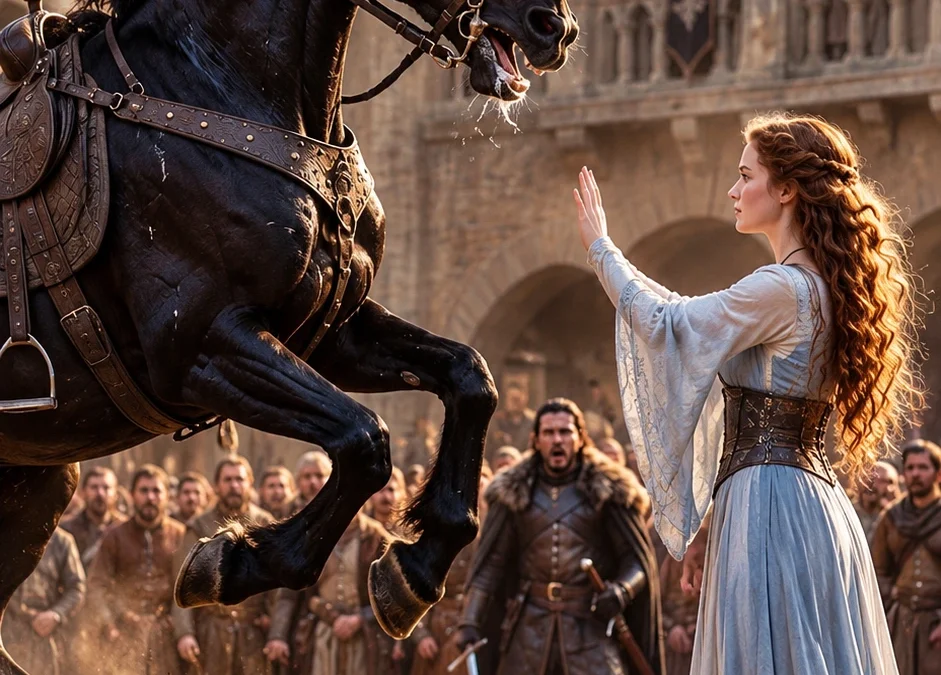
The Alpha King’s Warhorse Killed 3 Trainers and Obeyed No One. Then a Rejected Omega Maid Walked Into the Corpse Pit, Touched Its Bloody Muzzle, and Told the Entire Court One Sentence That Turned a Cousin Pale as Bone 😱🐺🐴
Part 1
The night Maeve Aldercroft stepped over the corpse-pit rope at Iron Fang, the executioner’s axe was already lifted. 🪓
Dawn was bleeding pink against the iron battlements, and the only living thing in the courtyard who recognized her for what she truly was had four legs and a mouthful of three trainers’ blood.
She did not know yet that the man watching from the wall above, the king with wolf-bright eyes and a scar bisecting his jaw, would within a single moon cycle break a thousand-year custom for her sake. She did not know that the polished cousin at his shoulder, all silver braid and courtly smile, was already counting the hours until she would be silenced.
She knew only that the great black stallion in the pit was screaming a grief so loud she could feel it in her teeth.
And that no one in the crowd of soldiers, stable hands, and gawking nobles could hear it.
They saw a feral beast. Frothing jaws. Rolling eyes. Three dead men in the straw.
They did not see what she saw: a creature kneeling inside its own mind beside a body it could no longer find.
The cold of the flagstones bit through her thin slippers. Behind her, Cook Sharon hissed her name and tried to drag her back by the apron strings. Ahead, Beta Master Garrick had already roared the order to strike.
And Maeve, who at sixteen had been marked rejected because her first shift never came, who had been called broken and lesser for seven years, who had survived the stronghold by scrubbing pots until her knuckles split and asking for nothing, walked across the frozen yard and put her bare hand on the bloody muzzle of King Torvin’s warhorse.
The stallion did not bite her.
He exhaled a long, shuddering breath that smelled of copper and hay and something old and inconsolable, and lowered his enormous head until his forelock brushed her wrist.
The axe did not fall. The crowd did not move.
Maeve, whose voice had rarely risen above the murmur needed to ask for the salt, lifted her face toward the wall and said, clearly enough that every soul in the courtyard heard:
“The horse is not feral. The horse is mourning.”
A breath.
“And the horse can still smell, on someone walking these halls, the man who killed his rider.”
On the wall, Torvin had been awake since the third bell. He had not slept properly in eleven months, not since his brother Cale rode out at the head of the mounted guard and came home across his own saddle with a crossbow bolt in his throat and his honor guard slaughtered to the last man. Only the horse, Vasker, had survived. He had carried Cale home and refused to let any living soul touch the body until Torvin himself lifted his brother down.
Since then Vasker had killed two grooms, savaged the undermarshal, and this very dawn gored a man named Edrin so badly that Edrin’s wife was being held upright in the kitchens by her sisters.
Torvin had given the order with ash in his mouth. Vasker was the last thing in the world that had loved Cale.
Then a girl in a flower-streaked apron had walked across his courtyard as if death held no meaning, touched a stallion that had killed three men, and told him in front of his entire court that he had been wrong.
He felt the wolf inside him stand up. Silent and grieving for eleven months, it lifted its head and said, in a voice quite distinct from his own:
That one.
He looked at the girl, at her impossibly thin shoulders, at the dark plait coming loose at her nape. Then at his cousin Garrick beside him, gone white. Then at his other cousin, Lord Regent Castain, who had gone whiter.
Torvin, King of Iron Fang, raised his hand and stopped the dawn.
He came down into the yard himself. Men fell away from him the way water falls from a thrown stone. Maeve felt the change in the air before she saw him, like a kitchen when someone opens an outside door in winter. She did not turn. She kept her hand on Vasker’s muzzle, because the stallion’s breath was still coming too fast and she could feel beneath her palm the place where grief had become a sound he could no longer stop making.
“Speak again,” the king said. “Tell me what you told the wall.”
She swallowed. Seven years of being invisible, and now she was the most visible thing in Iron Fang.
“He is not feral, sire. He is grieving. Most folk do not know horses grieve because most folk do not stand still long enough to listen. He has not been allowed to mourn. He has been muzzled and chained and asked to forget, and he cannot, because horses do not forget.” She kept her eyes on Vasker’s. “And there is something else. He smells someone. Someone who was there that day. Someone still inside these walls. He smells them every time they pass the stables, and he goes mad, because the only thing he has left of his rider is the memory of who took him. That is why he killed Edrin. Edrin walked him past the south corridor this morning. He was not aiming at Edrin. He was trying to reach whoever was in that corridor.”
Behind the king, Lord Regent Castain laughed, a small, polished laugh. How very kind, he said, that the child was clearly distressed. Grief in beasts was a poet’s notion. The horse was lame in the mind and ought to be put down before he killed a fourth.
Maeve did not look at Castain. She did not need to.
Under her hand, Vasker’s whole body went rigid at the sound of that laugh. His nostrils flared. The muscle along his neck jumped as if struck by a goad. In one heartbeat, grief became fury.
“Steady,” she whispered, only for him. “Steady.”
He smelled the killer of his rider. And the killer of his rider was standing six paces from his king.
Smiling.
Torvin, who had not moved, said without turning his head, “Cousin, step back.”
Castain stepped back.
Vasker did not lunge, because Maeve’s hand was on him, and because some thread between them, the thread she felt in animals the way healers felt it in wounds, was holding.
“Garrick, find a chamber adjoining the war room. The girl lodges there from this hour.” Then to Maeve: “You have one cycle of the moon to prove what you have told me. If at the end of it the horse cannot be ridden by my hand, he dies. If you are lying, you die with him. Do you understand the contract?”
She nodded once.
“What is your name?”
“Maeve.”
“Maeve,” said the king, more quietly, “do not let go of him until the yard is cleared.”
And Castain, smiling still, walked back into the keep like a man who has not yet decided which knife to use.
👉 Want Part 2? Find it in the comments, or leave any word below and I’ll send it to you privately! 🐺🌙
Part 2
Her chamber adjoined the war room. There was a door between them. The bolt was on her side.
She bolted it the first night and lay awake on a mattress thicker than any she had ever slept on, listening to the low rumble of the king’s voice through the wall, a rumble she could feel in the bones of the room, as if the walls themselves had a pulse.
By morning, word had spread. The broken omega touched the king’s horse and lived. No one in the kitchens knew whether to spit at her or curtsy, so they did neither, and that was almost worse.
She took bread and went to the stables before second bell. Vasker stood alone in the largest box, the stalls on either side empty because no horse would tolerate him. He pinned his ears at her, then unpinned them. She climbed onto the half door and ate her bread.
After a while, he came over and laid his great head on her knee.
And Maeve began to learn the shape of his mourning. He had loved his rider. His rider had smelled of leather and a particular smoke, and had hummed a low three-note song that Vasker carried in his ribs the way other creatures carry lullabies. And on the day his rider was taken, there had been other smells. Crossbow oil. And a man who came too close, who smelled of a particular soap, a soap Vasker had smelled again in the courtyard, the great hall, the corridors of the keep.
That smell was knotted in the horse’s mind with the smell of his rider’s blood.
She did not yet know whose soap. She did not name the polished cousin to herself. Naming a man without proof was the kind of mistake that ended girls like her.
On the second day, Beta Master Garrick came to the stable with his arms folded, a square man with hands that had broken many things on purpose. “No one ever told me a horse could grieve,” he said at last, the way a man says something that costs him.
“Most folk do not, sir.”
“What do you need?”
“Time. A pasture, not a yard. Dawn walks, before the keep wakes. And with respect, sir, I need every name of those who tended your king’s brother the day he died. Who cleaned his armor. Who dressed his body. Who walked the horse home. And what soap they used.”
Garrick stared. Then he barked a short laugh, not unkind. “By the bones, girl. You shall have your list by nightfall.”
The list held twelve names. One was Castain’s body servant, Pell. Another was Lord Regent Castain himself, who had insisted on personally laying out his cousin’s body, “out of love.”
She folded the list very small and tucked it inside her bodice. She told no one.
Each dawn she walked Vasker into the upper pasture where the frost lay heavy and the only smell was earth, and let him breathe air that did not contain his grief. The king watched from the gallery above. She did not know it. His wolf, silent for eleven months, would not stop speaking. It wanted to know why she never flushed or preened or angled herself toward him like every other unmated woman in the stronghold. It wanted to know, with confused affront, why she could not feel him watching.
On the fourth day, Torvin came to the stable and found her in the straw with Vasker’s head in her lap, softly naming her dead. Her mother, who died of fever when she was nine. Her father, who had not died but had walked away when the rejection mark went on her, which was a different kind of dying. The cat that slept on her feet in the scullery and was kicked to death by a drunk undermarshal. The kitchen boy with the limp. The bird that broke its neck on the great hall glass.
She had been doing it for two days, to show the horse how it was done. Grief eases when the names of the lost are said aloud to someone who will not flinch.
Torvin had come to inspect, to satisfy the council that the king was not bewitched by a scullery omega. Instead he stood in the doorway and listened to a girl name a kitchen boy as if he had mattered, and the wolf inside him made a sound he had never heard from it. Soft. Confused. Almost a whine.
He knelt in the straw, which a king did not do, and set his hand palm up between himself and the horse. Vasker lifted his head from Maeve’s lap and looked at the king for a long moment. Then, after a slow breath, he lowered his muzzle into the open hand.
Torvin bent his forehead to the stallion’s, and Maeve, who could not scent the wolf in the man, could see plain as morning that the king was weeping without sound.
She looked away. Some things were not for her.
“He has not let me touch him since Cale,” Torvin said at last.
“He was waiting, sire, to be told it was allowed. To grieve where you could see him. He thought you would not want him if he was broken.”
The king was quiet a long time. “Where did you learn this?”
“I do not know. I have always heard them. I cannot scent another wolf, not my mother, not my father, not the priestess who marked me rejected. I have been told all my life I am the wrong shape of person. But I can hear what a horse remembers. It is the only thing I have.”
He looked at her properly for the first time, straw in her hair, a horse’s tear-track on her sleeve. And the wolf inside him said, very clearly:
Ours.
“You will eat at the high table tonight,” he said.
“Sire, please, no.”
“Because if you keep taking your bread in the kitchens, my cousin will find a reason to put something in it.”
She went still. She had already understood which cousin.
At the feast she wore a dark green wool dress Cook Sharon had altered, weeping, from an old queen’s mourning gown, its high collar hiding the rejection mark. Castain sat in the heir’s seat and ate nothing he had not seen poured. Maeve did the same, and drank only from the pitcher Garrick himself filled. Garrick, her enemy four days ago, now sat at her elbow as if posted there.
Lady Frieda of Hollowmeer, who had been preparing since twelve to be queen, leaned across the table. Had anyone thought to check the scullery girl for fleas?
The hall laughed. Maeve, who had been laughed at for seven years, did not flush.
“My lady, the only fleas in Iron Fang are in the heir’s chamber, because the heir’s hound has not been treated in three months. She has begun chewing her own tail. If you permit, I can have her comfortable by morning.”
Silence.
Castain smiled at her, a smile she would remember. “How charming. The girl who whispers to beasts. Tell me, child, do they whisper back?”
“Yes, my lord. They tell me what they have smelled.”
His smile did not move. But his hand on the stem of his cup went, for the briefest instant, white.
At the head of the table, Torvin watched it happen. And beside Maeve, Garrick exhaled through his nose, the way a man does when a trap has settled into place.
After dinner a small hand tugged her elbow. A girl of about six, in a sleeping shift, hair the color of new straw, clutching a very fat, very anxious puppy.
“You are the one who hears them. This is Brindle. I am Katie. I am the king’s ward. My father was Cale.”
Maeve’s breath caught. She knelt, and the trembling puppy sighed and leaned into her hand.
“Brindle is sad. He misses my father too. Will you tell him my father went on a long ride, and it is taking longer than we thought?”
Maeve, who would later understand this was the moment that decided her, said, “I will tell him better than that. I will tell him your father loved him very much and will not be coming home, but you are still here, and he is your dog now, and his job is to sleep at the foot of your bed and be brave for you. A very important job. He has been promoted.”
Katie considered this with the gravity of small children about important matters. Then she leaned up and kissed Maeve on the cheek.
Maeve, who had not been kissed by a living thing since she was nine, held herself very straight and did not weep.
That night, Torvin knocked on the door between their rooms.
“May I sit?”
“Sire, this is your house.”
“Maeve. I am asking.”
She let him in. And he told her the thing she already knew: his cousin was going to try to kill the horse. “When we are alone, call me Torvin.”
“Torvin,” she said softly, and he closed his eyes.
“I cannot tell whether you can feel this, whatever this is between us. I have never been near a woman who could not feel me coming into a room. I do not know what to do with it.”
“I cannot feel it, my lord. I have never felt anything from any wolf. I know what that means. There can be no bond. I would not embarrass either of us by pretending.”
His wolf stood on its hind legs and howled, but he did not let her see, because she could not see it, because that was the whole problem, because he was going to have to learn an entirely new language to court her.
“Then we will find another way.”
👉 Want to know what Torvin brought her, and what Castain did on the day of the council ride? LIKE and comment “REVEAL” to unlock Part 3! It will be posted as soon as we reach enough comments. 🐺🌙🔥
Part 3
He courted her in a language she had to teach him as he learned it.
He could not bring his scent across a room. He could not let her feel the prickle of pack presence the way every other wolf wooed every other wolf. So he brought her things she could see, touch, and hear.
On the seventh day, a wool shawl, laid across Vasker’s half door by Garrick, with no note, because a note from a king to a scullery girl was a thing the keep could weaponize. She knew at once who it was from. She wore it on her dawn walk, and from the gallery the wolf inside him purred.
On the ninth day, a carved wooden horse no bigger than her thumb, with a tiny notch in the ear where Vasker had a notch, set on the war room windowsill where the sun struck it at the hour she always passed. She put it in her pocket and kept her hand around it all day. And the king, in council, kept losing the thread of what his lords said, because he could feel through the whole stronghold the small warm fact of a girl holding a wooden horse.
On the eleventh day, Katie, every afternoon for an hour, which he called tutoring but was only the four of them sitting in the straw, the child, Maeve, Brindle, Vasker, in a row.
On the thirteenth day, himself.
He came down at dusk and sat beside her on a straw bale. He said nothing. He laid his hand palm up on the bale between them and waited.
After a long moment, Maeve put her hand in his.
His fingers closed around hers the way a man closes his fingers around a moth he does not want to crush. They sat for an hour. He did not try to kiss her. He did not lean. When the evening bell rang, he lifted her hand and pressed his lips once, very gently, to her knuckles, and walked out.
And Maeve sat alone a long while, holding her own hand as if it had been changed. 💛
On the fifteenth day, Garrick came at dawn, his face the color of bad cheese. “Girl, the bran mash for tonight has been touched.”
She saw it without scent. An oily cast at the bucket’s edge. A dust of yellow-green at the rim. A barn cat that had jumped up to investigate and jumped down to vomit in the corner.
“Wolfsbane,” Garrick said quietly. “Enough for any horse who ate it.”
Maeve crouched, laid her hand on the cat’s back, felt the poison scraping along its nerves, and breathed with her, slow and slow, until the cat blinked and curled up to sleep.
“They did not get past my watch,” Garrick said.
“They did not. It came on the noon feed wagon. Whoever did it was in the kitchens at noon, with a pocket and a steady hand.”
“Pell?”
“Yes.”
“And Pell takes orders from…”
“Yes.”
“A horse is not a witness.”
“Then we will give him a voice.”
They told the king. He listened with his hands flat on the war table. When they finished, he said, “The council ride happens as planned. Castain rides at my left as cousin regent. Vasker is the horse I ride.” Garrick made a noise. “I trust this girl with my brother’s horse. I trust her with my brother’s child. I trust her with my own throat.” He looked at Maeve. “Do not tell me yet that I am wrong.”
“You are not wrong, Torvin.”
The night before the ride, he did not knock. He opened the door between their rooms and stood with the lamplight behind him. She sat on her bed in her shift, braiding her hair for sleep. She did not cover herself. With no scent for him to hide behind, she had never learned to hide at all.
He sat beside her, took the end of the braid from her hand, and finished it himself, with fingers not as clumsy as a king’s should have been. Then he laid his palm against the side of her throat, over the rejection mark, and kept it there, warm.
“If I die tomorrow, I want you to know.” He did not have the words. He had been raised among wolves who courted with scent and pack pressure and silent shapes. So he said it the way a man says a vow at an altar. “I love you.”
Maeve, who had never been told it, who could not scent whether it was true, asked the only honest thing she could.
“How do I know?”
He went very still.
“I am not asking to wound you. I cannot scent you, and you know it, and I do not have the thing other women have to tell them. So I am asking. How do I know?”
He thought for a long time, his hand on her throat, the candle guttering. Then he stood, opened the door, and whistled, low and short.
The fat puppy Brindle came waddling in. Behind him came Vasker, who should not have been in the keep at all, led up the servants’ stair by Garrick himself, who filled the doorway like a second night, walked across the rug, and laid his muzzle in her lap. Behind him came little Katie in her sleeping shift, holding the hand of Cook Sharon, who was weeping.
“You asked how you know,” the king said. “Ask them.”
Maeve put her hand on Vasker’s muzzle, on Brindle’s head, on the child’s hair, and felt the truth of him through every one of them. The horse who had refused all human touch for eleven months had let this man weep into his forelock. The puppy who feared every boot leaned into his. The child who had lost her father slept easy in his keep. And Cook Sharon wept because a girl she had raised in her kitchen was being chosen openly, in front of witnesses.
The kitchen knew what the high table did not: Maeve had never been broken. Only differently made.
“I know,” she said.
He crossed the room and knelt at the side of the bed. “Will you let me?”
“Yes.”
It was not a king’s kiss. It was the kiss of a man who had spent eleven months being careful and had found something he did not have to be careful with. And it ended not in treachery but in Vasker, who, deciding he had been still long enough, bumped the king so hard in the shoulder that Torvin rocked sideways. Katie laughed. Sharon half sobbed, half laughed. And Maeve, hands in his hair, laughed too, because the moment was too full of living things to be solemn.
“Tomorrow, after the ride,” he whispered against her forehead, “I will come back to you.”
The council ride went out at midmorning. Twelve riders. The king at the head on Vasker, Castain at his left on a pale gray, Garrick at his right on a bay. The courtyard crowd was triple what it should have been. The keep wanted to see whether the king’s mad horse would throw him.
Maeve stood at the gate with Katie on her hip, Brindle on a lead, and Sharon at her shoulder. She watched Vasker go out beneath the king, one ear cocked back to Torvin the whole time, holding his grief to one side because his man had asked him to.
Within the first hour, she knew something was wrong, because Brindle would not stop whining. He was staring at the gate.
“Sharon. Saddle me anything. The mule. The bread-cart pony.”
Sharon, who was no fool, did not ask. Maeve swung astride the stout, fat bread-cart pony called Bun in her green wool dress, handed Katie over, and rode out of Iron Fang at a flat gallop with Brindle yelping at her heels until a stable boy snatched him up and followed.
She reached the standing stones before they saw her. The council stood off their horses, ringed around something on the ground. Castain stood at the edge of the ring, his face arranged in grief. The thing on the ground was Garrick. It looked like a fall from his horse, but even from a hundred yards on a fat pony she could see the angle was wrong. The bay stood too quiet, too clean along the flank. The only blood was on the back of Garrick’s head and on Castain’s left sleeve.
She rode into the ring without dismounting. And in a voice that was not a scullery girl’s:
“Lord Regent Castain struck Beta Master Garrick from behind with the pommel of his own dagger six minutes ago. He meant to blame the king’s horse. The dagger is in his left sleeve. The blood on that sleeve is Garrick’s. And I offer you, my lords, three witnesses.”
The stable boy arrived panting with Brindle in his arms. The puppy ran not to Maeve but to Castain, bared his small teeth, and growled at the regent’s left boot. Behind the king, Vasker screamed the scream he had screamed in the corpse pit, the scream of a horse who had smelled the killer of his rider, and lunged, not at the king, not at Garrick, but at Castain. The king, who had been ready, threw an arm across the stallion’s chest and barely held him.
“Cousin. Empty your sleeve.”
“This is absurd! A child’s puppy and a mad horse and a scullery…”
“Empty your sleeve.”
Castain ran.
Pell, holding the pale gray, saw what was happening, dropped the reins, and fled the other way. Castain stumbled across the broken ground in his fine boots, the council shouting behind him, and made it as far as the river’s edge, where cold water ran fast over flat slabs of granite. Looking back over his shoulder at the king, the horse, and the girl, he did not see the slab.
His right boot struck it. The loose dagger in his left sleeve swung as he fell. Its weighted pommel, made for striking, drove under his own ribs as he came down on the stone.
He did not get up. The river took the rest.
Garrick, who had not died after all, thick of skull and thicker of grudge, found him two bends downstream, his own blade through his chest and his polished smile gone.
The eldest councilor, who had served three kings, looked from the river to the girl on the bread-cart pony, the puppy at her feet, and the great black horse with his head pressed to the king’s shoulder.
“Sire, I believe we have ridden long enough.”
Torvin, one hand on Vasker’s neck and his eyes on Maeve, said, “Aye. Let us go home.” 🐴
The wedding was at the next moon, in the upper pasture, with the frost just gone and the first green coming through. Cook Sharon officiated, because Maeve wanted no priest who had ever called her broken to bless her now. Torvin said yes, the way he said yes to her about everything. He bit her gently at the join of neck and shoulder, the mark of the alpha king’s claim. She did not feel the bond settle the way other women did, because she could not. But she felt his teeth, his breath, his hand at the small of her back. And she felt through Vasker standing behind them, through Brindle at their feet, through Katie holding the ribbon, through Sharon weeping into her apron, the absolute fact of being chosen.
That was enough, and would always be enough. And Torvin, who had learned in one moon cycle to court without scent, knew it without being told.
They lived. Through the spring of scrubbing out the council, because Castain had had fingers in many pots. Through the summer of Vasker learning to be ridden by others. Through the autumn when Garrick married Cook Sharon in the kitchen yard, surprising no one who had watched them argue over a stew pot for fifteen years. Through the winter when Katie, now seven, declared she would be a horse listener like her Aunt Maeve, and Maeve, hearing herself called aunt for the first time, sat down on the kitchen step and hid her face in her apron before she could answer.
“Yes, my heart. You are.”
And on a morning in the second spring, in the upper pasture where the frost had again just gone, Maeve stood with one hand on Vasker’s muzzle and the other low on her belly, where something was beginning that she did not yet know the shape of, but that the horse, nose pressed against her dress, very clearly did.
Torvin came up the pasture in his shirtsleeves with two cups of tea. He saw her. He saw where her hand was. He stopped halfway with the tea in both hands, and his face did a thing she had learned to read as well as any scent.
“You knew before I did.”
“The wolf has known for three days. I was waiting for you to tell me, because I did not want to take it from you.”
“Come here, you ridiculous man.”
He set the tea on a stone, laid his hand over hers, and pressed his forehead to hers. Vasker blew a long warm breath over them both. Brindle, now an enormous fat hound with a gray muzzle, lay down on her foot. And Katie, coming up the path with a basket, shrieked at the top of her lungs because she had guessed. 🥹
That morning, the upper pasture held every single thing Maeve had been told in seven years of being broken that she could not have.
She had it anyway. Because a horse in a corpse pit had laid his head in her hand and named her, in a language only she could hear, as the one who heard. Because a king had learned in one moon cycle to court a woman who could not scent him, by bringing her every living thing in his keep until she had to admit that a man loved by that many creatures could not be anything but loved by her, too.
When the standard test of the bond had been taken from her, another test had been offered. It was the harder one. And she had passed it.
So had he. 🌙🐺
This story is entirely fictional and created for entertainment purposes only. It does not represent any organization or individual, nor does it encourage inappropriate behavior. The content was generated with AI assistance.








