THE APACHE GIRL WAS LEFT TO DIE BEHIND A FALLEN TREE: THEN THE BROKEN COWBOY WHO SAVED HER FOUND A SECRET NAME IN HER POCKET THAT BROUGHT 50 WARRIORS AND THE U.S. CAVALRY TO HIS DOOR
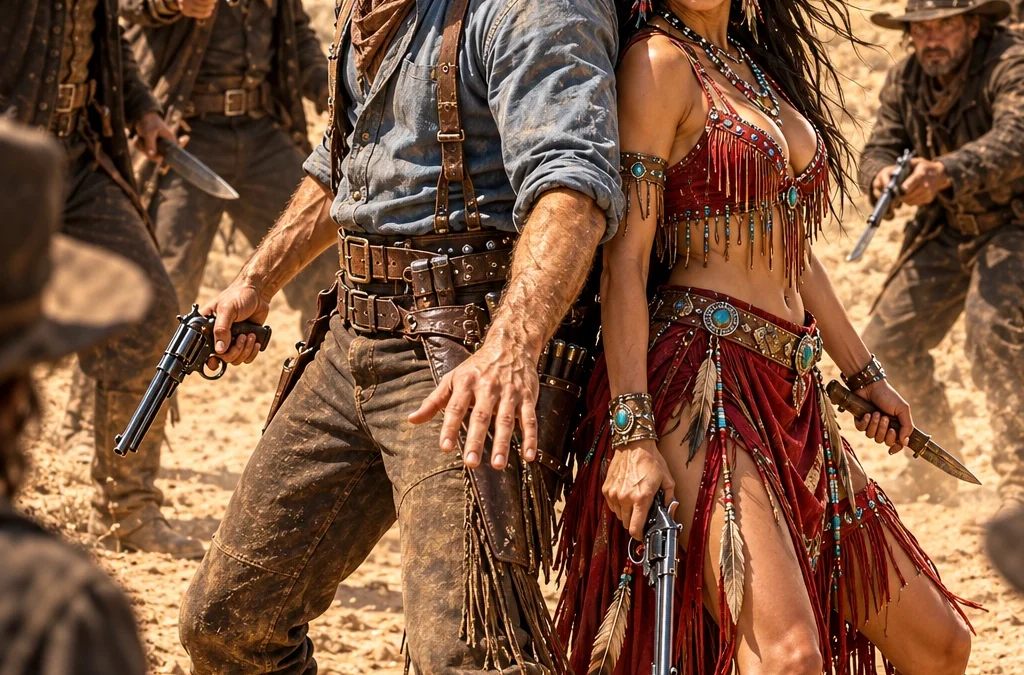
THE APACHE GIRL WAS LEFT TO DIE BEHIND A FALLEN TREE: THEN THE BROKEN COWBOY WHO SAVED HER FOUND A SECRET NAME IN HER POCKET THAT BROUGHT 50 WARRIORS AND THE U.S. CAVALRY TO HIS DOOR 😱🔥
Part 1
Three gunshots shattered the silence across the dry bed of Willow Creek.
Sharp. Brutal. Then one more, cold and deliberate. 💥
Behind a massive fallen cottonwood, a young girl lay pressed against the dirt, her buckskin dress soaked dark with blood across her shoulder. Her eyes were wide open. No fear. Only the ice-cold calculation of someone who had already made peace with dying.
The wound was wrong. Too small. Too clean. Not military.
Hoofbeats approached through the brush. A lone rider pulled up ten feet away, his hand frozen near his pistol. He stared down at her. She stared back.
The air hung tight as a bowstring. One wrong move, and everything would explode.
Earlier that morning.
The fence wasn’t broken. Eli Calhoun knew that. He had checked it three days ago, and the day before that, and the day before that.
But here he was at five in the morning, hammer in hand, standing in the same northeast corner of his property he had stood in for eleven days straight, hitting nails that didn’t need hitting into posts that didn’t need fixing. Because outside was not inside. And inside was the hook.
Ruth’s apron was still on it. The one she had worn every morning for twelve years. Faded blue cotton, with a small burn mark on the left pocket from the time she leaned too close to the stove and neither of them noticed until they smelled it. She had laughed about that. A real laugh, the kind that started somewhere low and surprised even her.
Three years. And Eli could still not walk past that hook without his chest doing something he had no name for and no patience with. 💔
Grief doesn’t negotiate. It doesn’t check whether you are busy. It just sits there on the hook and waits.
So he hit nails that didn’t need hitting and watched the Texas sky turn from black to bruised purple to the particular orange that made the cracked earth look almost beautiful. If you didn’t look too hard. If you didn’t notice the grass that gave up in July, or the creek bed that once ran waist-deep and now showed only pale rock and the bones of a coyote.
Year two of the drought. Year three without Ruth.
Then the shots came. Three, then silence, then one more, from the direction of Willow Creek.
Every smart rancher in 1876 Texas had a system for this. You heard gunshots. You noted the direction. You went inside, locked the door, and minded your own business.
Eli stood there with the hammer hanging from his hand and thought about being smart.
He thought about 1873. The territorial council in Abilene, the long tables spread with maps, all those careful lines drawn through land other people were living on. The petition that said the Comanche should be relocated by whatever means available. Magistrate Aldis Fen standing up at the end of the table, saying in his flat, deliberate voice, “This is a moral disgrace, and every man who signs it will answer for it eventually.”
The room had gone quiet. Then, one by one, the pens had moved. Including Eli’s.
He had signed. The same reason men do most things they later regret. Because the room expected it.
He had gone back alone the next morning and crossed his name off with two careful horizontal lines. Told no one.
Six months later, Ruth caught fever. Eli was four days away at another meeting, being smart, being a responsible member of the community, being everything except what he should have been. Home.
He walked to the barn and saddled his horse. 🐎
At Willow Creek, he found her behind the fallen cottonwood. Sixteen years old, maybe less. Her eyes were open, and they contained absolutely no fear. Only a rapid, precise inventory of his size, his hands, his horse, the distance to cover.
His hand went to his rifle. He knew what she was. He knew what her people had done. And he knew what the smart thing was, with nobody watching and nobody to answer to.
She watched him look at his own hand. The patience in the way she watched him decide.
That was what made him take his hand off the rifle.
“I’m going to help you,” he said. “You don’t have to like it.”
Then he saw it, the thing he set aside because the moment was too urgent. The wound was the wrong size. He had seen enough gunshots in four years of war to know army ordnance. This wasn’t.
Someone outside the army had shot this girl. 🕯️
He got her onto his horse, though she drove an elbow into his jaw hard enough to make his vision strobe white. He talked the entire ride home, though she understood nothing, because somewhere around the halfway point he noticed that when he stopped, her breathing got worse. So he told her about the fence. About the first winter he and Ruth burned their own fence posts for warmth and spent March rebuilding them.
In the barn he laid out the knife, the needle, the whiskey. He waited. Ruth had taught him that. Don’t rush people, Eli. Give them the ground to stand on.
She held out her arm. And for an hour he worked, while she bit down on folded leather and made exactly one sound.
When it was over, he found two things in her clothing. A small piece of carved bone on a cord. And a folded piece of paper.
Fine paper. Not frontier stock. English handwriting, a list of locations and times, and a signature at the bottom whose slanted capitals sparked a memory he couldn’t reach.
Someone had planned this.
Part 2
Someone had planned this.
At three in the morning, Eli sat on an overturned crate in the barn with his hat pulled over his eyes, not sleeping. He heard the change in her breathing. The pause. The quiet full-body inventory of someone waking in a strange place.
He heard her find all three exits.
When he pushed his hat back, she was already looking at him. Not with fear. Not with calculation. With the look of someone who has already made a judgment and is only confirming it.
Then she closed her eyes. Deliberately. Like a verdict being filed.
Eli sat in the dark, and something moved in his chest. He had been alone three years, and had forgotten what it felt like to be seen. 😶
The fever arrived at dawn. And so did the drums.
Distant. Low. A pulse that reached the chest before the ears. He went to a gap in the slats and counted twice, the way he had counted enemy positions in the war.
Fifty mounted warriors, painted, spreading across the northern approach in a slow, deliberate arc. At the center, on a painted stallion, a man with gray in his braided hair and a lifetime of consequence across his face.
“Your father,” he said to the girl. She pressed her good hand flat against the hay beside her. Stay.
He thought of Ruth. A man’s worth isn’t what he builds. It’s what he refuses to walk away from.
He left his hat on the crate. Hats looked like a man about to go somewhere. He opened the barn door and stepped out with both hands raised.
Fifty arrows found him instantly. He had expected that. He had not expected the silence.
“She’s alive,” Eli said, slower than his heartbeat. “Your daughter is alive. She’s hurt, but she’s going to heal. I found her by Willow Creek. She would have died there.”
“Show her to us,” said Chief Greywolf.
When Eli turned, the girl was standing in the barn doorway, one hand on the frame, her face bright with fever. She did not look at Eli. She looked at her father and said three words in Comanche.
Eli would learn their meaning much later. He saved me.
It should have been enough. But a younger warrior beside the chief leaned close to his ear and began whispering fast, his eyes fixed on Eli. Eli watched the chief’s softening reverse. The fury came back, muddier now, more dangerous for the doubt beneath it.
And Eli’s hand found the paper in his pocket.
The girl, whose name was Sawa, began speaking louder, directly to her father, past the fever and the pain. The young warrior’s face went very still. The chief’s tomahawk rose. Not toward Eli.
Toward the man on his left. 😳
His name was Daka. And when Sawa finished speaking, Daka’s hand went for his knife, and Eli moved before his brain finished the equation.
He tackled him. They hit the dry Texas dirt hard. A blade opened a line across Eli’s forearm. Daka got on top, the knife coming up again with intent.
Eli’s hand closed on a flat piece of limestone, the size of his palm.
One swing. Daka went sideways into the dust and stayed there, breathing.
The ranch went silent.
“You protected my daughter,” said the chief, looking down at Eli’s bleeding arm. “From one of my own.”
“I know what he has done,” the chief continued, flat and cold. “My daughter told me. Daka has been giving information to the army for eight months. Locations. Movements. Our plans. In exchange for money and promises about land.”
Eli handed him the paper. The chief unfolded it, and his jaw tightened.
“This handwriting,” Eli said. “I know it. Captain Breck Holloway. He passed through eight months ago, said he was surveying. Stationed at Fort Sill.”
Then he understood the shape of it, and it chilled him.
“He needed your people to look like the threat. He needed a trigger. Your daughter, shot with a civilian rifle so it couldn’t be traced to the army. Daka feeding him your position. A white rancher nearby to find her and bring her in, which would look like a kidnapping. And when you came for her with fifty men painted for war surrounding a white man’s ranch…”
“He would already be on his way,” said the chief.
From the north ridge came the sound of cavalry horses at a controlled trot. Two columns, closing from two directions, timed to arrive after the picture was complete.
And on the paper, below the locations, in different handwriting, Eli had missed a second name. D. Puit.
Declan Puit. A neighbor of twelve years. A man Eli had helped through two bad harvests and a horse sickness that nearly took his whole stock.
D. Puit had pulled the trigger.
Eli stood with that knowledge for exactly four seconds. Then he put it away.
“We need higher ground,” he said. “And we need Hank Devo.”
The cavalry came over the ridge at 7:43. At its head, a clean-shaven captain with a face that belonged on a recruiting poster, who took in the scene below, and saw that it wasn’t the one he had staged.
“Stand down, son,” Holloway called. “We’re here to get you out.”
“I don’t need getting out,” Eli called back from the barn roof. “Who gave the order to shoot the girl?”
The silence held. Eli watched the captain’s jaw shift.
“I also think Magistrate Aldis Fen is going to find that authorization very interesting reading.”
At the name Fen, something flickered behind Holloway’s eyes.
Then he raised his hand, and the cavalry charged. 💥
Part 3
The first shots hit the barn itself, the warning kind. Splintering wood. Pigeons exploding from the rafters. Then the Comanche returned fire, and the morning became noise.
Eli flattened on the roof and fired toward the east ridge. Not at the men. At the horses, the formation. Disrupt the formation and the assault slows. Slow the assault and time appears.
Below him, Chief Greywolf had transformed. The grief and betrayal were set aside with a completeness Eli found remarkable. What remained was a commander, moving his people through the ranch with an efficiency that turned buildings and fence posts and a water trough into defensive architecture Holloway had not designed for.
The second charge broke against it.
But the third would be worse. Eli counted his rounds. The number was not encouraging.
Come on, Hank, he thought. Come on.
Hank Devo arrived eighteen minutes later, about eleven minutes later than the situation would have preferred. He came over the south rise with nine ranchers behind him, armed with rifles and shotguns and, in old Creswell’s case, a pistol with a history.
They did not ride toward the Comanche. They rode toward the cavalry.
Hank, sixty-one, with a face like geography and a voice like a barn door, pulled up in open ground between the two forces.
“Who’s in command here?”
“Captain Breck Holloway, United States Army.”
“I know who you are. I saw you ride through here eight months ago. You asked me about water sources along the eastern ridge. I thought you were surveying.” Hank let that settle. “Now I’m looking at what you’re pointing those guns at, and I’m revising my understanding.”
On the ridge, some of the soldiers were looking at each other. They had signed on for order and purpose. Nobody had signed on to shoot a sixteen-year-old girl and call it a survey operation.
“This is a military operation,” Holloway said.
“Eli Calhoun is down there,” said Hank, flat, as if that were the whole argument. “In fifteen years I never saw him standing in the wrong place. So either he’s gone out of his mind, which I doubt, or the wrong place isn’t where I think it is this morning.” 🐎
Holloway pulled a paper from his jacket and raised it. “I have full authority to…”
“What does it say?”
The voice came from the barn doorway. Sawa had come out again. Nobody had been watching.
“She can read,” Eli called from the roof, realizing it only now. “English. Someone taught her. Someone whose handwriting I recognized on a paper in her pocket.”
At 9:15, Magistrate Aldis Fen arrived on a brown horse, summoned by Hank before he had even ridden out. He took in the two columns, the warriors, the ranchers, Eli on the roof, the captain with a raised document, and the girl in the doorway.
“Captain,” he said, not loud. He never needed to be. “Bring that paper down here.”
Fen read it twice. The second reading is where a document tells you what it actually says. Then he turned to Sawa.
“Young woman, I need you to tell me specifically what you saw.”
She spoke for a long time. Eli translated imperfectly. She described a meeting three months ago between Daka and a white man in army uniform near the eastern ridge. A silver ring on the man’s right hand, with an eagle’s head. A gray horse with one white sock. A document with a seal that Daka had burned. A conversation overheard three weeks ago, planning how the shooting should look.
And she described looking up from behind the fallen cottonwood and seeing a man with a civilian rifle. His face. His ring.
Everyone in the yard looked at Captain Holloway’s right hand.
Silver. An eagle’s head. 🦅
The recruiting-poster certainty was gone. What remained was whatever had been underneath it.
“Captain Breck Holloway,” said Fen, “I am placing you under civil authority pending a full inquiry into the events of the past eight months. Surrender your weapon and your documents. Now.”
Holloway looked at his columns. Some of the men were already looking at the ground.
That night, Eli rode to Fen’s office, not waiting for morning. Because if he waited, he knew himself well enough to know he would find a reason not to go.
On the desk, under the lamplight, lay the 1873 petition. The original. With his own name on it, and beneath it, in different ink, two careful horizontal lines.
“I’ve had it since 1873,” Fen said. “I was the one who processed your correction. You never told Ruth, did you?”
“I kept almost telling her. And then she was sick and I wasn’t there. And the thing I hadn’t told her became the thing I could never tell her.” Eli’s voice cracked. “I’ve been carrying the signing and the crossing out as the same weight. Like the correction didn’t count.”
“It counted,” said Fen.
Two words. In that lamplit room, at that hour, exactly enough.
Eli laid his hand flat on his own name and told him everything. The caliber. The paper. The ring. Declan Puit.
“Twelve years,” Fen said quietly.
“You told a whole room once that the truth doesn’t get easier to say if you wait. It just gets heavier.”
“I said that in 1873.”
“I’ve thought about it a lot.”
The next morning, Fen held the proceeding in the open ranch yard, with Chief Greywolf and eight warriors standing to one side, and Sawa watching from the barn step. Puit stood before him, thick-shouldered, weathered, a face Eli had sat across from at dinner tables.
“Did you fire the shot that wounded this young woman?”
A long pause. Puit’s right hand opened and closed twice.
“Yes.”
Chief Greywolf made a sound from somewhere below language.
Fen delivered his ruling standing, in the August sun, in a dusty suit with rolled sleeves. Holloway relieved of command. The authorization declared invalid on three grounds. Declan Puit held for trial on charges of assault and conspiracy.
As the deputy led Puit away, the old neighbor looked at Eli one last time. Eli had nothing to say that could make twelve years coexist with what had been done. So he said nothing.
Before Fen rode out, he handed Eli the petition.
“A man should have the evidence of his own correction. Not to display. Just to know it’s real.” He paused. “The men who signed and stayed signed were afraid. You were afraid too. But you came back the next morning.” 🌅
Sawa stayed two weeks. Then two more days, by her own choice.
They were not easy weeks. The fever spiked again, and Eli sat up three nights in a row. The language gap was sometimes a wall. And there were moments when Ruth’s absence in the cabin was so acute he had to stand outside in the heat before he could go back in.
But he taught her words, naming the water trough, the fence post, the barn cat he had never named because naming something meant keeping it. She named the cat instantly. Later he learned the word meant stubborn.
She taught him to read the ground. To find water by watching where the birds went at dawn. To sit so still that the landscape stopped treating him as an intrusion.
On the fifth day, she stopped by the hook inside the door and touched Ruth’s apron with one finger. Neither of them said anything.
On the ninth day, she found him on the porch with the petition. He pointed at his name, then at the lines. “I signed it. I thought I had to. I came back and crossed it out. But I never told anyone. I was ashamed of the signing, so I couldn’t take credit for the correction.”
She took the paper and folded it. Then she pressed her hand over her heart, moved it outward, and opened her fingers.
Let it go.
“I’m working on it,” he said. She nodded, as if that were acceptable progress.
On the fourteenth day, Chief Greywolf came back and walked alone into the yard. He looked at his daughter, sitting in the shade with a piece of leather and a bone tool. He looked at the cat.
“It means stubborn,” he said.
“That’s accurate.”
From his belt he drew a beaded medicine bag, worn soft with age. “This belonged to my wife. Sawa’s mother. She believed that people who carry good things find each other eventually, like water finding low ground.”
Eli took it. It weighed almost nothing, and more than almost nothing.
On the sixteenth morning, Sawa saddled her horse before dawn. Eli walked across the yard and handed her a page torn from the back of the almanac.
She read it slowly, one English word at a time.
You came into my barn and changed the direction I was facing. Three years I was facing the wrong way. You changed it. Wherever you go, there is a ranch in Texas with a gate that is always open.
She folded it into her pocket. Then she laughed, short and real, and pointed at the loft, where the cat sat at the edge, watching with elaborate indifference.
“He’s going to be insufferable when you’re gone,” said Eli.
She mounted in one motion and rode north without looking back. It was exactly right. She had already paid what looking back costs.
Eli went inside. He stood before the hook for a long time. Then he took down Ruth’s apron, held it to his face, and found it no longer smelled like her. Three years was too long. But it was still hers.
He folded it carefully and laid it in the trunk with the letters and the pressed wedding flowers. It wasn’t a goodbye. Ruth wasn’t on the hook. Ruth was in the trunk, and in the years, and in the correction he had made, and in the voice he had used to give a frightened girl something to track.
The hook was just a hook. 🕊️
Thirty years later. October, 1906.
Eli Calhoun was sixty-eight. The cabin had grown. The creek had come back after the drought broke in 1879. His ranch had become the place where people on opposite sides of something difficult came to sit down together and be heard.
He was sitting on the porch with his coffee when he heard a single horse coming from the north.
He knew her before he saw her face. By the way she sat the horse. By the quality of attention in her posture, reading the landscape as she moved through it.
Sawa was forty-six. Thirty years of difficult work in difficult places had not diminished her. It had made her more completely herself.
“You look terrible,” she said in clear, accented English.
“I’ve had a week.”
“You’ve had thirty years.”
“The week was worse.”
She had come four days, after a letter that reached her late in Washington, where she spent her life sitting across tables from powerful men, explaining the same hard truths until they were understood or the men were replaced. Fen had died the day before. Quietly, in his office, with documents still on his desk.
“Were you in time?” she asked.
“He knew I was there. He squeezed my hand.”
“Then you were in time.”
She stayed three days. On the morning she left, she set a small, smooth, gray stone on the porch rail beside his coffee cup.
“Comanche custom. When someone dies who mattered, you bring a stone to where they lived. To say, I remember. I will say your name. Your life is carried forward in me. It is for Fen. Will you tell him at his grave?”
“Yes.”
She turned to go. “Sawa.”
He took from his shirt pocket the medicine bag, soft and dark with thirty years of handling. “It was your mother’s. It should go home.”
She took it in both hands, and for a moment she was sixteen again.
“I’ll bring it back.”
He shook his head. “No. You bring it to the next person who needs it. That’s how I think things like that work.”
She considered that. Then she nodded once, mounted, and rode north into the October morning without looking back.
Eli stayed on the porch until the tree line gave back nothing but tree line. The cat sat beside him, also watching, also still.
He picked up his coffee.
It had gone cold. ❤️
THE END
This story is entirely fictional and created for entertainment purposes only. It does not represent any organization or individual, nor does it encourage inappropriate behavior. The content was generated with AI assistance.








