THE BABY DRAGON CRIED OVER HER BROKEN TOY—THEN THE HUMAN DID SOMETHING NO DRAGON EXPECTED
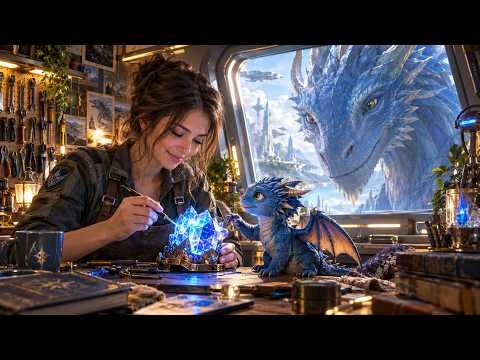
THE HUMAN FIXED THE DRAGON’S BROKEN TOY—AND AN ANCIENT DRAGON LEARNED THAT BROKEN DOESN’T MEAN WEAK
At dawn, I returned to the nesting hall carrying the little mechanical bird in both hands.
Ashka was awake.
She had spent the entire night curled in the same place, but the smoke had stopped coming from her nostrils. When she saw the brass bird resting in my palms, her golden eyes widened.
For several seconds, she didn’t move.
Then one tiny claw reached forward.
She touched the repaired crank.
I wound it.
The wings began to beat.
Slowly at first, then steadily, the brass bird flapped and released the tiny mechanical chirp I had built into it months earlier.
Ashka made a sound I had never heard from a dragon.
It was somewhere between a gasp and a laugh.
She pulled the bird against her chest, careful not to crush it, then pressed her snout against my shoulder in the gentlest head-butt I had ever received from a creature capable of crushing stone.
The nesting hall went silent.
Around us, the adult Vestra had gathered.
Vrek lowered his enormous head until his golden eyes were level with mine.
“You fixed it.”
“I did.”
His gaze moved to the wings.
“But it is scarred.”
I looked at the faint silver lines running across the brass.
“Yes.”
“It will never be as it was before.”
“No,” I said. “It won’t.”
Ashka wound the crank again.
The bird chirped.
“But it flies.”
Vrek stared at it for a long time.
Then the ancient dragon sat down.
“I have lived three centuries,” he said quietly. “I have watched stone crumble, mountains erode, and forests fall. I believed strength meant never breaking.”
He looked at Ashka.
“I never considered that there might be another kind of strength.”
I knew exactly what he meant.
Humans had never been the strongest species in the galaxy.
We had no claws capable of tearing through stone. We had no wings. No scales. No fire in our throats.
We grew up fragile.
We dropped things.
We broke things.
We failed.
And because we had no choice, we learned to repair what we could.
We learned patience.
We learned improvisation.
We learned that something didn’t have to return to its original condition to have value.
Sometimes the scars became part of the story.
That lesson had started with a bicycle wheel when I was nine years old.
I had crashed it badly, bending the front wheel into something that looked more like a piece of modern art than transportation.
My father could have bought me a new bicycle.
Instead, he spent an entire Saturday straightening the wheel, one spoke at a time.
When I asked why he bothered, he had looked at me and said:
“Because it’s yours.”
Then he smiled.
“And because I can.”
Twenty years later, three hundred light-years from Earth, I finally understood how important those words had been.
That afternoon, Vrek came to my workshop.
His enormous head appeared through the doorway, which had never been designed for anything remotely his size.
“Teach me,” he said.
I looked up from my tools.
“Teach you what?”
“To mend.”
I blinked.
Vrek folded his wings against his body and carefully lowered himself onto the stone floor.
“Not merely metal,” he continued. “Everything.”
His voice had lost its usual certainty.
“I have watched my kind discard broken weapons, broken tools, even broken bonds between dragons. Once something cracks, we abandon it and call that wisdom.”
He looked toward the nesting hall.
Ashka’s laughter echoed faintly through the corridor.
“I am beginning to wonder whether we called it wisdom because we never learned another way.”
I smiled.
“It starts with patience.”
Vrek nodded solemnly.
“And?”
“Believing something is worth the effort before you know whether you can save it.”
The ancient dragon considered that for several seconds.
Then he lowered one enormous claw beside my workbench.
“Show me.”
So I did.
I taught a three-hundred-year-old dragon how to hold a soldering tool.
It was not easy.
His claws were designed for tearing through armor, not manipulating tiny pieces of wire. The first time he tried to connect two components, he crushed both of them.
The second attempt melted the entire joint.
The third attempt produced a spark large enough to make him pull his head backward in surprise.
Ashka watched from the doorway.
Then she laughed.
Vrek stared at her.
Ashka laughed harder.
And, for perhaps the first time in his three centuries of life, Vrek laughed too.
It wasn’t graceful.
It was a deep, rumbling sound that shook dust from the ceiling.
But it was laughter.
By evening, the workshop had become strangely crowded.
Other dragons began bringing things.
A cracked hunting tool.
A damaged child’s pendant.
An old metal clasp from a ceremonial harness.
One dragon brought a broken instrument that had belonged to his grandmother.
Another carried in an ancient training blade that had been snapped during a battle decades earlier.
They had spent generations believing that damaged meant worthless.
Now they were placing those broken things on my workbench.
Not because humans were stronger.
Because humans had learned something the dragons had forgotten.
Worth was not always measured by whether something survived untouched.
Sometimes worth was measured by how much you were willing to do to save it.
Days later, Ashka became famous throughout the settlement.
Not because she was the strongest hatchling.
Not because her fire was unusually powerful.
She became known as the little dragon with the scarred bird.
She carried it everywhere.
Whenever she wound the crank, the brass wings moved in their slightly uneven rhythm, silver repair marks shining along the folds.
And every time it flew, she smiled.
One morning, I found her sitting outside my workshop.
She held the bird in her claws.
“Does it bother you?” I asked.
She tilted her head.
“The scars.”
She looked down at the brass wings.
Then she shook her head.
“No.”
Her translated voice was still rough, the words formed through the small translator implanted near her throat.
“It reminds me.”
“Of what?”
She looked directly at me.
“That broken does not mean gone.”
I had to look away for a moment.
Because somewhere along the way, I realized I had not only repaired her toy.
She had repaired something in me, too.
I had arrived on that world believing I was teaching dragons about human engineering.
Instead, they taught me something I had forgotten.
Humans often think our greatest advantage is technology.
It isn’t.
Technology can fail.
Ships break.
Machines burn out.
Buildings collapse.
Even the strongest systems eventually reach the point where something goes wrong.
Our advantage is what we do next.
We kneel beside the broken thing.
We examine the pieces.
We search through the scraps.
We try something.
It fails.
We try again.
And sometimes, after hours or days or years, the thing moves again.
Not exactly as it did before.
Better in one way.
Scarred in another.
But alive.
That evening, I stood outside the nesting hall beneath a sky lit by two moons.
Inside, Ashka was flying her mechanical bird in circles above her head while the younger dragons chased it, laughing.
Vrek sat nearby, carefully repairing a cracked tool with enormous claws that had once been used to tear apart stone.
He caught me watching.
“You humans are strange,” he said.
I smiled.
“I’ve heard that before.”
He glanced at the little bird.
“You see something broken and immediately ask how to repair it.”
“Usually.”
“And if you cannot repair it?”
I thought about that.
Then I looked through the doorway at Ashka, her scarred brass bird fluttering above her.
“Then we learn how to build something new.”
Vrek was silent.
Then he nodded.
Outside, the wind moved across the black stone towers.
Inside, the little mechanical bird chirped again.
And for the first time in three hundred years, the dragons of that world began to understand a very human idea:
Strength was not always the ability to avoid breaking.
Sometimes, the greatest strength was simply refusing to believe that broken meant the end.
#HFY #SciFiStory #HumanIngenuity #DragonStory #SpaceDragons #HumanityFirst #AlienStory #FoundFamily #EmotionalSciFi #ShortSciFi #ScienceFiction #HFYStories #DragonTales #HumanStrength #NeverGiveUp #StoryTime #SciFiTok #ViralStory #InspirationalStory #GalacticHumanity








