The Cannery Dumped 70 Tons of Giant Pumpkins on a Single Mom’s Farm and Laughed. Six Months Later, Luxury Cars Idled at Her Gate, and One Unread Contract Changed Everything…
The Cannery Dumped 70 Tons of Giant Pumpkins on a Single Mom’s Farm and Laughed. Six Months Later, Luxury Cars Idled at Her Gate, and One Unread Contract Changed Everything…
Part 1
The day the cannery trucks rolled up Willa Hartley’s gravel drive, the whole town of Brier Glen decided her story was already over. 🎃
Seventy tons of oversized pumpkins spilled across her pasture in a mountain of orange and green. Everyone assumed she had finally agreed to become the county’s newest dumping ground. Everett Blackstone, the cannery’s owner, told his people that a desperate single mother would take anything handed to her for free.
Hartley Hollow Farm sat at the edge of town like a tired animal that refused to lie down. Forty-six dairy goats remained in a herd that had once numbered more than a hundred, and every one of them depended on grain Willa could barely afford. She had learned to read a feed invoice the way other people read bad news, scanning quickly, bracing for the number that would force another sacrifice.
That week, the sacrifice had been the roof repair fund. Drained to nothing, so the animals would not go hungry through another cold snap.
Wade Rorr ran the only feed store within twenty miles, and he had grown fond of delivering his opinions along with his invoices. When Willa asked quietly if she could carry a balance until her next milk check cleared, he shook his head in front of two other customers.
“Your little operation is not failing fast. It is just failing slowly, one season at a time.”
She did not argue. She had learned that arguing with Wade only gave him a bigger audience, and she needed her energy for the drive home, where the goats were waiting and the barn roof was leaking again.
She kept a small notebook in the glove box where she tracked every expense down to the dollar, a habit left over from her food science courses. She had married young, believed in a partnership that dissolved the moment it became inconvenient, and inherited a farm along with a debt neither of them had ever fully explained. What remained was hers alone to carry, and she carried it quietly, without asking anyone to notice the weight. 💔
Forty miles north, inside the loading yard of Blackstone Valley Cannery, a very different kind of problem had taken shape. An entire harvest of pumpkins had grown far past the size the automated cutting line could accept. Hauling seventy tons to a proper waste facility would cost more than the crop was worth. A junior manager mentioned, almost as a joke, that some goat farmer out past the county line might take the whole mess for nothing.
Willa heard about it through a neighbor before the cannery even called, and she said yes.
The cannery agreed with a speed that should have made her suspicious, then added a condition. She had to accept delivery of the entire seventy tons within forty-eight hours. She read every line of the transfer paperwork before signing, lingering longest on the ownership clause, while the cannery’s own staff barely glanced at the page, eager only to empty their yard.
Trucks began arriving before sunrise the next morning, one after another, until the pumpkins formed a hill taller than her barn roof. Cars slowed on the county road so drivers could take pictures. Within a day, people were calling Hartley Hollow the pumpkin dump.
Everett drove out personally to watch the final truck unload, standing in his tailored coat at the edge of a field that smelled of crushed vine and wet earth. He laughed at the sight of her studying the mountain like it might answer back.
“You have just accepted tens of thousands of dollars in worthless produce,” he said, loud enough for his driver to hear, “without receiving a single cent for the trouble.”
Willa said nothing. Because she had already noticed what the cannery’s engineers missed.
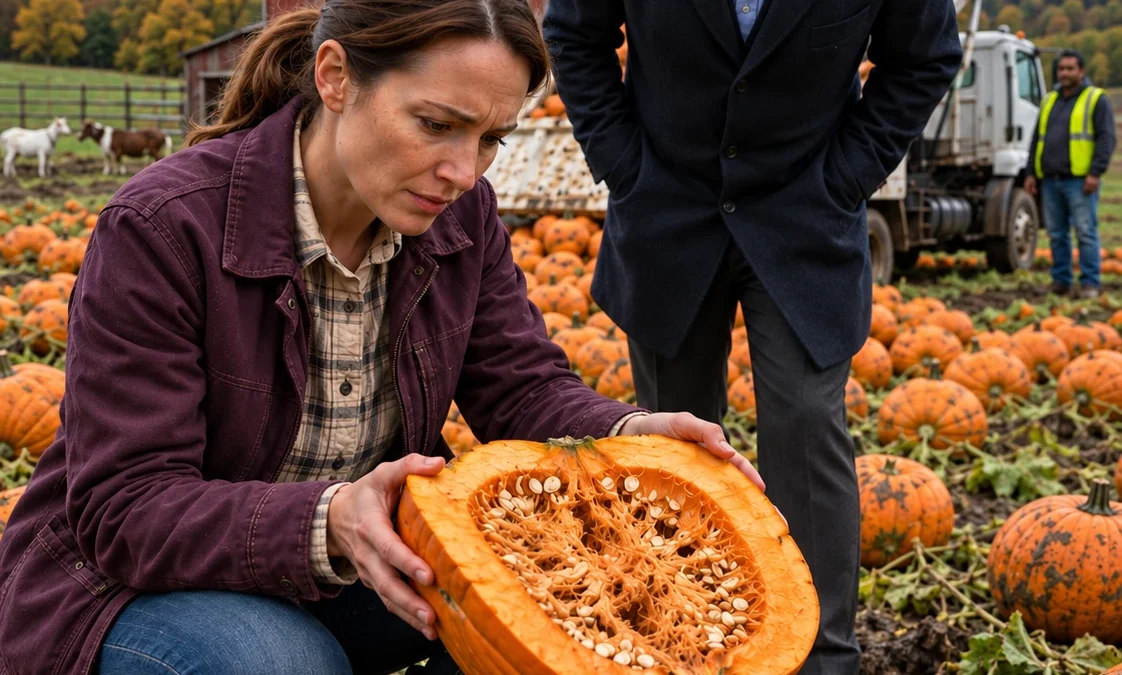
When she cut into one of the rejected pumpkins, the flesh was dense, sweet, and completely untouched by rot.
These pumpkins had not been thrown away because they were bad. They had been thrown away because they were too big for a machine built to handle something smaller.
Three days later, a warm spell hit, and the outer layer began turning soft. She had no cold storage, no grinder, and no crew. And when three neighboring farms refused to help, Willa picked up the phone and called the one person who might still believe in her. 😨
Part 2
Tessa Caldwell, a retired ruminant nutrition specialist who had once taught a short course Willa attended years earlier, answered on the second ring. She arrived within the hour wearing boots already caked in someone else’s mud, carrying a case of testing supplies she had apparently never stopped keeping in her truck.
“Feeding goats too much pumpkin too fast can throw off the balance of a ruminant diet in ways that are hard to reverse,” she warned.
Together they pulled samples from a dozen points in the pile, checking moisture, sugar, mold, and chemical residue. A lot could be recovered, if they moved fast.
Willa spent the last of her emergency savings renting an old grinder from a farm two counties over and converted her empty equipment shed into a makeshift processing line, using feed tubs, an ancient mixer, and every ounce of patience she had left. The flesh went through the grinder, blended with hay and mineral supplement in ratios Tessa calculated by hand, then set aside to ferment. Seeds were rinsed and spread to dry across every flat surface Willa owned. Pumpkins too far gone went to a composting corner near the fence.
Someone filmed her working waist-deep in orange pulp and posted it online, mocking the smell. Everett shared the clip himself, with a comment about garbage finally finding a proper home. 😤
Her daughter June appeared briefly that evening with a jug of water, said almost nothing, and disappeared back inside. Willa had no intention of letting her anywhere near the work.
By the end of seventy-two hours, the barn reeked of fermentation, and the yard was a mess of rind and stems. But the bulk of the harvest had become something usable. One elderly doe, who had refused feed for nearly a week, ate an entire portion of the experimental blend and licked the bowl clean.
It was one animal, one bowl. But Willa allowed herself, for the first time, to imagine the mountain outside her window might be worth something.
Tessa insisted on a slow approach. Nothing dramatic happened in the first three days. Meanwhile Wade spread word around town that Willa was feeding her animals whatever the cannery could not sell. Two customers cancelled standing orders. The bank called, saying her mortgage would be reviewed, given the possibility her property was becoming an informal waste site. 💔
She mailed over the certified transfer documents and lab paperwork. The credit line stayed frozen anyway.
But the herd settled into the routine, needing less of the expensive commercial supplement. Milk production stabilized. Tessa sent samples to an independent lab. And while she waited, Willa roasted a small batch of the dried seeds out of curiosity. The smell reminded her of an old cheesemaking course, where roasted seed oil had been used to coat the rind of an aged wheel.
She pressed a little oil from the roasted seeds and brushed it across one wheel of goat cheese already aging in her cellar.
The rind dried into a clean, even crust. The flavor underneath carried a faint roasted, nutty depth none of her previous cheeses had ever achieved. She named it Giant Harvest Reserve, almost as a private joke.
Tessa sent a wheel to an old acquaintance, head chef at a well-regarded restaurant two counties away. He called back within a day asking to buy the entire next batch before Willa had even settled on a price.
Then a black car with tinted windows pulled into her driveway. Grant Ashford, chief executive of Ashford Crown Provisions, tasted a wedge in her kitchen with the attention a jeweler gives a stone. He offered a sum large enough to erase her debt, provided she hand over both the recipe and the brand name.
Neighbors urged her to accept. Willa refused to sell the formula.
She took a smaller batch to a regional food fair instead, setting up a modest table beside jam and honey vendors. She told the true story of the pumpkins. She never claimed the goats ate nothing but pumpkin. The first batch sold out within an hour.
Grant called again. This time she kept the recipe and brand and gave him limited distribution rights. Everett discovered that the product he had called garbage was now selling for more per pound than the imported cheese in his own hotel partner’s dining rooms.
Then a letter arrived from the cannery, signed personally by Everett Blackstone, demanding she stop mentioning his pumpkins. His operations director demanded forty percent of her profits. And Willa walked to the folder where she had kept one piece of paper safe since the first morning the trucks arrived. 😱
Part 3
The document stated, in language written by the cannery’s own legal department, that ownership, use rights, processing rights, and any product derived from the material transferred entirely to the receiving party upon delivery.
The clause had been added to protect the cannery from liability if the rejected pumpkins ever harmed whatever farm accepted them. Never intended to create an opening this large. Everett had never read it closely, certain the shipment carried no value worth protecting.
In her attorney’s office, operations director Vanessa Whitmore argued Willa had exploited a mere administrative oversight. But Willa’s lawyer pointed out the cannery’s own financial records listed the transfer as a completed asset disposal. If Everett wanted to dispute the contract, he would also need to explain the disposal fees his company had already claimed for that same shipment.
Faced with that contradiction, Everett offered to buy the whole farm outright, at a price he clearly expected to overwhelm her judgment.
“Does the offer include the house, the herd, the brand name, and every future decision about how the farm operates?”
“It does.”
“Then no.” She said it in front of his entire legal team without a trace of hesitation. “You were given a chance to place a value on those seventy tons. You called them worthless.”
His attorney talked him into withdrawing every demand. But Vanessa had another idea. They did not need a lawsuit. They only needed to convince the public the product was unsafe.
An anonymous account posted photographs of pumpkins decomposing beside Willa’s goat pens, accusing her of feeding her herd spoiled produce. The images were real, but taken near her composting corner, far from the processing area. Wade helped the post spread, claiming he had personally smelled something toxic. Restaurants suspended orders. Ashford Crown activated an emergency inspection clause. 😨
Inspector Naomi Pierce arrived with a full county team within two days. Willa resisted nothing. She opened every storage room, every logbook, every lab result. They tested feed, milk, soil, water, and cheese.
They did find one genuine problem. Her composting area sat closer to the storm drainage than county guidelines allowed.
Everett seized on it, telling anyone who would listen that Willa had been deceiving customers all along. But she did not hide it or minimize it. She acknowledged it publicly, halted shipments voluntarily, and used a customer deposit fund to rebuild the composting area to specification. Grant Ashford, watching from a distance, chose not to cancel the contract. He later said the honesty she showed over a genuine mistake told him more than a company that always claimed perfection ever could.
Final results confirmed no dangerous substances in the feed, milk, or cheese. And the inspection uncovered something else by accident. Batch codes on several pumpkins matched cannery records claiming those same pumpkins had been shipped to a disposal facility weeks earlier. Blackstone Valley Cannery may have billed for processing twice, or filed inaccurate disposal reports with county regulators. Vanessa’s smear campaign had pulled inspectors directly into the cannery’s own paperwork. 🔥
Willa was cleared of every allegation. The county opened a financial and environmental review of the cannery going back years.
The night operations resumed, her inbox filled with more than four thousand new order requests. Grant proposed expanding the herd fivefold. She refused. Growing too fast would strain the land, compromise the quality, and leave her dependent on a company that could change its terms whenever it chose. Instead she set a firm annual production limit, with customers registering in advance and restaurants committing to fixed prices and quantities. Chefs began competing for a place on the list. A hotel chain asked to buy her entire production for three years. A premium airline asked about first class.
Grant organized a private tasting, hoping she would let the cheese become an auction item. She refused that too. A fixed price, with priority for buyers willing to commit to fair, long-term contracts.
When the tallies were done, six full seasons of future production had been claimed. Media called it the goat farm that sold out six years in advance.
Everett watched from across town as luxury cars belonging to chefs and distributors idled outside the very gate where cannery trucks had once dumped seventy tons of pumpkins nobody wanted. He arrived unannounced at her largest contract signing, claiming he could cut off her pumpkin supply for every season to come.
He did not know that for months, Willa had quietly built relationships with smaller farms across the county whose own oversized or misshapen produce never made it through commercial lines. Together they had formed a cooperative that bought rejected crops at a fair price, giving struggling farmers steady income and guaranteeing her a diverse, reliable supply. Her feed formula now relied on multiple crops. 💛
Everett discovered his own company depended on her far more than she depended on him. The cannery still paid disposal fees on thousands of tons of oversized produce every season. Vanessa proposed supplying her cooperative, with Blackstone’s name on the packaging. Willa refused outright.
At the signing, he tried once more to claim the first shipment still belonged to the cannery in some lingering sense.
Willa placed the original transfer contract on the table between them, open to the exact clause he had never bothered to read. She read it aloud, slowly, so that everyone in the room understood. All material, and every product derived from it, had transferred fully to Hartley Hollow the moment the first truck crossed onto her land.
Grant, seated nearby, confirmed that his company had only agreed to distribute her cheese because she held full, undisputed ownership of the process and brand.
Within weeks, the cannery’s board removed Everett from his position, citing inaccurate disposal reporting, a damaging smear campaign, and his refusal to accept a mutually beneficial partnership when it was offered. His replacement sent a new agreement. This time, the cannery agreed to pay her for accepting their oversized produce instead of expecting gratitude for taking it for free. 🕊️
She paid off her debts, repaired the barn roof that had leaked for years, and built a proper production facility. She never let the farm grow into a sprawling industrial operation. Her herd expanded only as far as the land and her small crew could support. Tessa led a small nutrition advisory board to make sure nothing was ever adjusted just to squeeze out a few more gallons.
She hired workers from town. She never offered Wade a partnership, no matter how often he hinted that his early skepticism had been honest caution. When Leland Carrington of the bank suggested the bank had believed in her from the start, she reminded him, without bitterness, that it had frozen her credit at the exact moment she needed it most.
She started a small fund helping other women running farms gain access to ingredient testing and basic legal guidance, the resources she had once scraped together alone. She never publicized it. Word traveled the way useful things traveled through Brier Glen, farmer to farmer, over fences and feed store counters.
Six years passed, and Hartley Hollow remained a modest farm. Trucks still arrived with oversized produce, but now every load was weighed, inspected, and paid for fairly before it crossed onto her land. June had grown tall and was preparing to study agricultural management at a small college not far from home.
At the end of that sixth harvest season, Willa hosted a dinner for the farmers of her cooperative, long tables set beneath the same barn that had once reeked of fermenting rind. The first wheel of each season was always shared among the people who had helped save that original crop. Tessa still kept the label from the very first batch of Giant Harvest Reserve, its ink slightly smudged, bearing two handwritten words.
Not garbage. 💛
A reporter asked whether she had known, that first day, that seventy tons of rejected pumpkins would sell out six years of production.
“I knew nothing of the sort,” she said. “I only knew those pumpkins still held real value, and that nothing holding real value deserves to be buried and forgotten just because a machine somewhere judged it too large to matter.”
At the center of the pasture where the mountain had once towered over her barn roof, a single giant pumpkin stood, kept every season as a quiet reminder.
Everett Blackstone had thrown away seventy tons of pumpkins because they did not fit the machine he had built his fortune around. Willa Hartley built an entire future from them, because she had never believed that value had to fit anyone else’s mold to matter. 🌅
This story is entirely fictional and created for entertainment purposes only. It does not represent any organization or individual, nor does it encourage inappropriate behavior. The content was generated with AI assistance.








