The Cowboy Bought Her Ranch at Auction in Front of Everyone, Then Walked Onto Her Porch and Said Six Words That Made Her Drop Everything
🤠 The Cowboy Bought Her Ranch at Auction in Front of Everyone, Then Walked Onto Her Porch and Said Six Words That Made Her Drop Everything
Part 1
The notice had been nailed to the courthouse board for four weeks. By the last Saturday in August, the paper had faded to the color of weak coffee.
Tessa Morgan had walked past it eleven times. She never stopped to read it, because she had written half the numbers on it herself.
The county seat of Bledsoe sat in a bend of dry country, under a sky so bright it hurt to look north. Wagons stood three deep along the courthouse fence. Men leaned in the thin shade of the cottonwoods with their hats tipped back, waiting for the sale to start the way men wait for weather.
Tessa stood at the very front, hands loose at her sides. She wore a flat-crowned hat gone pale at the band and a blue work shirt washed soft. Her boots had been resold twice, and the man who sold them last was standing forty feet away, waiting to bid on her ranch.
She was twenty-nine years old. Until ten o’clock that morning, she had owned Morgan Creek Ranch: 1,400 deeded acres along Cottonwood Creek, a house her grandfather built, and 600 head of cattle wearing the MC brand on the left hip.
In her shirt pocket sat a written financing commitment for exactly $22,000. It was backed by everything she could pledge without destroying the outfit. She had counted it eleven ways on eleven nights, and it never once got taller.
The debt itself was simple. Six years ago, her father bought the grazing land to the north, good country with year-round water, and signed an honest note at an honest rate. Then he died, thrown from a horse he had ridden nine years. The note came down to her with everything else.
She made every payment through a brutal winter, a wet spring, and a year when cattle prices collapsed across Colorado. What she could not make was the last one, the giant balloon payment that came due all at once.
Harlon Puit at the Basin County Bank gave her two extensions. He drove out himself to tell her there would not be a third, and he didn’t enjoy one bite of the supper she fed him. He wasn’t a wicked man. He was a man with a board of directors in Denver and books that would not bend.
So the sale was public, and it was legal. It was going to happen at ten o’clock whether she stood there or not.
She had decided a month ago that she would stand there.
The sheriff read the notice in a flat voice, like a man reading off a fence line. Then came the line that nearly dropped her: “…together with the branded livestock pledged under the same instrument.”
The cattle went with the ground. The whole outfit would cross the block as one piece: the house, the hay, the horses, and all 600 cows.
Bidding opened at $20,000, which was the debt. A wheat farmer bid $20,500, mostly so he could say he had. Then a land agent from Pueblo named Sturgis raised him to $21,000. He wore a linen duster and carried a folded map, and he had never walked one foot of the land he was buying.
“Twenty-one five,” Tessa said, clear as a bell. Half the crowd turned to stare. She kept her eyes on the sheriff.
Sturgis said “Twenty-two thousand” without blinking.
Tessa did not answer. Twenty-two thousand was every dollar she could raise, and matching a bid wouldn’t win the ranch. She felt the number slide past her the way you feel a horse go by in the dark, close enough to touch and already gone.
Then a voice came from the back of the crowd.
“Twenty-three thousand.”
A big, rangy man stood by the fence with his shoulder against a cottonwood, sleeves rolled back, face cut deep by sun. Every cattleman in three counties knew him. Clay Barrett had bossed trail herds up from Texas for a decade. Once, in the summer of ’83, he had pushed 900 head across her creek, and he’d asked her father’s permission first, which was more than most men ever did.
“Twenty-four,” Sturgis snapped, an edge in his voice now.
“Twenty-six,” said Clay.
The land agent studied him a long moment, like a man looking at a card he didn’t like. Then he folded his map and said nothing at all.
The hammer was just a block of pine on a table. It didn’t sound like much.
Sold. Twenty-six thousand dollars.
Tessa did not cry. Fifty neighbors were watching, and she would not hand them a story to carry home. She shook the sheriff’s hand and thanked him for reading it plainly. She shook the banker’s hand too. “You gave me a year I hadn’t earned,” she told him.
Then she walked back through the crowd, and the men took their hats off as she passed. That was worse than anything else that happened that morning.
She rode home eleven miles at a flat walk, because a trot would have looked like running. She knew the name of every draw, which slope greened first, and where the creek ran before the flood of ’78. She knew all of it, and none of it was hers.
At the ranch, she packed. She took her clothes, her saddle (bought with her own money at fifteen), her father’s pocketknife, and a photograph of her mother standing straight beside a buggy.
She left the good bridle, because it was bought with ranch money. She left the ledger and the kitchen clock she had wound every Sunday of her life.
At the desk in the front room, she spent half an hour writing down everything: which windmill needed leather, which cow was a fence-crawler, which gate had a bad hinge. She squared the pages under the lamp with the keys on top. Then she carried her things to the porch and stood there with her hat on, ready to go.
That’s when she saw dust on the road.
A single rider on a big sorrel came into the yard and stopped thirty feet from the porch. Clay Barrett stepped down, took off his hat, and looked at the pile of gear. Something crossed his face that she couldn’t read.
“It’s all clean,” Tessa said, before he could speak. “The inventory’s on the desk. Everything in this pile is mine, and you can look through it. I’d rather you look now than wonder later.”
“I don’t want to look through your saddle.”
“Then I’ll say it once, and you can believe me or not. You bought it. I’m leaving it clean.”
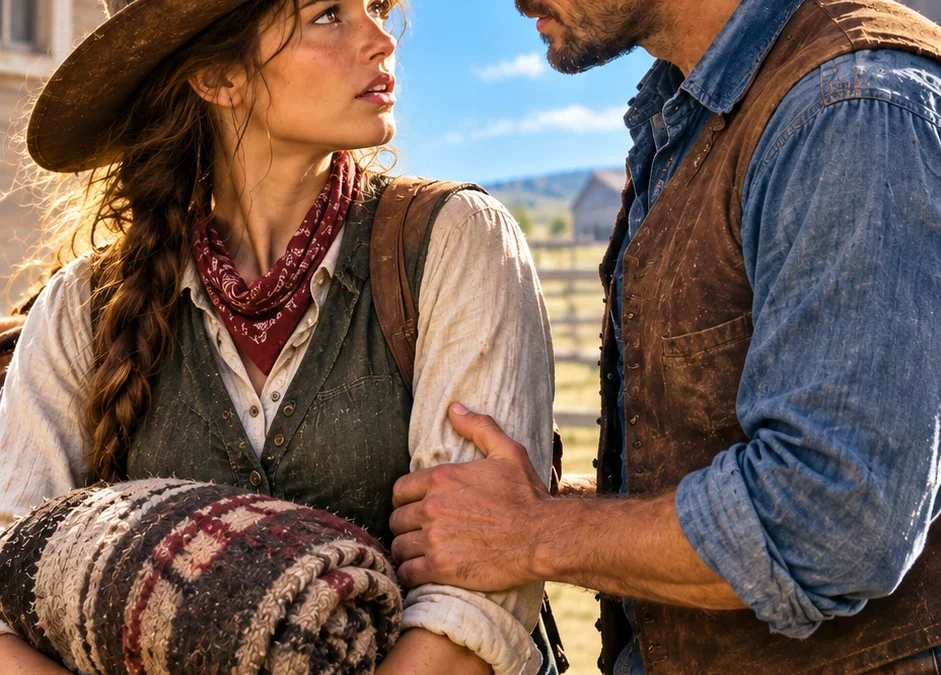
She bent to lift her bedroll. Clay came up the porch steps and laid his hand, barely, on her arm. It was the kind of touch you use to stop a horse from moving off before you’re ready.
“Wait. Please.”
She straightened. He took his hand away at once.
And then, in the stillness, with the wind moving dust across the yard, the new owner of Morgan Creek Ranch said the words that broke everything she had held together all day:
“I didn’t buy this place to make you leave.”
👉 Want Part 2? Find it in the comments, or leave any word below and I’ll send it to you privately. 🤠
Part 2
“I didn’t buy this place to make you leave.”
Tessa stood very still, and everything she had arranged in her chest all morning came loose.
“Then why did you buy it?”
He turned his hat once in his hands. “Fourteen years I’ve been saving. Trail wages, small shares in feeder herds. I wanted a working ranch with water, grass, and cattle already on it. I looked at nine places in two states. Yours has spring water on three sides and cattle that came through last winter looking better than mine ever did.” He took a breath. “But I’ve got the money and the paper. I don’t have the country. I don’t know where your creek goes in June. A man can learn that in five years, and I don’t have five. I could hire a foreman, but none of them knows this ground like the woman standing on this porch.”
“So you’re offering me my job back.”
“No. I’m asking you to run this place with me. You’re the boss day-to-day. Big decisions, we make together. You’re the owner. I’m the owner of the ground. I’d like to be the partner of the ranch.”
She looked at the creek, running clear the way it had her whole life.
“No,” she said.
Clay nodded once and stepped down without arguing. “I’ll be at the hotel in Bledsoe. If you want to leave me a list of every mistake I’m going to make, I’d be obliged.”
She sat on the porch step until the sun slid behind the barn. She thought of Odd, fifty-eight with nowhere to go. She thought of Reuben, who sent money to a mother overseas, and of young Nate Fisk. She thought of 204 steers promised to a buyer in nineteen days, and of a stranger learning all of it in that time.
And under it all, low and steady like water under ice, one thought: He didn’t have to ride out here. He had the deed. He could have sent a letter.
In the morning she found him at the hotel with an untouched plat map beside his plate.
“I have terms.”
They were hard ones. She would run the whole outfit, crew and cattle and horses. Anything over $200, or anything that sold land or herd, they would decide together. She wanted 35% of the fall proceeds (“and I won’t call it wages”). Then she laid her hands flat on the table. “And come spring, I get the first chance to buy in. At a price we set today. If I ever have money again, I want a door I can walk through, not a favor I have to ask for.”
Clay sat back. “Half the outfit for $14,000, same price I paid. It holds until the first of May, whatever the market does.”
They signed it in ink on hotel paper. At the bottom, Clay added a line in his own hand: either of them could walk away at the end of the season. “A thing you can’t walk out of isn’t a partnership. It’s a fence.”
The weeks that followed were the best of her life, and the most dangerous. He rode wide, slow circles and never crowded a cow. He fixed her sorting pens in two days. He set Nate’s broken wrist in the dirt while telling jokes. She kept a silent tally of every kindness, because kindness from the man who holds the deed is something you can be asked to pay for.
One night in the barn, with a lantern hissing, he brushed a strand of hair off her cheek. She wanted to close the last four inches between them.
“I don’t owe you this,” she whispered.
He stepped back at once. “Good. I wouldn’t take it as payment.”
Then came the fall. Amos Witcom, a Denver cattle lender, drove up with an offer that rearranged her life in one hour on a porch: $22,500, enough to buy Clay out completely. She would be sole owner by October fifteenth.
She told Clay that night. He listened, then said quietly, “What you’ve been building is a bridge. A good one, honestly made. But a bridge is something you cross and then you’re done with it.”
For six days they were perfectly, unbearably polite.
Then, on the twenty-seventh of September, the sky over the head of the basin stood up black to sixty thousand feet. At noon, the creek was ten inches up. By four, sixteen, and the color of red mud. She sat her horse for ninety seconds and knew.
“Get every man horseback! LANTERNS!”
Two hundred thirty steers were grazing in the low meadow. The only road out led through a lane eleven feet wide between a fence and a cut bank. Tessa had a plan, and it would work, if nothing went wrong.
Then the roar came up out of the willows. A hundred feet of bank collapsed into the channel. And in eight seconds, a third of the herd turned and ran the wrong way, straight toward the one place on the ranch that would kill them.
Tessa was on the wrong side to turn them.
She stood in her stirrups and screamed one name into the dark…
👉 Want to know whose name she screamed, and who made it out alive? LIKE this post and COMMENT the word “BARRETT” 🤠 and Part 3 drops as soon as we hit our goal!
Part 3
“CLAY! Downstream flank! Get below them and turn them off that bank!”
He didn’t ask a single question.
He put the sorrel down that meadow at a dead run in full dark, along the edge of a creek that was climbing out of its banks behind him. He got below the break and came up the outside of it, one man and one horse and a rope slapping against his chaps. The running steers felt him there in the dark. They gave him four feet, then ate it, then bent.
“Reuben, cut the stack panel and hold it open!” Tessa shouted. “Odd, wing them left, don’t turn them, just wing them!”
The panel dropped. Odd hung on their shoulder like a burr. And the stampede that had been aimed at 140 yards of death bent through a twenty-foot gap by the haystack and went pouring uphill with the rest of the herd, cattle pulling in behind each other the way cattle do the moment they decide the crowd is right.
Six minutes later, the water came over the meadow bank in a brown sheet, without any hurry at all. Where the herd had stood at sundown, it was eighteen inches deep and moving. 🌊
They pushed the herd up the old wagon grade as the rain finally broke, through the dry draw (which was no longer dry), and out onto the bench, long after eleven o’clock at night. Nate held that gate with his good hand and his broken one, counting every head aloud, because his father taught him that a man counts, and then he doesn’t have to argue.
“Two hundred twenty-eight.”
They lost two steers, forty rods of fence, a haystack, and a footbridge that wouldn’t be found until November, four miles downstream. But nobody drowned. Nobody was hurt. And in that whole night, nobody said one word about what anybody owed anybody.
At one in the morning, the five of them stood in Cora Weaver’s kitchen, dripping on the floor. Tessa’s hands were too numb to work her coat buttons. Clay came over, undid two of them without asking, put a cup of coffee in her hands, and stepped back.
“Thank you,” she said. It came out too small for what it was.
“You saw it four hours before anybody else would have. Men who’ve ranched forty years would’ve had two hundred head in that lane.”
“I sent you to the dangerous side,” she said. “I didn’t even think about it. I thought about the cattle, and I picked the man who could do it.”
“That’s right,” said Clay. “That’s how it’s supposed to work.”
She stood there with her wet hair down and could not, at that moment, remember what she had been so certain about for six days.
The creek was back in its channel by dark the next day. Sam Kitridge arrived on the twenty-ninth, looked at 228 steers standing on a clean, dry bench above the creek that had tried to eat them, and shook his head. “Ellis lost nineteen head off the flats. These don’t look like they were in it.”
“They weren’t. They were up here four hours before it came.”
He counted them himself, paid on the count, and didn’t shave a nickel. When he wrote the draft, he handed it to Tessa instead of Clay. Then he shook Clay’s hand. “You bought yourself a ranch, Barrett.”
“I bought half a ranch,” Clay said. “The other half wasn’t for sale.”
The check was $8,560, enough to rebuild the north fence, buy hay, and carry every wage to April. Morgan Creek went into winter in better shape than it had since her father died.
On the second of October, Amos Witcom’s letter arrived. The committee had approved both offers: $8,500 for a half interest, or $22,500 for the whole outfit. She could be sole owner by the fifteenth. Everything she had ever said she wanted, on paper, in her own name. 📜
She stood in the yard a long time. She looked at the barn, at the boy with the splint teaching a colt to lead, at the bench where 228 steers had stood in the rain. And at a man by the north fence, mending the wire she had cut.
Then she saddled her mare, rode up to the bench alone, and sat in the cold October light, looking down the whole length of the basin.
She had spent five weeks telling herself that owning it alone would make it safe. But she had owned it alone all the way to a courthouse yard in August. Owning a thing alone had never made it safe. It had only made her alone the moment it was taken.
What saved Morgan Creek was not a name on a deed. It was five people going out in the dark and a man riding a flooded bank on her word. And she thought about the barn, and the man who took his hand from her face in half a second because she said no, and who in five weeks had never once, in the middle of any argument, reminded her whose name was on the paper.
That was not a man she needed to buy her way free of.
That was a man she wanted to be bound to on purpose, with her eyes open, in a way that cost her something real.
She rode down and found him at the north fence with a spool of wire and a pair of pliers. She held out the letter. He read it, and she watched his face go still. She watched him decide to be decent about it before he even looked up.
“Congratulations.” He folded it along its own creases and handed it back. “I’ll ride into Bledsoe tomorrow and we’ll get the deed drawn. Tessa, if you’ll have me, I’d like to stay through shipping. If not, I can be out Thursday.” His voice moved one degree. “It’s a good ranch. It always was yours. I only ever held it a season.”
“I’m not buying you out,” she said.
He stopped with the pliers in his hand.
“I’m buying half. Fourteen thousand, at the price you wrote at the hotel. Fifty-five hundred from the surplus, and eighty-five hundred from Witcom on my own note, in my own name. I’ll be paying it off from my own calf crop for four years, and it’ll be the hardest money I ever earn.”
“You could have the whole of it,” he said. “It’s right there in that letter.”
“I could.” She held his eyes. “I’d rather have half of it with you than all of it by myself. It took me until this morning to say that out loud without feeling like I was giving something away.”
“What changed?”
“The water came, and I sent you down that bank, and it never crossed my mind that I owed you for going, or that you’d hold it over me after. It’s the first time in three years I’ve been in a room with somebody and not counted.”
Her voice steadied. “You bought my ranch, and you stood on my porch and told me you weren’t asking me to leave. I’m buying half of it back, Clay Barrett. And I’m not asking you to leave either.”
He crossed the two steps between them and put his hands on either side of her face, the way he had almost done in the barn. And this time, she came up to meet him. He kissed her against the broken north fence, with the whole gold basin standing open behind them. ❤️
When she could speak, she said, “You’re going to have to learn where the creek goes in June.”
“I’m going to have thirty years,” said Clay.
They rode into Bledsoe on the sixth of October and stood together at the county clerk’s window while a man in sleeve garters wrote both their names in the deed book on one clean line:
Tessa Morgan and Clay Barrett, an undivided one-half interest each, Morgan Creek Ranch.
She expected to feel relief. What she felt was steadier, and a great deal less lonely.
They kept the name. When she brought it up, Clay said Morgan was already carved on the gate post and he had no intention of doing carpentry to prove a point.
She ran the outfit, and that never changed. In November, she bought forty heifers at a price Clay swore was ten dollars too high. By the next September, she’d been proven right by six hundred, and he framed the tally sheet and hung it in the barn. He took the market side, and that winter came back from Denver with a two-year feeding contract Morgan Creek could never have won alone.
Odd and Reuben stayed. Nate Fisk grew four inches, learned to rope in the open, and by 1890 was the best hand on the place and knew it. They rebuilt the north fence wide on the high side, with a gate in it, because Tessa wanted to open a gate the next time the creek came, not cut a wire. Clay said it was the smartest four dollars they’d ever spend.
They were married the following June, on the porch, by a preacher who had to be fetched twice because he got the day wrong. Cora Weaver cried into a dish towel while Nate held the horses.
In August of 1888, they were back in Bledsoe on courthouse day. Another sale was posted, a small homestead on the flats, with a crowd in the same thin shade under the same cottonwoods. Old Harlon Puit saw them and came over, unable to help himself.
“Mrs. Barrett, I do believe your husband bought Morgan Creek standing right about where you’re standing now.”
“He bought the land,” said Tessa, and slid her hand through Clay’s arm. “The rest took a good deal longer.”
They rode home the eleven miles in the evening light, past the wagon grade, the hayfield, and the big cottonwood with the old flood mark six feet up its trunk. And the ranch came up on them all at once, past the last of the trees, the way it always did. 🌄
💛 If this story touched your heart, share it with someone who believes love is built by choosing each other on purpose. Follow for more original western romances!
Disclaimer: This story is entirely fictional and created for entertainment purposes only. It does not represent any organization or individual, nor does it encourage inappropriate behavior. The content was generated with AI assistance.








