THE COWBOY ORDERED A GENTLE, PETITE BRIDE BY MAIL. WHEN A SIX-FOOT APACHE WOMAN STEPPED OFF THE TRAIN, THE WHOLE TOWN GASPED. THEN HE FOLDED HER LETTER, AND THE REAL SECRET BEHIND HIS DEAD WIFE’S DEATH CAME OUT
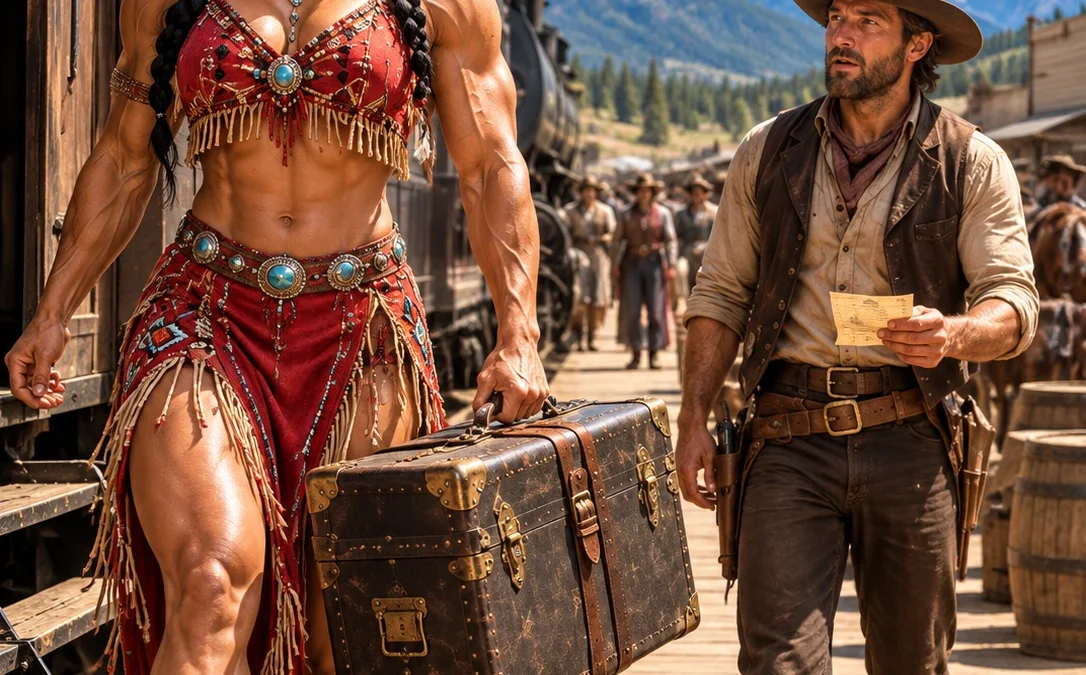
THE COWBOY ORDERED A GENTLE, PETITE BRIDE BY MAIL. WHEN A SIX-FOOT APACHE WOMAN STEPPED OFF THE TRAIN, THE WHOLE TOWN GASPED. THEN HE FOLDED HER LETTER, AND THE REAL SECRET BEHIND HIS DEAD WIFE’S DEATH CAME OUT 😱🔥
Part 1
Snow fell on the Colorado mountains, quiet and certain, as though the sky had decided something long ago.
At the foot of the mountain, a forge had sat cold for three years. But this morning, there was smoke. ❄️
Down in Red Canyon, a man sat in a warm office, smiling. Silas Rook had waited six years for this moment. He did not know that someone had just stepped down from the morning train.
A woman the entire platform held its breath for.
Her name was Nakoma Running Water. She was Apache. She was thirty years old, and she had been carrying real weight since the age of eight.
She was not small. Not in body. Not in voice. Not in the space she took up when she walked into a room.
Her father, Toono, had taught her that iron knows what it is. Before you touch it, you look at it, learn it, respect it, or you get burned. He had learned smithing from a Mexican smith named Carlos Esparza, who wandered through their territory in 1862 and stayed two years because he found the people more interesting than the land. Toono blended Spanish technique with something older and quieter that the Apache already knew about metal.
At eight, Nakoma watched at the bellows. At twelve, her hands knew the difference between iron that was ready and iron that needed another pass.
At fifteen, a man from a neighboring band said a girl had no place in a forge. Toono did not argue. He handed her a hammer and told her to show the bracket joint she had been working on. She showed him. The man went away.
Here is the work. Do it. Let the work speak.
That was the foundation of everything she was. 🔨
Then, in 1884, her father fell sick and the army came and took the land. She lost the forge. Not because she failed at anything. Because the system was built to take it.
Three years without fire. Three years without the particular quality of a morning in a place where iron waits and everything is still possible.
Then a friend named Delphine, an Apache woman married to a rancher in Tucson, found an advertisement. A blacksmith in Colorado needed a wife.
Delphine meant well. She wrote the letter herself, because the agency would never accept one from a woman who described herself honestly. In her letter, Nakoma was gentle, soft-spoken, skilled in domestic arts, eager for a quiet life.
None of that was her.
But Nakoma thought, with the stubbornness that was her most problematic and most useful quality, that what the man in Colorado had written and what he actually needed might be two entirely different things.
She booked her passage.
October, 1887. The train pulled into Red Canyon just after seven. The mountains already wore their first snow, the committed kind that does not apologize for itself.
In her trunk lay a small piece of iron wrapped in cloth. Her father’s last work, the last shape his hands made before they could not. It was the only thing she had left that mattered.
She stepped onto the platform.
The whole town went silent. Not the polite hush of strangers. The held-breath silence of people who have just seen something they have no category for.
A tall, broad-shouldered Apache woman. Six feet of her. Hands that told the entire story without a word.
She picked up her trunk by herself.
The collective gasp was, to be precise, audible.
She had been causing that exact gasp since she was fifteen. She did not find it interesting.
That was when she saw him. Standing forty feet away, not performing a welcome, not rushing. A man who had learned that events come to you eventually. Forty-two years old. Dark hair, silver at the temples. A face weathered by altitude and loss into something harder and more honest.
Callum Drey.
He was holding a letter. The one she had not written.
He looked at the letter. He looked at her. He looked at the letter again.
Here it is, she thought. He puts me back on the train.
But he did not.
He looked at her hands. Not her face. Not her height. Her hands, large and calloused, scarred in three places from three moments when heat and iron moved faster than expected.
“Your hands have worked,” he said.
“So have yours.”
He folded the letter, slid it into his coat, and said, “Wagons this way.”
That was the whole welcome. And somehow it was exactly enough. 🕯️
What she did not know, not yet, was that a week earlier Callum had received a letter from a councilman named Grover Patch. It warned him that the woman the agency had matched him with was an Apache Indian. That if he proceeded, he would lose his standing, his business, everything he had built in twenty years.
Callum read it twice. Then he walked to the fireplace and put it in the flames.
He never wrote to cancel.
The wagon climbed a road that was more suggestion than path. When the back wheel dropped into a hole the mountain had dug, Nakoma was off the seat before the horses had stopped. She planted both hands against the wagon and pushed from her heels through every muscle she had ever built.
The wheel came free.
When she climbed back up, Callum said nothing. But he shifted three inches to the left, making room that had not been there before.
From a man like that, three inches was a statement.
At the cabin, she saw the forge forty yards up the rise. Cold, but the smell was alive. Coal and iron and years of breath soaked into stone. Something she had not smelled in three years. Something in her chest that had been tightly held for a very long time recognized it.
Inside the cabin, behind the door, hung a woman’s dress. Dark wool. Faded at the shoulder where the light reached it.
She said nothing. But she understood. This was a man still holding a conversation with someone who was no longer there. 💔
That night, an old man named Festus Aldridge let himself in without knocking and told her everything. Silas Rook. A debt note. Nine hundred dollars. Sixty days. A railroad survey that made this land worth a fortune. And a legal trap that only worked on a widower living alone.
“A married man with a homestead has standing,” Festus said. “A lonely one doesn’t.”
Nakoma listened without interrupting. Then she asked a single question.
“Where is the original note?”
Callum answered quietly. “I found one page. There should be two.”
“Your father trusted people with things. Who did he trust most?”
A long silence.
“Festus.”
Nakoma turned to the old man. “Did Callum’s father leave anything with you?”
Festus went very still. The stillness of a man who has been holding an answer for a long time and is deciding whether this is the moment.
“There is a box,” he said. “Your father gave it to me in the winter of 1883. He said keep it until you truly need it.”
He paused.
“I have been waiting for the right question.”
The wind rolled off the mountain. The lamp flickered once and steadied.
Callum stared across the table, the look of a man who has just learned that the thing he gave up hoping for may not be as gone as he thought.
And then, three days later, Silas Rook walked into the forge with a bottle of whiskey and a smile, and glanced at the tools, the coal, the ceiling beams, pricing everything. His eyes landed on Nakoma. His expression did not change.
He already knew, she realized.
He knew exactly who she was.
But how? And what was Silas Rook really hiding about the night Callum’s wife died in the snow?
Part 2
“It’s good you have company now, Callum,” Silas said at the door, without turning back. “Mountain winters can be long on a man alone.”
He left. The forge felt different. Not colder. Aware of its own temperature.
“How much does he actually want?” Nakoma asked.
“Nine hundred. End of the month.”
“Do you have it?”
“No.”
“Do you have what you actually owe?”
Callum put down the hammer. “What do you mean?”
“A man with a fair claim does not come to your forge with whiskey to remind you. Men with fair claims don’t need to keep reminding.”
Callum was quiet a long moment. Then he told her. The original note was four hundred, borrowed by his father in ’79. Most of it was repaid. What remained when his father died was closer to two hundred. Then, the spring after his wife Mara passed, Silas arrived with a document showing nine hundred. Compound interest back to the beginning.
“And you signed it.”
“I was not in a condition to read carefully that spring.”
He said it flat. No self-pity. A fact he had finished being ashamed of because the shame had become too expensive to carry.
“Then we find the original,” Nakoma said.
In the days that followed, they worked. Side by side. No discussion. Callum’s hammer was heavier than she would have chosen, balanced for a patient man, each blow meaning something. She dressed his dull tools without being asked. He left a draw knife at her work position without comment. When the snow came in earnest on the twelfth day, she told him the walkway roof would not hold.
“I patched it in August.”
“I wasn’t satisfied with the patch.”
He went to deliver the Henderson order before the south road closed. She spent three hours on that roof in falling snow. When she came down, her hands had gone beyond cold. Callum looked at them without a word, went to the back of the forge, and returned with a pair of old leather gloves, soft with years of use.
“For next time.”
She put them on. They were warm. 🧤
The next morning she found a wooden box on a back shelf while looking for wire. It fell. Papers scattered. She gathered them quickly, not reading, but one page landed face up in her line of sight.
A draft of a letter. Callum’s careful handwriting. Addressed to the agency.
I am seeking a companion for this life on the mountain. Someone gentle in her nature. Patient. Soft-spoken. A woman who brings ease rather than difficulty. I am looking, I suppose, for the opposite of hard. Someone small enough in her presence that the house feels fuller rather than smaller. Someone who will let me be the strong one for once.
She put it back. Found her wire. Went back to work.
But she carried that page like something sharp in a coat pocket. She had heard those words or their near relatives her entire life, arranged as a description of the thing she was not.
And here they were in the handwriting of the man who had looked at her hands and not sent her back.
Were those the same man?
Then came the day a small basket appeared on the kitchen table. Half the size of the one she used for wood. Already packed, without explanation.
“I can carry the full size,” she said.
“I know.”
“Then why is this half the size?”
He set down his work and looked at the middle distance.
“I just thought you shouldn’t have to.”
There it was. His careful attempt to give her the consideration he had intended for the woman in the letter. The gentle one. The small one.
She sat down across from him, not angry, but deliberate.
“Can I ask you something about Mara?”
He went completely still.
“I think you have been trying to take care of her through every person near you since she was gone,” Nakoma said quietly. “I don’t need the small basket. But that doesn’t mean there is nothing I need.”
He looked at her fully, and she saw what she had been watching for weeks. Not only grief. The grief of a man who has blamed himself for four years and built his entire life around managing that blame.
He got up and went outside.
The next day, in Festus’s office, the old man opened a deep bottom drawer and set the box on the desk.
Inside, folded with a craftsman’s care, lay a promissory note. Two pages. Both present. Dated 1879. Four hundred dollars. And at the bottom, a notary’s signature: Absalom Price, Denver.
Beneath it, a sealed letter, Callum’s name on the outside in his father’s hand.
Callum took it to the window and read it with his back to them. When he turned, his face was neither broken nor relieved. It was something in between. The look of a man whose story about the worst moment of his life has just turned out to be incomplete.
“Write to Price tonight,” Nakoma said.
Festus was already reaching for his pen.
Out on the hill, in falling snow, Callum stopped beside her.
“I don’t know what we are yet. I want to be honest about that. You deserve honesty more than comfort.”
“I agree.”
“But I think you might be the most capable person I have ever worked beside. And I mean that as the highest thing I know how to say.”
She looked at him.
“Callum Drey, that is the most useful thing anyone has ever said to me.”
Two days later, alone in the forge, she heard footsteps on the walkway. Lighter. Careful.
A woman stood in the doorway. Forty years old. Dark wool coat, good buttons. A face composed for so long the composure had become structural.
Vera Rook. Silas’s wife.
“I have been trying to find a moment since the week you arrived,” she said.
She opened her coat. Sewn into the lining was a hidden pocket. She drew out a folded paper and laid it on the workbench.
“A complete copy of my husband’s private record of the debt. In his own hand. Confirming the real figure and every adjustment he made.”
Nakoma stared at it. “How long have you had this?”
“Two years.”
Then Vera looked at the fire, and her voice changed.
“But there is something else. Something I have known longer.”
The forge went very quiet.
“The night Mara died.”
Nakoma did not move.
“Callum had worked three days without sleep. He was out cold. A man came to the door. Geller. One of my husband’s errands. He told Mara there was a clause in the debt requiring both signatures before midnight, or the full amount came due at once. Callum was asleep. She did not wake him. She put on her coat.”
Vera swallowed.
“There was no clause. My husband made it up. He needed the cabin empty for something Geller was sent to find. And he knew the weather was turning. He sent Geller anyway.”
Nakoma felt the floor tilt.
Callum had spent four years carrying the wrong guilt.
Mara had not died because her husband slept.
Mara had died because Silas Rook put her in the path of a blizzard.
And that was only the first of the documents Vera had brought.
Part 3
Vera reached into her coat again and drew out a second folded document.
“A letter in my husband’s hand. To his lawyer. Dated 1881.”
Nakoma read it. Then read it again. It laid out, in cold detail, a strategy for acquiring the Drey property through debt manipulation, and a patient instruction to wait for a moment of personal vulnerability in the owner’s life.
- Six years ago. Before the blizzard. Before Mara. Before any of it.
“This took courage,” Nakoma said quietly.
“Don’t,” Vera said. “Courage would have been two years ago.”
“You are here now.”
“I am here now.”
Nakoma tucked both papers into the hidden pocket of her satchel. That evening she laid them on the table beside the note from Festus’s box, and she told Callum, plainly, about the night his wife died.
He did not interrupt. He sat with his hands flat on his knees and listened to every word. When she finished, the silence lasted a long time. Then he stood and walked out into the snow.
She did not follow. She went to the forge and built up the fire. Not because the forge needed it. Because he would need to come back inside eventually, and when he did, the warmth should already be waiting.
Some things you do not explain. The doing is the language.
Twenty minutes later, she heard him on the walkway.
He came in. Stood near the door, looking at the fire.
“I slept,” he said. “And she died. I have been telling myself that story for four years.”
“The story was wrong.”
“I know that now.”
“Does it help?”
A long pause. “No. And yes. It hurts differently.” He crossed to the anvil and laid his palm flat on the cold iron the way she had on her first morning. “A hurt you can locate is easier to carry than one you can’t.”
He picked up his hammer and held it, not to strike, just to hold.
“What do we do?”
“We go to the council. Publicly. Not a private negotiation where Silas can maneuver. A public record he cannot suppress.”
“How long?”
“Thirty days.”
He looked at her in the firelight, the look beneath all the cataloging and management.
“You have been planning this since the day you arrived.”
“I have been paying attention since the day I arrived. It is different. But the difference is small.”
He was quiet for a moment.
“Nakoma. When this is done, I want to ask you something properly. Not as an arrangement. Not as a solution.”
She nodded once. “When the time comes. Ask.”
They went back to work. Because that was who they were. 🔥
The thirty days went the way iron goes. Slow heat, steady hands. New commissions came: plow fittings, a cracked wagon axle. And the little changes accumulated. The small basket never returned. Callum began setting out two cups of coffee each morning without asking. And the dress that had hung behind the door, Mara’s dress, was no longer there. It was folded carefully in a side cupboard.
Not discarded. Relocated.
The difference between those two things was everything. 🕯️
On the twenty-second day, Silas came to the cabin. No whiskey this time. The performance was over.
“Can we speak privately, Callum?”
“No.”
Silas absorbed it. Something shifted behind his eyes. A recalculation.
“The council has five members,” he said. “I know four of them personally.”
“The law does not run on personal obligations,” Nakoma said. “It runs on documents.”
His eyes turned to her, slow. “You are very confident for someone who arrived six weeks ago with nothing.”
“I arrived with twenty-two years of knowing what honest iron looks like. Your documents are slag dressed up to pass inspection, Mr. Rook.”
His jaw tightened. “Whatever happens in that room, Callum, you still have to live in this town afterward.”
Callum looked at him without expression.
“You used my wife’s death to steal my land. We are done talking about my reputation.”
Silas stood a moment. Then he left, his footsteps fading down the frozen hill.
Three days before the council meeting, a letter arrived from Denver. Absalom Price, seventy-one years old and retired, confirmed his signature, the original terms, and the four-hundred-dollar figure. At the end he had added one sentence.
I have waited some years for someone to ask the right questions about this matter.
Festus looked at them over his spectacles. “You asked the right questions.”
“Callum asked the right questions.”
“You told me which ones to ask,” Callum said.
“Will one of you please accept the compliment,” Festus said, picking up his pen, “so we can move on?”
The council chamber in Red Canyon was one room above the post office. Every chair was full. In a small town, a public debt dispute between the most prominent businessman and the local blacksmith is the kind of event that gives people errands downtown.
Silas arrived with a silver-haired Denver lawyer named Cowell. Silas did not look at Nakoma. A man who is not worried looks at the things he isn’t worried about. A man who is, avoids them.
Callum rose and placed three documents before the council. The original note. Silas’s own private record. The 1881 letter.
Cowell was good. Objection after objection. No chain of evidence. Privileged correspondence. Inadmissible. For three minutes, two council members began to nod, persuaded by a man who knew how to use authority.
Festus stood and read Price’s sworn statement. The nodding slowed.
Cowell objected again. A statement cannot be cross-examined.
And from the second row, Vera Rook stood up.
Nakoma had not known she was there. Vera had given no warning. She stood in her dark wool coat with the stillness of a woman who has made a decision she will not unmake.
Silas turned. For the first time, his face did what faces do when the load-bearing wall of a structure suddenly shifts.
“Mrs. Rook,” said Chairman Burch, “you are welcome to speak.”
Vera walked to the front. She did not look at her husband, not once. He had already received all the looking she intended to give.
“My name is Vera Rook. I want to submit two documents.”
She set them on the table. Then she told the room what Silas had done. The 1881 letter. The patient plan. The words moment of personal vulnerability.
“My husband waited for Callum Drey to lose his wife,” she said. “He manufactured a reason to send a man to that cabin on the night of a blizzard. That man told Mara Drey she needed to sign a document urgently. She went out alone in the storm. She died.”
The room did not breathe.
“I know this because the men who went that night reported back to my husband in my presence. Believing, as men sometimes do, that I was not listening.”
She stepped back. “That is all I have.”
She returned to her seat and folded her hands in her lap.
Cowell tried. He raised spousal privilege and the admissibility of domestic documents. It was exactly no use. The room had heard what the room had heard. The truth, spoken plainly in a small room by someone with nothing left to lose, lands in the body, not just the mind.
The council stepped out to confer. Eleven minutes. Nakoma counted every one.
When they filed back in, Burch did not hesitate.
“The debt note presented by Silas Rook is found to be invalid. The alterations are documented by multiple independent sources. The actual debt is four hundred dollars, substantially repaid, with no more than two hundred outstanding. The Drey property and forge are unencumbered by any claim presented in these proceedings.”
He set down his pen.
“This matter is closed.”
For one second, silence. Then the sound of a room full of people releasing a breath they had been holding for an hour.
Callum sat completely still. So did Nakoma. Some things need a moment before they become real.
Beside her, Festus made a small private sound, like a man setting down a weight he had carried for four years.
Silas Rook left the room without looking at anyone. His lawyer followed, already talking. There was no next option. Some walls, when they come down, come all the way down.
Nakoma felt not triumph, but something quieter. The feeling of a person who has applied the right force in the right place, and watched the iron do what iron does when it is correctly worked.
It holds, or it breaks.
Silas Rook had shown which kind he was. 🌅
She found Vera at the door, a small bag already at her feet. She had packed before she came.
“The noon stage to Denver,” Vera said. “My sister is expecting me. I wrote her a week ago. She wrote back in two days. Come now. Come today. She said she had been waiting.”
“What you did in there was the bravest thing anyone did today.”
“You told me in the forge that being tired enough and being brave enough might be the same thing,” Vera said. “You were right. They are the same road.”
She picked up her bag.
“Good luck, Nakoma Running Water.”
“Call on your sister,” Nakoma said, “and stay.”
She stood in the doorway until the stage was gone around the corner.
She found Callum outside, hands in his coat pockets, the mountains right there, as they always were. They did not permit you to forget them.
“Festus wants a supper to celebrate,” he said. “I told him tomorrow.”
“Why?”
“Because tonight I want to go home. Not the cabin. Not the property. Not the forge. Home.”
She heard the word and what was in it, and said nothing, because some words do not need commentary. He offered his hand to help her into the wagon. She took it. Not because she needed help. Because he offered, and she chose.
The difference between need and choice. Small. Enormous.
At the cabin, the fire she had banked that morning was waiting. Callum stopped just inside the door and looked at the corner behind it. The empty hook.
She watched him understand it. That maintaining a vigil was not the same as honoring a person. That the empty hook was not an absence. It was a choice he had finally made.
“Tell me about her,” Nakoma said.
He turned, surprised, as if no one had invited him to simply speak of Mara in four years. Then he sat down at the table and told her. Not the grief version. The real one. The woman who laughed at her own jokes before she finished them. Who kept a kitchen garden so disorganized it somehow produced more every year. Who argued with him an entire evening about the angle of a bracket joint, and was right from the start, and let the argument happen because she found his process of reaching conclusions she’d already reached genuinely entertaining.
When he finished, the quiet in the room was fuller than before. The way a room feels when something that needed saying has finally been said, and the saying has made more space, not less.
“I wrote that letter because I thought I needed someone who would make me feel safe,” he said. “Someone I could not lose the way I lost her. Someone small enough that I would always be the one doing the protecting.”
“You were a man in pain trying to keep himself from more pain.”
“That is a generous reading.”
“It is an accurate one.”
“The man who wrote that letter and the man who didn’t put you back on the train. They are not the same.”
“I know.”
“The second one is more himself.”
“I think so too.”
He rose and went into the forge. She heard a drawer open. Something handled carefully. He came back and set it on the table between them.
A ring. Iron, worked by hand. No decoration. No excess. The form complete and clean and exactly right, made with the full attention of a craftsman who knew what he was making and why.
He did not speak. He let it sit there in the lamplight. A question in iron. 💍
She reached into her satchel, to the bottom, and drew out the cloth bundle. She unwrapped it and set it beside the ring. Her father’s last piece. Roughly rectangular, not refined. The last shape his hands put into metal.
Two pieces of iron on a wooden table. Different in shape, different in origin, alike in the one essential thing. Made by hands that understood what iron asks of the person working it. Honesty. Patience. Respect. And the willingness to let it become what it needs to be rather than what you wish it were.
“I have been trying to find the right way to ask you this for three weeks,” Callum said. “I do not have an elegant version.”
“Good. I wouldn’t trust an elegant version.”
And then he smiled. Fully this time. Not the architecture of one. The real thing, the expression that had been remembering how to exist for weeks, finally arriving whole.
“Will you stay? Not because of the forge. Not because of any arrangement. Because you want to. Because you are the only person I have ever worked beside who speaks the same language I do. And I do not want to go back to the silence.”
It was the right question, after all the wrong ones. After all the years of people asking what she was and what shape she should fit.
“I came here for the forge,” Nakoma said.
“I know.”
“I am staying for you. Those are two different things. And they are both true.”
He nodded once, the way he nodded at things that were settled.
Outside, the snow began again, soft, with no agenda, falling the way it does on a mountain in November. Steady. Quiet. Certain of itself.
The forge fire was banked but not out. It would be ready in the morning, and the morning after, and all the mornings after that.
The hammer was in her hand.
The forge was warm. 🔥❤️
This story is entirely fictional and created for entertainment purposes only. It does not represent any organization or individual, nor does it encourage inappropriate behavior. The content was generated with AI assistance.








