THE COWBOY WAS HIRED TO DRIVE THE APACHE AWAY—BUT THE CHIEF’S DAUGHTER FORCED HIM TO CHOOSE BETWEEN MONEY AND HIS SOUL
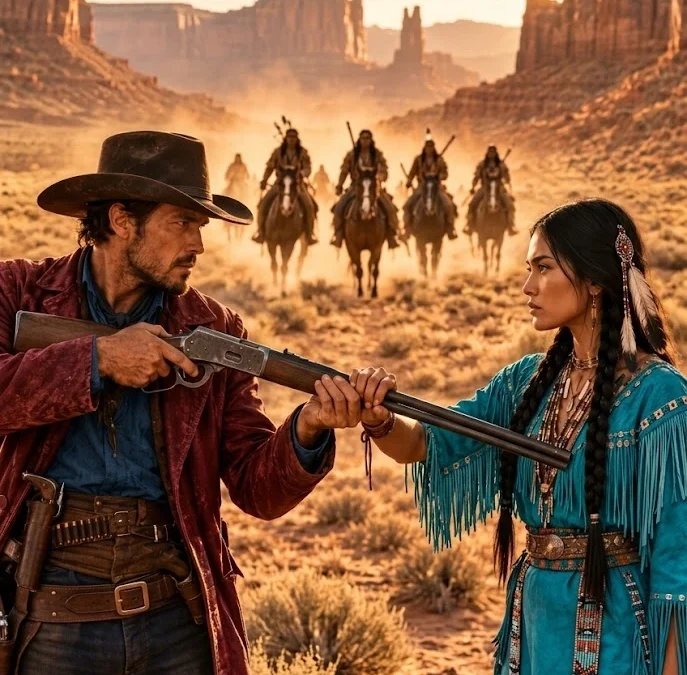
THE COWBOY WAS HIRED TO DRIVE THE APACHE AWAY—BUT THE CHIEF’S DAUGHTER FORCED HIM TO CHOOSE BETWEEN MONEY AND HIS SOUL 🤠💔
PART 1: THE WOMAN WHO REFUSED TO FEAR HIM
The first time Cole Barrett pointed his rifle at Nerra, he believed he was protecting his land. By the time he lowered it, he had begun to question everything he had ever believed about justice, loyalty, and the price of survival.
But neither of them could have imagined that their meeting beside a lonely river in Arizona would soon put an entire community on the edge of war.
In the scorching Arizona Territory, where red cliffs rose above dusty valleys and the wind carried the smell of sagebrush, stood a small settlement called Redemption Creek. Life there was hard, and trust was harder to earn. Ranchers fought to protect their cattle, families carried old griefs behind closed doors, and every stranger was treated as a potential threat.
Cole Barrett, thirty-six, was one of the toughest men in the territory. He owned a modest ranch, worked from sunrise to sunset, and had once earned his living hunting dangerous men for bounty money. His face was weathered by years beneath the desert sun, and his eyes held the exhaustion of someone who had lost too much to believe in happy endings.
His family had died when he was young, leaving him alone with his grief. Since then, he had learned to trust his rifle, his horse Dust, and very few people.
The only man who truly understood his quiet ways was Miguel Ortega, a forty-five-year-old ranch hand whose patience and loyalty kept Cole’s struggling property alive.
When several powerful ranchers began complaining that Apache families were moving closer to their grazing lands and water sources, they hired Cole to patrol the territory. They insisted they wanted peace, not bloodshed. They simply wanted someone to keep the Apache away.
Cole accepted the job. He needed the money, and he had grown accustomed to doing whatever it took to survive.
Then came the afternoon that changed everything.
While following tracks near the Rio Seco, Cole spotted a young Apache woman kneeling beside the water, gathering herbs among the damp stones. Her long black hair fell into two braids decorated with turquoise beads that shimmered in the afternoon sunlight.
Cole immediately dismounted and raised his rifle.
“Don’t move!” he ordered.
The woman rose slowly. Instead of trembling, she turned toward him with dark, furious eyes.
“You ride onto land that isn’t yours,” she said, “and then point a rifle at me as if I’m the trespasser?”
Cole frowned. He was accustomed to fear, excuses, and submission. This woman offered none of them.
“These lands belong to the ranchers who hired me,” he replied. “My job is to make sure your people stay away.”
She stepped closer.
“My people were here before your ranchers drove their first fence post into the ground. You took the land. You took the water. Now you hire men to guard whatever you haven’t taken yet.”
Her words struck him harder than he expected.
Cole lowered his rifle slightly. “I’m doing the work I’m paid to do.”
“Getting paid doesn’t make it right,” she answered. “It only means you’re willing to ignore what’s wrong as long as your pockets stay full.”
For the first time in years, Cole had no answer.
After a long silence, he asked her name.
“Nerra,” she replied. “I’m Tar’s daughter. He leads my people.”
Then she looked directly at the rifle in his hands.
“Tell your ranchers we will continue coming to this river. We were here before their deeds, before their fences, and before they decided a piece of paper could tell us where we were allowed to stand.”
With that, she picked up her basket and disappeared among the cottonwood trees.
Cole remained beside the river long after she was gone. He couldn’t decide whether he was angry with Nerra for challenging him or with himself because he couldn’t prove her wrong.
That night, he barely slept.
Over the following days, his patrol reports grew vague. He omitted sightings, ignored harmless tracks, and stopped treating every sign of Apache presence as evidence of danger.
Eventually, Hank Mercer, one of the most powerful ranchers in Redemption Creek, noticed.
“Your reports are getting mighty thin, Barrett,” Hank warned him. “I’m paying you to protect our property, not waste my money.”
Cole said nothing, but he knew his new doubts could cost him everything.
Then, nearly two weeks after his first encounter with Nerra, fate brought them together again.
Cole was leading a string of horses through a narrow canyon when a young colt named Rusty suddenly bolted. The frightened animal charged straight toward Nerra, who stood trapped between the canyon walls with nowhere to escape.
“Nerra!” Cole shouted.
He drove Dust forward, leaned from the saddle, and seized Rusty’s reins just seconds before the collision. The colt swerved violently, giving Nerra enough room to throw herself clear.
Dust and Rusty crashed shoulder-to-shoulder, filling the canyon with dust and frightened cries.
Cole jumped down and rushed to her side.
“Are you hurt?”
Nerra checked her scraped knee and bleeding forearm. “I’m fine.”
She looked at him suspiciously. “You shoved me.”
“I saved you from a runaway horse,” he snapped, though the relief in his voice betrayed him.
For a moment, neither spoke.
Then Cole noticed the basket beside her. It was empty.
“What are you doing out here alone?”
“Looking for a plant that grows in the shade beneath these rocks,” she admitted. “It helps bring down a fever. One of our people, Aan, is sick, and we need the medicine.”
Cole remembered watching his own family suffer through sickness years earlier, powerless to save the people he loved.
“Let me help you find it,” he offered.
Nerra stared at him in disbelief. “The man hired to keep my people away suddenly wants to help me gather medicine?”
“Maybe I’m tired of pretending I can’t tell right from wrong just because someone puts money in my hand.”
For the first time, Nerra saw something in him beyond the rifle, the hard expression, and the rancher’s orders.
Together, they searched the rocky slopes until they found the small white flowers she needed. They spoke cautiously at first, then gradually shared pieces of their lives. Cole told her about his lost family. Nerra spoke of her people, their traditions, and the responsibility she carried as the daughter of their leader.
When she slipped on a loose stone, Cole caught her arm before she fell. For several heartbeats, they stood close enough to feel each other’s breath.
Neither wanted to admit what was changing between them.
When they finally parted at the edge of Apache territory, Nerra reminded him that his kindness changed nothing. He still worked for men who wanted her people driven away.
Cole watched her disappear into the trees.
“Maybe I don’t have to do that job the way they expect me to,” he whispered.
He had no idea how soon he would be forced to prove those words.
❤️ LIKE and comment “TRUST” if you want to see how Cole risks everything to save Nerra and her people.
PART 2: THE TWELVE MISSING CATTLE AND THE DANGEROUS SECRET
He had no idea how soon he would be forced to prove those words.
Three days after the ranchers’ ultimatum, Cole rode into Apache territory with a warning that could determine the fate of both communities.
Twelve cattle had vanished from Hank Mercer’s ranch. Hank was convinced the Apache had stolen them, and his men were preparing to ride into their camp with guns loaded.
When Cole found Nerra among a group of Apache scouts, several men immediately raised their weapons. Nerra stepped forward and ordered them to stand down.
“What are you doing here?” she demanded. “You shouldn’t have come this far.”
“Cattle have disappeared,” Cole answered. “The ranchers blame your people. If I don’t find the truth, they’ll come here armed.”
Nerra’s expression hardened.
“We didn’t take their cattle.”
“I believe you,” Cole replied. “But I need proof before innocent people die.”
For a moment, she studied him as though trying to decide whether he had truly changed. Then she made a decision that surprised everyone.
“Take me to the place where the cattle disappeared,” she said. “We’ll find out who did this.”
She led him to her father, Tar, the respected leader of their people. Tar listened carefully as Cole explained the danger. Although he distrusted the white ranchers, he agreed to let Nerra help investigate.
Together, Cole and Nerra followed the trail toward the eastern canyon. They discovered hoofprints that didn’t match the horses used by the Apache, along with the remains of a camp where unfamiliar men had recently stayed.
Then Cole spotted something that made his blood run cold.
A distinctive horseshoe mark pressed into the dirt.
He had seen that mark before.
“The Black Viper Gang,” he whispered. “I’ve been tracking signs of these men for months.”
Suddenly, everything made sense. Outsiders had stolen the cattle and deliberately left misleading tracks, knowing the ranchers would blame the Apache without asking questions.
They finally had evidence that could prevent a massacre.
But as the sun sank behind the canyon walls, Cole and Nerra found themselves standing closer than either had intended. The fear, suspicion, and anger between them had slowly given way to something neither could deny.
“This is madness,” Nerra whispered.
“Probably,” Cole answered.
Then she leaned toward him, and he met her halfway.
Their kiss was brief at first, hesitant and almost disbelieving. But neither pulled away.
When Nerra finally stepped back, she looked frightened—not of Cole, but of what their feelings might mean for the people who depended on her.
“I have to go,” she whispered.
Cole watched her disappear into the fading light, knowing their lives would never be quite the same.
The following morning, he rode straight to Hank Mercer’s ranch with the evidence in his hands.
Hank studied the horseshoe sketch, his expression darkening with every word Cole spoke. Then he looked up and asked the question Cole had feared most.
“If you’re so certain the Black Vipers took our cattle, Barrett, tell me something. Why should I trust a man who’s been hiding Apache movements from us for weeks?”
Cole opened his mouth to answer.
But before he could speak, a rider came galloping into the yard, shouting that armed men had been spotted moving toward the Apache camp.
Hank reached for his gun.
And Cole realized that the truth alone might not be enough to stop the bloodshed.
❤️ LIKE and comment “TRUST” if you want to see how Cole risks everything to save Nerra and her people.
PART 3: THE CHOICE THAT CHANGED TWO WORLDS
For one terrible second, nobody moved.
Then Hank Mercer shoved the horseshoe sketch back into Cole’s hands and reached for his revolver.
“Get the men together!” he shouted. “If those Apache have decided to make their move, we’ll meet them ready.”
“They haven’t made any move!” Cole snapped, stepping between Hank and the stable. “You haven’t even established who those riders are.”
Hank’s face twisted with anger. “I’ve spent thirty years protecting what belongs to me. I’m not going to let some hired gun tell me how to defend my own property.”
“Then listen to the hired gun who knows what he’s talking about.”
The words hung between them.
Cole had spent years avoiding confrontations that didn’t pay. He had learned that a man could survive almost anything if he kept his head down, accepted his wages, and stayed out of other people’s quarrels.
But this was different.
He could already picture Nerra standing beside the river, her chin raised defiantly as she faced his rifle. He remembered the way she had looked at him in the canyon, the trust she had reluctantly offered, and the kiss that had changed everything.
He couldn’t allow fear to destroy the fragile understanding they had begun to build.
“Give me one hour,” Cole demanded. “Let me find out who those riders are before you send men into a fight you might never come back from.”
Hank hesitated.
Then the rider who had delivered the warning dismounted, breathing hard.
“I saw them from the northern ridge,” he explained. “They weren’t Apache. They were white men, riding hard toward the eastern canyon. At least six of them.”
Cole felt a surge of grim satisfaction.
“The Black Vipers,” he said. “They’re trying to finish what they started.”
Hank looked between the two men. For the first time, uncertainty crept into his expression.
“How do you know?”
“Because I’ve been watching their tracks for months. And because somebody wanted you angry enough to stop thinking.”
For a long moment, Hank said nothing.
Then he lowered his gun.
“All right, Barrett. You’ve got your hour. But if you’re wrong, you answer to me.”
Cole swung into Dust’s saddle.
“If I’m wrong, I’ll answer to you. But if I’m right, you’ll have to answer for what you nearly did.”
With that, he rode toward the eastern canyon.
He knew the Black Vipers would not welcome an unexpected visitor. The gang had survived by remaining elusive, stealing cattle, selling stolen goods, and exploiting the mistrust between settlers and Apache families. If they realized Cole had discovered their deception, they might try to silence him.
Still, he rode on.
As he approached the canyon, he found Nerra waiting near the rocks, accompanied by two Apache scouts. She had heard the distant hoofbeats and feared the ranchers had already begun their attack.
When she saw Cole approaching alone, she hurried toward him.
“Did they believe you?”
“They’re listening,” he answered. “For now.”
Nerra studied his face. “And the riders?”
“Heading this way. I believe they’re the men responsible for the theft.”
Her expression tightened. “Then we must be careful. If they discover our people are watching them, they’ll try to escape. And if the ranchers see us near those cattle, they’ll blame us all over again.”
Cole nodded.
“That’s why we’re going to make sure the truth is impossible to ignore.”
Together, they followed the tracks through a narrow passage until they reached a rocky overlook. Below them, a small herd of cattle moved through a hidden clearing. Several armed men stood nearby, arguing over the animals.
Cole recognized one of them immediately: a scarred outlaw he had encountered during his bounty-hunting days.
There was no doubt now.
The Black Vipers had stolen the cattle.
But Cole’s relief disappeared when he noticed something else. The gang had seen the tracks leading toward the Apache territory, and one of the men was pointing in Nerra’s direction.
“They know someone has been following them,” Cole whispered.
The scarred outlaw mounted his horse and shouted to the others.
“Get the herd moving! We’re leaving before those fools from Redemption Creek find us!”
Cole drew a slow breath. “If they get those cattle over the southern ridge, they’ll disappear into the desert.”
Nerra looked at him. “What do we do?”
Cole considered the narrow trail, the scattered boulders, and the men preparing to move the herd.
“We make them stop.”
He rode down into the clearing before Nerra could object.
“That’s far enough!” he shouted.
The outlaws spun toward him. Several immediately drew their weapons.
The scarred man recognized Cole and grinned.
“Well, well. Cole Barrett. I thought you’d learned to mind your own business.”
“I did,” Cole replied. “Then you stole twelve cattle and tried to start a war.”
The outlaw laughed.
“Prove it.”
Cole held up the sketch of the distinctive horseshoe mark.
“I already have.”
For a moment, the man’s smile vanished. Then he raised his revolver.
“You should’ve stayed home, Barrett.”
A gunshot shattered the stillness.
Cole threw himself behind a boulder as the bullet struck the rock beside his head. The Apache scouts moved quickly along the ridge, keeping their distance from the cattle while preventing the outlaws from escaping through the narrow passage.
Nerra remained behind cover, watching for an opening.
The gang leader shouted orders, but his men were beginning to panic. Their carefully planned escape was falling apart.
Then another sound rose from the northern trail.
Hooves.
A group of ranchers appeared on the ridge, led by Hank Mercer.
For a terrible moment, Cole feared everything would collapse. The ranchers saw armed Apache scouts on the rocks, stolen cattle in the clearing, and outlaws firing from behind the brush. Without understanding what was happening, they might shoot at the wrong people.
Cole rose from cover.
“Hold your fire!” he shouted. “The thieves are right in front of you!”
Hank recognized him and raised his hand, signaling his men to stop.
The scarred outlaw seized the opportunity. He mounted his horse and tried to escape through a narrow gap between the rocks.
But Nerra had anticipated the move.
She rode across the opening, forcing the outlaw to turn away from the trail. An Apache scout moved in from the opposite side, leaving the man nowhere to go.
Cole charged forward and struck the outlaw’s revolver from his hand.
Within minutes, the remaining gang members were surrounded. Two surrendered immediately. Another tried to flee but was stopped by the ranchers.
The stolen cattle were recovered.
And for the first time, the men of Redemption Creek had undeniable proof that the Apache had not been responsible.
Hank approached the captured gang leader, his face pale with anger.
“You nearly got innocent people killed.”
The outlaw spat into the dirt.
“Wasn’t hard to do. All we had to do was leave a few tracks. Everybody already hated everybody else.”
The words cut through the clearing more deeply than any bullet.
Everyone heard them.
Cole looked at Hank.
“That’s what I was trying to tell you. Fear makes people easy to manipulate. You were ready to ride into another man’s home without knowing whether he’d done anything wrong.”
Hank lowered his eyes.
For years, he had considered himself a practical man, someone who protected his interests and never let sentiment interfere with business. Now he had to confront the possibility that his certainty had nearly cost dozens of people their lives.
He turned toward Tar’s scouts.
“We were wrong,” he said stiffly. “Your people didn’t steal our cattle. I owe you an apology.”
The words were awkward, but they were a beginning.
One of the older scouts replied that an apology would not erase years of suspicion, stolen water, or disputed land. Hank listened without interrupting.
For the first time, the conversation was not about threats or weapons. It was about what would happen next.
Later that evening, Cole returned to the Apache camp with Nerra.
Tar was waiting near the central fire. When he saw his daughter approach beside Cole, his expression revealed little, but his eyes moved between them with unmistakable understanding.
“The cattle have been recovered,” Cole explained. “The thieves have been captured. Hank knows the truth.”
Tar nodded slowly.
“Truth is important,” he replied. “But truth spoken once does not undo years of mistrust.”
“I know,” Cole said.
Tar studied him. “And what will you do now, Cole Barrett? Will you return to the men who paid you to keep my people away?”
The question struck at the heart of everything Cole had been struggling with.
He thought of his ranch, the work that kept him alive, and the only life he had known since losing his family. Walking away from his contract meant uncertainty. It meant risking the little security he had managed to build.
Then he looked at Nerra.
She did not plead with him or ask him to choose her. She simply waited, giving him the freedom to make his own decision.
That made the choice clearer.
“No,” Cole answered. “I’m finished doing their work for them. I’ll keep my ranch, but I won’t help drive your people from their homes.”
Tar watched him for a long time before speaking.
“Words are easy, cowboy. What matters is what a man does when keeping his word costs him something.”
“Then you’ll see what I do.”
In the weeks that followed, Cole kept his promise.
He returned to Redemption Creek and told the ranchers he would no longer patrol Apache territory for their benefit. Some called him a traitor. Others accused him of allowing sentiment to cloud his judgment. Hank himself remained distant for a time, struggling to reconcile his anger with the evidence he had witnessed.
But the recovered cattle and the captured outlaws had changed the conversation.
A few ranchers began discussing agreements about access to water and the movement of livestock. Nothing was settled quickly, and old grievances did not disappear overnight. Yet the threat of immediate violence began to recede.
Cole continued working his land. Miguel Ortega stood beside him, offering the same quiet loyalty he always had.
One evening, as they repaired a fence, Miguel glanced toward the distant hills.
“So,” he remarked, “are you going to keep pretending those patrols are about cattle?”
Cole gave him a sideways look.
“I don’t know what you’re talking about.”
Miguel laughed. “Of course you don’t.”
For the first time in years, Cole found himself smiling without forcing it.
A few days later, he rode to the river where he had first met Nerra.
She was there, gathering herbs among the damp stones, her turquoise beads catching the late afternoon light.
When she saw him, she straightened.
“Have you come to warn me away from the water again?” she asked.
Cole dismounted, leaving his rifle secured in its holster.
“No. I’ve come to ask whether you’ll walk with me.”
Nerra studied him, and a small smile appeared at the corner of her mouth.
“You’ve become a very different man, Cole Barrett.”
“Not different enough,” he admitted. “I’ve still got plenty to learn.”
She stepped closer.
“So do I.”
For a moment, they stood beside the river, listening to the water move over the stones. Their future remained uncertain. Their communities still carried the wounds of conflict, and their relationship would not be free from opposition.
But neither of them was willing to let fear make every decision anymore.
Cole reached for her hand, and this time, Nerra took it without hesitation.
They began walking together beneath the cottonwoods as the setting sun painted the cliffs in shades of gold and crimson.
Cole had once believed survival meant never trusting anyone, never questioning the men who paid him, and never allowing his heart to interfere with his work.
Nerra had shown him that a man could spend his entire life protecting what he owned and still fail to understand what was worth protecting.
He had been hired to keep an entire people away from their land. Instead, he had discovered the courage to challenge injustice, the humility to admit he was wrong, and the possibility of loving someone whose world was different from his own.
Their love would not instantly heal the frontier. It would not erase stolen land, old grief, or years of mistrust. But it could become a small beginning—a bridge built one honest choice at a time.
And sometimes, that is how the greatest changes begin.
Not with a gunshot.
Not with a threat.
But with one person finally finding the courage to see another as human.
The End.
Disclaimer: This story is entirely fictional and created for entertainment purposes. Characters, events, dialogue, and dramatic situations are fictional and do not represent any specific individual or organization. The story was created with AI assistance.








