THE DUKE ASKED HER ONE QUESTION NO MAN HAD EVER DARED TO ASK
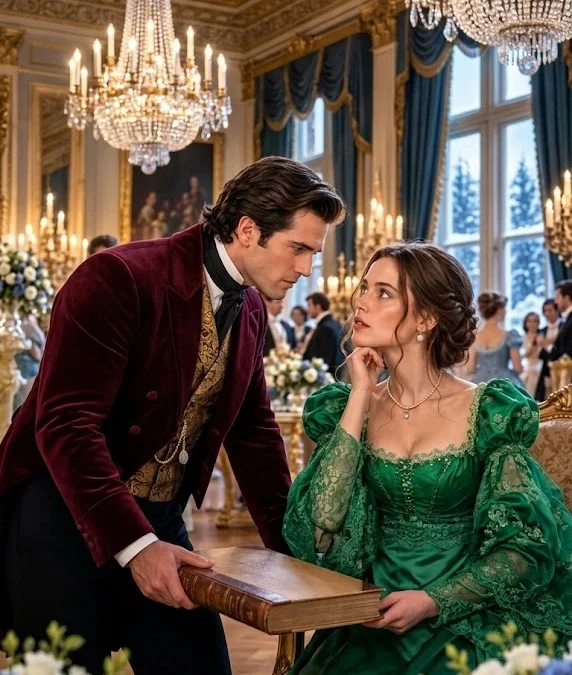
THE DUKE ASKED HER ONE QUESTION NO MAN HAD EVER DARED TO ASK 😱
PART 1
“No, Sir Edmund. I will not marry you.”
The words fell into the grand ballroom like stones into still water.
Outside Harrington House, snow drifted over London in heavy white curtains. Inside, beneath a thousand candles and glittering chandeliers, Eleanor Whitmore had calmly refused her eleventh suitor.
A ripple of laughter moved behind silk fans.
Everyone knew the story.
Miss Eleanor Whitmore was the proudest spinster in London—the beautiful, intelligent woman who had rejected eleven wealthy men and apparently intended to reject the twelfth, thirteenth, and every man unfortunate enough to follow.
But one man did not laugh.
Across the ballroom, Adrienne Blackwood, Duke of Blackwood, watched her in silence.
And eventually, he would ask her the one question no man had ever thought to ask.
London had surrendered to winter that year. Snow covered the stone steps of Mayfair, and carriages carved dark ribbons through the slush as they arrived at Harrington House.
Inside, the world was warm.
Fireplaces roared. Musicians played. Champagne flowed. Silk rustled beneath diamonds and pearls.
At the center of it all stood Eleanor.
She wore a gown of deep winter blue, simple compared with the glittering dresses surrounding her. Her dark hair was pinned without ornament.
Sir Edmund Clark stood before her, red-faced with embarrassment.
He had proposed loudly, deliberately, in front of nearly two hundred people.
He was wealthy. He owned three estates. He had connections in Parliament.
And Eleanor’s family was drowning in debt.
Everyone understood what his proposal really was.
A rescue.
A transaction.
A bargain.
“You are very generous, Sir Edmund,” Eleanor said calmly. “You offer me your house, your name, and your income. And in return, you expect my silence, obedience, and gratitude for the rest of my life.”
The ballroom became painfully quiet.
“I would rather live alone than be paid for.”
Someone gasped.
A glass slipped from a lady’s hand and shattered.
Sir Edmund’s face turned crimson.
“You foolish girl,” he hissed. Then, louder, because he wanted everyone to hear him, “You have had five seasons. Five. You will grow old and cold in some forgotten parish with no husband, no children, and no one to remember your name.”
Eleanor smiled.
It was almost gentle.
“Perhaps I will.”
She curtsied.
“But if I die alone, Sir Edmund, at least I will die with my own mind.”
Then she walked away.
Across the room, Adrienne Blackwood finally put down his untouched glass.
His oldest friend, Colonel Thomas Hail, stared at him.
“Who is she?”
Hail nearly choked.
“In twelve years of friendship, you have never once asked me the name of a woman.”
Adrienne said nothing.
Hail sighed.
“Miss Eleanor Whitmore. Eldest daughter of Lord Henry Whitmore. Five seasons. Eleven proposals. Eleven refusals.”
“Why?”
“Her family is nearly ruined. Everyone assumes she’s too proud to marry.”
Adrienne’s eyes followed Eleanor to the frosted window.
She stood there alone.
But she wasn’t watching the snow.
She was watching her younger sister, Amelia, laughing with a group of young gentlemen.
There was no jealousy in Eleanor’s expression.
Only love.
And exhaustion.
Adrienne knew that look.
His elder sister, Cassandra, had once worn it.
She had been brilliant, curious, and far too intelligent for the life chosen for her. Their father had married her to a wealthy man who wanted a beautiful wife, not a clever one.
Everyone had called it an excellent match.
Adrienne had watched the light disappear from Cassandra’s eyes.
She died at twenty-six.
Adrienne had never forgiven the world for calling that a successful marriage.
“Introduce me,” he said.
Hail stared.
“To Miss Whitmore?”
“Yes.”
“You realize she is guaranteed to refuse you.”
A faint smile touched Adrienne’s mouth.
“Perhaps that is exactly why.”
A few minutes later, Eleanor turned from the window and found herself facing the Duke.
“Your Grace.”
“Miss Whitmore.”
She studied him carefully.
“I suppose you saw my performance.”
“Everyone did.”
“Then let me save us both some trouble. Have you come to be the twelfth?”
“No.”
The answer was immediate.
Eleanor blinked.
“I have not come to propose,” Adrienne continued. “I have come to ask you a question.”
“What question?”
He glanced toward Sir Edmund, who was still complaining to a circle of gentlemen.
“Why was he wrong?”
Eleanor stared at him.
In five seasons, men had asked her countless questions.
Why are you so proud?
Why are you so difficult?
Who do you think you are?
What more could you possibly want?
But no one had ever asked her to explain herself as though her reasons might actually matter.
“I am not afraid of being alone,” she said finally.
Her eyes moved toward her father.
“What I am afraid of is becoming a debt.”
Adrienne said nothing.
“My father needs a marriage to save our family. Every gentleman who has asked for me has known it. One wanted our name. Another wanted our land. Another wanted a quiet wife who would never question his accounts.”
Her voice softened.
“They all came to purchase something.”
She looked back at him.
“And they all expected me to thank them for the price.”
Adrienne felt something tighten inside him.
“I would rather be a woman nobody wants,” Eleanor whispered, “than a wife somebody bought.”
The words struck him deeply.
Because they were the same words he had carried since Cassandra’s funeral.
They were both refusing the same thing.
A marriage without choice.
A life in which one person bought and another was sold.
“I think,” Adrienne said slowly, “you have paid a very great price to keep that belief.”
For the first time, Eleanor’s composure cracked.
Only slightly.
But he saw it.
Then he bowed.
“Good evening, Miss Whitmore.”
And he walked away.
For the first time in five years, Eleanor had no answer.
Nearly a week passed before she saw him again.
It happened at a winter concert.
Adrienne appeared near the fireplace, dressed in black.
“You do not care for music,” Eleanor said.
“I do not.”
“Then why are you here?”
“To continue our conversation.”
He led her toward a quiet corner.
“Everyone in London has seen you,” he said. “They have measured your gowns, counted your suitors, and calculated your father’s debts. But no one has looked at you.”
Eleanor’s expression softened.
Then Adrienne asked the question that made her angry.
“Does your sister resent you?”
Her face changed instantly.
“How dare you?”
“I asked because I watched her look at you.”
Eleanor stopped.
“She wasn’t resentful,” he said. “She was worried about you.”
The anger in Eleanor’s eyes faltered.
“You are a dangerous man, Your Grace.”
“Why?”
“Because you make me feel things I decided long ago I would never feel again.”
Three days later, Eleanor went to a forgotten library in a narrow London street.
She wanted somewhere no one knew her.
Naturally, Adrienne found her there.
“You followed me.”
“I prefer to call it a fortunate coincidence.”
He was holding a book.
Eleanor looked at the title.
A practical guide to the care and breeding of pigeons.
She burst out laughing.
Adrienne stared at the book.
Then at her.
“You find this amusing?”
“You came to a library and chose a pigeon manual.”
He returned it to the shelf with enormous dignity.
And Eleanor laughed again.
It was bright and completely unguarded.
Adrienne looked at her as though he had just heard music for the first time.
Then he asked:
“What do you read when no one is choosing your books for you?”
She hesitated.
Slowly, she pulled a heavy volume from a lower shelf.
Inside were diagrams of fields, ditches, soil, and water channels.
“I have studied drainage,” she admitted.
Adrienne looked up.
“Why?”
“Because Whitmore Park is drowning.”
She explained everything.
The flooded fields.
The failed engineers.
The buried stream.
The badly designed channels.
The way water moved through the land.
Her hands moved as she spoke.
Her eyes brightened.
For several minutes, she forgot she was speaking to a duke.
Adrienne listened.
Then he said something no suitor had ever offered her.
“I own thousands of acres in Yorkshire. Much of it is suffering from the same problem.”
He closed her book.
“Come to Blackwood Hall.”
Eleanor stiffened.
“No.”
“I am not asking you to marry me.”
She stared at him.
“I am asking you to look at my land.”
He paused.
“If you tell me it cannot be saved, I will believe you. If you tell me how to save it, I will listen.”
“A duke taking advice from a woman?”
“From an expert.”
She looked at him suspiciously.
“And what do you want in return?”
“Nothing.”
He gestured toward her book.
“I can give you something no man has given you yet.”
“What?”
“A field.”
For the first time in her life, Eleanor was offered a future that did not come with a ring.
Ten days later, the Whitmore carriage arrived at Blackwood Hall.
Eleanor barely looked at the magnificent house.
She was already studying the land.
By morning she was walking frozen fields with a notebook in one hand and an iron tool in the other.
She discovered the problem within days.
The drainage channels had been dug backward decades earlier.
The land was not cursed.
It had simply been misunderstood.
For weeks, Eleanor worked beside the estate steward, Samuel Caldwell.
Adrienne never took credit.
When the laborers looked to him for instructions, he pointed toward Eleanor.
“Ask Miss Whitmore.”
Slowly, the men stopped questioning her.
And every evening, she and Adrienne met in the library.
They spoke of books.
Soil.
Loss.
Cassandra.
Marriage.
Freedom.
One night Eleanor asked him the question that had been growing inside her.
“Then why do you keep coming to find me?”
Adrienne looked at her.
The fire cracked between them.
He did not answer.
Somehow, his silence said more than words could.
Then, before Christmas, Amelia fell in love with Lieutenant James Rowan.
He loved her too.
But he had little money.
Lady Margaret refused him.
And Amelia could not marry while Eleanor remained unmarried.
That night Eleanor found her sister crying on the stairs.
“I love him,” Amelia whispered.
Then she took Eleanor’s hands.
“Please don’t blame yourself.”
But Eleanor already was.
She went straight to Adrienne.
“I thought I was protecting her,” she said through tears. “But she has been paying for my choices.”
Adrienne’s face hardened.
“No one will sell you again.”
He meant it as a promise.
But he was about to make the very mistake he had spent his life despising.
And when Eleanor discovered what he had done, she would realize that even love could become another kind of cage.
If you want Part 2, look for it in the comments—or leave any word below and I’ll send it privately.
The next morning, Adrienne made a decision that would change all of their lives.
PART 2
The next morning, Adrienne made a decision that would change all of their lives.
He summoned two lawyers from York.
By noon, he had purchased the flooded lower fields of Whitmore Park, settled Lord Whitmore’s debts, secured Amelia a financial settlement, and arranged for Lieutenant James Rowan to receive a promotion and enough income to marry.
He also drew up a formal contract naming Eleanor as consulting surveyor for the Blackwood estate—with a salary entirely her own.
Adrienne believed he had solved everything.
He believed he had freed Eleanor.
But Eleanor discovered the papers by accident.
She entered his study looking for a survey map and found the documents spread across his desk.
She read them once.
Then again.
When Adrienne entered, her face was white.
“What have you done?”
“Your family is safe,” he said gently. “Your father owes nothing. Amelia can marry Rowan. And your work is finally being recognized.”
“You bought my father’s land.”
“It was a fair transaction.”
“You paid his debts.”
“Yes.”
“You bought my sister’s future.”
“I gave her a settlement.”
“And you did all of it without asking me.”
Adrienne stopped.
Eleanor’s hands trembled.
“You turned my whole family into a debt.”
“I did it so no one would have to sell you.”
“No.”
Her voice broke.
“You did it so everything we have now comes from you.”
She looked directly into his eyes.
“And I am the debt.”
Adrienne went still.
“If you asked me to marry you now, how would I ever know whether I said yes because I loved you—or because I owed you?”
He finally understood.
He had done to her with the best intentions what his father had done to Cassandra with the worst.
He had taken away her choice.
Eleanor walked out into the snow.
This time, Adrienne did not follow.
He did something harder.
He let her go.
Two days later, the lawyers returned to York.
Adrienne rewrote every agreement.
The land transaction remained a genuine sale.
Amelia’s settlement was made independent of Eleanor and Adrienne.
Eleanor’s position became permanent and could never be withdrawn as punishment for refusing him.
Most importantly, the papers stated clearly that Eleanor owed Adrienne nothing.
Not gratitude.
Not companionship.
Not marriage.
When Eleanor read the new documents, she finally understood what he had done.
She went to find him.
He stood alone in his study as snow fell beyond the windows.
“I thought,” Adrienne said quietly, “that I was supposed to ask whether you would marry me.”
He looked at her.
“But I am not going to ask you that.”
Eleanor’s breath caught.
“I am going to ask you something else.”
He stepped no closer.
The question he should have asked her from the beginning was finally waiting between them.
“Eleanor, what do you want?”
For the first time in her life, she knew she could answer without owing anyone anything.
LIKE this post and comment the word “CHOICE” if you want Part 3. Once enough comments are received, I’ll post Part 3 with Eleanor’s answer, Adrienne’s final test, Amelia’s wedding, and the ending of the story.
PART 3
“Eleanor, what do you want?”
The question hung between them.
Outside the study windows, snow continued to fall.
Inside, the fire burned low.
Eleanor looked at Adrienne Blackwood—the man who had first seen her standing alone in a ballroom and had somehow noticed the things no one else had.
He had asked why she refused.
He had asked what she read.
He had asked what she cared about.
He had given her a field instead of a ring.
And then, for one terrible moment, he had made the same mistake as every other man.
He had decided what was best for her.
But unlike the others, he had listened when she told him he was wrong.
He had given everything back.
Her freedom.
Her work.
Her family’s independence.
Even the possibility of loving him.
Eleanor lowered her eyes.
“I don’t know.”
Adrienne did not move.
“I thought I did,” she whispered. “All these years, I thought I wanted only one thing.”
“To be free?”
“Yes.”
She looked toward the window.
“I thought if I refused every man, no one could ever own me. I thought if I needed nothing, no one could bargain with me.”
Her voice trembled.
“And then you asked me what I wanted.”
Adrienne waited.
“I realized I had spent so long protecting myself from wanting anything that I had forgotten how to want.”
A tear slipped down her cheek.
She did not wipe it away.
“I want my work.”
“You have it.”
“I want Amelia to marry the man she loves.”
“She will.”
“I want my father to stand on his own feet.”
“He will.”
She drew a shaky breath.
“And I want…”
She stopped.
Adrienne’s expression remained calm, but she could see the tension in his jaw.
“You can say anything,” he said.
“I know.”
She looked directly at him.
“I want you.”
Adrienne froze.
Eleanor laughed through her tears.
“But not because you saved my family.”
He said nothing.
“Not because you are a duke.”
Still nothing.
“Not because you gave me a position.”
She took one step closer.
“I want you because when I am with you, I do not feel smaller.”
Adrienne finally breathed.
“I feel more like myself.”
He closed his eyes for a moment.
When he opened them, they were bright.
“Are you certain?”
Eleanor smiled.
“For the first time in my life.”
She stepped closer.
“Yes.”
Adrienne did not immediately touch her.
He had learned.
He would not assume.
He would not take.
He waited until she reached for him first.
Only then did his arms come around her.
Eleanor rested her forehead against his chest.
For five years, she had been told that she was difficult.
Proud.
Cold.
Unreasonable.
Unmarriageable.
Now, in the quiet of that study, she understood something.
She had never been difficult.
She had simply been waiting for someone to understand that her choice mattered.
Adrienne kissed her forehead.
Then he stepped back.
“There is still one thing I must do.”
“What?”
He went down on one knee.
Not because she was a duke’s possession.
Not because she was a ruined family’s daughter.
Not because he had purchased her future.
He knelt simply because he loved her.
“Eleanor Whitmore, will you choose me?”
She laughed softly through her tears.
“Yes.”
He smiled.
“And tomorrow?”
“Yes.”
“And in ten years?”
She raised an eyebrow.
“Ask me then.”
For the first time in years, Adrienne laughed.
A real laugh.
Warm.
Unrestrained.
And Eleanor realized that perhaps love was not the surrender she had feared.
Perhaps love was being allowed to remain entirely yourself while choosing to share your life with another person.
Their engagement caused a sensation.
London could not resist the story.
The Duke of Blackwood—the man who had refused every woman in England—had finally proposed.
To the woman who had refused every man in London.
Lady Victoria Portway nearly swallowed her fan.
Sir Edmund Clark stopped mentioning Eleanor altogether.
And Lady Margaret Whitmore, after several days of confusion, finally sat down and cried.
Not because her eldest daughter was marrying.
Because Eleanor had found a way to marry without selling herself.
But there was still one problem.
Amelia.
Eleanor refused to let her sister’s future be decided by hers.
So Adrienne arranged something very different.
He invited Lieutenant James Rowan to Blackwood Hall.
James arrived nervous enough to look as though he expected to be court-martialed.
Adrienne sat across from him.
“You love Amelia?”
“Yes, Your Grace.”
“Can you support her?”
James hesitated.
“Not as well as I wish.”
Adrienne smiled.
“Good.”
James blinked.
“A man who knows exactly what he lacks is easier to trust than one who pretends he lacks nothing.”
Adrienne offered him a position connected to the estate’s agricultural administration.
Not charity.
Employment.
James accepted.
And when he asked for Amelia’s hand again, Lord Whitmore could no longer object.
Amelia married James in the little stone chapel at Blackwood Hall on the first bright morning of spring.
Snowdrops filled the windows.
Eleanor stood beside her sister.
As Amelia walked toward her future, she stopped halfway down the aisle.
She looked at Eleanor.
Then smiled.
Eleanor began crying immediately.
Amelia reached her and whispered, “You know you were never keeping me trapped, don’t you?”
“I should have known.”
“You should have trusted me.”
Eleanor laughed through her tears.
“Yes.”
Amelia squeezed her hands.
“I love you.”
“I love you too.”
Then Amelia turned toward James.
The wedding went on.
And for the first time in five years, Eleanor did not feel a stone sewn into the hem of her gown.
Her sister was free.
Her family was safe.
And she had not had to sell herself to accomplish it.
Meanwhile, the work at Blackwood Hall continued.
Eleanor returned to the fields.
The drainage channels were redirected according to the natural fall of the land.
Old ditches were widened.
New channels were cut.
The buried stream was restored.
Caldwell watched everything with increasing astonishment.
One afternoon, he removed his hat and said, “My lady, I have managed land for thirty years.”
Eleanor smiled.
“And?”
“I have never been so pleased to discover that I was wrong.”
She laughed.
By spring, the difference was unmistakable.
The fields no longer drowned.
Water moved cleanly northward.
Crops began to grow where only mud had survived for decades.
Neighbors came to inspect the work.
Farmers asked Eleanor questions.
Stewards requested copies of her maps.
And the woman London had once called a useless spinster became known throughout the county for understanding land better than most men twice her age.
Adrienne never claimed credit.
Whenever someone praised the work, he simply said:
“My wife did it.”
At a gathering in York, Lady Victoria finally made one last attempt to humiliate her.
She raised her glass.
“It must be difficult for His Grace,” she said loudly, “to have a wife who can speak of nothing but ditches.”
The room went silent.
Adrienne set down his glass.
“My wife,” he said calmly, “accomplished in one winter what four engineers failed to accomplish in eight years.”
Lady Victoria’s smile disappeared.
Adrienne continued.
“She is not an amusement.”
His eyes swept across the room.
“She is the finest mind I have ever known.”
He paused.
“And I have no intention whatsoever of growing tired of her.”
No one laughed at Eleanor again.
But the most important change did not happen in a ballroom.
It happened months later.
One cold morning, Eleanor stood alone at the eastern field.
The ground was damp beneath her boots.
Water moved quietly through the new channel.
She knelt and touched it.
North.
Exactly as it should.
She smiled.
Footsteps approached behind her.
She didn’t turn.
“You are staring at me again.”
Adrienne stopped beside her.
“I wasted eleven years not looking at anything I loved.”
Eleanor looked up.
“I do not intend to waste another day.”
She stood.
He offered his hand.
She took it.
Together they walked across the field.
The winter remained cold.
The wind still carried snow over the hills.
But underneath the frozen ground, water was finally moving in the right direction.
And so was Eleanor’s life.
She had spent five years saying no.
No to men who wanted to buy her.
No to society’s expectations.
No to the idea that a woman’s life could be decided for her.
But her greatest victory was not finally saying yes to a duke.
It was learning that saying no and saying yes were both meaningless if neither belonged entirely to her.
Adrienne had not saved her.
She had not saved him.
They had simply met at the moment when two people who feared being owned finally understood what it meant to choose.
Years later, people would still tell the story.
They would say the Duke of Blackwood married London’s most impossible woman.
They would say Eleanor Whitmore had finally been conquered by love.
But Eleanor always corrected them.
“No,” she would say.
“He never conquered me.”
And when someone asked what changed everything, she would smile and remember a snowy ballroom, a quiet duke, and the question that had frightened her more than any proposal.
What do you want?
For the first time, she had discovered that the answer could belong entirely to her.
And that was the moment her life truly began.
Disclaimer: This story is entirely fictional and created for entertainment purposes only. It does not represent any organization or individual, nor does it encourage inappropriate behavior. The content was generated with AI assistance.








