THE DUKE CAME HOME EARLY—AND CAUGHT HIS FIANCÉE FORCING AN INNOCENT MAID TO CONFESS 😱
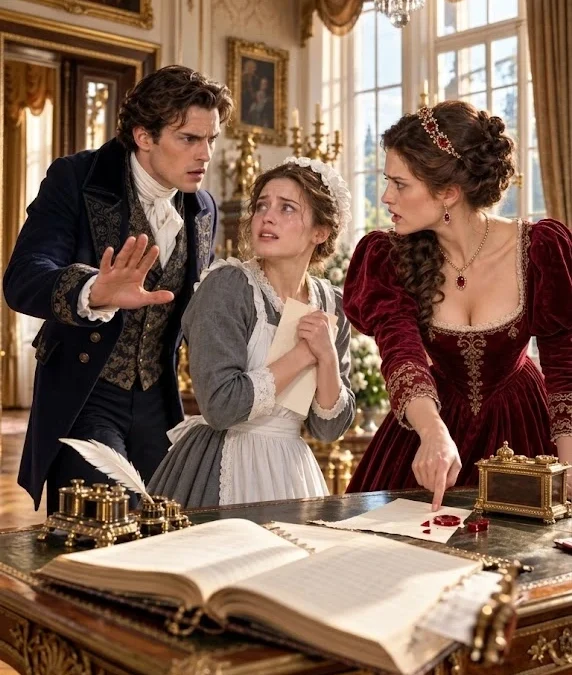
THE DUKE CAME HOME EARLY—AND CAUGHT HIS FIANCÉE FORCING AN INNOCENT MAID TO CONFESS 😱
Part 1
The sound of galloping hooves reached Highwood three days before anyone expected Duke Thaddius of Oak Haven to return.
That alone should have been harmless.
It wasn’t.
Thaddius had left London ahead of his carriage after receiving an unsettling note from his steward, Mr. Hale. The quarterly accounts had not been reconciled. A shipment had been delayed. Several payments seemed unclear.
Nothing catastrophic.
Yet something about the message had bothered him.
So instead of waiting for his valet and luggage, Thaddius rode through the night.
By late afternoon, his horse was carrying him through Highwood’s gates.
No announcement.
No welcoming servants.
No time for anyone to prepare.
And that was precisely why he heard the voice.
“You will sign it.”
Thaddius stopped outside his study.
The voice belonged to Lady Clarissa Vain—his fiancée.
But he had never heard Clarissa speak like that.
Her usual voice was soft and polished, perfected through years of dinners, drawing rooms, and aristocratic gatherings.
This voice was cold.
“You will sign it,” Clarissa repeated, “or I shall have you brought before the magistrate by supper.”
A second voice answered.
Quietly.
“I cannot confess to something I did not do.”
Thaddius opened the door.
The room fell silent.
Lady Clarissa stood behind his desk in a dark claret gown.
Across from her stood Rosalind Mallow, one of Highwood’s housemaids.
Rosalind’s face was pale, but her back was straight.
Between them lay the estate ledger.
Beside it was a handwritten confession.
And across that confession rested a quill.
For one strange moment, nobody moved.
Clarissa recovered first.
“Thaddius!”
Her expression transformed almost instantly.
“You weren’t expected until Thursday.”
“Evidently.”
He closed the door behind him.
“What is happening?”
Clarissa glanced toward Rosalind.
“Five hundred sovereigns are missing.”
Thaddius’s eyes narrowed.
“Missing?”
“From the household accounts. I discovered the discrepancy myself.”
She touched the confession.
“Rosalind has had daily access to the household purse. I was giving her an opportunity to admit what she has done before involving the magistrate.”
Rosalind finally spoke.
“That is not true, Your Grace.”
Clarissa’s expression hardened.
“Be careful.”
But Rosalind continued.
“I did not steal anything.”
She looked directly at Thaddius.
“The ledger has been altered.”
Silence.
Clarissa laughed once.
A small, incredulous sound.
“How convenient.”
Rosalind ignored her.
“I noticed it nearly two months ago. Numbers I remembered entering correctly were different when I looked again. At first I thought I had made mistakes.”
“And later?” Thaddius asked.
“I realized the changes happened whenever someone else had access to the book.”
Clarissa stepped forward.
“She is trying to save herself.”
Thaddius did not answer.
He walked toward the ledger.
The columns looked ordinary.
Payments.
Wages.
Household purchases.
Merchant accounts.
Then something caught his eye.
Ink.
Most entries were written in deep black or faded brown.
But several numbers had the faintest blue tint.
Thaddius leaned closer.
Clarissa noticed.
“Thaddius?”
He picked up the confession.
Blue-black ink.
Almost identical.
He placed it down again.
“Nobody is going to the magistrate tonight.”
Clarissa stared at him.
“You believe her?”
“I said nothing of the kind.”
“Then why—”
“Because,” Thaddius interrupted, “this confession appears to have been prepared before any proper inquiry.”
Clarissa’s face changed.
Only for a second.
But he saw it.
Fear.
Then it disappeared.
She smiled.
“Of course. Investigate as thoroughly as you wish.”
She swept toward the door, stopping beside Rosalind.
“Some truths are merely unpleasant when discovered.”
Her eyes settled on the maid.
“Others destroy lives.”
Then she left.
That evening, Thaddius remained in his study.
Supper went cold.
Midnight approached.
Still he examined the ledger.
Coal payments were too high.
Stable wages had been inflated.
Merchant invoices contained subtle discrepancies.
No single alteration was enormous.
Ten sovereigns here.
Twenty there.
A little more somewhere else.
But repeated over weeks…
Five hundred sovereigns could disappear almost invisibly.
Then Thaddius noticed something worse.
The ledger’s spine was uneven.
He held the book toward the candle.
Several pages had been carefully cut out.
Not torn.
Cut.
Someone had removed evidence and then rearranged the remaining leaves to hide the gap.
A knock sounded.
Rosalind entered wearing a gray shawl.
“I couldn’t sleep, Your Grace.”
“Neither could I.”
She glanced at the ledger.
“Did you find something?”
“Pages are missing.”
The color drained from her face.
“Then they knew.”
“Who?”
Rosalind hesitated.
“I don’t know.”
Thaddius studied her.
“Sit down.”
For the next hour, they reconstructed the accounts from memory.
Rosalind remembered astonishing details.
The butcher.
The coal merchant.
The farrier.
Seasonal wages.
Dates.
Amounts.
Each discrepancy pointed in the same direction.
Someone had systematically inflated expenses.
Finally, Thaddius closed the book.
“Why didn’t you tell Mr. Hale?”
“I tried.”
“What happened?”
“Lady Clarissa said the matter was beneath his attention. Then she suggested he travel to Gloucester.”
Thaddius went still.
Clarissa had been the one who suggested sending Hale away.
He looked toward the dark window.
Pieces were beginning to fit together.
But suspicion was not proof.
“Go to bed,” he told Rosalind.
She stood.
Then stopped.
“There is something else.”
Thaddius looked up.
Rosalind seemed frightened now.
Not of him.
Of saying the words.
“My father was a clerk,” she said. “Before he died, he taught me never to rely entirely upon another person’s books.”
“What does that mean?”
“It means…”
She swallowed.
“I kept my own.”
Thaddius slowly stood.
“A second ledger?”
“Not an official one. A private record. Every entry I personally made for the last six months. Dates, merchants, wages, amounts.”
“Where is it?”
“Not at Highwood.”
She glanced toward the door before lowering her voice.
“My cousin Edmund has it. He repairs clocks in Stroud. I gave it to him when I realized the figures here were changing.”
If Rosalind’s record matched the original transactions, the entire accusation against her could collapse.
More importantly, it could reveal exactly which entries had been altered.
“We retrieve it immediately.”
“Tonight?”
“Before whoever removed those pages realizes we know they existed.”
Before dawn, Thaddius woke Silas, his oldest and most trusted coachman.
Rosalind climbed into the small carriage.
“Go directly to Edmund,” Thaddius instructed. “Bring the book back yourself.”
Silas nodded.
The carriage disappeared through the side gate.
Thaddius watched until it vanished.
Then he returned toward the house.
A lamp was burning in an upstairs window.
Clarissa’s room.
A silhouette moved behind the curtain.
Watching the road.
Thaddius stopped.
The curtain immediately closed.
His blood ran cold.
Clarissa knew Rosalind had left.
And less than an hour later, a stable boy came running toward him.
“Your Grace!”
The boy could barely breathe.
“What is it?”
“A rider just left through the north gate.”
“Who?”
“I couldn’t see his face.”
“Which direction?”
The boy pointed toward the road.
Toward Stroud.
Thaddius turned slowly toward Clarissa’s darkened window.
Someone was racing after Rosalind.
And whoever reached Edmund’s workshop first would decide whether Rosalind returned with proof…
or returned with nothing at all.
👉 Part 2 is in the comments. Or comment ANY WORD below and I’ll send it to you privately.
Part 2
Someone was racing after Rosalind.
And whoever reached Edmund’s workshop first would decide whether Rosalind returned with proof…
or returned with nothing at all.
Thaddius did not wait.
He ordered his horse saddled and rode toward Stroud.
The morning sky was barely gray when he reached the outskirts.
Then he smelled smoke.
Not chimney smoke.
Something heavier.
He urged his horse forward.
When Edmund’s street appeared, people were already gathering outside a narrow brick workshop.
Flames flickered behind an upstairs window.
“Edmund!”
Rosalind was standing in the street.
Silas held her back.
Her face was white with horror.
“The workshop!” she cried when she saw Thaddius. “Someone set it on fire!”
Thaddius dismounted.
“Where is Edmund?”
“Inside!”
Before Silas could stop him, Thaddius wrapped his coat across his mouth and entered.
Smoke filled the room.
Tools lay scattered across the floor.
A grandfather clock had toppled sideways.
Then he heard coughing.
Behind the workbench.
Thaddius found Edmund half-conscious and dragged him outside.
Rosalind dropped beside her cousin.
“Edmund!”
The young clockmaker opened his eyes.
“They came…” he whispered.
“Who?” Thaddius demanded.
“A man…”
He coughed violently.
“He wanted the book.”
Rosalind stared toward the burning workshop.
“No.”
Edmund grabbed her wrist.
“I didn’t give it to him.”
“Where is it?”
A faint smile appeared through the soot covering his face.
“Your father taught me too.”
He pointed weakly toward the shop.
“Third clock… from the door.”
Thaddius turned.
The fire was spreading.
He went back inside.
One clock.
Two.
Three.
He pulled the tall case away from the wall.
Behind it was a narrow recess.
Inside sat a metal box.
He grabbed it and stumbled outside seconds before part of the ceiling collapsed.
Rosalind opened the box with trembling hands.
There it was.
Her private ledger.
Safe.
Thaddius looked through several pages.
The figures were devastating.
A coal payment recorded at thirty sovereigns in Rosalind’s book appeared as fifty in the estate ledger.
Stable wages of forty-two had become sixty-two.
A wine merchant had been paid eighteen.
The official ledger claimed thirty-eight.
Always the same pattern.
Twenty extra sovereigns.
Again.
And again.
And again.
But then Thaddius found something he had not expected.
A name.
Written beside several unusual payments.
C. Vain.
Clarissa.
Rosalind stared at it.
“Your Grace…”
Before Thaddius could answer, hoofbeats sounded.
A constable appeared at the end of the street with two men.
He stopped before them.
“Duke Thaddius?”
“Yes.”
The constable removed a folded document.
“I have received a sworn complaint regarding stolen estate property.”
Thaddius’s jaw tightened.
“From whom?”
“Lady Clarissa Vain.”
The constable looked directly at Rosalind.
“She claims this woman stole a private ledger during the night and fled Highwood.”
Rosalind’s mouth fell open.
“That’s mine!”
The constable stepped forward.
“I’m afraid you’ll need to come with me.”
Then another voice came from behind them.
“No.”
Everyone turned.
A carriage had stopped at the end of the street.
Lady Clarissa stepped down.
Perfectly dressed.
Perfectly composed.
She walked toward them as if she had not just sent a man racing through the darkness after an innocent servant.
“Don’t arrest Rosalind,” she said calmly.
Thaddius stared at her.
Clarissa smiled.
“Arrest the duke.”
Nobody spoke.
Then she reached into her cloak and produced a document bearing a seal Thaddius recognized immediately.
His own.
🔥 LIKE this post or comment the word “LEDGER” if you want Part 3. When there are enough “LEDGER” comments, I’ll post the final part.
Part 3
“Arrest the duke.”
Nobody spoke.
Then she reached into her cloak and produced a document bearing a seal Thaddius recognized immediately.
His own.
The constable looked from Clarissa to Thaddius.
“Lady Clarissa alleges that Your Grace has interfered with an investigation into the theft of estate funds.”
Thaddius stared at the document.
“My seal is genuine.”
Clarissa smiled.
“Of course it is.”
“But I did not sign this.”
Her smile disappeared.
The street had grown silent.
Even the people gathered around Edmund’s smoking workshop seemed to sense that something larger than a housemaid’s accusation was unfolding.
Thaddius took one step toward Clarissa.
“You used my seal.”
Clarissa’s eyes hardened.
“You should be very careful what you accuse me of publicly.”
“Why? You weren’t careful when accusing Rosalind.”
The constable cleared his throat.
“My lord, perhaps this should be discussed before the magistrate.”
“Gladly.”
Clarissa’s confidence returned.
“Excellent.”
Thaddius glanced toward Rosalind.
She was clutching the metal box containing her private ledger.
Clarissa noticed.
For the first time, genuine alarm crossed her face.
Only briefly.
But Thaddius saw it.
“What’s in the box?” Clarissa asked.
Rosalind answered before he could.
“The truth.”
Clarissa laughed.
“A servant’s scribblings?”
“My records.”
“Which you could have fabricated yesterday.”
“Except she didn’t.”
The voice came from the ground.
Edmund had pushed himself upright.
His face was covered in soot.
“I’ve had that book for weeks.”
Clarissa turned toward him.
Edmund continued.
“Rosalind gave it to me for safekeeping before anyone accused her of stealing anything.”
Clarissa’s expression remained calm.
But her hands had tightened.
Thaddius noticed.
So did Rosalind.
The constable frowned.
“If that’s true, Lady Clarissa, then the book predates the accusation.”
Clarissa lifted her chin.
“Her cousin would naturally lie for her.”
“Then don’t take his word,” Thaddius said.
He opened Rosalind’s ledger.
“Take the merchants’ word.”
Clarissa went very still.
Thaddius turned several pages.
“Rosalind recorded thirty sovereigns paid to Hallam Coal on June fourteenth. The estate ledger records fifty.”
Another page.
“Forty-two sovereigns in stable wages became sixty-two.”
Another.
“Eighteen to Bellamy Wines became thirty-eight.”
He looked up.
“Every discrepancy can be checked.”
Clarissa said nothing.
“And there is another interesting detail.”
Thaddius held up the book.
“Most alterations differ from the genuine payments by exactly twenty sovereigns.”
The constable looked interested now.
Clarissa’s eyes flashed.
“You are building an accusation out of arithmetic.”
“No,” said Rosalind quietly.
Everyone looked at her.
“I’m building it out of habit.”
Clarissa’s face changed.
Rosalind opened the ledger.
“My father taught me that people who steal repeatedly become creatures of pattern. They choose numbers that are easy to remember.”
She turned several pages.
“Twenty sovereigns. Again and again.”
Thaddius looked at her.
“What else?”
Rosalind hesitated.
Then pointed toward a notation.
“C. Vain.”
Clarissa immediately answered.
“My family name. Nothing more.”
“Precisely,” said Thaddius.
He closed the ledger.
“So we ask the merchants.”
Clarissa stared at him.
“The merchants?”
“The coal merchant. The wine merchant. The farrier. Every tradesman whose account was inflated.”
For the first time since she arrived, Clarissa looked frightened.
Not offended.
Not angry.
Frightened.
“You cannot drag respectable people into a household misunderstanding.”
“A household misunderstanding?”
Thaddius’s voice was low.
“Someone stole five hundred sovereigns, forged entries in my accounts, cut pages from my ledger, attempted to force a servant into confessing, forged my authorization, and apparently tried to destroy the only surviving record.”
He looked toward Edmund’s smoking workshop.
“That is considerably more than a misunderstanding.”
Clarissa’s composure finally cracked.
“You have no proof that I ordered that fire.”
“Not yet.”
Two words.
They struck harder than an accusation.
Not yet.
Clarissa looked toward her carriage.
Thaddius noticed.
So did the constable.
“Lady Clarissa,” he said, “I think perhaps you should remain here.”
Her head snapped toward him.
“Do you know who I am?”
“Yes, my lady.”
“Then you know better than to detain me based on the accusations of a servant.”
Rosalind lowered her eyes.
For a moment, she looked exactly as society expected her to look.
Small.
Powerless.
Insignificant.
Then Thaddius spoke.
“The accusation is mine.”
Clarissa turned.
Something passed between them then.
Not love.
Perhaps the memory of it.
Thaddius remembered the woman he thought he had agreed to marry.
Her elegance.
Her intelligence.
The softness she displayed toward tenants.
The charitable visits.
The careful smiles.
How much of it had been real?
“Why?” he asked.
Clarissa said nothing.
“Five hundred sovereigns cannot be worth this.”
Still nothing.
“Why, Clarissa?”
Her face twisted.
“Because you have never understood what it costs.”
“What what costs?”
“This.”
She gestured at herself.
“Being Lady Clarissa Vain. Being the woman everyone watches. The woman who must never wear last season’s silk, never arrive in the wrong carriage, never allow anyone to suspect that her family’s fortune has been collapsing for years.”
Thaddius stared at her.
The answer suddenly became visible.
Not greed alone.
Debt.
“Your father is insolvent.”
Clarissa laughed bitterly.
“My father has been nearly insolvent since before you met me.”
“Then why didn’t you tell me?”
“And say what?”
Her eyes shone now.
“That the magnificent Lady Clarissa came with creditors? That my father’s properties were mortgaged twice? That half the jewels you’ve seen me wear were borrowed?”
“You were going to be my wife.”
“Exactly.”
The word came out almost like a sob.
“I had to survive until the wedding.”
Rosalind looked at her.
“So you stole.”
Clarissa turned sharply.
“You know nothing about survival.”
Rosalind’s expression changed.
For the first time, anger replaced fear.
“I know more about it than you think.”
Her voice remained quiet.
“My father died owing money. My mother sold nearly everything we owned. I became a servant.”
She took a step closer.
“I cleaned rooms where women wore dresses worth more than my family possessed.”
Clarissa said nothing.
“And I still did not steal.”
The words landed heavily.
Rosalind continued.
“Being desperate explains what you did. It does not make me responsible for it.”
Clarissa’s eyes filled.
For one heartbeat, Thaddius almost saw regret.
Then her gaze shifted toward the ledger.
And something colder returned.
She moved suddenly.
Her hand darted toward Rosalind.
Not toward Rosalind herself.
Toward the book.
Thaddius caught Clarissa’s wrist.
“Enough.”
“Give it to me!”
“No.”
“You don’t understand!”
She struggled.
“If that book reaches the magistrate, my family is finished!”
Thaddius released her only when the constable stepped between them.
Clarissa stared at him.
“Our marriage.”
“There will be no marriage.”
The words seemed to silence even the morning.
Clarissa froze.
“Thaddius.”
“No.”
Her face crumpled.
“You would destroy everything over a servant?”
He looked at Rosalind.
Then back at Clarissa.
“This was never about choosing a servant over you.”
“Then what is it about?”
“Choosing truth over a lie.”
Clarissa’s shoulders fell.
For the first time, she looked tired.
Not aristocratic.
Not powerful.
Just tired.
“You loved me.”
“I loved the woman I believed you were.”
Clarissa looked away.
The constable quietly took the forged document from her hand.
“We should go.”
She did not resist.
But before entering the carriage, she turned toward Rosalind.
“I suppose you think you’ve won.”
Rosalind shook her head.
“No.”
Clarissa frowned.
“Then what do you call this?”
“A tragedy.”
That answer seemed to wound Clarissa more deeply than triumph would have.
She climbed into the carriage.
The door closed.
And she was taken away.
But the story did not end there.
Because Rosalind’s ledger contained one final surprise.
Three days later, Mr. Hale returned from Gloucester.
Thaddius, Rosalind, and Hale spent nearly an entire day reconstructing the accounts.
Merchant receipts were requested.
Tradesmen were questioned.
Bank drafts were compared.
The evidence revealed that Clarissa had not simply taken money directly.
She had created inflated payments and used an intermediary to collect the difference.
The missing pages had contained several of the earliest suspicious transactions.
But Rosalind’s private copies preserved them.
By evening, Hale removed his spectacles.
“Five hundred and twelve sovereigns.”
Thaddius leaned back.
“So Rosalind was correct.”
“Almost entirely.”
Rosalind frowned.
“Almost?”
Hale turned one page.
“There is one transaction here that I don’t understand.”
He pointed.
It was a payment of fifty sovereigns.
Rosalind looked at it.
“I remember that.”
“To whom?”
“A physician.”
Thaddius looked up.
“For whom?”
Rosalind hesitated.
“Lady Clarissa.”
The room fell quiet.
Hale searched the official ledger.
The entry was gone.
Not altered.
Removed entirely.
Thaddius frowned.
“Why would Clarissa hide a physician’s payment?”
Nobody knew.
So Thaddius visited Clarissa.
She was being held under supervision pending the magistrate’s inquiry.
When he entered, she did not rise.
“You came.”
“One question.”
“Only one?”
He placed Rosalind’s ledger on the table.
“Who was the physician?”
Clarissa’s face changed.
She looked toward the window.
“It doesn’t matter.”
“It mattered enough to remove the page.”
She remained silent.
“Clarissa.”
Finally, she spoke.
“My mother.”
Thaddius frowned.
“Your mother died years ago.”
“Not then.”
Her voice became softer.
“She was ill for months. My father refused to pay for another physician. He said there was nothing more to be done.”
Clarissa swallowed.
“I paid secretly.”
Thaddius stared at her.
“The first money you took…”
“Was for her.”
There it was.
The beginning.
Not jewels.
Not dresses.
Not gambling.
A desperate daughter trying to help her dying mother.
“What happened?”
“She died anyway.”
Clarissa gave a hollow laugh.
“And then the bill came.”
She looked at him.
“Once I discovered how easily I could alter one figure, I did it again. Then my father’s creditor came. Then another debt. Then there was always another reason.”
“And eventually Rosalind noticed.”
“Yes.”
“So you framed her.”
Clarissa’s eyes lowered.
“Yes.”
Thaddius stood silently for a long time.
Understanding her did not absolve her.
That was perhaps the hardest truth of all.
People rarely become cruel in a single moment.
Sometimes they cross one line for a reason that feels almost defensible.
Then another.
Then another.
Until one day they are standing over an innocent woman demanding she confess to their crimes.
“I wish you had told me,” Thaddius said.
Clarissa looked up.
“So do I.”
It was the last private conversation they ever had.
The magistrate’s inquiry took weeks.
Rosalind’s records, the merchants’ testimony, the forged document, and the damaged estate ledger established what had happened.
Clarissa’s role became impossible to deny.
But Thaddius refused to let the household turn her downfall into entertainment.
When servants whispered cruelly about her, he stopped them.
“What she did was wrong,” he told them. “That does not require us to become cruel ourselves.”
Rosalind heard about it.
She understood.
Months passed.
Highwood changed.
The most immediate change happened in the accounting room.
One morning, Rosalind arrived to find a desk waiting beside Mr. Hale’s.
On it lay fresh paper.
A new ledger.
And three bottles of ink.
She stared.
Thaddius stood near the window.
“What is this?”
“Your desk.”
“My…”
She looked at him.
“I don’t understand.”
“Hale needs an assistant.”
“Your Grace, I’m a housemaid.”
“No.”
He smiled faintly.
“You were a housemaid.”
Her eyes widened.
“I cannot accept charity.”
“Excellent.”
He crossed his arms.
“Because I’m not offering any.”
She almost smiled.
“Mr. Hale says you’re the most accurate clerk in Highwood.”
“He said that?”
“Reluctantly.”
That made her laugh.
It was the first time Thaddius had heard her laugh without fear somewhere behind it.
“You will be paid accordingly,” he continued. “And every quarter, the books will be independently checked.”
Rosalind glanced at the new ledger.
“Two records?”
“Three.”
“Three?”
“One for Hale. One for you. One locked in my study.”
She smiled.
“My father would approve.”
“I suspect your father was considerably wiser than most dukes.”
Rosalind sat at the desk.
Her fingers touched the blank page.
For years, she had entered that room carrying coal, cloths, tea trays, and messages.
Now she sat there because her mind was valued.
It should not have taken a crime to make anyone notice.
But sometimes justice begins when somebody finally sees the person everyone else has trained themselves to overlook.
A year later, Highwood’s accounts were healthier than they had been in a decade.
Rosalind became assistant steward.
Then, when Hale retired, something happened that scandalized several neighboring estates.
Thaddius appointed her estate steward.
A woman.
A former maid.
Responsible for accounts, contracts, rents, purchases, and household expenditures.
One visiting gentleman laughed when he heard.
“Surely you’re joking, Oak Haven.”
Thaddius looked across the dining room toward Rosalind, who was calmly correcting a merchant twice her age.
“No.”
“You trust a former servant with your fortune?”
Thaddius took a sip of wine.
“I once nearly trusted a lady with it.”
The gentleman never raised the subject again.
As for Clarissa, she eventually left Gloucestershire after the legal proceedings concluded.
Thaddius heard little about her.
Years later, a letter arrived.
There was no request for money.
No plea for forgiveness.
Only a few lines.
She wrote that she had spent years blaming desperation, society, her father, and fear.
Eventually, she had realized that while those things explained her choices, they had not made those choices for her.
At the bottom she had written:
Tell Miss Mallow that I am sorry. I do not expect her forgiveness.
Thaddius gave Rosalind the letter.
She read it twice.
“Will you answer?” he asked.
Rosalind folded it carefully.
“Yes.”
“What will you say?”
She thought for a moment.
“That I hope she builds a better life.”
“And forgiveness?”
Rosalind looked toward the shelves containing Highwood’s carefully kept ledgers.
“Forgiveness and trust are not the same thing.”
Thaddius nodded.
“No. They aren’t.”
She placed the letter beside her papers.
Then returned to work.
Outside, evening sunlight stretched across Highwood’s gardens.
The house looked much as it always had.
Same stone walls.
Same windows.
Same gravel drive where a duke had arrived unexpectedly one afternoon.
But some things could never return to what they had been.
Thaddius had learned that a title could not guarantee character.
Clarissa had learned that one desperate compromise could become another until a person no longer recognized the boundary she had crossed.
And Rosalind?
Rosalind had learned something different.
She had spent years believing her father’s private lesson was about bookkeeping:
Never trust only the master’s book. Keep your own record.
But eventually she understood that he had been teaching her something much larger.
Never surrender the evidence of who you are to someone else’s accusation.
Never let another person’s power become the only version of your story.
And when the truth is in your hands…
don’t be afraid to open the ledger.
Because sometimes the person everyone suspects is innocent.
Sometimes the person everyone trusts is guilty.
And sometimes justice begins with one quiet voice saying:
“That is not true.”
❤️
Disclaimer: This story is entirely fictional and created for entertainment purposes only. It does not represent any organization or individual, nor does it encourage inappropriate behavior. The content was generated with AI assistance.








