THE DUKE CAME TO EVICT A POOR WOMAN, BUT THE MAN LYING IN HER BED WAS HIS BROTHER, DECLARED DEAD FOR SIX MONTHS… AND HE WHISPERED: “DON’T LET HIM TAKE ME BACK.”
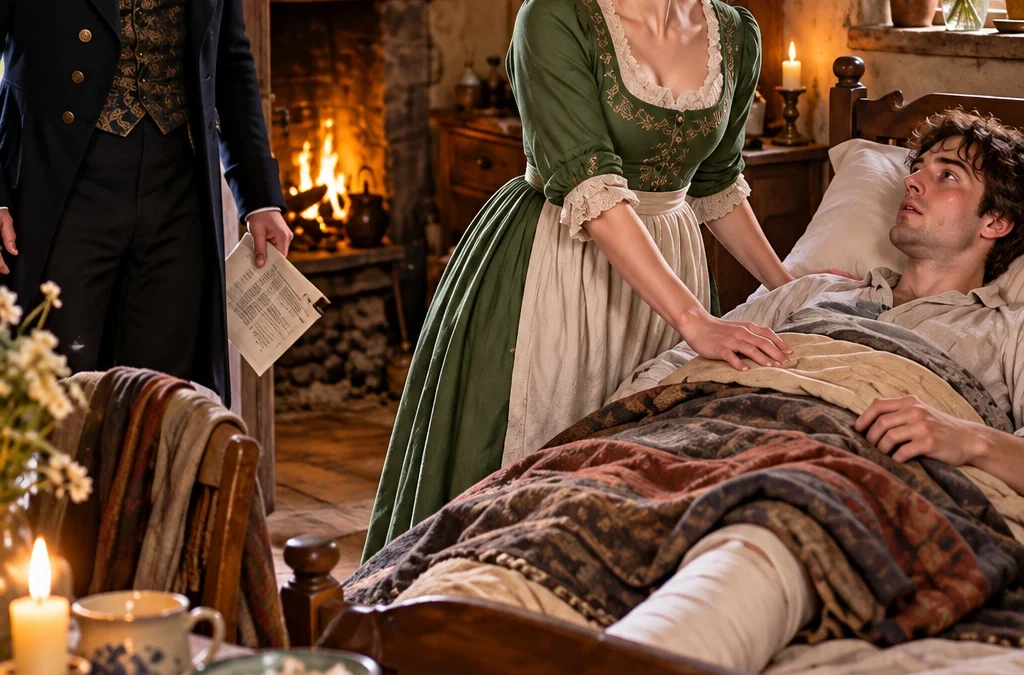
THE DUKE CAME TO EVICT A POOR WOMAN, BUT THE MAN LYING IN HER BED WAS HIS BROTHER, DECLARED DEAD FOR SIX MONTHS… AND HE WHISPERED: “DON’T LET HIM TAKE ME BACK.” 😱
Part 1
Duke Julian Ravenscraftoft carried an eviction notice in the inner pocket of his coat and expected to spend no more than ten minutes at the cottage.
By the time he crossed the threshold, he had forgotten the paper entirely. 😶
The house stood at the northern edge of his land, where the estate road narrowed into a muddy lane bordered by bare hedges and low stone walls. Smoke leaked weakly from the chimney. A section of the roof had been patched with mismatched slate.
He had passed it countless times on horseback without ever wondering who lived there.
That morning, his estate manager, Mr. Harkort, had placed three unpaid rent notices on his desk.
“She is three months behind, your grace. A stubborn young woman named Eleanor Reed. She takes in villagers, injured laborers, anyone who comes to her door. The place has become something between a charity ward and a lodging house.”
Julian had little patience for disorder disguised as kindness.
Ravenscraftoft supported nearly four hundred tenant families. If one woman decided rent was optional because her intentions were good, others would follow. And sympathy would become an expense paid by people who met their obligations.
So he had come in person.
He knocked once. Then again.
Inside came the scrape of furniture and the rapid tread of someone crossing the floor. The door opened only a few inches.
A woman looked out. She was perhaps twenty-five, in a plain brown wool gown with the sleeves rolled past her wrists. Loose strands of dark hair had escaped their pins. A faint green streak, like crushed herbs, marked one cheek.
Her eyes took in his expensive coat, his polished boots, his gloves.
They did not light up with recognition.
“If you’ve come about the rent,” she said, one hand on the door, “I know what I owe.”
“Then, Miss Reed, perhaps you also know why I am here.”
“You are Ravenscraftoft.”
“I am.”
Julian was used to people becoming more accommodating once they learned his title. Eleanor Reed became less so.
“I sent a letter explaining the situation.”
“I received no letter.”
That made her frown. “I gave it to Mr. Harkort personally.”
Julian opened his mouth to say that explanations did not settle accounts.
Then a cough tore through the house.
Not the shallow cough of a cold. It was deep, raw, and prolonged.
Eleanor turned her head at once. The sound came again, and she left the doorway without another word.
Julian caught the door before it closed and stepped inside.
“Miss Reed…”
“Your grace,” she said over her shoulder, already crossing the narrow sitting room, “unless you intend to help, this is an exceptionally poor time to discuss rent.”
The cottage smelled of rosemary, damp wool and wood smoke, and something metallic beneath it all. A kettle boiled over the kitchen fire. Strips of linen hung drying on a wooden frame. A table was crowded with glass bottles, folded cloth and handwritten notes.
Another cough. Eleanor vanished through an open doorway.
Julian followed, and stopped. 😨
A man lay on a narrow bed. His face was gaunt beneath weeks of beard. A fading purple scar ran from his forehead into his hair. His right leg was bound between two wooden splints.
Eleanor lifted his shoulders as the coughing seized him again. “Do not fight for the breath,” she murmured. “Let it come.”
The man struggled against her, confused and half awake. At first Julian could see almost nothing of his face.
Then the patient turned.
The room disappeared.
Julian did not remember moving closer. He remembered only the impossibility of what he was seeing: the crooked nose from a childhood fall, the pale line beneath the left eyebrow, the stubborn angle of the jaw that had appeared in every Ravenscraftoft portrait for generations.
“Thomas,” he whispered.
Eleanor looked over her shoulder.
The man on the bed opened his eyes. They were glazed with fever, but Julian knew them.
For six months, he had been told those eyes were under the ground somewhere.
His brother’s carriage had been found overturned near a ravine. One horse dead, the other gone. Blood on the road. Broken harness. Signs that several men had passed through. Search parties had combed the woods and rivers for weeks.
Eventually, the investigators had stopped using the word missing.
Julian never had.
Part 2
Julian never had.
He stepped toward the bed. “Thomas.”
His brother’s eyes shifted to him. For one second, there was nothing.
Then something like recognition flickered, and Thomas recoiled. His hand seized Eleanor’s sleeve with surprising strength.
“No.”
Eleanor placed herself between the two men. “Tom, look at me. You are inside the cottage. No one is taking you anywhere.”
Tom. It was the only name he could remember. 💔
Julian’s voice sounded strange to his own ears. “That man is Thomas Ravenscraftoft.”
“Your brother?”
“Yes.”
The shock on her face was real. Julian had spent enough years in Parliament to recognize rehearsed surprise. This was not rehearsed.
She slowly sat down. “I found him nearly eight weeks ago, near the old quarry road, three miles north of here. He was lying beside a ditch in the rain. His leg was badly broken. He had a head wound and could barely speak.”
“You kept him here for eight weeks,” Julian said, “and told no one.”
Her expression hardened. “I told someone.”
She pulled a folded paper from beneath a ledger. “I wrote to Ravenscraftoft Hall the morning after I found him. When he could describe where he thought he came from, I wrote again. I received a reply saying no missing person matching his description had been reported.”
Julian took the paper.
At the bottom was a familiar signature.
Harkort.
Something cold moved through him. 😳
“After that,” Eleanor said quietly, “I stopped waiting for help.”
Julian looked around the room again, and now he noticed what irritation had hidden from him. The medicine bottles were nearly empty. Linen had been cut from what looked like a good household sheet. A bowl on the table held broth so thin he could see the bottom.
On a stool lay a ledger, its pages filled with careful notes.
March 19th. Fever higher after sunset.
April 3rd. Woke screaming after hearing carriage wheels.
Every day was recorded. Food, fever, pain, fragments of memory. Someone had cared for Thomas with the discipline of a physician and the patience of family.
The woman Julian had come to evict had spent eight weeks keeping his brother alive.
He looked at her hands. The skin around her fingers was cracked and red.
“You paid for all this.”
“What I could not pay for,” Eleanor said, “I borrowed.”
Julian suddenly understood why the rent had stopped. Something in his chest tightened with an emotion dangerously close to shame.
Before he could speak, Thomas stirred. His eyes opened and found Julian at once.
Recognition returned.
So did terror.
Thomas pushed himself backward against the wall, breathing hard. “Don’t…”
Julian stepped forward instinctively. “Thomas, it is me.”
“No!”
Eleanor caught Thomas by the shoulders, keeping him from twisting his injured leg. “You are safe. Stay with me.”
Thomas looked at Julian over her shoulder. The fear on his face was unmistakable.
Then he spoke, more clearly than he had at any moment since Julian entered the room.
“Don’t let him take me back.”
The words struck Julian harder than anger could have. 😢
He stopped moving.
For six months, Julian Ravenscraftoft had wanted nothing more than to find his brother alive. Now he had. And Thomas was looking at him as though going home was the most dangerous thing in the world.
Eleanor slowly turned toward him.
The eviction notice lay forgotten inside his coat.
Then, from the front of the cottage, came a soft scrape.
Julian froze…
Part 3
…Julian rose at once. Eleanor turned.
Wood against metal. Someone was at the door.
But that was for later. That night, the sound was only the wind, and Julian did not sleep.
There was nowhere in Eleanor’s cottage intended for a Duke of Ravenscraftoft, and for once he did not try to make the world rearrange itself around his title. Eleanor gave him the narrow chair beside the kitchen. After Thomas finally settled into an exhausted sleep, she took the other chair, wrapped a faded shawl around her shoulders, and began grinding dried leaves with the blunt end of a spoon.
Neither spoke for several minutes. The fire popped. In the next room, Thomas breathed unevenly.
“Why is he afraid of me?” Julian asked.
“I do not know.”
“You have cared for him for eight weeks. You must have heard something.”
She looked at him then. “I have heard many things. Most were spoken in fever, or trapped inside some memory that frightened him. I will not take pieces of a sick man’s terror and arrange them into an accusation merely because you are impatient.”
No one had spoken to Julian that way in years. Oddly, he found he respected it more than he resented it.
“What did he say?”
Eleanor set down the spoon. “He spoke of wheels breaking. Men shouting. Someone opening the carriage door. Once he said he knew the route. Another time he kept repeating that he should never have trusted the accounts.”
Julian looked at her sharply.
The accounts.
She rose, took the ledger from a drawer, and placed it before him. Beside her notes of fever and pain were fragments.
April 8th. Said the numbers do not belong to the farms.
April 13th. Said he changed the books.
April 17th. Mentioned “Ha…” then stopped speaking.
Julian’s hand stilled.
“Do you know what that means?” Eleanor asked.
“I know what it might mean.” Ha. It could have been nothing. It could also have been the beginning of Harkort. 😨
“My brother always disliked estate business.”
“Perhaps.” She sat again. “I think people sometimes call someone careless because it is more convenient than listening to what they are trying to say.”
The remark irritated him, because it struck too near something he did not wish to examine. Thomas had complained about the estate books twice before disappearing, insisting certain payments made no sense. Julian had dismissed it as another attempt to provoke an argument.
There had been Parliament, a harvest dispute, three estates demanding attention. Thomas had been one problem among many.
Now he was sleeping in a rented cottage because someone had nearly killed him.
“I am taking him home tomorrow.”
“No.”
He stared at her.
“He has a broken leg, recurring fever, damaged memory, and a terror so severe that seeing you nearly made him hurt himself. If he believes Ravenscraftoft is dangerous, forcing him before we understand why could do more harm than good.”
“You are not a physician.”
“No.” She held his gaze. “But I am the person who has kept him alive for eight weeks.”
It ended the argument, not because Julian agreed, but because he had no answer that did not make him sound exactly as arrogant as she believed him to be.
The next morning, Thomas woke calmer. Julian stayed at the far end of the room while Eleanor helped his brother drink broth. It was strange, watching someone else know Thomas better in illness than he did.
Eleanor knew when to stop asking questions. She knew Thomas hated being touched unexpectedly on his left shoulder. She knew that talking about the road frightened him, while ordinary things brought him back.
“Can you remember what you ate yesterday?”
Thomas frowned. “Soup. Broth.”
“That is soup with ambition. So your memory is improving.”
For the first time, Thomas gave something close to a laugh.
Julian felt the sound like a blow. He had not heard his brother laugh in six months. 🥹
Thomas noticed him. The amusement vanished, though the terror did not return as violently.
“I am not taking you anywhere,” Julian said.
“You said that.”
“I am saying it now.”
A long pause. Then Thomas looked away. It was not forgiveness, but Julian understood he had been given permission to remain in the room.
That afternoon, he sent a messenger to the Hall for a physician and supplies. No carriage. No announcement. He sent a separate sealed note to his solicitor in London.
The physician confirmed much of what Eleanor had concluded. The leg could be saved. The head injury explained the fractured memory. Thomas needed rest, routine, and time. Eleanor asked better questions than anyone in the room, and the physician answered her with increasing respect.
Julian was beginning to notice many things.
That night he found her in the kitchen dividing a loaf of bread. Two generous portions. One much smaller.
“That one is yours.”
“It is enough.”
“It is barely half of what you gave Thomas.”
“He is recovering.”
“And you?”
“I am not.”
“You have not been eating properly.”
She gave him an exhausted look. “Your grace, if you have developed the habit of inspecting women’s meals, I recommend abandoning it.”
“I am not joking.”
“Neither am I.”
He looked at the nearly bare shelves. The thin broth, the patched roof, the empty bottles. Eleanor had not merely fallen into debt. She had sacrificed her own life to keep his brother alive.
“I can pay what you owe.”
Her expression turned cold. “That is not charity until the moment you decide it is. I should accept because you are uncomfortable with the consequences of my choices?”
“My brother benefited from those choices.”
“Then the debt is mine, not yours.”
Julian exhaled slowly. “You are incredibly difficult.”
“And your brother is alive.”
That ended another argument.
Over the next days, Julian stayed. The change in him was so subtle he did not notice it happening. He carried water unasked. He learned to lift Thomas without twisting the leg. He fixed a loose shutter after discovering the night wind made Thomas wake in panic. He stopped calling for servants, because there were none to call.
Eleanor noticed all of it. She said nothing.
That bothered him more than praise would have.
One morning, Thomas asked for paper. His hands shook too badly to write, so Eleanor held the board steady. At first the marks made no sense. Lines, boxes, numbers.
Then Julian recognized it.
An estate account layout.
Thomas circled three entries. “Not farms,” he muttered.
“What are they?”
Thomas pressed his fingers to his temple. “Payments. To whom, I don’t know.” His breathing quickened.
“You do not have to remember all of it now,” Eleanor said softly.
“He said I was mistaken.”
“Who?”
“I told him the numbers were wrong.”
Julian crouched beside the bed. “Thomas. Who did you tell?”
For a moment, Thomas seemed fully present. Then his eyes moved to Julian.
“Harkort.”
The room went still. 😶
“He said I did not understand the estate. Said Julian would agree.”
Julian’s stomach tightened.
He would have agreed. He had agreed. Months earlier, when Thomas complained that tenant repair payments appeared twice under different suppliers, Julian had told him Harkort had managed the accounts for twenty years and did not need lessons from a man who avoided every responsibility.
Thomas had left the room furious.
Three weeks later, he vanished.
“What happened?” Eleanor asked, seeing his face change.
“I dismissed him.” The admission tasted bitter. “I dismissed what he was trying to tell me.”
Thomas suddenly gripped the paper. “There was another book.”
“What book?”
“Small. Black cover. Not the estate ledger.” He squeezed his eyes shut. “I took it. I had it in the carriage. I hid it.”
“Where?”
“I don’t know.”
Then came a sound from the front of the cottage. A soft scrape. Wood against metal.
Julian crossed the room in silence. The latch moved. Not a knock. A test.
He flung the door open. A shadow detached itself from the wall and ran. Julian lunged after it, but the figure vanished through the hedge before he reached the lane.
When he returned, Eleanor stood in the kitchen with an iron poker. The door had been scratched around the lock.
Someone had tried to enter without being heard. 😨
Julian looked toward Thomas’s room, and thought of the black ledger, the intercepted letters, Harkort. For the first time, he no longer believed Thomas’s fear was the confusion of an injured mind.
Someone had known Thomas was alive. Someone wanted him silent.
And now they knew the Duke of Ravenscraftoft was asking questions.
Before sunrise, Julian left. He returned two hours later with a pistol, two horses, and a decision Eleanor immediately disliked.
“You are not coming.”
She looked at him over the rim of her cup. “Then you are not finding the place.”
“You said you found him near the quarry road.”
“Near. There are six miles of hedges, ditches, abandoned stone pits and woodland. Unless you plan to interrogate every puddle yourself, you need me.”
He opened his mouth. She raised an eyebrow. He closed it.
By mid-morning they reached the stretch where she had found Thomas. Winter rain had widened the ditch and dead leaves covered the slope. But Eleanor recognized the broken ash tree at once.
They searched for an hour. Nothing.
Then she remembered. “He kept saying under the stone. I thought he was recalling the accident.”
They followed the ditch toward the abandoned quarry until they found a flat slab half buried in weeds.
Beneath it lay a rusted metal box.
Inside, wrapped in oilcloth, was a small black ledger.
Julian opened it. The suppliers’ names he knew. The numbers beside them did not add up. Payments for roof repairs, fencing, grain and tenant cottages appeared twice, sometimes under different company names. Several of those companies did not exist.
One signature appeared again and again.
Harkort.
Julian stared at it until Eleanor said quietly, “Twenty years, and Thomas did not.”
He shut the book. “He tried to tell me.” There was no self-pity in his voice, and that made her listen. “I thought he was being irresponsible again. Harkort was experienced, efficient, dependable.”
“You believed the man who made your life easier.”
A bitter smile. “When you put it that way, it sounds remarkably foolish.”
“It usually does once someone finally says it plainly.”
For several seconds, neither spoke.
“You are very skilled,” said Julian, “at making a duke feel inadequate.”
“I have had practice.”
He laughed. The sound surprised them both. 😊
Back at the cottage, Thomas recognized the ledger at once. His hands began to shake. “Harkort knew I had it.”
Julian sat beside him. “What happened that night?”
It took Thomas several moments before the pieces returned. He had confronted Harkort privately. Harkort denied everything, then warned him to stop looking into accounts he did not understand. Thomas decided to bring the ledger straight to Julian.
He never reached the Hall.
Two men stopped his carriage on the northern road. The driver was struck. Thomas was dragged out. And he remembered Harkort’s voice.
Julian went completely still.
“I will have him arrested tonight.”
Thomas flinched.
“No,” said Eleanor.
His eyes snapped to her. “You cannot expect me to leave him free.”
“I expect you to prove what you say before you act. You have a ledger and the memory of a man recovering from a head injury. Harkort will say Thomas is confused and that I influenced him.”
Julian’s anger gave way to reason.
She was right again.
By the next morning, Harkort had begun defending himself. Rumors swept the village that Eleanor had deliberately concealed Thomas. By afternoon the story was uglier: she had kept a wealthy injured man in her house, hoping to extort his family. 😠
Julian wanted it stopped. Eleanor refused. “If you silence everyone repeating it, they will believe you are protecting me.”
“What would you prefer?”
“The truth.”
She placed her medical ledger beside Thomas’s black book. Her careful notes held dates, fragments of speech, and the exact day Thomas first mentioned altered accounts. Several entries had been written weeks before Julian arrived. Before she knew Thomas was anyone’s brother. Before there was any benefit in inventing a story.
“You were recording his memories before you knew who he was,” Julian said slowly.
“It proves I was caring for a sick man.”
He looked at her for a long moment. “And saving my family, while I came to throw you out.”
Her expression softened, but only slightly. “You did not know.”
“I did not bother to know.”
That evening, a reply came from his London solicitor. Two companies named in the black ledger were controlled through intermediaries linked directly to Harkort. A third was tied to Julian’s cousin, Lord Edwin Ravenscroft.
The man who stood closest to the succession after Thomas.
The scheme was larger than theft. If Thomas died, Edwin’s position improved. And if Julian kept trusting Harkort, no one would look closely enough to see why.
Eleanor read it and looked up. “This is why Thomas was afraid to go home.”
“He believed Ravenscraftoft itself was dangerous.”
“Was he wrong?”
The question hurt, because Julian could no longer answer yes.
Harkort arrived at the Hall believing he had been summoned to discuss irregularities in the Northern accounts. Instead he found the long library table arranged like a courtroom. Thomas sat near the fire, leg propped on a stool. Eleanor sat beside him, not behind him, her medical ledger under one hand. Julian’s solicitor waited at the far end, the black book open before him.
Lord Edwin arrived last. He smiled when he entered.
The smile vanished when he saw Thomas. ⚖️
“Your grace,” Harkort said smoothly, “I am relieved to see your brother alive. We all feared the worst.”
“That is curious,” said Julian.
“Why?”
“Because Miss Reed informed you eight weeks ago.”
Eleanor laid Harkort’s reply on the table.
“I received dozens of letters from tenants,” Harkort said.
“You answered this one,” said Eleanor. Her voice was calm, which made the accusation sharper.
Harkort called it a misunderstanding. The description had been vague. No reason to assume the stranger was the Duke’s brother. Julian let him speak.
Then his solicitor turned the pages of the black ledger. The payments linked Harkort to three false suppliers. Bank records traced two of those companies to men employed by Edwin.
“This proves theft at most,” Edwin said coldly. “It proves nothing about Thomas.”
Thomas shifted in his seat. For a moment, Eleanor feared he might retreat into himself.
Instead, he spoke. “I heard your voice.”
Edwin stared.
“On the road.” Thomas forced each memory into place. Harkort arguing with one of the men beside the overturned carriage. Edwin’s name being mentioned. Someone saying the ledger had to be found before Julian saw it.
Edwin laughed. “A man with a head injury remembers a convenient conversation months later. After living with a woman who has every reason to invent one.” His gaze slid to Eleanor.
There it was, the attack she had expected. A poor tenant. A duke’s missing brother. An opportunity.
Eleanor opened her ledger and turned it toward the solicitor. The ink changed over the weeks. Some pages bore stains of medicine and water. Long before Julian arrived, she had recorded Thomas speaking of altered accounts, false payments, a black book, and the beginning of Harkort’s name.
She had not known who Thomas truly was. She had not known Edwin existed.
The solicitor compared her dates with the financial records. The details matched. Payments Thomas had mentioned in fever corresponded to transactions in the black ledger. One company he had repeatedly called the second mill had received money on the exact dates in Eleanor’s notes.
It was not dramatic evidence. It was better.
It was consistent.
Harkort’s confidence finally cracked. Edwin noticed.
“You fool,” Edwin hissed.
The room went silent.
Harkort turned on him. “What did you expect me to do? He took the book!”
Julian closed his eyes for a fraction of a second. When he opened them, the matter was finished.
Harkort had just confessed that he knew Thomas possessed the ledger.
Within the hour, both men were under guard pending formal charges. Edwin kept protesting. Harkort did not.
Thomas watched them go. Then his shoulders sagged. Eleanor reached toward him but stopped before touching him.
Thomas looked at her and nodded.
Only then did she take his hand. 🥹
Julian saw the exchange. Months earlier, he might have believed protection meant deciding everything for the people he loved. Now he understood that sometimes it meant waiting until they chose what they needed.
Weeks passed. Thomas returned to the Hall gradually, first for an afternoon, then overnight. His memory did not repair itself perfectly, and loud carriage wheels could still make him freeze. But he no longer believed home itself was the danger.
Harkort’s scheme unraveled quickly. Stolen sums were recovered. Edwin’s involvement ended whatever future he had imagined within the succession.
Eleanor returned to her cottage. Julian did not cancel her rent without asking.
That surprised her more than any gift would have.
One afternoon near the beginning of summer, he came to see her. He stood in the same doorway where she had first refused to let him in. She noticed the folded paper in his hand.
“You have brought paperwork.”
“I have.”
“That rarely ends well.”
Julian smiled and handed it to her.
It was the original eviction notice.
She looked down at it, then up at him. “Have you finally come to remove me from Ravenscraftoft?”
“No.” His expression grew serious. “I came the first time believing you were a problem I could solve in ten minutes. I was wrong about nearly everything that day.”
Eleanor said nothing.
“I cannot repay you for saving Thomas. I have learned enough not to insult you by trying. But I can ask you something without attaching money, land, or obligation to the answer.” He took a breath. “Will you stay?”
Her eyes narrowed slightly. “As your tenant?”
“As the woman I would like beside me for the rest of my life.”
The silence stretched.
“And if I say no?”
“The cottage remains yours to rent on the same terms. Your debts remain your business unless you ask for help. Thomas will keep visiting, because he prefers your cooking to mine. And I will leave without punishing you for an answer I do not like.”
Eleanor looked at him for a long moment.
That answer mattered more than the proposal.
She folded the eviction notice. “You have improved painfully.”
“Slowly, I have been told.”
She smiled.
Then she reached for his hand. 💞
A year later, the cottage still stood at the edge of Ravenscraftoft land. Only now, one of its rooms had become a small infirmary for tenants who could not afford a physician. Thomas often sat by the window while Eleanor worked, complaining loudly whenever anyone treated him like an invalid.
Julian kept the old eviction notice in the drawer of Eleanor’s desk.
One evening, she found him looking at it.
“You are strangely attached to that paper.”
“It reminds me how close I came to throwing the best thing in Ravenscraftoft out of its smallest house.”
Eleanor folded the notice and returned it to the drawer. “You would have regretted it for the rest of your life.”
The notice had once been meant to send her away.
Instead, it became a reminder of the day Julian found his brother, found the truth, and found the woman he would never again ask to leave. ❤️
This story is entirely fictional and created for entertainment purposes only. It does not represent any organization or individual, nor does it encourage inappropriate behavior. The content was generated with AI assistance.








