The Duke Divorced the Wife Who Secretly Built His Fortune… Then She Left One Sealed Letter on His Desk, and He Never Opened It
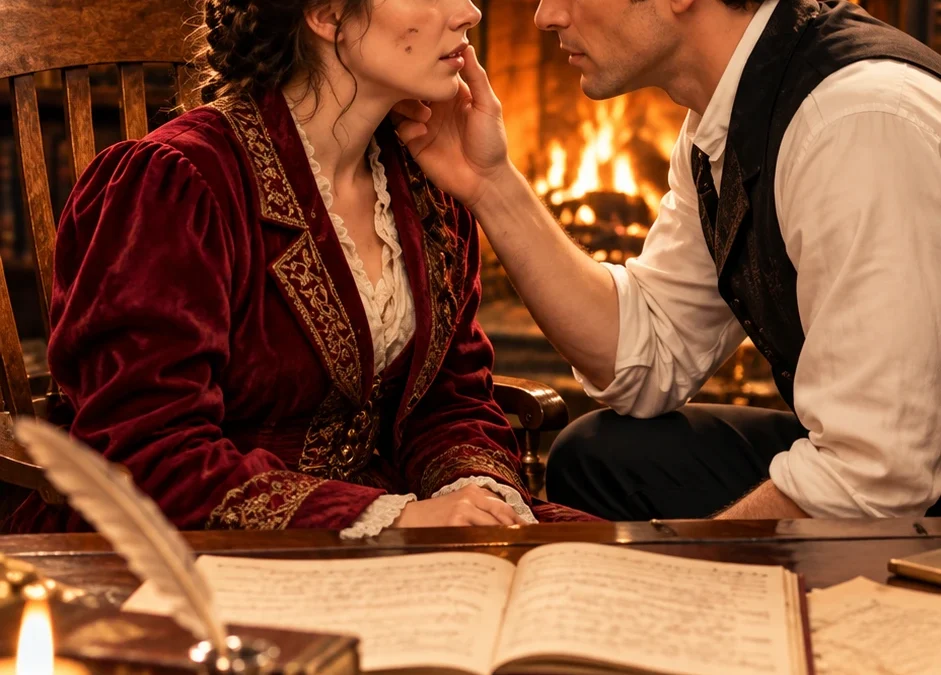
😱 The Duke Divorced the Wife Who Secretly Built His Fortune… Then She Left One Sealed Letter on His Desk, and He Never Opened It
Part 1
The Duke of Blackmir divorced the wife who had quietly built his fortune.
He believed he was setting himself free.
Before long, he would discover exactly what he had thrown away. 😨
It was the late summer of 1864, and on the evening it began, Gerard only wanted the conversation finished before dinner.
“Sit down, Isabel.”
She did not sit.
She had been the Duchess of Blackmir for fourteen years, and in fourteen years she had learned that when Gerard asked her to sit, he meant to say something he had already decided. So she stood by the long table in the library, where the lamps had just been lit, and waited.
Gerard Moore, Duke of Blackmir, was a handsome man. Even past the first bloom of youth, he had the kind of face that looked well on a horse and better at the head of a table. He stood at the window with his hands behind his back, as if the conversation were a view he was obliged to admire.
“I have spoken to my lawyers in London. The papers are drawn. I intend to end our marriage.”
The clock on the mantel went on ticking. Somewhere below, a footman laughed and was hushed.
Isabel looked at him for a long moment. “End it,” she said. “It can be done now. There is a court for it. It is not pleasant and it is not quick, but it can be done.”
He turned at last. “I will not pretend. You know that Lady Georgiana is widowed.”
She did know. All of Harrow Cross knew. Lady Georgiana Frier had been the great beauty of Gerard’s youth, the girl he had wanted and not been permitted to marry. She had married a viscount instead. The viscount had obliged everyone by dying in the spring.
“I mean to marry her. I would rather say it to your face than have you hear it from the servants.”
“That is considerate of you.”
He searched her voice for sarcasm and could not find it. That unsettled him a little. He had prepared for tears. He had a speech ready for tears.
“You have been a loyal wife, Isabel. I want that understood. You will be provided for.”
“Loyal.” She let the word sit in the room. “That is a remarkably small word for fourteen years.”
Gerard frowned. He disliked not understanding things. So he did what he always did when a conversation slipped out of his hands.
He made it simple.
“You kept my household. I built everything else.”
Isabel turned her head and looked around the library. There was the long table where the quarry contracts had been spread out every spring. There was the cabinet of tenant correspondence she had sorted by farm and by family. There was the desk where she had sat until the small hours the winter the bank had nearly called in the loans, rewriting the terms in her own hand so that he could copy them out fair and sign his name.
There, on the shelf, were the account books. Every one of them had her figures in the margins.
He had never once looked at the margins.
“Everything?” she asked.
“Everything.”
Something in her face went very calm. It was not the calm of a woman about to forgive. It was the calm of a woman closing a book she had finished reading.
“Then you have nothing to fear from my leaving.”
She did not cry. She did not raise her voice. She inclined her head to him exactly as a duchess should to a duke, and walked out of the library with her back straight.
Gerard stood alone among the lamps and felt, to his own surprise, a little cheated. He had expected a scene.
Instead, he had been given a curtsy.
She left Blackmir Park before the week was out. She took her clothes, her mother’s writing box, and a small trunk of books. She left the estate keys on the hall table in a neat row, each one labeled in her clear, small hand.
And she left a sealed letter on Gerard’s desk with his name on the front. ✉️
He found it that evening and turned it over in his fingers. He did not break the seal. There would be reproach in it, he thought, or terms, or some last attempt to make him feel what she had not let him see.
He wanted none of it. He slid the letter into the top drawer of his desk, closed the drawer, and went in to dinner.
The steward caught her in the stable yard as the carriage was brought round. Mr. Talis had served at Blackmir longer than Isabel had been married to it. He was a gray, careful man who wore his loyalty like a good coat, buttoned all the way up.
“Your Grace, forgive me. Shall I continue to send the Linfold reports to you?”
She looked at him kindly. “No, Mr. Talis.”
He hesitated. “But His Grace has never handled the Linfold farms. He has never read a single report from them. He does not even know the tenants by name.”
“Then perhaps it is time he learned.”
She gave him her hand, which she had never done before, and he bowed over it as if she were still mistress of the house.
Then she climbed into the carriage, and it went down the long drive between the limes.
Gerard watched from the window of his dressing room until the gates swallowed it. And what he felt, standing there, was relief. Clean, plain relief, like opening a window in a stuffy room.
He believed he had removed the one unnecessary thing from his household.
Within a fortnight, he would begin discovering how many pieces of his life had been resting quietly in her hands.
For the first week, nothing went wrong at all. The house ran. Dinners were served. The quarry carts went down the hill to the canal wharf in their usual slow procession. Gerard rode out in the mornings and wrote letters in the afternoons, and almost all of them were to Lady Georgiana, who wrote back in a large, looping hand that told him he was brave.
Lord Tremaine, Georgiana’s brother, rode over to dine and raised his glass over the port.
“To freedom! You should have done this years ago, Blackmir. She was a dull little thing. Worthy, very worthy, but dull.”
Gerard drank the toast. He did not quite like the word dull. But he drank it.
The first crack came on a Tuesday, in the form of a wool merchant from the north.
Mr. Ridley had bought the Blackmir wool clip for as long as anyone could remember. He named a price that made Gerard laugh out loud.
“That is a jest, sir.”
“No jest, Your Grace. It is the market price.”
“Then renew last year’s agreement and have done with it.”
Mr. Ridley looked at Talis. Talis looked at the floor.
“Your Grace,” the steward said quietly, “there was no standing agreement. Her Grace renegotiated the price every Michaelmas.”
Gerard stared at him. “Her Grace.”
“She wrote to Mr. Ridley every August. She knew what the northern mills were paying, and which years Mr. Ridley needed our wool more than we needed his money. She settled the terms by letter, and then put the agreement on your desk to sign.”
Gerard remembered signing things. He had always signed things. He had never once wondered where they came from.
Then the tenants came. A knot of farmers from the Linfold side stood in the yard on a wet morning with their caps in their fists. The eldest, a broad old man named Pollard, asked respectfully when the rent adjustment would be confirmed.
“What adjustment?”
Pollard blinked. “Her Grace promised it, after the flood took the low meadows. She walked the fields with us herself. She said the rents would come down until the drainage was dug, and the drainage would be dug before winter.”
Gerard turned to Talis. Talis had stopped looking surprised.
“It is in the Linfold reports, Your Grace. Which she kept, and has now returned to this office. They are on your desk.”
There was a stack of them. Gerard had assumed they were bills.
That afternoon, a letter came from the county bank. It reminded His Grace that the extension on the Blackmir loan would expire at the end of the month. Gerard had not known the loan existed. Or rather, he had known it the way a man knows his house has foundations.
Then there was the canal contract. That evening, for the first time, he took it out of its folder and read it. He found, written into the body of it in a neat hand that was not a lawyer’s, a clause protecting Blackmir from paying for barges that sat idle when the canal froze. He found another that fixed the toll against any rise. He found a third that gave Blackmir first refusal on the new wharf.
He felt something he did not have a name for. It was very like anger.
He rang for Talis. “Why was none of this brought to me?”
“It was, Your Grace. Every year.”
“I would remember.”
Talis was quiet for a moment. He was a loyal man, and loyal men do not enjoy their master’s face at moments like this.
“Her Grace remembered for you,” he said.
Gerard did not answer. He sat with his hand flat on the canal contract, and the fire talked to itself in the grate. 🔥
It was Talis who found the red book.
He had gone into the small office off the gun room, where the Duchess had worked when the library was full of guests, looking for the drainage estimates. Instead, at the back of the lowest drawer, beneath a pile of seed catalogues, he found a ledger bound in red leather. It was thick, worn at the corners, and fastened with a small brass lock. Stamped on the cover in faded gilt were two words.
Contingencies. Private.
He brought it to the Duke because he did not know what else to do with it. Gerard turned it in his hands and tried the clasp. It held.
“Where is the key?”
“I do not know, Your Grace. Her Grace returned every key belonging to the estate. I checked them against the inventory myself. This key did not belong to the estate. It seems it belonged to her.”
Gerard looked down at the red cover for a long time. Then he put the ledger in the cabinet behind his desk and turned the key on it, as if a locked book could be made more locked.
“It is nothing,” he said. “Household nonsense. Recipes and linen.”
But he did not throw it away. And on more than one night that autumn, he found himself looking at the cabinet door. 😶
👇 Want to know where Isabel went, and who came looking for her? Find Part 2 in the comments, or leave any word and I’ll send it to you privately! 👇
Part 2
Isabel took rooms above a bookseller’s shop on Fish Street in the market town of Harrow Cross.
They were small rooms. The ceiling sloped and the floor tilted gently toward the window, so that a dropped pencil always rolled to the same corner. In the mornings she could hear the bookseller’s wife singing hymns while she swept the shop.
It was the first home she had ever had that asked nothing of her. She did not know what to do with that.
She had grown up in a tall, cold house on the edge of a cathedral town, the only daughter of a gentleman with good manners and bad debts. Her mother had been an invalid for as long as Isabel could remember. Her father had been charming and helpless and grateful, and from the time she was old enough to reach the desk, Isabel had kept the household accounts.
And every time she solved a problem, her father would kiss the top of her head and say the same words.
There’s my useful girl.
She had loved those words. She had worked for them the way other girls worked for ribbons. And somewhere in the working, without anyone ever saying it aloud, she had come to believe something very simple.
If I am useful enough, I will be kept.
She had carried that belief into her marriage like a dowry. For fourteen years she had made herself indispensable to Blackmir, and Gerard had put her out of the door anyway.
So now she sat in her tilted room and did nothing. And the nothing frightened her more than anything had in years.
The divorce went forward in London. Isabel did not contest it. Her lawyer, a dry and honest man named Mr. Qualls, begged her to.
“You could make it very costly for him.”
“I could make it very ugly for both of us,” she answered. “That is not the same thing.”
Society did what society does. The invitations stopped. Ladies who had dined at her table crossed the market square to avoid her. Isabel bore it. She was good at bearing things. It was the only skill she had never been thanked for.
The first letter came in October, on heavy paper, in a narrow upright hand. It was signed with a name she knew very well.
Alistair Rendle, Duke of Coldridge.
Coldridge lay across the river from Blackmir. The two estates had been neighbors for generations and rivals for nearly as long. They sold wool to the same merchants and stone to the same builders. And for as long as Isabel had been Duchess of Blackmir, whenever Coldridge had reached for something, Blackmir had reached it first.
The Duke of Coldridge was spoken of in the county as a cold man, careful and unsmiling. He did not dance. He did not gamble. His father had been the opposite of all those things, and had nearly sold the roof off Coldridge Hall to pay for it.
The letter asked with great courtesy whether she would receive him. She wrote back that she was not receiving anyone.
A second letter came a week later. She was not meeting anyone, either.
The third came on a Saturday, while the bookseller’s wife was singing about the green hills far away. It was only a few lines long.
For years, I believed that your husband was defeating me. I no longer believe that. I should very much like to know whether I am right.
She put the letter face down on the table. She picked it up again.
Then she wrote that she would be in the private parlor of the Hart and Hollow at noon on Tuesday, and that she would stay for a quarter of an hour.
He was there before her. He stood when she came in, which most men in Harrow Cross had stopped doing. He was tall and lean, and dressed like a man who disapproved of tailors. His face was all straight lines and shadows. He looked like a man who had been tired for a long time and had decided not to mention it.
He did not waste her quarter of an hour. He opened a leather case and laid a sheaf of papers on the table between them.
“Over the last several years, your husband made a series of decisions that should have been impossible to anticipate. He sold his barley a month before the price fell. He bought the lease on the Harrow Cross wharf a fortnight before the canal company announced it would double the traffic. He refused a partnership in a slate company that went bankrupt the following spring.”
“You counted,” Isabel said.
“I lost money each time. One tends to remember.”
The corner of her mouth moved. She looked away to hide it.
“I thought he was a better man of business than I was. It seemed very unjust, because I had read his letters, and they were not the letters of a clever man. So I began to collect things. Copies of contracts. Correspondence with the carrying company. And I found one thing common to every decision I could not explain.”
He turned the papers toward her.
Corrections. Annotations in the margins. A clause crossed out and rewritten. A figure underlined twice. A note in tiny letters at the foot of a page: Ask Ridley about the Northern Mills before agreeing.
Her handwriting. All of it.
“I believe,” said the Duke of Coldridge, “that I have been competing with the wrong person.”
Isabel sat very straight and kept her hands folded in her lap so he would not see them.
“Perhaps I simply have tidy handwriting.”
“And perhaps I lose gracefully. But I doubt it. I have lost to you a great many times, Mrs. Moore. And I have never once done it gracefully.”
The clock in the passage struck the quarter. She did not get up to leave.
“What do you want?”
He told her plainly. He always told things plainly, she would learn. It was one of the most unsettling things about him.
Coldridge was not ruined, but it was not well. He had land, a title, and a name men still bowed to. What he did not have was money in hand. His father’s debts had been paid, but paying them had drained the estate dry, and the merchants and bankers of the county still remembered the old Duke’s promises. They traded with Coldridge cautiously, and at a price.
“I want your judgment. On Coldridge. Its accounts, its contracts, its tenants. I want you to look at it the way you looked at Blackmir and tell me what I cannot see.”
“You wish to use me against my former husband.”
He did not look away. He did not soften it, and he did not deny it.
“When I first wrote to you? Yes. Now I want to know whether I was right about you. I have spent a long time thinking about the person who wrote in those margins. I should like to know if she is real.”
It was not flattery. Isabel had heard a great deal of flattery as a duchess, and she knew its taste. This was something else. This was a man who had been beaten over and over, and had finally gone looking for the hand that beat him, wanting to shake it.
“If I agree, there would be conditions. I will be paid properly, not as a favor, not as charity. A fee set down in writing through my own lawyer.”
“Agreed.”
“I may refuse any question, and stop whenever I choose.”
“Agreed.”
“You will not use anything I tell you to take revenge on Blackmir. If you happen to beat him, I shall not weep. But I will not be your weapon.”
“Agreed.”
“And my former husband is not to be discussed unless directly relevant.”
He held out his hand across the table, the way one man of business offers his hand to another.
“Agreed.”
She took it. His hand was warm and dry and rough at the knuckles, as if he had been mending a fence that morning.
It turned out later that he had.
The papers came to Fish Street in a locked box, carried up the narrow stairs by a Coldridge footman who looked deeply suspicious of the bookshop. Isabel opened the first ledger on the tilted table by the window.
For the first time since she had left Blackmir, her hands stopped shaking.
The first real problem was timber. Coldridge Hanger was the great wood that climbed the hill behind the house, oak below and larch above. A timber merchant from Bristol had offered to buy the felling rights. The price was poor, but the money was ready, and the Coldridge creditors were pressing. The Duke had very nearly signed.
Isabel spent a fortnight with the papers. Then she spent a week doing things that made her landlady very curious. She counted wagons on the turnpike road. She sat in the corner of the Hart and Hollow coffee room and listened to the surveyors who had begun to lodge there, men with muddy boots and rolled maps who talked about gradients. She read every word of the parliamentary notices in the county newspaper.
When the Duke came to the parlor the following Tuesday, she was waiting for him with a map.
“Do not sell the oak.”
He sat down slowly. “Good morning to you, too.”
“Good morning. Do not sell the oak.”
“Mrs. Moore, the Bristol man is offering ready money. My creditors want paying before Lady Day.”
“I am asking you to stop confusing urgency with value.”
His jaw tightened. “Urgency is what has kept this estate alive.”
“No,” Isabel said. “Urgency has kept it dying slowly.”
The parlor went very quiet. She had not meant to say it so sharply. She waited for him to rise and leave. Gerard would have. Gerard would have told her she did not understand these things and gone to find a man who agreed with him.
The Duke of Coldridge did not rise.
“Explain.”
So she spread the map on the table and showed him the line the surveyors were drawing from Harrow Cross down through the valley toward the coast. A new branch railway. The bill had passed in the spring.
“A railway needs sleepers. Thousands of them. It needs piles for its bridges and timber for its stations, and it needs them close at hand, because carting oak across the county costs more than the oak. Your Hanger is the nearest stand of good timber to that line for many miles. The Bristol man knows that. That is why he wants it now, before anyone else notices.”
The Duke looked at the map for a long time.
“Fell the larch on the top of the hill,” she went on. “It is mature and in the way of the oak. It will pay the interest and show the bank you are not asleep. Then write to your creditors yourself, not through a lawyer. Tell them exactly what you are waiting for and why. They have been lied to by a Duke of Coldridge before. They have never been told the truth by one.”
He was silent so long that she began to fold the map.
“Leave it,” he said.
He followed her advice. It did not work quickly. The Bristol merchant withdrew his offer with a sniff. The larch barely covered the interest. A hard old banker in the cathedral town wrote that he would believe this explanation when he saw it in coin. The winter came on, and no railway contractor appeared.
Isabel lay awake in her tilted room and wondered whether she had just helped a man she barely knew to ruin himself on a guess.
In the middle of February, a man in a good brown coat rode up the Coldridge drive. He was the agent of the railway contractors, and he had walked the Hanger the day before without permission. He wanted oak, a great deal of oak, over several years. He named a price. It was more than the Bristol merchant had offered for everything, and it was for only part of the wood.
The Duke read the contract twice. Then he sent it, unsigned, to the rooms above the bookseller’s with a note in his narrow hand.
What have I missed?
She sent it back with a clause altered and another added. He signed it that evening.
For the first time in a generation, Coldridge had breathing room. 🌳
Months passed. The work outgrew the parlor, and Isabel began to come to Coldridge itself in a hired gig. A broad, sensible housekeeper named Mrs. Penny sat in the estate office with a basket of mending, for the sake of the proprieties. And the Duke of Coldridge, who had spent years collecting Isabel’s handwriting, began to collect other things.
He noticed that she rubbed the tips of her fingers together when she was anxious, as if feeling for ink that was not there. He noticed that she disliked large dinners. He noticed that on her way from the gig to the office she always went the long way round, past the paddock where the oldest horse at Coldridge lived out his retirement, a vast gray cob with a Roman nose and a disapproving expression whom the grooms called the Archdeacon. Nobody fed the Archdeacon apples. Isabel fed him one every time, and looked guilty about it every time.
One July afternoon he came quietly into the office while Mrs. Penny was out and found Isabel bent over the drainage report with every sign of deep concentration. Tucked inside it was a novel, a lurid thing in several volumes about a governess, a bigamist, and a body in an ornamental lake.
She closed it with a snap.
He said nothing. He simply walked to the window and looked out at the garden with his hands behind his back.
“Your Grace. If you are laughing at me, I would rather you did it to my face.”
“I would never laugh at a woman reading about drainage. Does the governess survive?”
“I have not finished it.”
“Then I shall not spoil it for you. I read it in the spring.”
She stared at his back. And then she laughed. It was not the polite laugh she gave at dinners. It was a startled, unguarded sound, low and a little rough, as if it had not been used in a long time.
He turned from the window, and she put her hand over her mouth, and he thought with great clarity that he would do a great many ridiculous things to hear it again.
The next morning there was a pear on her blotter. A small russet pear, lumpy, with a blush on one side, from the old tree against the south wall of the kitchen garden. She had eaten one there the autumn before, and said it was the best pear she had ever tasted.
She had not known anyone was listening.
“Thank you,” she said.
“For what?” he asked, without looking up from his letter.
By then, the county had begun to talk. 🍐
The talk reached Isabel in small ways at first, and then in a large way in the person of Georgiana, Duchess of Blackmir, in the doorway of the circulating library.
“Why, Mrs. Moore, how well you look. Gerard says you were always happiest with a ledger in your hands. How fortunate that you have found a new household to keep.”
Isabel held her gaze for a long moment. “I hope you will be very happy at Blackmir, Your Grace. It is a beautiful house. It takes a great deal of looking after.”
She stepped past her into the library, chose a book, paid for it, and walked home with her face burning and her back perfectly straight.
She did not tell the Duke of Coldridge. He heard anyway. Harrow Cross was a small town.
He came to Fish Street himself the following week, which he had never done. He had to stoop under the sloping ceiling, and the floor tilted under him, and he stood in the middle of her tiny room looking, for once, as if he did not know how to begin.
“There is a matter of business. I should like your advice on it.”
His grandfather, he explained, had left part of the Coldridge capital in trust under a board of elderly trustees, to be released upon one condition only: that the Duke be married. “My father was married and was not steadied in the least. But my grandfather was an optimist about everyone except his son. I need that capital to buy back the farms my father mortgaged.”
“Then you should marry,” said Isabel, keeping her voice level. “Surely there are any number of ladies in the county who would oblige you.”
“There is a second part. Your reputation is being damaged because of me. Because of work the county would praise from the rooftops if you were a man.” He drew a breath. “So I have a proposal, and I would like your judgment on it as I would on any other contract. I am asking you to marry me.”
Downstairs, the bookseller’s wife had stopped singing.
“You wish to turn your adviser into your duchess.”
“I wish to prevent society from punishing you for work it would applaud in a man.”
“How practical.”
He took a folded document from his coat and laid it on her tilted table. A marriage settlement. She knew marriage settlements. She had signed her own at nineteen, understanding half of it, and had spent fourteen years understanding the rest.
She read this one twice. It gave her an income of her own, paid quarterly in her own name. It placed every penny she brought and every penny she earned beyond the reach of her husband. It allowed her a lawyer of her own choosing. And it set out in clear language what would happen if she ever chose to live apart from him. A house. An income. Her freedom. No conditions.
She looked up.
“You have given me the means to leave you.”
“Yes.”
“That is a very peculiar way to propose marriage.”
He stood by the low window, half bent under the eaves, the afternoon light falling across the straight lines of his face.
“No woman should have to stay beside a man because leaving him would destroy her.”
Isabel looked down at the settlement. She found that she could not see it clearly. She had stayed beside Gerard for fourteen years because she believed she had nowhere else to go. She had made herself necessary because necessary felt safe. It had never been safe.
“And if I stay?” she asked quietly.
“Then I should like it to be,” said the Duke of Coldridge, “because staying was your choice.”
She was silent so long that he began, she thought, to brace for a refusal.
“I should like Mr. Qualls to read this,” she said finally.
“Of course. And I should like it understood that I accept as a matter of business.”
Something moved in his face. It might have been relief.
“As a matter of business,” he agreed. 💍
👇 LIKE or COMMENT “REVEAL” to see Part 3! It will be posted as soon as we have enough comments. 👇
Part 3
They were married at the end of August, in the little chapel beside the house, with Mrs. Penny and Mr. Qualls for witnesses and the Archdeacon looking in disapprovingly from the paddock fence. The vicar of Harrow Cross had declined to perform the ceremony. The old chaplain at Coldridge, who had baptized the Duke and buried his father, did not decline.
The new Duchess of Coldridge went upstairs to a set of rooms on the east side of the house. There was a lock on her own door, and the key was on her own side of it.
He had seen to that, too.
They were careful with each other at first. They breakfasted together, because the work began at breakfast. He passed her the commercial pages without being asked. She corrected his arithmetic in the margins of his letters, and he pretended to be offended. They argued about drainage and fencing and the price of seed with a grave enjoyment that made the footmen exchange glances.
When the land agent came to talk about the mortgaged farms, the Duke listened to his proposal, then turned in his chair and said, “Duchess,” and waited. And when she spoke, he did what she said. The land agent never forgot it.
She discovered she had a temper at a dinner in September, when a red-faced gentleman across the table remarked loudly that the Coldridge fortunes were what one might expect, given the blood. Isabel set down her fork.
“My husband has paid every penny of his father’s debts out of his own pocket, and has never once complained of it in public. I wonder how many gentlemen at this table could say the same.”
There was a terrible silence.
In the carriage going home, the Duke sat opposite her in the dark and said nothing for a long time.
“You did not have to do that. He was right about my father.”
“He was not right about you,” Isabel said, and turned to the window, because her heart was beating rather fast and she did not know why.
At the harvest supper in the great barn, the tenants cleared the floor for dancing, and somebody’s uncle played the fiddle very badly and very loudly. The Duke of Coldridge, who did not dance, stood and held out his hand to his wife.
He was not a good dancer. He was stiff, and counted under his breath. But halfway down the set, the barn grew hot and loud, and she began, without knowing it, to rub her fingertips together. He simply turned them both out of the line and walked her through the great doors into the cool dark of the yard.
“Better?”
She stood with her back against the barn wall and breathed in cut hay and cold night. “How did you know?”
He did not answer. He stood beside her, shoulder very close to hers, not touching, and they listened to the fiddle through the wall. Their hands, hanging at their sides, were perhaps a breath apart.
Neither of them closed it. 🌾
That autumn Coldridge began to rise. It was not one victory but a great many small ones, made between the two of them across the breakfast table and the estate desk, and it was impossible afterward to say whose any of them had been. She saw that the trust capital could buy back the farms for far less if the purchase was made before the railway opened. He saw that some of the farms had wet ground that would swallow half the profit. She revised the offer and dropped them. He worked out that the Coldridge teams, hauling oak to the line in the mornings, could carry lime and seed back in the afternoons for nothing.
Only once did something come between them. It was at the county bank, where a smooth young director from London bowed over her glove and said, “So this is the famous mind behind Coldridge.”
“She is my wife,” said the Duke, shortly, in a tone that closed the subject.
Isabel said nothing. She waited until the carriage had cleared the town.
“She is my wife. Last spring, you stood up before the whole county and told them I had rewritten your contract. This morning, a man called me the mind behind Coldridge, and you corrected him.”
He was silent so long she thought she had angered him.
“I did not correct him. I did not like the way he said it. As if your mind were the only reason a man could have married you.” He turned to her. “You are my wife, Isabel. You are also my partner. Neither title cancels the other. And I will say both to anyone for as long as you like.”
The next time they went to the bank, he introduced her to the young director as his wife and his partner. The young man went pink to the ears.
One morning in November, he came into the estate office with a sheet of her calculations and laid it on the desk.
“You were wrong.”
Her whole body went still. He saw it happen. Her shoulders locked, her hands flattened on the blotter, and her face became very smooth and very empty, like a window with the shutters closed.
He slid the paper across and pointed. “The price of lime. You have taken last year’s figure. It has gone up since the quarry flooded.”
Isabel looked at the figure. He was right.
She waited for the rest of it. The sigh. The remark about women and arithmetic. The cold silence that would last until dinner, and the faint polite contempt that would last a week. She had lived for years inside the weather of a man’s displeasure.
Nothing came.
“The rest is excellent,” said the Duke of Coldridge, and turned to go.
“You are not angry.”
He stopped at the door, genuinely puzzled. “Why would I be angry? I make mistakes.” And then, for the first time since she had known him, she saw him smile, a small crooked thing gone almost before it arrived. “Congratulations. You are human.”
He went out. Isabel sat alone with the corrected paper, and found to her astonishment that her eyes had filled with tears.
Nobody had ever given her permission to be wrong. Not her father, who had needed her to be right. Not Gerard, who had needed her to be invisible. She had spent her whole life being careful because she believed one mistake would make her replaceable.
And this man had just found her mistake and congratulated her on it. 🥹
In December, she asked him about his father. They were in the shabby library at Coldridge, snow falling soft and steady outside.
“He was a wonderful man,” the Duke said at last. “Everyone said so. Generous, handsome, great fun. He bought racehorses and paintings and half a coal mine in Wales that turned out to have no coal in it. He had schemes, always schemes, and every one was going to make us rich. My mother spent my whole childhood pretending. She sold her jewels one by one and had them copied in paste so no one would know. I found her one night, when I was a boy, sitting in the dark with an empty jewel case on her knees. She told me she was looking for a button.”
Isabel put her book down.
“I grew up in a house full of people pretending everything was well, because admitting the truth embarrassed them. And it very nearly killed us. Not the debts. The pretending.” He turned from the fire. “That is why I value you.”
She smiled a little sadly. She knew this part. “Because I am clever.”
“No,” said the Duke of Coldridge. “Because you tell me when I am wrong.”
The snow went on falling. Something shifted inside her, quietly, the way ice shifts on a river before it breaks.
After that, she began to tell him things, too. That she had hated her father’s house. That she still woke sometimes in the small hours, sure she had forgotten to pay the butcher. And one night, very late, over the household accounts, the thing she had never told anyone.
“When Gerard first spoke of Georgiana, I was not surprised. I had been waiting for it for years. I always knew there would be someone more beautiful, or more charming, or simply newer. I thought if I made myself necessary enough, it would not matter.” She gave a small, dry laugh. “It turns out he could afford to replace me very easily.”
He said nothing. But he reached across the desk and took the pen gently from her fingers, because she had been gripping it so hard her knuckles were white.
In January, she fell asleep over the accounts. When she woke, the fire had burned low, and a heavy coat lay over her shoulders. It smelled of wood smoke and cold air, and him.
He crouched beside her chair and, with his thumb, very carefully brushed a smudge of ink from her cheek. His hand stayed a moment longer than it needed to.
“Does it frighten you? Being happy?”
She looked away toward the dying fire. “Happiness is easy to lose.”
“So is money. You recover money.” He was silent a moment, his hand still warm against her face. “Then perhaps we should learn how to recover happiness, too.”
She did not decide to kiss him. Afterward, she was quite certain she had not decided anything at all. One moment he was looking at her with those grave gray eyes, and the next there was no space between them, and the coat had slipped to the floor, and neither of them noticed.
When they drew apart, he rested his forehead against hers and let out a long breath, as if he had been holding it since October.
“That,” said Isabel unsteadily, “was not a matter of business.”
“No,” he agreed. “It was not.” 💛
Across the river, Gerard Moore had begun to hear the name of Coldridge everywhere he went. On a cold market day in February, he saw it for himself. He walked into the corn exchange expecting what he had always found there: men stepping aside, hats lifted.
Nobody hurried over. They were gathered at the far end of the hall around a tall man in a plain dark coat. And beside him, with her gloved hand on his arm, stood Isabel, in a gray wool cloak and a small string of new pearls. Gerard watched old Ridley take off his hat to her. He heard a corn dealer murmur that there was not a better-run estate in the county, and that everyone knew why.
Nobody had noticed the Duke of Blackmir come in.
At dinner that night, Georgiana watched him across the candles. “I think you spent your whole marriage being told to wait,” she said softly. “Perhaps what you call caution was simply a marriage that kept teaching you to doubt yourself.”
It was the most comfortable lie anyone had offered him in years. That Isabel had never been protecting him at all. That she had been holding him back.
“My brother says the new harbor company is raising money,” Georgiana went on, as if it were an afterthought. “The men who buy in now will be the men everyone talks about by midsummer. But I suppose that would take a little courage.”
In the morning, he sent for Talis and told him to sell the railway shares.
“Your Grace, those shares pay well. A harbor company is not a railway. It has no line, no traffic, and no profits, only promises. To buy enough of it to matter, you would have to borrow against the estate.”
“Then I will borrow against the estate.” Gerard’s voice was very cold. “My former wife made a great many cautious decisions in this house for a great many years. Cautious decisions are why Blackmir has stood still while Coldridge has grown. Sell the shares.”
Talis sold the shares. Gerard borrowed against the Linfold farms, the quarry, and the house itself. For a few weeks the price went up and up, and he was the cleverest man in Harrow Cross.
In March, the Duke and Duchess of Coldridge signed a contract of their own. It was Isabel’s idea. The same harbor company wanted oak for its pier, and she had read its papers carefully. Its plans were sensible, and its money came from one of the oldest banking houses in London.
“It is a good contract. I am sure of it.”
Alistair read it twice and agreed. They felled the oak through the spring and sent it down the line on credit, to be paid for at midsummer.
In May, the great London house failed.
By morning there were frightened crowds outside every bank in the county. Within the week, the harbor company had stopped paying anyone at all. Coldridge had delivered most of its oak and been paid for almost none of it.
It was not ruin. Isabel worked it out that night, alone in the estate office with every candle lit. The farms were safe. The railway contract was safe. But a year’s profit had gone into the ground with that oak.
And it had gone because of her. 😔
She went into Harrow Cross the next morning, because she was not a woman who hid in her rooms when there was a reckoning to be faced. The market square was full of anxious men in good coats. They fell silent when she stepped down from the carriage.
Gerard was there, with Lord Tremaine. He had lost far more than Coldridge. But he had not yet understood what that meant.
“Your Grace,” he said, with an elaborate bow, raising his voice for the men nearby. “How reassuring. I had begun to think you infallible. They tell me Coldridge has lost a great deal on harbor oak. Does your new husband know yet that your miracles eventually run out?”
Someone laughed uneasily.
Isabel looked at the man she had once been married to, and saw quite clearly that he had no idea. He did not know the bank behind him was even now counting his debts. She could have told him, in front of all these men.
“Good morning, Gerard,” she said quietly, and walked past him into the bank.
She held her head up through the meeting with the manager. She held it up in the carriage home, and through the front door, and up the stairs. Then she sat down at the desk and put her face in her hands and shook.
That was where Alistair found her. He closed the door and stood with his back against it. She lifted her head and waited for the blow.
“We lost money,” he said.
She waited for more. There was no more.
“That is all? I was wrong. I told you it was a good contract. I told you I was sure.”
“Yes,” he said.
She flinched as if he had struck her.
“Yes, you were wrong,” he said gently. “And so have I been, many times. I read that contract twice, Isabel, and I signed it. If the fault is yours, it is mine as well.”
“You trusted me,” she whispered.
He crossed the room, knelt beside her chair, and took both her cold hands in his. “I still do.”
He drew her up into his arms, and for one moment she let him. She leaned her forehead against his shoulder and allowed herself to believe that a man could watch her fail and still hold on. It was the safest she had felt in her whole life.
It lasted until midnight.
She could not sleep. She never could after a bad day. So she went down to his study in her wrapper with a candle, meaning to find the old correspondence with the harbor company, hoping for some forgotten guarantee. She found the letters in the bottom drawer of his desk. And underneath them, in another bundle, she found his copies of letters to his man of business in London, Mr. Greaves.
She was not looking for them. She saw her own name.
The letter was dated the October before they met, in his narrow upright hand. She read it standing, with the candle shaking.
I am now nearly certain of what I suspected. The brains of Blackmir were never Blackmir’s. They were his wife’s. If my suspicions are correct, securing her counsel may finally allow us to overtake Blackmir. I mean to approach her. From what I hear, she is no longer of any use to him, which may make her very useful indeed to me.
Very useful indeed.
She heard Gerard’s voice in the lamplit library. You have been a loyal wife. She heard Alistair’s voice in the parlor of the Hart and Hollow. I want your judgment.
Gerard had called her loyal. Alistair had called her useful. And in the candlelight, for the first time, the distance between those two words seemed very small.
She folded the letter exactly along its old creases, put it back exactly where it had been, and tied the tape exactly as she had found it. She blew out the candle and stood alone in the dark study for a very long time. 💔
In the days that followed, she went back over everything. The parlor, the papers, the grave voice saying I have been competing with the wrong person. The oak. The corn exchange. The settlement on her tilted table. The pear, the coat, the kiss. Every moment looked different now.
He had wanted her mind. He had said so that first morning, and she had admired his honesty. She had not understood that it was the whole truth. Gerard had valued what she did. This man had gone looking for what she did, and hired it, and married it, and called it by a kinder name.
And now she had failed. What was a mind worth once it had been proved wrong?
The old voice in her head, the one she had carried since she was a girl at her father’s desk, spoke quite calmly.
You were kept because you were useful. You are less useful now.
She grew quiet. She stopped laughing at breakfast. She stopped going the long way round past the Archdeacon. When the Duke came into the estate office, she answered his questions perfectly and looked at his collar instead of his face.
“Isabel. What is it?”
“Nothing.”
He did not believe her. But he would not press, because he had promised never to make her stay, and could not see how to ask without seeming to.
She made her decision that night. She did not punish him. It did not occur to her to. She did what she had always done when a house was in trouble.
She put it in order.
She spent most of a week with the receivers of the harbor company and came back with an agreement. The unused oak would be returned to Coldridge to be sold again. She settled the quarter’s wages so no laborer would go unpaid. She wrote out the timber orders for the railway through the end of the year. She brought every ledger up to date, labeled them, and left them in a neat row on the desk.
Early on a gray morning at the end of May, she left a letter on his desk with his name on the front. She took her clothes, her mother’s writing box, and the novel about the bigamist she had never finished. She took the hired gig into Harrow Cross, and a room at the Hart and Hollow to wait for the London coach.
He found the letter at noon, with Mr. Greaves closeted in the library about the harbor company. He knew her hand at once. He had known it before he knew her face.
You once told me no woman should remain beside a man because leaving him would destroy her. I am taking you at your word. Your estate is secure. The wages are paid and the railway orders are written. You will not need me for anything. I found your letter to Mr. Greaves. I do not blame you for it. You never pretended. It was I who pretended it had become something else. I have spent my whole life being useful. Perhaps it is time I learned whether I can be something other than useful. Isabel.
He read it once. Then again. Then he began to fold it neatly, the way he folded every letter. He managed the first fold. His hands would not manage the second.
“Your Grace?” Mr. Greaves put his head round the door, saw his face, and understood a great deal very quickly. He asked the practical question. “Will the estate manage without her?”
The Duke of Coldridge turned his head.
“I do not care.”
In all the years he had known him, Mr. Greaves had never heard Alistair Rendle say he did not care about Coldridge. Coldridge was the whole of his life.
“I spent months proving to her that I respected her judgment, in every room, in front of every banker in the county.” He looked down at the letter. “And I never once proved that I loved the woman who possessed it.”
He put the letter, still half folded, in his breast pocket.
“Saddle my horse.”
He rode first to Fish Street. The bookseller’s wife came out with floury hands. “Not here, Your Grace. Not since the wedding.”
He turned his horse and rode on through the town, the market crowd scattering before him, toward the coaching inn at the bottom of the hill.
But he was not the first to arrive.
Across the river, the county bank had called in the Blackmir loans a week before. The manager had been very sorry. After the London failure, his directors had given him no choice. Gerard had shouted. He had sent for Tremaine, who had discovered urgent business in London. He had gone home and told his wife, and Georgiana had listened very calmly, asked whether her own settlement was safe, and gone to bed.
And then Gerard Moore had sat alone in his library among the lamps and understood that he had no idea what to do.
He did not know how to answer the bank. He did not know which farms could be sold and which must be kept. He did not know who in the county might lend to a duke who had just been very publicly foolish. For fourteen years, someone else had always known these things.
He had never once asked how.
He opened the top drawer of his desk to find a pen. And there, where he had put it on the day she left, was a sealed letter with his name on the front.
He had genuinely forgotten it. He turned it over. The seal was unbroken, and something small and hard slid against the paper inside.
He broke the seal. A little brass key fell out onto the blotter.
Gerard, this is the key to the red book in my office. Everything I could think of is in it. I hope with all my heart you will never need it. But if you do, begin at the back. Isabel.
He sat looking at the key for a long time. Then he unlocked the cabinet behind his desk and took out the red ledger he had once dismissed as recipes and linen.
The key turned as if it had been waiting. 🗝️
He sent for Talis. When the steward came, he found his master turning the pages very slowly, with an expression Talis had never seen on his face.
It was all there. All fourteen years of it. The winter the bank had nearly called in the loans, and the terms she had written out by candlelight for him to copy and sign. The tenant who had threatened to go to law over a boundary wall, and the wall rebuilt at her own expense out of her pin money. The slate company Gerard had wanted to buy into, and the note beside it: He is set on this. I must find a way to make him think refusing was his own idea. The barley sold before the price fell. The wharf lease bought before the canal doubled its traffic. Crises he had never known about, solved before breakfast and recorded in a few words. And on every page, in the margins, a plan for what to do if each thing failed.
Gerard turned to the back of the book, as she had told him to.
On the last page was a list. If the worst comes. Which farms to sell first and which never to sell. Which banker in the cathedral town would lend on the quarry and which would not. What the canal company would pay for the wharf lease, and how to ask for more. How to tell the tenants, in what order, and what to promise them.
A plan to save Blackmir from ruin, written in her small clear hand years before the ruin came.
And near the bottom, a little apart from the rest, one more line.
Gerard has excellent instincts when he is not hurried by pride. If he ever learns to listen before he decides, this estate may one day become everything he dreams it can be.
His face changed. He had braced himself all the way through the book to find her contempt written somewhere, a cold remark, a sneer in the margin, proof that he had been right to send her away.
Instead he had found this.
“She never thought me a fool,” he said. His voice was strange. “All those years. She spent fourteen years preparing for my mistakes, and never once used them to make me feel small.” He looked up. His eyes were wet, and he did not seem to know it. “Then why did she never tell me?”
Talis was a loyal man. He had protected his master from the truth ever since she left, out of kindness and out of habit. He could not protect him from it any longer.
“She did, Your Grace,” he said quietly. “Every year. Every Michaelmas, every Lady Day. Every time she put a paper on your desk to sign, she told you what was in it. Every time she said, Gerard, let me look at that first.” His voice did not rise. “She told you. You did not listen. And after a while, she stopped expecting you to, and simply did it herself.”
The library was very silent. Gerard closed the red book and sat with both hands flat on the cover. Talis, who had never in his life touched his master without being asked, laid one hand briefly on his shoulder, then took it away and went out.
The next morning the kitchens said the Duchess of Coldridge had been seen at the Hart and Hollow with her trunk. By the time it reached the library, Gerard was already calling for his horse.
He found her in the private parlor, the same parlor. She sat by the window with her hands folded, looking out at the coaching yard, and did not seem surprised.
“Gerard.”
He stood in the doorway with his hat in his hands. He looked older than he had a year ago, thinner. He had not shaved properly.
“I opened the book. I know now, Isabel. I know everything. I read every page.” He came a step into the room. “I was wrong. I was a proud fool, and I was wrong, and I am more sorry than I know how to say.”
It was a real apology. In all their marriage, she had never heard him make one.
“Thank you. That cannot have been easy.”
Something moved in his face, unguarded and almost young. For a moment he seemed about to say a different thing altogether. Missed, perhaps. Or loved. For one breath it was almost in his mouth.
Then the fear came back into his eyes. The bank. The letter. The red book.
“Come home.”
She looked at him steadily. “Why?”
He answered at once, too quickly, the way a man answers when the truth is the only thing in his mouth. And then he heard what he had said. She watched the words reach his own ears and settle and show him himself.
Not I miss you. Not I was wrong to let you go. Only: The house is falling down, and you know where the beams are.
Her eyes softened. Not with anger. With sadness, and something very like pity.
“And that is why I cannot.”
He closed his eyes.
“Begin at the back of the book, Gerard. Do what it says in the order it says it. Go to Talis before you go to the bank, and listen to him before you decide. You can save most of it. Not all, but most.”
He opened his eyes and looked at her, and for the first time in all the years she had known him, Gerard Moore looked at his wife and saw her.
It was much too late. They both knew it.
The parlor door opened behind him. The Duke of Coldridge stood in the doorway, mud to the knees, hair wild from the ride. He looked at Isabel. Then at Gerard. And something in his face went very hard and very still.
“Do not pretend you are any different,” Gerard said bitterly. “Your estate doubled after she came to you. Then you need her every bit as much as I did.”
“No,” said the Duke of Coldridge.
The word fell into the room like a stone into still water.
“You came after her because Coldridge cannot afford to lose her.”
“Coldridge can.”
“And you?”
The Duke looked past him at Isabel by the window. “I cannot.”
He crossed to her. He did not touch her. He stood before her, and when he spoke, it was to her alone, as if Gerard were no longer there.
“If every lease failed tomorrow, if every tenant left, if every account in every bank in England emptied before morning, I would still be here.”
Her hands tightened in her lap. “You say that because you have never lost everything.”
“Then let me lose it. I mean it, Isabel. I would rather lose every acre with you than keep them by making you believe you must earn your place beside me.”
She rose. She was trembling, and she would not let him see it, and she failed.
“I found your letter to Mr. Greaves, before we ever met. Do not tell me it was not true.”
He did not look away. He never had.
“It was true. When I first sought you out, I wanted your mind. I will not pretend otherwise. I wanted to beat Blackmir, and I thought you were the way to do it.” His voice dropped. “Then I wanted your opinion on the oak. Then on everything. Then I wanted your company on days when there was no business at all. When I married you, I told myself it was for your reputation and my grandfather’s trust. It was not. Then I wanted your laughter. I began to wait for your footsteps outside my study. I began to know which chair you would choose before you came into a room. And then I began to miss you while you were still in the room.”
The coaching horn blew in the yard. Neither of them heard it.
“You did not build my fortune,” he said.
She flinched.
“We built it. Together. And if it disappears tomorrow, we will build something else. I have no doubt of that at all.” He drew a breath. “But I cannot build another you.”
Isabel stood very still.
For fourteen years she had been told what she was worth by what she did. Her father had told her. Her husband had told her. She had told herself every day, in a voice so old and so quiet she had stopped hearing it. And this man had just stood in a coaching inn with his estate half lost and his boots full of mud and told her he would give up all of it before he let her believe that voice again.
She put her hand flat against his chest, over the pocket where her letter was.
“You came after me. You left the estate in the middle of the worst week it has had in years, and you came after me.”
“Of course I came after you.”
“Mr. Greaves will be beside himself.”
“Mr. Greaves,” said the Duke of Coldridge, “can manage the estate without either of us for a day.”
And she laughed. It was the startled, unguarded laugh he had first heard in the estate office over a novel about a bigamist. It broke in the middle into something else, and he caught her as it did and held her. When she lifted her face to his, he kissed her as if the parlor were empty. 💞
It nearly was. Gerard Moore had let himself out quietly while the Duke was speaking, and walked down through the yard to his horse. He rode home slowly. He went straight to Talis, and for the first time in his life, he asked his steward what he ought to do, and listened to the answer before he decided.
A year went by.
It was the year the branch line opened and the whole county turned out to watch the first train come down the valley with flags on the engine. It was the year the county agricultural exhibition was held on the long meadow below Harrow Cross, with a luncheon in the great tent for every person of consequence in the shire. And it was said by everyone that there was no estate in the county now to match Coldridge.
It had happened steadily, the way all real things happen. The oak contracts were renewed. The bought-back farms thrived. The railway carried Coldridge timber and wool and corn to markets that had never heard of Coldridge before. The banks that had once traded with the estate cautiously now competed to lend to it. And they did not compete for long, because Coldridge did not borrow.
Blackmir had survived. That was the most anyone could say. The Linfold farms had been sold and the quarry pledged, and the Duchess had spent most of the winter with her brother in town. But the house still stood, the tenants were paid, and the old steward walked the estate every morning beside his master, who had learned, rather late, to ask questions.
Gerard was in the great tent that afternoon, with his wife on his arm. He saw them come in.
The Duke and Duchess of Coldridge did not make an entrance. They simply arrived together, talking quietly about something that seemed to amuse them both. She wore dark green silk and a small brooch that had been his grandmother’s. He was looking down at her as she spoke, the way he always looked at her now, as if every word were worth the full price.
The Lord Lieutenant of the county stepped forward, a large, important man who liked to be heard. He raised his voice so the whole tent might share in his compliment.
“Your Grace! Congratulations! They tell me you have built the most prosperous estate in the county!”
A great many people near the front had turned to listen. Gerard Moore was one of them.
The Duke of Coldridge smiled. “They are mistaken.”
There was a puzzled pause.
Alistair turned and held out his hand to his wife. “We built it.”
Isabel looked at the hand. Then she took it, in front of the whole county. In front of the Lord Lieutenant and the bankers and the merchants and the vicar’s wife and the ladies who had crossed the market square to avoid her. In front of the man who had once stood in a lamplit library and told her that he had built everything else.
Nobody laughed. Nobody gasped. There was only a small, curious silence. And in it, Georgiana’s voice, low and light, meant only for her husband.
“How odd. You always told me she only kept the house.”
Gerard did not answer her. He stood in the warm, crowded tent and watched his greatest rival lead his former wife away toward the luncheon tables, her hand in his, her head held high. He watched until the crowd closed behind them. Then, very quietly, he went to find Talis. 🍂
That evening at Coldridge, the house was dark except for one window. The Duchess sat at the desk in her stocking feet with a cup of tea strong enough to strip paint and a proposal from a mining company spread before her. The Duke came in and leaned against the doorframe.
“What are you doing?”
“Saving you from another dreadful investment.”
“How do you know it is dreadful?”
“It is a coal mine in Wales.” She turned a page. “Your father would have loved it.”
He laughed. Then he crossed the room and stood behind her chair, looking down over her shoulder.
“And if I make it anyway?”
“Then you will lose money.”
He was quiet a moment. When he spoke again, his voice was still light, still teasing, but she heard the thing underneath it. She had learned to hear the things underneath his voice, the way he had learned to see the things behind her face.
“And will you leave me?”
She put down her pen. She turned in the chair and looked up at him. Then she rose and stood so close that she had to tip her head back to see his face.
“No.”
“Why?” he asked softly.
She put her hand against his cheek. “Because this is the first home where I was wanted before I was needed.”
He closed his eyes. He turned his face into her palm and kissed it. And for a long while neither of them said anything at all, because there was nothing left that needed saying. 🏡
Once, a duke had stood in a library surrounded by everything she had helped to create and told her, I built this.
Now whenever anyone congratulated the man she loved on all that Coldridge had become, he always looked at her first before he gave the same small answer.
We did.
And for Isabel, that was enough.
THE END
If Isabel’s quiet strength touched your heart, please LIKE and SHARE this story with fellow romance and historical drama lovers! And remember: if a room forgot to notice you today, that was the room’s failing, never yours. ❤️
This story is entirely fictional and created for entertainment purposes only. It does not represent any organization or individual, nor does it encourage inappropriate behavior. The content was generated with AI assistance.








