The Duke Dropped His Glass and Went White When He Saw Her Across the Ballroom… She Had Never Met Him in Her Life
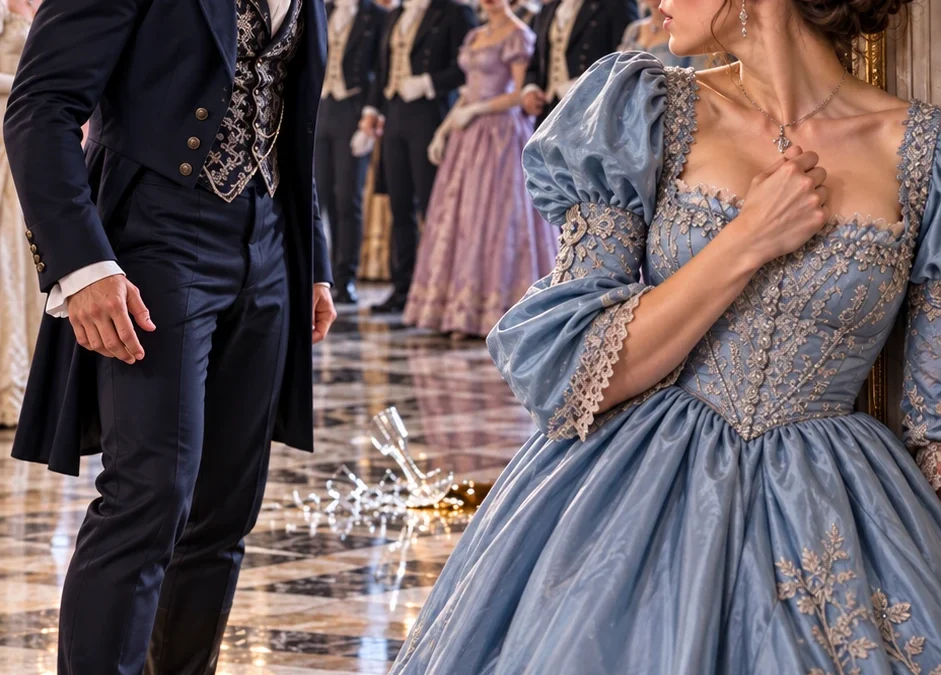
👻 The Duke Dropped His Glass and Went White When He Saw Her Across the Ballroom… She Had Never Met Him in Her Life 😱
PART 1
He dropped his glass. That was the first thing that happened.
In a ballroom dripping with diamonds and desperate ambition, the most powerful man in England stopped dead. The crystal shattered against the polished floorboards. The music stumbled, the whispers flared, and across a suffocating sea of silk, the Duke of Keldon stared at a woman he had never met, his face the color of bone.
Beatrice did not know him. But he looked at her as if she were a ghost. 👻
Beatrice Lynfield was twenty-six years old, thoroughly unremarkable, and the owner of a pair of borrowed slippers that were entirely too small. She stood pressed against the damask wall of the Harrington Ballroom, hoping the maroon curtains might swallow her whole. Four hundred beeswax candles burned overhead, dripping heat and the cloying scent of wax onto the crowd below.
She was not a guest in any true sense. She was a fixture, a poor cousin dragged from a damp Somerset parsonage to chaperone her cousin Caroline. She had calculated that she had exactly two hours and forty minutes before her aunt would finally call for the carriage.
It was an agonizingly mundane evening. Then the doors at the top of the grand staircase opened, and the air changed.
Beatrice felt it in the sharp intake of breath from the dowagers beside her. The dancers faltered. Oliver Keldon had arrived.
Everyone in England knew of the Duke of Keldon. He owned half of Cornwall and controlled several seats in Parliament. His reputation was less whispered about than nervously avoided. He did not dance. He did not mingle. He moved through society like a dark weather front, unpredictable and impossible to ignore.
He looked tired, she thought, for all his terrifying power. The lines around his eyes were carved deep with exhaustion. She felt a flash of cynical amusement. Money, it seemed, did not cure a miserable disposition.
She looked away. She had no interest in dukes. She was far more concerned with the blister forming on her heel.
Then came a sharp crack, like a gunshot.
Beatrice’s head snapped up. The Duke had stopped in the center of the cleared floor. At his feet lay a hundred glittering shards, the pale wine bleeding into the oak. He was not looking at the mess. He was looking directly at her.
His face had drained of every drop of color. His hands were trembling. 😶
She glanced over her shoulder, certain someone important must be standing behind her. There was only blank silk and velvet. When she turned back, four hundred pairs of eyes had followed his line of sight to the shadowed corner where a spinster in a drab olive dress stood clutching her reticule.
Then he walked toward her, like a man wading through deep water. Up close he blocked out the chandeliers. He smelled of rain, starch, and raw panic. His voice, when it came, was a ruin.
“How?” The word tore from his throat. “How are you here?”
The naked grief in his eyes knocked the breath from her. But practicality, honed by years of being ignored, reasserted itself. She was becoming a spectacle, and a spinster could not afford that.
“Your Grace, my name is Beatrice Lynfield. I do not know you, and I believe you are mistaking me for someone else.”
The broken man vanished. The ruthless Duke returned. “You are not leaving.”
Before she could answer, her cousin Caroline appeared, curtsying so deeply it was a miracle she did not topple. The Duke never looked at her. His gaze stayed locked on Beatrice.
“Miss Lynfield. You will dance with me.”
He did not ask for her hand. He took it. 😳
They waltzed in the center of the floor while the entire ton watched. He searched her face like a man mapping a grave.
“Who sent you? Who paid you to wear that face?”
“If I were being paid, I would have bought shoes that fit.”
“Where did you get the scar on your chin?”
Her hand flew to the faint crescent beneath her jaw. “I fell from an apple tree. I was seven.”
“Catherine fell from a horse,” he whispered. “She struck her chin on a mounting block.”
“I have never ridden a horse. I am afraid of them.”
He stopped dead, and the grief in his eyes was so vast it felt like a weight in the air. “You have her eyes. You have her mouth.”
“I am not Catherine,” Beatrice said quietly. “Look at me, Your Grace. I am Beatrice.”
He looked. The ghost left his face, and in its place was a man utterly devastated.
“Forgive me, Miss Lynfield,” he said, suddenly cold. “I have mistaken you for someone long dead.”
He walked out, leaving her alone on the floor beneath a roar of whispers.
In the retiring room, her aunt’s eyes glittered with a terrifying new light. Lady Lynfield no longer saw a burden. She saw an opportunity. “You will stay in London. You will be seen. Refuse, and I will cut off your father’s stipend.”
Beatrice realized with a chill that she was no longer a poor relation. She was bait. 🎣
Across London, in the dark of his study, Oliver Keldon drank whiskey straight from the decanter and whispered to the empty room that his wife was dead. He had buried her. Then he summoned his secretary, and his voice turned to ice.
“She has my dead wife’s face, and I am going to find out why.”
👇 Part 2 is in the comments. Can’t find it? Leave any word below and I’ll send it to you privately.
PART 2
“She has my dead wife’s face, and I am going to find out why.”
The transformation of Beatrice Lynfield began at seven the next morning, and it was not gentle. It was a hostile takeover.
Dressmakers, milliners, and a terrifying French hairdresser swarmed the sitting room, treating her like a piece of furniture in need of reupholstery. A corset was laced tight enough to crack ribs.
“Pull it tighter,” Lady Lynfield ordered. “Catherine always wore structured bodices. The Duke favors a severe silhouette.”
Beatrice gripped the dressing screen. She understood transactions. If the Duke wanted a ghost, her aunt would dress her in a shroud and sell her to the highest bidder.
Meanwhile, in his study, Oliver stared at a stack of papers. Bramwell, his secretary, read them in a careful monotone. Born in Somerset. Father a vicar. Mother dead of fever. A village apothecary who remembered the apple tree and the five stitches.
“It is a coincidence, Your Grace. A cruel trick of nature.”
“Nature does not repeat the exact slope of a jawline and the exact location of a scar,” Oliver said, his voice dropping to a deadly calm. “That is not coincidence, Bramwell. That is a forgery.”
On Thursday, Hyde Park became a theater of sanctioned cruelty. Beatrice sat in an emerald pelisse cut too tight across the shoulders, trapped beside Caroline while her aunt fished for a duke. 🎣
The crowd rippled. Oliver rode through the traffic on a massive black gelding and stopped inches from their carriage. The emerald made her eyes look almost identical to Catherine’s, and he felt it like a blow.
“Are you going to ask me if I am a ghost again, Your Grace,” Beatrice said, “or shall we simply stare until the traffic clears?”
Her aunt made a sound like a strangled cat. Oliver felt something astonishing. He nearly laughed. Catherine had never once been blunt.
He leaned down from the saddle. “I want to know if you like the water, Miss Lynfield.”
It was a trap. Catherine had drowned in the freezing Atlantic.
Beatrice frowned. “I care for water when it is boiled and poured over good tea. Otherwise it ruins leather and causes dampness in the joints. Why, are you planning to throw me in?”
She did not flinch. Her eyes held no terror of the sea. 🌊
His forgery theory crumbled to dust. “I am planning to observe you,” he said. “I will see you at the theater tonight. Do not wear the emerald.”
That night, at the Royal Opera House, Beatrice defied her aunt and wore her own charcoal gray dress. When the box door clicked open, Oliver stepped inside and said two words. “Leave us.”
Lady Lynfield dragged Caroline out so fast the door nearly shook off its hinges.
Oliver sat beside her and laid a folded parchment on the velvet railing. His voice was clinical, stripped of all desperation.
“My secretary found the apothecary who stitched your chin. He found the midwife who signed your birth. And then he found a ledger in the estate archives of the late Earl of Radnor.”
Beatrice stopped breathing. 😨
“The Earl’s wife gave birth in Somerset twenty-six years ago. It was a difficult labor. She delivered twin girls.”
The music blurred into a meaningless hum.
“The first was robust. The second was small, sickly, and entirely unwanted. And the Earl paid a grieving local vicar five hundred pounds.”
Beatrice went cold to her fingertips. She did not want to hear what came next.
👇 Want to know who Beatrice’s father really was… and what the Duke offered her in that dark opera box?
LIKE ❤️ and COMMENT with any word you choose to unlock Part 3. Once we reach enough comments, I’ll post it!
PART 3
“The vicar’s wife had delivered a stillborn child only hours before,” Oliver said quietly. “A transaction was made. The aristocratic twin was erased from the family line and left in a drafty parsonage to survive or fade as God saw fit. The healthy twin was taken home to Yorkshire. Her name was Catherine.”
Beatrice slowly turned her head. She looked at the man beside her, and she realized, with a jarring shock, that he was finally seeing her. Not the ghost. Beatrice.
“My father sold me,” she whispered.
All of it came rushing back: the cold winters, the rationed coal, the haggling with the butcher over a bone. Twenty-six years of poverty, and every day of it built on a purchased lie.
“Yes,” Oliver said. He did not offer pity. He knew she would despise it.
“And Catherine is my sister.”
“Was. Yes.”
A violent anger rose in her throat. “So the mystery is solved. You have your answer, Your Grace. You may leave my box now. I have a great deal of anger to sit with.”
He did not move. He leaned his forearms on the railing, and his voice was low. “Your aunt will sell you by Tuesday to whichever aging, titled fool offers the most advantageous connection. You are entirely trapped, Beatrice. I am offering a solution.”
“You are offering to marry me because I look like the wife you buried?”
“No.” His gloved hand covered hers on the rail, warm and grounding. “I spent three years married to Catherine. She was brilliant and ruthless and she would have wept and fainted to get what she wanted from this situation. You wore charcoal to a royal opera to spite me, and you look as though you want to burn this theater to the ground.”
A startled, wholly inappropriate laugh escaped her. 😅
“I burned her clothes this morning,” he said. “The name is yours, and we shall live wherever you wish.”
“I prefer the country,” Beatrice said softly.
For the first time, the brutal lines around his eyes softened. But she took her hand back. “I will not decide in a theater box, Your Grace, with my aunt listening at the door.”
He did not argue. “Then decide where you like. But I should tell you what I mean to do tomorrow.”
The next morning, Oliver’s carriage took her out of London before her aunt had woken. Lady Lynfield, discovering the empty bed, shrieked so loudly that a footman dropped a tray. 😤
They reached the Somerset parsonage by dusk. It looked smaller than Beatrice remembered, its roof patched, its garden choked with weeds. Her father, Henry Lynfield, opened the door and aged ten years in the space of a breath.
He saw her. Then he saw the Duke standing behind her. And he sat down heavily on the hall chair as though his legs had been cut from beneath him.
“You know why we are here,” Oliver said.
Henry did not deny it. He wept the way old men weep, without noise. “My wife lay dead in the next room with our stillborn child, and a lord’s man came to the door with a basket and a purse. He said the baby would die in a week. He said if she lived, I would be doing God’s work to take her in.” He pressed his hands to his face. “I spent the money on the church roof. I told myself it was penance. It was never enough.”
Beatrice stood very still. She had planned a hundred cruel speeches on the ride down. None of them came.
“Did you ever love me?” she asked. “Or was I only a debt?”
He looked up, and for the first time in her life she saw him clearly: a frightened, grieving man who had made one terrible bargain and spent twenty-six years paying for it in kindness he never knew how to show.
“You were the only thing that ever kept me alive after she died,” he said. “I could not look at you without seeing what I had done. So I looked away. That was my sin, Bea. Not the money. Looking away.”
She crossed the hall and stood in front of him. She did not forgive him. Not yet. But she knelt, and she took his shaking hands in hers.
“You looked away,” she said. “I’m looking now. Don’t make me regret it.”
Behind them, Oliver quietly turned his back, giving them the room. 🥹
Lady Lynfield arrived two days later in a rented carriage, white-faced and furious, with Caroline wailing beside her. She swept into the parsonage garden where Beatrice sat with the Duke and demanded, in a voice that could have cracked glass, that her niece return at once.
“I have made you what you are,” she hissed. “I dressed you. I presented you. You owe me everything.”
“My Lady,” said Oliver, without raising his voice. He drew a folded paper from his coat. “This is a record of every pound you have borrowed against the stipend you threatened to withhold. And this is a letter from Mr. Bramwell concerning the mortgage on your London house, which, as of this morning, I own.”
Lady Lynfield stopped breathing. 😳
“I shall not ruin you,” Oliver said, almost gently. “Beatrice has asked me not to. But you will write to the vicar this week confirming his stipend in full, in perpetuity. And you will never again speak to my wife as though she were a possession.”
“Your wife,” Lady Lynfield whispered.
Beatrice stood. She looked at her aunt, and for the first time she felt no fear at all. “I have not said yes yet. But if I do, Aunt, it will be because I chose it. Not because you sold me. That is the difference between us.”
Her aunt left without another word. Caroline, trailing behind, glanced back once at the cousin she had spent a season mocking. It was almost an apology. It was not quite one. Beatrice let it be enough.
That evening, the garden went gold and quiet. Oliver sat beside her on the broken stone bench beneath the apple tree, the very one that had given her the scar.
“I need to tell you something I have not told anyone,” he said. “I did not love Catherine. I wanted to. I tried for three years. But she was a woman who loved being admired, and I was a man who didn’t know how to be anything but severe. We were two strangers who happened to share a name.”
“Then why did you grieve so terribly?”
“Because I never got to learn who she was.” His voice cracked. “And because for three years, I told myself I would have found her, eventually, if she had lived. When I saw you in that ballroom, I thought I had been given the chance. It was not fair to you. I am sorry for it.”
Beatrice was quiet for a long moment. Then she took a breath. “She was my sister. I never knew her. I should have liked to.”
“I think,” said Oliver slowly, “that she might have liked you. In the end.”
They sat together as the light faded. Then she said, very softly, “If I say yes, it must be on terms.”
“Name them.”
“I choose the house. It will be in the country, and it will have a garden. I will keep my own accounts. I will not be dressed like her, or spoken of as her, or loved as her.”
“I do not want her,” Oliver said, and his hand found hers. “I want the woman who asked me if I meant to throw her in the pond.”
She smiled. It was small, and it was real. “Then yes, Your Grace.”
“Oliver.”
“Then yes, Oliver.”
They were married in the spring in the little church where her mother lay buried, beneath a roof her father’s guilt had mended. Her father walked her down the aisle in a borrowed coat, and he did not look away once. 🌸
When the vows were done, Beatrice knelt alone beside her mother’s grave and laid a bundle of primroses on the stone. She had one more stop to make. Oliver drove her to the Keldon family vault in Cornwall, and for the first time she stood before Catherine’s tomb.
She did not feel grief. She felt something quieter, a sort of tenderness for a woman who had been given everything and loved nothing, who had worn the life that should have been shared between them.
“I’ll look after him,” she whispered. “And I’ll be happier than either of us was meant to be.”
Oliver stood a respectful distance behind her, hat in hand. When she turned, he held out his arm. She took it, and they walked back through the cold spring wind toward a country house with a garden, a good fire, and boots by the door that did not pinch.
Beatrice Lynfield had once been a ghost in other people’s lives, a poor relation, a face no one wanted to look at. Now she was a woman who had been seen, truly and completely, and chosen anyway.
She would tell you it was worth every blister. 👣
💬 Did you guess the twin twist? Have you ever been the one nobody noticed until someone finally looked at you properly? Tell me in the comments. I read every one. ❤️
Disclaimer: This story is entirely fictional and created for entertainment purposes only. It does not represent any organization or individual, nor does it encourage inappropriate behavior. The content was generated with AI assistance.








