The Duke Found a Pressed Violet Hidden for Five Years. By Sunrise He Was Riding to a Humble Cottage, and a Child’s Question Shattered His Whole World
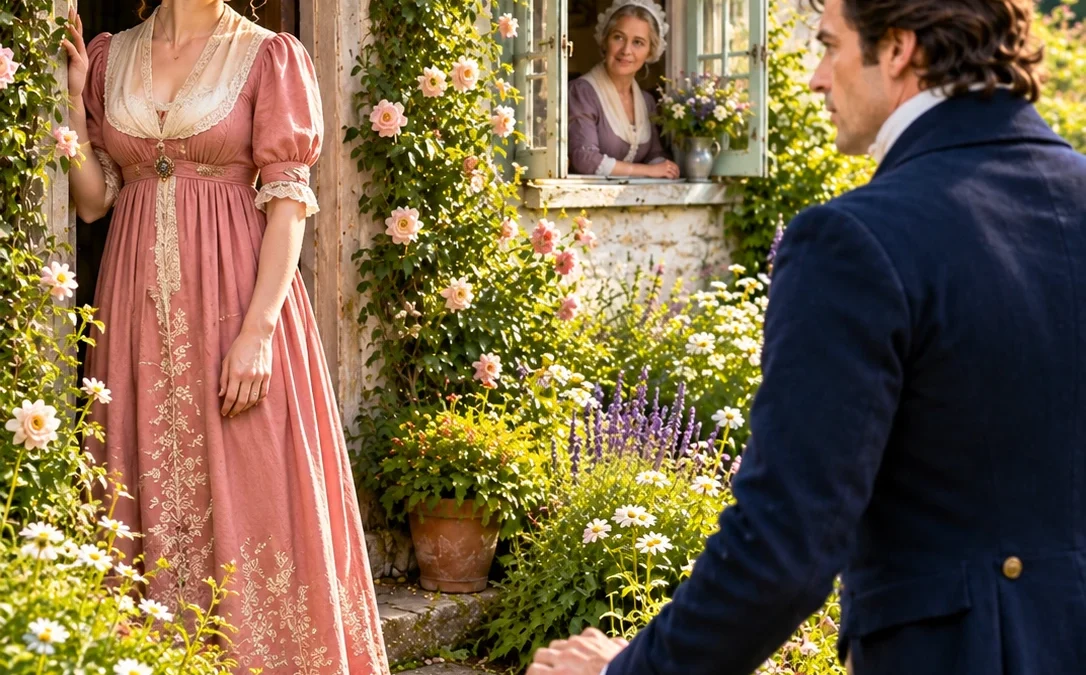
The Duke Found a Pressed Violet Hidden for Five Years. By Sunrise He Was Riding to a Humble Cottage, and a Child’s Question Shattered His Whole World
PART 1
The pressed violet slipped out of the old drawer and landed on the desk like a small purple warning. 💜
Alister Ashford, Duke of Hardcastle, stopped breathing.
He had not seen that flower in five years, and he had been very careful never to look for it.
Downstairs, the music of the grand ball drifted through the halls. Three hundred guests were drinking his wine and praising his name. Every mother in the room had pushed a daughter toward him that night, and every daughter had smiled the same smile. By midnight, a bishop and two earls had told him it was time to choose a duchess.
He had slipped away to his study, claiming he needed air.
Now he held a flower that smelled of summer and old promises. The petals were thin as paper.
Eleanor Whitmore had given it to him on the day he asked her to marry him, in the garden behind her father’s house. She was a country doctor’s daughter with ink on her fingers, and she had laughed at him when he knelt down.
Then she had said yes.
He remembered that yes better than anything else in his life.
Three months later, a letter had come. He still knew every word. Eleanor wrote that she had never truly loved him, that she had been dazzled by his title, and that she wished to be released. The handwriting was hers. The signature was hers.
He had read it standing in this very room, and something inside him had closed like a door. He had not written back. He had not ridden to her village. His pride would not allow it. And his mother, the Dowager Duchess Lavinia, had simply poured him a cup of tea and said:
“Better to learn it now, my dear. That sort of girl always wants more than she says.”
For five years, Alister had believed that story.
Tonight, for the first time, a cold question crept into his mind. Why had Eleanor, who could never tell a lie without blushing, written such a cold and careful letter? 🕯️
A soft knock sounded. Pembroke, the old butler, entered with a tray and a worried face. “Your Grace, the guests are asking for you. Shall I say you are unwell?”
“Say whatever you like.” Then, almost without meaning to: “Pembroke, do you remember Miss Whitmore?”
The old man’s hands trembled, and the cups rattled on the tray. “I do, Your Grace.”
“Do you know what became of her?”
Pembroke glanced at the door and spoke too quickly, the way a man does when he has carried a secret too long. “She still lives in Thornby, Your Grace. In a cottage at the end of Miller’s Lane. I only heard it from the baker’s boy.” His face turned red. “Forgive me. I should not have said it.”
Alister stood. The violet was still in his palm.
“Have my horse saddled before sunrise. Tell no one. Not the guests. Not the duchess.”
Pembroke’s eyes widened. “Not even your mother, Your Grace?”
Something in the old man’s face made Alister’s stomach tighten.
“Especially not my mother,” he said quietly. 😶
The horse was trembling with tiredness when he saw the chimneys of Thornby, but he did not slow. He had ridden since dawn in a plain brown coat, with no carriage, no footman, no crest on his saddle. For the first time in his life, nobody bowed to him on the road. It felt like walking without shoes.
A woman at the village well stared at him as if he were a ghost. When he asked the way to Miller’s Lane, she pointed with one shaking finger, dropped her bucket, and hurried away.
At the end of the muddy lane stood a small stone cottage. The roof sagged on one side. The gate hung crooked on one hinge. Yet smoke curled happily from the chimney, and the windows shone clean in the morning light.
This was not the life he had pictured for her.
Small things caught his eye, and each one tightened his chest. A vegetable garden in neat rows. Herbs along the wall, the same herbs her father used to grow. Shutters mended with mismatched wood, painted carefully to hide the repairs. Someone here worked hard and refused to give up.
Then he saw it, lying in the grass beside the step.
A little wooden horse with a chipped ear and a string for a tail. Beside it, a pair of tiny boots drying in the sun. 👢
Alister stopped walking.
A child lived here. The thought struck harder than he expected. Eleanor had a husband, then. A family. A whole life that had gone on perfectly well without him.
He almost turned around.
“I would not do that if I were you.”
An old woman stood at the gate, leaning on a walking stick, her eyes sharp as needles. “I am Mrs. Hollis. I know a rich man’s boots when I see them. If you have come to hurt that girl again, go back the way you came.”
“Again? Madam, I have never hurt her. She was the one who…”
Mrs. Hollis looked at him for a long moment. Her face changed. It was not anger he saw now. It was fear.
“Today is Tuesday,” she said slowly. “Perhaps you should come back another day.”
“Why does the day matter?”
She did not answer. Her eyes slid to the hedge behind the cottage, where the corner of a black carriage sat hidden, plain and unmarked, its horses resting in the shade. 🐎
Alister turned back to the door. His hand was shaking, so he made a fist to steady it. His knuckles stopped an inch from the wood.
A sound floated out through the thin door and went through him like cold water.
Someone was singing. A soft, low voice, cracked a little with age, singing a lullaby about a boat on a silver sea.
Alister knew that song.
He had not heard it since he was four years old, when a woman had sat on his bed all night and sung it again and again until the sun came up.
That woman was his mother.
He shook his head. Impossible. The Dowager Duchess Lavinia had not left the Hardcastle estate in eleven years. She hated mud, hated villages, and above all hated anything small and poor. She did not sing.
Then the voice did something worse.
It laughed. 😳
He crept to the window, where a gap had been left between curtain and glass, and looked in. A tiny, warm room. A fire crackling in a stone hearth. And on the rug before the fire, in her best gray silk gown, sitting right down on the floor like a girl, was the Dowager Duchess of Hardcastle.
In her lap sat a little boy of about four, with dark untidy hair and bright, curious eyes, stacking wooden blocks into a tower. Every time it fell, Lavinia clapped her hands as though it were the finest performance she had ever seen.
Then the boy turned his face toward the window, and the light fell on it.
Alister gripped the stone sill to stay on his feet.
The boy’s eyes were gray. Not just any gray. The pale, stormy gray of the Ashford family. The same gray he saw in his own mirror every morning. The gray of every duke in the long gallery.
Five years. The child was four.
A woman stepped out of the shadows with a tray of tea. Thinner than he remembered. Faint lines near her eyes. Sleeves rolled up, hands red and rough from hard work.
It was Eleanor. Unmistakably Eleanor.
“Grandmama?” said the boy clearly. “Is the tea ready?”
Grandmama.
The word echoed in Alister’s head until he felt dizzy. His mother, who had called Eleanor unsuitable, who had told him that girl wanted more than she said, was sitting on this cottage floor being called Grandmama by a boy with his own eyes.
Something hot rose in his chest. He did not remember crossing the garden. He only knew that the door flew open and struck the wall with a crack like thunder, and the cheerful sounds inside stopped at once.
The teacup slipped from Eleanor’s fingers and shattered on the floor. Lavinia’s face lost every drop of color.
The little boy looked at the tall stranger in the doorway. He tilted his head. And in a clear, innocent voice, he asked the question that split the room in two.
“Grandmama, why does that man look like me?” 💔
PART 2
“Grandmama, why does that man look like me?”
Nobody moved. Even the fire seemed to hold its breath.
Lavinia rose slowly from the rug, her silver hair slipping loose from its pins. For the first time in his life, Alister saw his mother look small.
“Alister,” she whispered. “Let me explain.”
“Then explain it now, Mother.” His voice shook. “Whose child is that?”
Eleanor bent and spoke softly to the boy. “Sweetheart, go and see the hens with Mrs. Hollis.” The old woman appeared at once and led him away.
Eleanor lifted her eyes to Alister at last.
“I never planned for you to find out like this. I never planned for you to find out at all.”
“Find out what?”
“That he is your son.” 🕯️
The words landed like a stone dropped in deep water. Alister gripped the back of a chair.
“I did not know,” he said hoarsely. “Eleanor, I swear to you, I did not know.”
“I believe you. I have believed you for two years.”
He turned toward his mother. Lavinia’s chin trembled, but she did not look away.
“The letter ending your engagement,” she said. “I wrote it. I copied her handwriting and sealed it myself.”
The floor seemed to tilt. “You what?”
“I told myself I was protecting you. I thought you would grieve for a season and then forget her.” Her voice broke. “I was a proud and foolish woman.”
“There was more,” said Eleanor quietly. “Two months later I learned I was expecting a child. I wrote to you at once. I wrote again and again, every week for a whole spring. No answer ever came.”
“Because I destroyed them,” said Lavinia. “Your footman brought me every letter before it reached your desk. I burned the last one in my own sitting room.” 🔥
Eleanor’s voice stayed steady, though her hands did not. “My father died that winter. A fever took him in three days. I sold his books to pay for the burial. I took in sewing. I grew vegetables. I told myself you had read my letters and chosen silence, and that I would never beg a man who did not want us.”
“I wanted you,” said Alister, and his voice cracked. “I wanted you every day.”
Lavinia stepped forward. “I found out two years ago from a cousin who had passed through Thornby. I came to see for myself. I meant to leave. But the child ran to the door and held up a dandelion, and I could not go.” She wiped her eyes. “I have come every Tuesday since. I could not tell you, Alister. I was a coward.”
Alister walked to the fireplace and stood with his back to them both.
“You took five years from me, Mother. You took a father from that boy.”
“Yes.”
She did not argue. It was somehow the worst thing of all.
He turned to Eleanor. “I will fix this. Tell me how.”
She shook her head gently, with quiet sadness. “You cannot give me back five years, Alister. You cannot give him back his first word or his first steps. An apology will not undo what has been done.” She drew a breath. “Go home. Please. I need time.”
He bowed his head. He walked out into the cold bright afternoon, and he did not look back. 💔
The great hall of Hardcastle had never been so quiet. Forty relatives sat in carved chairs, whispering, wondering why the Duke had called them home on a Sunday morning. Then the Dowager stood and spoke plainly, in a voice that carried to every corner. She told them about the false letter, the burned pages, and the child who had grown up without a father.
She laid her ring of keys on the table. She said she would live in the small dower house at the edge of the park, and visit Thornby only when Eleanor allowed it.
When the bishop wrote asking about the choosing of a duchess, Alister sent back a single line.
“The matter is closed.”
The following Saturday he rode to Thornby with nothing but a box of tools. The gate was still crooked. He knelt in the mud and began to fix it. Eleanor watched from behind the curtain. When he left that evening, he laid the pressed violet on the gatepost, without a note.
In the morning, it was gone. 💜
He came back every week. He mended the roof and blistered his hands doing it. He never knocked unless invited, and never spoke of the past unless she did.
The boy was harder. For a month he hid whenever the tall man came near. Then one afternoon Alister sat down on the grass with the chipped wooden horse and began to mend its ear with a little glue and a steady hand.
A small shadow fell across him.
“That’s mine,” said the boy.
“I know. I am only fixing it.”
“What is its name?”
“Barley.”
The boy crept closer. “I am Edmund. After my grandfather. He was a doctor. Mama says he could fix anything.”
Alister’s throat tightened. And just as the boy reached out a small hand toward him, the cottage door opened behind them, and Eleanor stood there with her face unreadable and a folded paper in her hand…
PART 3
“What is that?” Alister asked, rising slowly from the grass.
Eleanor did not answer at first. She looked at Edmund, who was already tugging the mended horse out of Alister’s hands, and said gently, “Take Barley to Mrs. Hollis, love. Show her his ear.”
When the boy had gone, she held out the paper.
It was creased and brown at the edges. The seal had been broken long ago. Across the front, in her own hand, was his name.
“It is the last letter I wrote you,” she said. “Your mother burned the others. This one I could not send. I wrote it the night Edmund was born, and I was too proud to post it.” She pressed her lips together. “I think I want you to read it now.”
He sat down on the garden step, and he read.
Alister, our son was born tonight. He has your eyes. I do not know why I am telling you this, since you will never read it. But if you ever do, know that I did not stop loving you. I only stopped waiting.
The paper trembled in his hands. When he looked up, his eyes were wet, and he did not trouble to hide it.
“I would have come,” he said. “On foot. On my knees.”
“I know.” She sat down beside him on the step, not close, but not far. “That is why I am showing you. I have been angry for five years, Alister, and I am tired. I think I would like to put some of it down.” 🥹
A long silence passed. In the garden, the hens muttered, and Edmund’s laughter drifted from behind the hedge.
“Why did you not go to my mother’s house?” he asked softly. “When the letters went unanswered?”
“I did. In the second winter. I stood at your gates in the snow with Edmund in my arms.” Her smile was thin. “A footman told me the Duke was not receiving. Your mother watched from an upper window. I saw her curtain move.”
Alister closed his eyes. “I did not know. I swear to God.”
“I know. That is what made it so hard to hate you.” 💔
The weeks turned into months. Autumn gave way to the first snows. Alister kept coming to Thornby, and slowly the village stopped treating him like a ghost. The baker sent him home with warm bread. Mrs. Hollis grudgingly admitted that he held a hammer better than most dukes. And Edmund began to wait at the gate on Saturdays, with Barley tucked under one arm.
“Papa Alister,” the boy called him one evening, trying out the words. Then, shy, “Is it all right if I say that?”
Alister could not speak. He knelt down in the snow and held the child very hard, and Edmund patted his back with great seriousness, as one pats a horse that is upset.
“It is all right,” said Alister, when he could. “It is the best thing anyone has ever called me.”
Over Eleanor’s shoulder in the doorway, he saw her turn away quickly and press the back of her hand to her mouth. 😭
The Dowager came, too, on Tuesdays, as always. Eleanor allowed it, though stiffly, for a long while. Lavinia did not demand forgiveness. She brought no gifts that were not asked for. She sat on the rug and built block towers, and when Edmund fell asleep against her shoulder, she held perfectly still for an hour so as not to wake him.
One bitter evening, after the child was in bed, Lavinia stood at the cottage door in her plain gray cloak.
“Eleanor,” she said. “I know I have no right to ask anything. But I wanted to say it, once, plainly, to your face. I am sorry. I do not expect you to forgive me. I only wanted you to know I understand what I did.”
Eleanor was quiet for a long time, wiping a bowl that was already dry.
“You did a cruel thing,” she said at last.
“Yes.”
“You stole my life and his.”
“Yes.”
“And you have come every Tuesday for two years, in the rain, to sing a lullaby to a child who did not know you.” Eleanor set the bowl down. “I think cruelty and love can live in the same person, Your Grace. It does not make the cruelty smaller. But it does make it harder to hate.”
Lavinia’s eyes filled. She bowed her head and said nothing at all.
“Come in,” said Eleanor. “It is cold. I will make tea.” 🕯️
It was not forgiveness. It was a door left ajar. But the old woman stood on the threshold for a long moment as if she did not quite believe it, and then she went in.
In the spring, the clinic opened.
It stood at the edge of the village, a low whitewashed building with a green door and a brass plate reading Whitmore Surgery. Eleanor ran it with a fierce, gentle competence. She set bones, delivered babies, and sat up through the night with fevers. She had learned everything she knew at her father’s side, and the village, which had always quietly known it, finally had a place to say so.
Alister stood at the back on opening day, hat in his hands, one more face in the crowd. When the speeches ended, she found him and said, low, “You paid for all of this.”
“It is not a gift. It is a debt.”
“I know. You have said so a hundred times.” She looked up at him. The lines near her eyes had softened over the winter. “I do not want you to owe me anymore, Alister.”
His heart stopped. “Eleanor…”
“I want you to choose me. Not because of Edmund. Not because of guilt. I want you to stand here, in this ordinary place with no portraits, and ask me for what you really want.” She lifted her chin. “And I will answer you honestly. That was my first term. It is still my first term.”
Alister drew a long breath. His hands were shaking, as they had been at her father’s garden gate, so many years ago.
“I want you at the other end of my table,” he said. “I want a life where you keep your work, your roof, and your name, and I am simply the man lucky enough to come home to it. I want to sit on your doorstep on Saturdays until I am old.” His voice cracked. “I do not want a duchess. I want you. I have wanted you every day for five years.”
“That,” said Eleanor, with tears on her face, “is a better speech than the one you gave in the garden.”
“I was nervous then.”
“You are nervous now.”
“Terribly.”
She laughed, and the sound nearly undid him. Then she took his hand. “Ask me properly, Alister.”
He knelt there, in the dust outside the little green door, with the whole village watching and pretending not to. He had no ring. He had only one thing in his pocket, and he drew it out with trembling fingers: a pressed violet, thin as paper.
“Eleanor Whitmore. Will you marry me? Truly, honestly, on your own terms?”
She looked at the flower for a long moment. Then she smiled, the same smile she had worn in a garden five years before.
“Yes,” she said. “I will.”
The village cheered so loudly that the hens in Mrs. Hollis’s yard scattered in alarm. 💜
They were married in the little church at Thornby, in the first week of summer, with only the people who had truly mattered. Mrs. Hollis wept into a handkerchief the size of a tablecloth. Pembroke, the old butler, had begged leave to attend and sat in the back pew looking enormously relieved. And in the front row sat the Dowager Duchess, in a gray silk gown, holding a small boy’s hand and trying very hard not to sob.
Edmund carried the ring on a cushion. He walked the whole aisle with great solemnity, then looked up at his parents and announced, in a clear voice that carried to the rafters, “I fixed Barley’s ear. I think we should fix everything else too.”
The congregation dissolved into laughter. Eleanor wiped her eyes. And Alister, the Duke of Hardcastle, who had once believed that love was a door closed forever, knelt and kissed his son’s forehead in front of everyone.
“We will,” he promised. “One day at a time.”
They did not move into the great house with its portraits and its long cold gallery. Instead, the Duke of Hardcastle spent more nights in a crooked-gated cottage than anyone in the county ever quite believed. Eventually the roof was properly mended, a second room was added, and the old stone wall was lined with fresh herbs.
Edmund grew up with muddy knees and bright gray eyes, equally at home among sheep and ledgers. He learned his letters at his mother’s clinic and his horses from his father. Every Tuesday, a gray-haired woman in a plain cloak arrived to teach him an old lullaby about a boat on a silver sea, and he never once told her he already knew the words.
And on the windowsill of the little kitchen, in a small blue cup where the light could reach it, a pressed violet sat through every season, thin as paper, no longer a warning.
Only a promise, kept. 💜
💭 Isn’t it something, how a single flower can carry five years of silence and still find its way home?
If this story moved you, a LIKE genuinely helps. 👍 Share it with anyone who believes the right love is worth waiting for, and the right apology is worth hearing. And tell me in the comments: would you have let Lavinia back in? 👇
Disclaimer: This story is entirely fictional and created for entertainment purposes only. It does not represent any organization or individual, nor does it encourage inappropriate behavior. The content was generated with AI assistance.








