THE DUKE GAVE AWAY HIS FOUR OLD GOVERNESSES “FREE TO ANY HOME” AT AN AUCTION, AND LAUGHED AS THEY LEFT… BUT WHEN A SILENT LITTLE GIRL WALKED THREE MILES THROUGH THE SNOW TO THEIR DOOR, HE FOUND OUT WHAT HIS OWN STEWARD HAD BEEN DOING IN HIS NAME
THE DUKE GAVE AWAY HIS FOUR OLD GOVERNESSES “FREE TO ANY HOME” AT AN AUCTION, AND LAUGHED AS THEY LEFT… BUT WHEN A SILENT LITTLE GIRL WALKED THREE MILES THROUGH THE SNOW TO THEIR DOOR, HE FOUND OUT WHAT HIS OWN STEWARD HAD BEEN DOING IN HIS NAME 😱
Part 1
“Four old governesses,” called the auctioneer, and he grinned. “Past teaching, past use, free to any home that will feed them.”
The crowd laughed. Not everyone, but enough. 💔
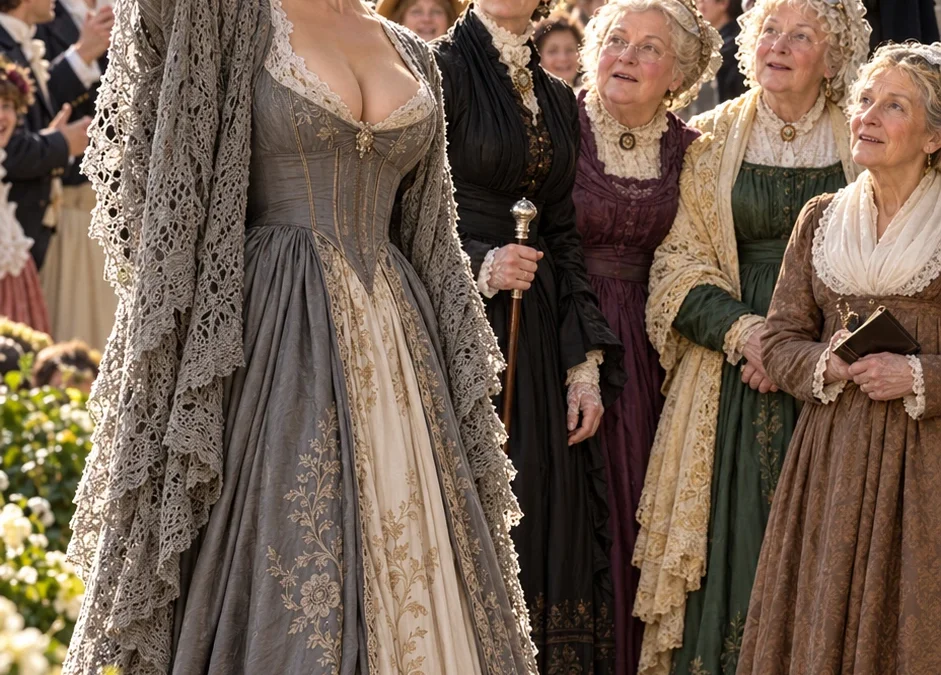
It was Michaelmas morning at Hollingford Court, and they were selling the governess house one piece at a time in the open courtyard under a low gray sky. The globe had gone for two pounds. Forty years of copybooks had gone in one bundle for a shilling. The schoolroom pianoforte had gone for five. And beside it, in a neat row, in their best black dresses, stood the last lot of the day: the four women who had lived and taught in that house for forty years.
Before the year was out, every great house in the county would be begging for a place on their benches. Nobody in that courtyard would have believed it.
The eldest, Miss Fairweather, did not move. She was seventy-six. She fixed her eyes on a point just above the auctioneer’s head, the way she had once looked at girls who whispered during French.
On the steps of the great house, the Duke of Hollingford watched without any expression at all.
“That will do,” he said. He did not raise his voice. The laughter stopped at once.
His steward bent to his ear. Mr. Silas Pruitt had managed Hollingford for twenty-two years, a soft-spoken man with a soft hat and very clean hands.
“The ladies have no claim on the estate, your grace. I have read your late uncle’s will twice. There is not one word about them.”
“His late grace promised us that house for our lives,” said Miss Fairweather clearly. “He told us so himself on his last night.”
“Promises are not papers, madam,” said Pruitt gently. “I am so very sorry.”
The Duke looked at the four old women for a long moment. “So am I. But I am bound by the will and by the debts.”
At the back of the crowd, someone raised a hand.
“I will take them.”
Every head turned. 😶
She was young, in a gray dress that had been black eight months ago and had been dyed and washed until it was not quite either. Hester Lane, widow of the village curate, had come to the sale to buy a box of cheap slates for the Sunday school.
“Mrs. Lane,” said Pruitt, smiling. “You can barely feed yourself.”
“Then we shall all be hungry together. But nobody is going to sell them like a cracked teapot.”
The Duke came down the steps, tore a page from his pocketbook, wrote on it, and held it out. “Five shillings a week for each of them until Lady Day. Paid through my steward. After that, they are the parish’s concern.”
Hester took the page. She did not curtsy.
“They will never be the parish’s concern, your grace. Not while I have a roof.”
She turned her back on the Duke of Hollingford, offered her arm to Miss Fairweather, and walked all four of them out of the courtyard. Nobody stopped them. Nobody helped them, either.
High above, at a nursery window, a small, pale face watched them go. The Duke did not see it. He did not know that the little girl at that window had not spoken a single word in seven months. And he had no idea that by spring he would stand in a village schoolroom with his hat in his hands, begging those four old women to teach her. 🕯️
The village was three miles away. Hester gave the carrier her last sixpence to take the ladies and their single trunk in his cart, and walked beside it.
Miss Fairweather taught French and Italian, and walked with an ebony cane she held like a sword. Miss Kemp, seventy-one, taught arithmetic and the stars, and carried a brass telescope she had refused to let them sell. “It was my father’s.” Miss Malone, sixty-eight, from County Clare, taught music, and laughed at the carrier’s horse, which kept stopping to eat the hedge. And Miss Cole, the youngest at sixty-three, taught drawing, botany, and needlework, and spoke so softly you had to lean close. For forty years she had kept every record of the governess house in a tiny, perfect hand.
Hester lived in the old village schoolhouse, one long room with benches, a cold iron stove, and two small bedrooms behind. It belonged to the Hollingford estate, and the lease ran until Lady Day in March. She had nine pounds and four shillings in the world. That night the soup was mostly water and onion.
“We shall not be a burden to you, Mrs. Lane,” said Miss Fairweather. “We shall be useful or we shall be gone.”
“Then be useful. And eat your soup.”
Miss Malone laughed out loud. Then, in her cracked old voice, she began a song from Clare about a blackbird. And Hester, who had not cried since the funeral, cried into the washing-up water, and nobody said a word about it.
Later, drying cups beside her, Miss Cole spoke very softly. “Your husband came to the Court that last night, Mrs. Lane, when his grace was dying. Did you know?”
Hester did not know. Samuel had been called out near midnight one night in January. He came home at dawn, white and tired, and said only, “His grace is gone.” Within a week he had the same fever. Within two, he was dead.
She had never asked him what happened that night. 🥹
On the first Saturday, Mr. Pruitt brought the money himself. It should have been one pound, five shillings for each lady. He counted out fifteen shillings in total onto the table. “Deductions, for the carrier and the trunk.”
“I paid the carrier myself.”
“Then you were careless with your money, Mrs. Lane.”
He smiled, touched his soft hat, and left. Miss Cole took a small book from her pocket and wrote in it. Received of Mr. Pruitt, 15 shillings. The next Saturday it was twelve. The Saturday after, ten.
Miss Cole wrote down everything. Nobody had asked her to.
On the third Saturday she came back from the village very quiet. “There are new curtains at the governess house. Yellow ones.” Mr. Pruitt had asked the Duke for the empty house at a fair rent, to be nearer the estate office, and the Duke, believing nobody had any claim on it, had said yes.
“Twenty-two years that man looked at our house,” said Miss Kemp, “like a dog at a butcher’s window.”
That evening Miss Fairweather tapped her cane on the floor. “Mrs. Lane, you have a schoolroom. We are four governesses. There are girls in this village who cannot write their own names. Let us teach.”
“They cannot pay.”
“Then they shall pay a penny a week. And any girl who cannot pay a penny shall bring a stick for the stove.”
On Monday, three girls came. Bess Hobbs, the blacksmith’s daughter, ten years old, with soot under her nails and a frown like a thundercloud. And the miller’s twins, Sukey and Jane Dunn, seven, who held hands the whole day. Miss Kemp taught them to count by the stars in the yard at dusk. Miss Malone taught them the kings and queens of England as a song. Miss Cole taught them to draw a leaf exactly as it was. And Miss Fairweather taught them to stand up straight and say good morning in French.
By Christmas there were eleven.
Three miles away at Hollingford Court, the sixth governess since summer was packing her bag. “The child will not speak, your grace. She will not eat. She sits at the window and watches the lane. I cannot teach a statue.”
Effie was eight, the daughter of the Duke’s late sister. Her father, a naval lieutenant, had been lost at sea two years before. Her mother had died of fever in Portsmouth that March. And Effie had not said one word since the funeral.
The Duke, Hugh Carrick, had been a Navy captain for fifteen years and a duke since January. He could take a ship through a storm off Finisterre. He did not know how to talk to a child. He sat beside her at the window that evening.
“What are you watching for?”
She did not answer. She watched the lane that led down to the village.
The first snow came in December. And on the afternoon it came, Effie was gone… 😨
Part 2
On the afternoon the first snow came, Effie was gone.
The Duke rode out with every groom he had, a lantern on every horse. At the schoolhouse, just after dark, there was a knock.
On the step stood a small girl in a blue velvet cloak soaked to the knees, her lips gray with cold. She had walked three miles alone through the snow.
“Effie,” said Miss Malone. “Oh, my darling.”
She knew her. All summer, it came out, Effie had slipped away every afternoon to the governess house and sat beside Miss Malone at the pianoforte. Miss Malone played. Effie listened. She never said a word, but she came every single day.
“We wrote to his grace in August,” said Miss Fairweather, “to tell him where the child went, and that she was safe with us. He never answered.”
They wrapped Effie in blankets by the stove. Miss Malone had no pianoforte anymore, so she sat close and hummed the song about the blackbird.
And Effie began to sing. 🥹
It was a small voice, thin and true. That was what the Duke heard when he pushed open the schoolhouse door with snow on his shoulders and fear all over his face. He had not heard his niece’s voice since her mother’s funeral. He stood in the doorway and could not move.
Afterwards, Hester walked out into the yard with him while the groom brought up his horse.
“She has not spoken since March,” he said. “Not one word to me or to anyone.”
“She did not speak to us either. She sang. It is not the same thing, but it is something.”
“Why here?”
“Because the people who were kind to her are here. You sent them here.”
He was silent a long time. “Miss Fairweather says she wrote to me in August. I never had a letter.”
Hester looked at his face. He was telling the truth. She was sure of it.
“I was raised by a tutor with a cane and a Latin grammar. I went to sea at twelve. I do not know what to say to a child who will not speak.”
“Then don’t say anything. Sit beside her. That is all Miss Malone ever did.”
He took Effie home that night wrapped in his own coat on the saddle in front of him. At the gate, she twisted around to look back at the lit window until the dark swallowed it.
The next morning he asked Mr. Pruitt about the letter. Mr. Pruitt was very sorry. The post was so unreliable in summer.
Pride is a heavy thing for a proud man to put down. But he made one decision. On Sunday afternoons, Effie might visit the schoolhouse for an hour with her nurse.
In January, the rector’s wife, Mrs. Penrose, heard who was teaching in the old schoolhouse. Twenty-five years before, she had learned her arithmetic from Miss Kemp. She came the next morning with her two daughters and paid two guineas a quarter for each in advance. Others followed. By the end of January, there were nineteen pupils: eleven village girls at a penny a week, and eight gentlemen’s daughters at two guineas a quarter.
It was just as well. By January, Mr. Pruitt’s Saturday money had stopped altogether.
“His grace has ordered economies,” he said, and did not sit down. 😠
At the end of that month, on a Thursday morning, the Duke came to the schoolhouse himself. He stood in the doorway while nineteen girls recited the kings and queens of England. When they finished, he asked to speak to the ladies.
“Come back to the Court. All four of you. Teach my niece. I will pay whatever you ask.”
Nobody spoke. Then Miss Fairweather folded her hands on her cane.
“Your grace. In September, you stood on your steps while we were offered free to any home that would feed us. We were sold with the furniture. And furniture does not come back when it is called.”
“I did not laugh.”
“No. But you did not stop it, either. Not until it was done.” She went on. “If you want the child taught, bring her here. She may sit on the bench like any other pupil, beside the blacksmith’s daughter.”
“My niece is the ward of a Duke.”
“Bess Hobbs can do long division, your grace. Can your niece?”
At the back, Bess Hobbs went pink to the ears and sat up very straight.
The Duke bowed stiffly and left. Hester walked him to the gate. “Your Miss Fairweather is a very hard woman.”
“She is seventy-six years old, and she was put out of her home of forty years with one trunk. She is allowed to be hard.”
He looked as though he wanted to answer. Then he rode away up the white lane.
In the first week of February, Mr. Pruitt delivered a letter to the schoolhouse. The lease would not be renewed at Lady Day. His grace required the building. The tenants were to leave by noon on the twenty-fifth of March.
What the letter did not say was that Mr. Pruitt had already promised the schoolhouse to his brother-in-law, the maltster, as a storehouse for barley.
And that was not all he did. The story began to move around the county, quietly, the way Mr. Pruitt did everything. At the market. At the church door. Over the draper’s counter. The four old women, people said, had been turned out because they were past their wits. The eldest wandered at night. His grace was ashamed of the school and wished it closed.
It was said in his grace’s name, and nobody repeated it to his grace. Nobody repeats such things to a duke.
Within two weeks, six of the eight gentlemen’s daughters were taken away. Lady Brandon removed her daughter Sophie without a word. Thirty years before, she had learned her own French from Miss Fairweather. Only Mrs. Penrose kept her girls where they were. “I know a lie when I hear one. I was taught to by Miss Kemp.” 🔥
February turned bitter. The coal ran low, then lower. Hester pawned her mother’s silver brooch in the town for thirty shillings and said nothing to anyone. Miss Cole’s little book filled with the same word. January: nothing. February: nothing.
One evening Hester knelt by a box she had not opened since January. It held Samuel’s old sermons. She meant to use the backs of the pages for the children’s sums. Under the sermons lay his little pocket diary.
She turned to January, to the night he was called to the Court. His handwriting was small and tired.
Called to the Court near midnight. His grace very weak, but clear in his mind. He dictated a codicil for the four ladies of the governess house and signed it himself. The house is to be theirs for their lives, with thirty pounds a year to each, paid from the estate. Dr. Morrow, Bright the valet, and I signed as witnesses. His grace sealed it and gave it to Pruitt to go to Mr. Ellery in London by the morning mail. He was asleep when I left. He was smiling.
Hester read it three times, her hands shaking.
She took it to Miss Cole without a word. Miss Cole read it once and closed her eyes. “We were all four at the Court that night. His grace had sent for us to say goodbye. Then Mr. Pruitt sent us out, and the maids with us. When he came down the stairs he had a packet under his arm. I saw him from the landing.”
“Then the codicil exists.”
“It existed,” said Miss Cole softly. “Whether it exists now is another question.”
Bright the valet had been pensioned off soon after the funeral and gone to his sister in Devon. The other witness, Dr. Morrow, lived ten miles away. Hester wrote to him that night. No answer came.
And that same week, Miss Fairweather fell ill. 😰
It began as a cough. Within three days it was in her chest. The coal was gone, and Hester burned two of the benches. It was not enough…
Part 3
On Sunday afternoon, Effie came with her nurse for her hour. She saw Miss Fairweather in the chair by the stove, under every blanket in the house. She saw the empty grate. She saw the pale square on Hester’s dress where the brooch had been.
Effie took off her blue velvet cloak and laid it very carefully over Miss Fairweather’s knees.
That evening at Hollingford Court, the Duke was dining alone, as he always did. The door opened. His niece walked in in her nightgown and stood beside his chair. She had never come to him of her own accord before.
“Miss Fairweather is cold.”
The Duke went perfectly still. It was the first thing she had said to him in eleven months.
“She is cold because there is no money. Mrs. Lane’s brooch is gone. You said you would pay them. You didn’t pay.”
“I have paid every Saturday,” said the Duke slowly. “I signed for it myself.”
Effie looked at him with her mother’s eyes. “Then somebody took it.”
Children see plainly. 😶
The Duke rose, went to his study, and opened his own pay book. Every Saturday since Michaelmas, in his own hand, to Mr. Pruitt for Mrs. Lane: £1.
Within the hour he was in the saddle. Behind him came a cart loaded with coal, blankets, and food. Beside him rode Dr. Morrow, who had been dining at the Court that night. They reached the schoolhouse after ten. The Duke carried in the first sack of coal himself.
“An inflammation of the lungs,” said Dr. Morrow. “Keep her warm day and night, and I believe she will live. She is far too stubborn to do otherwise.”
“I can hear you, doctor,” said Miss Fairweather without opening her eyes.
Then Dr. Morrow straightened and looked at the four old ladies one by one as if he could not believe his eyes. “Why in the world are you here? You should be in the governess house. His late grace’s codicil…”
The room went silent.
“What codicil?” said the Duke.
“Your uncle’s codicil, your grace. I signed it myself, with the curate and your uncle’s valet, the night he died. I have been with my daughter in York since before Michaelmas. I came home only last week, and found a letter from a Mrs. Lane waiting on my desk. I had not even opened it.”
Hester went to the box and came back with Samuel’s diary. She opened it at January and laid it before the Duke. He read it by candlelight. His face did not change, but his hand closed slowly on the edge of the table.
Miss Cole stepped forward and laid her own little book beside it. “The money Mr. Pruitt gave us, your grace. Every Saturday since Michaelmas. October: fifteen shillings, twelve, ten. November: eight. December: five. And then nothing. January: nothing. February: nothing.”
The Duke laid his pay book next to hers. £1 every Saturday, in his own hand.
“He stole from you,” he said quietly. “In my name, while you sat in the cold.”
“And the letter Miss Fairweather wrote you in August,” said Hester. “About Effie.”
“Given to Mr. Pruitt at the estate office,” said Miss Fairweather from beneath her blankets. “On the second of August. Miss Cole has the date.”
“Of course she does.”
“I shall dismiss him tonight.”
“If you dismiss him tonight,” said Hester, “he will burn every paper in that office and be on the Dover packet by Thursday with your money. He means to put us out on Lady Day at noon. So let him come in front of witnesses. We had planned an examination that morning. The girls will show what they have learned. The parents are invited, the rector, anyone who wants to see whether these ladies are past their wits.”
“Then let the county see everything at once.”
That night he wrote to Mr. Ellery in London, to Bright in Devon, and to Sir Edward Lyle, the magistrate. From that night on, the coal and the money came to the schoolhouse by Dr. Morrow’s gig. Mr. Pruitt was told nothing at all. 🔥
Late that night, Hester and the Duke sat by the stove, warm for the first time in a month.
“You took them in when I would not. You fed them while my own steward starved them in my name. I do not know how to thank you.”
“Pay the coal merchant,” said Hester.
He laughed. It was the first time she had heard him laugh, and it changed his whole face. He reached across, very slowly, as if he were not sure he was allowed, and his hand almost found hers.
“If his grace is staying,” called Miss Malone from the bedroom, “there is more broth. And if he is not, he should let Mrs. Lane go to bed.”
The Duke took his hand back. Hester looked at the stove. And from the bedroom came the sound of three old women trying very hard not to laugh. 🥹
Mr. Ellery’s answer came in the second week of March. He had received the late Duke’s will in January of last year. He had received nothing else. No codicil had ever reached his office. The same week, a letter came from Devon in old Bright’s shaky hand. He remembered that night exactly. He had wondered for a year why nothing ever came of it.
Two days later, Mr. Pruitt called at the schoolhouse. He looked at the coal heaped by the stove, the fresh bread on the table, and Miss Fairweather sitting up by the window with color in her cheeks.
“Someone has been generous.”
“The village has been very kind,” said Hester.
He smiled his soft smile. “His grace asks me to remind you, Mrs. Lane. The bailiff will be here at noon on Lady Day. I trust the ladies will be ready to go.”
“We shall be ready, Mr. Pruitt. I promise you.”
When he had gone, Miss Kemp lowered her telescope from the window where she had watched him walk down the lane. “He looked back twice. A man with nothing to fear does not look back.”
On Lady Day morning, the schoolroom was full. Village parents stood along the walls in their Sunday clothes. Mrs. Penrose sat in front with the rector. At the end of the row, upright and uncomfortable, sat Lady Brandon, who had come, she said, to see for herself. At the back, in a plain dark coat, a tall man stood half hidden behind the stove. Nobody noticed him.
Bess Hobbs walked to the slate and did a long-division sum with five figures without one mistake, then folded her arms. Her father, the blacksmith, had to go out into the yard for a moment. The Dunn twins named every star on Miss Kemp’s chart, taking turns, never letting go of each other’s hand. Miss Fairweather, pale but upright in her chair, conducted the French recitation. Halfway through, Lady Brandon murmured, “Charmant.”
“Charmante,” said Miss Fairweather without turning her head. “You were always lazy with your endings.”
Lady Brandon went crimson. The whole room laughed, and after a moment, so did she.
And last of all, Miss Malone said, “Effie, darling, will you?”
Effie stood up from the visitors’ bench in her blue velvet cloak, walked to the front, took Miss Malone’s stiff old hand, and sang the song about the blackbird. Her voice was small, but the room was so quiet every word reached the back. Behind the stove, the tall man in the dark coat put his hand over his eyes. When she finished, nobody clapped at first. Lady Brandon was crying openly into her handkerchief. 😭
At that moment the church clock struck twelve.
The door opened, and Mr. Pruitt walked in with the bailiff.
“By order of his grace, this building is to be vacated at once. I am sorry it must be done in front of you all. But these poor women are a charity his grace no longer chooses to support. The eldest wanders at night. His grace is ashamed this school was ever…”
“I have never said one word of the kind, Mr. Pruitt.”
The Duke stepped out from behind the stove. Mr. Pruitt’s face went the color of old paper.
“Your grace. I did not know you were…”
“No,” said the Duke. “You did not.”
He unfolded a letter. “This is from Mr. Ellery, my late uncle’s solicitor. He writes that no codicil ever reached him. My uncle gave you a sealed codicil on the night he died, Mr. Pruitt, to post to London. It left the governess house to these ladies for their lives, with thirty pounds a year to each. What became of it?”
“There was never any codicil. His late grace was raving with fever. The curate was half dead himself, poor man…”
Dr. Morrow stood up from the second row. “I signed it as a witness beside the curate and the valet at a quarter past midnight. His late grace was perfectly clear in his mind. I watched him put it into your hand.”
Hester stood beside him with Samuel’s diary and read the entry aloud, every word. Her voice shook only once.
“Old men’s memories,” said Pruitt, wetting his lips. “That is not proof.”
“Then here is something else.” The Duke held up his pay book. “Every Saturday since Michaelmas, I paid you one pound for these ladies. Miss Cole?”
Miss Cole stood. In forty years, nobody had ever heard her raise her voice. She did not raise it now. The room was so still she did not need to. She read from her little book, Saturday by Saturday. Fifteen shillings, twelve, ten, eight, five. Nothing. Nothing. Nothing.
“That is the scribbling of a spinster!” Pruitt’s voice had gone high.
“I have kept the accounts of the governess house since the autumn of 1776, Mr. Pruitt. I have never once been wronged by a farthing. You are welcome to check them.”
Sir Edward Lyle rose from his seat by the door. “Silas Pruitt. I am arresting you for embezzling the money of your master. The rest can be settled at the assizes.”
The bailiff, who had come to put four old women into the lane, found himself holding Mr. Pruitt’s arm instead. He looked as if he rather preferred it. 🔥
When Mr. Pruitt had been taken out, the Duke turned to the four ladies. In front of the whole village, he took off his hat.
“Miss Fairweather, Miss Kemp, Miss Malone, Miss Cole. My uncle’s codicil may have been burned, but his wishes were not. The governess house is yours for your lives, as he meant it to be. With thirty pounds a year each, and every penny Mr. Pruitt kept from you. I do not need a judge to tell me what my uncle wanted.”
Miss Malone began to cry. Miss Kemp patted her hand and pretended not to be crying herself.
“And there is one more thing. I have no right to ask it.” He looked at Effie, then back at Miss Fairweather. “My niece. Will you teach her here, on the bench, like any other pupil, beside Bess Hobbs, if Bess will have her?”
Miss Fairweather looked at him for a very long time.
“There is a list, your grace.”
The room burst out laughing.
“Then put me at the bottom of it,” said the Duke.
Bess Hobbs moved along the bench without a word. Effie sat down beside her. Then Lady Brandon rose, still holding her wet handkerchief. “Miss Fairweather, if there is a list, might Sophie be on it again?”
“At the bottom, Maria,” said Miss Fairweather. “Below his grace.” 🥹
Silas Pruitt was tried at the summer assizes. In the end he admitted that he had burned the codicil in his own grate, because he had wanted the governess house for himself for twenty years. He was convicted of embezzling his master’s money and transported to New South Wales for fourteen years. His brother-in-law never got his barley store.
The Duke’s debt of thirty-eight thousand pounds did not vanish. But Mr. Ellery traced twenty years of Pruitt’s stolen rents through the estate books, and every recovered pound went back into the estate. The Duke sold his late uncle’s London house and his racehorses and let the farms he did not need. It took nine years. The governess house cost him thirty pounds a year for each lady. It was the best-spent money in Hollingford.
In May, the yellow curtains came down and the four ladies moved back into the governess house. The Duke found the old pianoforte in a farmhouse two parishes away and bought it back for twice what it had sold for. By summer, the school had moved there too. The village girls paid nothing. The Duke paid for them. By autumn, the Duchess of Arden had written from London begging a place for her granddaughter. The list was two years long.
Effie talked. First to Miss Malone, then to Bess Hobbs, who became her dearest friend, and then, one evening at dinner, to her uncle, about the stars, for an hour without stopping. 🤍
Hester became the headmistress. Every Saturday the Duke brought the ladies their money himself. “A captain counts his own stores.”
In June, in the garden of the governess house, he asked her to marry him.
“I am a poor sort of bargain, Mrs. Lane. I sold my uncle’s governesses with the furniture.”
“You bought them back,” said Hester. “And the pianoforte.”
They were married at Michaelmas, one year to the day after the sale. The four ladies sat in the front pew, and Miss Fairweather pronounced the sermon adequate. Effie sang the song about the blackbird in a voice that was not small anymore. 💍
A year later there was a son. Miss Fairweather taught him French before he could properly walk.
They had been offered once, free to any home that would feed them. In the end, every great house in the county was begging for a place on their benches. ✨
Who was the teacher who changed YOUR life? The one who saw something in you before anyone else did. Tell me about them in the comments, and share this with someone who deserves to hear that they were never “past use.” 👇
This story is entirely fictional and created for entertainment purposes only. It does not represent any organization or individual, nor does it encourage inappropriate behavior. The content was generated with AI assistance.








