THE DUKE HAD 3 HOURS TO FIND A WIFE OR LOSE EVERYTHING… THEN THE MAID SWEEPING UP HIS BROKEN GLASS LOOKED HIM IN THE EYE AND SAID: “THEN MARRY ME.”
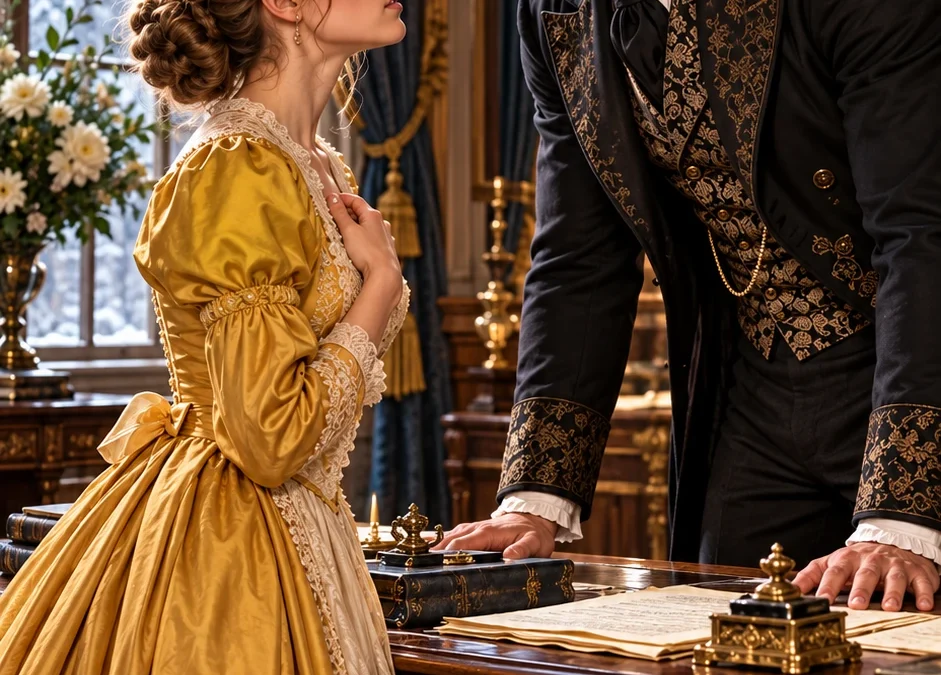
THE DUKE HAD 3 HOURS TO FIND A WIFE OR LOSE EVERYTHING… THEN THE MAID SWEEPING UP HIS BROKEN GLASS LOOKED HIM IN THE EYE AND SAID: “THEN MARRY ME.” 😱
Part 1
Midnight was three hours away, and the Duke of Rothford was about to lose everything.
The late Duke’s will was ironclad. Marry by your thirtieth birthday, or the estate, the title and the fortune pass to your cousin, a man who had gambled away his own inheritance in a single season.
Arthur Pendleton stared at the dying fire, a glass of whiskey in his hand. His final, desperate proposal had been rejected an hour ago.
He was ruined.
Rain lashed the tall study windows, a violent drumming that matched the ticking of the grandfather clock in the corner. Nine o’clock. Three hours left. 🕰️
Across the room, his solicitor, a small, pinched man named Mr. Finch, was snapping the clasps of his leather briefcase. Finch had not looked at him for two hours, ever since the last candidate, a terrified, bird-like girl named Lady Beatrice, had fled the room in tears, unable to stomach Arthur’s frantic and transactional proposal.
“There is nothing left to be done, Your Grace,” Finch told the carpet. “The Archbishop’s special license remains blank. The magistrate arrives at a quarter to midnight to verify the marriage. If there is no wife, the transfer of the estate to Lord Thomas begins at dawn.”
“I am aware,” Arthur said.
“It is a tragedy. But the law is the law, and your father’s will was remarkably specific. I bid you good evening.”
The door clicked shut.
Arthur hurled his crystal tumbler at the fireplace. It exploded against the brick, a violent burst of glass that briefly drowned out the rain. He dragged a hand down his face and pressed his palms into his eyes until he saw stars.
He was twenty-nine years and three hundred and sixty-four days old.
For a year he had put this nightmare off, arrogant enough to believe a willing woman would turn up in the final weeks. He had underestimated how much London despised him. He had a temper and no charm. He treated conversation like negotiation and courtship like a hostile takeover.
Women did not want him. Not even for a dukedom. 💔
A quiet scraping sound pulled him out of the spiral.
In the corner, kneeling by the hearth, a woman was sweeping the shards of crystal into a brass dustpan with steady, rhythmic strokes. She wore the plain charcoal uniform of the household staff, a white apron tied around a narrow waist, hair the color of wet straw pinned beneath a plain cap.
He barely knew her name. Clara? Cora? She was simply always there, tending fires, emptying ash, replacing candles. She was as invisible to him as the velvet curtains.
“Leave it,” Arthur rasped.
The brush kept scratching against the stone. “Glass travels, Your Grace. If I leave it, someone will bleed tomorrow.”
“Tomorrow doesn’t matter.”
She swept up the last slivers, tapped the pan, and stood. She was not tall, and there was nothing remarkable about her face. She looked tired. Her hands were red from lye soap, her posture stiff with the deep ache of endless labor.
She turned toward the servants’ door.
“He will dismiss you all, you know,” Arthur heard himself say to her back. He did not know why he was speaking to a maid. Only that the silence had become suffocating. “Thomas brings his own staff. Or he will sell this townhouse outright. You will be on the street by Friday.”
Her hand stopped on the brass doorknob.
She stood perfectly still for a long moment, firelight flickering across the side of her pale face. Then she turned and looked him directly in the eye.
Staff never looked him in the eye.
“I am aware, Your Grace,” she said. Her voice was flat, stripped of the deference he was used to. It was the voice of a woman who had weighed her options and found them wanting.
Her gaze dropped to the desk, to the blank, heavy parchment of the Archbishop’s license lying beside the inkwell.
“The will,” she said quietly. “Does it stipulate the bloodline of the bride?”
Arthur frowned. The whiskey had slowed his head. “What?”
“Does it say you must marry a lady? A peer’s daughter? A woman of fortune?”
“It says I must take a lawful wife,” he muttered, annoyed by the interrogation. “My father cared nothing for blood. He only wanted an heir, to keep the line out of Thomas’s hands. Why are you asking me this?”
She set the dustpan on a side table and walked back into the center of the room. The shadows fell away from her face. Her eyes were hazel, sharp, and profoundly exhausted.
“Because it is a quarter past nine,” she said. “And I need fifty pounds to keep my brother out of a prison ship.”
Arthur stared at her. His mind misfired. “What did you say?”
She stepped closer. There was no fear in her, only a brittle, pragmatic resolve.
“You need a wife. I need money. A great deal of it, by the end of the week, or my brother boards the hulks. You have a blank license on that desk, a carriage in the mews, and three hours before you lose everything. I am offering you a way to keep it.”
Arthur barked a harsh, incredulous laugh that sounded like a cough. “You are mad. You are a scullery maid.”
“A parlor maid,” she corrected smoothly. “And you are desperate. Do you want the estate, Your Grace? Or do you want your pride? You cannot keep both tonight.”
He rose. He was a broad-shouldered, imposing man, a presence that usually made his staff shrink away.
She did not flinch. She tipped her chin up just enough to hold his gaze.
“You understand what this means,” he said, searching her face for the punchline, the nervous crack of a joke. He found nothing. “If I write your name on that paper, you become the Duchess of Rothford. The ton will tear you to pieces. The press will hound you. My cousin may try to have you killed.”
“My brother owes fifty pounds to a man called Butcher Bill in Southwark,” she replied, perfectly even. “The ton fights with whispers. Bill fights with a cleaver. I will take my chances with the aristocracy.”
Arthur let out a long breath. He looked at the clock. Half past nine.
He walked to the desk and lifted the heavy gold pen. He hovered the nib over the parchment, and felt insane. He was about to anchor his entire life, his legacy, and a fortune worth hundreds of thousands of pounds to a woman whose surname he was not certain he even knew.
“What is your name?” he asked, staring at the paper.
“Clara Jane Higgins.”
He wrote it. The ink bled slightly into the thick vellum. 🖋️
“And your terms, Miss Higgins?”
“Fifty pounds at once. A private allowance of three hundred a year, in my own name, untouchable by you. If you die, a modest cottage in the country and a widow’s pension. I do not want the London house, the jewels, or the society events.” She paused, and for the first time, a faint flush crept up her pale neck. “And you will not come to my bed drunk. You will not raise a hand to me. If you do either, I leave, and you may explain to the magistrate why your duchess has vanished.”
It was a bold demand for a servant. It was an astonishing one for any woman.
Arthur felt a strange, jarring spike of respect.
“Agreed.”
He counted fifty gold sovereigns from a velvet pouch and pushed them across the polished wood. She did not snatch them. She picked them up one by one, counting in silence, then tied them in a handkerchief and shoved it deep into her apron pocket.
“Get your coat, Miss Higgins,” Arthur said, seizing his overcoat. “We have a vicar to wake.”
The carriage tore through London in a nightmare of mud and rain. Clara sat pressed into the far corner, still in her uniform, her knuckles white in her lap. Halfway there, she unpinned her cap and let it drop to the floor. Her dull, dark-blonde hair fell around her shoulders. She untied her apron and folded it neatly beside her.
“Better?” she asked flatly.
“It will have to do.”
In a decaying stone church behind the Strand, a half-dressed vicar stood at the altar in a nightshirt and hastily thrown cassock, holding a dripping candle. The ceremony was a blur of archaic words in a freezing, empty church. No music. No flowers. No guests. Only the storm against the stained glass.
“Wilt thou have this woman?” the vicar asked.
“I will,” Arthur barked.
“Wilt thou have this man?”
Clara thought of her brother, huddled in a rented room in Southwark, waiting for men to break his legs. She thought of the gold in her pocket. She thought of the endless, bone-crushing decades of scrubbing floors that stretched ahead of her.
“I will,” she said. Her voice did not shake.
“The ring,” the vicar whispered.
Arthur froze. He had forgotten it. He swore under his breath, then wrenched his father’s heavy gold signet ring from his finger and slid it onto hers. It was comically large. She had to close her fist to keep it from falling off. 💍
She signed the register in neat, tidy letters. Clara Pendleton.
Eleven forty.
They reached the townhouse at five minutes to midnight. Harrison, the butler, stood in the doorway looking shaken.
“Your Grace. Lord Thomas is here. And Magistrate Davies.”
Arthur gripped Clara’s shoulders in the marble foyer. “In that room is a man who wants to destroy me. He will look at you and see prey. If you show him fear, he will rip you apart.” His voice dropped. “Are you a duchess, Clara, or are you a maid?”
She felt the heavy ring slide against her finger. She had scrubbed the mud from Lord Thomas’s boots. She had endured his sneers. She knew exactly what waited for her behind those doors.
She pulled her shoulders back.
“I am your wife, Arthur,” she said. “Show me to the drawing room.”
Arthur shoved the double doors open so hard they cracked against the plaster.
Lord Thomas Pendleton lifted his glass of Arthur’s best brandy, smiling a lazy, triumphant smile. And then his eyes found the woman standing beside the Duke in a damp, charcoal servant’s dress…
…and his smile slowly curdled into recognition.
“I know you,” he breathed. “You served my tea on Tuesday.”
Part 2
“You served my tea on Tuesday.”
The room went dead silent.
“Good God, Arthur,” Thomas said, a harsh laugh cracking through his polished veneer. “You married a servant? You pulled a woman from the gutter to play dress-up? The will requires a lawful marriage, not a pantomime!”
Magistrate Davies looked at Arthur in horror. “Your Grace. Is this true?”
“Her prior employment is irrelevant to the legality of the marriage,” Arthur said, his voice a low rumble of warning. He dropped the Archbishop’s license on the table before the magistrate. “Signed, sealed and witnessed not an hour ago. She is my wife.”
“It is fraud!” Thomas shouted. His composure shattered, the panic of a man watching his last lifeline burn. “He bought her! Look at her, she is trembling! He probably threatened to throw her in the river if she refused. Davies, you cannot validate this!”
“I am not trembling,” Clara said.
The flat, quiet authority in her voice stopped Thomas cold.
She did not look at Arthur. She did not look at the magistrate. She looked straight into Thomas’s bloodshot eyes and raised her left hand, so that the heavy gold crest of the Rothford signet caught the firelight.
“I am perfectly calm, Lord Thomas. I married the Duke of my own free will. He did not threaten me. He did not coerce me.”
“You scrub floors!” Thomas spat, closing the distance until he loomed over her, reeking of sour wine and panic. “You empty chamber pots! You expect me to believe you are the Duchess of Rothford?”
Clara did not step back.
“I expect you to believe the law. And since I scrubbed the floors of this house, Lord Thomas, I know exactly what happens in it.”
She tilted her head.
“I know you bribe the footmen to let you in through the kitchen door when you are hiding from your creditors. I know you owe two thousand pounds to the betting books at White’s, and five hundred more to a moneylender in Cheapside.”
Thomas went violently pale.
“I know this,” she said, in a voice so level it was a blade, “because you left your coat in the blue guest room last month, and I emptied the pockets before I brushed the velvet.”
Behind her, Arthur stood utterly still.
“I am the Duchess of Rothford now,” Clara continued. “Which means I manage the household accounts. If you do not leave my house this instant, I will have Harrison bar you permanently. And when your creditors come looking for you tomorrow, they will not find you hiding in our guest rooms.”
In the corner, the grandfather clock began to chime.
Bong.
The sound vibrated through the floorboards. 🕰️
Bong.
Magistrate Davies folded the special license, tucked it into his breast pocket, and rose.
“The documentation is entirely in order. The marriage is recognized by the Crown. Lord Thomas, the estate remains with His Grace.”
Thomas looked from the magistrate, to Arthur, to Clara. His hands shook. He had lost, and he had lost to a woman who had once scraped the mud from his boots. He let out a breathless, venomous hiss and stormed from the room.
The front door slammed so hard it rattled the windows.
The clock finished its twelve strikes.
Arthur stood by the fire, breathing heavily as the adrenaline drained out of him. Across the room, Clara’s shoulders finally dropped. Her fingers brushed the heavy lump of gold in her pocket.
She had done it. Her brother was safe.
“Harrison,” Arthur called. “Have the master suite prepared for my wife. And draw a hot bath. She is freezing.”
“I do not need the master suite,” Clara protested. “I can take one of the—”
“You are the Duchess of Rothford,” Arthur said, cutting her off. “You do not sleep in the servants’ quarters. Good night, Clara.”
He turned his back and stared into the fire.
The transaction was complete.
The marriage had begun. 💍
In the gray light of morning, Clara woke with a violent jolt, her heart hammering.
The mattress was too soft. The linen was too fine. The air smelled of beeswax and lavender instead of lye soap and damp stone. It was past seven, and she had not slept past five since she was ten years old.
Panic seized her. Her brother. The debt.
She dressed in her charcoal uniform, which had been washed and pressed while she slept, pinned her hair into its severe bun, and went downstairs to find the Duke at the head of a table set for twenty, alone, reading a ledger.
“I am going out,” she said. “My brother’s debt is due at noon. If I do not deliver this money to Southwark, they will break his hands.”
Arthur studied her. The cynical edge in his eyes softened a fraction.
“Harrison. The unmarked carriage, no crest. And send James with her.” He looked at Clara. “You are carrying my name now. If you are found dead in an alley, I will have to answer for it. That is not a request.”
It made sense. It was cold, logical, and entirely unsentimental.
She nodded once.
In a freezing, rotting tenement near the docks, she found her brother Ned wrapped in a threadbare blanket, twenty-two years old and looking forty. She poured the gold onto the floorboards. He stared at it, wide-eyed.
“Where did you get this? Clara, did you steal from the Duke?”
“No.” She pressed the heavy signet ring into his palm. “I married him.”
Ned stared at the Rothford crest glinting in the dim light.
“You what?”
“Pay the debt today,” she said, her voice hard and final. “Then use the rest to buy a ticket to Liverpool. And Ned? If you incur another debt, I will not save you again.”
She loved him fiercely. But the streets had taught her that pity was a luxury they could not afford.
When she returned to the townhouse, its grand facade looked different. It was no longer just a place of labor.
It was a fortress. And she had locked herself inside.
For three weeks, a cold, efficient routine settled over the house. They dined in silence. They slept in separate rooms. It was exactly the transaction they had agreed to.
Until the Tuesday that Lady Agatha arrived.
Harrison stumbled into the morning room, genuinely panicked. “Your Grace. Lady Agatha Pendleton is here.”
A woman swept in like a galleon under full sail. Late sixties, aggressive violet silk, a silver-tipped cane. Arthur’s aunt. The undisputed matriarch of the Pendleton family. A woman whose tongue was known to make grown men weep in Parliament.
She stopped in the center of the room, her gaze forensic.
“So,” Agatha barked. “This is the creature my nephew used to save his skin.”
Clara stood. She did not curtsy. She did not look away.
“I am Clara Pendleton, Lady Agatha. Will you take tea?”
“I do not take tea with opportunists. I came to see the damage for myself. They are calling you the dustpan duchess in the drawing rooms of Mayfair.”
“Dustpan duchess,” Clara repeated, tasting the syllables. “A bit wordy, but accurate. I did use a dustpan quite frequently.”
Agatha blinked. She had expected tears. She had expected shouting.
She had not expected agreement.
“You admit it, then,” Agatha sneered, thumping her cane. “You are exactly the low-bred mercenary the papers claim.”
Clara walked out from behind the desk, with the steady, deliberate step of a woman who had spent years balancing heavy trays on steep stairs.
“I am a mercenary, Lady Agatha. I married your nephew for fifty pounds and a pension. He married me to keep three estates, an immense fortune and his pride. Tell me which of us struck the better bargain.”
“You insolent—”
“Do not speak to me of opportunism,” Clara cut in, her voice hardening. She stepped closer. “I know exactly who you are. I know you married Lord Hastings at nineteen, when he was sixty-two, specifically because of his weak heart and his great entailment.”
Agatha’s mouth fell slightly open.
“You secured your fortune through marriage just as surely as I did. The only difference, Lady Agatha, is that you wore silk to the altar. And I wore wool.”
Silence crashed into the room. 😮
In the doorway, hidden in the shadows of the hall, Arthur stood completely still. He had come home early to intercept his aunt, certain she would tear his wife apart.
He had arrived just in time to watch his wife do it to her.
And then Lady Agatha did something no one in London had seen her do in thirty years.
She laughed.
Part 3
It was a short, sharp bark of laughter, entirely devoid of humor, but it held a grudging, shocked respect.
“Well,” Agatha said, leaning on her cane. “He did not marry a weeping willow. I will give him that. You have teeth, girl.”
“I have had to,” Clara replied.
Agatha turned on her heel. “Harrison! Bring the tea. Assam, no sugar. And tell my nephew he may come out of the hallway. His wife has already handled the bloodshed.”
Arthur stepped into the light. His aunt gave him a dismissive sniff and sat on the velvet sofa. Then he looked at Clara, truly looked at her, for the first time since the rotting church.
The transaction between them shifted. The cold, mechanical arrangement fractured, just a little.
He had not simply bought a wife to save his estate. He had married a partner who could actually defend it.
He crossed to the tray without a word, poured two cups, handed one to his aunt, and then, in a gesture of profound, silent solidarity, handed the second to his wife. Their fingers brushed against the porcelain.
Clara looked up. The cynical exhaustion in Arthur’s eyes was gone, replaced by a steady, burning respect.
The battle for the estate was over.
The battle for the ton was just beginning. ⚔️
The Duke of Devonshire’s winter ball was a glittering, suffocating battlefield.
Thousands of beeswax candles burned in the crystal chandeliers, casting blinding light over three hundred members of London’s elite. They smelled of expensive perfume, hot wax and thinly veiled cruelty.
Clara stood at the edge of the dance floor in a gown of deep midnight-blue velvet. No ruffles. No lace. No ostentatious show of wealth. Her neck was bare. The only jewel she wore was the heavy gold signet ring, now resized by a Mayfair jeweler to fit her finger.
Arthur stood beside her, a heavy, undeniable anchor.
Every eye in the room was on them. The whispers hissed through the ballroom like a draft under a door. The servant. The opportunist. The joke of the season.
“They are waiting for you to trip,” Arthur murmured, pitched so only she could hear. “To use the wrong fork. To flinch when they stare.”
“Let them wait,” said Clara.
She sipped her champagne. It tasted sour.
A murmur rippled through the crowd by the grand staircase. The sea of silk and broadcloth parted.
Lord Thomas emerged, a smug, venomous smile plastered on his pale face. He had lost the estate, but society was his territory. Here, he still held the upper hand.
He carried a silver tray, commandeered from a passing footman. On it sat a single damp bar of cheap lye soap.
The aristocrats fell silent, wide-eyed with terrible, eager anticipation.
“A homecoming gift, Your Grace,” Thomas announced, his voice carrying across the hushed floor. “I thought you might be homesick. The velvet must be terribly stifling. I know you prefer the feel of an honest scrub brush.”
A few muffled laughs broke out behind him.
Arthur went rigid. A muscle jumped in his jaw. He took a half step forward, fists clenching, ready to drag his cousin out of the room by the throat.
Clara laid a hand on his arm. Her grip was tight and commanding.
Stop.
She looked at the soap. Then she looked at Thomas.
She did not blush. She did not tremble. She reached out, lifted the soap, and held it to the candlelight, examining it as though it were a rare gemstone.
“You are mistaken, Lord Thomas,” she said, her voice ringing clear through the silence. “I do not miss it at all. But I understand why you brought it.”
She stepped forward and dropped the soap into the front pocket of his immaculately tailored tailcoat.
“You will need it. I audited the estate ledgers this afternoon. Your allowance was entirely discretionary, granted by the late Duke. As the new mistress of the accounts, I have severed it completely.”
The color drained from Thomas’s face.
“You are officially penniless, Thomas. You might want to hold onto that soap. You will be washing your own shirts by Tuesday.” 🧼
He opened his mouth. The devastating reality of his ruin choked the words in his throat.
Clara turned away, dismissing him entirely, and looked up at her husband.
“I believe they are playing a waltz, Arthur. I would like to dance.”
Arthur stared at her, a feral grin breaking through his stoic mask. He offered her his arm.
“Your Grace. With pleasure.”
They swept onto the floor, leaving Thomas paralyzed in a circle of very silent, very uncomfortable peers. The whispers in the ballroom changed. No one was looking at a maid in a borrowed dress anymore.
They were looking at a fortress. 👑
The townhouse was dark when they returned. The grandfather clock ticked in the hall, a quiet echo of the night they had bound themselves together.
Clara stripped off her long silk gloves and stood by the dying fire in the study. Her feet ached fiercely. The velvet gown weighed thirty pounds, dragging at her shoulders. She stared into the embers and let the exhaustion wash over her.
She had survived. She had carved out her place in their world, and she had done it with a blade.
The door clicked shut. Arthur poured two glasses of whiskey and brought her one. Their fingers brushed.
“He will flee to the Continent tomorrow,” Arthur said, leaning against the oak desk. “He owes too much in London without that allowance. You destroyed him.”
“He destroyed himself,” Clara said, taking a slow sip. “I merely sped up the paperwork.”
Arthur chuckled, a low, rough sound in the quiet room. He set his glass on the mantel. He did not step away. He stood very close, his shadow falling across her face.
“You were magnificent tonight.”
Clara looked down at the amber liquid in her glass. The transactional safety of their arrangement was slipping. For weeks they had been business partners. But tonight, when his hand had rested on her waist during the waltz, there had been nothing mechanical about it.
“I was protecting my investment,” she said, trying to hold on to the cynical armor she had worn since the night she had knelt on this very floor with a dustpan.
“Stop,” Arthur said softly. He took the glass from her hand and set it beside his own. “Stop calculating, Clara. The ledger is balanced. The estate is secure. Thomas is gone. You do not have to fight anymore.”
“Fighting is the only thing I know how to do,” she whispered. “If I stop, what is left?”
“This.”
His large hands, rough from riding and fencing, cupped her face. He did not grab her. He held her with a terrifying, absolute care, as though she were the most valuable thing in the house. His thumbs brushed over her cheekbones, erasing the tension that had lived there for years.
Clara’s breath hitched.
She had prepared herself for a lifetime of cold indifference. She had prepared for a man who would demand an heir in the dark and ignore her in the light.
She had not prepared for tenderness.
“I bought a wife to save my pride,” Arthur murmured, his eyes dropping to her lips. “It was the best bargain I ever made. Because I ended up with a woman I actually want.”
He kissed her.
It was not a polite, aristocratic press of lips. It was hungry, desperate, and entirely real. Clara’s hands went to his chest and gripped the fine linen of his shirt. She did not push him away. She pulled him closer, kissing him back with the same fierce, unyielding drive that had kept her alive on the streets. 🔥
The transaction ended.
The marriage began. ❤️
Spring came late to London, dragging a stubborn dampness through the streets. But inside the townhouse, the air was finally warm. The twenty-seat dining table had been abandoned in February. Now they breakfasted in a small, glass-paned morning room that caught the eastern light.
Clara sat by the hearth, a woolen shawl over her shoulders, holding a single sheet of cheap, rough paper. The ink was smudged. The handwriting was cramped and hurried.
“Ned is a foreman,” she said, not looking up. Her thumb traced the uneven edge of the page. “He works the dry docks in Liverpool. He says the noise is enough to split his skull, and his boots are forever rotting from the salt water. But they pay him on Fridays.”
She pushed a small folded packet across the table.
“He sent five pounds. First installment.”
Arthur sat across from her in a simple linen shirt, collar undone, sleeves rolled past his elbows. He looked at the packet. He did not touch it.
“Tell him to buy better boots.”
“He owes me,” Clara said. “And I owe you fifty.”
“You owe me nothing.”
His eyes dropped to her hands. The heavy gold signet still swallowed her ring finger. Over four months, she had wound a small piece of waxed thread around the inside of the band to keep it from slipping.
“It looks absurd,” Arthur said. “The thread is fraying. I can send for a jeweler this afternoon. Diamonds, sapphires, a band that does not require haberdashery to stay on your hand.” His voice dropped, losing the sharp aristocratic clip he used with his peers, shifting into the low, rough cadence he saved entirely for her. “You are a duchess. You should wear something that does not look as though you stole it from a dead man.”
Clara looked at him. She saw the man who had ripped this ring off his own finger in a freezing church because he had forgotten to buy one. She saw the man who had handed her a cup of tea while his aunt tried to tear her to shreds.
“No,” she said.
She reached across the table and laid her hand over his. His knuckles were bruised from a sparring match at his club. Her skin was still rough at the edges, a permanent map of her years on her knees scrubbing stone.
When their fingers intertwined, the fit was seamless.
“A proper ring is a polite transaction,” she said quietly, her eyes locked on his. “It implies a traditional arrangement. This ring means survival. It means you were desperate and I was ruthless, and we anchored each other in the dark. I am not trading it for glass.”
Arthur let out a slow, steady breath. The cynical armor he wore for the rest of the world dissolved completely. He turned his hand over and gripped hers fiercely. He brought her knuckles to his mouth and pressed a long, heavy kiss to the scarred gold of the Rothford crest. 💍
Outside, the morning traffic of Mayfair rumbled over the cobblestones, carrying the peers of the realm to their polite calls and petty wars.
But inside that small, sunlit room, the Duke and his wife were entirely untouchable.
The maid who had once swept up his broken glass had not saved his fortune that night.
She had saved him. ❤️
THE END
This story is entirely fictional and created for entertainment purposes only. It does not represent any organization or individual, nor does it encourage inappropriate behavior. The content was generated with AI assistance.








