THE DUKE HADN’T LAUGHED IN SEVEN YEARS—UNTIL HIS HOUSEKEEPER CHARGED HIM FOR BROODING
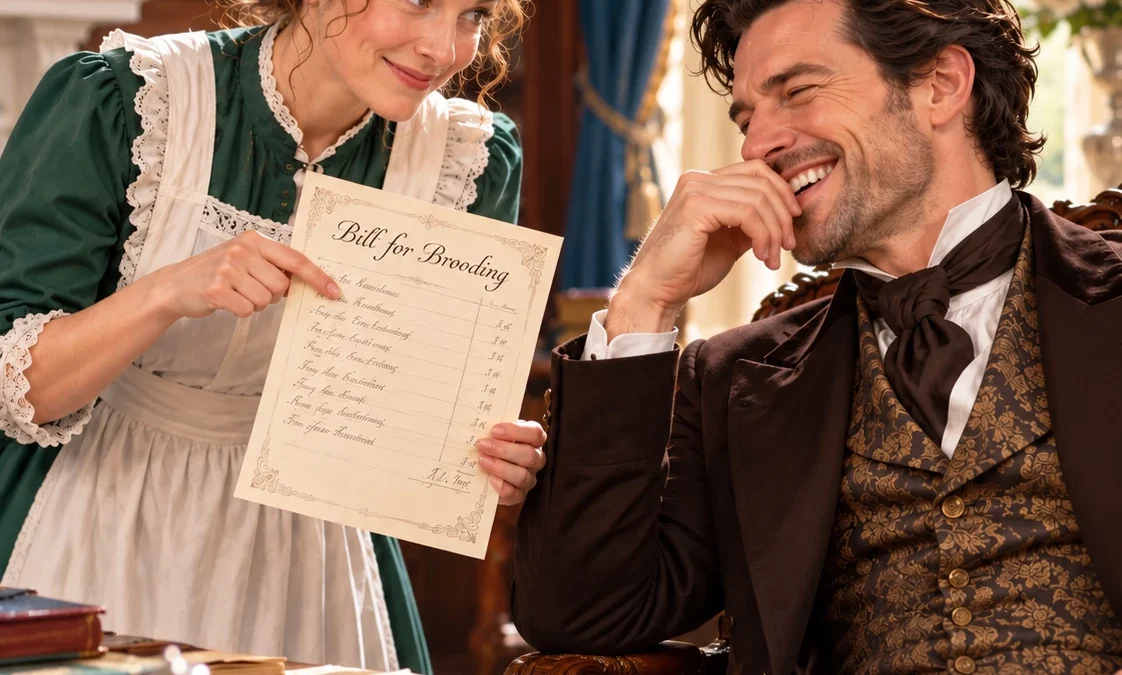
THE DUKE HADN’T LAUGHED IN SEVEN YEARS—UNTIL HIS HOUSEKEEPER CHARGED HIM FOR BROODING 😳
PART 1
The Duke of Mirale read the final line of the bill twice.
Across his enormous mahogany desk, Ruth Bennett stood perfectly still, already calculating whether her savings would survive an unexpectedly early dismissal.
The paper in Julian Wycliffe’s hand was not, strictly speaking, a real bill.
That might not save her.
His eyes moved down the handwritten charges again.
Coal wasted during three evenings of undecided brooding — two shillings.
Servants dispatched repeatedly to discover whether silence meant dinner — one shilling.
Then came the final item:
Compensation to the portrait in the west hall for being expected to look cheerful by comparison.
The Duke stared at it.
Ruth swallowed.
His mouth moved.
She braced herself.
And then a sound escaped him.
Rough. Startled. Almost broken.
Julian Wycliffe laughed.
Outside the study door came a metallic crash.
Mr. Pike, the butler, had apparently dropped the bell he had been polishing.
Nobody at Mirale Hall had heard their master laugh in seven years.
Julian pressed the paper flat against his desk.
“Mrs. Bennett.”
“Yes, Your Grace?”
“Have you actually assessed the emotional burden placed upon my portrait?”
Ruth folded her hands.
“It bears a considerable burden, Your Grace.”
His shoulders shook again.
That was how the impossible began.
Ruth had been housekeeper at Mirale Hall for eight months. At thirty-five, widowed and accustomed to earning every ounce of security she possessed, she was not easily intimidated by titles.
But the Duke was a difficult man to manage.
Not cruel.
That would almost have been simpler.
He paid wages promptly. Approved repairs. Treated servants with formal courtesy.
Yet ordinary household decisions disappeared into his silences.
Should dinner be held for him?
Would the east rooms remain closed?
Could the village music teacher borrow chairs?
Should a visitor wait?
Nobody knew.
The servants had spent years interpreting moods instead of receiving instructions.
The previous day, Ruth had finally reached her limit after watching two maids move the same armchair from one room to another—and then back again—because nobody knew what the Duke wanted.
She had taken twelve unanswered household questions to his study.
“Use your judgment,” Julian had said.
“I did yesterday. Your note reversed it this morning.”
He had looked up.
“Then use it again.”
“Authority to guess is not authority, Your Grace.”
Near the door, Mr. Pike had suddenly developed a profound interest in the curtains.
Julian’s eyes sharpened.
But Ruth did not lower hers.
Her husband Samuel had been dead for years. Widowhood had taught her that dignity could be expensive.
She still considered it worth the price.
Julian promised written answers by evening.
None came.
So that night, Ruth sat at the servants’ table with a clean sheet of paper.
At the top she wrote:
A PRIVATE JEST — NOT AN ENTRY IN THE HOUSEHOLD ACCOUNTS.
Then she listed the ridiculous costs created by one man refusing to make decisions.
She did not mention grief.
That was important.
Ruth knew there was grief somewhere inside the Duke’s silence, although she did not yet know its name.
Sorrow was not hers to price.
But indecision?
Indecision was making extra work for twenty-three people.
That was fair game.
Now, astonishingly, Julian was laughing.
When the sound finally faded, Ruth placed the actual account book before him.
“The twelve questions remain.”
He looked at her.
Then something changed.
Perhaps laughter had loosened a door that had rusted shut.
“Very well,” he said.
They answered every question.
Dinner would be served at seven whether he appeared or not.
The east sitting room could reopen.
Miss Shaw, the village music teacher, could borrow chairs.
And Ruth would make routine household decisions without waiting for a second instruction.
Julian wrote everything down and signed his name.
As Ruth turned to leave, he lifted the ridiculous invoice.
“May I keep this?”
“It belongs to you.”
“I thought you might want the evidence destroyed.”
“Only if Your Grace intends to use it as permission to laugh at the staff.”
His expression immediately sobered.
“I won’t.”
Ruth believed him.
That evening, the Duke arrived for dinner at exactly seven.
The servants behaved as though a rare astronomical event had occurred.
Ruth refused to celebrate.
One laugh did not erase seven years.
One dinner did not cure grief.
But later, passing the study, she heard Julian call her name.
He was holding the ridiculous invoice again.
Beside it lay an old concert program.
Seven years old.
One name had been circled beside a piano performance.
Thomas Wycliffe.
Julian reached for it quickly.
Then stopped.
“My brother,” he said.
Ruth waited.
“He used to make the whole house laugh.”
Suddenly the joke about the portrait felt very far away.
Julian looked toward the closed piano in the adjoining room.
“Thomas was six years younger. He considered that proof of superior intelligence.”
The corner of his mouth almost lifted.
Almost.
“He died coming home from a concert.”
Ruth said nothing.
“We had argued before he left.”
His voice changed.
“The last thing I said to him was that the house might enjoy a quiet evening.”
Seven years.
Seven years of silence because his final careless words to his brother had asked for silence.
Ruth finally understood.
She sat when Julian asked her to.
“My husband and I argued about a leaking roof the morning he became ill,” she said quietly.
Julian looked at her.
“I spent a long time wishing I had said something finer.”
“Did you stop?”
“Not entirely.”
Ruth looked down at her hands.
“But Samuel lived with me for eleven years. Eventually I understood that he heard more from me than one sentence.”
Julian’s fingers loosened around the concert program.
She did not call it healing.
Some things became smaller when people named them too quickly.
The next morning, Ruth passed the adjoining sitting room.
The piano cover was open.
Nobody was playing.
But it was open.
Days later, Miss Shaw came to collect the borrowed chairs and mentioned that the village school wanted to hold a small musical evening.
Their room was too cramped.
There was, of course, a perfect place at Mirale Hall.
The east music room.
It had been locked since Thomas died.
Ruth did not volunteer it.
Instead, she gave Julian three choices.
“The barn, weather permitting. The school in smaller groups. Or the hall.”
He studied the list.
“You did not put the music room first.”
“It is not first unless you choose it.”
He stared at her for a long moment.
“Give me a day.”
The following evening, Julian appeared outside Ruth’s office.
In his hand was a brass key.
“The music room,” he said. “We may inspect it tomorrow.”
“Inspecting is not promising.”
“I know.”
He held out the key.
Their fingers touched.
Only briefly.
Still, Ruth felt the contact long after he walked away.
The next morning, they opened the room together.
Dusty sunlight spread over covered chairs and a silent piano.
On a narrow table lay sheets of music.
The top page held a melody written in Thomas’s careless hand.
It stopped halfway through.
The final bar was blank.
Julian stood staring at it.
“He was forever beginning things.”
Ruth placed the pages carefully into a dry folder and wrote Thomas’s name across it.
Then they inspected windows, floorboards, chimney, chairs.
Practical things.
Manageable things.
By afternoon, Julian had authorized repairs.
The piano would be tuned.
The room would be aired.
And Miss Shaw could prepare a modest village program.
Over the next few weeks, Mirale Hall changed.
Not dramatically.
That mattered.
Julian began answering questions instead of making others guess.
He arranged transport for elderly tenants.
He checked the music-room seating.
He even laughed softly one afternoon when Ruth told him Samuel had once claimed she sang “as though negotiating with the melody.”
“Did the melody surrender?” Julian asked.
“Never.”
His laughter followed her for the rest of the day.
But grief does not move in a straight line.
During rehearsal, Miss Shaw played a country melody containing a phrase that reminded Julian of Thomas.
His face went white.
He left.
That evening, Ruth found a note on her desk.
Cancel the gathering.
Nothing else.
Just Julian’s signature.
The old silence had returned.
Ruth stared at the paper.
Across the hall, the Duke’s miserable portrait stared back.
But this time she did not write another joke.
She went to his study.
The room was dark except for one candle.
Her ridiculous invoice lay open on his desk.
“I thought I could do this,” Julian said.
“Perhaps you can do less today.”
“Everyone has worked for weeks.”
“Then tell them what changed.”
His eyes lifted.
“Do not make them invent an answer, Your Grace.”
He rubbed his face.
“The music sounded like Thomas practicing upstairs. For one second, I expected him to miss the same note he always missed.”
His voice cracked.
“It felt ordinary.”
Ruth understood immediately.
“And that was worse,” she said.
“Yes.”
She sat opposite him.
“The invoice was about instructions. It was never a cure.”
He looked at her for a long time.
Then he crossed out the cancellation.
The gathering would be postponed one week.
He would explain the change himself.
And he did.
But while Julian was learning to reopen his life, Ruth was quietly preparing to leave it.
She and Samuel’s sister, Agnes, had saved money for years to purchase a small lodging house in the market town.
Now a suitable property had become available.
The roof was sound.
The kitchen needed work.
The numbers were possible.
Six weeks.
That was all Ruth would have left at Mirale Hall.
When she told Julian, his face became still.
For one terrible moment, she feared the old silence.
Instead, he asked:
“Do you wish to proceed?”
Ruth looked at her ledger.
“Yes.”
The word hurt more than she expected.
Julian nodded.
“Then we should find someone capable to succeed you.”
At the doorway, he stopped.
His back remained toward her.
Then he said quietly:
“I shall miss more than the accounts.”
Ruth’s heart seemed to forget its rhythm.
Before she could answer, Julian turned.
“You owe me no reply while I am still the man signing your wages.”
And then he walked away.
Three days before the rescheduled musical evening, the music room stood ready.
Julian asked Ruth to sit among the guests instead of working at the back.
She agreed.
On the night itself, villagers filled the room Thomas had once loved.
Julian stood before them.
His hands trembled.
“My brother died,” he said. “Missing him was real. Believing this house had to remain joyless to prove I missed him was mistaken.”
His voice broke.
Nobody rescued him from the silence.
Nobody needed to.
He continued.
And then Miss Shaw announced something Ruth had not expected.
A short piece composed by Thomas Wycliffe.
Unfinished.
To be played exactly as he had left it.
The first notes floated through the room.
Light.
Uncertain.
Tender.
Julian closed his eyes.
The melody reached the final unfinished bar—
—and stopped.
In that silence, Ruth looked at him and realized that whatever happened next would change both their lives.
Find Part 2 in the comments—or leave any word below and I’ll send it to you privately. ❤️
PART 2
In that silence, Ruth looked at him and realized that whatever happened next would change both their lives.
Julian did not smile to reassure anyone. He did not pretend the unfinished melody had magically repaired seven years of grief. He simply sat with wet eyes while the room remained quiet around him. Then the applause began—softly at first, almost like rain—and Julian bowed his head.
The program continued. Children sang a familiar round. One entered too early, another too late, and a third sang the wrong words with magnificent confidence.
Julian laughed.
Ruth laughed too.
This time, nobody gasped.
Nobody dropped a bell.
Nobody counted how many years it had been.
After the guests departed, Ruth found Julian stacking chairs.
“I believe that falls outside the duties of a duke.”
“I am expanding my qualifications.”
“Dangerous.”
“Mrs. Bennett, I have survived your accounting methods. I fear nothing.”
Outside, the rain had stopped. Julian walked her toward her office but remained at the open doorway, respecting the invisible boundary between them.
“When you are settled in town,” he said, “may I visit?”
Ruth’s pulse quickened.
“As a guest?”
“As a man who would like to court you.”
She said nothing.
He continued before she could misunderstand him.
“After you have left my employment. Not before. And only if you wish it.”
Ruth had spent years protecting her independence. She had loved Samuel. She had built savings from wages. She was about to own part of a business. She would not exchange one form of security for dependence on a powerful man simply because her heart had become inconvenient.
But Julian was not asking her to stay.
That mattered.
He was letting her leave.
“As a man courting a woman who no longer works for him?” she asked.
“Yes.”
“Then I think I would like that.”
Relief crossed his face so openly that she almost smiled.
Two weeks later, Ruth handed the household keys to Mrs. Hail, her successor, and walked out of Mirale Hall carrying only one key that truly mattered now—the key to the lodging house she and Agnes owned.
Their first Monday brought two guests, a rebellious stove, too many potatoes, and a traveler who apparently believed boots abandoned on staircases became someone else’s responsibility.
Ruth loved it.
The exhaustion belonged to her.
So did the decisions.
A week later, Julian arrived carrying flowers wrapped in plain paper.
Agnes examined the Duke of Mirale from behind a sack of flour.
“The kitchen is overwhelmed,” she informed him.
“I can return.”
“Nonsense. Sit there.”
She pointed to a chair squeezed beside an umbrella stand.
The Duke obeyed.
Ruth entered and laughed so hard she had to grip the doorway.
“I see your qualifications continue expanding.”
“I am currently studying obedience.”
Autumn passed in visits, walks, tea, awkward town gatherings and increasingly easy conversation.
Julian met people who knew Ruth not as his former servant, but as a capable widow and businesswoman.
He learned to enter her world instead of purchasing a new one for her.
And when the anniversary of Thomas’s death approached, he wrote that he would understand if Ruth wished to postpone their walk because he expected to be poor company.
Her reply was simple:
You need not be amusing to be welcome.
They walked.
He spoke little.
She demanded nothing.
Weeks later, Ruth heard a song Samuel had once loved and suddenly found herself unable to continue working.
Julian discovered her sitting beside the window.
“Would you like company?”
“Yes.”
So he stayed.
He did not act wounded by her grief.
He did not behave as though loving him should erase Samuel.
By winter, Ruth understood something that frightened her precisely because it felt so calm.
She loved Julian.
One evening, he asked her to walk into the small garden behind the lodging house.
Inside, Agnes stood at the window pretending to count spoons.
Julian stopped beside a bare rosebush.
Cold air clouded between them.
“I love you,” he said.
Ruth’s breath caught.
“I love you too.”
He stared at her as if seven years of silence had not prepared him for those five words.
Then he asked the question.
“Will you marry me?”
Ruth looked at the man she loved.
And instead of saying yes, she asked:
“What happens to my share of the lodging house?”
Julian blinked.
Then slowly smiled.
“We ask a solicitor how to protect it.”
Ruth searched his face.
“You would not expect me to surrender it?”
“No.”
“And Agnes keeps her position?”
“If Agnes allows me to survive long enough to marry you.”
From the window came an indignant clatter of spoons.
Ruth laughed.
Then Julian’s expression changed.
“There is something else,” he said.
He reached inside his coat.
And when Ruth saw what he was holding, all the warmth left her face.
It was the original bill.
The ridiculous invoice that had started everything.
Except someone had written a new charge at the bottom.
And the handwriting was not Julian’s.
LIKE this post or COMMENT “INVOICE” if you want Part 3. Once I see enough comments, I’ll post the complete ending. ❤️
PART 3
Ruth took the paper from Julian.
The original invoice was unmistakable.
Her handwriting still marched down the page in crisp, practical lines: wasted coal, unnecessary errands, compensation to the portrait.
But beneath her final joke, another sentence had appeared.
One housekeeper lost to matrimony — cost to be determined.
Ruth stared.
Then she looked at Julian.
“You wrote this?”
“No.”
“Mr. Pike?”
“I questioned him.”
“You questioned your butler about forged additions to a satirical household invoice?”
“With considerable dignity.”
“And?”
“He denied everything with even greater dignity.”
Ruth examined the handwriting.
Then the lodging-house window flew open.
Agnes leaned out.
“If you two intend to stand in the cold discussing my handwriting all evening, at least have the decency to become engaged first!”
Ruth closed her eyes.
Julian looked upward.
“Mrs. Bennett’s sister-in-law?”
“Yes?”
“I believe you have compromised an important moment.”
“You have been having important moments for months. Some of us have supper.”
The window slammed.
For several seconds, Ruth and Julian stood in silence.
Then Julian laughed.
Ruth joined him.
When it faded, he became serious again.
“The question remains.”
Ruth folded the invoice carefully.
“So does mine.”
“Your share of the lodging house.”
“Yes.”
“We protect it legally. You remain an owner. Agnes remains your partner. You may continue working here if you wish, although I hope you occasionally permit yourself a day without arguing with suppliers.”
“That seems an unreasonable marital condition.”
“I am prepared to negotiate.”
Ruth looked at him.
Years ago, when Samuel died, she had learned how quickly a woman’s future could become something discussed by other people.
She had promised herself she would never again surrender the practical foundations of her life merely because emotion made surrender sound romantic.
Julian knew that.
More importantly, he did not resent it.
They discussed where they might live. How often Ruth would return to the lodging house. What would happen to her investment. What responsibilities she wanted at Mirale Hall—and which she absolutely did not.
Only after the practical questions were answered did Ruth return to the first one.
“Yes.”
Julian went completely still.
“Yes?” he repeated.
“Yes, Julian. I will marry you.”
He took her hand.
He kissed it.
Then he looked into her eyes with another unspoken question.
Ruth answered by stepping closer and kissing him.
From inside the lodging house came an enormous crash.
Ruth pulled back.
“Agnes?”
A voice shouted through the window.
“I dropped the spoons!”
Julian looked at Ruth.
“She has counted those spoons three times.”
“Four,” Ruth said.
They laughed against each other in the cold.
For the first time, Ruth understood that loving again did not mean replacing Samuel.
And Julian understood that happiness was not betrayal.
They were not purchasing a future by selling the past.
They were simply making room.
Their wedding took place in late winter.
There was pale sunlight through the church windows, a hard frost outside, and Agnes inspecting every fastening on Ruth’s coat as though the marriage depended upon proper buttons.
At the altar, Julian waited without the stern expression preserved forever in his infamous portrait.
When Ruth reached him, something in his face softened.
They spoke their vows plainly.
Mr. Pike cried.
He later denied it.
Nobody challenged him.
Mrs. Turner produced a wedding cake large enough to feed what Ruth described as “an irresponsibly optimistic county.”
At the meal, Agnes raised her glass.
“To Ruth’s happiness,” she declared, “and to her continued ability to add a column correctly.”
Julian raised his own glass.
“The second quality is essential to my personal security.”
Laughter moved around the table.
Ruth looked across at him.
Seven years earlier, laughter in his house had died with Thomas.
Now it had returned without asking Thomas to disappear.
That distinction meant everything.
Before the wedding, a solicitor had completed the marriage settlement.
Ruth’s interest in the lodging house remained protected.
Agnes continued managing its daily business with paid assistance.
Ruth visited every week, checked the accounts and occasionally informed overconfident guests that becoming a duchess had not made her less capable of noticing unpaid bills.
At Mirale Hall, Mrs. Hail remained housekeeper.
This proved surprisingly difficult for Ruth.
One morning she spotted a supplier’s ledger on Mrs. Hail’s desk and instinctively reached toward it.
Then stopped.
Julian, standing nearby, saw everything.
He said nothing.
Ruth slowly withdrew her hand.
“You may enjoy that,” she muttered.
“I would never.”
She turned.
He was smiling.
“Briefly,” she added.
“Thank you.”
Spring arrived.
Mirale Hall no longer waited for its master to determine what emotion everyone else was allowed to have.
The music room remained open.
Sometimes Julian attended.
Sometimes he did not.
That was perhaps the greatest change.
The room no longer depended upon his ability to be cheerful.
Children practiced there.
Miss Shaw held monthly rehearsals.
Villagers occasionally gathered for modest performances.
Thomas’s unfinished melody remained safely in its folder and was played only when Julian wanted to hear it.
Nobody completed the final bar.
Julian had considered asking Miss Shaw to finish it once.
Then he changed his mind.
“Thomas left enough,” he told Ruth.
She understood.
Samuel remained present too.
His old watch sat among Ruth’s keepsakes.
She spoke about him when memories came.
Julian never treated the dead man as a rival.
One afternoon, Ruth caught Julian trying to repair a loose chair.
She watched him struggle with the joint for several minutes.
“Samuel could have fixed that in half the time.”
Julian looked up.
“I am deeply grateful for this comparison.”
“He would also have lost his spectacles while doing it.”
“Better.”
“And then blamed the chair.”
Julian considered this.
“I believe I would have liked him.”
Ruth’s smile became softer.
“I think you might have.”
Their marriage was not a miraculous cure for grief.
That would have been another kind of dishonesty.
Near the anniversary of Thomas’s death, Julian sometimes became quiet.
The difference was that now he could say why.
“I do not think I can attend dinner tonight.”
“Very well.”
“I am not angry.”
“I know.”
“I thought I should say it.”
Ruth would nod.
“That is generally cheaper than making twenty-three people guess.”
On another evening, it was Ruth who became silent.
She had found one of Samuel’s old notes inside a book.
Nothing important.
A reminder about lamp oil.
His handwriting was enough.
Julian found her sitting alone.
“Do you want company?”
“Yes.”
He sat beside her.
No advice.
No jealousy.
No demand that she prove she was happy with him.
Only company.
Love, Ruth discovered, was sometimes less about grand declarations than having someone who knew when not to turn your sadness into a problem requiring immediate repair.
Months passed.
Then, on the anniversary of the day Ruth had first marched into Julian’s study carrying the absurd bill, he invited her to tea.
The original page lay on his desk beneath a clean protective sheet.
Ruth stopped in the doorway.
“No.”
Julian looked innocent.
“No?”
“You have preserved it.”
“It is historically significant.”
“It is evidence of insubordination.”
“You were remarkably insubordinate.”
“I was your housekeeper.”
“Exactly.”
She sat opposite him.
“I had hoped that page might eventually perish.”
“I considered framing it.”
“Julian.”
“Beside the portrait.”
“Julian.”
He smiled and handed her another sheet.
At the top, in his careful handwriting, were the words:
ACCOUNT OF RECENT BENEFITS.
Ruth stared.
He had listed:
Dinners eaten while warm.
Decisions completed before candles burn out.
Music heard without household catastrophe.
One difficult husband tolerated with unreasonable patience.
There were no prices.
At the bottom Julian had written:
Payment offered: attention, honest answers, and the last piece of cake when available.
Ruth looked up.
“When available?”
“I refuse to make promises beyond my means.”
She laughed.
Julian joined her.
Outside the study, nobody gasped.
Nobody dropped anything.
Nobody ran downstairs to announce that the Duke had laughed.
That, Ruth thought, might be the loveliest part.
Joy was no longer an event at Mirale Hall.
After tea, they walked through the house.
They stopped before the portrait.
Painted Julian remained stern beneath a dramatic sky, forever younger and apparently offended by existence.
Julian studied it.
“Should I replace him?”
Ruth tilted her head.
“No.”
“No?”
“He has served faithfully under extremely difficult conditions.”
Julian shook his head.
“I married a merciless woman.”
“You were warned in writing.”
They continued toward the music room.
Miss Shaw was inside helping two children play the same passage.
The children failed.
Miss Shaw corrected them.
They failed differently.
Then all three laughed.
Julian stopped at the doorway.
For one brief moment, Ruth saw the old sadness cross his face.
Thomas should have been there.
There would always be a version of Julian’s life in which his brother had come home from that concert, laughed in the hallway, grown older, perhaps married, perhaps filled the house with children and badly timed piano music.
That life was gone.
Nothing could make it otherwise.
Julian looked at Ruth.
“Is there room?”
Miss Shaw glanced around.
“There is always room for someone willing to listen.”
A chair was moved.
Ruth sat beside her husband.
Their hands rested together between the seats.
The children began again.
One missed the note.
The other stopped too soon.
Miss Shaw counted patiently.
“Again.”
They tried.
Outside, afternoon light stretched across the grounds.
Inside, the music continued.
Imperfect.
Unfinished.
Alive.
Years earlier, Julian had believed grief required him to close every door through which happiness might enter.
Ruth had believed independence required her to guard every part of herself against needing anyone again.
Neither had been entirely wrong.
Grief could make happiness frightening.
Dependence could cost a woman dearly.
But somewhere between a ridiculous invoice, an unfinished melody, a lodging-house ledger and a terrible old portrait, they had learned something quieter.
You did not honor the dead by refusing to live.
You did not prove independence by refusing to love.
And you did not need to erase yesterday before accepting tomorrow.
One of the children struck the wrong note again.
Julian smiled.
Ruth squeezed his hand.
He did not need to laugh for her to know he was happy.
He did not need to stop missing Thomas either.
Ruth did not need to forget Samuel.
There was room for all of it.
The loss.
The gratitude.
The memories.
The new love.
The mistakes.
And another attempt.
“Again,” Miss Shaw said.
Small fingers returned to the keys.
The melody began once more.
This time, they reached farther.
Not perfectly.
Not without hesitation.
But farther.
And nobody closed the door.
Disclaimer: This story is entirely fictional and created for entertainment purposes only. It does not represent any organization or individual, nor does it encourage inappropriate behavior. The content was generated with AI assistance.








