THE DUKE INVITED HIS “UNEDUCATED” WIFE TO DINNER AS A JOKE… THEN THE RUSSIAN AMBASSADOR STOOD UP AND BOWED TO HER
🦊🍷 THE DUKE INVITED HIS “UNEDUCATED” WIFE TO DINNER AS A JOKE… THEN THE RUSSIAN AMBASSADOR STOOD UP AND BOWED TO HER 👑
PART 1
Cruelty rarely wears a monster’s face. Usually it wears a tailored coat and a bored expression. 🥂
Gareth invited his wife to the grand dining room tonight for one reason: to watch her fail.
She was a simple girl from the mud-soaked valleys, entirely unfit for polite society. Handing her to the wolves of the ton was a bitter man’s entertainment. But he didn’t know who he had married. And neither did the wolves.
Rain battered the high arched windows of the Langdale townhouse, a rhythmic, violent sound that offered the only comfort in the suffocating room. Gareth stood by the hearth, staring into the fire, gripping a crystal tumbler of scotch so tightly his knuckles shone white.
He was a man built for the high, unforgiving fells of the north. His shoulders were too broad for the charcoal coat he wore. His hands, scarred from years of hauling timber and breaking wild horses, were wrong for delicate cut glass. He was the Duke of Langdale now. A carriage accident had claimed his uncle and two cousins, dragging him from the mountains he loved into the glittering, venomous pit of London society.
He despised all of it. The powdered lords. The calculated giggles. The endless dances of etiquette, where a man’s worth was measured by how he folded his napkin rather than how he kept his word. 😤
Tonight was a battlefield. The Langdale estates were vast, but bleeding money. The tenant farmers were starving. Gareth needed capital to build a railway through the fells, and the only man holding a purse heavy enough was Ambassador Leonid of the Russian Empire, who wanted British timber for the Tsar’s expanding naval shipyards. Securing that contract meant survival for Gareth’s people. Failing meant returning to the mountains to watch them freeze.
Naturally, the London elite had smelled the money. Lord Harrington and Lady Beatrice, two of the most vulture-like aristocrats in the city, had wormed their way into the dinner. They owned the shipping lines that would carry the timber, and they were here to ensure Gareth didn’t ruin things with his provincial manners.
He turned to his valet. “Did you deliver the message?”
“I did, Your Grace. Her Grace has been informed she is expected at dinner.”
A harsh smirk pulled at Gareth’s mouth. Nora. His wife of six months.
The London matchmakers had descended the moment he arrived, parading delicate debutantes before him like prized fillies at auction. Lady Beatrice had been the worst, pushing her shrill niece into his path. In disgust, Gareth had ridden back to the northern borders and married the first woman he found who didn’t smell of lavender and desperation.
He had found Nora in a market square in a mud-drenched village, standing in freezing rain, silently handing a copper coin to a baker for a stale loaf. She wore homespun wool. Her hands were raw from labor. She hadn’t looked at him with awe or terror. She had just looked at him.
They were married within the week.
He had expected a tough woman of the earth. Instead, she folded into herself. A ghost in his massive house. She barely spoke. She kept her eyes downcast, hiding in the library or the gardens. Society assumed she was a dim rustic, a tragic mistake made by a savage duke. Gareth had begun to believe it.
Tonight he was throwing her to the wolves. He knew it was cruel. He knew Harrington would sneer and Lady Beatrice would carve her up with polite, poison-laced questions. But he was a bitter man, and he wanted to watch the refined aristocrats choke on their own awkwardness while dining with a woman who didn’t know which fork to use for fish.
“Shall I have the chef prepare a simpler plate for Her Grace?” the valet asked.
“No. She will eat the caviar. She will eat the roasted squab. Let her navigate the bones.” 🍽️
Upstairs, cold silk slid over calloused skin.
Nora stood perfectly still before the gilt mirror in her dressing room as two maids laced the emerald gown tight. “Hold your breath, Your Grace,” sighed Clara, the older maid. The title sounded like a curse in her mouth.
Nora did not hold her breath. She simply let the heavy fabric settle against her ribs. The dress was a monstrous thing, heavy with pearls and whalebone. It felt like a cage. But she was used to cages.
She stared at her hands against the dark green velvet. The maids had scrubbed them for months with pumice and rose water, but the evidence remained. Tiny white scars crisscrossed her knuckles. Calluses thickened her fingertips. These were not the hands of a duchess. They were the hands of a survivor.
“Do you understand the forks, ma’am?” whispered Lucy, the younger maid, barely sixteen. “Start from the outside. Work your way in. Please don’t use the soup spoon for the pudding.”
Nora offered a faint, close-lipped smile and nodded once. She did not speak. She rarely did.
Her gray eyes, usually masked behind lowered lashes, looked startlingly clear tonight. She knew exactly what this was. Gareth thought her a simpleton who couldn’t comprehend the machinery of his world. He had married her as an insult to his peers, and now he was pulling her out of the cupboard to use as a weapon. He was hoping she would spill wine on the damask. Stare blankly when spoken to.
She walked to the small writing desk in the corner and let her eyes brush past the locked drawer. Inside rested her only true inheritance.
She was not a peasant. She had not been born in the mud.
She had been born in a sunlit estate in Vienna. Her father, Antonin, had been one of the most brilliant diplomatic minds of his generation, a master negotiator who served courts across Europe. But brilliance breeds enemies. A political coup. A fabricated charge of treason. A desperate midnight escape across the Channel. They had fled to the freezing north of England, hiding in the damp fells.
As her father lay coughing by a meager peat fire, he taught Nora everything. French, the language of courts. Russian, the language of power. Latin, German, Italian. The ruthless games of statecraft. The way one misplaced word at a dinner table could sink a naval fleet.
“Never show them your blade until they have bared their neck, Nora,” he had rasped, tracing maps in the dirt floor. “Let them think you are nothing. The unseen observer is the most dangerous person in the room.” 🗺️
When he died, she buried him in an unmarked grave. She survived by chopping wood, pulling roots, fading into the background of the harsh village. When the scowling Duke of Langdale pointed at her in the rain and demanded her hand, she accepted. It meant food. It meant a roof.
Since arriving in London, she had kept her father’s rule. She played the mute, terrified girl. She listened to servants’ gossip. She slipped into Gareth’s library at midnight and read his correspondence, learning the precarious state of his finances and the timber deal with Russia. She knew exactly who Ambassador Leonid was: a man notoriously difficult to please, who despised weakness.
“The carriage has arrived, Your Grace,” said Clara. “The guests are here.”
Nora smoothed her skirt and pulled on elbow-length white silk gloves, hiding the scars.
Gareth wanted a joke. She would give him a masterpiece. ✨
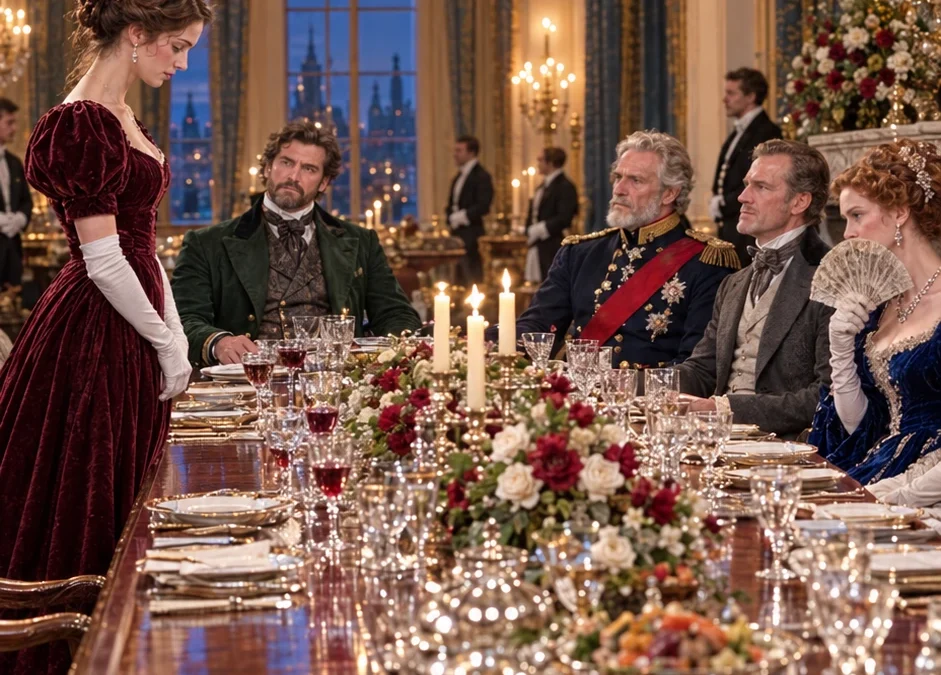
The dining room was a precise, bloodless sport. Lord Harrington swirled sherry by the fire, lips curved in a perpetual sneer. Lady Beatrice perched on a velvet settee, fanning herself lazily. The table gleamed with silver beneath a crystal chandelier.
“I was surprised to hear you were hosting His Excellency yourself, Langdale,” Harrington drawled. “Russian diplomats are not accustomed to country manners.”
“My timber is in the country, Harrington. I imagine the Tsar cares more for the strength of my oak than the depth of my bow.”
Lady Beatrice’s laugh scraped his nerves. “And will the Duchess be joining us? I haven’t seen the poor dear creature in months. Does she still hide behind the curtains?”
“My wife will be joining us. I trust you will make her welcome.”
The doors swung open. A footman struck his staff. “His Excellency, Ambassador Leonid.”
The temperature seemed to drop. Leonid was tall and broad-shouldered, silver hair cropped close, beard neatly trimmed, a dark military coat heavy with gold braid. His eyes were like chipped ice, missing nothing. He barely glanced at the bowing Harrington and stopped before Gareth. For a moment, the mountain man and the imperial envoy simply assessed each other.
“Duke Langdale. I have heard much about your forests. I hope the wood is stronger than the tea I have been served in this city.”
Gareth barked a short laugh. “I promise you, Ambassador, the wood is harder than anything in London. And I serve scotch, not tea.”
Leonid’s eyes crinkled with approval.
They moved to the table. The seat at Gareth’s right stayed empty. Leonid frowned. “We are waiting for someone.”
“My wife,” Gareth said, leaning back. “She is unaccustomed to formal company, but I believe a man should not hide his household from his guests.”
Harrington shared a mocking look with Beatrice. Leonid sensed the unspoken cruelty. The Russian hated games.
Then the doors opened softly. Nora stepped in.
She made no sound across the Persian rug. The emerald gown dragged behind her. She kept her head bowed, shoulders rigid. To Harrington and Beatrice, she looked exactly as they expected: a terrified field mouse dragged into the light.
Come on, Gareth thought. Show them how out of place you are. 😈
She took her seat, folded her hands, and fixed her eyes on the empty china plate. Gareth introduced her to the ambassador with a drip of sarcasm. Leonid offered a polite nod. Nora gave a tiny, almost imperceptible nod in return.
“She is a woman of few words,” Gareth said, sipping scotch. “I fear the political complexities of our timber deal may be beyond her. We shall keep the conversation simple.”
“Quite right,” Harrington chuckled. “Perhaps we should discuss the weather. Or knitting.”
Nora remained perfectly still. Her heart beat a slow, steady rhythm. She felt the weight of their contempt. She felt Gareth’s eyes, waiting for her to break.
The soup course arrived. Three silver spoons lay beside her plate. She knew exactly which was correct. But she also knew what Gareth wanted. Her fingers hovered over the large, round dessert spoon. Lady Beatrice leaned forward, eyes bright with glee.
Nora’s hand moved. She bypassed the dessert spoon. She bypassed the soup spoon. She lifted her wine glass by the stem and took a slow sip.
Then she looked up. Straight across the crystal and silver, past Harrington, past Beatrice, she locked eyes with Ambassador Leonid.
He had seen the trap. And he had seen her neatly sidestep it by refusing to play the game of spoons altogether. 🍷
👉 What did the “mute” Duchess say to the Russian ambassador that made him rise from his chair and bow? Find PART 2 in the comments, or leave any word and I’ll send it to you privately! 🦊👑
PART 2
Leonid had seen the trap. And he had seen her sidestep it.
The soup was cleared. The main course arrived, and the real maneuvering began.
“Ambassador,” Harrington began, oily and persuasive, “regarding transport, my shipping lines operate out of Newcastle. We can offer a rate that heavily undercuts the northern ports. It would require routing the wood south, but the savings would be substantial.”
Leonid cut into his fish without looking up. “Routing south adds three weeks, Lord Harrington. The Baltic freezes early. I need the timber in St. Petersburg before November.”
“But surely the cost…”
“The Tsar does not concern himself with pennies when building a fleet.” Leonid turned to Gareth. “Duke Langdale, your railway. When will it be operational to the northern ports?”
Gareth scowled. “If we secure funding tonight, ground breaks in a week. Six months to lay track to the coast.”
“Six months is too late. The French expand their naval presence in the Mediterranean. If you cannot transport the wood before the frost, this deal is useless.”
“We can move it by wagon through the high passes. Slower, but we can begin immediately.”
“Wagons through mountain passes in autumn rain? You will lose half the wood to mud.”
“It is the only way,” Gareth insisted, his mountain temper flaring.
“Perhaps,” Harrington cut in smoothly, sensing blood, “we should reconsider my southern route.”
Leonid leaned back. “Gentlemen, you offer me a choice between a frozen sea and a muddy grave. This is not a negotiation. This is a waste of my time.” He reached for his napkin to stand.
Gareth felt cold dread. He had failed. 💔
“There is a third route.”
The voice was quiet, steady, and crystalline. It cut through the tense air like a thrown dagger.
Everyone froze. Gareth snapped his head to the right. Nora was looking at the ambassador, hands calmly folded.
“I beg your pardon!” gasped Lady Beatrice, genuinely shocked that the mute creature had spoken.
Nora ignored her. “There is a third route, Your Excellency.”
“Nora, be quiet,” Gareth hissed, panic flaring. “You know nothing of this.”
But Leonid raised a single hand. He had heard something in her tone. Precise. Familiar. “Let her speak.”
When Nora spoke again, it was not in English. The words that flowed from her mouth were harsh, melodic, and perfectly accented. High aristocratic Russian.
“The River Derwent runs high in September from the fell rains. You do not need wagons, and you do not need the southern ports. You need flat-bottomed timber barges. They can ride the Derwent directly to the western coast at Workington. The port there is deep enough for your transport frigates, and the water does not freeze until late January. You can have the first shipment in St. Petersburg in six weeks.”
The silence was absolute. Harrington’s jaw hung open, uncomprehending but terrified by the shift in power. Lady Beatrice’s fan froze midair.
Gareth felt the floor vanish beneath him. The peasant girl, the simpleton, the joke, sat with a perfectly straight spine, staring down one of the most terrifying men in Europe. 😱
Leonid sat perfectly still, ice-cold eyes widening. He looked at Nora’s face, really looked, for the first time. The severe pull of her hair. The high cheekbones. The shape of her jaw. A memory struck him violently.
He pushed his chair back. Wood scraped the floor. He stood, stepped back from the table, brought his heels together with a sharp military click, and bowed perfectly from the waist. Not the shallow nod he had given Harrington. A bow of profound, absolute deference.
“My God,” Leonid whispered in Russian. “You are Antonin’s daughter. You are the Ghost of Vienna.”
Gareth stared. Nora did not blush. She did not shrink. She inclined her head, a precise, measured movement.
“Rise, Excellency. My father is dead. The ghosts of Vienna have no place at a dinner table in London. We are here to discuss timber.”
Leonid straightened. The ice in his eyes had melted into something fiercely bright. It was the look of a man who had walked into a slaughterhouse and found a grandmaster at a chessboard.
“I was a junior attaché in Paris when Antonin negotiated the Prussian borders,” he said in Russian, voice thick with memory. “He took a map, a pen, and three bottles of wine, and rewrote the map of Europe before sunrise. When he vanished, we thought the Tsar’s enemies had poisoned him.”
“The damp of the English fells proved more effective than poison. But he taught me the maps before he died. He taught me the rivers.”
“What the devil is going on?” Harrington sputtered, face mottled red. “Langdale, demand they speak English! This is incredibly poor form!”
Gareth ignored him entirely. His heart hammered like a falling axe. “Nora. Translate.”
She turned her head and, for the first time in six months, met his eyes dead on. The gray in her irises was not dull. It was steel waiting to be struck. 🗡️
“The Ambassador and I were discussing the Derwent, Your Grace,” she said in flawless, unaccented English. “Flat-bottomed barges can navigate the autumn swells and bypass the southern ports entirely.”
“Absurd,” Harrington scoffed. “Workington is a miserable little port. It cannot handle Imperial frigates.”
“Workington expanded its northern docks three years ago for the iron ore trade,” Nora said flatly, her eyes still on Gareth. “The draft at high tide is thirty-two feet. An Imperial frigate requires twenty-eight. Tight, but sufficient. And the tariffs are fixed under an old municipal charter. Forty percent lower than the rates Lord Harrington charges at Newcastle.”
Harrington opened his mouth like a fish dragged onto a deck. Lady Beatrice snapped her fan shut. “Duchess, it is highly unseemly for a woman to speak of drafts and tariffs at a dinner party. You are embarrassing your husband.”
Nora finally shifted her gaze. Beatrice instinctively shrank back.
“I am saving my husband’s estate, Lady Beatrice. If you find survival embarrassing, you are welcome to wait in the drawing room.” 🔥
Gareth let out a sharp, involuntary breath, nearly a laugh. He had wanted to watch wolves tear into a sheep. Instead, he had locked them in a room with a leopard.
Leonid slammed his hand on the table, rattling the crystal, and barked a joyous laugh. In heavy English: “She has the numbers. She has the geography. Your southern route is dead, Lord Harrington.”
Panic set into Harrington’s bones. His shipping lines were overleveraged, bleeding money into dry docks and failed ventures in the West Indies. He needed this gold. “Your Excellency, you cannot trust the logistics of an empire to a woman who…”
“He will have the barges,” Nora said.
“With what money?” Harrington sneered, finding familiar ground. “Langdale is practically destitute!”
Nora took a slow sip of wine. The whole room waited.
“You do not own the banks, Lord Harrington,” she said, setting the glass down precisely. “You owe them considerably.”
Harrington went dead pale.
“Your primary creditors are the Barings. You borrowed heavily against your Newcastle fleet three years ago. Two of those ships sank off the coast of Cornwall last winter and you haven’t replaced them. If you fail to secure this timber transport, you will default on your quarterly payment by the end of November.”
Gareth stared at her, mind reeling. How did she know that?
“You have been reading my private correspondence,” he said softly.
“You leave the library unlocked, Your Grace,” Nora replied without flinching. “And you discard letters from the northern magistrates in the fireplace without fully burning them. I have had a great deal of free time to read.”
Beatrice gasped. “This is espionage in a gentleman’s home!”
“This is leverage,” Leonid corrected, a grim smile spreading through his beard.
👉 Will Nora expose Harrington completely, and what will the Ambassador place before her? LIKE this post and COMMENT the word “GHOST” 🦊 to unlock PART 3! As soon as we reach enough comments, I’ll post it! 🔥👑
PART 3
Harrington shot out of his chair. “Langdale, are you going to let this feral creature insult a peer of the realm at your own table?”
Gareth looked up at the sweating, desperate lord. Then at his wife, sitting perfectly composed, hands folded, breathing evenly. She had just secured the contract, saved the tenants, and cut the middleman out of the profit.
“Sit down, Harrington.”
“I will not be humiliated.”
“I said sit down, or I will throw you through the window. It is entirely up to you.”
Harrington sank back, hands shaking.
Leonid drew a thick leather-bound document and a silver fountain pen from his coat. He bypassed Harrington entirely. He did not push it to Gareth. He pushed it to Nora.
“The terms of purchase. Review them.”
She read the dense legal Russian with terrifying speed, pausing once at a clause on the third page. “Article four stipulates a penalty for late delivery due to weather. Strike it. The fells are unpredictable. We guarantee delivery, but we do not accept penalties for acts of God.”
Leonid didn’t argue. He crossed out the line with a sharp scratch and initialed it. “The rest is acceptable,” Nora said, sliding the document to Gareth. “Sign it, Your Grace.”
Gareth looked at the Cyrillic text. He couldn’t read a word. He looked at Nora. She nodded once. He signed. ✍️
Leonid folded the contract away and stood. “The Tsar will expect the first shipment by November.” He looked at Gareth. “You are a fortunate man, Duke Langdale. Most men marry for wealth or beauty. You married an army.”
He clicked his heels and bowed to Nora one final time. He did not say goodnight to Harrington or Beatrice. The doors clicked shut behind him.
Harrington and Beatrice fled the townhouse less than ten minutes later, like rats from a burning ship. Their pride shredded. Their pockets empty.
The fire in the dining room had burned to red embers. The table was a wreck of half-eaten fish and spilled wine. Gareth stood at the sideboard pouring a third scotch. The crystal clinked too loudly in the empty room. He did not turn.
“Who are you?”
“I am Nora, Your Grace.”
“Don’t lie to me. Not anymore.” He turned and gripped the sideboard. “I found you in the mud. You were buying stale bread. You flinched when the wind blew.”
“I flinched because survival requires appearing small. When you are hunted, you do not draw attention. You make yourself a shadow.”
“Hunted by whom?”
“Men who wanted my father’s secrets. The Prussian guard. French intelligence. When his lungs gave out in the cold, I buried him in a ditch so they wouldn’t find his grave and know he was dead. I stayed in that village because running further would take money, and money draws eyes.”
Gareth stared at her. “You let me think you were a fool. You let the servants mock you. You let me drag you down here tonight to be a joke.” His anger rose, and beneath it, something raw and strange. “Why?”
Nora stood. Her movement was fluid, graceful, devoid of the nervous hesitation she had faked. She was much smaller than he, barely reaching his chest. But in the dying firelight she looked immovable.
“Because I needed a roof. I was freezing to death. You offered me a warm bed and food in exchange for a legal binding. You wanted a peasant to spite the London tongue. I played the part. I would have played it for the rest of my life if it meant I never had to freeze again.”
The truth struck Gareth like a blow. He had used her. He had never once asked about her life before the village. He had bought her, clothed her, and ignored her, assuming she was empty inside.
“But you didn’t play the part tonight,” he said, his voice losing its thunder. “You broke cover. Why?”
She traced the rim of her wine glass with a scarred finger. “Because I read your ledgers, Gareth.” It was the first time she had used his given name. The sound of it sent a jolt down his spine. “I know how much debt the estate carries. I know that if the Ambassador walked out that door tonight, the tenant farmers would starve this winter. I know what it feels like to watch someone cough until their lungs bleed because there is no coal. I will not let your people die just to maintain my cover.”
Her gray eyes burned. “You brought me down here to be a joke. I hope you found the punchline amusing.” 😢
Gareth stood frozen. He was a man of the mountains who prided himself on strength, and he had been blind to the hardened strength of the woman right in front of him. He looked at the white scars on her knuckles. He had thought them the marks of a simple farm girl. Now he knew they were the marks of a woman who had dug a grave in frozen earth with her bare hands to protect her father’s legacy.
He set his glass down. He closed the distance. She did not step back. She tilted her chin up as his massive shadow fell over her. He lifted his hand and, carefully, brushed his calloused thumb along her jaw. Her skin was warm. He felt her pulse beating in her throat.
“I have been a blind, arrogant fool. I thought I brought a sheep into a den of wolves.”
A spark of the old aristocratic fire flared in her eyes. “And what do you think now, Your Grace?”
A slow, dark smile curved his lips.
“I think I am going to have to learn Russian.” 💛
Morning broke over London in flat gray light. The servants moved with frantic energy, eyes darting toward the Duke’s study. Word had spread: The mute duchess had spoken. She had brought a lord to his knees and a Russian envoy to heel.
Gareth sat behind his desk, a map of the northern counties pinned beneath his scarred hands. He hadn’t slept. Shirt-sleeves rolled to the elbow, he traced the blue vein of the Derwent.
The door clicked open. Nora walked in, in a simple dark wool daydress, hair pinned practically. She dropped a thick ledger onto the desk with a solid thud.
“We are short on iron rivets. If we are to build twenty flat-bottomed barges in five weeks, we need nails, pitch, and heavy iron chains. The local forge cannot produce the volume.”
“There is a foundry in Carlisle owned by a man named Higgins. He owes my family a favor.”
“No. Higgins uses cheap slag. His iron fractures under cold water stress. The Derwent runs just above freezing. You will hit the rapids near Cockermouth. The chains will snap and the timber will scatter into the Irish Sea. Buy from the foundry at Barrow. It costs ten percent more, but it holds.”
Gareth stared at her. He knew timber. He didn’t know metallurgy. She did. “Barrow it is. But labor: I need fifty men to fell old-growth oak and forty more at the mill. The tenants are stretched thin with harvest.”
She leaned over the map, her shoulder brushing his arm. Gareth stiffened, aware of the warmth through her wool. “The harvest failed in the eastern pockets two weeks ago from frost. The men there are idle and starving. Send riders today. Offer a shilling a day and a hot meal. You will have a hundred men by Tuesday.”
He looked at her profile. “You planned this. You knew exactly how to execute this contract before Leonid walked into the dining room.”
“I do not gamble, Gareth. My father gambled once with the Prussian court, and it cost him his country. I only sit at a table when I have already won.” She closed the ledger. “We leave for the north tomorrow. London is useless now. The wood is in the dirt, and that is where we need to be.”
Gareth stood. The bitterness that had defined him for a year felt strangely lighter. He wasn’t dragging this weight alone anymore. “Pack warm. The wind in the fells cuts through bone.”
A faint, knowing smirk touched her mouth. “I survived the fells once, Your Grace. I suspect I will survive them again.” 🏔️
The carriage ride north was punishing. By the fifth evening, as they crossed into the jagged foothills of Langdale, the rain turned to sleet. Gareth swung into the carriage, bringing a blast of freezing air. Nora sat shivering in a thin travel cloak, lips pale, hands tucked under her arms.
He said nothing. He unfastened the heavy oil-treated bearskin mantle from his shoulders and draped it over her. The weight nearly pushed her into the upholstery, but the warmth was immediate. She pulled it to her chin. “Thank you.”
“Silk and cashmere are for drawing rooms. Up here, they are a death sentence.” He sat opposite. The silence between them was no longer terrified. It was the heavy, comfortable silence of two soldiers waiting for battle.
“Show me your hands.”
She hesitated. Then slowly withdrew them, bare scars exposed in the lantern light. He took them in his. His own palms were rough, but his touch was surprisingly gentle. He traced the thick white scar across her left knuckle.
“How did you get this one?”
“A hatchet. The blade slipped on frozen pine.”
“And this?” A burn on her wrist.
“Hot grease. I washed dishes in the village tavern at night for extra coin.”
There was no pity in his eyes. Only deep, profound respect. “You will never chop your own wood again. You will never wash another dish. You are the Duchess of Langdale. This land belongs to you as much as it belongs to me.”
He held her hands until the shivering stopped, until the carriage lurched to a halt in the muddy courtyard of Langdale Keep. 🕯️
The next four weeks were a brutal symphony of noise, mud, and exhaustion. A hundred desperate men arrived from the eastern farms, just as she had predicted. Gareth worked among them, swinging an axe, felling oaks, earning loyalty in sweat. Nora commanded the operation from a wooden shed by the riverbank. She traded dresses for wool trousers, heavy boots, and a thick sweater. She looked nothing like a duchess, and she was utterly terrifying.
She managed the ledgers. She calculated payload against river displacement. When the Barrow iron arrived, she inspected every chain and rejected two shipments of faulty rivets with a coldly furious note that made the blacksmith sweat. When a burly sawyer named Miller argued that her draft calculations were wrong, she walked to a fresh-cut pine board and drew the proof in jagged charcoal lines.
“The water does not care about your opinion, Mr. Miller. It only cares about physics. Cut the hull to specification or you will drown in the rapids.”
Gareth watched from the mud, a fierce protective pride swelling in his chest. She was a weapon forged in the cold, and she was his.
Late one night, near the end of the fourth week, he found her asleep at the drafting table, head on a pile of shipping manifests, a smudge of charcoal on her cheek. Twenty flat-bottomed barges sat in the dry docks, smelling of pitch and cut oak. He lifted her against his chest. She weighed almost nothing.
“I have to check the manifests,” she mumbled into his collarbone.
“The manifests are done, ghost,” Gareth whispered, carrying her into the cold night. “The river takes them tomorrow.” 🌙
The Derwent ran black and violent at dawn, swollen exactly as Nora had predicted. Twenty ugly, brutalist barges waited on the slipways, loaded heavy with Langdale oak and bound in Barrow iron. Gareth stood at the edge of the water, a rope coiled over his shoulder. Nora stood on a wooden crate above the slipways, a brass chronometer in her hand, tracking debris to gauge the current.
“The current is peaking! If we miss the crest, the barges drag on the gravel bars at Cockermouth. We launch now!”
“Knock the blocks!”
Sledgehammers swung in unison. The chocks shattered. The first barge groaned, shrieked down the rails, and hit the river with an explosive splash. The hull dipped low. Then, just as Nora had calculated, it bobbed back up and stabilized in the furious current. A cheer rose from the men. 🌊
One by one the barges launched. The seventh slid sideways. The stern caught the current too fast, spinning the vessel. The iron chain tore with a sound like a gunshot. The wooden mooring post cracked.
Gareth didn’t think. He hurled himself forward and seized the slack of the massive chain as the post gave way. The force of the barge hit him. His boots dug trenches in the mud as he was dragged toward the freezing water. The iron tore through his gloves, shredding skin. He roared, planted his back foot against a buried rock, and halted the slide. He held three tons of wood and water by brute strength alone.
“Secure the secondary line!”
Nora was suddenly beside him, in the mud, her boots sinking, grabbing the thick hemp rope. She looped it around a stone piling and hauled it tight. “Let the chain go, Gareth! The rope has it!”
He released and fell backward into the freezing mud, gasping. The hemp groaned, stretched, and held. The barge steadied. The pilot scrambled aboard.
Nora dropped to her knees beside him, hands raw, face pale. She grabbed his collar. “Are you insane? You could have been pulled under! You cannot fight the river with your bare hands!”
He looked up at her, covered in mud, hands bleeding, chest heaving. He started to laugh, wild and breathless. “We held it.”
Nora stared at him, adrenaline shaking her frame. She looked at his bleeding hands, then his muddy, grinning face. And then, for the first time since he had met her, she laughed. Not a polite aristocratic giggle, but a bright, genuine sound that cut through the gray morning. 😂
Together they watched the final barge launch. The fleet formed a long, ugly, beautiful line down the Derwent, disappearing around the bend, carrying their salvation toward the western sea.
Hours later the keep was quiet. The men were in the village tavern drinking ale Gareth had bought. In the study, a massive fire roared. Gareth sat in a leather chair in a clean linen shirt, wrapping a bandage around his torn palm.
The door opened. Nora walked in, freshly bathed, dark hair falling in heavy waves, in a simple white nightgown and woolen shawl. She said nothing. She gently took the bandage from his hand, knelt on the rug between his knees, and wrapped the wound herself. Her touch was incredibly light.
“The rider returned from Workington. The frigates were waiting. The timber is loaded. The contract is fulfilled. You have your money, Gareth. The estate is safe.”
“We have our money.”
She looked up and did not let go of his hand. “When we return to London, what happens?”
He touched her cheek with his uninjured hand. “We do not return to London to play their games. We return to own the board. Harrington is ruined. We hold the transport monopoly to the north. And when the ton looks at my wife, they will not see a joke. They will see the woman who broke an empire’s supply chain without raising her voice.”
The ghosts of her past, the cold years of hiding, the terror in the mud, finally seemed to recede.
“I do not want to be a ghost anymore,” Nora whispered.
“You aren’t.” He leaned down, closing the small distance. His voice was a rough, quiet vow. “You are my wife. You are the Duchess of Langdale. And God help anyone who forgets it.”
He kissed her. It was not polite or tentative. It was desperate, heavy, and deeply real. Nora let out a soft breath, her hand sliding up to grip his broad shoulders, pulling him closer. The cold of the fells was entirely gone, replaced by the fierce, undeniable heat of two survivors who had finally found their match. 🔥💛
Cruelty requires weakness. But strength forged in the shadows always bites back. The Duchess didn’t just survive the wolves. She bought the forest they hunted in. 👑
THE END
What would YOU have said to Lord Harrington? Tell me in the comments, drop a 🦊 if you loved Nora, share this with someone who knows the quietest person in the room is always the most dangerous, and tell me which state you’re reading from so I can give you a shout-out in the next story!
Disclaimer: This story is entirely fictional and created for entertainment purposes only. It does not represent any organization or individual, nor does it encourage inappropriate behavior. The content was generated with AI assistance.
Note: This source was much longer than the others, so I condensed some mid-story scenes (the Derwent launch, the carriage ride, and the build-up) while keeping every major plot beat and all main characters. I corrected a few garbled names (Leonid, Beatrice, Antonin, Cockermouth, Barrow).








